Unsupervised Concept-to-text Generation with Hypergraphs
Ioannis KonstasandMirella Lapata
Institute for Language, Cognition and Computation School of Informatics, University of Edinburgh
10 Crichton Street, Edinburgh EH8 9AB
[email protected], [email protected]
Abstract
Concept-to-text generation refers to the task of automatically producing textual output from non-linguistic input. We present a joint model that captures content selection (“what to say”) and surface realization (“how to say”) in an unsupervised domain-independent fashion. Rather than breaking up the generation pro-cess into a sequence of local decisions, we de-fine a probabilistic context-free grammar that globally describes the inherent structure of the input (a corpus of database records and text describing some of them). We represent our grammar compactly as a weighted hypergraph and recast generation as the task of finding the best derivation tree for a given input. Experi-mental evaluation on several domains achieves competitive results with state-of-the-art sys-tems that use domain specific constraints, ex-plicit feature engineering or labeled data.
1 Introduction
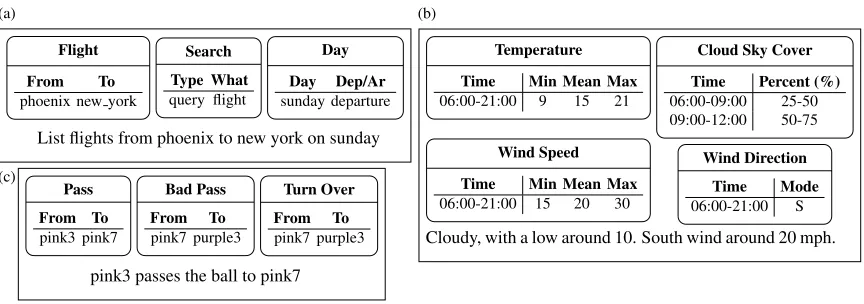
Concept-to-text generation broadly refers to the task of automatically producing textual output from non-linguistic input (Reiter and Dale, 2000). Depend-ing on the application and the domain at hand, the input may assume various representations includ-ing databases of records, expert system knowledge bases, simulations of physical systems and so on. Figure 1 shows input examples and their correspond-ing text for three domains, air travel, sportscastcorrespond-ing and weather forecast generation.
A typical concept-to-text generation system im-plements a pipeline architecture consisting of three core stages, namely text planning (determining the
content and structure of the target text), sentence planning (determining the structure and lexical con-tent of individual sentences), and surface realiza-tion (rendering the specificarealiza-tion chosen by the sen-tence planner into a surface string). Traditionally, these components are hand-engineered in order to generate high quality text, however at the expense of portability and scalability. It is thus no surprise that recent years have witnessed a growing interest in automatic methods for creating trainable genera-tion components. Examples include learning which database records should be present in a text (Duboue and McKeown, 2002; Barzilay and Lapata, 2005) and how these should be verbalized (Liang et al., 2009). Besides concentrating on isolated compo-nents, a few approaches have emerged that tackle concept-to-text generation end-to-end. Due to the complexity of the task, most models simplify the generation process, e.g., by creating output that con-sists of a few sentences, thus obviating the need for document planning, or by treating sentence planning and surface realization as one component. A com-mon modeling strategy is to break up the genera-tion process into a sequence of local decisions, each learned separately (Reiter et al., 2005; Belz, 2008; Chen and Mooney, 2008; Angeli et al., 2010; Kim and Mooney, 2010).
In this paper we describe an end-to-end gen-eration model that performs content selection and surface realization jointly. Given a corpus of database records and textual descriptions (for some of them), we define a probabilistic context-free grammar (PCFG) that captures the structure of the database and how it can be rendered into natural
Flight
From To phoenix new york
Search Type What query flight
Day
Day Dep/Ar sunday departure
List flights from phoenix to new york on sunday
Temperature
Time Min Mean Max 06:00-21:00 9 15 21
Wind Speed
Time Min Mean Max 06:00-21:00 15 20 30
Cloud Sky Cover
Time Percent (%) 06:00-09:00 25-50 09:00-12:00 50-75
Wind Direction Time Mode 06:00-21:00 S
Cloudy, with a low around 10. South wind around 20 mph.
Pass From To pink3 pink7
Bad Pass From To pink7 purple3
Turn Over
From To pink7 purple3
pink3 passes the ball to pink7
(b) (a)
[image:2.612.93.525.61.213.2](c)
Figure 1: Input-output examples for (a) query generation in the air travel domain, (b) weather forecast generation, and (c) sportscasting.
language. This grammar represents a set of trees which we encode compactly using a weighted hy-pergraph (or packed forest), a data structure that de-fines a probability (or weight) for each tree. Gen-eration then boils down to finding the best deriva-tion tree in the hypergraph which can be done effi-ciently using the Viterbi algorithm. In order to en-sure that our generation output is fluent, we intersect our grammar with a language model and perform decoding using a dynamic programming algorithm (Huang and Chiang, 2007).
Our model is conceptually simpler than previous approaches and encodes information about the do-main and its structure globally, by considering the input spacesimultaneouslyduring generation. Our only assumption is that the input must be a set of records essentially corresponding to database-like tables whose columns describe fields of a certain type. Experimental evaluation on three domains ob-tains results competitive to the state of the art with-out using any domain specific constraints, explicit feature engineering or labeled data.
2 Related Work
Our work is situated within the broader class of data-driven approaches to content selection and sur-face realization. Barzilay and Lapata (2005) focus on the former problem which they view as an in-stance of collective classification (Barzilay and La-pata, 2005). Given a corpus of database records and texts describing some of them, they learn a con-tent selection model that simultaneously optimizes
local label assignments and their pairwise relations. Building on this work, Liang et al. (2009) present a hierarchical hidden semi-Markov generative model that first determines which facts to discuss and then generates words from the predicates and arguments of the chosen facts.
A few approaches have emerged more recently that combine content selection and surface realiza-tion. Kim and Mooney (2010) adopt a two-stage ap-proach: using a generative model similar to Liang et al. (2009), they first decide what to say and then ver-balize the selected input with WASP−1, an existing
Similar to Angeli et al. (2010), we also present an end-to-end system that performs content selec-tion and surface realizaselec-tion. However, rather than breaking up the generation task into a sequence of local decisions, we optimize what to say and how to say simultaneously. We do not learn mappings from a logical form, but rather focus on input which is less constrained, possibly more noisy and with a looser structure. Our key insight is to convert the set of database records serving as input to our gen-erator into a PCFG that is neither hand crafted nor domain specific but simply describes the structure of the database. The approach is conceptually sim-ple, does not rely on discriminative training or any feature engineering. We represent the grammar and its derivations compactly as a weighted hypergraph which we intersect with a language model in order to generate fluent output. This allows us to easily port surface generation to different domains without having to extract new templates or enforce domain specific constraints.
3 Problem Formulation
We assume our generator takes as input a set of database recordsdand produces textwthat verbal-izes some of these records. Each recordr∈dhas a typer.tand a set of fields fassociated with it. Fields have different values f.v and types f.t (i.e., in-teger or categorical). For example, in Figure 1b, wind speed is a record type with four fields: time, min, mean, andmax. The values of these fields are
06:00-21:00,15,20, and30, respectively; the type of time is categorical, whereas all other fields are integers.
During training, our algorithm is given a cor-pus consisting of several scenarios, i.e., database records paired with texts like those shown in Fig-ure 1. In the weather forecast domain, a scenario cor-responds to weather-related measurements of tem-perature, wind, speed, and so on collected for a spe-cific day and time (e.g., day or night). In sportscast-ing, scenarios describe individual events in the soc-cer game (e.g., passing or kicking the ball). In the air travel domain, scenarios comprise of flight-related details (e.g., origin, destination, day, time). Our goal then is to reduce the tasks of content selection and surface realization into a common probabilistic
pars-ing problem. We do this by abstractpars-ing the struc-ture of the database (and accompanying texts) into a PCFG whose probabilities are learned from train-ing data.1 Specifically, we convert the database into rewrite rules and represent them as a weighted di-rected hypergraph (Gallo et al., 1993). Instead of learning the probabilities on the PCFG, we directly compute the weights on the hyperarcs using a dy-namic program similar to the inside-outside algo-rithm (Li and Eisner, 2009). During testing, we are given a set of database records without the corre-sponding text. Using the trained grammar we com-pile a hypergraph specific to this test input and de-code it approximately via cube pruning (Chiang, 2007).
The choice of the hypergraph framework is moti-vated by at least three reasons. Firstly, hypergraphs can be used to represent the search space of most parsers (Klein and Manning, 2001). Secondly, they are more efficient and faster than the common CYK parser-based representation for PCFGs by a factor of more than ten (Huang and Chiang, 2007). And thirdly, the hypergraph representation allows us to integrate ann-gram language model and perform de-coding efficiently usingk-best Viterbi search, opti-mizing what to say and how to say at the same time.
3.1 Grammar Definition
Our model captures the inherent structure of the database with a number of CFG rewrite rules, in a similar way to how Liang et al. (2009) define Markov chains in the different levels of their hierar-chical model. These rules are purely syntactic (de-scribing the intuitive relationship between records, records and fields, fields and corresponding words), and could apply to any database with similar struc-ture irrespectively of the semantics of the domain.
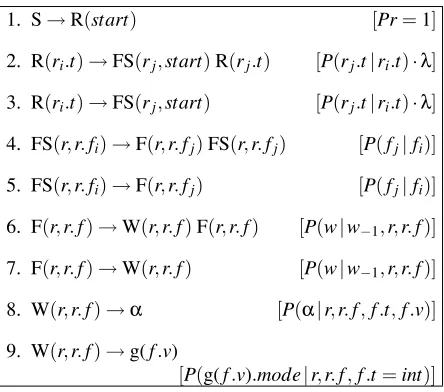
Our grammar is defined in Table 1 (rules (1)–(9)). Rule weights are governed by an underlying multi-nomial distribution and are shown in square brack-ets. Non-terminal symbols are in capitals and
1. S→R(start) [Pr=1]
2. R(ri.t)→FS(rj,start)R(rj.t) [P(rj.t|ri.t)·λ]
3. R(ri.t)→FS(rj,start) [P(rj.t|ri.t)·λ]
4. FS(r,r.fi)→F(r,r.fj)FS(r,r.fj) [P(fj|fi)]
5. FS(r,r.fi)→F(r,r.fj) [P(fj|fi)]
6. F(r,r.f)→W(r,r.f)F(r,r.f) [P(w|w−1,r,r.f)]
7. F(r,r.f)→W(r,r.f) [P(w|w−1,r,r.f)]
8. W(r,r.f)→α [P(α|r,r.f,f.t,f.v)]
9. W(r,r.f)→g(f.v)
[image:4.612.76.298.58.254.2][P(g(f.v).mode|r,r.f,f.t=int)]
Table 1: Grammar rules and their weights shown in square brackets.
note intermediate states; the terminal symbol α
corresponds to all words seen in the training set, and g(f.v) is a function for generating integer num-bers given the value of a field f. All non-terminals, save the start symbol S, have one or more features (shown in parentheses) that act as constraints, sim-ilar to number and gender agreement constraints in augmented syntactic rules.
Rule (1) denotes the expansion from the start symbol S to record R, which has the special ‘start’ record type (hence the notation R(start)). Rule (2) defines a chain between two consecutive records, i.e., going from a source record ri to a target rj.
Here, FS(rj,rj.f) represents the set of fields of the
target rj, following the source record R(ri).
For example, the rule R(skyCover1.t) → FS(temperature1,start)R(temperature1.t) can be interpreted as follows. Given that we have talked about skyCover1, we will next talk about temperature1and thus emit its corresponding fields.
R(temperature1.t) is a non-terminal place-holder
for the continuation of the chain of records, and
start in FS is a special boundary field between consecutive records. The weight of this rule is the bigram probability of two records conditioned on their record type, multiplied with a normalization factorλ. We have also defined anull record type i.e., a record that has no fields and acts as a smoother for words that may not correspond to a particular record. Rule (3) is simply an escape rule,
so that the parsing process (on the record level) can finish.
Rule (4) is the equivalent of rule (2) at the field level, i.e., it describes the chaining of two consecutive fields fi and fj. Non-terminal
F(r,r.f) refers to field f of record r. For example, the rule FS(windSpeed1,min) →
F(windSpeed1,max)FS(windSpeed1,max),
spec-ifies that we should talk about the field max of record windSpeed1, after talking about the field
min. Analogously to the record level, we have also included a special null field type for the emission of words that do not correspond to a specific record field. Rule (6) defines the expansion of field F to a sequence of (binarized) words W, with a weight equal to the bigram probability of the current word given the previous word, the current record, and field. This is an attempt at capturing contextual dependencies between words over and above to integrating a language model during decoding (see Section 3.3).
Rules (8) and (9) define the emission of words and integer numbers from W, given a field type and its value. Rule (8) emits a single word from the vocabu-lary of the training set. Its weight defines a multino-mial distribution over all seen words, for every value of field f, given that the field type is categorical or the specialnull field. Rule (9) is identical but for fields whose type is integer. Function g(f.v) gener-ates an integer number given the field value, using either of the following six ways (Liang et al., 2009): identical to the field value, rounding up or rounding down to a multiple of 5, rounding off to the clos-est multiple of 5 and finally adding or subtracting some unexplained noise.2 The weight is a multino-mial over the six generation functionmodes, given the record field f.
3.2 Hypergraph Construction
So far we have defined a probabilistic grammar that captures the structure of a database d with records and fields as intermediate non-terminals, and wordsw(from the associated text) as terminals. Us-ing this grammar and the CYK parsUs-ing algorithm, we could obtain the top scoring derivation of records and fields for a given input (i.e., a sequence of
S0,7
R0,2(start)
R0,1(start)
· · ·
FS0,1(skyCover1,start)
R1,1(skyCover1.t)
R1,1(temp1.t)
FS0,1(temp1,start)
· · ·
F0,1(skyCover1,%)
FS1,1(skyCover1,%)
F0,1(skyCover1,time)
FS1,1(skyCover1,time)
W0,1(skyCover1,%)
W0,1(skyCover1,time)
FS1,2(temp1,start)
R2,2(temp1.t)
FS1,2(skyCover1,start)
R2,2(skyCover1.t)
· · ·
sunny
F1,2(temp1,min)
FS2,2(temp1,min)
W0,1(temp1,min) g0,1(min,v=10)
F1,2(temp1,max)
FS2,2(temp1,max)
W0,1(temp1,max) g0,1(max,v=20)
[image:5.612.89.526.59.209.2]with
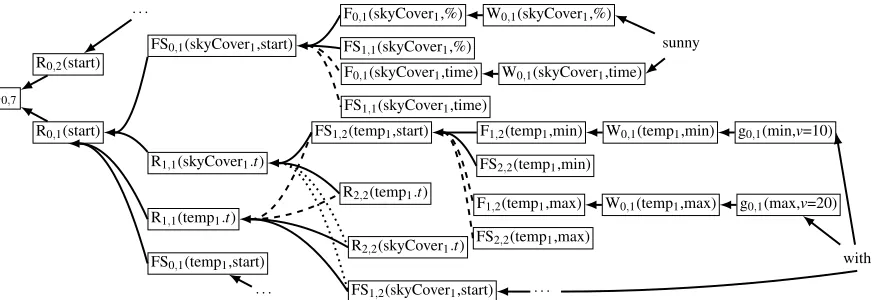
Figure 2: Partial hypergraph representation for the sentence“Sunny with a low around 30 .”For the sake of readability, we show a partial span on the first two words without weights on the hyperarcs.
words) as well as the optimal segmentation of the text, provided we have a trained set of weights. The inside-outside algorithm is commonly used for esti-mating the weights of a PCFG. However, we first transform the CYK parser and our grammar into a hypergraph and then compute the weights using inside-outside. Huang and Chiang (2005) define a weighted directed hypergraph as follows:
Definition 1 An ordered hypergraph H is a tuple
hN,E,t,Ri, where N is a finite set of nodes, E is a finite set of hyperarcs and R is the set of weights. Each hyperarc e ∈ E is a triple e = hT(e),h(e),f(e)i, where h(e)∈N is its head node, T(e)∈N∗is a set of tail nodes and f(e)is a mono-tonic weight functionR|T(e)| toRand t∈N is a tar-get node.
Definition 2 We impose the arity of a hyperarc to be
|e|=|T(e)|=2, in other words, each head node is connected with at most two tail nodes.
Given a context-free grammar G =hN,T,P,Si (where N is the set of variables, T the set of ter-minals,Pthe set of production rules, andS∈N the start symbol) and an input stringw, we can map the standard weighted CYK algorithm to a hypergraph as follows. Each node [A,i,j] in the hypergraph corresponds to non-terminal A spanning words wi
towj of the input. Each rewrite ruleA→BCinP,
with three free indices i < j < k, is mapped to the hyperarch((B,i,j),(C,j,k)),(A,i,k),fi, where
f= f((B,i,j))f((C,j,k))·Pr(A→BC).3 The
hy-3Similarly, rewrite rules of typeA→Bare mapped to the hyperarch(B,i,j),(A,i,j),fi, withf=f((B,i,j))·Pr(A→B).
pergraph can be thus viewed as a compiled lattice of the corresponding chart graph. Figure 2 shows an example hypergraph for a grammar defined on database input similar to Figure (1b).
In order to learn the weights on the hyperarcs we perform the following procedure iteratively in an EM fashion (Li and Eisner, 2009). For each train-ing scenario we build its hypergraph representation. Next, we perform inference by calculating the in-side and outin-side scores of the hypergraph, so as to compute the posterior distribution over its hyperarcs (E-step). Finally, we collectively update the posteri-ors on the parameters-weights, i.e., rule probabilities and emission multinomial distributions (M-step).
3.3 Decoding
In the framework outlined above, parsing an input string w(given some learned weights) boils down to traversing the hypergraph in a particular order. (Note that the hypergraph should be acyclic, which is always guaranteed by the grammar in Table 1). In generation, our aim is to verbalize an input scenario from a databased (see Figure 1). We thus find the best text by maximizing:
arg max
w P(w|d) =arg maxw P(w)·P(d|w) (1)
set-tingwto a fixed length, we rely on a linear regres-sion predictor that uses the counts of each record type per scenario as features and is able to produce variable length texts.
In order to perform decoding with ann-gram lan-guage model, we adopt Huang and Chiang’s (2007) dynamic-programming algorithm for SCFG-based systems. Each node in the hypergraph is split into a set of compound items, namely+LM items. Each +LM item is of the form(na?b), where aandb are boundary words of the generation string, and?is a place-holder symbol for an elided part of that string, indicating a sub-generation part ranging fromatob. An example +LM deduction of a single hyperarc of the hypergraph in Figure 2 using bigrams is:
(2) FS1,2(temp1,start)low:(w1,g1),
R2,2(temp1.t)around?degrees:(w2,g2)
R1,1(skyCover1.t)low?degrees:(w,g1g2)
w=w1+w2+ew+Plm(around|low) (3)
wherew1,w2are node weights,g1,g2are the
corre-sponding sub-generations,ewis the weight of the
hy-perarc andwthe weight of the resulting +LM item.
Plm and(na?b)are defined as in Chiang (2007) in a
generic fashion, allowing extension to an arbitrary size ofn-gram grammars.
Naive traversal of the hypergraph bottom-up would explore all possible +LM deductions along each hyperarc, and would increase decoding com-plexity to an infeasibleO(2nn2), assuming a trigram model and a constant number of emissions at the ter-minal nodes. To ensure tractability, we adopt cube pruning, a popular approach in syntax-inspired ma-chine translation (Chiang, 2007). The idea is to use a beam-search over the intersection grammar coupled with the cube-pruning heuristic. The beam limits the number of derivations for each node, whereas cube-pruning further limits the number of +LM items con-sidered for inclusion in the beam. Sincef(e)in Def-inition 1 is monotonic, we can select thek-best items without computing all possible +LM items.
Our decoder follows Huang and Chiang (2007) but importantly differs in the treatment of leaf nodes in the hypergraph (see rules (8) and (9)). In the SCFG context, the Viterbi algorithm consumes ter-minals from the source string in a bottom-up fashion
and creates sub-translations according to the CFG rule that holds each time. In the concept-to-text generation context, however, we do not observe the words; instead, for each leaf node we emit thek-best words from the underlying multinomial distribution (see weights on rules (8) and (9)) and continue build-ing our sub-generations bottom-up.
4 Experimental Design
Data We used our system to generate soccer com-mentaries, weather forecasts, and spontaneous utter-ances relevant to the air travel domain (examples are given in Figure 1). For the first domain we used the dataset of Chen and Mooney (2008), which consists of 1,539 scenarios from the 2001–2004 Robocup game finals. Each scenario contains on av-erage|d|=2.4 records, each paired with a short sen-tence (5.7 words). This domain has a small vocabu-lary (214 words) and simple syntax (e.g., a transitive verb with its subject and object). Records in this dataset (henceforth ROBOCUP) were aligned
man-ually to their corresponding sentences (Chen and Mooney, 2008). Given the relatively small size of this dataset, we performed cross-validation follow-ing previous work (Chen and Mooney, 2008; An-geli et al., 2010). We trained our system on three
ROBOCUPgames and tested on the fourth, averaging
over the four train/test splits.
For weather forecast generation, we used the dataset of Liang et al. (2009), which consists of 29,528 weather scenarios for 3,753 major US cities (collected over four days). The vocabulary in this domain (henceforth WEATHERGOV) is comparable
to ROBOCUP (345 words), however, the texts are longer (|w|=29.3) and more varied. On average, each forecast has 4 sentences and the content selec-tion problem is more challenging; only 5.8 out of the 36 records per scenario are mentioned in the text which roughly corresponds to 1.4 records per sen-tence. We used 25,000 scenarios from WEATHER -GOV for training, 1,000 scenarios for development
and 3,528 scenarios for testing. This is the same par-tition used in Angeli et al. (2010).
on-WEATHERGOV ATIS ROBOCUP
1
-B
E
S
T Near 57. Near 57. Near 57. Near 57. Near 57. Near 57. Near 57. Near 57. Near 57. Near 57. Near 57. South wind.
What what what what flights
from Denver Phoenix Pink9 to to Pink7 kicks
k
-B
E
S
T
As high as 23 mph. Chance of precipitation is 20. Breezy, with a chance of showers. Mostly cloudy, with a high near 57. South wind between 3 and 9 mph.
Show me the flights from Denver to Phoenix
Pink9 passes back to Pink7
A
N
G
E
L
I
A chance of rain or drizzle, with a high near 57. South wind between 3 and 9 mph.
Show me the flights leave from Nashville to Phoenix
Pink9 kicks to Pink7
H
U
M
A
N
A slight chance of showers. Mostly cloudy, with a high near 58. South wind between 3 and 9 mph, with gusts as high as 23 mph. Chance of precipitation is 20%.
List flights from Denver to Phoenix
[image:7.612.79.531.58.245.2]Pink9 passes back to Pink7
Table 2: System output on WEATHERGOV, ATIS, and ROBOCUP(1-BEST, k-BEST, ANGELI) and corresponding human-authored text (HUMAN).
line flight booking system. We used the dataset introduced in Zettlemoyer and Collins (2007)4 and automatically converted their lambda-calculus ex-pressions to attribute-value pairs following the con-ventions adopted by Liang et al. (2009). For ex-ample, the scenario in Figure 1(a) was initially represented as: λx.f light(x)∧ f rom(x,phoenix)∧
to(x,new york)∧day(x,sunday).5 In contrast to the two previous datasets, ATIS has a much richer
vo-cabulary (927 words); each scenario corresponds to a single sentence (average length is 11.2 words) with 2.65 out of 19 record types mentioned on av-erage. Following Zettlemoyer and Collins (2007), we trained on 4,962 scenarios and tested on ATIS NOV93 which contains 448 examples.
Model Parameters Our model has two
parame-ters, namely the number ofk grammar derivations considered by the decoder and the order of the language model. We tuned k experimentally on held-out data taken fromWEATHERGOV,ROBOCUP,
andATIS, respectively. The optimal value wask=15
forWEATHERGOV, k=25 for ROBOCUP, and k=40
4The original corpus contains user utterances of single dia-logue turns which would result in trivial scenarios. Zettlemoyer and Collins (2007) concatenate all user utterances referring to the same dialogue act, (e.g., book a flight), thus yielding more complex scenarios with longer sentences.
5The resulting dataset and a technical report describ-ing the mappdescrib-ing procedure in detail are available from http://homepages.inf.ed.ac.uk/s0793019/index.php?
page=resources
forATIS. For theROBOCUP domain, we used a
bi-gram language model which was considered suffi-cient given that the average text length is small. For
WEATHERGOVandATIS, we used a trigram language
model.
System Comparison We evaluated two
configu-rations of our system. A baseline that uses the top scoring derivation in each subgeneration (1-BEST) and another version which makes better use of our decoding algorithm and considers the bestk deriva-tions (i.e., 15 for WEATHERGOV, 40 for ATIS, and
25 forROBOCUP). We compared our output to
An-geli et al. (2010) whose approach is closest to ours and state-of-the-art on the WEATHERGOV domain.
For ROBOCUP, we also compare against the
best-published results (Kim and Mooney, 2010).
Evaluation We evaluated system output
doc-ROBOCUPWEATHERGOV ATIS
System BLEU BLEU BLEU
[image:8.612.87.290.59.134.2]1-BEST 10.79 8.64 11.85 k-BEST 30.90 33.70 29.30 ANGELI 28.70 38.40 26.77 KIM-MOONEY 47.27 — —
Table 3: BLEU scores on ROBOCUP(fixed content se-lection), WEATHERGOV, and ATIS.
uments from the test set (for each domain) and gen-erated output with our models (1-BESTandk-BEST) and Angeli et al.’s (2010) model (see Figure 2 for examples of system output). We also included the original text (HUMAN) as gold standard. We thus obtained ratings for 48 (12×4) scenario-text pairs for each domain. The study was conducted over the Internet using WebExp (Keller et al., 2009) and was completed by 114 volunteers, all self reported native English speakers.
5 Results
We conducted two experiments on theROBOCUP
do-main. We first assessed the performance of our gen-erator (k-BEST) on joint content selection and
sur-face realization and obtained a BLEU score of 24.88. In comparison, the baseline’s (1-BEST) BLEU score
was 8.01. In a second experiment we forced the generator to use the gold-standard records from the database. This was necessary in order to compare with previous work (Angeli et al., 2010; Kim and Mooney, 2010).6 Our results are summarized in Ta-ble 3. Overall, our generator performs better than the baseline and Angeli et al. (2010). We observe a substantial increase in performance compared to the joint content selection and surface realization setting. This is expected as the generator is faced with an easier task and there is less scope for error. Our model does not outperform Kim and Mooney (2010), however, this is not entirely surprising as their model requires considerable more supervision (e.g., during parameter initialization) and includes a post-hoc re-ordering component.
6Angeli et al. (2010) and Kim and Mooney (2010) fix con-tent selection both at the record and field level. We let our gen-erator select the appropriate fields, since these are at most two per record type and this level of complexity can be easily tack-led during decoding.
ROBOCUP WEATHERGOV ATIS
System F SC F SC F SC
[image:8.612.315.558.60.135.2]1-BEST 2.47∗† 2.33∗† 1.82∗† 2.05∗† 2.40∗† 2.46∗† k-BEST 4.31∗ 3.96∗ 3.92∗ 3.30∗ 4.01 3.87 ANGELI 4.03∗† 3.70∗† 4.26∗ 3.60∗ 3.56∗† 3.33∗† HUMAN 4.47† 4.37† 4.61† 4.03† 4.10 4.01
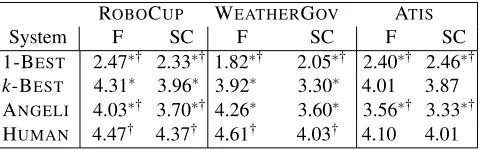
Table 4: Mean ratings for fluency (F) and semantic cor-rectness (SC) on system output elicited by humans on ROBOCUP, WEATHERGOV, and ATIS(∗: sig. diff. from HUMAN;†: sig. diff. fromk-BEST.)
With regard to WEATHERGOV, our generator
im-proves over the baseline but lags behind Angeli et al. (2010). Since our system emits words based on a language model rather than a template, it displays more freedom in word order and lexical choice, and is thus penalized by BLEU when creating output that is overly distinct from the reference. On ATIS, our
model outperforms both the baseline and Angeli et al. This is the most challenging domain with re-gard to surface realization with a vocabulary larger thanROBOCUPandWEATHERGOVby factors of 2.7
and 4.3, respectively.
The results of our human evaluation study are shown in Table 3. We carried out an Analysis of Variance (ANOVA) to examine the effect of system
type (1-BEST,k-BEST,ANGELI, and HUMAN) on the
fluency and semantic correctness ratings. Means differences were compared using a post-hoc Tukey test. On ROBOCUP, our system (k-BEST) is
signif-icantly better than the baseline (1-BEST) and AN -GELIboth in terms of fluency and semantic
correct-ness (a<0.05). On WEATHERGOV, our generator
performs comparably toANGELI on fluency and
se-mantic correctness (the differences in the means are not statistically significant); 1-BEST is significantly
worse than 15-BEST and ANGELI (a<0.05). On ATIS,k-BESTis significantly more fluent and
seman-tically correct than 1-BEST and ANGELI (a<0.01).
There was no statistically significant difference be-tween the output of our system and the originalATIS
sentences.
In sum, we observe that taking thek-best deriva-tions into account boosts performance (the 1-BEST
system is consistently worse). Our model is on par withANGELI onWEATHERGOV but performs better
auto-matically and by humans. In general, a large part of our output resembles the human text, which demon-strates that our simple language model yields coher-ent scoher-entences (without any template engineering), at least for the domains under consideration.
6 Conclusions
We have presented an end-to-end generation system that performs both content selection and surface re-alization. Central to our approach is the encoding of generation as a parsing problem. We reformulate the input (a set of database records and text describ-ing some of them) as a PCFG and show how to find the best derivation using the hypergraph framework. Despite its simplicity, our model is able to obtain performance comparable to the state of the art. We argue that our approach is computationally efficient and viable in practical applications. Porting the sys-tem to a different domain is straightforward, assum-ing a database and correspondassum-ing (unaligned) text. As long as the database is compatible with the struc-ture of the grammar in Table 1, we need only retrain to obtain the weights on the hyperarcs and a domain specific language model.
Our model takes into account the k-best deriva-tions at decoding time, however inspection of these shows that it often fails to select the best one. In the future, we plan to remedy this by using forest reranking, a technique that approximately reranks a packed forest of exponentially many derivations (Huang, 2008). We would also like to scale our model to more challenging domains (e.g., product descriptions) and to enrich our generator with some notion of discourse planning. An interesting ques-tion is how to extend the PCFG-based approach ad-vocated here so as to capture discourse-level docu-ment structure.
Acknowledgments We are grateful to Percy Liang
and Gabor Angeli for providing us with their code and data. We would also like to thank Luke Zettle-moyer and Tom Kwiatkowski for sharing their ATIS
dataset with us and Frank Keller for his feedback on an earlier version of this paper.
References
Gabor Angeli, Percy Liang, and Dan Klein. 2010. A simple domain-independent probabilistic approach to generation. InProceedings of the 2010 Conference on Empirical Methods in Natural Language Processing, pages 502–512, Cambridge, MA.
Regina Barzilay and Mirella Lapata. 2005. Collec-tive content selection for concept-to-text generation. InProceedings of Human Language Technology and Empirical Methods in Natural Language Processing, pages 331–338, Vancouver, British Columbia. Anja Belz. 2008. Automatic generation of
weather forecast texts using comprehensive probabilis-tic generation-space models. Natural Language Engi-neering, 14(4):431–455.
David L. Chen and Raymond J. Mooney. 2008. Learn-ing to sportscast: A test of grounded language acqui-sition. InProceedings of International Conference on Machine Learning, pages 128–135, Helsinki, Finland. David Chiang. 2007. Hierarchical phrase-based
transla-tion.Computational Linguistics, 33(2):201–228. Deborah A. Dahl, Madeleine Bates, Michael Brown,
William Fisher, Kate Hunicke-Smith, David Pallett, Christine Pao, Alexander Rudnicky, and Elizabeth Shriberg. 1994. Expanding the scope of the atis task: the atis-3 corpus. InProceedings of the Workshop on Human Language Technology, pages 43–48, Plains-boro, NJ.
Pablo A. Duboue and Kathleen R. McKeown. 2002. Content planner construction via evolutionary algo-rithms and a corpus-based fitness function. In Pro-ceedings of International Natural Language Genera-tion, pages 89–96, Ramapo Mountains, NY.
Giorgio Gallo, Giustino Longo, Stefano Pallottino, and Sang Nguyen. 1993. Directed hypergraphs and appli-cations.Discrete Applied Mathematics, 42:177–201. Liang Huang and David Chiang. 2005. Better k-best
parsing. InProceedings of the 9th International Work-shop on Parsing Technology, pages 53–64, Vancouver, British Columbia.
Liang Huang and David Chiang. 2007. Forest rescoring: Faster decoding with integrated language models. In Proceedings of the 45th Annual Meeting of the Asso-ciation of Computational Linguistics, pages 144–151, Prague, Czech Republic.
Liang Huang. 2008. Forest reranking: Discriminative parsing with non-local features. In Proceedings of ACL-08: HLT, pages 586–594, Columbus, Ohio. Frank Keller, Subahshini Gunasekharan, Neil Mayo, and
Joohyun Kim and Raymond Mooney. 2010. Generative alignment and semantic parsing for learning from am-biguous supervision. InProceedings of the 23rd Con-ference on Computational Linguistics, pages 543–551, Beijing, China.
Dan Klein and Christopher D. Manning. 2001. Parsing and hypergraphs. InProceedings of the 7th Interna-tional Workshop on Parsing Technologies, pages 123– 134, Beijing, China.
Zhifei Li and Jason Eisner. 2009. First- and second-order expectation semirings with applications to minimum-risk training on translation forests. InProceedings of the 2009 Conference on Empirical Methods in Natu-ral Language Processing, pages 40–51, Suntec, Sin-gapore.
Percy Liang, Michael Jordan, and Dan Klein. 2009. Learning semantic correspondences with less supervi-sion. Inroceedings of the Joint Conference of the 47th Annual Meeting of the ACL and the 4th International Joint Conference on Natural Language Processing of the AFNLP, pages 91–99, Suntec, Singapore.
Wei Lu and Hwee Tou Ng. 2011. A probabilistic forest-to-string model for language generation from typed lambda calculus expressions. In Proceedings of the 2011 Conference on Empirical Methods in Natural Language Processing, pages 1611–1622, Edinburgh, UK.
Kishore Papineni, Salim Roukos, Todd Ward, and Wei-Jing Zhu. 2002. Bleu: a method for automatic eval-uation of machine translation. InProceedings of 40th Annual Meeting of the Association for Computational Linguistics, pages 311–318, Philadelphia, Pennsylva-nia.
Ehud Reiter and Robert Dale. 2000. Building natural language generation systems. Cambridge University Press, New York, NY.
Ehud Reiter, Somayajulu Sripada, Jim Hunter, and Ian Davy. 2005. Choosing words in computer-generated weather forecasts. Artificial Intelligence, 167:137– 169.