MojaveComm: A View-Oriented Group Communication
Protocol with Support for Virtual Synchrony
Thesis by
David A. Noblet
In Partial Fulfillment of the Requirements
for the Degree of
Master of Science
California Institute of Technology
Pasadena, California
2008
© 2008 David A. Noblet
Acknowledgements
I would like to extend gratitude to my advisor, Professor Jason Hickey, and to all the members of
the Mojave Lab, past and present, who took the time to participate in all those lively whiteboard
discussions. In particular, I want to offer my special thanks to Cristian Ţăpuş, Nathaniel Gray,
Abstract
In this thesis, we explore the feasibility of implementing a general communication protocol that
addresses common classes of problems that one encounters in the development of distributed
appli-cations, such as: multipoint-to-multipoint communication, message (re)ordering, mutual exclusion,
and consensus. The paper details both the design and implementation of MojaveComm, a
view-oriented total-order group communication protocol suitable for deployment on wide-area networks.
Moreover, we provide a high-level overview of MojaveFS, a sequentially consistent distributed
filesys-tem, and show how we can use the message-ordering guarantees of MojaveComm as the basis for
Contents
Acknowledgements iv
Abstract v
1 Introduction 1
1.1 Related Work . . . 3
1.2 Overview . . . 5
2 MojaveComm Protocol Specification 7 2.1 Groups & Views . . . 7
2.1.1 View Change Events . . . 9
2.1.2 Failure Detection . . . 11
2.2 Message Transmission & Delivery . . . 11
2.3 Application Interface . . . 13
3 MojaveComm Implementation 15 3.1 Design Choices & Goals . . . 15
3.2 Layers . . . 16
3.2.1 Transport . . . 17
3.2.1.1 MojaveComm Reliable Multicast Protocol. . . 18
3.2.1.2 Advanced Features. . . 19
3.2.2 Sequencer . . . 19
3.2.3 View Manager . . . 22
3.2.4 Protocol Stages . . . 23
4 MojaveFS: A Case Study 25 4.1 Overview . . . 25
4.2 Sequential Consistency . . . 27
5 Conclusion 31
List of Figures
2.1 Multiple intersecting views . . . 9
2.2 View synchronization that necessitates aghost view change . . . 10
2.3 NodeBsends two messages in two different MojaveComm groups. . . 13
3.1 The layered architecture of MojaveComm.. . . 17
3.2 A twelve-node view arranged into a ring by the token sequencer protocol. . . 20
3.3 This figure represents the state machine for the view management protocol. . . 22
3.4 Multiple views merging . . . 23
4.1 The layered architecture of MojaveFS. . . 26
4.2 Violating the sequential consistency constraints . . . 28
Chapter 1
Introduction
In recent years, there has been a proliferation of network-enabled applications. In large part, this
is due to the advent of cheap and readily-available access to global communications infrastructure
provided by the Internet. Nevertheless, this physical access is only one contributing factor to the
momentum of this trend. Another influence, perhaps more important, is the success of the
com-munication protocols that run on top of this physical infrastructure: namely, the TCP-IP protocol
suite.
The Transmission Control Protocol (TCP [19]) has supported rapid expansion of network-enabled services and applications because it significantly decreases the barrier to entry for developers. TCP
provides a concise set of strong communication guarantees upon which one can build more
compli-cated application-specific communication protocols to suit the needs of a specific service. Moreover,
these assurances provided by TCP represent a large common subset of the functionality required by
many applications while still maintaining a simple semantics that is easy to reason about (and build
upon).
As a testament to the ubiquity of TCP, many of the most popular network-enabled applications
and services make use of this protocol: web browsing (HTTP), email (POP, IMAP, and SMTP), file
transfer (FTP), remote login (telnet, ssh), chat (IRC), etc. Nevertheless, TCP is not ideally suited
for all applications. In particular, TCP provides only point-to-point communication between nodes.
In cases where data needs to be disseminated to multiple entities simultaneously, the use of TCP
may be inefficient – or the guarantees it provides may be insufficient to directly meet the needs of
the application.
This fundamental limitation of TCP has become more obvious as the push to develop larger and
more complex network-enabled systems moves forward. Specifically, the recent interest indistributed systems by the software community has worked to move this issue to the forefront. Distributed systems are a natural extension of traditional network-enabled applications. Traditional network
applications generally follow the client-server model, whereby some fixed set of network entities
former (called clients). When a client needs to access some service, it connects directly to one of the
corresponding servers that provide that service and the server is then responsible for responding to
the request of the client. Customarily, the server with which the client is communicating is a single
network entity; in a distributed system, this is not necessarily true.
In the development of a distributed system, one seeks to provide a single service among multiple
network entities. These network entities then act as a coherent unit, in spite of the fact that this unit
is composed of distinct entities. Of course, in a distributed environment such as this, each individual
component of the system must be able to make local decisions that somehow contribute to the service
as a whole. Thus, in order to make informed decisions, the components must communicate with one
another (over the network).
By taking a distributed approach to the solution of many problems, it is possible to eliminate
many of the bottlenecks that are present in traditional centralized systems. The reasons for
dis-tributing a service over multiple distinct network entities are primarily threefold:
• Reliability - Through replication/redundancy, it is possible to ensure that the failure of one component will not disrupt the entire system.
• Scalability - As demand for the service increases, it is possible to add more components dy-namically to meet this need.
• Performance- The more components that contribute to the service, the faster the service can respond (if the service is sufficiently parallelizable).
In fact, with current technology, many problems require a distributed solution to achieve the desired
scale and performance.
Of course, once one starts to distribute the processing of some service across multiple entities, it
becomes necessary to consider issues such as data consistency and communication loss/error. And,
to make matters worse, when such communication between entities is over unreliable
communica-tion channels, one runs up against fundamental impossibility results regarding consensus in this
context [10]. In the end, it is these types of problems that must be addressed when developing a dis-tributed network application. And, often times, the solutions to these issues greatly complicates the
design and implementation of such protocols. Nevertheless, many of the problems that one
encoun-ters in the design of a distributed application or service are not specific to the particular application
in question, but are rather more general problems inherent in the design of such distributed systems.
For example, typical classes of problems include: multipoint-to-multipoint communication, message
(re)ordering, mutual exclusion, and consensus.
In this thesis, we address the question of whether it is possible to implement a general
support of an answer in the affirmative. In the following text, we present the design and
imple-mentation ofMojaveComm, a group communication protocol intended to allow groups of network entities (called nodes) to self-organize into groups within which MojaveComm provides strong
or-dering guarantees with respect to the transmission and receipt of messages; the specification of this
protocol is given in Chapter2and an overview of the implementation is detailed in Chapter3. And
Chapter4is a case study illustrating an application of MojaveComm to a particular domain (in this
case, distributed filesystems). Finally, we provide some closing remarks in Chapter5.
1.1
Related Work
There is an extensive body of work in the area of reliable group communication systems that dates
back to the 1980’s. In early projects, like ISIS [5] and the process group extension to the V Kernel [7], the emphasis on the respective group communication protocol is secondary to that of a larger system.
Nevertheless, many of these projects offer insight and develop abstractions that subsequent projects
on group communication systems will borrow (such as in [6] [9] [4] [8] [17]). For example, nearly all of the works cited in this section provide some type of group membership abstraction; moreover,
these projects also have at least limited support for state synchronization adhering to some flavor
or other of thevirtual synchronymodel. In the text below, we provide an overview of the history of group communication systems (though this account is not exhaustive by any account).
Theprocess group [7] extension to the V Kernel is among the earliest work in the area of group communication systems. The V Kernel is designed to be a distributed kernel that transparently
coordinates multiple participating machines and presents them to the user as a single coherent
sys-tem. The extension described in the paper introduces the process group abstraction as a mechanism
whereby groups of processes may communicate with one another without prior explicit knowledge
of the group membership. A process group is distinguished by its identifier (simply an integer in the
implementation). In terms of governing group membership, a processes may create, join, or leave
a group. Processes exchange messages in the context of a group using sendandrecv. This type of message exchange is considered to be reliable1.
The ISIS [5] project introduces an abstraction called a resilient object. Conceptually, a resilient object is a record of data and operations that is replicated across multiple machines on a network.
The replicas of a resilient object act as a coherent entity. In particular, operations performed
on a resilient object are transactional in nature; either the operation is performed successfully
such that the result consistent across all the replicas, or the operation fails (and the result is not
reflected on any of the replicas). In its implementation, ISIS relies on a reliable, ordered message
broadcast mechanism,GBCAST(for Group Broadcast), to ensure that replicas remain consistent. In GBCAST, messages are sent within the context of agroup(different groups correspond to individual resilient objects in ISIS); each group has exactly one membership set and all messages sent to a group
using GBCAST are totally ordered within that set.
Consul [16] is a system that aims to provide the user with a set of basic abstractions that can be used to build reliable systems based on the replicated state machine approach. Collectively, these
abstractions embody three services: multicast, membership, and recovery. In Consul terminology,
to send a message a process participates in a conversationwith a set of processes; actual message exchange is handled by the Psync protocol. During the lifetime of a conversation, Psync maintains
a “context graph” that satisfies the happens-before relation for all the messages exchanged in the conversation. To ensure correct ordering on delivery, each message is paired with a list identifying
its dependencies calculated from this context graph. The membership protocol is responsible for
the detection of remote process failures for each conversation the local process participates in. In
the event of a failure (or detection thereof), the membership of the conversation is renegotiated and
the recovery protocol takes over to ensure that all processes have received the same set of messages.
As failure detection in Consul is conservative, it is possible that after a failure two or more distinct
membership sets may exist for a single conversation; Consul does not provide any special facilities
to handle this situation.
The VS [8] system provides explicit support for suchpartitionablegroup communication services (whereby membership of the communicating set may partition and recombine arbitrarily). As such,
VS provides a group abstraction, similar to ISIS groups or Consul conversations, called a view. Although, views differ from the aforementioned abstractions in that a view is more like a partition
or fragment of a group. Also, VS does not provide explicit recovery (i.e. message synchronization)
on changes in view membership; rather, it simply exposes enough information such that it is possible
to perform such synchronization at the upper layers if desired. An extension of VS, called DVS [20], broadens support for such group partitions by introducing the abstraction ofprimaryviews to VS. A primary view is usually considered to be the view that contains a majority of the available processes
in the system; but generally speaking, the definition of primary simply needs to ensure that there is
never more than one primary view at a time. The motivation is that, in spite of the fact many views
may exist, to maintain their consistency guarantees many distributed applications require that at
most one of these views be allowed to make progress.
The successors to ISIS, Horus and Ensemble [6], were an architectural and design effort to break from the monolithic and single-purposed origin of their predecessor in an attempt to provide greater
flexibility and increased confidence in the correctness of the protocols. In both of these projects, the
drive specifically was to develop a general framework for providing group communication services.
many ways in the implementation via the composition of different sets of micro-protocols. Because of correctness and performance concerns, Ensemble emerged as a reimplementation of Horus using
the OCaml programming language; this was done to ensure that the developers could reason about
the behavior of Ensemble using the automated proof assistant NuPRL. With NuPRL, it was possible
to perform provably-correct code transformations to reduce overhead introduced by the many layers
of micro-protocols.
Newtop [9] is a group communication system that, in addition to strict total ordering guarantees on message delivery, also provides explicit support for multiple groups and multiple views within
each group. In Newtop, a process creates a group by specifying its maximal member set. Thus,
initially all processes in a group have the same view membership. As there are network partitions
and/or process failures, Newtop’s failure detection mechanism renegotiates a new view with the
other members of the existing view in order to agree on a new view that is a strict subset of the
existing view membership. To join old members of a view, the process creates an entirely new group
with the desired membership.
The Spread [4] group communication system is specifically designed for wide-area deployment. In order to remove the constraints placed on such a system by the diversity present in the physical
network, Spread constructs an overlay network upon which it exchanges messages. In order to
provide an efficient routing solution on top of this overlay, Spread introduces its own routing protocol,
called Hop. Although, in practice this overlay serves to increase performance and efficiency of the
protocol in general, Spread relies on a static configuration file to describe the underlying physical
network topology on top of which the overlay is installed.
More recently, work on the QSM [17] project addresses the scalability problems seemingly in-herent with group communication systems. The key insight in this work is that it is possible to
take advantage of the potential overlap in separate group membership in order to deliver messages
more efficiently (i.e. without having to filter out as many of the unwanted messages). In particular,
the authors suggest a more efficient scheme to map application-level (“lightweight”) groups onto
low-level multicast (“heavyweight”) groups. The authors claim scalability on the order of hundreds
or thousands of participants for QSM using the scheme they present.
It is also worth mentioning work such as that found in [12], which attempts to make the ordering of messages between groups more efficient by constructing apropagation graphinstead of using the traditional token-based protocols.
1.2
Overview
To put the project described in this paper into the context of the existing work, MojaveComm
deployment. In particular, in this work we strive to provide a highly distributed and
dynamically-configurable solution. For example, we avoid the use of a statically configured overlay network such
as the one used in [4]. Moreover, we try to embrace the reliability constraints imposed on our system by targeting a wide-area network environment; to this end, we allow for group partitions to exist
(and even provide mechanisms to facilitate their detection and recovery).
In our express formulation of thevirtual synchronyproperty (see Equation2.1), it is possible
for many different sequencing and delivery policies to satisfy the specification. For example, because
of the conditional nature of our guarantee, it is possible for the MojaveComm implementation
to fine-tune its guarantees while still maintaining a consistent interface to the application-layer.
Nevertheless, in spite of this flexibility, we want to be able to provide a more rigid and well-defined
interface than that of [6] in order to avoid the problems of having an unconstrained protocol stack (and the introduction of the resulting optimization problem).
Also, unlike [8], we opt to embed our message synchronization mechanism and corresponding guarantees into the group communication system itself as we believe this makes applications
imple-mented on top of MojaveComm easier to reason about (and, thus, eases the burden on the developer).
And, although we recognize the utility of a system that natively supports aprimary view abstrac-tion (like [20]), we choose to defer this processing to the application. Even though MojaveComm does not support primary views directly, we ensure that the application-layer interface is sufficiently
expressive to allow a wide range of application-specific primary view implementations on top of our
Chapter 2
MojaveComm Protocol Specification
This chapter presents the abstract behavioral specification for a network communication protocol
called MojaveComm. This protocol is designed to provide strict message ordering guarantees between
sets of communicating network entities (called nodes).
MojaveComm makes weak assumptions regarding the underlying communication mechanism
upon which the protocol is built. The communication model for underlying message transport
is as follows: messages may take an arbitrarily long time in transit; messages can be lost, reordered,
and/or duplicated; and messages are not corrupted by the network (i.e. if a message is received, it
has the same payload as specified at its origin). In our model, nodes are fail-stop.
In order to identify which nodes can communicate with one another, MojaveComm introduces
an abstraction device called agroup(see related work in Section1.1). Conceptually, a group is a set of nodes. Using MojaveComm, two nodes may only communicate if they are both members of the
same group simultaneously. The entire system may be comprised of many groups. It is possible for
groups to have intersecting membership.
MojaveComm imposes a total order on all of the messages sent within a group. In this way, each
node receives all the messages sent to the group in the same order (and without “gaps”).
2.1
Groups & Views
Group membership is dynamic and nodes may join or leave a group at any time. Since the underlying
communication mechanism is unordered and unreliable, from the perspective of individual nodes in
a group, group membership membership is not always globally consistent. This local perception of
group membership is known as aview (similar to views in [8], or subgroups in [9]).
Each node has exactly one view of each group of which that node is currently a member; a node
is always in its own view. Moreover, a node only appears in a view of a group if that node was once
a member of that group. To become a member of a particular group, a node simply includes itself
view to expand by merging this view with the views of other group members (this is described in
Section2.1.1).
In order to identify when two nodes “share” a view (i.e. when two nodes are members of the
same view at the same time), we introduce an identifying tag, called an epoch number (or simply epoch), that we associate with a view so as to allow us to uniquely identify views with identical
membership1. In this way, we can represent a view as a triple:
(G, M, e)∈group ID×node ID set×epoch
For convenience we use the notation GM
e to denote the triple (G, M, e). Note that two views,GMe
andG′Me′′, are equal iff each of their components is equal:
GMe =G′ M′
e′ ≡G=G′∧M =M′∧e=e′
Locally, each node keeps track of the set of views of which it is a member. For a given node n,
we denote this set asV(n);V(n)is the sequence of the values of V(n)over time for noden. Also,
since it is often necessary to talk about a particular node being a member of some view, we will
introduce the operators∈V and ∈V to represent this fact (for current and past view membership, respectively):
n∈V GMe ≡G M
e ∈V(n)∧n∈M
n∈V GMe ≡ ∃V ∈⟨⟩V(n) :GMe ∈V ∧n∈M
Overall, there are two primary guarantees governing how view membership is related to group
membership at a given instance in time (which follow directly from the statements above):
1. The intersection of all views of a group is a subset of the actual group membership.
2. The union of all views of a group is a subset of all the nodes that have ever been a member of that group (up to that point).
However, it is important to note that this definition allows for the possibility that a view of a
group contains one or more nodes that are not currently members of the group. Such a view is
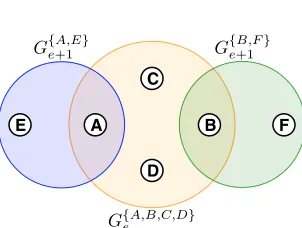
known as a stale view. In general, it is not possible to detect accurately when a view is stale (see the discussion on failure detection in Section 2.1.2). For example, consider the scenario presented
in Figure2.1. Here, nodesA andB have split off from view Ge{A,B,C,D} to form viewsG{eA,E+1 } and
G{e+1B,F}. Although the failure detection mechanism of MojaveComm will ensure that all remaining
A B C
D
E F
G{eA,B,C,D}
G{B,F} e+1
G{eA,E+1 }
Figure 2.1: Multiple intersecting views
members of G{eA,B,C,D}, C andD, will eventually move on to new views, there may be a period of
time in which all three views depicted in the figure may exist simultaneously.
2.1.1
View Change Events
View membership may change for a variety of reasons: failure detection (i.e. when a process is
suspected to be dead; see Section2.1.2), an explicit view synchronization request (i.e. a group Join
operation; see Section2.3), or implicit synchronization initiated by remote instances of either of the
former events. This type of view synchronization event (no matter how it is initiated) is known as
aview change. When one of these synchronizations occurs, MojaveComm notifies the application of this change through a view change event.
Although the installation of a new view itself is ultimately a local operation, there are a number
of global guarantees that MojaveComm enforces on a view change event. For example, consider the
situation where a nodenreceives a view changeGM′
e′ . Furthermore, let us denote the previous view
changenhas received asGMe (wheree̸=e′), and the sequence of messagesnhas received since view change GMe – but before the next view change – asRn. In this case, MojaveComm guarantees the
following property:
∃V, V′:GMe ∈V ∧GMe′′ ∈V′∧ ⟨V, V′⟩ ⊆⟨⟩V(n) =⇒ [virtual synchrony]
∀m∈M′:∃V, V′:GMe ∈V ∧GeM′′ ∈V′∧ ⟨V, V′⟩ ⊆⟨⟩V(m) =⇒ Rn=Rm (2.1)
In other words, all nodes that shared a previous view over the course of a singleview change are guaranteed to have received the same sequence of messages (i.e. the same messages in the same
order) in the previous view2.
Nevertheless, it is important to note that, when a node n receives a view change eventGM e , it
A
B C
A
B C
C B
A
B
Figure 2.2: View synchronization that necessitates aghostview change
is not guaranteed that every nodem∈M also has received such a view change. Rather, it is only guaranteed that it would be consistent if those nodes were to have received the same view change
eventGM
e . We will refer to such a situation as aghostview change.
Such ghost view changes are not directly observable by the application in the same way that
normal view changes are (though, for a noden, they do appear in the view historyV(n)). Instead,
they only serve to inhibit future unsafe synchronization in the event of failure; the application is
never explicitly notified of such events. Thus, when a node n receives a view change event GMe ,
MojaveComm ensures that every remote memberm∈M of the new view either has received a real or ghost view change event inGcorresponding toGM
e .
Although we defer the discussion of the specifics of the implementation of the view management
protocol (the protocol in the implementation that governs view synchronization and the
correspond-ing view change events) to Section 3.2.3, it is worth introducing an example here to illustrate the
necessity of these ghost view change events. Consider the following situation depicted in Figure2.2.
There are three nodesA, B, and C, that initially share a view. One node, C, splits off (initiating
a view synchronization) and nodes A and B start to form a new view. A and B proceed to the
stage of the protocol where they are prepared to commit the new view; however, they are still both
waiting for a final Commit message (upon receipt of which they will actually commit the view). NodeA receives theCommitbut B doesn’t. At this pointC has started, but not finished, its own view change and, by the time B detects that it is missing a message from A, B and C continue a
view synchronization together and both successfully commit the new view.
In the scenario depicted above, it is necessary for node B to undergo a ghost view change
with the membership {A, B}. Otherwise, without any intermediate view change, it is possible for node B to receive a view change event with membership {B, C} where the virtual synchrony property holds (according to the definition presented by Equation2.1). However, it is not possible
to guarantee that thevirtual synchronyproperty can hold for two such views in general. This is
of the messages that were sent in the previous view. In such a case, this would violate virtual
synchrony; thus, we introduce the ghost view change mechanism to prevent this from occurring.
2.1.2
Failure Detection
As described in Section2.1.1, failure detection is one of the triggers for a view change event. However,
as a result of the underlying communication model that MojaveComm uses, it is not possible to
perfectly determine when a node has actually failed. The fundamental problem, of course, is that
messages may take arbitrarily long in transit from the source to the destination. Since there is no
specific time limit within which all messages must be delivered, it becomes impossible to distinguish
between a node that has crashed and one whose messages take a long time to arrive.
In such an environment, it is important that we are always able to detect a failed node in a
finite amount of time; otherwise, it will be impossible to guarantee progress in general. Thus, we
adopt an approximate failure detection mechanism whereby we are always able to identify nodes
that actually have failed, but where we may inadvertently identify slow (but live) nodes as dead as
well. Although such behavior is obviously undesirable, the incorrect detection of node failure does
not affect the overall correctness of the guarantees that the MojaveComm protocol provides. Rather,
it only degrades protocol performance and/or impedes application-level progress.
For example, if one node is connected to the rest of the nodes in the view membership over some
slow and/or lossy physical link in the network, it is possible that the approximate failure detection
mechanism will incorrectly identify this node as having failed. This, in turn, will trigger a view
synchronization; during the view synchronization, transmission of pending application-level messages
is suspended. In the best case, this reduces efficiency and slows down the message transmission
rate. More severely, the slow node may even be ejected from the view, potentially halting any
application-level progress on that node or others (in the event that the nodes require some specific
view membership in order to advance). Overall, this situation only impacts the system liveness, not
its safety.
2.2
Message Transmission & Delivery
Of course, the whole reason we care about view membership is because we would like to be able to
make guarantees with respect to message ordering within a group. In particular, we would like to
constrain the behavior of message transmission and delivery (to the application) in such a way as to
ensure that thevirtual synchronyproperty (see Equation2.1) is met on each view change event
received by the application.
In order to send a message, a node must first assign the message a position in the group total
message and to constrain the ordering of message delivery. Thus, conceptually, a MojaveComm
message can be represented as a triple: (P, s, GM
e )∈message payload×sequence number×view; for convenience, we denote this asPs:GMe . In this way, the pair(s, GMe )serves as a unique identifier
for messagePs:GMe .
In addition to the virtual synchrony property, MojaveComm provides the following guarantees
with respect to message transmission and delivery:
• For any two messagesPi:GMe andP′j:GMe such thati < j, if a nodenreceives both messages
then nwill deliverPi :GMe beforeP′j :GMe (no matter the order in which they are actually
received).
• For any two messagesPi:GMe andP′j:G′ M′
e′ that originate from nodenand are delivered to
nodem, ifi < j then mwill deliverPi:GMe to the application before it deliversP′j:G′ M′ e′ .
• For any two views GM
e and G′
M′
e′ , if a node n ∈ M ∩M′ sends two messages Pi : GMe and
P′j :G′ M′
e′ (in that order), theni < j.
In other words, there are two ordering constraints to which all communicating participants must
adhere: the group order, and the node order. Thus, all nodes that share a view must receive all
messages sent in that view in the same order; moreover, all nodes (regardless of view membership)
must receive messages from the same node in the same order.
In order to enforce these ordering guarantees, MojaveComm adopts a policy that ensures the
first two properties specified above are always met3. Consider the following scenario. Suppose that
noden is a member of groupsGi∈0..m and thatnhas just received a messagePj : (Gi)Me . Noden
may only deliverPj: (Gi) M
e under the following conditions:
• Pj: (Gi) M
e is the next message in the sequence for view (Gi) M e .
• It is known, for all views corresponding to groups Gk∈0..m (k̸=i), that the next message to deliver in the sequence for view(Gk)
M′
e′ , messageP′s: (Gk) M′
e′ , has sequence numbers > j.
The policy above is sufficient to directly enforce the first two ordering conditions detailed above.
The first component of the message transmission and delivery policy satisfies the group ordering
condition. If two messages sent in a group are delivered out of order (such that a message with
a higher sequence number is delivered before a message with a lower sequence number), then that
delivery necessarily must violate the first policy component (since messages are assigned sequence
numbers in strictly increasing order).
Moreover, the second component of the message transmission and delivery policy satisfies the
node ordering condition. If a node delivers a message in one group then it is possible to prove that
A
B
C D
Message 1
Message 2 Group A Group B
Figure 2.3: Node Bsends two messages in two different MojaveComm groups.
the message has the smallest sequence number of the next message to deliver in any other group
of which that node is a member. Suppose that this most-recently delivered message is the message
that was delivered out of order for a given node. Next, suppose that we receive another message in
some group for that same node that was supposed to be delivered earlier. In that case, either the
message was in the same group (in which case we already know from the argument above that this
cannot happen) or the message is in a different group. In the case that the message was received
in a different group, if this message was supposed to be delivered before our most-recently delivered
message, then we know that it has a sequence number less than the one of that message. However,
we will only deliver a message if we know that the message has a smaller sequence number than that
of any other group of which that node is a member. As this leads to a contradiction, we know that
this case is also not possible.
Consider the scenario depicted in Figure 2.3. In the diagram, there are two views: A{eA,B,C}
andBf{A,B,D}; nodeBsends one message in each view. Without loss of generality, supposeBsends message1before message2. In this case, we know that the sequence number for message1is strictly less than that for message2. Thus, MojaveComm guarantees that all nodes in the intersection of the two groups (i.e. {A, B}) receive the messages in the order ⟨1,2⟩. It is important to note, however, that MojaveComm does not constrain the exact timing of delivery, only the order. In this way, for
example, it is possible for nodeDto deliver message2beforeA orBeven receives message 1.
2.3
Application Interface
So far, we have described some of the message ordering guarantees that MojaveComm exposes
to the application, but we have not presented any specifics with respect to the actual interface
through which MojaveComm presents these features to the application. This section details an
abstract specification of the MojaveComm application interface. Conceptually, the interaction of
MojaveComm with the application can be grouped into two classes: application-initiated actions,
From an abstract perspective, MojaveComm supports the following actions:
• Create - Become a member of groupG
– Input: IdG, the identifier representing groupG, the group of which to become a member – Output: HG, a unique handle representing the node’s membership in groupG
• Destroy- Cease to remain a member of groupG
– Input: HG, a handle representing the node’s membership in groupG
• Join- Attempt to synchronize views (for groupG) with nodesN∪M (whereGM
e is the node’s
view of G)
– Input: HG, the handle to membership in group G; N, a set of identifiers representing nodes in group Gwith which to attempt to synchronize views in addition to nodes inM
– Output: b, a Boolean representing success or failure (i.e. b≡ ⊥iff no view synchronization occurs)
• Send- Attempt to send a messageP to viewGMe
– Input: HG, the handle to membership in group G; P, a payload message to deliver to nodes in GM
e
and issues the following notifications:
• Receive- Receive a messageP in viewGM
e from node m∈M
– Parameters: HG, the handle to membership in groupG; Idn, the identifier representing noden; andP, a payload message received from node nin viewGM
e
• View Change- The local view GM
e of groupGhas changed
– Parameters: GMe , the new local view of the membership of group G; Mvs ⊆ M, the set of nodes for which the antecedent of the virtual synchronyproperty holds;i, an
optional message identifier representing the last message sent in the previous view (if
Chapter 3
MojaveComm Implementation
This chapter provides design and implementation details for the reference implementation of
Mo-javeComm (available via subversion at [2]). The code-base for the reference implementation is written in OCaml [3], and can be compiled to run on a variety of different platforms; for the time-being, however, only Unix-based systems are supported.
The implementation is designed to adhere to the specification presented in Chapter2. Of course,
as such an abstract description is not suitable to describe an actual working model of the protocol,
Chapter3describes in detail the design decisions we have made in our MojaveComm implementation.
3.1
Design Choices & Goals
Although the primary goals of the MojaveComm protocol are embodied in the guarantees detailed
in the abstract specification presented in Chapter2, there are a number of secondary considerations
that we would like to take into account during the design of an actual realization of the protocol.
In particular, we would like to ensure that the implementation of MojaveComm is fully distributed
(i.e. there is no central point of failure), modular and configurable, and implemented on top of the
existing network infrastructure. These objectives, although ultimately orthogonal to the message
delivery guarantees of Chapter2, are nevertheless important aspects of the design of the protocol and
serve to improve the reliability, scalability, performance, and ease of adoption of the MojaveComm
implementation.
One of the primary design considerations is the choice to utilize IP-multicast as the underlying
network transport mechanism for low-level MojaveComm message passing. Since MojaveComm
does not make strong assumptions about the underlying communication model in order to provide
its guarantees, many of the existing network protocols would be sufficient to use in the MojaveComm
implementation. In the interest of efficiency, it would be ideal to choose a protocol that provides
the most guarantees of which MojaveComm can take advantage, while adding the least amount of
can clearly take advantage of the IP-multicast broadcast communication facility (as messages need
to be delivered to all members of each view) – and since IP-multicast provides exactly the best-effort
message delivery required by the MojaveComm abstract specification.
Another driving influence in the design of the protocol is the desire to ensure that MojaveComm is
fully distributed. In this way, we would like to avoid the use of any specific coordination infrastructure
that would introduce a central point of failure; such bottlenecks generally serve to decrease reliability
and scalability as a coordinator may fail or become overloaded. Moreover, a fully distributed solution
does not require any additional configuration to identify nodes with “elevated” privileges and/or
responsibilities in the network in order to function properly (although we still need to solve the
bootstrapping problem; see Section3.2.3).
Given that the abstract MojaveComm specification does not tightly constrain many specific
design choices (such as those mentioned above), it is important to make the implementation of
MojaveComm modular and configurable. In this way, it is possible to easily expand the MojaveComm
implementation and to customize the behavior of the protocol as a whole in order to fit the needs
of a specific MojaveComm deployment. For example, although we strive in the implementation we
present in this text to avoid any centralized coordination, it is possible that a specific deployment
environment has a set of ultra-reliable high performance nodes that would make communication
more efficient if MojaveComm were able to exploit these. In such a case, the we intend that the
MojaveComm implementation architecture is flexible enough to accommodate this.
3.2
Layers
Conceptually, MojaveComm is organized into the following set of components: the transport,
se-quencer, view manager, and application modules. Each of these components presents an abstract
interface with which the other components interact. Each module has the following responsibilities:
• Transport- The transport module provides a reliable multicast primitive.
• Sequencer- The sequencer module handles the sequencing and reordering of all incoming and outgoing messages; it also keeps a cache of received messages (both delivered and undelivered).
• View Manager - The view manager keeps track of the view membership and coordinates view changes.
• Application - The user provides the application module to drive the operation of Mo-javeComm and to react to any notifications MoMo-javeComm generates.
In Figure 3.1, we present a block diagram of the modules detailing the interactions between
Application
Transport View Manager Sequencer
MojaveComm
IP Multicast
Figure 3.1: The layered architecture of MojaveComm.
two components interact directly with one another and each expose a fraction of their interface to the
Application layer (though this is fully transparent as there is only one combined interface exposed to the user). TheSequencer and theView Managerboth communicate with theTransportlayer in order to send and receive both component-specific and application payload messages. Ultimately,
the Transport layer rests on top of standard IP Multicast; the IP Multicast layer is responsible for the actual low-level message exchange. The dotted line in the figure that circumscribes the
Sequencer,View Manager, andTransportlayers indicates the interface boundary with which external components interact; in the implementation, there exists some glue code which presents a unified
interface to the external environment.
In the remaining sections of this chapter, the text details both the interface that each of the
modules exposes, as well as the specifics of the actual protocol implementation for each of the
components of the MojaveComm reference implementation.
3.2.1
Transport
The transport module is the bottommost layer of the MojaveComm protocol. This layer is
re-sponsible for providing a reliable point-to-multipoint communication mechanism. Reliability, in this
context, refers to two features: failure detection/notification, and automated message retransmission.
The interface for the transport module supports the following actions:
• Select - Wait for an I/O event (read/write) ontdesc, the specified transport descriptor.
• Send - Send an outgoing message, P, addressed to some set of nodes, M, on the specified transport descriptor, tdesc.
• MessageReceived- Receive a message,Pfrom node non transport descriptortdesc
• XmitFeedback- Receive notification of the set of nodes, M, for for which it is not possible to guarantee that the message Pwas successfully delivered to such nodes.
• SelectEvent- Receive notification that descriptortdeschas pending I/O events (i.e. read/write).
3.2.1.1 MojaveComm Reliable Multicast Protocol
The implementation of the transport protocol for the MojaveComm reference implementation is
called theMojaveComm Reliable Multicast Protocol(or MCRMP). MCRMP is a negative acknowl-edgment (NACK) based point-to-multipoint communication protocol with congestion control
imple-mented on top of IP-multicast (modeled after the protocols in [11] and [13]). MCRMP provides one primary guarantee: if a messagePis sent from one nodento a set of nodesM, theneventuallynwill receive feedback in the form of a setF ={f|f ∈M∧nwas not able to provef received messageP}. Note that this feedback mechanism is consistent with the approximate failure detector of
Sec-tion2.1.2.
MCRMP has four basic types of messages: payload, NACK, NACK-reply, and heartbeat. Payload
messages are responsible for transporting upper-layer message payloads to other nodes in the system.
MCRMP usesNACKmessages to let a sender know that a recipient has not received a given payload message; and MCRMP uses NACK-reply messages to retransmit NACKed messages. Each node using MCRMP periodically sends heartbeat messages to all other nodes with which it is actively communicating for the purpose of failure detection and to update its retransmission cache.
Conceptually, the MCRMP message types have the following format:
• Payload(ID,source,destination set,data)
– ID- An identifier uniquely identifying this message with respect to the source – source - The node identifier representing the origin of the message
– destination set- A set of node identifiers, representing the destination(s) of the message – data- The message payload
• NACK(NACK ID, source)
– NACK ID - The identifier of the message to negatively acknowledge – source - The origin of message to negatively acknowledge
• NACK-reply(NACK ID, source,data)
– data- The payload of the message to resend
• Heartbeat(source,delivered ID) – source - The origin of the message
– delivered ID - The identifier of the last message delivered atsource(for which the origin was the recipient of this message)
3.2.1.2 Advanced Features
The description of the MCRMP message types presented in Section3.2.1is somewhat of an
oversim-plification. In particular, MCRMP supports both message fragmentation and congestion control –
two features that require additional communication beyond that which has already been described.
Although these features do not directly impact the guarantees provided by MojaveComm, they play
an instrumental role in ensuring high performance and usability for the protocol.
Messagefragmentationallows MCRMP to split up a message into many smaller pieces (or frag-ments) in order to send them in multiple distinct IP-multicast packets. One of the practical
con-siderations of introducing a message fragmentation mechanism at this layer is that IP-multicast has
constraints on the maximum size of a multicast message [18]. Thus, since MCRMP uses IP-multicast to send all of its low-level messages, if the size of a MCRMP message exceeds this limit then that
message will not be delivered. In order to prevent such a situation from occurring, MCRMP allows
the destination set and the data fields of a payload message to be split up into multiple smaller chunks and exchanged via separate packets over the network; MCRMP recombines these fragments
on the recipient end.
Also, MCRMP makes use of a rate-based congestion control algorithm in order to ensure that
no message recipient is being flooded with more messages than it can handle. In the event that
MCRMP detects this scenario (by paying attention to message transmission failures), it will limit
the transmission rate of the sender in order to compensate. To ensure that the rate does not get
stuck in a local minimum, MCRMP constantly performs an AIMD (additive increase, multiplicative
decrease) search of the available bandwidth.
3.2.2
Sequencer
The sequencer module is one of the two middle-layer components of the MojaveComm protocol stack
(the other is the view manager module; see Section3.2.3). The sequencer is primarily responsible for
ordering payload messages that are sent using the MojaveComm protocol. For outgoing messages,
this involves assigning such messages appropriate sequence numbers; for incoming messages, the
sequencer is responsible for reordering the messages to ensure that messages are delivered in the
n
1n
0n
2n
3n
4n
5n
6n
7n
8n
9n
10n
11T
Figure 3.2: A twelve-node view arranged into a ring by the token sequencer protocol.
As one of the responsibilities of the sequencer is to reorder incoming messages for in-order delivery
to the application, the sequencer must also perform some message caching (to postpone the delivery
of out-of-order messages). Since the sequencer is required to do this caching anyway to properly
reorder messages, this cache serves a dual purpose and is consulted by the view manager module
during the message synchronization phase of the view synchronization protocol (see Section 3.2.3).
In order to assign sequence numbers to outgoing messages, the sequencer module relies on a
token-based mutual exclusion protocol. The basic functionality of the protocol behaves as follows.
Associated with each unique view is a token. The protocol guarantees that at most one node in
each view has possession of (or “owns”) the token at one time. Upon a view change, one node
from the view membership is selected to initially take possession of the token for that view. The
actual protocol uses the fact that node identifiers are unique and totally ordered; so, by default, the
protocol chooses the node with the smallest identifier in the view as the initial owner of the token.
The protocol then arranges the view into a ring, where the successor of nodenis the node with the
next-largest identifier ton(or the node with the smallest identifier, ifnhas the largest identifier in
the view). Figure3.2 depicts the formation of such a ring for a view of twelve processes; n1 holds
the token.
Associated with the token is a pair of values that travels around with the token as it is passed
from one node to another in the ring. One value represents the last sequence number assigned to
a message in this view (or a special value, None, if no messages have been assigned a sequence number). The other value is the first available (i.e. unused) sequence number that may be assigned
to a message.
From the moment that a node assumes ownership of the token, it may assign sequence numbers to
pending outgoing messages and update the two token values appropriately. In order to determine the
exact placement of a message within the sequence of messages for a particular view, MojaveComm
sequenced message (in that view) in the message header. To ensure that each node in the view
gets a chance to sequence its messages, a node is only allowed to possess the token for at most
some maximum amount of time (this is configured statically; the value may be a function of the
view size). When a node relinquishes ownership of the token, it passes the token (along with its
associated satellite data) to the next node in the ring of nodes that the view has formed. It is
possible that communication failure may occur in attempting to pass the token on to the next node.
In this case, the nodes will detect the transmission failure, initiate a new view synchronization (see
Section3.2.3), and create a new token for the next view.
Of course, assigning sequence numbers to outgoing messages is only one of the responsibilities of
the sequencer. The other primary function that the sequencer must perform is to reorder incoming
messages for in-order delivery to the application. According to the abstract specification of the
message delivery guarantees presented in Section 2.2, message delivery is subject to two ordering
constraints: node order, and view order.
In order to adhere to these constraints, the sequencer adopts the following policy. When a node
receives the token in some view, it increases the next available message ID to be at least as large
as one greater than the largest sequence number of any message the node has currently received (in
any view, regardless of whether or not this message has been delivered) so far (unless the current value is already at least this large); while the node has possession of the token, this value is also
updated similarly on receipt of any subsequent messages (again, in any view). In this way, it is
possible for the node to locally establish a lower bound on the sequence number of the next message
to be sequenced in each view.
The sequencer uses this lower bound on the sequence number of the next message in each view
to determine if the second ordering constraint of Section2.2is satisfied for a given message that is
a candidate for delivery. It is possible for the node to determine if the first constraint is satisfied
directly, as each message contains both the sequence number for that message and the sequence
number for the previous message sent in that view.
In practice, the sequencer does not have an infinite amount of space to use as a cache for incoming
messages to reorder. Unfortunately, this means that it is possible that the sequencer will have to
drop some messages. The policy we choose in the implementation is to first drop any delivered
messages from the cache (in ascending order). Then we drop undelivered messages (in descending
order). This ensures that we always make room for undelivered messages (in the hopes of delivering
them) and that we drop undelivered messages with the least chance of being delivered (since we have
to deliver those messages before it, at least). Discarding an undelivered message ultimately results
IE IC C(I) PE PC C(P) Wait Cmt. ViewIn expanding contracting sync sync fixed point fixed point consensus done MSR MC MAR commit commit MAR
stage failure detected yield
yield
MAR MSR
- Initiator Consensus - Participant Consensus - Initiator Contracting Stage - Initiator Expanding Stage - Membership
Acknowledgment Request - Membership Change - Membership Suggestion Request
- Participant Contracting Stage - Participant Expanding Stage C(I) C(P) IC IE MAR MC MSR PC PE
Figure 3.3: This figure represents the state machine for the view management protocol.
3.2.3
View Manager
The view manager is the component of MojaveComm that is responsible for performing the view
synchronization required by the abstract protocol specification detailed in Chapter2. Although the
view manager is primarily responsible for arbitrating consensus on view membership when nodes
fail or new nodes join, the view manager is also instrumental in enforcing thevirtual synchrony
guarantee (see Equation 2.1). This involves both calculating a new view membership, identifying
the subset of nodes for which the virtual synchrony property will hold, and then making sure
that these nodes have the same set of messages sent in the previous view.
The view manager implementation embodies this process in a series of four stages: Expanding,
Contracting,Consensus, andWait Commit. Figure 3.3depicts the state machine for the protocol. Conceptually, there exists two “paths” from the beginning to the end of a view synchronization
using this protocol. One path is for theinitiatorof a view synchronization; the other is for a view synchronizationparticipant. Any node may be either an initiator or a participant. And, although a node is never both an initiator and a participant (at least within the context of a single group) at
the same time, a node may assume both of the roles over the course of a single view synchronization.
Initially each node starts out in theIn Viewstate, where the node is not actively performing any view synchronization. However, when a node is in this state, one of two events may trigger a view
synchronization: either one node issues a join request, or a node failure is detected. Join request messages serve to notify members of one view that one or more members of another view wish to
merge views1. If a process is detected to have failed, then one or more members of the view initiate
a view change and try to exclude the process from the view.
If a node is the one to initiate a view synchronization, it assumes the role of the initiator, and takes the upper path depicted in Figure 3.3. The initiator is responsible for coordinating the view
synchronization. Multiple nodes may simultaneously attempt to initiate a view change. In this
event, the view management protocol has a mechanism that allows one initiator toyieldto another
Figure 3.4: Multiple views merging
so that a single initiator is elected. Unfortunately, because of the possibility of transient failures, it
is impossible to guarantee that the initiator election will result in exactly one initiator; in this case,
multiple view synchronizations proceed simultaneously.
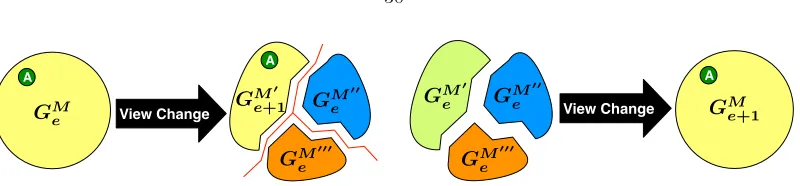
Nevertheless, one major advantage of our protocol is that it allows changes in view membership
to include, at the same time, multiple processes joining and leaving the view. For example, Figure3.4
illustrates how, in one step, three views merge and some nodes from each view will be excluded as
they fail during the view change process.
3.2.4
Protocol Stages
The purpose of the first stage, theExpandingstage, of the view synchronization process is to collect suggestions from the current members of the view and, from these suggestions, ascertain what the
new membership of the view should be. This stage is repeated until a fixed point is reached (nodes
are only added to the membership with each round of suggestions). In the example presented in
Figure3.4this is shown in the drawing to the left. At the end of the expanding stage, the expanded
view contains all the members of the three initial views.
During the Contracting stage, processes that have failed or that want to leave the group are removed from the maximal fixed point view reached during the previous stage. The goal of this
stage is to reduce the membership of the view to the current set of active processes. It is important
to note that between a process expressing interest in joining a group and the commit of the view
change, that process could fail or there might be a network partition – in which case more than
one process might need to be excluded from the view. In Figure 3.4 the new view illustrates the membership after the contracting stage, where failed nodes have been evicted from the final view.
TheConsensusstage is critical for preservingvirtual synchrony. During this stage, processes that have survived so far agree on what messages they need to deliver to the application layer to
guarantee that all members of the view that survive the view change have delivered the same set
of messages in the previous view. The consensus stage is illustrated by the arrows in the second
drawing of Figure 3.4; here, each surviving process synchronizes with all the other processes in its
previous view.
installed by each member. The view change initiator sets the epoch of the new view to be larger
than the largest epoch involved in the view change. Also, the sequence number is reset to 0 and
the view manager propagates a view change event to the upper layer with the new epoch and the
new sequence number is broadcast to all members of the new view. Upon receiving the view change
Chapter 4
MojaveFS: A Case Study
MojaveFS [21] is a network-based distributed filesystem designed with the intent to be highly flexible and fault tolerant while retaining the familiar read/write semantics of traditional local, centralized
filesystems. In particular, MojaveFS aims to provide location transparency and automatic data
replication; replicas may be added to or removed from the system dynamically without need to stop
the filesystem in order to perform the reconfiguration. Moreover, the ordering of all file operations
are bound by a strict consistency model that makes MojaveFS a drop-in replacement for traditional
storage solutions.
Because of its distributed nature and strict ordering guarantees, we consider MojaveFS to be
a good candidate for the type of application that would most be able to take advantage of the
MojaveComm protocol and the communication guarantees that it provides. In this chapter, we
present a high-level overview of the design and implementation of the MojaveFS filesystem, with
particular emphasis on the role that MojaveComm plays with respect to facilitating the file-access
semantics of MojaveFS. It is important to note that this chapter is not intended to provide an
exhaustive description of MojaveFS and/or its implementation; rather, this text aims to expose
enough details so as to give the reader sufficient context to understand how MojaveComm is used
in this system.
4.1
Overview
In most respects, MojaveFS acts like a typical Unix filesystem. For example, MojaveFS supports
the usual filesystem abstractions like files, directories, access permissions, and metadata. In terms
of the actual implementation, MojaveFS is written as a FUSE [1] module1 and, when mounted, is presented as a traditional Unix-style mount point. Thus, to access files stored in MojaveFS, a user
GC
DIO
IIO
FUSE
create, join, send, set timer, destroy create, join, read,
write, store, destroy view change, data, timeout view change, data
new file, data create, read, write,
destroy create, read, write,
getattr, etc.
Figure 4.1: The layered architecture of MojaveFS.
system calls for file manipulation.
The major differences between MojaveFS and most traditional local filesystems is that the file
data, file metadata, and the directory hierarchy itself is stored in a distributed manner across multiple
physical machines. In fact, this filesystem state may even be replicated in multiple places. In this
way, although this data distribution and replication is fully transparent from the user’s perspective,
from the perspective of the administrator MojaveFS provides a rich environment for tailoring the
data distribution and replication policy necessary for a specific deployment environment.
Conceptually, each file and directory in a MojaveFS filesystem is served by a unique virtual server2. A virtual server is comprised of multiple physical nodes; these nodes all serve as consistent
replicas of the file/directory. When a node contributes to the operation of a virtual server in this
way, it is said to be a member of that virtual server. A node may dynamically join or leave the membership of a virtual server at any time. Moreover, a node may be a member of multiple virtual
servers simultaneously.
Virtual servers serve as the infrastructure for MojaveFS; they provide the storage back-end.
However, nodes that mount the filesystem and access the files that the virtual servers provide are
known as clients. In practice, a member of a virtual server may also be a client.
In order to present the illusion that MojaveFS acts like a traditional local filesystem, MojaveFS
adopts a strict consistency model for the ordering of all file operations. Specifically, MojaveFS
con-forms to a consistency model calledsequential consistency(see Section4.2for a detailed description). Consistency is maintained at two levels: within each virtual server, and between virtual servers (this
is important when a client is using multiple virtual servers simultaneously).
From an implementation point of view, MojaveFS is split into three major components:
nam-ing/lookup, replication/data consistency, and operation-sequencing. Figure4.1 depicts the layered
1The FUSE project enables developers to write filesystems that execute their code outside of the operating system kernel. FUSE implementations are currently available for both Linux and Mac OS X.
architecture of the MojaveFS implementation; the bottom three layers correspond roughly to the
three components listed above, respectively. In particular, the Direct I/O (or DIO) layer is re-sponsible for maintaining consistent copies of replicated data and, in conjunction with the Group Communication(or GC) layer, enforcing the overall operation-sequencing guarantees of MojaveFS.
4.2
Sequential Consistency
It is often the case that distributed/concurrent systems are more difficult to reason about than their
centralized, sequential counterparts. For the most part, this difficulty stems from the unnatural
evaluation semantics of such systems. In general, it is possible for operations of a node to be
observed in a different order on different nodes. In order to guarantee some agreement on the order
of operations, it is necessary for all the nodes in the system to adhere to an agreed-upon consistency
model.
The morestrict the consistency model is, the more restrictions it imposes (and the more guar-antees it provides) on the ordering of operations each node performs with respect to one another.
Generally speaking, in a distributed system, the choice of consistency model impacts the efficiency
of global operations within the system (because it may be necessary to postpone some operations,
as their execution may violate the consistency policy); the more strict the model, the less efficient
the system may be.
Nevertheless, in spite of the potential for reduced efficiency, it is generally easier to reason about
a system that adheres to a strict consistency model. In particular, the “gold standard” consistency
model in a distributed system is a model that closely resembles that of a centralized system. In the
strict consistency model, operations are required to be executed in the exact order that they are issued on the remote nodes (i.e. the order the operations would be issued on a traditional centralized
system). However, the primary disadvantage of strict consistency is that it is only possible to be
implemented in a distributed environment where there is a perfectly synchronized globally-shared
clock available. Unfortunately, this is not typically available to most distributed systems and, worse,
not even possible to achieve over unreliable communication channels (i.e. those where messages may
be dropped) [10].
However, there is another consistency model,sequential consistency, that is more acceptable from an implementation-perspective for distributed systems which operate in an environment without a
global synchronized clock. Consider the situation where a distributed system is comprised of a set
ofN nodes (each of which has a local program from which it issues a set of operations). In this case,
sequential consistency guarantees the following two ordering constraints [15]:
P
1 P2 P3
W(x,a) W(x,b) R(x)=a R(x)=b R(x)=b R(x)=a
(a) Violation 1
W(x,b)
P
1 P2 P3
W(x,a)
R(x)=a
W(y,b)
R(y)=b
R(x)=b
(b) Violation 2
Figure 4.2: Violating the sequential consistency constraints
2. There exists a global sequence of operations ⟨o1..ok⟩such that, for every noden∈N,⟨o1..ok⟩