Volume 2006, Article ID 43154, Pages1–12 DOI 10.1155/ASP/2006/43154
Iterative Refinement Methods for
Time-Domain Equalizer Design
G ¨uner Arslan,1Biao Lu,2Lloyd D. Clark,3, 4and Brian L. Evans5
1Silicon Laboratories, Corporate Headquarters, 7000 West William Cannon Drive, Austin, TX 78735, USA 2Schlumberger Sugar Land Product Center, 110 Schlumberger Drive, Sugar Land, TX 77478, USA 3Schlumberger Austin Systems Center, 8311 N FM 620 Road, Austin, TX 78726, USA
4TICOM Geomatics, 9130 Jollyville Road, Austin, TX 78759, USA
5Department of Electrical and Computer Engineering, The University of Texas, Austin, TX 78712-1084, USA
Received 1 December 2004; Revised 23 May 2005; Accepted 2 August 2005
Commonly used time domain equalizer (TEQ) design methods have been recently unified as an optimization problem involving an objective function in the form of a Rayleigh quotient. The direct generalized eigenvalue solution relies on matrix decompositions. To reduce implementation complexity, we propose an iterative refinement approach in which the TEQ length starts at two taps and increases by one tap at each iteration. Each iteration involves matrix-vector multiplications and vector additions with 2×2 matrices and two-element vectors. At each iteration, the optimization of the objective function either improves or the approach terminates. The iterative refinement approach provides a range of communication performance versus implementation complexity tradeoffs for any TEQ method that fits the Rayleigh quotient framework. We apply the proposed approach to three such TEQ design methods: maximum shortening signal-to-noise ratio, minimum intersymbol interference, and minimum delay spread.
Copyright © 2006 G¨uner Arslan et al. This is an open access article distributed under the Creative Commons Attribution License, which permits unrestricted use, distribution, and reproduction in any medium, provided the original work is properly cited.
1. INTRODUCTION
Multicarrier modulation is a widely used modulation me-thod for reliable high-speed communication. Discrete multi-tone (DMT) modulation is a popular variant of multicarrier modulation that has been standardized for asymmetric and very high-speed digital subscriber loops (ADSL and VDSL,
resp.) [1]. In these applications, a guard sequence known as
thecyclic prefixis prepended to each symbol to help the re-ceiver eliminate intersymbol interference (ISI) and perform symbol recovery.
A DMT symbol consists ofNsamples, and the cyclic
pre-fix is a copy of the lastνsamples of the symbol. The length
of the channel impulse response has to be less than or equal
to (ν+ 1) samples in order for all ISI to be eliminated. Using
a cyclic prefix, however, reduces the channel throughput of
a DMT transceiver by a factor ofν/(N+ν). Therefore, it is
desirable to chooseνas small as possible.
The ADSL and VDSL standards set ν to be N/16. In
the field, however, ADSL and VDSL channel impulse
re-sponses can exceedN/16 samples. It is up to the equalizer
in the receiver to shorten the channel impulse response and to correct for frequency distortion in the shortened channel. These two equalization tasks may be decoupled or combined
[2]. In a decoupled approach, the equalizer is a cascade of
a time-domain equalizer (TEQ) to shorten the channel, a fast Fourier transform (FFT) to perform multicarrier demodula-tion, and a frequency-domain equalizer (FEQ) to invert the
frequency response of the shortened channel [3]. These three
operations are linear. Combined equalization approaches ex-ploit the linearity by either moving the TEQ into the FEQ
to yield per-tone equalizers [4], or moving the FEQ into the
TEQ to yield complex-valued time-domain equalizer filter
banks [5]. Combined equalization approaches yield higher
data rates than decoupled approaches for the downstream
ADSL case [2].
A TEQ is generally implemented as a finite impulse re-sponse (FIR) filter placed at the receiver. The cascade of the
channel impulse response and the TEQ forms an effective
channel impulse response with length ofν+ 1 samples, as
shown in Figure 1. (In the case of ADSL, the channel
im-pulse response is actually shortened toνsamples.) Various
design criteria resulting in many different design methods
have been proposed to calculate the TEQ coefficients [3,6–
8]. These four cited design methods can be unified as an
op-timization problem involving a Rayleigh quotient [2]. The
×10−3
2 1.5 1 0.5 0
−0.5
−1
−1.5
−2
A
m
plitude
0 50 100 150 200 250 300
Discrete time Original channel
Shortened channel
Figure1: Example of the channel impulse response (carrier serving area loop 1), and the shortened channel impulse response obtained with a 16-tap TEQ designed with a maximum shortening signal-to-noise ratio (MSSNR) method.
is in general not practical to implement in real-time on pro-grammable digital signal processors.
Instead, iterative design methods could be applied. The
iterative method could fix the TEQ length,Nw, and use
gra-dient descent based on the Rayleigh quotient formulation to
iterate towards an optimal answer [9]. The step size must
be chosen with care, and scaling (normalization) may be needed at each iteration. Although each iteration depends on matrix-vector multiplications and vector additions involving
Nw×Nwmatrices and vectors of lengthNw, matrix
decom-positions are avoided.
We propose an iterative refinement approach in which the TEQ length starts at two taps and increases by one tap at each iteration. A maximum TEQ length may be set. Other stopping criteria include the cases in which no significant improvement in the objective function over the previous iteration, and cases in which the objective function value has degraded over the previous iteration. Hence, the ap-proach will improve the design at each iteration until it ter-minates. No step size needs to be chosen and no scaling is needed. Each iteration involves matrix-vector
multiplica-tions and vector addimultiplica-tions but involving 2×2 matrices and
two-element vectors. Provided that the proposed approach completes its initialization step, the proposed approach can be terminated at any time and a useful TEQ will result. Hence, our approach scales with the available computational resources.
We apply the iterative refinement approach to the
objec-tive functions of three different TEQ design methods:
max-imum shortening signal-to-noise ratio (MSSNR) [6],
min-imum intersymbol interference (min-ISI) [7], and
mini-mum delay spread (MDS) [8] methods. For each TEQ
de-sign method, we develop two iterative refinement algorithms. The divide-and-conquer Rayleigh quotient (DC-Rayleigh) algorithm uses the objective function in Rayleigh quotient form. The divide-and-conquer eigenvector algorithm (DC-eigenvector) optimizes the numerator of the objective func-tion subject to a constraint involving the TEQ. The DC-eigenvector algorithm will have lower implementation com-plexity than the DC-Rayleigh algorithm, which in turn will have significantly lower complexity than the originally re-ported TEQ design method.
The rest of the paper is organized as follows.Section 2
summarizes the three TEQ design methods of interest with
their objective functions.Section 3derives the closed-form
solutions for the DC-Rayleigh and DC-eigenvector meth-ods.Section 4applies the DC-Rayleigh and DC-eigenvector
methods to three TEQ design methods.Section 5shows
de-tailed simulation results for the proposed methods.Section 6
concludes the paper.
2. BACKGROUND
In this section, we summarize three existing TEQ design methods and the objective functions they optimize. All
methods assume thatνis the length of the cyclic prefix, that
the equalized or effective channel impulse response has a
to-tal delay of Δsamples, and that perfect knowledge of the
channel impulse response is available. In ADSL and VDSL, the channel impulse response can be estimated during train-ing. During training, the discrete Fourier transform (DFT) of the channel impulse response is estimated, from which we can obtain the channel impulse response estimate. The ef-fect of channel estimation error on the following TEQ design
methods has been quantified in [10].
2.1. The maximum shortening signal-to-noise ratio method
Melsa et al. [6] approach the TEQ design as solely a
chan-nel shortening problem. They define a shortening signal-to-noise (SSNR) and derive the optimal TEQ in terms of maxi-mizing SSNR which is the ratio of the energy inside a
win-dow of (ν+ 1) samples starting at sample (Δ+ 1) to the
energy outside the same window of the shortened channel impulse response. An ideal shortened channel impulse re-sponse would be zero-valued outside the window in order to yield zero ISI and infinite SSNR. The assumption is that the larger the SSNR, the closer the shortened channel impulse re-sponse is to the ideal. However, optimizing SSNR is not nec-essarily equivalent to maximizing bitrate or minimizing bit-error rate but only an approximation to make the TEQ design problem mathematically tractable. Although this method ig-nores all noise components simulation results show that it performs comparably well to other methods that take noise
into account [2].
Let us define the effective or shortened channel impulse
responseheff(k) as
where h(k) is the channel impulse response of length Lh,
w(k) represents theNw TEQ coefficients, and “∗” denotes
linear convolution. We can representheff(k) in vector form
as
heff =heff(1),heff(2),. . .,heffLh+Nw−1. (2)
The goal is to choose the TEQ coefficients such that the
en-ergy of the effective channel impulse response heff mostly
concentrates inside a window with lengthν+ 1, one sample
longer than the cyclic prefix. To accomplish this goal, we split
heffinto two parts,hwinandhwall, which represent samples of
the effective channel impulse response inside and outside the
window [6], respectively:
hwin
=heff(Δ+1),heff(Δ+ 2),. . .,heff(Δ+ν+ 1),
hwall
=heff(1),. . .,heff(Δ),heff(Δ+ν+ 2),. . .,heffLh+Nw−1.
(3)
The samples inhwallinclude the samples before the window
and the samples after the window. The SSNR objective
func-tion [6] is defined as
SSNR=10 log10 Energy inhwin
Energy inhwall
, (4)
wherehwinandhwallcan be written in matrix form as shown
in the following:
⎡ ⎢ ⎢ ⎢ ⎢ ⎣
heff(Δ+ 1)
heff(Δ+ 2) .. . heff(Δ+ν+ 1)
⎤ ⎥ ⎥ ⎥ ⎥ ⎦ hwin = ⎡ ⎢ ⎢ ⎢ ⎢ ⎣
h(Δ+ 1) h(Δ) · · · hΔ−Nw+ 2 h(Δ+ 2) h(Δ+ 1) · · · hΔ−Nw+ 3
..
. ... . .. ...
h(Δ+ν+ 1) h(Δ+ν) · · · hΔ+ν−Nw+ 2
⎤ ⎥ ⎥ ⎥ ⎥ ⎦ Hwin ⎡ ⎢ ⎢ ⎢ ⎢ ⎣ w(0) w(1) .. . wNw−1
⎤ ⎥ ⎥ ⎥ ⎥ ⎦ w (5) ⎡ ⎢ ⎢ ⎢ ⎢ ⎢ ⎢ ⎢ ⎢ ⎢ ⎢ ⎣
heff(1) .. . heff(Δ)
heff(Δ+ν+ 2) .. . heffLh+Nw−1
⎤ ⎥ ⎥ ⎥ ⎥ ⎥ ⎥ ⎥ ⎥ ⎥ ⎥ ⎦ hwall = ⎡ ⎢ ⎢ ⎢ ⎢ ⎢ ⎢ ⎢ ⎢ ⎢ ⎢ ⎣
h(1) 0 · · · 0
..
. ... . .. ...
h(Δ) h(Δ−1) · · · hΔ−Nw+ 1 h(Δ+ν+ 2) h(Δ+ν+ 1) · · · hΔ+ν−Nw+ 3
..
. ... . .. ...
0 0 · · · hLh−1
⎤ ⎥ ⎥ ⎥ ⎥ ⎥ ⎥ ⎥ ⎥ ⎥ ⎥ ⎦ Hwall ⎡ ⎢ ⎢ ⎢ ⎢ ⎣ w(0) w(1) .. . wNw−1
⎤ ⎥ ⎥ ⎥ ⎥ ⎦ w . (6)
The energy ofhwinandhwallin (4) can be written as
hTwallhwall=wTHTwallHwallw=wTAw,
hTwinhwin=wTHTwinHwinw=wTBw,
(7)
where theNw×Nwmatrices are defined as
A=HTwallHwall B=HTwinHwin.
(8)
Note that bothAandBare real, symmetric and positive
def-inite (excluding the case of ideal equalization which is not possible in practice) by definition. SSNR can then be written in compact form as
SSNR=10 log10w
TBw
wTAw. (9)
This form is known as the Rayleigh quotient. The optimal
shortening method would findwto minimizewTAwwhile
satisfyingwTBw = 1 [6]. Solving this problem via the
La-grange multiplier method easily yields the solution that w
should be chosen as the generalized eigenvector ofBandA
corresponding to the largest generalized eigenvalue [11].
The approach in [6] to find the solutions is based on the
assumption thatBis positive definite so that it has a Cholesky
decomposition as,B = √B√BT. Then,lminis computed as
the eigenvector associated with the smallest eigenvalue of the
matrix (√B)−1A(√BT)−1. Finally,wopt=(
√
BT)−1lmin.
A more complicated method in [6] applies whenBis
sin-gular. In order to avoidBfrom being singular, Yin and Yue
[12] suggest an objective function to maximizewTBwwhile
satisfying the constraintwTAw = 1. In this case, they
as-sume thatAis positive definite since they perform a Cholesky
decomposition onA. Both cases [6,12] require a Cholesky
decomposition, an eigendecomposition, and a matrix
inver-sion of anNw×Nwmatrix to findwopt.
2.2. The minimum intersymbol interference method
Arslan et al. [7] propose a TEQ design method that can
a simplified version of the maximum bitrate TEQ [7] design method that directly optimizes bitrate based on a subchannel SNR model:
SNRi= Sx,i
Csignal,i2
Sn,iCnoise,i2+Sx,iCISI,i2
, (10)
whereSx,i,Sn,i,Csignal,i,Cnoise,i, andCISI,iare the signal power,
noise power, signal path gain, noise path gain, and ISI path
gain in theith subchannel, respectively. The min-ISI method
makes use of the observation that the ISI term in the sub-channel SNR model is the dominant factor limiting bitrate; hence, minimizing ISI alone would be a viable alternative to
the Maximum Bit Rate (MBR) method [7] that otherwise
re-quires nonlinear optimization to calculate the TEQ taps. The objective function for the min-ISI method can also be
writ-ten as a Rayleigh quotient with matricesAandBdefined as:
A=HTDT
i∈R fiHSx,ifi
DH,
B=HTwinHwin,
(11)
whereHis the channel convolution matrix,Hwinis defined
in (5),fiis theith row of theN×NDFT matrix, andDis a
diagonal matrix where the diagonal is defined as
gk=
⎧ ⎨ ⎩
0, Δ+ 1≤k≤Δ+ν+ 1,
1, otherwise. (12)
Compared to the MSSNR method, the min-ISI method holds
the energy inside the window of size (ν+ 1) constant while
minimizing a frequency-weighted form of the energy outside the window. The frequency weighting is based on the signal energy at a given frequency bin which can be thought as the ISI energy. The weighting can also be chosen to take channel
noise into account by replacingSx,iin (11) withSx,i/Sn,iwhere
Sn,iis the noise power in subchanneli. This weighting
func-tion emphasizes the placement of ISI in the frequencies with high SNR (low noise power). A small amount of ISI power in subchannels with low noise power can reduce the overall SNR dramatically. In subchannels with low SNR, however, the noise power is large enough to dominate the ISI power
such that the effect of ISI power on the SNR is negligible.
2.3. The minimum delay spread method
Schur and Speidel [8] propose another approach to shorten
a channel impulse response which can be described as vari-ation of the MSSNR method. The idea behind this approach
is to minimize the square of the delay spread of the effective
channel impulse response which is defined as
D=
1
E Lc
n=0
(n−n)2c[n]2, (13)
wherecis the effective channel impulse response defined as
c = Hw.Lc is the length of the effective channel impulse
response,E=cTcis the total energy in the effective channel
impulse response, andnis the predefined “center of mass.”
If we can think of the MSSNR method as weighting the
samples of the effective channel impulse response with zero
inside the window of sizeν+ 1 and one elsewhere, the MDS
method, on the other hand, weights all samples with the square distance from the “center of mass” which has a similar
function to theΔdelay parameter in the MSSNR or min-ISI
methods. The objective function of this method is the square delay spread which can be written as a Rayleigh quotient with
AandBdefined as
A=HTQH,
B=HTH, (14)
whereQis a diagonal matrix with the diagonal made of the
vector [(0−n)2, (1−n)2,. . ., (Lw+Lh−1−n)2], andnis the
“center of mass.”
3. DIVIDE-AND-CONQUER METHODS
Each method in the previous section requires a Rayleigh quotient to be optimized. The solution to this optimiza-tion problem is a generalized eigenvector of the two matri-ces. Computing the generalized eigenvectors is a computa-tionally challenging task that requires a heavy computational burden and careful scaling to prevent singularities in the matrix computations. In this section, we propose two sub-optimal methods called the divide-and-conquer Rayleigh-quotient (DC-Rayleigh) and divide-and-conquer eigenvec-tor (DC-eigenveceigenvec-tor) methods that can be used with most objective functions that can be written as a Rayleigh quotient.
The proposed DC methods divide the calculation of aNw
-tap TEQ into smaller problems of finding two--tap TEQs, one per iteration. A unit-tap constraint is placed on each two-tap
TEQ. The proposed methods are computationally efficient
and do not require any advanced matrix computation that could cause singularity problems.
3.1. Divide-and-conquer Rayleigh quotient method
The goal is to optimize an objective function of the form
J= wTAw
wTBw. (15)
At theith iteration,wiis a 2×1 vector (a two-tap equalizer),
andAiandBiare 2×2 matrices. Assuming a unit-tap
con-straint on eachwi:
wi=1,giT (16)
the objective function becomes
Ji=w T iAiwi
wiTBiwi =
1 gi aa1,i a2,i
2,i a3,i
1 gi
1 gi bb1,i b2,i
2,i b3,i 1 gi
=a1,i+ 2a2,igi+a3,igi2 b1,i+ 2b2,igi+b3,igi2.
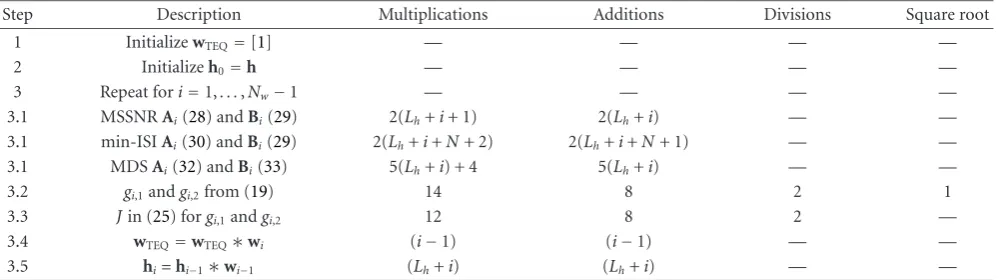
Table1: DC-Rayleigh algorithm steps and complexity analysis for MSSNR, min-ISI, and MDS TEQ design, only step 3.1 differs among the TEQ methods.
Step Description Multiplications Additions Divisions Square root
1 InitializewTEQ=[1] — — — —
2 Initializeh0=h — — — —
3 Repeat fori=1,. . .,Nw−1 — — — —
3.1 MSSNRAi(28) andBi(29) 2(Lh+i+ 1) 2(Lh+i) — —
3.1 min-ISIAi(30) andBi(29) 2(Lh+i+N+ 2) 2(Lh+i+N+ 1) — —
3.1 MDSAi(32) andBi(33) 5(Lh+i) + 4 5(Lh+i) — —
3.2 gi,1andgi,2from (19) 14 8 2 1
3.3 Jin (25) forgi,1andgi,2 12 8 2 —
3.4 wTEQ=wTEQ∗wi (i−1) (i−1) — —
3.5 hi=hi−1∗wi−1 (Lh+i) (Lh+i) — —
The assumption that matrixBis positive definite prevents the
denominator in (17) from going to zero for any value ofgi.
Inspection of theBmatrices in the three objective functions
in the previous section will show that all are symmetric and positive definite by definition.
DifferentiatingJi in (17) with respect to gi, setting the
derivative to zero, and simplifying the result leads to
a3,ib2,i−a2,ib3,i
g2
i +a3,ib1,i−a1,ib3,i
gi
+a2,ib1,i−a1,ib2,i
=0. (18)
The solutions to the quadratic function ofgiin (18) are
gi,(1,2)=−
a3,ib1,i−a1,ib3,i±γ
2a3,ib2,i−a2,ib3,i , (19)
whereγis
a3,ib1,i−a1,ib3,i2−4a3,ib2,i−a2,ib3,ia2,ib1,i−a1,ib2,i.
(20)
We choose the value ofgiamong{gi,1,gi,2}in (19) that gives
the optimal value for Ji. Once the value for gi is chosen,
we have a two-tap TEQwithat maximizes the given
objec-tive.
Our goal is to maximize the objective for aNw-tap TEQ.
After the first iteration, we convolve the calculated two-tap
TEQ with the channel impulse responsehto obtain an
in-termediate effective channel impulse responseh1. Assuming
that this newly calculated intermediate effective channel
im-pulse response is our new channel we repeat the above proce-dure and calculate a new two-tap TEQ and a new
intermedi-ate channel impulse response. This process is repeintermedi-atedNw−1
times so that we havegi, and hencewifori=1,. . .,Nw−1.
TheNw-tap TEQ can than be obtained by convolving all
two-tap TEQs together:
w(k)=w1(k)∗w2(k)∗ · · · ∗wNw−1(k), (21)
wherewi(k) is the two-tap TEQ obtained at theith iteration.
Table 1summarizes the steps of the DC-Rayleigh method. We can also design a two-tap equalizer with a unit-norm constraint (UNC) as
wi=sinθi, cosθiT. (22)
By factoring out sinθi, we can rewrite (22) to obtain
wi=sinθi, cosθiT =sinθi 1,cosθi
sinθi
!T
=sinθi1,ηiT.
(23)
If we substitute (23) into (17), then the sinθiterm would
can-cel out, which would give the same result as (19).
3.2. Divide-and-conquer eigenvector method
The DC-Rayleigh method finds a suboptimal solution of an objective function described as a Rayleigh quotient. In many cases, however, the denominator term of the objective func-tion is constrained to prevent the trivial all-zero TEQ solu-tion. For example in the MSSNR and min-ISI methods the denominator term is to constrain the energy inside the
win-dow of lengthν+ 1. In the MDS method the denominator is
constraining the total energy in the effective channel impulse
response. The DC-Rayleigh method already places a unit-tap constraint on each two-tap TEQ, which prevents the trivial solution.
The DC-eigenvector method is developed to drop the de-nominator term from the objective function and optimize the numerator only in order to prevent over-constraining the solution space. The problem is reduced to optimizing the quadratic objective function
Ji=wiTAiwi. (24)
We apply the same idea in optimizing this objective
objective function at theith iteration as
Ji=wTiAiwi=
1 gi aa1,i a2,i
2,i a3,i
1 gi
=a1,i+ 2a2,igi+a3,igi2.
(25)
DifferentiatingJi in (25) with respect togi and setting the
derivative to zero gives
gi= −aa2,i
3,i. (26)
Once again we obtain the optimal solution for a two-tap
TEQ. Repeating this process Nw −1 times and convolving
the resulting two-tap TEQs together, we obtain theNw-tap
TEQ.
Note that the DC-Rayleigh method requires the
calcula-tion of all entries of bothAandBmatrices at every iteration,
but the DC-eigenvector method only requires two entries of
the Amatrix to be computed in every iteration. The
DC-eigenvector method also does not require a square root oper-ation, which further reduces the computational complexity and is more suitable for real-time implementation on a pro-grammable digital signal processor.
Similar to the DC-Rayleigh method we can derive the
unit-norm constrained DC-eigenvector by replacing wi in
(25) by (23) to obtain
Ji,UNC=wiTAiwi
=sinθi
1 ηi aa1,i a2,i
2,i a3,i
sinθi
1 ηi
=sin2θia1,i+ 2a2,iηi+a3,iηi2
(27)
which will make ηi equal to gi in (26) after we solve for
ηi. Therefore, both unit-tap constraint and unit-norm
con-straint in DC-Rayleigh and DC-eigenvector methods should yield the same performance.
4. APPLICATION OF DIVIDE-AND-CONQUER METHODS
This section gives detailed derivations on how the MSSNR, min-ISI, and MDS objective functions can be used in con-junction with DC-Rayleigh and DC-eigenvector methods.
Tables 1 and 2 describe the steps and quantify the
computations per iteration for the Rayleigh and DC-eigenvector methods, respectively. Note that only the
calcu-lation of theAiandBimatrices differ between methods.
The delay parameter (Δ in the min-ISI and MSSNR
methods ornin the MDS method) is still an important
pa-rameter in the DC methods although it does not appear in the derivation of the DC methods themselves. This
param-eter is embedded in theAiandBimatrices, as it was in the
original methods. In [2], a range of 15–35 for the delay
pa-rameter caused a change in achieved bitrate of less than±1%
for MDS,±2% for MSSNR, and±5% for min-ISI methods.
A reasonable initial guess for the delay parameter is the cyclic
prefix lengthν(i.e., 32 for downstream ADSL). When using
the DC methods, a delay search could be performed during the first iteration.
4.1. Application to MSSNR
In the case of MSSNR, theAiandBimatrices used at iteration
iare written as
Ai=HTi,winHi,win=
a1,i a2,i
a2,i a3,i
= ⎡ ⎢ ⎢ ⎢ ⎢ ⎢ ⎢ ⎣
Δ+ν+1
k=Δ+1
h2
i(k)
Δ+ν+1
k=Δ+1
hi(k)hi(k−1)
Δ+ν+1
k=Δ+1
hi(k)hi(k−1)
Δ+ν+1
k=Δ+1
h2
i(k−1)
⎤ ⎥ ⎥ ⎥ ⎥ ⎥ ⎥ ⎦ , (28)
Bi=HTi,wallHi,wall=
b1,i b2,i b2,i b3,i
= ⎡ ⎢ ⎢ ⎢ ⎣
k∈S h2
i(k)
k∈S
hi(k)hi(k−1)
k∈S
hi(k)hi(k−1)
k∈S h2
i(k−1)
⎤ ⎥ ⎥ ⎥ ⎦, (29)
where hi(k) = hi−1(k)∗wi(k) for i = 1,. . .,Nw−1, k =
0,. . .,Lh+i−1, andh0(k) is the original channel impulse response. The convolution to obtain the new intermediate channel impulse response is simplified by the fact the first tap of the two-tap TEQ is always set to one; hence, only one multiplication and one addition is required to calculate each tap of the new intermediate impulse response. Also note that
a3,iandb3,iare closely related toa1,iandb1,i, respectively, in
that they differ in only two elements of the sums hence can
be derived from each other without recomputing the square of the sums.
4.2. Application to min-ISI
In the case of min-ISI, theBimatrix is the same as given in
(29) and the elements ofAiare defined as
a1,i=
k∈R N−1
n=0
hi(n)s(k−n)
2
,
a2,i=
k∈R
N−1
n=0
hi(n)s(k−n) N−1
n=0
hi(n)s(k−1−n)
2
,
a3,i=
k∈R N−1
n=0
hi(n)s(k−1−n)
2
,
(30)
whereS = {1,. . .,Δ,Δ+ν+ 2,. . .,N}ands(n) is the
time-domain equivalent of the frequency-time-domain weighting
func-tionSx,iand is defined as
s(n)=
N−1
i=0
Sx,iej(2π/N)in. (31)
The application of DC methods to the min-ISI objective function requires first the calculation of the time-domain
weighting function s(n), which can be performed with an
Table2: Implementation complexity of DC-eigenvector algorithms for MSSNR, min-ISI, and MDS TEQ design methods. Only step 3.1 differs among the TEQ methods.
Step Description Multiplications Additions Divisions Square root
1 InitializewTEQ=[1] — — — —
2 Initializeh0=h — — — —
3 FixΔ. Fori=1,. . .,Nw−1 — — — —
3.1 MSSNRAi(28) (Lh+i−ν) (Lh+i−ν−1) — —
3.1 min-ISIAi(30) (Lh+i−ν) + 2(N+ 1) (Lh+i−ν−1) + 2(N+ 1) — —
3.1 MDSAi(32) 3(Lh+i) + 2 3(Lh+i) — —
3.2 g(26) — — 1 —
3.3 wTEQ=wTEQ∗wi (i−1) (i−1) — —
3.4 hi=hi−1∗wi−1 (Lh+i) (Lh+i) — —
once and not for every iteration. However the inner sums
in (30) are required for every iteration which adds to the
computational complexity compared to the MSSNR objec-tive function. As a side benefit, the DC methods get around a restriction of the min-ISI method that the TEQ length could exceed the CP length by designing two taps at a time.
4.3. Application to MDS
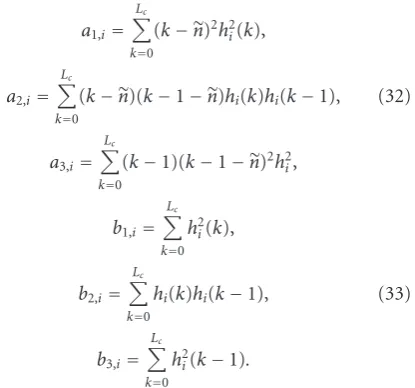
For the MDS objective functions, theAiandBi matrix
ele-ments are defined as
a1,i= Lc
k=0
(k−n)2h2
i(k),
a2,i=
Lc
k=0
(k−n)(k−1−n)hi(k)hi(k−1),
a3,i= Lc
k=0
(k−1)(k−1−n)2h2i,
(32)
b1,i= Lc
k=0
h2
i(k),
b2,i=
Lc
k=0
hi(k)hi(k−1),
b3,i= Lc
k=0
h2
i(k−1).
(33)
As with the MSSNR method the calculation of botha3,iand
b3,ican be based ona1,iandb1,i, respectively, to avoid
recal-culating the sum of squares. Even with these savings, how-ever, the MDS method requires all sums to be over the entire length of the intermediate channel impulse response dou-bling the computational complexity compared to the former two methods.
4.4. Comparison of computational complexity
We compare the computation complexity of the applica-tion of both the DC-Rayleigh and DC-eigenvector meth-ods to all three objective functions in this section. For a fair
comparison of computational complexity, we replace the eigenvalue decomposition in the original methods by the
it-erative power method [13] since only the dominant
eigen-value and its corresponding eigenvector are needed. We
as-sume 10 iterations for the power method as in [14].
Table 3 summarizes the original TEQ design methods
and their computational costs, whereas Tables1and2
sum-marize the DC-Rayleigh and DC-eigenvector methods and their computational complexity, respectively.
Both proposed methods have reduced computational complexity when compared to the original methods and are better suited for real-time implementation on digital signal processors because they avoid any matrix calculations that require careful scaling. The complexity gap between the
orig-inal and proposed methods increases with increasingNw
be-cause the dominant cost savings are from the matrix
opera-tions performed onNw×Nwmatrices in the original
meth-ods.
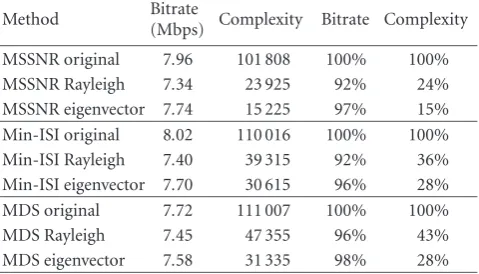
Table 4lists the computational complexity for each of the
methods for a moderate length TEQ of sizeNw = 16 and
N =Lh=512, andν=32, by assuming 10 iterations in the
power method for the original methods. The largest com-plexity reduction is 24% and 15% for the MSSNR objective function for the DC-Rayleigh and DC-eigenvector methods, respectively. Percentage savings in all cases would increase for longer TEQs.
5. SIMULATION RESULTS
We showed in the previous section that the divide-and-conquer methods, especially the DC-eigenvector method, have significant complexity savings over the original meth-ods. In this section, we present simulation results to analyze the bitrate performance of the proposed methods. It is worth noting that the DC-Rayleigh method communication per-formance is bounded above by the perper-formance of the origi-nal method used because it optimizes the same function but two taps at a time. Since we fix the previous taps at every iteration, we are not guaranteed to obtain the optimal solu-tion. It is not possible to determine the upper-bound perfor-mance for the DC-eigenvector method in terms of the
origi-nal methods since the DC-eigenvector method uses different
Table3: Implementation complexity of the MSSNR, min-ISI, and MDS methods.
Step Description Multiplications Additions Divisions
1 AandBfor MSSNR (8) Nw(Lh+ 2Nw−2) Nw(Lh+ 2Nw−3) — 1 AandBfor min-ISI (11) Nw(Lh+ 2Nw−1 +N) Nw(Lh+ 2Nw−2 +N) —
1 AandBfor MDS (14) 2Nw(Lh+ 2Nw−2) +Lh+Nw−1 2Nw(Lh+ 2Nw−3) +Lh+Nw−1 — 2 Cholesky DecompositionB N3
w Nw3 —
3 (√B)−1[11] (5N3
w+Nw)/3 (5Nw3+Nw)/3 —
4 c=(√B)−1A(√BT)−1 2N3
w 2Nw2(Nw−1) —
6 Power method to find eigenvector corresponding to the minimum eigenvalue ofC
6.1 CalculateC−1[11] (5N3
w+Nw)/3 (5Nw3+Nw)/3 0
6.2 Initializel(0) — — —
6.3 z(k)=C−1l(k−1) N2
w (Nw−1)Nw 0
6.4 l(optk)=z(k)/z(k) Nw Nw−1 Nw
6.5 λ(k)=[l(k)]TC−1l(k) (Nw+ 1)Nw N2
w−1 0
6.6 if|λ(k)−λ(k−1)|>threshold, go to step 6.3 — — —
7 wopt=(
√
BT)−1l(k)
opt Nw2 (Nw−1)Nw 0
Table 4: Tradeoff between bitrate performance and complexity (multiplications) of the original and the two divide-and-conquer variations of each TEQ design method forν =32,Nw =16, and
Lh =512. Complexity of original methods assume that the power method is run for 10 iterations.
Method Bitrate
(Mbps) Complexity Bitrate Complexity
MSSNR original 7.96 101 808 100% 100% MSSNR Rayleigh 7.34 23 925 92% 24% MSSNR eigenvector 7.74 15 225 97% 15% Min-ISI original 8.02 110 016 100% 100% Min-ISI Rayleigh 7.40 39 315 92% 36% Min-ISI eigenvector 7.70 30 615 96% 28% MDS original 7.72 111 007 100% 100% MDS Rayleigh 7.45 47 355 96% 43% MDS eigenvector 7.58 31 335 98% 28%
All simulations are based on the commonly used eight carrier-serving-area (CSA) loops that were obtained from
the UT Austin Matlab DMTTEQ Toolbox [15]. The CSA
loops are placed in cascade with two fifth-order high-pass Chebyshev filters. The first filter has a turn-on frequency of
4.8 kHz and simulates the effect of the splitter that separates
the voice-band from the data-band. The second filter is used to separate the upstream from the downstream in frequency division multiplexing at a frequency of 138 kHz.
A transmit signal power of 26 dBm on a 100Ω load is
assumed. The thermal noise is modeled as white Gaussian
noise with−140 dBm/Hz spectral power. Near-end crosstalk
noise is introduced for 8 ISDN disturbers as described in the
ADSL specifications [1]. All methods make use of an ideal
estimate of the channel impulse response.
The delay parameter is chosen based on a heuristic search that gives satisfactory performance with minimal complexity
[14]. The method uses a rectangular window of sizeν+ 1
that is slid over the original channel impulse response so that
the SSNR as defined in (4) is maximized. The index of the
first nonzero sample of the window is chosen as the delay parameter.
Simulations are carried out for 300 DMT symbols carry-ing quadrature phase-shift keycarry-ing (QPSK) signals in all sub-channels, except for subchannel 0 (voiceband) which is not used for data, subchannels 1–5 (ISDN band) which are not
used for data, and subchannelN/2 + 1 which cannot carry
complex symbols. At the receiver, an FIR TEQ filters the re-ceived noisy signal, and passes its output through the cyclic prefix removal block and the FFT. A one-tap FEQ per sub-channel rotates the symbols in each subsub-channel. (We de-signed the FEQ tap on each subchannel to be optimal in a mean-squared error sense.) The rotated symbols are then compared to the transmitted symbols in each subchannel,
and the difference is the error signal, from which the receiver
SNR is calculated. Based on the SNR in each subchannel, we calculate the total bitrate achievable for the given TEQ by us-ing
bDMT=
k∈R "
log2
#
1 +SNRi
Γ
$%
, (34)
whereRis a set of indices for all used subchannels, SNRiis
the SNR in subchanneli, and the SNR gapΓis 10.8 dB [16].
Figure 1 shows the impulse response of CSA loop 1
and the shortened or effective impulse response obtained
with a 16-tap TEQ designed with the proposed
MSSNR-DC-Rayleigh method. Figure 2 compares the performance
10 9 8 7 6 5 4 3 2 1 0
Bi
tr
at
e
(M
b
p
s)
1 2 3 4 5 6 7 8
CSA loop MFB
MSSNR MINISI MDS MSSNR-RQ MINISI-RQ
MDS-RQ MSSNR-EV MINISI-EV MDS-EV NO-TEQ
Figure2: Performance of all methods on 8 CSA loops with TEQ lengthNw=16, symbol lengthN=512, channel lengthLh=512, and cyclic prefix lengthν=32.
exist [2]. As expected, the proposed suboptimal
divide-and-conquer methods generally perform worse than the orig-inal methods. However, on CSA loops 6 and 8, the pro-posed MDS-DC-eigenvector method actually outperforms the original MDS method. This could be expected since none of the methods directly optimize bitrates but alternative ob-jective functions such as the delay spread in this case. Since optimizing the delay spread is not equivalent to optimizing the bitrate, one can sometimes expect the bitrate to increase while the delay spread decreases.
Another observation fromFigure 2 is that most of the
time, the eigenvector method outperforms the DC-Rayleigh method. At first thought, one might think that the DC-Rayleigh method should perform better because it solves the original objective functions as opposed to a sim-plified one, as the DC-eigenvector method does. As
men-tioned inSection 3.2, the DC-Rayleigh method may be
over-constraining the solution due to the new constraint on the first tap of the two-tap equalizers designed at every iteration. For all three original methods in this paper, the denominator of the Rayleigh quotient serves mostly as a constraint to pre-vent the all-zero trivial solution for the TEQ. The divide-and-conquer methods already have a unit-tap constraint built into them. Thus, removing the original constraint expands the solution space, and the DC-eigenvector method is able to find better solutions most of the time while having lower im-plementation complexity. Taking into account the reduction in computational complexity when compared to the DC-Rayleigh method the DC-eigenvector method seems to be a better choice in general.
The primary motivation of the proposed DC methods is to reduce the computational complexity and avoid ma-trix computations that require careful scaling in return for
some communication performance loss.Figure 3(a)maps all
methods referred in this paper onto a two-dimensional space with one axis representing the computational complexity and the other communication performance. The best solutions
would lie in the lower right corner of this map where perfor-mance is maxima and computational complexity is minimal. This plot is obtained by averaging the bitrate numbers ob-tained for each method on each of the eight CSA loops. We see from this plot that the MSSNR-DC-eigenvector method is the choice when computational complexity is the major de-ciding factor. If, however, communication performance is the only factor, then the original min-ISI or the MSSNR meth-ods seemed to be the best choice. Complexity of the original methods assume that the power method is run for 10 itera-tions. One could easily argue that the performance gap be-tween the proposed DC methods and the original methods
is so small (on the order of 0.5 Mbps) that the extra
com-plexity and implementation hardship due to matrix opera-tions is not justified. This plot also reveals that for all DC-Rayleigh methods there exists a method that gets better per-formance with lower computational complexity. A similar ar-gument holds for the min-ISI objective function which seems not to perform as well as the other two objective functions when DC methods are applied. The MSSNR-DC-eigenvector method gives on average better performance with less com-plexity compared to the min-ISI when DC methods are
ap-plied. Figure 3(b) shows performance for all methods
un-der varying numbers of TEQ taps. The graph shows that most methods settle around an upper-bound performance with a 10-tap TEQ. The DC-Rayleigh methods actually re-duce bitrate performance with increasing numbers of taps. This again could be explained by the fact that none of these methods directly optimize the bitrate. It turns out that the DC-Rayleigh method tends to use the additional freedom of more TEQ taps in the wrong direction in terms of bitrate performance.
Finally we analyze the effect of channel estimation error
on each method. The channel estimation error is modeled as additive white Gaussian noise on the ideal (real) channel impulse response. The noisy channel estimate is used in the
calculations of the TEQ coefficients with each method while
the performance estimation is done using the real channel impulse response.
As shown inFigure 4the performance of all methods
in-creases with increasing SNR of the channel estimation error. For SNRs higher than 80 dB the original methods outper-form the iterative methods by similar margin as with an ideal
channel so the noise is too low to have an effect on the results.
The performance gap between the original and DC meth-ods increases for SNRs lower than 80 dB–90 dB. The worst-case additional performance loss of the DC methods over the original methods is around 3% for the MSSNR and min-ISI-based DC methods and about 14% for the MDS-based DC methods. So we can conclude that the MDS method is more sensitive to channel estimation errors when used in conjunction with the proposed DC methods. This
conclu-sion also agrees with the results in [10].
×104
12 10 8 6 4 2 0
C
o
mple
xit
y
(n
umber
o
f
m
ultiplications)
7.4 7.6 7.8 8 8.2
Bitrate (Mbps) MSSNR
MINISI MDS
MSSNR-RQ MINISI-RQ MDS-RQ
MSSNR-EV MINISI-EV MDS-EV (a)
8
7.5
7
6.5
6
5.5
A
chie
vable
bit
rat
e
(Mbps)
5 10 15 20 25 30
Number of TEQ taps (Nw) MSSNR
MSSNR-EV MSSNR-RQ
(b) 8
7.5
7
6.5
6
5.5
A
chie
vable
bit
rat
e
(Mbps)
5 10 15 20 25 30
Number of TEQ taps (Nw) MINISI
MINISI-EV MINISI-RQ
(c)
8
7.5
7
6.5
6
5.5
A
chie
vable
bit
rat
e
(Mbps)
5 10 15 20 25 30
Number of TEQ taps (Nw) MDS
MDS-EV MDS-RQ
(d)
Figure3: With symbol lengthN =512 and channel lengthLh=512, communication performance versus (a) implementation complexity for all methods with TEQ lengthNw =16 and cyclic prefix lengthν=32, where the bitrates are taken as the average over all eight CSA loops; (b) TEQ length for MSSNR methods; (c) TEQ length for min-ISI methods; and (d) TEQ length for MDS methods. EV means the DC-eigenvalue method and RQ means the DC-Rayleigh method.
methods are less constrained hence have a larger space to find a better solution even with noisy channel estimates. The orig-inal methods as well as the DC-Rayleigh methods practically stop working at low SNR situations delivering only about 10% of the peak bitrate with 20 dB estimation noise.
6. CONCLUSION
The design of a time-domain equalizer (TEQ) for dis-crete multitone modulation has been studied extensively and
10 5 0
A
chie
vable
bit
rat
e
(Mbps)
20 30 40 50 60 70 80 90 100
Channel estimation SNR (dB) MSSNR
MSSNR-EV MSSNR-RQ
(a)
10 5 0
A
chie
vable
bit
rat
e
(Mbps)
20 30 40 50 60 70 80 90 100
Channel estimation SNR (dB) MINISI
MINISI-EV MINISI-RQ
(b)
10 5 0
A
chie
vable
bit
rat
e
(Mbps)
20 30 40 50 60 70 80 90 100
Channel estimation SNR (dB) MDS
MDS-EV MDS-RQ
(c)
Figure4: Performance of all methods on CSA loop 1 with TEQ lengthNw =16, symbol lengthN =512, channel lengthLh=512, cyclic prefix lengthν=32, and SNR of channel estimation error. Estimation error is modeled as additive white Gaussian noise. Performance is averaged over 10 runs.
The first method is the divide-and-conquer Rayleigh quotient (DC-Rayleigh) method. The DC-Rayleigh gives an approximate solution to the Rayleigh quotient optimization problem. Our simulation results show that the proposed DC-Rayleigh method gives close to ideal performance with re-duced computational complexity. The fact that the proposed DC-Rayleigh method introduces an additional unit-tap con-straint on the solutions motivates us to further simplify the TEQ design methods by dropping the divisor term from the Rayleigh quotient. This yields to a quadratic cost functions with eigenvector solutions. The second method is the divide-and-conquer eigenvector method (DC-eigenvector), which solves the eigenvalue problem approximately with further re-duced complexity.
We apply both divide-and-conquer methods to optimize
the objective functions of three different TEQ design
meth-ods. The methods are the maximum shortening signal-to-noise ratio, minimum intersymbol interference, and mini-mum delay spread (MDS). Complexity analysis and simu-lations results show that the proposed methods reduce the computational complexity of the original methods with mi-nor performance degradation. In fact, the proposed itera-tive refinement approach provides a range of communication
performance versus implementation complexity tradeoffs for
any TEQ method that fits the Rayleigh quotient framework. The measure of communication performance depends on the objective function used by the TEQ method.
REFERENCES
[1] “ANSI T1.413-1995, Network and customer installation in-terfaces: Asymmetrical digital subscriber line (ADSL) metal-lic interface,” printed from: Digital Subscriber Line Technol-ogy by T. Starr, J. M. Cioffi, and P. J. Silverman, Prentice-Hall, 1999.
[2] R. K. Martin, K. Vanbleu, M. Ding, et al., “Unification and evaluation of equalization structures and design algorithms for discrete multitone modulation systems,” IEEE Transac-tions Signal Processing, vol. 53, no. 10, part 1, pp. 3880–3894, 2005.
[3] J. S. Chow and J. M. Cioffi, “A cost-effective maximum likeli-hood receiver for multicarrier systems,” inProceedings of IEEE International Conference on Communications (ICC ’92), vol. 2, pp. 948–952, Chicago, Ill, USA, June 1992.
[4] K. Van Acker, G. Leus, M. Moonen, O. van de Wiel, and T. Pollet, “Per tone equalization for DMT-based systems,”IEEE Transactions on Communications, vol. 49, no. 1, pp. 109–119, 2001.
[5] M. Ding, Z. Shen, and B. L. Evans, “An achievable per-formance upper bound for discrete multitone equalization,” inProceedings of IEEE Global Telecommunications Conference (GLOBECOM ’04), vol. 4, pp. 2297–2301, Dallas, Tex, USA, November–December 2004.
[7] G. Arslan, B. L. Evans, and S. Kiaei, “Equalization for discrete multitone transceivers to maximize bit rate,”IEEE Transactions Signal Processing, vol. 49, no. 12, pp. 3123–3135, 2001. [8] R. Schur and J. Speidel, “An efficient equalization method to
minimize delay spread in OFDM/DMT systems,” in Proceed-ings of IEEE International Conference on Communications (ICC ’01), vol. 5, pp. 1481–1485, Helsinki, Finland, June 2001. [9] R. K. Martin, K. Vanbleu, M. Ding, et al., “Implementation
complexity and communication performance tradeoffs in dis-crete multitone modulation equalizers,” to appear in IEEE Transactions Signal Processing, http://www.ece.utexas.edu/
bevans/papers/2005/equalizationII.
[10] M. Ding, B. L. Evans, and I. Wong, “Effect of channel estima-tion error on bit rate performance of time domain equalizers,” inProceedings of 38th IEEE Asilomar Conference on Signals, Systems and Computers, vol. 2, pp. 2056–2060, Pacific Grove, Calif, USA, November 2004.
[11] G. H. Golub and C. F. Van Loan,Matrix Computation, John Hopkins University Press, Baltimore, Md, USA, 3rd edition, 1996.
[12] C. Yin and G. Yue, “Optimal impulse response shortening for discrete multitone transceivers,”IEE Electronics Letters, vol. 34, no. 1, pp. 35–36, 1998.
[13] J. W. Demmel, Applied Numerical Linear Algebra, SIAM, Philadelphia, Pa, USA, 1997.
[14] B. Lu, L. D. Clark, G. Arslan, and B. L. Evans, “Fast Time-Domain Equalization for Discrete Multitone Modulation Sys-tems,” inProceedings of IEEE Digital Signal Processing Work-shop, Hunt, Tex, USA, October 2000.
[15] G. Arslan, M. Ding, B. Lu, M. Milosevic, Z. Shen, and B. L. Evans, “MATLAB DMTTEQ Toolbox 3.1,” 2003, Available at: http://www.ece.utexas.edu/∼bevans/projects/adsl/dmtteq/ dmtteq.html.
[16] N. Al-Dhahir and J. M. Cioffi, “A bandwidth-optimized reduced-complexity equalized multicarrier transceiver,”IEEE Transactions on Communications, vol. 45, no. 8, pp. 948–956, 1997.
G¨uner Arslanreceived his Ph.D. degree in electrical engineering (2000) at the Uni-versity of Texas at Austin in Austin, Texas, USA. His dissertation was entitled Equal-ization for Discrete Multitone Transceivers. He received his M.S. degree in electron-ics and communications engineering from Yildiz Technical University, Istanbul, Turkey in 1998, and his B.S. degree in electronics and communications engineering as
Vale-dictorian of his class from Yildiz University, Kocaeli, Turkey in 1994. He is currently a Senior Systems Design Engineer in the wire-less product division of Silicon Laboratories based in Austin, Texas, USA. He is also an Adjunct Faculty in the Electrical and Computer Engineering Department at the University of Texas at Austin. His research interests are in digital signal processing, communications systems, and embedded real-time digital signal processing. He is a Member of IEEE Signal Processing and Communication Soci-eties.
Biao Lureceived her Ph.D. degree in elec-trical engineering (2000) and M.S.E.E. de-gree (1997) from the University of Texas at Austin in Austin, Texas, USA. Her disserta-tion was entitled Wireline Channel Estima-tion and EqualizaEstima-tion. She received her B.S. degree in biomedical engineering (1992) from the Capital Institute of Medicine in Beijing, China. Since 2000, she has been with Schlumberger in Houston, Texas, USA,
where she is currently a Senior Software Engineer in telemetry sys-tems. Her research interests include signal processing, image pro-cessing, neural networks, and embedded systems.
Lloyd D. Clarkreceived his B.S., M.S., and Ph.D. degrees in electrical engineering and computer science from the Massachusetts Institute of Technology in 1984, 1986, and 1990, respectively. From 1990 to 2003, he held various positions at the Schlumberger Austin Technology Center in Austin, Texas, USA, including Principal Engineer and Re-search Scientist. While at Schlumberger, he designed and developed wireline telemetry
systems for well logging applications for the oil field, as well as wireless metering systems. Since 2004, he has been a Principal Sci-entist with Ticom Geomatics in Austin, Texas, USA, where he has been the technical lead on several wireless geolocation projects. He holds several patents, has published several technical papers, and has coadvised graduate students at both MIT and the University of Texas at Austin.
Brian L. Evans is Professor of Electrical and Computer Engineering at the Univer-sity of Texas at Austin in Austin, Texas, USA. His B.S.E.E.C.S. (1987) degree is from the Rose-Hulman Institute of Technology in Terre Haute, Indiana, USA, and his M.S.E.E. (1988) and Ph.D.E.E. (1993) degrees are from the Georgia Institute of Technology in Atlanta, Georgia, USA. From 1993 to 1996, he was a Postdoctoral Researcher at the