An abridged version of this paper appears in the Proceedings of the 39th International Cryptology Conference—CRYPTO 2019. This is the full version.
Match Me if You Can: Matchmaking Encryption
and its Applications
Giuseppe Ateniese∗1, Danilo Francati†1, David Nu˜nez‡2, and Daniele Venturi§3 1Stevens Institute of Technology, USA
2NuCypher, USA
3Sapienza University of Rome, Italy
May 31, 2019
Abstract
We introduce a new form of encryption that we name matchmaking encryption (ME). Using ME, sender S and receiver R (each with its own attributes) can both specify policies the other party must satisfy in order for the message to be revealed. The main security guarantee is that of privacy-preserving policy matching: During decryption nothing is leaked beyond the fact that a match occurred/did not occur.
ME opens up new ways of secretly communicating, and enables several new applications where both participants can specify fine-grained access policies to encrypted data. For instance, in social matchmaking, S can encrypt a file containing his/her personal details and specify a policy so that the file can be decrypted only by his/her ideal partner. On the other end, a receiver R will be able to decrypt the file only if S corresponds to his/her ideal partner defined through a policy.
On the theoretical side, we define security for ME, as well as provide generic frameworks for constructing ME from functional encryption.
These constructions need to face the technical challenge of simultaneously checking the policies chosen by S and R, to avoid any leakage.
On the practical side, we construct an efficient identity-based scheme for equality policies, with provable security in the random oracle model under the standard BDH assumption. We implement and evaluate our scheme and provide experimental evidence that our construction is practical. We also apply identity-based ME to a concrete use case, in particular for creating an anonymous bulletin board over a Tor network.
Keywords. Secret handshake, attribute-based encryption, social matchmaking, Tor.
∗
1
Introduction
Intelligence operations often require secret agents to communicate with other agents from differ-ent organizations. When two spies meet to exchange secrets, they use a type of secret handshake to ensure that the parties participating in the exchange are the ones intended. For example, an FBI agent may want to communicate only with CIA agents, and if this is not the case, the communication should drop without revealing membership information and why the communi-cation failed. This form oflive drop communication,1 when parties are online and interact, has been implemented in cryptography and it is referred to as secret handshake (SH) protocol [8]. In SH, two parties agree on the same secret key only if they are both from the same group. Privacy is preserved in the sense that, if the handshake fails, nobody learns anything relevant other than the participants are not in the same group. In SH with dynamic matching [5], groups and roles can even be determined just before the protocol execution.
SH can be thought of as an evolution of traditional key exchange protocols, where protect-ing privacy of the participants assumes an essential role. As any other key agreement protocol, SH is inherently interactive and its purpose is for the parties to converge on a secret key. A natural question is whether there exists a non-interactive version of SH, in a similar way as ElGamal public-key encryption can be interpreted as a non-interactive version of the classical Diffie-Hellman key exchange. This new cryptographic primitive would allow senders to en-crypt messages offline given only the public key of the receiver, thus getting rid of real-time interactions, while at the same time providing strong privacy guarantees for time-delayed com-munications such as email. Non-interactivity mitigates or preventstraffic analysis which affects all SH protocols when deployed within a network environment (see, e.g., [5]). In particular, increased traffic between nodes may signal to an adversary that the SH protocol was successful, even though the nodes’ group affiliations and roles remain private.
Non-interactive SH is even more relevant if we consider that the most common method of espionage tradecraft is the dead drop one,1 which maintains operational security by using a secret location for the exchange of information, thus relieving the agents from meeting in person. Unfortunately, dead-drop communication cannot be captured by any existing cryptographic primitive, since it requires a form of expressiveness that is not currently provided by encryption and its more advanced forms.
Matchmaking encryption. In this paper, we are revamping the encryption primitive and introducing a new concept termed“Matchmaking Encryption”, or ME. In ME, a trusted author-ity generates encryption and decryption keys associated, respectively, to attributes of the sender and the receiver. The authority also generates an additional decryption key for the receiver, associated to an arbitrary policy of its choice. The sender of the message can specify on the fly an arbitrary policy the receiver must satisfy in order for the message to be revealed. The guarantee is now that the receiver will obtain the message if and only if a match occurs (i.e., the sender’s attributes match the receiver’s policy and vice-versa). Nothing beyond that is leaked; furthermore, the sender’s attributes are certified by the authority, so that no malicious sender can forge a valid ciphertext which embeds fake attributes.
For instance, the sender, during encryption, can specify that the message is intended for an FBI agent that lives in NYC. The receiver, during decryption, can also specify that he wants to read messages only if they come from CIA agents. If any of these two policies is not satisfied, the message remains secret, but nobody learns which policy failed. In this vein, ME can be seen as a non-interactive version of SH, but with much more enhanced functionality. Indeed, an SH works only for groups and roles, while attribute-based key agreements [25] do not consider
privacy. We refer the reader to§1.3 for a comparison between ME and other primitives in the realm of attribute-based cryptography.
Other killer applications of ME are those where the receiver must be sheltered from the actual content of messages to avoid liability, inconvenience or inappropriateness. ME naturally tacklessocial matchmakingconfidentiality, where potential partners open files intended for them but only if they contain the traits of the desired person; if decryption fails, nobody learns why, so that privacy is preserved. Encrypting bids (or votes) under ME provides an exciting twist to well-studied problems. Bidders send private bids to a collector and specify the conditions under which the encryption should be opened. The collector opens only the bids that match specific requirements. If decryption fails, the collector does not learn why, and the actual bid (or vote) remain sealed. ME avoids exposing information connected to unlooked-for bids which could influence the receiver and adversely affect the bidding process outcome.
ME also supports marginalized and dissident communities in authoritarian countries. It can act as an enabler for journalists, political activists and minorities in free-speech technical applications such as SecurePost ([35]) that provides verified group anonymity. Indeed, in their thorough study [35], the authors reveal that, in authoritarian countries, anonymous communi-cation may not be credible and cannot be trusted since sources are unknown.2 ME provides a comprehensive technical solution for censorship-resistant communication while providing source authenticity and strong privacy guarantees that cannot be obtained with existing tools. For instance, the ability to check ciphertexts against a policy before decryption allows journalists or activists to vet messages and avoid exposure to unwanted information that would make them liable. To this end, in Section §6, we introduce and implement a privacy-preserving bulletin board that combines Tor hidden services with ME to allow parties to collect information from anonymous but authentic sources.
1.1 Our Contributions
We initiate a systematic study of ME, both in terms of definitions and constructions. Our main contributions are summarized below.
Syntax of ME. In ME, a trusted authority publishes a master public key mpk, associated to a master secret key msk. The master secret key msk is used by the authority to generate three types of keys: (i) An encryption key ekσ, associated with attributes σ for the sender
(created using an algorithm SKGen); (ii) A decryption keydkρ, associated with attributesρfor
the receiver (created using an algorithm RKGen); (iii) A decryption key dkS, associated to a policyS that the sender’s attributes should satisfy, but that is chosen by the receiver (created using an algorithmPolGen).
A sender with attributes σ, and corresponding encryption key ekσ obtained from the
au-thority, can encrypt a plaintext m by additionally specifying a policy R (chosen on the fly), thus yielding a ciphertext c that is associated with both σ and R. Finally, the receiver can attempt to decrypt c using keys dkρ and dkS: In case of a match (i.e., the attributes of both
parties satisfy the counterparty’s policy), the receiver obtains the plaintext, and otherwise an error occurs.
Security of ME. We consider two properties termed privacy, and authenticity. On rough terms, privacy looks at the secrecy of the sender w.r.t. the plaintextm, the chosen policyR, and its attributesσ, whenever a malicious receiver, possessing decryption keys for several attributes ρ and policies S:
2
• Can’t decrypt the ciphertext (“mismatch condition”), i.e., either the sender’s attributes do not satisfy the policies held by the receiver (S(σ) = 0), or the receiver’s attributes do not satisfy the policy specified by the sender (R(ρ) = 0).
• Can decrypt the ciphertext (“match condition”), i.e., both the sender’s and the receiver’s attributes satisfy the corresponding policy specified by the counterpart (R(ρ) = 1 and S(σ) = 1). Of course, in such a case the receiver is allowed to learn the plaintext.
On the other hand, authenticity says that an attacker not possessing attributes σ should not be able to create a valid ciphertext (i.e., a ciphertext not decrypting to⊥) w.r.t. any access policy that is satisfied by σ.
Black-box constructions. It turned out that building matchmaking encryption is quite difficult. While a compiler turning key agreement into public-key encryption exists (e.g., Diffie-Hellman key exchange into ElGamal public-key encryption), there is no obvious way of building ME from SH, even by extending the model of SH to include attributes and policies in order to achieve something akin to attribute-based key agreement protocols. The main technical challenge is to ensure that the policies established by the sender and receiver are simultaneously checked to avoid any leakage. This simultaneity requirement is so elusive that even constructions combining attribute-based encryption (ABE) with authentication mechanisms fail to achieve it (more on this later).
Our first technical contribution is a construction of an ME for arbitrary policies based on three tools: (i) an FE scheme for randomized functionalities [1] (rFE), (ii) digital signatures, and (iii) non-interactive zero-knowledge (NIZK) proofs. When using the rFE scheme from [1], we can instantiate our scheme assuming the existence of either semantically secure public-key encryption schemes and low-depth pseudorandom generators,orconcrete assumptions on multi-linear maps, or polynomially-secure indistinguishability obfuscation (iO).
This construction satisfies only security against bounded collusions, where there is an a-priori upper bound on the number of queries a malicious receiver can make to oracles RKGen
and PolGen. We additionally give a simpler construction of ME for arbitrary policies that even achieves full security (i.e., security against unbounded collusions), albeit under stronger assumptions. In particular, we replace rFE with 2-input functional encryption (2FE) [24]. When using the 2FE scheme by Goldwasser et al.[24], we can instantiate this construction based on sub-exponentially secure iO.
Being based on strong assumptions, the above constructions should be mainly understood as feasibility results showing the possibility of constructing ME for arbitrary policies. It is nevertheless worth pointing out a recent construction of iO based on LWE, bilinear maps, and weak pseudorandomness [4], which avoids multi-linear maps. Additionally, Fischet al.[20] show how to implement efficiently FE and 2FE using Intel’s Software Guard Extensions (SGX), a set of processors allowing for the creation of isolated execution environments called enclaves. At a high level, in their practical implementation, a functional decryption keyskf consists of a
signature on the functionf, while messages are encrypted using standard PKE. In order to run the decryption algorithm, a client sendsskf together with ciphertextcto adecryption enclave,
The identity-based setting. Next, we turn to the natural question of obtaining efficient ME in restricted settings. In particular, we focus on the identity-based setting where access policies are simply bit-strings representing identities (as for standard identity-based encryption). This yields identity-based ME (IB-ME). For this setting, we provide an efficient construction that we prove secure in the random oracle model (ROM), based on the standard bilinear Diffie-Hellman assumption (BDH) over bilinear groups.
Recall that in ME the receiver needs to obtain from the authority a different key for each access policy S. While this requirement is perfectly reasonable in the general case, where the policy might consist of the conjunction of several attributes, in the identity-based setting a receiver that wants to receive messages from several sources must obtain one key for each source. As this would not scale well in practice, we change the syntax of IB-ME and remove the PolGenalgorithm. In particular, the receiver can now specify on the fly an identity string
snd (playing the role of the access policy S) that is directly input to the decryption algorithm (together with the secret key associated to the receiver’s identity).
While the above modification yields much more efficient IB-ME schemes, it comes with the drawback that an adversary in the privacy game can try to unlock a given ciphertext using different target identities snd chosen on the fly. The latter yields simple attacks that required us to tweak the definition of privacy in the identity-based setting slightly. We refer the reader to§5 for more details.
Concrete use case and implementation. We give evidence of the practical viability of our IB-ME construction by providing a prototype implementation in Python. Our experimental evaluation can be found in §6. There, we also detail a concrete use case where IB-ME is used in order to realize a prototype of a new privacy-preserving bulletin board that is run on the Tor network [43]. Our system allows parties to communicate privately, or entities such as newspapers or organizations to collect information from anonymous sources.
A public bulletin board is essentially a broadcast channel with memory. Messages can be encrypted under ME so that their content is revealed only in case of a policy match. The privacy-preserving feature of ME ensures that, if decryption fails, nobody learns which policies were not satisfied. This effectively creates secure and private virtual rooms or sub-channels. Arranged ME. In ME a receiver can obtain independent decryption keys for its attributes and policies. Note that these keys can be arbitrarily combined during decryption. For this reason, we also consider an alternative flavor of ME, called arranged matchmaking encryption (A-ME), where there is a single decryption keydkρ,Sthat describes simultaneously the receiver’s
attributes ρ and the policy S chosen by the receiver. Thus, an A-ME scheme does not come with aPolGenalgorithm. This feature makes sense in applications where a receiver has different attributes, each bearing different restrictions in terms of access policies. A-ME is simpler to construct, in fact we show how to obtain A-ME for arbitrary policies from FE for deterministic functionalities, digital signatures, and NIZK proofs.
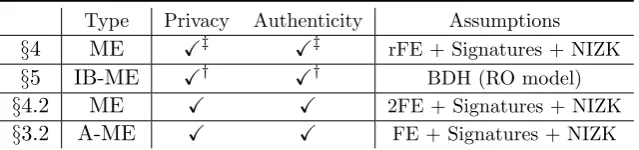
See Tab. 1 for a summary of our constructions in terms of assumptions and for different flavors of ME.
1.2 Technical Approach
Below, we describe the main ideas behind our constructions of ME. We start by presenting two unsuccessful attempts, naturally leading to our secure constructions. Both attempts are based on FE. Recall that FE allows us to generate decryption keysdkf associated to a functionality
Type Privacy Authenticity Assumptions
§4 ME X‡ X‡ rFE + Signatures + NIZK
§5 IB-ME X† X† BDH (RO model)
§4.2 ME X X 2FE + Signatures + NIZK
§3.2 A-ME X X FE + Signatures + NIZK
Table 1: Results achieved in this work. † Security only holds in the identity-based setting. ‡
Security only holds in case of bounded collusions.
f(x) (and nothing more). Note that FE implies both ciphertext-policy ABE [12] (CP-ABE) and key-policy ABE [28] (KP-ABE).
First attempt. A first natural approach would be to construct an ME scheme by combining two distinct FE schemes. The idea is to apply sequentially two functionalitiesf1 and f2, where the first functionality checks whether the sender’s policy R is satisfied, whereas the second functionality checks whether the receiver’s policy S is satisfied. More in details, let f1 and f2 be the following functions:
fρ1(R, c) =
c, ifR(ρ) = 1
⊥,otherwise f
2
S(σ, m) =
m, ifS(σ) = 1
⊥, otherwise
where R(ρ) = 1 (resp. S(σ) = 1) means that receiver’s attributes ρ (resp. sender’s attributes σ) satisfy the sender’s policyR(resp. receiver’s policyS). A sender now encrypts a message m under attributesσ by first encrypting (σ, m) under the second FE scheme, and thus it encrypts the corresponding ciphertext concatenated with the policy R under the first FE scheme. The receiver first decrypts a ciphertext using secret key dkρ associated with function fρ1, and then
it decrypts the obtained value using secret keydkS associated with function fS2.
While “semantic security” of the underlying FE schemes computationally hides the plaintext of the resulting ME scheme, privacy is not guaranteed completely: In fact, when the first encrypted layer decrypts correctly (resp. does not decrypt correctly), a receiver infers that the sender’s attributes σ match (resp. do not match) the policyS.
Second attempt. One could think to salvage the above construction as follows. Each function fi returns a random keyr
i in case the corresponding policy (i.e., the policy checked by function
fi) is satisfied, and otherwise it returns a random value generated by running a secure PRFF. Both partial keysr1, r2 are then needed to unmask the stringr1⊕r2⊕m, which is included in the ciphertext.
More precisely, consider functionsfρ1(R, r1, k1) andfS2(σ, r2, k2), such thatfρ1(R, r1, k1) (resp.
f2
S(σ, r2, k2)) returnsr1 (resp.r2) ifρsatisfiesR(resp.σsatisfiesS); otherwise, it returnsFk1(ρ)
(resp. Fk2(S)), where k1 (resp. k2) is a key for the PRF F. An encryption of message m w.r.t.
attributesσ and policyRwould now consist of three values (c1, c2, c3), wherec1is an encryption of (R, r1, k1) under the first FE scheme, c2 is an encryption of (σ, r2, k2) under the second FE scheme, and finallyc3 =r1⊕r2⊕m. A receiver (with keysdkρand dkS associated to functions
fρ1 and fS2 as before) would decrypt c1 and c2 using dkρ and dkS, and finally xor the outputs
between them and withc3.
match) or an output ofFki (i.e., there was no match). However, a malicious receiver possessing
distinct attributes ρ and ρ0, such that both satisfy the policyR, is able to figure out whether the sender’s policy is matched by simply decrypting c1 twice (using attributes ρ and ρ0) and comparing if the decryption returns twice the same value (i.e., r1). A similar attack can be carried out using two different keys for distinct policies S and S0, such that both policies are satisfied by the attributesσ.
ME from 2FE. Intuitively, in order to avoid the above attacks, we need to check simul-taneously that S(σ) = 1 and R(ρ) = 1. 2FE comes handy to solve this problem, at least if one is willing to give up on authenticity. Recall that in a 2FE scheme we can associate secret keys with 2-ary functionalities, in such a way that decrypting ciphertextsc0, c1 computed using independent keysek0,ek1, and corresponding to plaintextsx0, x1, yields f(x0, x1) (and nothing more).
Wlog., we reserve the 1st slot to the sender, while the 2nd slot is reserved to the receiver; the administrator gives the key ek0 to the sender. The sender now encrypts a message m under attributes σ and policy R by computing Enc(ek0,(σ,R, m)), which yields a ciphertext c0 for the first input of the function f. The receiver, as usual, has a pair of decryption keys
dkρ, dkS obtained from the administrator; here, dkS = Enc(ek1,S) = c1 is an encryption of S
under keyek1. Hence, the receiver runsDec(dkρ, c0, c1), wheredkρis associated to the function
fρ((m, σ,R),S) that returns mif and only if bothR(ρ) = 1 andS(σ) = 1 (i.e., a match occurs). On rough terms, privacy follows by the security of the underlying 2FE scheme, which guaran-tees that the receiver learns nothing more than the output off. Unfortunately, this construction does not immediately satisfy authenticity. To overcome this limitation, we tweak it as follows. First, we let the sender obtain from the authority a signature s on its own attributes σ; the signature is computed w.r.t. a verification key that is included in the public parameters of the scheme. Second, during encryption, the sender computes the ciphertext c0 as above, but now additionally proves in zero knowledge that it knows a valid signature for the attributes that are hidden in the ciphertext. As we show, this modification allows us to prove authenticity, while at the same time preserving privacy. We refer the reader to §4.2 for the formal proof.
ME from rFE. In§4, we give an alternative solution that combines rFE and FE (and thus can be instantiated from weaker assumptions). Recall that rFE is a generalization of FE that supports randomized functionalities. In what follows, we write f1 for the randomized func-tionality supported by the rFE scheme, and f2 for the deterministic functionality supported by the plain FE scheme. The main idea is to let the sender encrypt (m, σ,R) under the rFE scheme. We then consider the randomized function fρ1 that checks if ρ satisfies R: In case a match occurs (resp. does not occur), it returns an encryption of (m, σ) (resp. of (⊥,⊥), where⊥
denotes garbage) for the second functionf2
S that simply checks whether the policy Sis satisfied
or not. The receiver decryption keys are the keys dkρ,dkS associated to the functionsfρ1 and
f2
S.
Roughly speaking, since the randomized functionf1passes encrypted data tof2, a malicious receiver infers nothing about the satisfiability of policyR. On the other hand, the satisfiability of Sremains hidden, as long as the FE scheme for the function f2 is secure.
While the above construction does not directly satisfy authenticity, we can show that the same trick explained above for the 2FE-based scheme works here as well.
attributesρ), in A-ME there is a single decryption keydkρ,Sthat represents both the receiver’s
attributes ρ and the policyS.
As a result, looking at our construction of ME from 2FE, we can now hard-code the policyS (together with the attributesρ) into the function, which allows us to replace 2FE with plain FE. This way, each A-ME decryption key dkρ,S is the secret key corresponding to the functionfρ,S
for the FE scheme. The security proof, which appears in§4.3, only requires FE with game-based security [12], which in turn can be instantiated under much weaker assumptions.
IB-ME. Above, we mentioned that the natural construction of ME where a ciphertext masks the plaintextmwith two distinct padsr1, r2—wherer1, r2 are re-computable by the receiver as long as a match occurs—is insecure. This is because the expressiveness of ME allows us to have two distinct attributesρ and ρ0 (resp. two distinct policiesSand S0) such that both satisfy the sender’s policyR (resp. both are satisfied by the sender’s attributesσ).
The main idea behind our construction of IB-ME (cf. §5) under the BDH assumption is that the above attack does not work in the identity-based setting, where each receiver’s policy S (resp. receiver’s policyR) is satisfied only by the attributeσ =S (resp.ρ =R). This means that an encryption m⊕r1⊕r2 yields an efficient IB-ME as long as the random padr2 (resp. r1) can be re-computed by the receiver if and only if its policy Sis satisfied (resp. its attributes ρ satisfy the sender’s policy). On the other hand, if S is not satisfied (resp.ρ does not satisfy the sender’s policy), the receiver obtains a padr20 (resp.r10) that is completely unrelated to the real r2 (resp.r1). In our scheme, we achieve the latter by following a similar strategy as in the Boneh-Franklin IBE construction [11].
1.3 Related Work
Secret handshakes. Introduced by Balfanzet al.[8], an SH allows two members of the same group to secretly authenticate to each other and agree on a symmetric key. During the protocol, a party can additionally specify the precise group identity (e.g., role) that the other party should have.
SH preserves the privacy of the participants, meaning that when the handshake is successful they only learn that they both belong to the same group (yet, their identities remain secret), whereas they learn nothing if the handshake fails. Subsequent work in the area [29, 42, 5, 13, 46, 49, 32, 47, 31, 30, 41] focused on improving on various aspects of SH, including members’ privacy and expressiveness of the matching policies (i.e., attribute-based SH).
In this vein, ME can be thought of as a non-interactive SH. Indeed, ME gives privacy guarantees similar to that of SH, but it provides a more efficient way to communicate (being non-interactive) and, at the same time, it is more flexible since a party is not constrained to a group.
In ABE, only one party can specify a policy, and thus only one entity has the power to select the source (or the destination) of an encrypted message. Motivated by this limitation, Attrapadung and Imai [6] introduced dual-policy ABE. Here, the sender encrypts a message by choosing both a policy and a set of attributes. The receiver can decrypt the ciphertext using a single decryption key that describes both the receiver’s policy and attributes. Similarly to ME, if both policies are satisfied by the respective counterpart, the message is revealed.
Dual-policy ABE and ME differ in several aspects. First, on the syntactical level, in ME there are two distinct decryption keys: One for the attributes and one for the policy specified by the receiver. This yields improved flexibility, as receivers are allowed to choose attributes and policies independently. (Indeed, the syntax of dual-policy ABE is more similar to that of A-ME.) Second, on the security level, both ME and A-ME provide much stronger privacy guarantees than dual-policy ABE. In fact, the security definition for dual-policy ABE only protects the secrecy of the plaintext. Additionally, the actual constructions in [6, 7] are easily seen not to preserve privacy w.r.t. the sender’s attributes/policy whenever a match does not occur. Intuitively, this is because the procedure that checks, during decryption, whether a match occurred or not, is not an atomic operation. Also note that dual-policy ABE does not directly provide authenticity, which instead is a crucial property for ME and A-ME (those being a type of non-interactive SH).
Attribute-based key exchange. Gorantla et al. [25] introduced attribute-based authenti-cated key exchange (AB-AKE). This is essentially an interactive protocol which allows sharing a secret key between parties whose attributes satisfy a fixed access policy. Note that the policy must be the same for all the parties, and thus it must, e.g., be negotiated before running the protocol.
In a different work, Kolesnikovet al. [34] built a different AB-KE without bilateral authen-tication. In their setting, a client with some attributes (certificated by an authority) wants to authenticate himself to a server according to a fixed policy. The server will share a secret key with the client if and only if the client’s attributes satisfy the server’s policy.
Note that in ME both senders and receivers can choose their own policies, a feature not present in attribute-based key exchange protocols.
Access control encryption. Access control encryption (ACE) [19, 33, 21, 44] is a novel type of encryption that allows fine-grained control over information flow. The actors are a set of senders, a set of receivers, and a sanitizer. The goal is to enforce no-read and no-write rules (described by a policy) over the communication, according to the sender’s and receiver’s identities.
The flow enforcement is done by the sanitizer, that applies a randomized algorithm to the incoming ciphertexts. The result is that only receivers allowed to communicate with the source will be able to decrypt the sanitized ciphertext correctly, obtaining the original message (no-read rule). On the other hand, if the source has not the rights to communicate with a target receiver (e.g., the sender is malicious), then the latter will receive a sanitized ciphertext that looks like an encryption of a random message (no-write rule).
2
Preliminaries
2.1 Notation
We use the notation [n]def={1, . . . , n}. Capital boldface letters (such as X) are used to denote random variables, small letters (such asx) to denote concrete values, calligraphic letters (such as X) to denote sets, and serif letters (such asA) to denote algorithms. All of our algorithms are modeled as (possibly interactive) Turing machines; if algorithmAhas oracle access to some oracleO, we often implicitly write QO for the set of queries asked by AtoO.
For a string x∈ {0,1}∗, we let |x|be its length; ifX is a set,|X |represents the cardinality of X. When x is chosen randomly in X, we write x←$X. If A is an algorithm, we write
y←$A(x) to denote a run of A on input x and output y; if A is randomized, y is a random
variable andA(x;r) denotes a run ofA on inputx and (uniform) randomnessr. An algorithm
Aisprobabilistic polynomial-time (PPT) ifAis randomized and for any inputx, r∈ {0,1}∗ the computation ofA(x;r) terminates in a polynomial number of steps (in the input size).
Negligible functions. Throughout the paper, we denote by λ∈ N the security parameter and we implicitly assume that every algorithm takes as input the security parameter. A function ν :N→[0,1] is callednegligible in the security parameterλif it vanishes faster than the inverse of any polynomial inλ, i.e. ν(λ)∈O(1/p(λ)) for all positive polynomials p(λ). We sometimes write negl(λ) (resp., poly(λ)) to denote an unspecified negligible function (resp., polynomial function) in the security parameter.
2.2 Signature Schemes
A signature scheme is made of the following polynomial-time algorithms.
KGen(1λ): The randomized key generation algorithm takes the security parameter and outputs a secret and a public key (sk,pk).
Sign(sk, m): The randomized signing algorithm takes as input the secret keysk and a message m∈ M, and produces a signatures.
Ver(pk, m, s): The deterministic verification algorithm takes as input the public keypk, a mes-sagem, and a signatures, and it returns a decision bit.
A signature scheme should satisfy two properties. The first property says that honestly generated signatures always verify correctly. The second property, called unforgeability, says that it should be hard to forge a signature on a fresh message, even after seeing signatures on polynomially many messages.
Definition 1 (Correctness of signatures). A signature scheme Π = (KGen,Sign,Ver) with mes-sage space M is correct if ∀λ∈N, ∀(sk,pk) output by KGen(1λ), and ∀m ∈ M, the following holds:
P[Ver(pk, m,Sign(sk, m)) = 1] = 1.
Definition 2 (Unforgeability of signatures). A signature scheme Π = (KGen,Sign,Ver) is ex-istentially unforgeable under chosen-message attacks (EUF-CMA) if for all PPT adversaries
A:
P
h
1. (sk,pk)←$KGen(1λ).
2. (m, s)←$ASign(sk,·)(1λ,pk)
3. If m6∈ QSign, andVer(pk, m, s) = 1, output1, else output0.
2.3 Functional Encryption
2.3.1 Functional Encryption for Randomized Functionalities
A functional encryption scheme for randomized functionalities [26] (rFE) f :K × X × R → Y
consists of the following polynomial-time algorithms.3
Setup(1λ): Upon input the security parameter, the randomized setup algorithm outputs a mas-ter public keympk and a master secret keymsk.
KGen(msk, k): The randomized key generation algorithm takes as input the master secret key
msk and an indexk∈ K, and outputs a secret key skk forfk.
Enc(mpk, x): The randomized encryption algorithm takes as input the master public keympk, an inputx∈ X, and returns a ciphertextcx.
Dec(skk, cx): The deterministic decryption algorithm takes as input a secret key skk and a
ciphertext cx, and returns a valuey∈ Y.
Correctness of rFE intuitively says that decrypting an encryption ofx∈ X using a secret key
skk for function fk yields fk(x;r), where r←$R. Since fk(x) is a random variable, the actual
definition requires that whenever the decryption algorithm is invoked on a fresh encryption of a messagex under a fresh key for fk, the resulting output is computationally indistinguishable
tofk(x).
Definition 3 (Correctness of rFE). A rFE scheme Π = (Setup,KGen,Enc,Dec) for a random-ized functionalityf :K × X × R → Y is correct if the following distributions are computationally indistinguishable:
{Dec(skkj, ci)}kj∈K,xi∈X {fkj(xi;ri,j)}kj∈K,xi∈X
where (mpk,msk)←$Setup(1λ), skk
j←$KGen(msk, kj) for kj ∈ K, ci←$Enc(mpk, xi) for xi ∈ X, and ri,j←$R.
As for security, the setting of rFE tackles malicious encryptors. However, for our purpose, it will be sufficient to consider a weaker security guarantee that only holds for honest encryptors. In this spirit, the definition below is adapted from [1, Definition 3.3] for the special case of honest encryptors.
Definition 4((q1, qc, q2)-NA-SIM-security of rFE). A rFE schemeΠ = (Setup,KGen,Enc,Dec) for a randomized functionalityf :K×X ×R → Y is(q1, qc, q2)-NA-SIM-secure if there exists an
efficient (stateful) simulator S= (S1,S2,S3,S4) such that for all PPT adversaries A= (A1,A2) where A1 makes at most q1 key generation queries and A2 makes at most q2 key generation query, the output of the following two experiments are computationally indistinguishable:
3Often, and equivalently, FE schemes are parameterized by a function ensembleF={f
REALΠ,A(λ)
(mpk,msk)←$Setup(1λ) (x∗, α)←$AO1(msk,·)
1 (1
λ,mpk)
wherex∗= (x0, . . . , xqc) ci←$Enc(mpk, xi)fori∈[qc]
out←$AO2(msk,·)
2 (1
λ,{c i}, α)
return(x,{k},out)
IDEALΠ,A(λ)
(mpk, α0)←$S1(1λ)
(x∗, α)←$AO
0
1(α0,·)
1 (1
λ,mpk)
wherex∗= (x0, . . . , xqc) Let{k1, . . . , kq1}=QO01
Fori∈[qc], j∈[q1]
yi,j=fkj(xi;ri,j), whereri,j←$R
({ci}, α0)←$S3(α0,{yi,j})
out←$AO
0
2(α0,·)
2 (1
λ,{c i}, α)
return(x,{k0},out)
where the key generation oracles are defined in the following way:
O1(msk,·) and O2(msk,·): Are implemented with the algorithm KGen(msk,·). The ordered set
{k} is composed of the queries made to oracles O1 andO2.
O01(st0,·) and O02(st0,·): Are implemented with two simulatorsS2(α0,·),S4(α0,·). The simulator
S4 is given oracle access to KeyIdeal(x∗,·), which, on input k, outputs fk(xi;r), where
r←$Rfor everyxi∈x∗. The ordered set{k0} is composed of the queries made to oracles O01 and the queries made by S4 toKeyIdeal.
2.3.2 Functional Encryption for Deterministic Functionalities
Functional encryption (FE) for deterministic functionalities f : K × X → Y can be cast as a special case of rFE. Since f is a deterministic functionality, correctness now simply says that whenever the decryption algorithm is invoked on a fresh encryption of a message x under a fresh key forf, the resulting output equals fk(x).
Definition 5(Correctness of FE). A functional encryption schemeΠ = (Setup,KGen,Enc,Dec) for a functionality f :K × X →ρ is correct if ∀x∈ X,∀k∈ K, the following holds:
P
(mpk,msk)←$Setup(1λ), skk←$KGen(msk, k),
Dec(skk,Enc(mpk, x)) =fk(x)
= 1
Definition 6 ((q1, qc, q2)-SIM-security of FE). A functional encryption scheme Π = (Setup,
KGen,Enc,Dec) for a functionality f : K × X → ρ is (q1, qc, q2)-SIM-secure if there exists an efficient simulator S = (S1,S2,S3,S4) such that for all probabilistic polynomial time adversary
A= (A1,A2), where A1 makes at most q1 key generation queries and A2 makes at most q2 key generation queries, the output of the following two experiments are computationally indistin-guishable:
REALΠ,A(1λ)
(mpk,msk)←$Setup(1λ) (x∗, α)←$AO1(msk,·)
1 (1
λ,mpk)
wherex∗= (x0, . . . , xqc) ci←$Enc(mpk, xi)fori∈[qc]
out←$AO2(msk,·)
2 (1
λ,{c i}, α)
return(x,{k},out)
IDEALΠ,A(1λ)
(mpk, α0)←$S1(1λ)
(x∗, α)←$AO
0
1(α0,·)
1 (1
λ,mpk)
wherex∗= (x0, . . . , xqc) Let{k1, . . . , kq1}=QO01
Fori∈[qc], j∈[q1]
yi,j=fkj(xi)
({ci}, α0)←$S3(α0,{yi,j})
out←$AO
0
2(α0,·)
2 (1λ,{ci}, α)
where the key generation oracles are defined in the following way:
O1(msk,·) and O2(msk,·): Are implemented with the algorithm KGen(msk,·). The ordered set
{k} is composed of the queries made to oracles O1 andO2.
O01(st0,·) and O02(st0,·): Are implemented with two simulatorsS2(α0,·),S4(α0,·). The simulator
S4 is given oracle access to KeyIdeal(x∗,·), which on input k, outputs fk(xi) for every
xi ∈ x∗. The ordered set {k0} is composed of the queries made to oracles O01 and the queries made by S4 toKeyIdeal.
Definition 7 (Game-based security of FE). A functional encryption schemeΠ = (Setup,KGen,
Enc,Dec)for a functionalityf :K×X → Y is secure if for all valid PPT adversaryA= (A1,A2),
we have:
P
h
GfeΠ,A(λ) = 1
i
−1
2
≤negl(λ) where Gfe
Π,A(λ) is the following experiment: 1. (msk,mpk)←$Setup(1λ)
2. (m0, m1, α)←$AKGen(msk,·)
1 (1λ,mpk). 3. c←$Enc(mpk, mb) where b←${0,1}.
4. b0←$AKGen(msk,·)
2 (1λ, c, α).
5. If b=b0 then output1, and otherwise output 0.
Adversary A = (A1,A2) is called valid if ∀k ∈ QKGen we have fk(m0) = fk(m1), where QKGen contains all the queries submitted by A1 andA2 to oracle KGen.
2.3.3 Two-Input Functional Encryption
A 2-input FE (2FE) scheme for a 2-arity functionality f : K × X0 × X1 → Y consists of the following efficient algorithms.
Setup(1λ): Upon input the security parameter, the randomized setup algorithm outputs 2 en-cryption keysek0,ek1, and a master secret keymsk.
KGen(msk, k): The randomized key generation algorithm takes as input the master secret key
msk, and an index k∈ K, and outputs a secret keyskk forfk.
Enc(eki, xi): Fori∈ {0,1}, the randomized encryption algorithm takes as input the encryption
keyeki, a value xi ∈ Xi, and returns a ciphertext cxi.
Dec(skk, cx0, cx1): The deterministic decryption algorithm takes as input a secret keyskk forfk,
and two ciphertexts cx0, cx1, and returns a valuey∈ Y.
Correctness of a 2FE means that decrypting (cx0, cx1), where cxi is an encryption of xi,
using a secret keyskk for functionfk yieldsfk(x0, x1).
Definition 8 (Correctness of 2FE). A 2FE schemeΠ = (Setup,KGen,Enc,Dec)for a function-ality f :K × X0× X1 → Y is correct if ∀(x0, x1)∈ X0× X1,∀k∈ K:
P
(ek0,ek1,msk)←$Setup(1λ), skk←$KGen(msk, k),
c0←$Enc(ek0, x0), c1←$Enc(ek1, x1) Dec(skk, c0, c1) =fk(x0, x1)
Security changes significantly depending on which keys among (ek0,ek1) are public. The flavor we require has one public and one private key, with the adversary given oracle access to the encryption algorithm for the private key. The formal definition follows below.
Definition 9 (IND-security of 2FE, {0,1}-semi-private setting). Fori∈ {0,1}, a2FE scheme Π = (Setup,KGen,Enc,Dec) for a functionality f :K × X0× X1 →ρ is indistinguishably secure in the i-semi-private setting if for all valid PPT adversaries A= (A1,A2):
P
h
GsprivΠ,A(λ, i) = 1
i
−1
2
≤negl(λ),
where GsprivΠ,A(λ, i) is the following experiment: 1. (msk,ek0,ek1)←$Setup(1λ)
2. ((m00, m01),(m10, m11), α)←$AKGen(msk,·),Enc(eki,·)
1 (1λ,ek1−i). 3. c0←$Enc(ek0, mb0),c1←$Enc(ek1, mb1), where b←${0,1}.
4. b0←$A2KGen(msk,·),Enc(eki,·)(1λ,(c0, c1), α).
5. If b=b0 then output1, and otherwise output 0.
AdversaryA= (A1,A2) is called valid if ∀k∈ QKGen, ∀x∈ X1−i,∀x0 ∈ QEnc, we have: fk(m00, m01) =fk(m10, m11)
and
fk(m00, x) =fk(m10, x) andfk(x0, m01) =fk(x0, m11), if i= 0 fk(x, m01) =fk(x, m11) andfk(m00, x0) =fk(m10, x0), if i= 1.
The above definition is a generalization of [24, Def. 4] with parameters (n, t, q) = (2,1,1), where the adversary is additionally given oracle access to Enc(eki,·); this notion is easily seen
to be implied by [24, Def. 4] with parameters (n, t, q) = (2,2,1) as the latter means that both keys (ek0,ek1) can be made public. In turn, IND-secure 2FE for arbitrary functionalities in the public setting exists assuming sub-exponentially hard indistinguishability obfuscation for all functions [24].
2.4 Bilinear Diffie-Hellman Assumption
Our practical implementation of IB-ME is provably secure under the BDH assumption, which we recall below.
Definition 10 (BDH assumption). Let G and GT be two groups of prime order q. Let e :
G×G→GT be an admissible bilinear map, and let P be a generator of G. The BDH problem is hard in (G,GT, e) if for every PPT adversaryA:
P
h
A(q,G,GT, e, P, Pa, Pb, Pc) =e(P, P)abc
i
2.5 Non-Interactive Zero Knowledge
Let R be a relation, corresponding to an NP language L. A non-interactive zero-knowledge (NIZK) proof system for R is a tuple of polynomial-time algorithms Π = (I,P,V) specified as follows. (i) The randomized algorithm I takes as input the security parameter and outputs a common reference string ω; (ii) The randomized algorithm P(ω,(y, x)), given (y, x) ∈ R outputs a proof π; (iii) The deterministic algorithm V(ω,(y, π)), given an instance y and a proof π outputs either 0 (for “reject”) or 1 (for “accept”). We say that a NIZK for relation R is correct if for all λ ∈ N, every ω output by I(1λ), and any (y, x) ∈ R, we have that
V(ω,(y,P(ω,(y, x)))) = 1.
We define two properties of a NIZK proof system. The first property, called adaptive multi-theorem zero knowledge, says that honest proofs do not reveal anything beyond the fact that y∈L. The second property, called knowledge soundness, requires that every adversary creating a valid proof for some statement, must know the corresponding witness.
Definition 11 (Adaptive multi-theorem zero-knowledge). A NIZKΠ for a relationR satisfies adaptive multi-theorem zero-knowledge if there exists a PPT simulator Z:= (Z0,Z1) such that the following holds:
• Algorithm Z0 outputsω and a simulation trapdoor ζ.
• For all PPT distinguishers D, we have that
P
h
DP(ω,(·,·))(ω) = 1 : ω←$I(1λ) i
−PhDO(ζ,(·,·))(ω) = 1 : (ω, ζ)←$Z0(1λ) i
≤negl(λ),
where the oracle O(ζ,·,·) takes as input a pair (y, x) and returns Z1(ζ, y) if (y, x) ∈ R (and otherwise ⊥).
Definition 12 (Knowledge soundness). A NIZKΠ for a relation R satisfies knowledge sound-ness if there exists a PPT extractorK= (K0,K1) such that the following holds:
• Algorithm K0 outputs ω and an extraction trapdoor ξ, such that the distribution of ω is computationally indistinguishable to that of I(1λ).
• For all PPT adversariesA, we have that
P
V(ω, y, π) = 1∧
(y, x)6∈R :
(ω, ξ)←$K0(1λ)
(y, π)←$A(ω)
x←$K1(ξ, y, π)
≤negl(λ).
3
Matchmaking Encryption
As explained in the introduction, an ME allows both the sender and the receiver, characterized by their attributes, to choose fined-grained access policies that together describe the access rights both parties must satisfy in order for the decryption of a given ciphertext to be successful.
3.1 Security Model
Formally, an ME is composed of the following polynomial-time algorithms:
Setup(1λ): Upon input the security parameter 1λ the randomized setup algorithm outputs the master public key mpk, the master policy key kpol, and the master secret key msk. We implicitly assume that all other algorithms takempk as input.
SKGen(msk, σ): The randomized sender-key generator takes as input the master secret key
msk, and attributes σ ∈ {0,1}∗. The algorithm outputs a secret encryption key ekσ for
attributes σ.
RKGen(msk, ρ): The randomized receiver-key generator takes as input the master secret key
msk, and attributes ρ ∈ {0,1}∗. The algorithm outputs a secret decryption key dkρ for
attributes ρ.
PolGen(kpol,S): The randomized receiver policy generator takes as input the master policy key
kpol, and a policy S:{0,1}∗ → {0,1} represented as a circuit. The algorithm outputs a secret decryption keydkS for the circuitS.
Enc(ekσ,R, m): The randomized encryption algorithm takes as input a secret encryption key
ekσ for attributesσ ∈ {0,1}∗, a policyR:{0,1}∗→ {0,1} represented as a circuit, and a message m∈ M. The algorithm produces a ciphertextc linked to bothσ and R.
Dec(dkρ,dkS, c): The deterministic decryption algorithm takes as input a secret decryption key
dkρfor attributesρ∈ {0,1}∗, a secret decryption keydkSfor a circuitS:{0,1}
∗→ {0,1}, and a ciphertextc. The algorithm outputs either a messagem or⊥(denoting an error). Note that the decryption keys dkρ and dkS are independent, thus allowing a receiver with
attributes ρ to obtain decryption keys for different policiesS. We also remark that the master policy key kpol could be considered as part of the master secret key msk, but we preferred to use distinct keys for clarity.
Correctness. The intuition for correctness is that the output of the decryption algorithm using decryption keys for receiver’s attributesρand access policyS, when decrypting an honestly generated ciphertext which encrypts a message m using sender’s attributes σ and policy R, should equal m if and only if the receiver’s attributes ρ match the policy R specified by the sender, and at the same time the sender’s attributes σ match the policy S specified by the receiver. On the other hand, in case of mismatch, the decryption algorithm returns ⊥. More formally:
Definition 13 (Correctness of ME). An ME with message space M is correct if ∀λ ∈ N,
∀(mpk,kpol,msk) output by Setup(1λ),∀m∈ M,∀σ, ρ∈ {0,1}∗, ∀R,S:{0,1}∗ → {0,1}: P[Dec(dkρ,dkS,Enc(ekσ,R, m)) =m]≥1−negl(λ),
whenever S(σ) = 1 and R(ρ) = 1, and otherwise
P[Dec(dkρ,dkS,Enc(ekσ,R, m)) =⊥]≥1−negl(λ),
where ekσ ←$SKGen(msk, σ), dkρ←$RKGen(msk, ρ),dk
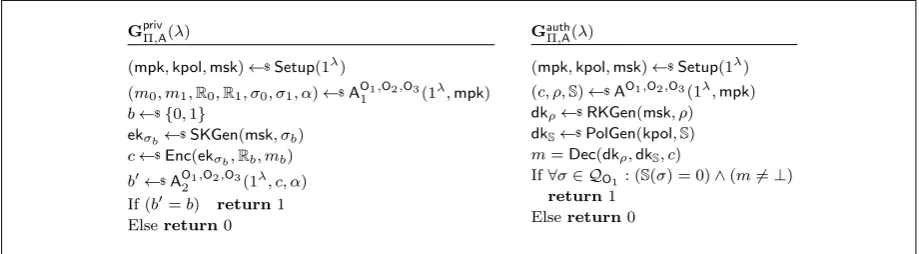
GprivΠ,A(λ)
(mpk,kpol,msk)←$Setup(1λ)
(m0, m1,R0,R1, σ0, σ1, α)←$AO1,O2,O3
1 (1
λ,mpk)
b←${0,1}
ekσb←$SKGen(msk, σb)
c←$Enc(ekσb,Rb, mb) b0←$AO1,O2,O3
2 (1λ, c, α)
If (b0=b) return1 Elsereturn0
Gauth
Π,A(λ)
(mpk,kpol,msk)←$Setup(1λ) (c, ρ,S)←$AO1,O2,O3(1λ,mpk) dkρ←$RKGen(msk, ρ) dkS←$PolGen(kpol,S) m=Dec(dkρ,dkS, c)
If∀σ∈ QO1: (S(σ) = 0)∧(m6=⊥)
return1 Elsereturn0
Figure 1: Games defining privacy and authenticity of ME. OraclesO1,O2,O3are implemented by SKGen(msk,·),RKGen(msk,·),PolGen(kpol,·).
Security. We now turn to defining security of an ME via two properties, that we dubprivacy and authenticity. Intuitively, privacy aims at capturing secrecy of the sender’s inputs (i.e., the attributesσ, the policy for the receiverR, and the plaintextm), in two different conditions: In case of a match between the sender’s and receiver’s attributes/policy, and in case of mismatch. This is formalized by requiring that the distributionsEnc(ekσ0,R0, m0) andEnc(ekσ1,R1, m1) be
computationally indistinguishable to the eyes of an attacker with oracle access toSKGen,RKGen,
PolGen, where the values (m0, m1,R0,R1, σ0, σ1) are all chosen by the adversary. The actual definition requires some care, as the adversary could, e.g., obtain a decryption key for attributes ρ and policySsuch thatR0(ρ) = 0∨S(σ0) = 0 but R1(ρ) = 1∧S(σ1) = 1, which clearly allows him to distinguish by evaluating the decryption algorithm. In order to exclude such “trivial attacks”, we quantify privacy over all valid adversaries, as explained below:
• In case of a mismatch, i.e., when the adversary cannot decrypt the challenge ciphertext, it must be the case that for each attribute ρ and policyS for which the adversary knows a valid decryption key: (i) Either ρ does not satisfy policiesR0 and R1; (ii) or σ0 andσ1 do not satisfy policy S; (iii) or ρ does not satisfy R0 and σ1 does not satisfy S; (iv) orρ does not satisfyR1 and σ0 does not satisfyS.
• In case of match, i.e., when the adversary can decrypt the challenge ciphertext, it must be the case thatm0 =m1, and additionally, for each attribute ρ and policy S for which the adversary knows a valid decryption key, it holds that both: (i) R0 and R1 have the same evaluation on attributes ρ (i.e.,R0(ρ) =R1(ρ)); and (ii)S has the same evaluation on attributesσ0 and σ1 (i.e.,S(σ0) =S(σ1)).
Definition 14 (Privacy of ME). We say that an ME Π satisfies privacy if for all valid PPT adversaries A:
P
h
GprivΠ,A(λ) = 1
i
−1
2
≤negl(λ),
where game GprivΠ,A(λ) is depicted in Fig.1. Adversary A is called valid if ∀ρ∈ QO2,∀S∈ QO3 it
satisfies the following invariant:
• (Mismatch condition). Either
(R0(ρ) =R1(ρ) = 0)∨(S(σ0) =S(σ1) = 0)
∨(R0(ρ) =S(σ1) = 0)∨(R1(ρ) =S(σ0) = 0); (1)
• (Match condition). Or (if ∃ρˆ∈ QO2,ˆS∈ QO3 s.t. Eq. (1) does not hold)
Note that in the above definition the challenge ciphertext is honestly computed. This is because privacy captures security against malicious receivers. Authenticity, on the other hand, demands that the only way to produce a valid ciphertext under attributes σ is to obtain an encryption keyekσ from the authority, thus guaranteeing that if a ciphertext decrypts correctly,
then it has been created by a sender with the proper encryption key. This captures security against malicious senders.
The latter is modeled by a game in which the attacker has oracle access to SKGen,RKGen, andPolGen. The attacker’s goal is to output a tuple (ρ,S, c) such thatDec(dkρ,dkS, c)6=⊥, and
none of the encryption keysekσ for attributes σ (obtained by the adversary via oracle queries)
satisfies the policy S. Observe that the adversary is not given access to an encryption oracle. The reason for this is that we only consider security in the presence of chosen-plaintext attacks, and thus ciphertexts might be malleable,4 which makes it possible to forge in the authenticity game.
Definition 15 (Authenticity of ME). We say that an ME Π satisfies authenticity if for all PPT adversariesA:
P
h
GauthΠ,A(λ) = 1i≤negl(λ), where game Gauth
Π,A(λ) is depicted in Fig.1.
Finally, a secure ME is an ME satisfying all the properties.
Definition 16 (Secure ME). We say that an ME Π is secure, if Π satisfies privacy (Def. 14) and authenticity (Def. 15).
Sometimes, we will also consider a weaker definition where there is an a priori upper bound on the number of queries an attacker can make to oracles RKGenand PolGen. We refer to this variant as security against bounded collusions. In particular, we say that an ME is (q1, q01, q2, q20 )-secure if it has (q1, q10, q2, q02)-privacy and authenticity, where q1, q01 (resp. q2, q02) denote the number of queries toRKGen and PolGenallowed by A1 (resp. A2) in the privacy game.
Relation to ABE. An ME for arbitrary policies can be used as a CP-ABE with the same expressiveness. The idea is to ignore the attributes of the sender and the policy of the receiver. It is sufficient to set the ABE master public key to (mpk,ekσ) and an ABE receiver’s decryption
key to (dkρ,dkφ), where ekσ is the encryption key generated for attributes σ = 0λ, dkφ is the
policy key for a tautology φ (i.e., a circuit whose output is always 1 regardless of the input), and dkρ is the decryption key for attributesρ. The encryption of a message m under a policy
Rworks by running the ME encryption algorithmEnc(ekσ,R, m). The receiver will decrypt the ciphertext by using the keys (dkρ,dkφ). Sinceφis a tautology, it does not matter under which
attributes the message has been encrypted. Thus, the scheme will work as a normal CP-ABE. Following a similar reasoning, ME implies KP-ABE. This is achieved by setting ekσ = σ,
and by using the same approach described above (i.e., set the sender’s policy circuit R to a tautologyφwhich ignores the receiver’s attributes). Note that for this implication authenticity is not required, which is reminiscent of the fact that in ABE the attributes are not explicitly certified by an authority.
4Note that malleability (and thus the authenticity property considered in our paper) might be a desirable
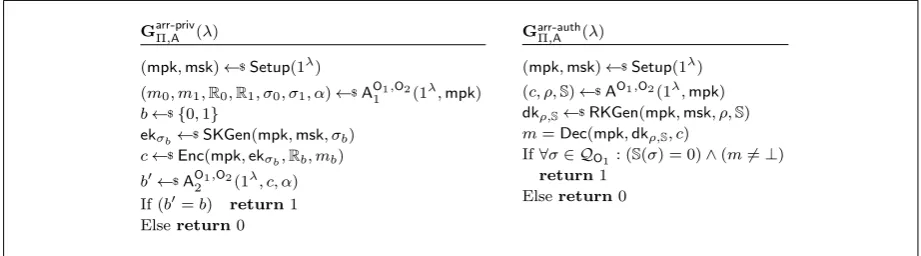
GarrΠ,-Apriv(λ)
(mpk,msk)←$Setup(1λ)
(m0, m1,R0,R1, σ0, σ1, α)←$AO1,O2
1 (1
λ,mpk)
b←${0,1}
ekσb←$SKGen(mpk,msk, σb)
c←$Enc(mpk,ekσb,Rb, mb) b0←$AO1,O2
2 (1λ, c, α)
If (b0=b) return1 Elsereturn0
Garr-auth
Π,A (λ)
(mpk,msk)←$Setup(1λ) (c, ρ,S)←$AO1,O2(1λ,mpk) dkρ,S←$RKGen(mpk,msk, ρ,S)
m=Dec(mpk,dkρ,S, c)
If∀σ∈ QO1: (S(σ) = 0)∧(m6=⊥)
return1 Elsereturn0
Figure 2: Games defining privacy and authenticity of A-ME. OraclesO1,O2 are implemented by SKGen(msk,·) andRKGen(msk,·).
3.2 Arranged Matchmaking Encryption
The syntax of an A-ME is similar to that of an ME, except that decryption keys are associated with both attributes and policies. In particular, the following efficient algorithms make an A-ME:
SKGen,Enc: Identical to the ones in an ME (cf. §3.1).
Setup: Upon input the security parameter 1λ, the randomized setup algorithm outputs the
master public keympk and the master secret key msk.
RKGen(msk, ρ,S): The randomized receiver key generator takes as input the master public key
mpk, the master secret key msk, attributes ρ ∈ {0,1}∗, and a policy S :{0,1}∗ → {0,1} represented as a circuit. The algorithm outputs a secret decryption keydkρ,S.
Dec(dkρ,S, c) The deterministic decryption algorithm takes a decryption keydkρ,S, and a
cipher-textc. The algorithm outputs either a messagem or⊥(denoting an error).
The definitions below capture the very same correctness and security requirements of an ME, but translated to the arranged case.
Definition 17 (Correctness of A-ME). An A-ME with message spaceM is correct if ∀λ∈N, (mpk,msk) output by Setup(1λ), ∀m∈ M, ∀σ, ρ∈ {0,1}∗, ∀R,S:{0,1}∗→ {0,1}:
P[Dec(dkρ,S,Enc(mpk,ekσ,R, m)) =m]≥1−negl(λ),
whenever σ ∈S and ρ∈R, and otherwise
P[Dec(dkρ,S,Enc(mpk,ekσ,R, m)) =⊥]≥1−negl(λ),
where ekσ and dkρ,S are generated by SKGen(mpk,msk, σ) and RKGen(mpk,msk, ρ,S).
Definition 18(Privacy of A-ME). An A-MEΠsatisfiesprivacyif for all valid PPT adversaries
A:
P
h
GarrΠ,A-priv(λ) = 1i−1
2
≤negl(λ),
where game GarrΠ,A-priv(λ) is depicted in Fig. 2. Adversary A is called valid if ∀(ρ,S) ∈ QO2 it
• (Mismatch condition). Either
(R0(ρ) =R1(ρ) = 0)∨(S(σ0) =S(σ1) = 0)
∨(R0(ρ) =S(σ1) = 0)∨(R1(ρ) =S(σ0) = 0); (2)
• (Match condition). Or (if ∃( ˆρ,Sˆ)∈ QO2 s.t. Eq.(2) does not hold)
(m0=m1)∧(R0(ρ) =R1(ρ))∧(S(σ0) =S(σ1)).
Definition 19 (Authenticity of A-ME). We say that an A-ME Π satisfies authenticity if for all PPT adversaries A:
P
h
GarrΠ,A-auth(λ) = 1
i
≤negl(λ), where game GarrΠ,A-auth(λ) is depicted in Fig. 2.
Definition 20 (Secure A-ME). An A-ME Π is secure if it satisfies privacy (Def. 18), and authenticity (Def. 19).
Relation to ABE. As for ME, A-ME for arbitrary policies implies CP-ABE and KP-ABE with the same expressiveness. The constructions are similar to the ones discussed in §3.1 for the case of ME. It is also easy to show that A-ME implies dual-policy ABE, which is achieved by settingekσ =σ. Note that for all these implications, authenticity is not required.
Relation between ME and A-ME. We stress that ME and A-ME are incomparable. On the one hand, it is not clear how to use an A-ME to define an ME. This is because A-ME decryption keydkρ,S describes both receiver’s attributes and policy, and thus it is unclear how
to implement the PolGenalgorithm of an ME.
On the other hand, it is unclear how to define an A-ME starting with an ME. The natural construction which setsdkρ,S= (dkρ,dkS) does not work. In a nutshell, this is because a
mali-cious receiver can detach the two keys, thus breaking the privacy of the A-ME. For concreteness, let R0, R1, σ0 =σ1 = σ be the policies and the attributes contained in the challenge chosen by the adversary during the privacy game. The attacker can request a first decryption key
dkρ,S = (dkρ,dkS) such that ρ satisfies both R0 and R1, but S(σ) = 0. Next, it can request a
second decryption keydkρ0,
S0 = (dkρ0,dk
S0) for which the symmetric condition holds: R0(ρ
0) = 0 and R1(ρ0) = 0, but S0(σ) = 1. Finally, it can interleave the keys creating a new decryption key dkρ,S0 = (dkρ,dkS0), which makes it possible to decrypt the challenge ciphertext and win
the game. Observe that both decryption keys are legal queries in the privacy game. Hence, the attacker is valid.
4
Black-Box Constructions
4.1 ME from rFE
Our construction is based on the following two functionalitiesfFE and frFE: fSFE(σ, m) =
m, ifσ 6=⊥ ∧S(σ) = 1
⊥, otherwise
and
f(rFEρ,mpk
FE)(R, σ, m;r) =
Enc(mpkFE,(σ, m);r),ifR(ρ) = 1
Enc(mpkFE,(⊥,⊥);r), otherwise.
Construction 1 (ME for arbitrary policies). Let FE, rFE, SS, NIZK be respectively an FE scheme for the deterministic functionality fFE, a rFE scheme for the randomized functionality frFE, a signature scheme, and a NIZK proof system for the NP relation:
R1 def=
((c,pk,mpkrFE),(σ, s)) :
∃r, m,R s.t.
c=EncrFE(mpkrFE,(R, σ, m);r)∧
Ver(pk, s, σ) = 1
.
We construct an ME scheme in the following way:
Setup(1λ): On input the security parameter 1λ, the setup algorithm computes (mpkFE,mskFE)
←$SetupFE(1λ),(sk,pk)←$KGenSS(1λ),(mpkrFE,mskrFE)←$SetuprFE(1λ), andω←$I(1λ).
Finally, it outputs the master secret keymsk= (mskrFE,sk), the master policy key kpol=
mskFE, and the master public key mpk = (pk, ω,mpkFE,mpkrFE). Recall that all other algorithms are implicitly givenmpk as input.
SKGen(msk, σ): On input the master secret key msk = (mskrFE,sk), and attributes σ ∈ {0,1}∗, the algorithm returns the encryption key ekσ = (σ, s) where s←$Sign(sk, σ) (i.e., s is a
signature on attributes σ∈ {0,1}∗).
RKGen(msk, ρ): On input the master secret key msk= (mskrFE,sk), and attributes ρ ∈ {0,1}∗, the algorithm computes the decryption keysk(ρ,mpkFE)←$KGenrFE(mskrFE,(ρ,mpkFE)). Then,
it outputs the decryption key dkρ=sk(ρ,mpkFE).
PolGen(kpol,S): On input the master policy key kpol = mskFE, and policy S represented as a circuit, the algorithm computes the function key skS by runningKGenFE(mskFE,S). Then, it outputs the decryption key dkS=skS.
Enc(ekσ,R, m): On input an encryption keyekσ = (σ, s), a policyRrepresented as a circuit, and a message m, the algorithm encrypt the message by computing c←$EncrFE(mpkrFE,(R, σ,
m)). Finally, it returns the ciphertext cˆ= (c, π) where π←$P(ω,(pk, c,mpkrFE),(σ, s)). Dec(dkρ,dkS, c): On input two keys dkρ = sk(ρ,mpkFE), dkS = skS, and a ciphertext ˆc = (c, π),
the algorithm first checks whether V(ω,(pk, c,mpkrFE), π) = 1. If that is not the case, it returns⊥, and else it returns DecFE(skS,DecrFE(sk(ρ,mpkFE), c)).
4.2 ME from 2-Input FE
In this section we explain how to construct an ME combining a signature scheme SS, a non-interactive zero-knowledge proof NIZK, an 2FE scheme. In order to build ME from 2FE, we use a 2-ary functionalityf that checks if a match occurs. More formally, consider the following functionality f :K × X0× X1 → {0,1}∗∪ {⊥}:
fρ((R, σ, m),S) =
m, S(σ) = 1∧R(ρ) = 1
⊥, otherwise.
Construction 2 (ME for arbitrary policies). Let 2FE, SS, and NIZK be respectively a2FE for the functionality f above, a signature scheme, and a NIZK proof system for the NP relation:
R2 def=
((pk, c,ek0),(σ, s)) : ∃r, m,R s.t.
c=Enc2FE(ek0,(R, σ, m);r)∧Ver(pk, s, σ) = 1
.
We build an ME scheme in the following way:
Setup(1λ): On input the security parameter 1λ, the setup algorithm runs (ek0,ek1,msk2FE)←$ Setup2FE(1λ),(sk,pk)←$KGenSS(1λ), andω←$I(1λ). Finally, it outputs the master secret
key msk = (msk2FE,sk), the master policy key kpol = ek1, and the master public key
mpk= (pk, ω,ek0).
SKGen(msk, σ): On input the master secret key msk= (msk2FE,sk), and attributes σ ∈ {0,1}∗, the algorithm returns the encryption keyekσ = (σ, s) where s=Sign(sk, σ).
RKGen(msk, ρ): On input the master secret key msk= (msk2FE,sk), and attributes ρ ∈ {0,1}∗, the algorithm computes the key skρ←$KGen2FE(msk2FE, ρ). Then, it outputs dkρ=skρ. PolGen(kpol,S): On input the master policy key kpol = ek1, and a policy S :{0,1}∗ → {0,1}
represented as a circuit, the algorithm runs c1←$Enc2FE(ek1,S). Then, it outputs the
decryption keydkS=c1.
Enc(ekσ,R, m): On input an encryption key ekσ = (σ, s), a policy R : {0,1}∗ → {0,1} repre-sented as a circuit, and a message m, the algorithm encrypts the message by computing c0←$Enc2FE(ek0,(R, σ, m)). Finally, it returns the ciphertextc= (c0, π)where π←$P(ω,
(pk, c0,ek0),(σ, s)).
Dec(dkρ,dkS, c): On input a decryption key dkρ = skpk, a decryption key dkS = c1, and a ciphertext c= (c0, π), the algorithm first checks whetherV(ω,(pk, c0,ek0), π) = 1. If that is not the case, it returns⊥, and else it returns Dec2FE(skρ, c0, c1).
4.3 A-ME from FE
In this section, we show a general construction of A-ME from FE. Consider the following functionality f :K × X → {0,1}∗∪ {⊥}:
f(ρ,S)(R, σ, m) =
m, S(σ) = 1∧R(ρ) = 1
⊥, otherwise.
Construction 3 (A-ME). Let FE andSS be respectively an FE scheme for the functionality f above and a signature scheme, and a NIZK proof system for the NP relation:
R3 def=
((pk, c,mpkFE),(σ, s)) : ∃r, m,Rs.t.
c=EncFE(mpkFE,(R, σ, m);r)∧Ver(pk, s, σ) = 1
.
We build an A-ME scheme in the following way:
Setup(1λ): On input the security parameter 1λ, the setup algorithm runs (mpkFE,mskFE)←$ SetupFE(1λ),(sk,pk)←$KGenSS(1λ), and ω←$I(1λ). Finally, it outputs the master secret
key msk= (mskFE,sk), and the master public key mpk= (pk, ω,mpkFE).
SKGen(msk, σ): On input the master secret key msk= (mskFE,sk), and σ{0,1}∗, the algorithm returns the encryption key ekσ = (σ, s) where s=Sign(sk, σ).
RKGen(msk, ρ,S): On input the master secret key msk = (mskFE,sk), attributes ρ ∈ {0,1}∗, and a policy S : {0,1}∗ → {0,1} represented as a circuit, the algorithm computes the encryption key sk(ρ,S)←$KGenFE(mskFE,(ρ,S)). Then, it outputs dkρ,S=sk(ρ,S).
Enc(ekσ,R, m): On input , an encryption key ekσ = (σ, s), a policy R : {0,1}∗ → {0,1} rep-resented as a circuit, and a message m, the algorithm encrypts the message in the fol-lowing way: c0←$EncFE(mpkFE,(R, σ, m)). Finally, it returns the ciphertext (c0, π) where
π←$P(ω,(pk, c0,mpkFE),(σ, s)).
Dec(dkρ,S, c): On input, a decryption keydkρ,S=sk(ρ,S), and a ciphertext c= (c0, π), the algo-rithm first checks whether V(ω,(pk, c0,mpkFE), π) = 1. If that is not the case, it returns
⊥, and else it returns DecFE(sk(ρ,S), c
0).
The correctness of the above scheme follows directly by the correctness of the underlying primitives. As for security, we establish the following result, whose proof appears in§A.3 of the appendix.
Theorem 3. Let FE, SS, and NIZK be respectively an FE scheme, a signature scheme, and a NIZK proof for the relation R3. If FE is secure (Def. 7), SS is EUF-CMA (Def. 2), andNIZK satisfies adaptive multi-theorem zero knowledge (Def. 11) and knowledge soundness (Def. 12), then the A-ME Π from Construction 3 is secure (Def. 20).
5
Identity-Based Matchmaking Encryption
While any ME as defined in §3 perfectly works for this restricted setting, the problem is that in order to select the identity snd of the source, a receiver must ask to the administrator the corresponding key dksnd such that S = snd. (Recall that the sender, instead, can already specify the target identity R=rcv on the fly, during encryption.) In particular, if the receiver is interested in decrypting ciphertexts from several distinct sources, it must ask for several decryption keysdksnd, which is impractical.5
We resolve this issue by removing algorithm PolGenfrom the syntax of an IB-ME, so that the decryption algorithm takes directly as input the description of the target identitysnd (i.e.,
Dec(dkρ,snd, c)). This way, the receiver can specify the target identity the source must satisfy
on the fly, without talking to the authority.
5.1 Security of IB-ME
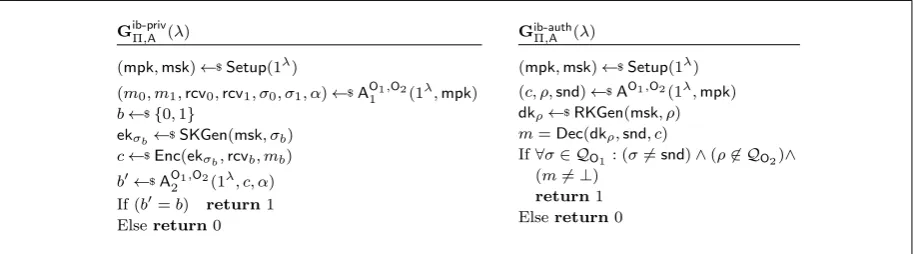
The choice of removing the PolGenalgorithm has an impact on the security properties for IB-ME. Below, we revisit each security guarantee in the identity-based setting and explain how (and why) the security definition has to be adapted. We refer the reader to Fig. 3 for the formal definitions.
Privacy of IB-ME. We cannot require that the sender’s identity remains hidden in case of a decryption failure due to a mismatch condition. In particular, a malicious receiver can always change the sender’s target identity in order to infer under which identity a ciphertext has been encrypted.
More formally, consider the adversary that chooses a tuple (m, m,rcv,rcv, σ0, σ1), and re-ceives a ciphertextcsuch thatc←$Enc(ekσ
b,rcv, m), where the encryption keyekσb corresponds
to identity σb; the attacker can simply pick a target identity snd0 such that, say, σ0 = snd0
(whereas σ1 6= snd0), and thus distinguish σ0 from σ1 by decrypting c with dkρ and target
identity snd0.6 On the other hand, privacy might still hold in case of mismatch, as long as the keys dkρ held by the receiver correspond to identities ρ that do not match the receiver’s
target identity. Thus, in the security game, an attacker is now valid if for every decryption key
dkρ obtained from the oracle, it holds that ρ 6=rcv0 and ρ 6=rcv1, where the target identities
rcv0,rcv1 are chosen by the adversary. Lastly, note that in case of a match, if a receiver has identity ρ and specifies a policy snd, it can automatically infer that σ =snd and rcv =ρ. For this reason, the privacy game does not consider any match condition.
This relaxed form of privacy is enough and desirable in many scenarios. Intuitively, it guarantees that nothing is leaked to an unintended receiver who doesn’t match the sender’s policy; on the other hand, an intended receiver can choose which ciphertexts to decrypt by trying different policies. This feature is essential in our bulletin board application (Section§6) because it allows parties, e.g., journalists and political activists, to select which type of messages to read. IB-ME works well in this scenario since it provides enough flexibility to the intended receivers while protecting senders from possible attackers.
Finally, we note that the above security definition does not guarantee that the message m remains secret with respect to anhonest receiver that chooses the “wrong” target identitysnd. The latter is, however, a desirable feature that our practical scheme will satisfy (cf. Remark 1).
5This isnotan issue for an ME that supports arbitrary policies, as in that case, a single policy encodes a large
number of attributes.
6This attack can be generalized to show that privacy does not hold if the PolGen algorithm (and thus the