
ansco memar
28
0
0
Full text
(2) how to use your. J'T,NSC. www.orphancameras.com.
(3) Your Nlernar takes standard 35mm double frame pictures in black and s'hite (shown bclow) anti color. The black and 'll'hite pictures rnay be enlarged to give prints of album size or larger for your enjoyment..
(4) your ansco MEMAR You rvili find that the Mernar CaDlera is easy to use. compact to cany and pro' duces superior pictures. This 35mm camera is equipped with an Agfa* Apotar f/3.5 coated lens in a Pronto shutter. It for flash and with its is synchronized automatic winding device, self-timer antl optical viewfinder, it is a versatile carnera for pictures anyrvhere, anytime. The Memar is easy to operate, but before using it, read the following directions carefull]', trying all the working ' parts as )'ou |ead. when 1'ou hale become thoroughly familiar with its opera-. tion, load the camera with one of Ansco's fine 35mm films (see page 11) and enjoy taking pictures with this superior camera.. *Agfo ond regisiered trodemqrks of Ansco Division of @ore Generol Aniline ond Film Corp. of Binghomion, N. Y.. www.orphancameras.com.
(5) Taken from www. butkus.ors/chinon. camera parts 7. I. _#&-'. 1, 2. 3. 4. 5. 6. 7. 8. 9. 10. 11. 12. 13. 14. 15. 16. 17. 18.. Exposure Counter Automatic Wlnding Device Cable Release Socket Shutter Release Button Accessory CIiD Viewfinder Film Type Indicator Film Rewind Knob Diaphragm Aperture Scale Diaphragm Setting Ring Shutter Speed Setting Ring Depth of Field Scale Distance Setting Ring Locking Slide Flash Connector Self-Timing Lever Rewind Release Button Tripod Socket.
(6) ---'t'. the viewfinder. F P. The Xlemar canel'a is equipped with an optical-type r-iervfinder. Holding the c a m e r a t o t h e e , v e .) ' o u r , ' i l l s e e t h e a r e a t.hich wili appear in the picture. When focusing on objects closer than 7 feet, sight slightl:' above the subject to compensate for the difference in view betr.een the lens and the r.iewflntier. For corlection when taking vertical pictures, turn the camera siishtly in the direction cf the r.iervfinder.. www.orphancameras.com.
(7) Taken from www. butkus.orglchinon f. .. IOCtrSTng The focusing. ring is the foremost. ele-. ment of the lens mount and is identified o (inflnity). by tire figures 3 through When the distance from camera to subject has been determined, turn the focusing. ring. until. that. distance. figure. is. opposite the diamond-shaped index mark on the stationary. lens mount.. Estimate. as possible so. distances as accurately i-our pictures will be sharp and clear. \\-hen taking from. pictures. from. 3 to 10 feet. the subject, it is l,ery important. that the distance be estimated accuratel.v (ol better yet, rneasure the exact distance) because of the limited. depth of. fielcl. For distant views, set the camera at infinitr' (o ).. 1? *1 t*. * rii.
(8) zone focusing To use the Memar as a fixed focus camera, set the focusing ring at either 10 or 30 feet (the numbers in red)' Then set the diaphragm ring at the red dot on the diaphragm aperture (f stop) scale and the shutter at 1/50th of a second. With the camera focused at 10 feet, everything from 7 to 15 feet will be in focus: at 30 feet, everYthing from 15 feet to infinity will be in focus. Sharpest pictures of any specific subject will result, of course, if the lens is focused at the exact camera-to-subject distance.. the diaphragm The diaphragm, or Iens oPening as it is often called, governs the amount ot. Iisht which passes through the lens while the shutter is open. The diaphragm opening is set by turning the wide diaphragm ring which has an index mark on top. Turn this ring so the index mark coincides exactly with the line opposite the f number on the diaphragm aperture scale. As it moves from the lower number (f,23.5)to the higher (f/16), the size of the opening decreases and the diaphragm is said to be "stopped down". Remember, the lower the number, the Iarger the aperture and the greater the amount of light admitted. To observe the action of the diaphragm, set the shutter at B, open the back of the camera and press and hold down the shutter release button. Looking into the back of the camera toward light, revolve the diaphra8m ring back and forth. Notice how the size of the opening varies. www.orphancameras.com.
(9) the shutter. automatic winding device. The shutter of a camera determines the length of the exposure. The Pronto shutter on the Memar has mechanically regulated speeds ot l/25t}: to 1/200th of a second, plus B (for time exposures). It is also synchronized for flash (see paee 17). The shutter speed is set by turning the thin milled ring so that the desired speed is opposite the diamondshaped index mark on the stationary Iens mount. The shutter is released (the exposure made) by pressing down on the shutter release button. Be sure to hold the camere level and steady and press the release button with a firm, slow pressure.. After each exposure, grip the straight edge of the winding lever with the right thumb (shown in picture at right) antl pull it to the right as far as it will go. Be sure it goes the full distance or the shutter will not be ready for the next exposure. This action winds the film, cocks the shutter and counts the exposures, so after each winiling, the camera is ready for the next exposure. This automatic winding feature prevents double exposures since the shutter release button will remain Iocked until the film is wound.. 6. .. t .. a. r.
(10) tirne exposures For exposures of longer than 1/25th second, it will be necessary to take a time exposure. Turn the thin milled ring until the B is opposite the intlex mark' When reacly to take the picture' press the shutter release button and holcl down for the length of the exposure required. remain open as long as The shutterwill the shutter release button is depressed. Be sure the camera is mounted on a tripod or other firm, Ievel support for all time exposures.. www.orphancameras.com.
(11) self - timer. depth of field. The \{emar has a self-timing nechanism which allows about a nine second delay in exposure to permit the photographer time to get in the picture. With and shutter opening the diaphragm speed set, move the lever at the bottom of the lens mount to the left as far as it will go. Release the shutter in the usual manner and after about a nine second delay, the picture will be taken. "8." The self-timer will not work on since time exposures are not mechanically pre-determined.. Depth of field is that distance between the nearest and farthest points of sharp focus. With the diaphragm set at f,/3.5, and the distance setting at 6 feet, every-. DEPTHOF FIETDTABTE_ ANSCO MEMAR This table has been accurately calculated to help ]-ou determine the depth of field quickly and easily..
(12) thing from 5' 4" to 7' will be in acceptably sharp focus. However, with the closed down to f/16, everydiaphragm thing from 3' 8" to 15' 8" will be in focus. f/3.5. at the same distance setting. Therefore, it should be remembered that if existing light permits, the diaphragm should be closed down for sharPer Pictures. t/fl. f/4. ts. 15' 10"-140' t7'2"-23'. 6'9"-9'rr". r0'9"-25'. 6' 8"-10'2". 13' 10"-o 9' 4"- q. 15' 2"- q. v8"-34'. 8' 4"-69'. 7' 4"-15'9". g8-w. 6' 2"-L7' 4". ,' 10"-r3'6". 4' 11"-7'8" 4' -6' 9". 4' 5"-5'r0" 3' 6"-4' 9" \' 3"-3' 70" z' 10'-3'2'. |' 3"-}' 10". z' t0"-3'2". f/16. \' 2"-4' 2'9"-\' 4". *. 5'10"-a. 5'r0"-37'. 4' 11"- q. ,' 1"-r8'9". 4'4' -45'. 4' 3"-t0'6". \' 8"-!'' 8". 3' 8"-7' 9". |' 3"-r0'5". !' 2"-s' 10". z' 8"-4' 8" www.orphancameras.com 2' 7"-\' 6". 7'2"- q. z' 6"-S' r0". z' 10"-6'9" 2'7"-,' 5". z' 3"-4' 3".
(13) depth of field. scale. A depth-of-field scale is conveniently Iocated on the stationary lens mount at the front of the camera. On each side of the center index mark are identical markings which indicate the various diaphragm settings from f/3.5 through f/16. With the eamera set at any particular distance, the depth of field for any specific diaphragm opening can readily be The tlepth of field is that determined. distance between the trilo lines reDre-. being setting the diaphragm senting used. You will see that with the camera set at 8 feet, at f/16 tt'e depth of fleld extends from 4' 4" to 45 feet. At f/3.5, everything from 6' 9" to 9' 11" will be in focus. If the indicated depth of field is in' sufficient to cover the proposed subiect, close rlown the diaphragm, but don't for' get to compensate for this smaller opening by increasing the exposure time..
(14) there is anAnsco film for every picture SUPREME - A fast panchromatic flnegrain film ideal for indoor or outdoor photography. It comes in 20 and 36exposure standard daylight loading rnagazines and in bulk lengths. ULTRA-SPEED PAN - Ansco's highest speed 35 mm panchromatic fllm for high quality pictures under adverse light conditions or when fast shutter speeds are AIso excellent for use under important. Available in light conditions. normal standard 20 and 36-exposure rnagazines and in bulk loads. Available in ANSCO COLOR FILM and Tungsten Types, it both Daylight rvill give you natural color transparencies for projection or for Ansco Color Printon enlargements. It is sold in 20exposure magazines and in bulk lengths.. www.orphancameras.com. l1.
(15) film type indicator A film type indicator is incorporated in the top of the rewind knob. The indicator is set as a reminder of the kind of fi]m in the camera. For example, the ASA exposure index for Ansco UltraSpeed Pan film is 100- set the indicator at 100/ASA. If Ansco Color Film Daylight Type is used, set at COLID; or for. { Tungsten Type, COLIT. Set the indi cator when loading the camera. With the rewind knob pulled all the way out, press the index finger of your left hand against the serrated edge untler the knob. With your right hand, turn the top of the knob so the proper setting shows in the opening.. loading the camera To open the camera, pull down on the latch at the bottom of the left side of the camera and swing out the hinged back. Turn the winding spool until the slot is on top. Do not attempt to remove this spool from camera, t2. I.
(16) Taken from www. butkus.ors/chinon Set the counter disc at A by pressing in the center and turning counterclockwise. PulI out the rewintl knob (marked R on top) and insert the film magazine with the emulsion side (light side) of the film toward the lens. Set the film type indicator as tlescribed on page 12. Push in the rewind knob and holding down the film magazine with your left hand, pull out a short length of film. Insert the end of the film into the slot of. the winding spool, engaging the tooth ot the slot in the second full perforation of the small tongue" Turn the winding spool with your thumb until about /a inch of the full width of the film is visible. Close the back of the camera firmlY. Press the shutter release button and "expowind the film; repeat until three sures" have been made and the film counter is on 1. The film is now in posi' tion and the flrst picture can be made. t3. www.orphancameras.com.
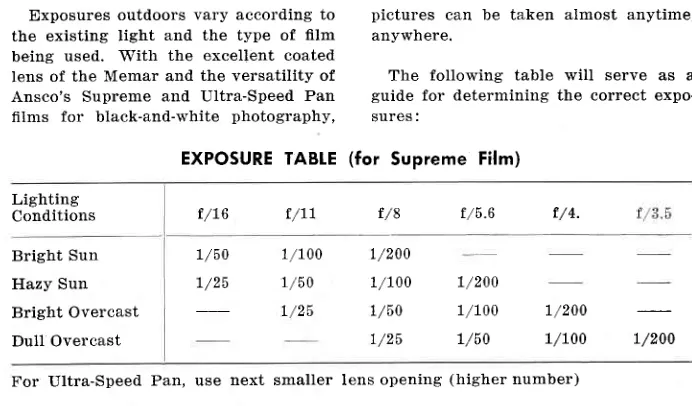
(17) r. l. oulcr.oor exposures Exposures outdoors vary according to the existing light antl the type of film being used. With the excellent coated Iens of the Memar and the versatility of Ansco's Supreme antl Ultra-Speed Pan films for black-and-white photography,. pictures. can be taken anywhere.. almost. anytirne,. table wiII serve as a The following guide for determining the correct exposures:. EXPOSURE TABTE( f o r S u p r e m e F i l m ) Lighting Conditions. t/16. t/17. Bright Sun. r/50. 1/r00. L/200. Hazy Sun. 7/25. r/50. 1./700. l/200. r/25. r/50. r/r00. r/200. r/25. 1/50. r/100. Bright Overcast Dull Overcast. t/8. r/5.6. t/4.. For Ultra-Speecl Pan, use next smaller lens opening (higher number). 11. r/200.
(18) indoor exposures tor pictures indoors The illumination or floodlamps either from should be is a flashlamps. Flootllamp illumination convenient, economical source of light tor indoor pictures. A good basic setup calls for two number 2 photoflood lamps in good quality reflectors (or two Reflector Flood #2 lamps), placed as shown in the accompanying diagrams. The main light source should be directed down-. u'ard at a 45' angle, and the flll-in lisht should be placed close to the camera' table was comPuted The following flom these lighting diagrams and wiII serve as a basic guide to help you tte' termine the correct exposure" The table is based on average subiects against walls colored light Darker colors require or two stops.. or surroundings' an increase of one. www.orphancameras.com l5.
(19) FTOODLAMPEXPOSURETABTE (for Supreme Film) 10'. D. Main Light. t4'. Fill-in Light. t/Lt. ti25. t/8. t/50. r/25. f /5.6. r/t00. r/50. r/25. t/4.. r/200. r/100. r/50. 1/25. r/200. l/r00. L/50. t/3.5. tr''or Ultra-Speed Pan, use next smaller lens opening (higher number) be used to minimize the chance of jarFor exposures longer than 1/25th of a ring the camera. The cable release seconrl, the camera must be mounted on screws into the top of the shutter re' a tripod, or other firm, level support. It lease button. is also recommentled that a cable release l6.
(20) flashlamp. exposures. To get the IulI enio)'ll)ent from your camera, try making flash pictures. It is ahvays fun to take pictures indoors at parties, of the children at play, of special occasions. flash sYnhas built-in The Memar is No other synchronizer chronization. necessary. The Ansco Universal Flash Unit (JN206) is recomtnended for aII' around ease of operation and compactness. Just fasten the camera to the bracket and plug the tip of the cord into the flash connector (No. 15, fig. 1). Do. not use force as rough treatment will The Ansco tr'lash darnage the connector. Unit takes all bayonet type lamps 8. B a n t a m a n d P H S SXI, SF, #5,25 and' The. following. table. use of the Ansco Fiash a satin finish reflector'. is based on the Unit. which. For. other. has type. units, follow the manufacturer's Please bear in mind recommenalations. have a 3mm conmust that the unit type connector to fit on the tinental flash. Memar. camera.. www.orphancameras.com t7.
(21) ::,r:. ::',:,:t':. i:. '. .. ir'l:::.:::::;. :1;,.. ' ,. ,rFIA$ll,,EXfO$ltBf :TA8ff. .;,;,,1,La$ltlrl;1,. $h$tter, r.Spesil'. i. Fla$h Guide Numbef. il}!{a-i p*,.ed Sdprerne. :;r:r,F6.6-::::::.;. ffi. ,.:rS3l1!:,$Srrr,:iB-12100 il::i:i:il,,:i,::r'r,:, ' *t ok : -#Vr 4q. llcoq :. s;li 50] 1 /1n{l ::::::t !,,:'. 1 /ton. :.s$ ,.": ,'CI. 12q. ;, :t:*::::. ,r,tQ::. tl:t:'::,1':. oq. ..:. 'IU. : ,140.: l: :,1;l'i:: t ^ ; : :. IUU a : ! :. :FIi8i:i;.,',r igarxia'm,g. titl. Bll/fo. l I /1nn :,:l. ::: l. tqfi(r. .: 62. : . 4. i1n. i. 4ri. using the guide numbers. :UA. To find the col'rect exposure, divide the guide llumber by the distance frorn the flashlamp to the subject! the result' ing figure wiil represent the lens openThe guide numing required. Example: ber for a PHS or Bantam 8 lamP with Supreme fllm at 1,z50th is 80' The sub' ject is 10 feet arvay, therefore 80 -: 10 -. to. 8, use f/8..
(22) color photography Color photography is fun - color photography vrith your Memar is easy. The can be viewed resulting transparencies or enlargements can be by projection made on Ansco Color Printon. Just keeD. in mind that your subject should be well lighteal and heavy shadows should be tables are ofThe following avoided. fered as a guide to help you determine the correct exposure.. DAYLIGHT EXPOSURETABTE (Ansco Color Film Doylight Type) Bright Sunlight Front Lighted. Bright Sunlight. Bright. j Sunlight. Side Lishteal. Back Lighted. f/8. t/5.6 & t/8. Between. Red Dot Between f"/5.6& t/8 t/5.6. fi5.6 t/4.. Bright Sunlight Soft Shadows. Between t/5.6 & f./8. t/4.. t/4.. f/3.5. t/3.5. Bright Overcast No Shadows f/4. t/3.5. t/3.5. www.orphancameras.com I9.
(23) color photography. indoors. FLOoDLAMPS Color transParencies can be made by the illumination from two #2 photoflood lamps in good metal reflectors - or two Reflector Flood #2 lamps. Using the lishtins diagram on page 15, exposures can be made atl/25t}r second at f /3.5, or equivalent' with Ansco Color Tungsten TYPe Film.. FLASHLAMPS With the Ansco X'lash Unit attached to your camera' you can lighten those deep shadows in outdoor pictures and take indoor snapshots. The guide numbers for popular flashlamps for use with Ansco Color Daylight and Tungsten Type films follow' See page 18 for use of guide numbers. ANSCO UNIVERSAT FLASH UNIT Tungstcn Type Film* Shutter Guide No. SPeed Lamp 40 B-1I1OO SM, SF'. TABTEWITH THE EXPOSURE FTASHLAMP Daylight Type Film Shutter Lamp. 58, 25B. Guide. S. B-t/50. r/r00 r/208. 45 35 26. PHS, Bantam8 5; 25. r/200 B-1l50 r/r00 7/200 B-1l50 1/rt0 r/200. 29. |)U. 40 z9 59 44. * llse with a UV16 F ilter.
(24) unloading the camera When the flnal exposure has been made. the fllm must be rewound into the magazine before the camera is opened and the fiIm rernoved, Do not advance the fiIm beyond the last exposure since the fiIm might become detached from the magazine and cannot be rewound. To rew'ind the film, depress the small button on the bottom of the camera and. turn the rewind knob in the direction of the arrow. Continue turning until you feel a lessening of the tension, indicat' ing the flIm has been released from the take-up spool. PuII down on the locking lever and open the back of the camera. PuIl up tlle rewind knob and the magazine can be removed easily from the camera, z l. www.orphancameras.com.
(25) t. t. tripod socket The tripod socket is located in the center of the bottom of the camera. It is used not only for attaching the canera to a tripod, but also for attaching the carrying case to the camela and the carnera to the Ansco Flash Unit.. filters Ansco has available several t-vpes of high qualitl. optical glass fllters, mounted for color photogin spun alurninum, raphl' the UV15, UV16 and UV17 Liltraviolet absorption filters and the #10 #11 Conr.ersion. Ask your dealer for series 5 Ansco Filters.. %.
(26) memar. carryrng. case. Protect )'out' ]Ienar canlera from dirt, rain, dampness. bl' keeping it in an Ansco Memar EvereadY CarrYing Case Since it is genuine top-grain cowhide. the lens and other front elements of the Memar have no self-protective covering, it is even more important to protect it frorn hartl knocks.. The Memar case has a short carrying strap and an additionai length can be added to rnake it a convenient shoulder carrying case.. Your tlealer will have this l'Iemar Carrying Case - ask for the JN445.. www.orphancameras.com.
(27) flash unit As tnentioned earlier, you'll get much more enjoyment frorn your Memar calrrera if you can use it around the clock. Buy an Ansco Flash L'rnit and complete the versatility of your camera. It will accept all bayonet type lamps aud takes two size C batteries or a battery capacitor cartridge. It also has an extension outlet for multiple flash pictures. Your dealer has the Ansco Uni versal Flash Unit JN206.. b.'o.
(28) camera. care. Your Memar is ;r fine precision instrurnent. Given proper care, it will give )'or-r years of service. Clean the front and rear elements of the lens often with a clean, soft lintless cloth. Blow out the back of the camera each time 1-ou load it to be sure there are no dust particles or 1int. It is recomnlended that you make a of your lecord of the serial ttunber camera for your orvn protection. FiIl in the Ansco Guarantee card and send in Ansco rvill send you a the registration. flee roll of 35mn Ansco Color Film upon receipt of the card.. r. www.orphancameras.com. P r i n l - e Ci n U . S . A .. C-106+4.
(29)
Figure

Related documents