
Splinter: Practical Private Queries on Public Data
Frank Wang, Catherine Yun, Shafi Goldwasser, Vinod Vaikuntanathan, Matei Zaharia
†MIT CSAIL,
†Stanford InfoLab
Abstract
Many online services let users query public datasets such as maps, flight prices, or restaurant reviews. Unfortu-nately, the queries to these services reveal highly sensitive information that can compromise users’ privacy. This pa-per presents Splinter, a system that protects users’ queries on public data and scales to realistic applications. A user splits her query into multiple parts and sends each part to a different provider that holds a copy of the data. As long as any one of the providers is honest and does not collude with the others, the providers cannot determine the query. Splinter uses and extends a new cryptographic primitive called Function Secret Sharing (FSS) that makes it up to an order of magnitude more efficient than prior systems based on Private Information Retrieval and garbled cir-cuits. We develop protocols extending FSS to new types of queries, such as MAX and TOPK queries. We also pro-vide an optimized implementation of FSS using AES-NI instructions and multicores. Splinter achieves end-to-end latencies below 1.6 seconds for realistic workloads includ-ing a Yelp clone, flight search, and map routinclud-ing.
1 Introduction
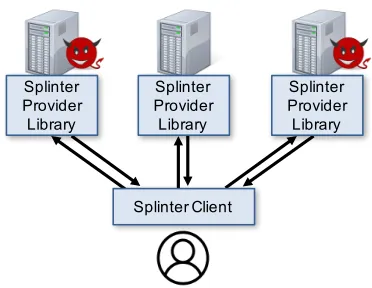
Many online services let users query large public datasets: some examples include restaurant sites, product cata-logs, stock quotes, and searching for directions on maps. In these services, any user can query the data, and the datasets themselves are not sensitive. However, web ser-vices can infer a great deal of identifiable and sensitive user information from these queries, such as her current location, political affiliation, sexual orientation, income, etc. [38, 39]. Web services can use this information mali-ciously and put users at risk to practices such as discrim-inatory pricing [26, 57, 61]. For example, online stores have charged users different prices based on location [29], and travel sites have also increased prices for certain fre-quently searched flights [58]. Even when the services are honest, server compromise and subpoenas can leak the sensitive user information on these services [31, 51, 52]. This paper presents Splinter, a system that protects users’ queries on public datasets while achieving practi-cal performance for many current web applications. In Splinter, the user divides each query into shares and sends them to differentproviders, which are services hosting a copy of the dataset (Figure 1). As long as any one of the providers is honest and does not collude with the others, the providers cannot discover sensitive information in the query. However, given responses from all the providers, the user can compute the answer to her query.
Splinter Client Splinter Provider
Library Splinter
Provider Library
Splinter Provider Library
Figure 1:Splinter architecture. The Splinter client splits each user query into shares and sends them to multiple providers. It then combines their results to obtain the final answer. The user’s query remains private as long as any one provider is honest.
Previous private query systems have generally not achieved practical performance because they use expen-sive cryptographic primitives and protocols. For ex-ample, systems based on Private Information Retrieval (PIR) [11, 41, 53] require many round trips and high bandwidth for complex queries, while systems based on garbled circuits [8, 32, 64] have a high computational cost. These approaches are especially costly for mobile clients on high-latency networks.
Instead, Splinter uses and extends a recent crypto-graphic primitive called Function Secret Sharing (FSS) [9, 21], which makes it up to an order of magnitude faster than prior systems. FSS allows the client to split certain functions into shares that keep parameters of the function hidden unless all the providers collude. With judicious use of FSS, many queries can be answered at low CPU and bandwidth cost in only a single network round trip.
Splinter makes two contributions over previous work on FSS. First, prior work has only demonstrated efficient FSS protocols for point and interval functions with addi-tive aggregates such as SUMs [9]. We present protocols that support a more complex set of non-additive aggre-gates such as MAX/MIN and TOPK at low computational and communication cost. Together, these protocols let Splinter support a subset of SQL that can capture many popular online applications.
optimizations let Splinter query datasets with millions of records at sub-second latency on a single server.
We evaluate Splinter by implementing three applica-tions over it: a restaurant review site similar to Yelp, airline ticket search, and map routing. For all of our ap-plications, Splinter can execute queries in less than 1.6 seconds, at a cost of less than 0.02¢in server resources on Amazon EC2. Splinter’s low cost means that providers could profitably run a Splinter-based service similar to OpenStreetMap routing [46], an open-source maps ser-vice, while only charging users a few dollars per month.
In summary, our contributions are:
• Splinter, a private query system for public datasets
that achieves significantly lower CPU and communi-cation costs than previous systems.
• New protocols that extend FSS to complex queries with non-additive aggregates, e.g., TOPK and MAX.
• An optimized FSS implementation for modern CPUs.
• An evaluation of Splinter on realistic applications.
2 Splinter Architecture
Splinter aims to protect sensitive information in users’ queries from providers. This section provides an overview of Splinter’s architecture, security goals, and threat model. 2.1 Splinter Overview
There are two main principals in Splinter: theuserand theproviders. Each provider hosts a copy of the data. Providers can retrieve this data from a public repository or mirror site. For example, OpenStreetMap [46] publishes publicly available map, point-of-interest, and traffic data. For a given user query, all the providers have to run it on the same view of the data. Maintaining data consistency from mirror sites is beyond the scope of this paper, but standard techniques can be used [10, 62].
As shown in Figure 1, to issue a query in Splinter, a user splits her query intoshares, using the Splinter client, and submits each share to a different provider. The user can select any providers of her choice that host the dataset. The providers use their shares to execute the user’s query over the cleartext public data, using the Splinter provider library. As long as one provider ishonest(does not col-lude with others), the user’s sensitive information in the original query remains private. When the user receives the responses from the providers, she combines them to obtain the final answer to her original query.
2.2 Security Goals
The goal of Splinter is to hide sensitive parameters in a user’s query. Specifically, Splinter lets users run
parametrized queries, where both the parameters and query results are hidden from providers. For example, consider the following query, which finds the 10 cheapest flights between a source and destination:
SELECT TOP 10 flightid FROM flights WHERE source = ? AND dest = ? ORDER BY price
Splinter hides the information represented by the ques-tions marks, i.e., the source and destination in this ex-ample. The column names being selected and filtered are not hidden. Finally, Splinter also hides the query’s results—otherwise, these might be used to infer the source and destination. Splinter supports a subset of the SQL language, which we describe in Section 4.
The easiest way to achieve this property would be for users to download the whole database and run the queries locally. However, this requires substantial bandwidth and computation for the user. Moreover, many datasets change constantly, e.g., to include traffic information or new product reviews. It would be impractical for the user to continuously download these updates. Therefore, our performance objective is to minimize computation and communication costs. For a database ofnrecords, Splin-ter only requiresO(nlogn)computation at the providers andO(logn)communication (Section 5).
2.3 Threat Model
Splinter keeps the parameters in the user’s query hidden as long as at least one of the user-chosen providers does not collude with others. Splinter also assumes these providers arehonest but curious: a provider can observe the inter-actions between itself and the client, but Splinter does not protect against providers returning incorrect results or maliciously modifying the dataset.
We assume that the user communicates with each provider through a secure channel (e.g., using SSL), and that the user’s Splinter client is uncompromised. Our cryp-tographic assumptions are standard. We only assume the existence of one-way functions in our two-provider imple-mentation. In our implementation for multiple providers, the security of Paillier encryption [48] is also assumed.
3 Function Secret Sharing
In this section, we give an overview of Function Secret Sharing (FSS), the main primitive used in Splinter, and show how to use it in simple queries. Sections 4 and 5 then describe Splinter’s full query model and our new techniques for more complex queries.
3.1 Overview of Function Secret Sharing
Function Secret Sharing [9] lets a client divide a func-tionf intofunction shares f1,f2, . . . ,fkso that multiple
parties can help evaluatef without learning certain of its parameters. These shares have the following properties:
• They are close in size to a description of f.
ItemId Price
ItemId1 Price1 ItemId2 Price2 … ... ItemIdn Pricen
f1(ItemId1)
f1(ItemId2)
… f1(ItemIdn)
r1= f1(ItemIdi)
i=1
n
∑
answer =
r1 + r2
ItemId Price
ItemId1 Price1 ItemId2 Price2 … ... ItemIdn Pricen
f2(ItemId1)
f2(ItemId2)
… f2(ItemIdn)
r2= f2(ItemIdi) i=1
n
∑
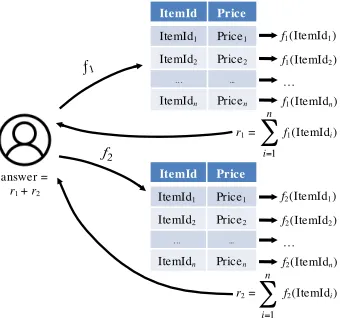
Figure 2: Overview of how FSS can be applied to database records on two providers to perform a COUNT query.
• They sum to the original function f. That is, for any inputx, Âk
i=1fi(x) = f(x). We assume that all compu-tations are done overZ2m, wheremis the number of bits in the output range.
• Given anyk 1 shares fi, an adversary cannot recover
the parameters of f.
Although it is possible to perform FSS for arbitrary functions [16], practical FSS protocols only exist forpoint
andintervalfunctions. These take the following forms:
• Point functions faare defined asfa(x) =1 ifx=aor
0 otherwise.
• Interval functions are defined as fa,b(x) =1 ifax
bor 0 otherwise.
In both cases, FSS keeps the parametersaandbprivate: an adversary can tell that it was given a share of a point or interval function, but cannot findaandb. In Splinter, we use the FSS scheme of Boyle et al. [9]. Under this scheme, the shares fi for both functions requireO(ln)
bits to describe andO(ln)bit operations to evaluate for a security parameterl (the size of cryptographic keys), andnis the number of bits in the input domain.
3.2 Using FSS for Database Queries
We can use the additive nature of FSS shares to run private queries over an entire table in addition to a single data record. We illustrate here with two examples.
Example: COUNT query. Suppose that the user wants to run the following query on a table served by Splinter: SELECT COUNT(*) FROM items WHERE ItemId = ?
Here, ‘?’ denotes a parameter that the user would like to keep private; for example, suppose the user is searching forItemId = 5, but does not want to reveal this value.
To run this query, the Splinter client defines a point function f(x) =1 ifx=5 or 0 otherwise. It then divides this function into function sharesf1, . . . ,fnand distributes
them to the providers, as shown in Figure 2. For
simplic-ItemId Price f1(ItemId) f2(ItemId)
5 8 10 -9
1 8 3 -3
5 9 10 -9
Figure 3:Simple example table with outputs for the FSS func-tion sharesf1, f2applied to the ItemId column. The function is a point function that returns 1 if the input is 5, and 0 otherwise. All outputs are integers modulo 2mfor somem.
ity, suppose that there are two providers, who receive shares f1and f2. Because these shares are additive, we know that f1(x) +f2(x) = f(x)for every inputx. Thus, each providerpcan compute fp(ItemId)for every ItemId
in the database table, and send backrp=Âni=1fp(ItemIdi)
to the client. The client then computesr1+r2, which is equal toÂn
i=1f(ItemIdi), that is, the count of all matching
records in the table.
To make this more concrete, Figure 3 shows an exam-ple table and some samexam-ple outputs of the function shares,
f1and f2, applied to the ItemId column. There are a few important observations. First, to each provider, the out-puts of their function share seem random. Consequently, the provider does not learn the original function fand the parameter “5”. Second, becausefevaluates to 1 on inputs of 5,f1(ItemId) +f2(ItemId) =1 for rows 1 and 3. Simi-larly, f1(ItemId) +f2(ItemId) =0 for row 2. Therefore, when summed across the providers, each row contributes 1 (if it matches) or 0 (if it does not match) to the final re-sult. Finally, each provider aggregates the outputs of their shares by summing them. In the example, one provider returns 23 to the client, and the other returns -21. The sum of these is the correct query output, 2.
This additivity of FSS enables Splinter to havelow com-munication costsfor aggregate queries, by aggregating data locally on each provider.
Example: SUM query. Suppose that instead of a COUNT, we wanted to run the following SUM query:
SELECT SUM(Price) FROM items WHERE ItemId=? This query can be executed privately with a small extension to the COUNT scheme. As in COUNT, we define a point function f for our secret predicate, e.g.,
f(x) =1 ifx=5 and 0 otherwise. We divide this function into shares f1 and f2. However, instead of computing rp=Âni=1fp(ItemIdi), each providerpcomputes
rp= n
Â
i=1
fp(ItemIdi)·Pricei
As before,r1+r2is the correct answer of the query, that is, Ân
i=1f(ItemIdi)·Pricei. We add in each row’s
price, Pricei, 0 times if the ItemId is equal to 5, and 1 time
Query format:
SELECTaggregate1,aggregate2,. . . FROMtable
WHEREcondition
[GROUP BYexpr1,expr2,. . .]
aggregate:
• COUNT | SUM | AVG | STDEV (expr) • MAX | MIN (expr)
• TOPK (expr,k,sort_expr) • HISTOGRAM (expr,bins)
condition:
• expr=secret
• secret1exprsecret2
• AND of ‘=’ conditions and up to one interval
• OR of multiple disjoint conditions
(e.g.,country="UK" OR country="USA")
expr: any public function of the fields in a table row (e.g.,ItemId + 1orPrice * Tax)
Figure 4:Splinter query format. The TOPK aggregate returns the topkvalues ofexprfor matching rows in the query, sorting them bysort_expr. In conditions, the parameters labeledsecret are hidden from the providers.
4 Splinter Query Model
Beyond the simple SUM and COUNT queries in the pre-vious section, we have developed protocols to execute a large class of queries using FSS, including non-additive aggregates such as MAX and MIN, and queries that re-turn multiple individual records instead of an aggregate. For all these queries, our protocols are efficient in both computation and communication. On a database ofn
records, all queries can be executed inO(nlogn)time and
O(logn)communication rounds, and most only require 1 or 2 communication rounds (Figure 6 on page 6).
Figure 4 describes Splinter’s supported queries using SQL syntax. Most operators are self-explanatory. The only exception is TOPK, which is used to return up tok
individual records matching a predicate, sorting them by some expressionsort_expr. This operator can be used to implementSELECT...LIMITqueries, but we show it as a single “aggregate” to simplify our exposition. To keep the number of matching records hidden from providers, the protocol always pads its result to exactlykrecords.
Although Splinter does not support all of SQL, we found it expressive enough to support many real-world query services over public data. We examined various websites, including Yelp, Hotels.com, and Kayak, and found we can support most of their search features as shown in Section 8.1.
Finally, Splinter only “natively” supports fixed-width integer data types. However, such integers can also be
used to encode strings and fixed-precision floating point numbers (e.g., SQL DECIMALs). We use them to repre-sent other types of data in our sample applications.
5 Executing Splinter Queries
Given a query in Splinter’s query format (Figure 4), the system executes it using the following steps:
1. The Splinter client builds function shares for the con-dition in the query, as we shall describe in Section 5.1. 2. The client sends the query with all the secret pa-rameters removed to each provider, along with that provider’s share of the condition function.
3. If the query has a GROUP BY, each provider divides its data into groups using the grouping expressions; otherwise, it treats the whole table as one group. 4. For each group and each aggregate in the query, the
provider runs an evaluation protocol that depends on the aggregate function and on properties of the con-dition. We describe these protocols in Section 5.2. Some of the protocols require further communication with the client, in which case the provider batches its communication for all grouping keys together. The main challenge in developing Splinter is designing efficient execution protocols for Splinter’s complex condi-tions and aggregates (Step 4). Our contribution is multiple protocols that can execute non-additive aggregates with low computation and communication costs.
One key insight that pervades our design is thatthe best strategy to compute each aggregate depends on properties of the condition function. For example, if we know that the condition can only match one value of the expression it takes as input, we can simply compute the aggregate’s result foralldistinct values of the expression in the data, and then use a point function to return just one of these results to the client. On the other hand, if the condition can match multiple values, we need a different strategy that can combine results across the matching values. To reason about these properties, we define threecondition classesthat we then use in aggregate evaluation. 5.1 Condition Types and Classes
For any conditionc, the Splinter client defines a function
fcthat evaluates to 1 on rows wherecis true and 0
other-wise, and divides fcinto shares for each provider. Given a
conditionc, letEc= (e1, . . . ,et)be the list of expressions
referenced inc(theexprparameters in its clauses). Be-cause the best strategy for evaluating aggregates depends onc, we divide conditions into three classes:
• Single-value conditions. These are conditions that can only be true on one combination of the values of (e1, . . . ,et). For example, conditions consisting of an
AND of ‘=’ clauses are single-value.
true on an interval of the range of valuese1||e2||. . .||et
(where||denotes string concatenation).
• Disjoint conditions,i.e., all other conditions.
The condition types described in our query model (Fig-ure 4) can all be converted into sharable functions, and categorized into these classes, as follows:
Equality-only conditions. Conditions of the forme1= secret1AND. . . ANDet=secrettcan be executed as a
single point function on the binary stringe1||. . .||et. This
is simply a point function that can be shared using existing FSS schemes [9]. These conditions are also single-value. Interval and equality. Conditions of the form e1= secret1AND. . . ANDet 1=secrett 1ANDsecrett
etsecrett+1can be executed as a single interval function on the binary stringe1||. . .||et. This is again supported
by existing FSS schemes [9], and is an interval condition. Disjoint OR. Suppose thatc1, . . . ,ctaredisjoint
condi-tions that can be represented using funccondi-tions fc1, . . . ,fct. Thenc=c1OR. . .ORctis captured byfc=fc1+···+fct. We share this function across providers by simply giving them shares of the underlying functionsfci. In the general case, however,cis a disjoint condition where we cannot say much about which inputs give 0 or 1.
5.2 Aggregate Evaluation 5.2.1 Sum-Based Aggregates
To evaluate SUM, COUNT, AVG, STDEV and HIS-TOGRAM, Splinter sums one or more values for each row regardless of the condition function class. For SUM and COUNT, each provider sums the expression being aggre-gated or a 1 for each row and multiplies it by fi(row), its
share of the condition function, as in Section 3.2. Comput-ing AVG(x) for an expressionx, requires finding SUM(x) and COUNT(x), while computing STDEV(x) requires finding these values and SUM(x2). Finally, computing a HISTOGRAM into bin boundaries provided by the user simply requires tracking one count per bin, and adding each row’s result to the count for its bin. Note that the binning expression is not private—only information about which rows pass the query’s condition function.
5.2.2 MAX and MIN
Suppose we are given a query to find MAX(e0) WHERE c(e1, . . . ,et), for expressionse0, . . . ,et. The best
evalua-tion strategy depends on the class of the condievalua-tionc. Single-value conditions. Ifcis only true for one com-bination of the valuese1, . . . ,et, each provider starts by
evaluating the query
SELECT MAX(e0) FROM data GROUP BY e1, . . . ,et
This query gives anintermediate tablewith the tuples (e1, . . . ,et)as keys and MAX(e0)as values. Next, each
A
Size-2 intervals
Size-4 intervals
Size-8 intervals
3 5 1 2 4 1 0 1
5 2 4 1
5 4
5
A[3..6]
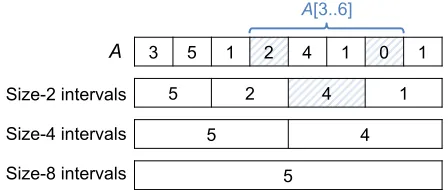
Figure 5:Data structure for querying MAX on intervals. We find the MAX on each power-of-2 aligned interval in the ar-ray, of which there areO(n)total. Then, any interval query requires retrievingO(logn)of these values. For example, to findMAX(A[3..6]), we need two size-1 intervals and one size-2.
provider computesÂMAX(e0)·fi(e1, . . . ,et)across the
rows of the intermediate table, where fi is its share of
the condition function. This sum will add a 0 for each non-matching row and MAX(e0)for the matching row, thus returning the right value. Note that if the original table hadnrows, the intermediate table can be built in
O(n)time and space using a hash table.
Interval conditions. Suppose thatcis true if and only if
e1||. . .||et is in an interval[a,b], whereaandbare secret
parameters. As in the single-value case, the providers can build a data structure that helps them evaluate the query without knowingaandb.
In this case, each provider builds an arrayAof entries (k,v), where the keys are all values ofe1||. . .||etin
lexico-graphic order, and the values are MAX(e0)for each key. It then computes MAX(A[i..j])for allpower-of-2 aligned
intervals of the arrayA(Figure 5). This data structure is similar to a Fenwick tree [19].
Query evaluation then proceeds in two rounds. First, Splinter counts how many keys inAare less thanaand how many are less thanb: the client sends the providers shares of the interval functions k2[0,a 1] and k2
[0,b 1], and the providers apply these to all keyskand return their results. This lets the client find indicesiand j
inAsuch that all the keysk2[a,b]are inA[i..j]. Second, the client sends each provider shares of new point functions that select up to two intervals of size 1, up to two intervals of size 2, etc out of the power-of-2 sized intervals that the providers computed MAXes on, so as to cover exactlyA[i..j]. Note that any integer interval can be covered using at most 2 intervals of each power of 2. The providers evaluate these functions to return the MAXes for the selected intervals, and the client combines these
O(logn)MAXes to find the overall MAX onA[i..j].1 For a table of sizen, this protocol requiresO(nlogn) time at each provider (to sort the data to buildA, and then to answerO(logn)point function queries). It also
1To hide which sizes of intervals were actually required, the client
only requires two communication rounds, andO(logn) communication bandwidth. The same protocol can be used for other associative aggregates, such as products. Disjoint conditions. If we must find MAX(e0) WHEREc(e1, . . . ,et)but know nothing aboutc,
Splin-ter builds an arrayAof all rows in the dataset sorted bye0. Finding MAX(e0) WHEREcis then equivalent to finding the largest indexiinAsuch thatc(A[i])is true. To do this, Splinter uses binary search. The client repeatedly sends private queries of the form
SELECT COUNT(*) FROM A
WHERE c(e1, . . . ,et) AND index2[secret1,secret2],
whereindexrepresents the index of each row inAand the interval for it is kept private. By searching for secret intervals in decreasing power-of-2 sizes, the client can find the largest indexisuch thatc(A[i])is true. For exam-ple, if we had an arrayAof size 8 with largest matching element ati=5, the client would probeA[0..3],A[4..7], A[4..5],A[6..7]and finallyA[4]to find that 5 is the largest matching index.
Normally, ANDing the new condition index 2
[secret1,secret2]withcwould cause problems, because the resulting conditions might no longer be in Splinter’s supported condition format (ANDs with at most one inter-val and ORs of disjoint clauses). Fortunately, because the intervals in our condition are always power-of-2 aligned, it can also be written as an equality on the firstkbits of
index. For example, supposing thatindexis a 3-bit value, the conditionindex2[4,5]can be written asindex0,1= “10”, whereindex0,1is the first two bits ofindex. This lets
us AND the condition into all clauses ofc.
Once the client has found the largest matching indexi, it runs one more query with a point function to select the row withindex=i. The whole protocol requiresO(logn) communication rounds andO(nlogn)computation and works well ifchas many conditions.
However, ifchas a small number of OR clauses, an optimization is to run one query for each clause in parallel. The user then resolves the responses locally to find the answer to the original query. Although doing this opti-mization requires more bandwidth because the returned result size is larger, it avoids theO(logn)communication rounds and theO(nlogn)computation.
5.2.3 TOPK
Our protocols for evaluating TOPK are similar to those for MAX and MIN. Suppose we are given a query to find TOPK(e,k,esort) WHEREc(e1, . . . ,et). The evaluation
strategy depends on the class of the conditionc.
Single-value conditions. Ifcis only true for one com-bination ofe1, . . . ,et, each provider starts by evaluating
Aggregate Condition Time Rounds Bandwidth
Sum-based any O(n) 1 O(1)
MAX/MIN 1-value O(n) 1 O(1)
MAX/MIN interval O(nlogn) 2 O(logn)
MAX/MIN disjoint O(nlogn) O(logn) O(logn)
TOPK 1-value O(n) 1 O(1)
TOPK interval O(nlogn) 2 O(logn)
TOPK disjoint O(nlogn) O(logn) O(logn)
Figure 6:Complexity of Splinter’s query evaluation protocols for a database of sizen. For bandwidth, we report the multiplier over the query’s normal result size.
SELECT TOPK(e, k, esort) FROM data GROUP BY e1, . . . ,et
This gives an intermediate table with the tuples(e1, . . . ,et)
as keys and TOPK(·)for each group as values, from which we can select the single row matchingcas in MAX. Interval conditions. Here, the providers build the same auxiliary arrayAas in MAX, storing the TOPK for each key instead. They then compute the TOPKs for power-of-2 aligned intervals in this array. The client finds the intervalA[i..j]it needs to query, extracts the topkvalues for power-of-2 intervals covering it, and finds the overall topk. As in MAX, this protocol requires 2 rounds and
O(logn)communication bandwidth.
Disjoint conditions. Finding TOPK for disjoint condi-tions is different from MAX because we need to return multiple records instead of just the largest record in the table that matchesc. This protocol proceeds as follows:
1. The providers sort the whole table byesortto create an auxiliary arrayA.
2. The client uses binary search to find indicesiand jin
Asuch that the topkitems matchingcare inA[i..j]. This is done the same way as in MAX, but searching for the largest indices where the count of later items matchingcis 0 andk.
3. The client uses a sampling technique (Appendix A) to extract thekrecords fromA[i..j]that matchc. Intu-itively, although we do not know which rows these are, we build a result table of>kvalues initialized to 0, and add the FSS share for each row of the data to one row in the result table, chosen by a hash. This scheme extracts all matching records with high probability. This protocol needsO(logn)communication rounds and
O(nlogn)computation if there are many clauses, but like the protocol for MAX, if the number of clauses incis small, the user can issue parallel queries for each clause to reduce the communication rounds and computation. 5.3 Complexity
com-putation time isO(nlogn)and the communication costs are much smaller than the size of the database. This makes Splinter practical even for databases with millions of records, which covers many common public datasets, as shown in Section 8. Finally, the main operations used to evaluate Splinter queries at providers, namely sorting and sums, are highly parallelizable, letting Splinter take advantage of parallel hardware.
6 Optimized FSS Implementation
Apart from introducing new protocols to evaluate complex queries using FSS, Splinter includes an FSS implemen-tation optimized for modern hardware. In this section, we describe our implementation and also discuss how to select the best multi-party FSS scheme for a given query. 6.1 One-Way Compression Functions
The two-party FSS protocol [9] is efficient because of its use of one-way functions. A common class of one-way functions is pseudorandom generators (PRGs) [33], and in practice, AES is the most commonly used PRG because of hardware accelerations, i.e. the AES-NI [56] instruction. Generally, using AES as a PRG is straightforward (use AES in counter mode). However, the use of PRGs in FSS is not only atypical, but it also represents a large portion of the computation cost in the protocol. The FSS protocol requires many instantiations of a PRG with different initial seed values, especially in the two-party protocol [9]. Initializing multiple PRGs with different seed values is very computationally expensive because AES cipher initialization ismuch slowerthan performing an AES evaluation on an input. Therefore, the challenge in Splinter is to find an efficient PRG for FSS.
Our solution is to useone-way compression functions. One way compression functions are commonly used as a primitive in hash functions, like SHA, and are built using a block cipher like AES. In particular, Splinter uses the Matyas-Meyer-Oseas one-way compression function [37] because this function utilizes a fixed keycipher. As a result, the Splinter protocol initializes the cipher only once per query.
More precisely, the Matyas-Meyer-Oseas one-way compression function is defined as:
F(x) =Ek(x) x
wherexis the input, i.e. PRG seed value, andEis a block cipher with a fixed keyk.
The output of a one-way compression function is a fixed number of bits, but we can use multiple one-way compression functions with different keys and concate-nate the outputs to obtain more bits. Security is preserved because a function that is a concatenation of one-way functions is still a one-way function.
With this one-way compression function, Splinter
ini-tializes the cipher,Ek, at the beginning of the query and
reuses it for the rest of the query, avoiding expensive AES initialization operations in the FSS protocol. For each record, the Splinter protocol needs to perform only
nXORs andnAES evaluations using the AES-NI instruc-tion, wherenis the input domain size of the record. In Section 8.3, we show that Splinter’s use of one-way com-pression functions results in a 2.5⇥speedup over using AES directly as a PRG.
6.2 Selecting the Correct Multi-Party FSS Protocol There is one efficient protocol for two-party FSS, but for multi-party (more than 2 parties) FSS, there are two dif-ferent schemes ([9], [14]) that offer difdif-ferent tradeoffs between bandwidth and CPU usage. Both still only re-quire that one provider is honest and does not collude with the remaining providers. In this section, we will provide an overview of the two schemes and discuss their tradeoffs and applicability to different types of applications. Multi-Party FSS with one-way functions: In [9], the authors present a multi-party protocol based on only one-way functions, which provides good performance. How-ever, there are two limitations. First, the function share size is proportional to the number of parties. Second, the output of the evaluated function share is only additive mod 2 (xor homomorphic), which means that the provider cannot add values locally. This limitation affects queries where there are multiple matches for a condition that re-quires aggregation, i.e. COUNT and SUM queries. To solve this, the provider responds with all the records that match for a particular user-provided condition, and the client performs the aggregation locally. The size of the result is the largest number of records for a distinct con-dition, which is usually smaller than the database size. Other queries remain unaffected by this limitation. Ap-plications should use this scheme by default because it provides the fastest response times on low-latency net-works. However, for SUM and COUNT queries, an ap-plication should be careful using this scheme in settings that are bandwidth-sensitive. Similarly, an application should avoid using this scheme for queries that involve many providers.
beneficial in settings where the user uses many providers.
7 Implementation
We implemented Splinter in C++, using OpenSSL 1.0.2e [45] and the AES-NI hardware instructions for AES encryption. We used GMP [20] for large inte-gers and OpenMP [44] for multithreading. Our opti-mized FSS library is about 2000 lines of code, and the applications on top of it are about 2000 lines of code. There is around 1500 lines of test code to issue the queries. For comparison, we also implement the multi-party FSS scheme in [14] using 2048 bit Paillier encryp-tion [48]. Our FSS library implementaencryp-tion can be found athttps://github.com/frankw2/libfss.
8 Evaluation
In our evaluation, we aim to answer one main question: can Splinter be used practically for real applications? To answer this question, we built and evaluated clones of three applications on Splinter: restaurant reviews, flight data, and map routing, using real datasets. We also com-pare Splinter to previous private systems, and estimate hosting costs. Our providers ran on 64-core Amazon EC2
x1servers with Intel Xeon E5-2666 Haswell processors and 1.9 TB of RAM. The client was a 2 GHz Intel Core i7 machine with 8 GB of RAM. Our client’s network latency to the providers was 14 ms.
Overall, our experiments show the following:
• Splinter can support realistic applications including the search features of Yelp and flight search sites, and data structures required for map routing.
• Splinter achieves end-to-end latencies below 1.6 sec for queries in these applications on realistic data.
• Splinter’s protocols use up to 10⇥fewer round trips
than prior systems and have lower response times. 8.1 Case Studies
Here, we discuss the three application clones we built on Splinter. Figure 7 summarizes our results, and Figure 8 describes the sizes and characteristics of our three datasets. Finally, we also reviewed the search features available in real websites to study how many Splinter supports. Restaurant review site: We implement a restaurant re-view site using the Yelp academic dataset [65]. The origi-nal dataset contains information for local businesses in 10 cities, but we duplicate the dataset 4 times so that it would approximately represent local businesses in 40 cities. We use the following columns in the data to perform many of the queries expressible on Yelp: name, stars, review count, category, neighborhood and location.
For location-based queries, e.g., restaurants within 5 miles of a user’s current location, multiple interval con-ditions on the longitude and latitude would typically be
used. To run these queries faster, we quantize the loca-tions of each restaurant into overlapping hexagons of dif-ferent radii (e.g., 1, 2 and 5 miles), following the scheme from [40]. We precompute which hexagons each restau-rant is in and expose these as additional columns in the data (e.g.,hex1miandhex2mi). This allows the location queries to use ‘=’ predicates instead of intervals.
For this dataset, we present results for the following three queries:
Q1: SELECT COUNT(*) WHERE category="Thai"
Q2: SELECT TOP 10 restaurant WHERE category="Mexican" AND (hex2mi=1 OR hex2mi=2 OR hex2mi=3) ORDER BY stars
Q3: SELECT restaurant, MAX(stars) WHERE category="Mexican" OR
category="Chinese" OR category="Indian" OR category="Greek" OR category="Thai" OR category="Japanese"
GROUP BY category
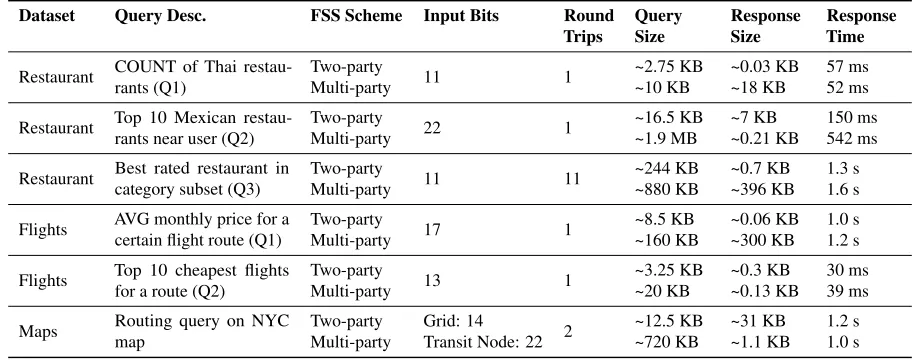
Q1 is a count on the number of Thai restaurants. Q2 re-turns the top 10 Mexican restaurants within a 2 mile radius of a user-specified location by querying three hexagons. We assume that the provider caches the intermediate table for the Top 10 query as described in Section 5.2.3 because it is a common query. Finally, Q3 returns the best rated restaurant from a subset of categories. This requires more communication than other queries because it performs a MAX with many disjoint conditions, as described in Section 5.2.2. Although most queries will probably not have this many disjoint conditions, we test this query to show that Splinter’s protocol for this case is also practical. Flight search: We implement a flight search service similar to Kayak [30], using a public flight dataset [17]. The columns are flight number, origin, destination, month, delay, and price. To find a flight, we search by origin-destination pairs. We present results for two queries:
Q1: SELECT AVG(price) WHERE month=3 AND origin=1 AND dest=2
Q2: SELECT TOP 10 flight_no
WHERE origin=1 and dest=2 ORDER BY price Q1 shows the average price for a flight during a cer-tain month. Q2 returns the top 10 cheapest flights for a given source and destination, which we encode as inte-gers. Since this is a common query, the results in Figure 7 assume a cached Top 10 intermediate table.
re-Dataset Query Desc. FSS Scheme Input Bits Round
Trips QuerySize ResponseSize TimeResponse
Restaurant COUNT of Thai restau-rants (Q1) Two-partyMulti-party 11 1 ~2.75 KB~10 KB ~0.03 KB~18 KB 57 ms52 ms
Restaurant Top 10 Mexican restau-rants near user (Q2) Two-partyMulti-party 22 1 ~16.5 KB~1.9 MB ~7 KB~0.21 KB 150 ms542 ms
Restaurant Best rated restaurant incategory subset (Q3) Two-partyMulti-party 11 11 ~244 KB~880 KB ~0.7 KB~396 KB 1.3 s1.6 s
Flights AVG monthly price for acertain flight route (Q1) Two-partyMulti-party 17 1 ~8.5 KB~160 KB ~0.06 KB~300 KB 1.0 s1.2 s
Flights Top 10 cheapest flightsfor a route (Q2) Two-partyMulti-party 13 1 ~3.25 KB~20 KB ~0.3 KB~0.13 KB 30 ms39 ms
Maps Routing query on NYCmap Two-partyMulti-party Grid: 14Transit Node: 22 2 ~12.5 KB~720 KB ~31 KB~1.1 KB 1.2 s1.0 s
Figure 7:Performance of various queries in our case study applications on Splinter. Response times include 14 ms network latency per network round trip. All subqueries are issued in parallel unless they depend on a previous subquery. Query and response sizes are measured per provider. For the multi-party FSS scheme, we run 3 parties. Input bits represent the number of bits in the input domain for FSS, i.e., the maximum size of a column value.
Dataset # of rows Size (MB) Cardinality Yelp [65] 225,000 23 900 categories Flights [17] 6,100,000 225 5000 flights
NYC Map [15] 260,000 nodes733,000 edges 300 1333 transit nodes
Figure 8:Datasets used in the evaluation. The cardinality of queried columns affects the input bit size in our FSS queries.
stricted set of operations. The challenge is to find a short-est path algorithm compatible with Splinter. Fortunately, extensive work has been done to optimize map routing [3]. One algorithm compatible with Splinter is transit node routing (TNR) [2, 5], which has been shown to work well in practice [4]. In TNR, the provider divides up a map into grids, which contain at least one transit node, i.e. a transit node that is part of a "fast" path. There is also a separate table that has the shortest paths between all pairs of transit nodes, which represent a smaller subset of the map. To execute a shortest path query for a given source and destination, the user can use FSS to download the paths in her source and destination grid. She locally finds the shortest path to the source transit node and destina-tion transit node. Finally, she queries the provider for the shortest path between the two transit nodes.
We used the source code from [2] and identified the 1333 transit nodes. We divided the map into 5000 grids, and calculated the shortest path for all transit node pairs. The grid table has 5000 rows representing the edges and nodes in a grid, and the transit node table has about 800,000 rows representing the number of shortest paths for all transit node pairs.
Figure 7 shows the total response time for a routing query between a source and destination in NYC. Figure 9 shows the breakdown of time spent on querying the grid
FSS scheme Grid Transit Node Total
Two Party 0.35 s 0.85 s 1.2 s Multi-party 0.15 s 0.85 s 1.0 s
Figure 9: Grid, transit node, and total query times for NYC map. A user issues 2 grid queries and one transit node query. The two grid queries are issued together in one message, so there are a total of 2 network round trips.
and transit node table. One observation is that the multi-party version is slightly faster than the two multi-party version because it is faster at processing the grid query as shown in Figure 9. The two-party version of FSS requires using GMP operations, which is slower than integer operations used in the multi-party version, but as shown in Figure 7, the two-party version requires much less bandwidth. Communication costs: Figure 7 shows the total band-width of a query request and response for the various case study queries. The sum of those two values represents total bandwidth between the provider and user.
Website Search Feature Splinter Primitive
Yelp Booking Method, Cities, DistancePrice EqualityRange Best Match, Top Rated, Most Reviews Sorting
Free text search —
Hotels.com
Destination, Room type, Amenities Equality Check in/out, Price, Ratings Range Stars, Distance, Ratings, Price Sorting
Name contains —
Kayak Date, Flight time, Layover time, PriceFrom/To, Cabin, Passengers, Stops EqualityRange
Google Maps From/To, Transit type, Route options Equality
Figure 10:Example website search features and their equivalent Splinter query class.
Coverage of supported queries: We also manually characterized the applicability of Splinter to several widely used online services by studying how many of the search fields on these services’ interfaces Splinter can support. Figure 10 shows the results. Most services use equality and range predicates: for example, the Ho-tels.com user interface includes checkboxes for selecting categories, neighborhoods, stars, etc, a range fields for price, and one free-text search field that Splinter does not support. In general, all features except free-text search could be supported by Splinter. For free-text search, sim-ple keywords that map to a category (e.g., “grocery store”) could also be supported.
8.2 Comparison to Other Private Query Systems To the best of our knowledge, the most recent private query system that can perform a similar class of queries as Splinter is that of Olumofin et al. [41], which uses multi-party PIR. Olumofin et al. creates anm-ary (m=4) B+ index tree for the dataset and uses PIR to search through it to return various results. As a result, their queries requireO(logmn)round trips, wherenis the number of records. In Splinter, the number of rounds trips does not depend on the size of the database for most queries. As shown in Section 5.2.2 and Section 5.2.3, the exception is for MIN/MAX and TOPK queries with many disjoint conditions where Splinter’s communication is similar; if there are a small number of disjoint conditions, Splinter will be faster than previous systems because the user can issue parallel queries.
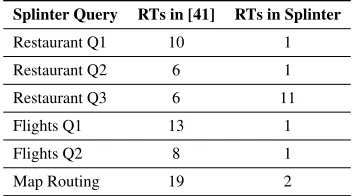
Figure 11 shows the round trips required in Olumofin et al.’s system and in Splinter for the queries in our case studies. Splinter improves over [41] by up to an order of magnitude. Restaurant Q3 uses a disjoint MAX, so the communication is similar.
We see a similar performance difference from the re-sults in [41]’s evaluation, which reports response times of of 2-18 seconds for queries with several million records, compared to 50 ms to 1.6 seconds in Splinter. Moreover, the experiments in [41] do not use a real network, despite
Splinter Query RTs in [41] RTs in Splinter
Restaurant Q1 10 1 Restaurant Q2 6 1 Restaurant Q3 6 11 Flights Q1 13 1 Flights Q2 8 1 Map Routing 19 2
Figure 11:For our queries, we show the round trips required for the system of Olumofin et al. [41] and Splinter.2
having a large number of round trips, so their response times would be even longer on high-latency networks. Fi-nally, the system in [41] has weaker security guarantees: it requiresallthe providers to be honest, whereas Splinter only requires thatoneprovider is honest.
For maps, a recent system by Wu et al. [64] used gar-bled circuits for map routing. They achieve response times of 140-784 seconds for their maps with Los An-geles as their largest map, and require 8-16 MB of total bandwidth. Splinter has a response time of 1.2 seconds on a larger map (NYC), which is 100⇥lower, and with a total bandwidth of 45-725 KB, which is 10⇥lower. 8.3 FSS Microbenchmarks
Cryptographic operations are the main cost in Splinter. We present microbenchmarks to show these costs of var-ious parts of the FSS protocol, tradeoffs between vari-ous FSS protocols, and the throughput of FSS. The mi-crobenchmarks also show why the response times in Fig-ure 7 are different between the two-party and multi-party FSS cases. All of these experiments are done on one core to show the per-core throughput of the FSS protocol. Two-party FSS: For two-party FSS, generating a func-tion share takes less than 1 ms. The speed of FSS eval-uation is proportional to the size of the input domain, i.e. number of bits per record. We can perform around 700,000 FSS evaluations per second on 24-bit records, i.e. process around 700,000 distinct 24-bit records, using one-way compression functions. Figure 12 shows the per-core throughput of our implementation for different FSS schemes, i.e. number of unique database records that can be processed per second. It also shows that using one-way compression functions as described in Section 6, we obtain a 2.5⇥speedup over using AES as a PRG. Multi-party FSS: As shown in Figure 12, for the multi-party FSS scheme from [9] that only uses one-way func-tions, the time to generate the function share and evaluate it is proportional to 2n/2wherenis the number of bits in
2The number of round trips in Restaurant Q3 isO(logn)in both
Figure 12:Per-core throughput of various FSS protocols. The graph shows the number of FSS operations that can be per-formed, i.e. database records processed, per second for various input sizes, on one core.
Time to generate function shares # of bits Query Gen in
Boyle et al [9] Query Gen inRiposte [14]
8 <1 ms 0.06 s
16 <1 ms 1 s
24 44 ms 16 s
32 166 ms 265 s
Figure 13:Query generation times for multi-party FSS schemes using one-way functions [9] and using Paillier [14].
the input domain. The size of the share scales with 2n/2 rather than justnin the two-party case. An important observation is that using one-way compression functions instead of AES does not make a significant difference for multi-party FSS because the PRG is called less often compared to two-party FSS. For small input domains (< 20 bits), the multi-party version of FSS is faster than the 2-party version, but as stated in Section 6.2, a provider cannot aggregate locally for SUM and COUNT queries.
For the scheme from [14], which uses Paillier encryp-tion, generating a function share is slower compared to [9] because it requires many exponentiations over a large in-teger group and depends on the number of record bits. Figure 13 shows a summary of the query generation times for both schemes. However, the evaluation of the function share is independent of the size of the input domain. The output of the function share in [14] returns a group ele-ment that is additive in a large integer group, but in order to have this property, the performance is lower compared to [9]. We can perform 250 FSS evaluations a second, but this lower performance is useful for SUM and COUNT operations on bandwidth-constrained clients.
8.4 Hosting Costs
We estimate Splinter’s server-side computation cost on Amazon EC2, where the cost of a CPU-hour is about 5 cents [1]. We found that most of our queries cost less than
0.002¢. Map queries are a bit more costly, about 0.02¢to run a shortest path query for NYC, because the amount of computation required is higher.
9 Discussion and Limitations
Economic feasibility: Although it is hard to predict real-world deployment, we believe that Splinter’s low cost makes it economically feasible for several types of appli-cations. Studies have shown that many consumers are will-ing to pay for services that protect their privacy [28, 55]. In fact, users might not use certain services because of privacy concerns [52, 54]. Well-known sites like OkCu-pid, Pandora, Youtube, and Slashdot allow users to pay a monthly fee to remove ads that collect their information, showing there is already a demographic willing to pay for privacy. As shown in Section 8.4, the cost of running queries on Splinter is low, with our most expensive query, map routing, costing less than 0.02¢in AWS resources. At this cost, providers could offer Splinter-based map routing for a subscription fee of $1 per month, assuming each user makes 100 map queries per day. Splinter’s trust model, where only one provider needs to be honest, also makes it easy for new providers to join the market, in-creasing users’ privacy. Whether such a business model would work in practice is beyond the scope of this paper. One obstacle to Splinter’s use is that many current data providers, such as Yelp and Google Maps, generate revenue primarily by showing ads and mining user data. Nonetheless, there are already successful open databases containing most of the data in these services, such as OpenStreetMap [46], and basic data on locations does not change rapidly once collected. Moreover, the availability of techniques like Splinter might make it easier to intro-duce regulation about privacy in certain settings, similar to current privacy regulations in HIPAA [27].
Unsupported queries: As shown in Section 4, Splinter supports only a subset of SQL. Splinter does not sup-port partial text matching or image matching, which are common in types of applications that might use Splinter. Moreover, Splinter cannot support private joins, i.e. Splin-ter can only support joining with another table if the join condition is public. Despite these limitations, our study in Section 8.1 shows Splinter can support many application search interfaces.
Full table scans: FSS, like PIR, requires scanning the whole input dataset on every Splinter query, to prevent providers from figuring out which records have been ac-cessed. Despite this limitation, we have shown that Splin-ter is practical on large real-world datasets, such as maps. Splinter needs to scan the whole table only for con-ditions that contain sensitive parameters. For example, consider the query:
SELECT flight from table WHERE src=SFO AND dst=LGA AND delay < 20
If the user does not consider the delay of 20 in this query to be private, Splinter could send it in the clear. The providers can then create an intermediate table with only flights where the delay<20 and apply the private con-ditions only to records in this table. In a similar manner, users querying geographic data may be willing to reveal their location at the country or state level but would like to keep their location inside the state or country private. Maintaining consistent data views: Splinter requires that each provider executes a given user query on the same copy of the data. Much research in distributed systems has focused on ensuring databases consistency across multiple providers [13, 43, 63]. Using the appropriate consistency techniques is dependent on the application and an active area of research. Applying those techniques in Splinter is beyond the scope of this paper.
10 Related Work
Splinter is related to work in Private Information Retrieval (PIR), garbled circuit systems, encrypted data systems, and Oblivious RAM (ORAM) systems. Splinter achieves higher performance than these systems through its map-ping of database queries to the Function Secret Sharing (FSS) primitive.
PIR systems: Splinter is most closely related to sys-tems that use Private Information Retrieval (PIR) [12] to query a database privately. In PIR, a user queries for the
ithrecord in the database, and the database does not learn the queried indexior the result. Much work has been done on improving PIR protocols [42, 47]. Work has also been done to extend PIR to return multiple records [24], but it is computationally expensive. Our work is most closely related to the system in [41], which implements a parametrized SQL-like query model similar to Splinter using PIR. However, because this system uses PIR, it has up to 10⇥more round trips and much higher response times for similar queries.
Popcorn [25] is a media delivery service that uses PIR to hide user consumption habits from the provider and content distributor. However, Popcorn is optimized for streaming media databases, like Netflix, which have a small number (about 8000) of large records.
The systems above have a weaker security model:all
the providers need to be honest. Splinter only requires
onehonest provider, and it is more practical because it extends Function Secret Sharing (FSS) [9, 21], which lets it execute complex operations such as sums in one round trip instead of only extracting one data record at a time. Garbled circuits: Systems such as Embark [32], Blind-Box [59], and private shortest path computation sys-tems [64] use garbled circuits [7, 22] to perform private computation on a single untrusted server. Even with im-provements in practicality [6], these techniques still have high computation and bandwidth costs for queries on large datasets because a new garbled circuit has to be gen-erated for each query. (Reusable garbled circuits [23] are not yet practical.) For example, the recent map routing system by Wu et al. [64] uses garbled circuits and has 100⇥higher response time and 10⇥higher bandwidth cost than Splinter.
Encrypted data systems: Systems that compute on encrypted data, such as CryptDB [49], Mylar [50], SPORC [18], Depot [36], and SUNDR [34], all try to protect private data against a server compromise, which is a different problem than what Splinter tries to solve. CryptDB is most similar to Splinter because it allows for SQL-like queries over encrypted data. However, all these systems protect against a single, potentially compromised server where the user is storing data privately, but they do not hide data access patterns. In contrast, Splinter hides data access patterns and a user’s query parameters but is only designed to operate on a public dataset that is hosted at multiple providers.
ORAM systems: Splinter is also related to systems that use Oblivious RAM [35, 60]. ORAM allows a user to read and write data on an untrusted server without revealing her data access patterns to the server. However, ORAM cannot be easily applied into the Splinter setting. One main requirement of ORAM is that the user can only read data that she has written. In Splinter, the provider hosts a public dataset, not created by any specific user, and many users need to access the same dataset.
11 Conclusion
Acknowledgements
We thank our anonymous reviewers and our shepherd Tom Anderson for their useful feedback. We would also like to thank James Mickens, Tej Chajed, Jon Gjengset, David Lazar, Malte Schwarzkopf, Amy Ousterhout, Shoumik Palkar, and Peter Bailis for their comments. This work was partially supported by an NSF Graduate Research Fellowship (Grant No. 2013135952), NSF awards CNS-1053143, CNS-1413920, CNS-1350619, CNS-1414119, Alfred P. Sloan Research Fellowship, Microsoft Faculty Fellowship, an Analog Devices grant, SIMONS Investi-gator award Agreement Dated 6-5-12, and VMware.
References
[1] Amazon. Amazon EC2 Instance Pricing.https://aws.
amazon.com/ec2/pricing/.
[2] J. Arz, D. Luxen, and P. Sanders. Transit node routing reconsidered. InExperimental Algorithms, pages 55–66. 2013.
[3] H. Bast, D. Delling, A. Goldberg, M. Müller-Hannemann, T. Pajor, P. Sanders, D. Wagner, and R. F. Werneck. Route planning in transportation networks.arXiv preprint arXiv:1504.05140, 2015.
[4] H. Bast, S. Funke, and D. Matijevic. Ultrafast shortest-path queries via transit nodes.The Shortest Path Problem: Ninth DIMACS Implementation Challenge, 74:175–192, 2009.
[5] H. Bast, S. Funke, P. Sanders, and D. Schultes. Fast routing in road networks with transit nodes. Science, 316(5824):566–566, 2007.
[6] M. Bellare, V. T. Hoang, S. Keelveedhi, and P. Rogaway. Efficient garbling from a fixed-key blockcipher. In Pro-ceedings of the 34th IEEE Symposium on Security and Privacy, pages 478–492, San Francisco, CA, May 2013. [7] M. Bellare, V. T. Hoang, and P. Rogaway. Foundations of
garbled circuits. InProceedings of the 19th ACM Confer-ence on Computer and Communications Security (CCS), pages 784–796, Raleigh, NC, Oct. 2012.
[8] A. Ben-David, N. Nisan, and B. Pinkas. FairplayMP: A system for secure multi-party computation. InProceedings of the 15th ACM Conference on Computer and Communi-cations Security (CCS), pages 257–266, Alexandria, VA, Oct. 2008.
[9] E. Boyle, N. Gilboa, and Y. Ishai. Function secret sharing. InProceedings of the 34th Annual International Confer-ence on the Theory and Applications of Cryptographic Techniques (EUROCRYPT), pages 337–367. Sofia, Bul-garia, Apr. 2015.
[10] C.-H. Chi, C.-K. Chua, and W. Song. A novel ownership scheme to maintain web content consistency. In Inter-national Conference on Grid and Pervasive Computing, pages 352–363. Springer, 2008.
[11] B. Chor, N. Gilboa, and M. Naor. Private information retrieval by keywords. Citeseer, 1997.
[12] B. Chor, E. Kushilevitz, O. Goldreich, and M. Sudan.
Private information retrieval.Journal of the ACM (JACM), 45(6):965–981, 1998.
[13] J. C. Corbett, J. Dean, M. Epstein, A. Fikes, C. Frost, J. J. Furman, S. Ghemawat, A. Gubarev, C. Heiser, P. Hochschild, et al. Spanner: Google’s globally dis-tributed database. ACM Transactions on Computer Sys-tems (TOCS), 31(3):8, 2013.
[14] H. Corrigan-Gibbs, D. Boneh, and D. Mazières. Riposte: An anonymous messaging system handling millions of users. InProceedings of the 36th IEEE Symposium on Security and Privacy, San Jose, CA, May 2015.
[15] DIMACS. 9th DIMACS Implementation Challenge - Shortest Paths. http://www.dis.uniroma1.it/
challenge9/download.shtml.
[16] Y. Dodis, S. Halevi, R. Rothblum, and D. Wichs. Spooky encryption and its applications. InProceedings of the 36th Annual International Cryptology Conference (CRYPTO), pages 93–122, Santa Barbara, CA, Aug. 2016.
[17] Enigma. Arrival Data for Non-Stop Domestic Flights by Major Air Carriers for 2012. https:
//app.enigma.io/table/us.gov.dot.rita.trans-stats.on-time-performance.2012.
[18] A. J. Feldman, W. P. Zeller, M. J. Freedman, and E. W. Fel-ten. SPORC: Group collaboration using untrusted cloud resources. InProceedings of the 9th Symposium on Oper-ating Systems Design and Implementation (OSDI), Van-couver, Canada, Oct. 2010.
[19] P. M. Fenwick. A new data structure for cumulative frequency tables. Software – Practice and Experience, 24(3):327–336, Mar. 1994.
[20] F. S. Foundation. GNU Multi Precision Arithmetic Library.
https://gmplib.org/.
[21] N. Gilboa and Y. Ishai. Distributed point functions and their applications. InProceedings of the 33rd Annual International Conference on the Theory and Applications of Cryptographic Techniques (EUROCRYPT), pages 640– 658. Copenhagen, Denmark, May 2014.
[22] S. Goldwasser. Multi party computations: past and present. InProceedings of the 16th Annual ACM Symposium on Principles of Distributed Computing (PDC), pages 1–6, 1997.
[23] S. Goldwasser, Y. Kalai, R. A. Popa, V. Vaikuntanathan, and N. Zeldovich. Reusable garbled circuits and succinct functional encryption. InProceedings of the 45th Annual ACM Symposium on Theory of Computing (STOC), pages 555–564, Palo Alto, CA, June 2013.
[26] A. Hannak, G. Soeller, D. Lazer, A. Mislove, and C. Wil-son. Measuring price discrimination and steering on e-commerce web sites. InProceedings of the Conference on Internet Measurement Conference (IMC), pages 305–318, 2014.
[27] Health Insurance Portability and Accountability
Act. https://en.wikipedia.org/wiki/Health_
Insurance_Portability_and_Accountability_ Act.
[28] D. Indiviglio. Most Internet Users Willing to Pay for Pri-vacy, December 22 2010. http://www.theatlantic.
com/business/archive/2010/12/most-internet-users-willing-to-pay-for-privacy/68443/.
[29] J. S.-V. Jennifer Valentino-Devries and A. Soltani. Web-sites Vary Prices, Deals Based on Users’ Information, De-cember 24 2012. Wall Street Journal.
[30] Kayak. Kayak.https://www.kayak.com.
[31] J. Kincaid. Another Security Hole Found on Yelp, Facebook Data Once Again Put at Risk, May 11 2010.
http://techcrunch.com/2010/05/11/another-
security-hole-found-on-yelp-facebook-data-once-again-put-at-risk/.
[32] C. Lan, J. Sherry, R. A. Popa, S. Ratnasamy, and Z. Liu. Embark: Securely outsourcing middleboxes to the cloud. InProceedings of the 13th Symposium on Networked Sys-tems Design and Implementation (NSDI), pages 255–273, Santa Clara, CA, Mar. 2016.
[33] L. A. Levin. One way functions and pseudorandom gener-ators.Combinatorica, 7(4):357–363, 1987.
[34] J. Li, M. Krohn, D. Mazières, and D. Shasha. Secure untrusted data repository (SUNDR). InProceedings of the 6th Symposium on Operating Systems Design and Imple-mentation (OSDI), pages 91–106, San Francisco, CA, Dec. 2004.
[35] J. R. Lorch, B. Parno, J. Mickens, M. Raykova, and J. Schiffman. Shroud: Ensuring private access to large-scale data in the data center. In Proceedings of the 11th USENIX Conference on File and Storage Technolo-gies (FAST), pages 199–213, San Jose, CA, Feb. 2013. [36] P. Mahajan, S. Setty, S. Lee, A. Clement, L. Alvisi,
M. Dahlin, and M. Walfish. Depot: Cloud storage with minimal trust. InProceedings of the 9th Symposium on Operating Systems Design and Implementation (OSDI), Vancouver, Canada, Oct. 2010.
[37] S. M. Matyas, C. H. Meyer, and J. Oseas. Generating strong one-way functions with cryptographic algorithms. IBM Technical Disclosure Bulletin, 27(10A):5658–5659, 1985.
[38] A. Narayanan and V. Shmatikov. Robust de-anonymization of large sparse datasets. InProceedings of the 29th IEEE Symposium on Security and Privacy, pages 111–125, Oak-land, CA, May 2008.
[39] A. Narayanan and V. Shmatikov. Myths and fallacies of personally identifiable information. Communications of the ACM, 53(6):24–26, 2010.
[40] A. Narayanan, N. Thiagarajan, M. Lakhani, M. Hamburg, and D. Boneh. Location privacy via private proximity testing. InProceedings of the 18th Annual Network and Distributed System Security Symposium, San Diego, CA, Feb. 2011.
[41] F. Olumofin and I. Goldberg. Privacy-preserving queries over relational databases. InProceedings of the 10th Pri-vacy Enhancing Technologies Symposium, pages 75–92, Berlin, Germany, 2010.
[42] F. Olumofin and I. Goldberg. Revisiting the computational practicality of private information retrieval. InFinancial Cryptography and Data Security, pages 158–172. 2011. [43] D. Ongaro and J. Ousterhout. In search of an
understand-able consensus algorithm. InProceedings of the 2014 USENIX Annual Technical Conference, pages 305–319, Philadelphia, PA, June 2014.
[44] OpenMP. OpenMP.http://www.openmp.org/. [45] OpenSSL. OpenSSL.https://openssl.org.
[46] OpenStreetMap. OpenStreetMap. https://www.
openstreetmap.org/.
[47] R. Ostrovsky and W. E. Skeith III. A survey of single-database private information retrieval: Techniques and applications. InPublic Key Cryptography (PKC), pages 393–411. 2007.
[48] P. Paillier. Public-key cryptosystems based on composite degree residuosity classes. InProceedings of the 18th Annual International Conference on the Theory and Ap-plications of Cryptographic Techniques (EUROCRYPT), pages 223–238, Prague, Czech Republic, May 1999. [49] R. A. Popa, C. M. S. Redfield, N. Zeldovich, and H.
Bal-akrishnan. CryptDB: Protecting confidentiality with en-crypted query processing. In Proceedings of the 23rd ACM Symposium on Operating Systems Principles (SOSP), pages 85–100, Cascais, Portugal, Oct. 2011.
[50] R. A. Popa, E. Stark, J. Helfer, S. Valdez, N. Zeldovich, M. F. Kaashoek, and H. Balakrishnan. Building web appli-cations on top of encrypted data using Mylar. In Proceed-ings of the 11th Symposium on Networked Systems Design and Implementation (NSDI), pages 157–172, Seattle, WA, Apr. 2014.
[51] F. Y. Rashid. Twitter Breached, Attackers Stole 250,000 User Data, February 2 2013.
http://securitywatch.pcmag.com/none/307708-
twitter-breached-attackers-stole-250-000-user-data.
[52] R. Ravichandran, M. Benisch, P. G. Kelley, and N. M. Sadeh. Capturing social networking privacy preferences. InProceedings of the 9th Privacy Enhancing Technologies Symposium, pages 1–18, Seattle, WA, Aug. 2009. [53] J. Reardon, J. Pound, and I. Goldberg. Relational-complete
private information retrieval. University of Waterloo, Tech. Rep. CACR, 34:2007, 2007.
[55] R. J. Rosen. Study: Consumers Will Pay $5 for an App that Respects their Privacy, December 26 2013. http: //www.theatlantic.com/technology/archive/
2013/12/study-consumers-will-pay-5-for-an-app-that-respects-their-privacy/282663/.
[56] J. Rott. Intel advanced encryption standard instructions (AES-NI). Technical report, Technical report, Intel, 2010. [57] F. Salmon. Why the Internet is Perfect for Price Discrimination, September 3 2013. http: //blogs.reuters.com/felix-salmon/2013/09/
03/why-the-internet-is-perfect-for-price-discrimination/.
[58] R. Seaney. Do Cookies Really Raise Airfares?, April 30 2013. http://www.usatoday.com/story/travel/
columnist/seaney/2013/04/30/airfare-expert-do-cookies-really-raise-airfares/2121981/.
[59] J. Sherry, C. Lan, R. A. Popa, and S. Ratnasamy. Blind-box: Deep packet inspection over encrypted traffic. In Proceedings of the 2015 ACM SIGCOMM, pages 213–226, London, United Kingdom, Aug. 2015.
[60] E. Stefanov, M. van Dijk, E. Shi, C. Fletcher, L. Ren, X. Yu, and S. Devadas. Path ORAM: An extremely sim-ple oblivious RAM protocol. InProceedings of the 20th ACM Conference on Computer and Communications Se-curity (CCS), Berlin, Germany, Nov. 2013.
[61] A. Tanner. Different customers, Different prices, Thanks to big data, March 21 2014.
http://www.forbes.com/sites/adamtanner/
2014/03/26/different-customers-different-prices-thanks-to-big-data/.
[62] R. Tewari, T. Niranjan, and S. Ramamurthy. WCDP: A protocol for web cache consistency. InProceedings of the 7th Web Caching Workshop. Citeseer, 2002.
[63] S. Tu, W. Zheng, E. Kohler, B. Liskov, and S. Madden. Speedy transactions in multicore in-memory databases. In Proceedings of the 24th ACM Symposium on Operating Systems Principles (SOSP), Farmington, PA, Nov. 2013. [64] D. J. Wu, J. Zimmerman, J. Planul, and J. C. Mitchell.
Privacy-preserving shortest path computation. In Proceed-ings of the 2016 Annual Network and Distributed System Security Symposium, San Diego, CA, Feb. 2016. [65] Yelp. Yelp Academic Dataset.https://www.yelp.com/
dataset_challenge/dataset.
A Extracting Disjoint Records with FSS
This appendix describes our sampling-based technique for returning multiple records using FSS, used in TOPK queries with disjoint conditions (Section 5.2.3). Given a tableT of records and a conditioncthat matches up tokrecords, we wish to return those records to the client with high probability without revealingc.
To solve this problem, the providers each create a result tableRof sizel>k, containing (value, count) columns all initialized to 0. They then iterate through the records and choose a result row to update for each record based
on a hash functionhof its indexi. For each record r, each provider adds 1·fc(r)toR[h(i)].count andr·fc(r)
toR[h(i)].value, where fcis its share of the conditionc.
The client then adds up theRtables from all the providers to build up a single table, which contains a value and count for all indices that a record matchingchashed into. Given this information, the client can tell how many records hashed into each index: entries with count=1 have only one record, which can be read from the entry’s value. Unfortunately, entries with higher counts hold multiple records that were added together in the value field. To recover these entries, the client can run the same process multiple times in parallel with different hash functionsh. In general, for any given value ofrandk, the proba-bility of a given record colliding with another under each hash function is a constant (e.g., it is less than 1/3 for r=3k). Repeating this process with more hash functions causes the probability to fall exponentially. Thus, for any
k, we can return all the distinct results with high proba-bility using onlyO(logk)hash functions and hence only


![Figure 13: Query generation times for multi-party FSS schemesusing one-way functions [9] and using Paillier [14].](https://thumb-us.123doks.com/thumbv2/123dok_us/7951259.1319540/11.612.90.277.296.364/figure-query-generation-times-multi-schemesusing-functions-paillier.webp)
