Advances in Medical Education and Practice 2018:9 881–886
Advances in Medical Education and Practice
Dove
press
submit your manuscript | www.dovepress.com 881
O r i g i n A l r E s E A r c h open access to scientific and medical research
Open Access Full Text Article
Validating the modified System for Evaluation of
Teaching Qualities: a teaching quality assessment
instrument
Ahmed Al Ansari1–3
Mona r Arekat4
Abdel halim salem5
1Medical Education, Training and
Education Department, Bahrain
Defense Force Hospital, Riffa, Kingdom of Bahrain; 2General Surgery
and Medical Education Department,
College of Medicine and Medical Sciences, Arabian Gulf University, Manama, Kingdom of Bahrain; 3rcsi
Bahrain, Manama, Kingdom of Bahrain;
4internal Medicine Department,
Arabian Gulf University, Manama, Kingdom of Bahrain; 5Anatomy
Department, Arabian Gulf University, Manama, Kingdom of Bahrain
Construct: We assessed the validity of the modified System for Evaluation of Teaching
Quali-ties (mSETQ) in evaluating clinical teachers in Bahrain.
Background: Clinical teacher assessment tools are essential for improving teaching quality. The mSETQ is a teaching quality measurement tool, and demonstrating the validity of this tool could provide a stronger evidence base for the utilization of this questionnaire for assessing medical teachers in Bahrain.
Approach: This study assessed the construct validity of this questionnaire in medical schools
across Bahrain using 400 medical students and 149 clinical teachers. Data were analyzed using confirmatory factor analysis (CFA). The goodness-of-fit index (GFI), comparative fit index (CFI), root mean square residual, and standardized root mean square error of approximation (RMSEA) indices were used to evaluate the model fit. The internal consistency reliability was assessed using Cronbach’s alpha.
Results: The results of the CFA revealed an acceptable fit. All criteria for a good model fit were
met except for the RMSEA fit index and the standardized root mean square residual (SRMR) value, which was very close to an acceptable value. Good overall reliability was found in the study (α=0.94).
Conclusion: The overall findings of this study provided some evidence supporting the
reli-ability and validity of the mSETQ instrument.
Keywords: clinical teachers, student-centered learning, validity, teacher evaluation
Introduction
The quality of patient care is indirectly dependent on the quality of the training that the physicians receive. This student–teacher rapport necessitates the sharing of knowledge, attitudes, skills, experiences, influences, and interactions in the relationship in an appro-priate manner.1 In the recent years of learner-centered education, teaching hospitals
around the world have placed greater emphasis on evaluating their clinical teachers based on their clinical competency, teaching skills, personal qualities, involvement of teachers with the students, involvement of students in the provision of patient care, and the provision of guidance and feedback.2–4 Past literature reviews have identified many
different instruments that have been used to assess clinical teachers.5–7 The results from
these reviews indicate that approximately 30–35 instruments were available in the form of questionnaires that included 1–58 items. The assessments were mainly based on responses from student learners or residents. These assessments were used to provide formative feedback on the students’ teaching efficiency, resource allocation, promo-tions, and performance review.5–7 Considering the implications of these instruments,
correspondence: Ahmed Al Ansari Medical Education, Training and
Education Department, Bahrain Defense Force Hospital, Off Waly Alahed Avenue, PO Box 28743, West Riffa, Kingdom of
Bahrain
Tel +973 1776 6666 ext 6233 Email [email protected]
Journal name: Advances in Medical Education and Practice Article Designation: Original Research
Year: 2018 Volume: 9
Running head verso: Al Ansari et al
Running head recto: Validating the mSETQ: a teaching quality assessment instrument DOI: http://dx.doi.org/10.2147/AMEP.S181094
Advances in Medical Education and Practice downloaded from https://www.dovepress.com/ by 118.70.13.36 on 19-Aug-2020
For personal use only.
Dovepress
Al Ansari et al
they should display high validity and reliability.8 There are
five sources of validity evidence which have been identified by the American Psychological and Educational Research Associations as follows: content, response process, internal structure, relation to other variables, and consequences.9
These assessments are essential for continuous development and improvement in clinical teaching skills and need to be applied to a wide variety of samples at different points in the learning process.8 The System for Evaluation of Teaching
Qualities (SETQ) was developed and has been used exten-sively in the Netherlands to assess clinical teachers.10–13 The
SETQ consists of two sets of questionnaires containing the same items: one is for the supervisor’s self-evaluation and the other collects the learners’ assessments of their clinical teachers.11 Studies of the SETQ using confirmatory factor
analysis (CFA) in teaching hospitals in the Netherlands have concluded that this instrument is a highly reliable and valid tool for assessing physicians’ teaching performances.14–16
This original instrument has been modified and tested for reliability and validity by Al Ansari et al15 in a teaching school
in Bahrain. However, to increase the strength of the evidence regarding the psychometric properties of the instrument, it must be applied in several settings.8 The modified SETQ
(mSETQ) created by Al Ansari et al15 consists of 25 items in
six domains that include the teaching and learning environ-ment, professional attitude toward and support of residents, communication of goals, evaluation of students, feedback, and promotion of self-directed learning.15 A previous study
that evaluated the validity of the mSETQ in Bahrain had a sample size that was too small. Hence, the present study aimed to use a larger sample size to strengthen the validity of this questionnaire for assessing clinical teachers in Bah-rain to provide a stronger evidence base for the use of this questionnaire in this specific context.
Materials and methods
The msETQ instrument
The 25-item mSETQ instrument was previously developed as a modification of the SETQ.15 The mSETQ is composed
of the following six domains: teaching and learning environ-ment (six items), professional attitudes toward students (four items), communication of goals (three items), evaluation (five items), feedback (four items), and promotion of self-directed learning (three items). Each of the items is a statement about which the participants have to identify the extent to which they agree by providing their rating on a 5-point Likert scale ranging from “strongly disagree” to “strongly agree”. In this study, this questionnaire was presented several times
in printed handouts, and the participants were shown a list of teachers that they could choose to evaluate. The students wrote the name of the tutor they would like to evaluate on top of each mSETQ questionnaire. They were informed they could evaluate as many (or as few) teachers as they liked using separate questionnaires.
Study population, setting, and data
extraction
A total of 400 medical students from three different clinical years and 149 clinical teachers working at four different teaching hospitals in the Kingdom of Bahrain were invited to participate in the study from September 2016 until June 2017. The sample included students from the Arabian Gulf University (AGU) who were from different nationalities including Bahrain, Kuwait, Saudi Arabia, and Oman. The written informed consent to participate was obtained from the clinical teachers, and the verbal consent was obtained from students which was acceptable and approved by research ethical committee at the AGU of Bahrain. The study was conducted in accordance with the Declaration of Helsinki.16
The study was approved by the research ethics committee at AGU, Bahrain. The students and teachers were aware that their data would be stored anonymously (using numbers rather than names) and that their data might be published. The clinical teachers were working in different departments that included internal medicine, obstetrics, gynecology, pediatrics, surgery, ophthalmology, psychiatry, and family medicine. The printed mSETQ questionnaire was distributed to the students by their clinical coordinators during their rotations in different hospitals and during their in-campus lectures. The students were requested to evaluate as many teachers as they liked (by completing several mSETQ ques-tionnaires) and to return the completed questionnaires to their clinical coordinators. A total of 1,615 completed surveys were received. Incomplete questionnaires were excluded from the study. In total, the number of teachers included in the final analysis was 125, and 1,551 complete questionnaires were used in the analysis.
Statistical analyses
Missing data are common in much educational research, and we used pairwise deletion method to handle the miss-ing data in the analysis. Pairwise deletion only removes the specific missing values from the analysis (not the entire case). Thus, pairwise deletion maximizes all data available by an analysis-by-analysis basis. The strength of this technique is that it increases the power of analyses.
Advances in Medical Education and Practice downloaded from https://www.dovepress.com/ by 118.70.13.36 on 19-Aug-2020
Dovepress Validating the mSETQ: a teaching quality assessment instrument
CFA was performed to evaluate the construct validity of the questionnaire. The analysis was conducted using EQS Structural Equation Modeling software (Multivariate software Inc, Broadway, CA, USA). The descriptive and reliability analyses were conducted by IBM SPSS version 23.0 (IBM Corporation, Armonk, NY, USA). In this study, the data were negatively skewed and violated the normal-ity assumption. Therefore, we performed CFA with the
robust maximum likelihood estimation (MLE) method.17
The robust maximum likelihood (ML) estimator provides ML parameter estimates with standard errors and a chi-squared test statistic that are robust to non-normality. The fit indices used to determine the fit of the model were the comparative fit index (CFI), goodness-of-fit index (GFI), adjusted GFI (AGFI), root mean square error of approxi-mation (RMSEA), and standardized root mean square residual (SRMR).18 GFI, CFI, and AGFI values of >0.90
suggested a good model fit.19,20 An RMSEA value between
0.08 and 0.10 indicated an average model fit, and values below 0.06 demonstrated a good fit. SRMR values below 0.08 demonstrate a good fit.21
The internal consistency reliability was assessed using the Cronbach’s alpha for each scale. A Cronbach’s alpha
coefficient value of ≥0.70 was considered as an acceptable reliability.
Results
Descriptive data
The number of student raters varied from 3 to 41 for each clinical tutor. The response rates were 83.8% (N=125/149) for the clinical teachers and 100% (N=400/400) for the clinical raters.
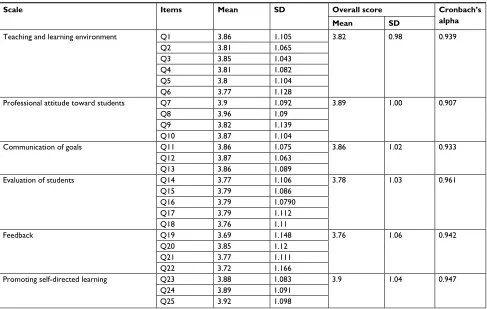
In this study, 3.57% of the total values were missing (9.73% of the cases), and pairwise deletion method was used to handle the missing data. Table 1 describes the students’ evaluation scores for each item and the overall score of each scale. The overall scores ranged from 3.76 to 3.90. The scale “promoting self-directed learning” was achieved the highest rating of an average score of 3.90 followed by “professional attitude toward students” scored 3.89 and “communication of goals” scored an average of 3.86.
Construct validity
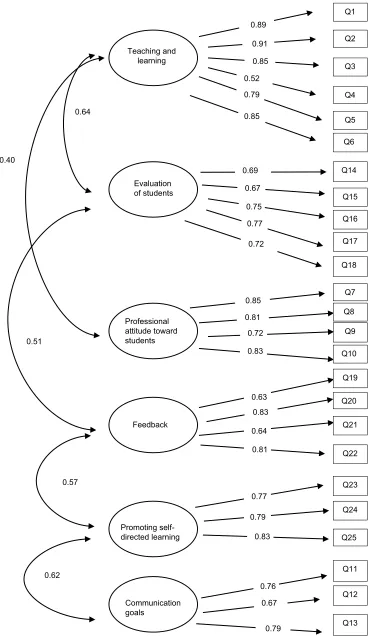
The CFA results of the six-factor mSETQ are shown in Figure 1. The path diagram shows the standardized regres-sion weights (factor loadings) which explains the pattern of
Table 1 Mean (SD) of students’ responses and Cronbach’s alpha of different scales of the mSETQ instrument
Scale Items Mean SD Overall score Cronbach’s
alpha
Mean SD
Teaching and learning environment Q1 3.86 1.105 3.82 0.98 0.939
Q2 3.81 1.065
Q3 3.85 1.043
Q4 3.81 1.082
Q5 3.8 1.104
Q6 3.77 1.128
Professional attitude toward students Q7 3.9 1.092 3.89 1.00 0.907
Q8 3.96 1.09
Q9 3.82 1.139
Q10 3.87 1.104
Communication of goals Q11 3.86 1.075 3.86 1.02 0.933
Q12 3.87 1.063
Q13 3.86 1.089
Evaluation of students Q14 3.77 1.106 3.78 1.03 0.961
Q15 3.79 1.086
Q16 3.79 1.0790
Q17 3.79 1.112
Q18 3.76 1.11
Feedback Q19 3.69 1.148 3.76 1.06 0.942
Q20 3.85 1.12
Q21 3.77 1.111
Q22 3.72 1.166
Promoting self-directed learning Q23 3.88 1.083 3.9 1.04 0.947
Q24 3.89 1.091
Q25 3.92 1.098
Abbreviations: mSETQ, modified System for Evaluation of Teaching Qualities; Q, question.
Advances in Medical Education and Practice downloaded from https://www.dovepress.com/ by 118.70.13.36 on 19-Aug-2020
Dovepress
Al Ansari et al
Figure 1 Path analysis of different scales of the teaching quality, teaching and learning environment, professional attitude toward children, communication of goals, evaluation of students, feedback, and promoting self-directed learning.
Abbreviation: Q, question.
Q1
Q2
Q16 Teaching and
learning
Q4
Q5
Q14
Q15 Q3
Q17
Q7 Q6
Q8 Q18
Q9
Q10
Q19
Q20
Q23
Q25
Q11
Q13 0.64
0.83 0.51
Q12 0.57
0.64
0.52 0.89
0.91
0.69
0.75
0.83 0.72
0.63
Q21 0.72
0.79 Q24
0.62 0.40
Evaluation of students
Professional attitude toward students
Promoting self directed learning
-Communication goals
0.77
0.81 Q22
Feedback
0.79
0.85
0.77
0.85 0.81
0.83
0.76 0.67
0.79 0.67
0.85
Advances in Medical Education and Practice downloaded from https://www.dovepress.com/ by 118.70.13.36 on 19-Aug-2020
Dovepress Validating the mSETQ: a teaching quality assessment instrument
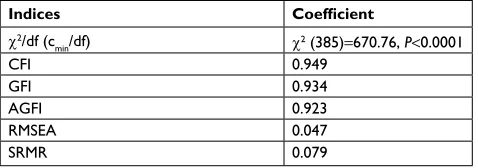
item–factor relationships, and all the factor-loading values are >0.40. The results of the CFA suggested an acceptable model fit. All values met the criteria for a good model fit (ie, GFI, CFI, and AGFI >0.90). However, a cutoff value close to 0.08 for SRMR and a cutoff value close to 0.06 for RMSEA are needed for a good model fit. This study reported an RMSEA (0.047) and SRMR (0.079). The chi-squared value was significant: c2 (385)=670.76, P<0.0001. Table 2
summarizes the values of the fit indices.
Reliability
The overall reliability was measured using the internal con-sistency reliability (Cronbach’s alpha). The overall reliability of the instrument was 0.94 showing excellent reliability. The subscale reliabilities are described in Table 1.
Discussion
The present multicentre study is an attempt to assess the construct validity and internal structure of the mSETQ questionnaire that was used to evaluate the clini-cal teaching quality of cliniclini-cal teachers in four different teaching hospitals in Bahrain. Four hundred medical stu-dents rated 125 clinical teachers using the questionnaire. All teachers included were involved with clinical teaching of the student raters. The results of this study indicate an overall teaching score between 3.76 and 3.90, which is considered satisfactory. Regarding the individual compo-nents, similar scores were observed across all components with teaching and learning environment, communication, and promoting self-directed learning exhibiting the highest values. According to our CFA, the mSETQ with 26 items in six factors was identified as a reliable and valid tool for assessing clinical teaching which showed an acceptable model fit.
The response rate is a major criterion that determines the overall outcome of questionnaire-based research. Previ-ous studies have revealed that the average response rate for data collected from individuals is 40–80%.22–24 The
accept-able response rate is reported to be between 60% and 80%. Considering this rate, the questionnaire tool used should provide high response rates with limited numbers of evalu-ations, which is an indication of the feasibility of use. This is the greatest advantage of the mSETQ; the response rate of clinical teachers was 83.8% and that of the student raters was 100%.
Limitations
In this study, the learners were allowed to choose their objects of evaluation; this is a limitation as it could lead to selection bias. Future studies should avoid selection bias and ensure appropriate randomization by not allowing the learners to select their objects of evaluation. It is possible that allowing students to choose their objects of evaluation influenced the ceiling effect found in this study. The finding that most teachers scored highly in their evaluations in this study suggests that some alterations must be made to the methodology of the study. Moreover, another limitation of the current study is that the self-evaluation component of SETQ was not incorporated and utilized in the mSETQ. Therefore, future studies should replicate this study and include the self-evaluations as well as aim to reduce selec-tion bias and the ceiling effect.
Conclusion
We provided some evidence supporting the reliability and the validity of the mSETQ tool for evaluating the clinical teaching quality of teachers. This system not only evaluates the current situation but also provides the teachers a scope for improvement in the future based on the feedback they receive. This feedback leads to the identification of learn-ing needs and the development of innovative strategies for teaching and learning. Validity is concerned with meaningful associations, inferences, and their interpretations, and it is of utmost importance to validate any form of an assessment before interpreting it inferences. This notion is important considering the influence provided by the inferences. The validation of the mSETQ before its use in the current study will provide a reliable and meaningful interpretation of clinical teaching quality when the questionnaire is used for assessments in the future. This paper recommends the use of this questionnaire for assessing heterogeneous groups of clinical teachers from different departments in clinical education studies.
Acknowledgment
We would like to thank Professor Claudio Violato for review-ing and modifyreview-ing the statistical analysis.
Table 2 CFA results: the model fit indices
Indices Coefficient
c2/df (cmin/df) c2 (385)=670.76, P<0.0001
CFI 0.949
GFI 0.934
AGFI 0.923
rMsEA 0.047
srMr 0.079
Abbreviations: AGFI, adjusted goodness-of-fit index; CFA, confirmatory factor analysis; CFI, comparative fit index; GFI, goodness-of-fit index; RMSEA, root mean square error of approximation; SRMR, standardized root mean square residual.
Advances in Medical Education and Practice downloaded from https://www.dovepress.com/ by 118.70.13.36 on 19-Aug-2020
Advances in Medical Education and Practice
Publish your work in this journal
Submit your manuscript here: http://www.dovepress.com/advances-in-medical-education-and-practice-journal Advances in Medical Education and Practice is an international, peer-
reviewed, open access journal that aims to present and publish research on Medical Education covering medical, dental, nursing and allied health care professional education. The journal covers undergraduate education, postgraduate training and continuing medical education
including emerging trends and innovative models linking education, research, and health care services. The manuscript management system is completely online and includes a very quick and fair peer-review system. Visit http://www.dovepress.com/testimonials.php to read real quotes from published authors.
Dovepress
Dove
press
Al Ansari et al
Disclosure
The authors report no conflicts of interest in this work.
References
1. Schmidt HG, Mamede S. How to improve the teaching of clinical reason-ing: a narrative review and a proposal. Med Educ. 2015;49(10):961–973. 2. Woolley S, Emanuel C, Koshy B. A pilot study of the use and perceived utility of a scale to assess clinical dental teaching within a UK dental school restorative department. Eur J Dent Educ. 2009;13(2):73–79. 3. Mookherjee S, Monash B, Wentworth KL, Sharpe BA. Faculty
develop-ment for hospitalists: structured peer observation of teaching. J Hosp
Med. 2014;9(4):244–250.
4. Biery N, Bond W, Smith AB, Leclair M, Foster E. Using Telemedi-cine Technology to Assess Physician Outpatient Teaching. Fam Med. 2015;47(10):807–810.
5. Fluit CR, Bolhuis S, Grol R, Laan R, Wensing M. Assessing the qual-ity of clinical teachers: a systematic review of content and qualqual-ity of questionnaires for assessing clinical teachers. J Gen Intern Med. 2010;25(12):1337–1345.
6. Lombarts MJ, Heineman MJ, Arah OA. Assessing the quality of clinical teachers. J Gen Intern Med. 2011;26(1):14.
7. Beckman TJ, Ghosh AK, Cook DA, Erwin PJ, Mandrekar JN. How reliable are assessments of clinical teaching? A review of the published instruments. J Gen Intern Med. 2004;19(9):971–977.
8. Spencer J. Learning and teaching in the clinical environment. ABC of learning and teaching in medicine. Br Med J. 2003;326:591–594. 9. Downing SM. Validity: on meaningful interpretation of assessment
data. Med Educ. 2003;37(9):830–837.
10. Boerebach BC, Arah OA, Busch OR, Lombarts KM. Reliable and valid tools for measuring surgeons’ teaching performance: residents’ vs self evaluation. J Surg Educ. 2012;69(4):511–520.
11. Lombarts KM, Bucx MJ, Arah OA. Development of a system for the evaluation of the teaching qualities of anesthesiology faculty.
Anesthe-siology. 2009;111(4):709–716.
12. van der Leeuw R, Lombarts K, Heineman MJ, Arah O. Systematic evaluation of the teaching qualities of Obstetrics and Gynecol-ogy faculty: reliability and validity of the SETQ tools. PLoS One. 2011;6(5):e19142.
13. van der Leeuw R, Lombarts K, Heineman MJ, Arah O. Systematic evalu-ation of the teaching qualities of Obstetrics and Gynecology faculty: reliability and validity of the SETQ tools. PLoS One. 2011;6(5):e19142. 14. Boerebach BC, Lombarts KM, Arah OA. Confirmatory Factor Analysis of the System for Evaluation of Teaching Qualities (SETQ) in Graduate Medical Training. Eval Health Prof. 2016;39(1):21–32.
15. Al Ansari A, Strachan K, Hashim S, Otoom S. Analysis of psychometric properties of the modified SETQ tool in undergraduate medical educa-tion. BMC Med Educ. 2017;17(1):56.
16. World Medical Association. Declaration of Helsinki. Bull World Health
Organ. 2001;79(4).
17. Bentler P. EQS Structural Equations Program Manual. Encino (Calif.): Multivariate Software; 1995.
18. Harrington D. Confirmatory Factor Analysis. Oxford: Oxford University Press; 2009.
19. Kline RB. Principles and Practice of Structural Equation Modeling. 3rd ed. New York: Guilford Publications; 2015.
20. Byrne B. Structural Equation Modeling with AMOS. Mahwah: Lawrence Erlbaum Associates; 2001.
21. Hu L, Bentler PM. Cutoff criteria for fit indexes in covariance structure analysis: Conventional criteria versus new alternatives. Struct Equ
Modeling A Multidisciplinary J. 1999;6(1):1–55.
22. Fekete C, Segerer W, Gemperli A, Brinkhof MW; SwiSCI Study Group. Participation rates, response bias and response behaviours in the com-munity survey of the Swiss Spinal Cord Injury Cohort Study (SwiSCI).
BMC Med Res Methodol. 2015;15(1):80.
23. Eskander A, Freeman J, Rotstein L, et al. Response rates for mailout survey-driven studies in patients waiting for thyroid surgery. J
Otolar-yngol Head Neck Surg. 2011;40(6):462–467.
24. Christensen AI, Ekholm O, Kristensen PL, et al. The effect of multiple reminders on response patterns in a Danish health survey. Eur J Public
Health. 2015;25(1):156–161.
Advances in Medical Education and Practice downloaded from https://www.dovepress.com/ by 118.70.13.36 on 19-Aug-2020