ISSN(Online): 2319-8753 ISSN (Print): 2347-6710
I
nternational
J
ournal of
I
nnovative
R
esearch in
S
cience,
E
ngineering and
T
echnology
(A High Impact Factor, Monthly, Peer Reviewed Journal) Visit: www.ijirset.com
Vol. 8, Issue 8, August 2019
BER Analysis Wavelet Based OFDM in LTE
Using Different Modulation Techniques
Khushbu Mehta, Aabhas Mathur, Dr. Hemant Dhabai
Research scholar M.Tech. (D.C), Arawali Institute of Technical Studies, Udaipur, Rajasthan, India
Associate Professor & Head, Arawali Institute of Technical Studies, Udaipur, Rajasthan, India
Professor, Arawali Institute of Technical Studies, Udaipur, Rajasthan, India
ABSTRACT: In this paper wavelet based OFDM at the place of Discrete Fourier Transform (DFT) based
OFDM in LTE. We have compared the BER performance of wavelets and DFT based OFDM. The performance analysis of an Orthogonal Frequency Division Multiplexing (OFDM) system and the bandwidth extension achieved with carrier aggregation (CA). Data, when transmitted through any communications system, primarily faces three types of problems, errors, power management, and bandwidth. For the purpose of analyzing OFDM performance, we have taken a two-fold approach. Different types of modulation schemes such as QPSK and 16-QAM with OFDM are studied for their Bit Error Rate (BER). A noisy channel adversely affects data transmission. For this work, we study the modulation schemes with OFDM over two types of noise channels, BER rates for both these channels has been simulated in MATLAB simulation
KEYWORDS: QPSK,QAM,OFDM,BER,DFT
I. INTRODUCTION
ISSN(Online): 2319-8753 ISSN (Print): 2347-6710
I
nternational
J
ournal of
I
nnovative
R
esearch in
S
cience,
E
ngineering and
T
echnology
(A High Impact Factor, Monthly, Peer Reviewed Journal) Visit: www.ijirset.com
Vol. 8, Issue 8, August 2019
performed on the transmitter side and then the reversal operations of the aforementioned processes are performed. In the receiver side the cyclic prefix is removed from the channel output data and then the pilot synchronization is performed after that the Fourier transform is applied on the synchronized data and then the demodulation is formed. [10][5]And the demodulated data is decoded at the receiver. Finally the BER performance is estimated. Orthogonal Frequency Division Multiplexing (OFDM) and Multiple Input and Multiple Output (MIMO) are two main techniques in the Long term evolution communication process. In the OFDM system multiple carriers are used and it provides higher level of spectral efficiency as compared to Frequency Division Multiplexing (FDM). In the OFDM systems there exist some problems such as Intersymbol interference and Intercarrier Interference which due to the loss of orthogonality between the subcarriers. In order to avoid this problem cyclic prefix is added to the signal before passing into the channel. By adding that the cyclic prefix data which uses 20% of available bandwidth. So the inefficiency of the bandwidth is raised. In order to solve that Wavelet based OFDM provides good orthogonality and with its use Bit Error Rate (BER) is improved. Wavelet based system does not require cyclic ][prefix, so spectrum efficiency is increased[1][7][5]
II. RELATED WORK
In the existing system the discrete Fourier transform is used for the orthogonal basis function. First the Random data is generated and then the data is encoded by the encoder and the corresponding modulation is processed. The modulated signal is applied with the inverse Fourier transform is performed. After that the cyclic prefix data is added to the modulated signal and then the signal is passed into the channel with the noise. And the aforementioned process are performed on the transmitter side and then the reversal operations of the aforementioned processes are performed. In the receiver side the cyclic prefix is removed from the channel output data and then the pilot synchronization is performed after that the Fourier transform is applied on the synchronized data and then the demodulation is performed. And the demodulated data is decoded at the receiver. Finally the BER performance is estimated.
III. PROPOSED METHO
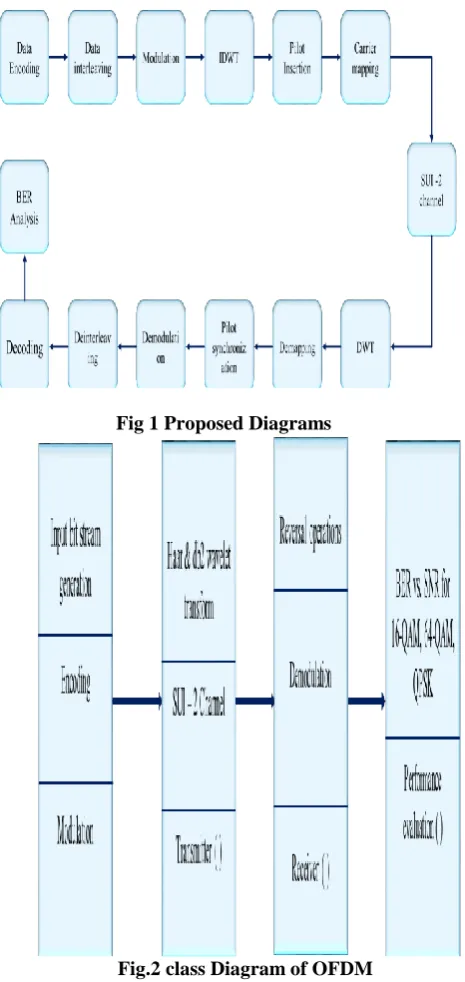
The proposed system we are using inverse discrete Fourier transform IDWT and discrete Fourier transform DWT at the place of IDFT and DFT. SUI - 2 channels is used for transmission and cyclic prefixing is not used. In the transmission side conventional encoding is performed and then interleaving is performed on the encoded data. Then the data is converted to decimal form and modulation is done. Here we are use the QPSK, QAM-16 and QAM-64 is performed. After modulation the pilot insertion and sub carrier mapping is performed on the data and then IDWT of the data, which provides the orthogonality to the subcarriers. IDWT will convert time domain signal to the frequency domain. After passing through th
channel on the signal DWT will be performed and then pilot synchronization where the inserted pilots at the transmitter are removed then the demodulation is performed. Demodulated data is converted to binary form and the de-interleaved and decoded to obtain the original data transmitted. Finally the performance of the system is evaluated by using the BER analysis.
ALGORITHM :SUI – 2 Channel Model: Imax technology is a broadband wireless data communications
technology based around the IEE 802.16 standard providing high speed data over a wide area. Stanford University Interim (SUI) model is developed for IEEE 802.16 by Stanford University. It is used for frequencies above 1900MHz. IEEE 802.16. Broadband Wireless Access working group proposed the standards for the frequency band below 11 GHz containing the channel model developed by Stanford University, namely the SUI models. The SUI model describes three types of terrain; they are terrain A, terrain B and terrain C. Terrain A can be used for hilly areas with moderate or very dense vegetation.OFDM has been incorporated into WiMAX technology to enable it to provide high speed data without the selective fading and other issues of other forms of signal format
QAM MODULATION:QAM (quadrature amplitude modulation) is a method of combining two
ISSN(Online): 2319-8753 ISSN (Print): 2347-6710
I
nternational
J
ournal of
I
nnovative
R
esearch in
S
cience,
E
ngineering and
T
echnology
(A High Impact Factor, Monthly, Peer Reviewed Journal) Visit: www.ijirset.com
Vol. 8, Issue 8, August 2019
combination of both Amplitude and phase modulation techniques. QAM is better than QPSK in terms of data carrying capacity. QAM takes benefit from the concept that two signal frequencies; one shifted by 90 degree with respect to the other can be transmitted on the same carrier. For QAM, each carrier is ASK/PSK modulated. Hence data symbols have different amplitudes and phases.QPSK: quadrature phase shift keying. Quadrature means the signal shifts among phase states that are separated by 90 degrees. The signal shifts in increments of 90 degrees from 45° to 135°, -45° (315°), or -135°
Fig 1 Proposed Diagrams
ISSN(Online): 2319-8753 ISSN (Print): 2347-6710
I
nternational
J
ournal of
I
nnovative
R
esearch in
S
cience,
E
ngineering and
T
echnology
(A High Impact Factor, Monthly, Peer Reviewed Journal) Visit: www.ijirset.com
Vol. 8, Issue 8, August 2019
(225°). Data into the modulator is separated into two channels called I and Q. Two bits are transmitted simultaneously, one per channel. Each channel modulates a carrier. The two carrier frequencies are the same, but their phase is offset by 90 degrees (that is, they are “in quadrature”). The two carriers are combined and transmitted • Four states because 2^2 = 4. Theoretical bandwidth efficiency is two bits/second/H.
USECASE DIAGRAM
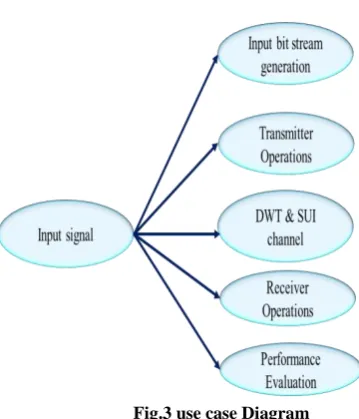
Fig.3 use case Diagram
Orthogonal Frequency Division Multiplexing (OFDM) and Multiple Input and Multiple Output (MIMO) are two main techniques employed in 4th Generation Long Term Evolution (LTE). In OFDM multiple carriers are used and it provides higher level of spectral efficiency as compared to Frequency Division Multiplexing (FDM). In OFDM because of loss of orthogonality between the subcarriers there is inter carrier interference (ICI) and intersymbol interference (ISI) and to overcome this problem use of cyclic prefixing (CP) is required, which uses 20% of available bandwidth. Wavelet based OFDM provides good orthogonality and with its use Bit Error Rate(BER) is improved. Wavelet based system does not require cyclic prefix, so spectrum efficiency is increased. It is proposed to use wavelet based OFDM at the place of Discrete Fourier Transform (DFT) based OFDM in LTE. We have compared the BER performance of wavelets and DFT based OFDM
SEQUENCE DIAGRAM
ISSN(Online): 2319-8753 ISSN (Print): 2347-6710
I
nternational
J
ournal of
I
nnovative
R
esearch in
S
cience,
E
ngineering and
T
echnology
(A High Impact Factor, Monthly, Peer Reviewed Journal) Visit: www.ijirset.com
Vol. 8, Issue 8, August 2019
ER DIAGRAM
Fig.5 ER Diagram
IV. MODULES
OFDM Symbol Generation Model Modulation Model
SUI – 2 Channel Model Performance Analysis Model
OFDM SYMBOL GENERATION MODEL: Using a large number of parallel narrow-band subcarriers instead of a
single wide-band carrier to transport information. OFDM is a frequency-division multiplexing (FDM) scheme used as a digital carrier modulation method and is essentially identical to coded OFDM (COFDM) and discrete multi-tone modulation (DMT). It is used in such diverse applications as digital television and audio broadcasting, wireless networking and broadband internet access. OFDM has also been adopted in some military communication systems. OFDM scheme, a large number of orthogonal, overlapping, narrow band sub-channels or subcarriers, transmitted in parallel, divide the available transmission bandwidth. The separation of the subcarriers is theoretically minimal such that there is a very compact spectral utilization. The attraction of OFDM is mainly due to how the system handles the multipath interference at the receiver. Multipath generates two effects: frequency selective fading and intersymbol interference (ISI). The "flatness" perceived by a narrow-band channel overcomes the former, and modulating at a very low symbol rate, which makes the symbols much longer than the channel impulse response, diminishes the latter. Using powerful error correcting codes together with time and frequency interleaving yields even more robustness against frequency selective fading, and the insertion of an extra guard interval between consecutive OFDM symbols can reduce theIn an effects of ISI even more. Thus, an equalizer in the receiver is not necessary.
MODULATION MODEL:QAM (quadrature amplitude modulation) is a method of combining two
ISSN(Online): 2319-8753 ISSN (Print): 2347-6710
I
nternational
J
ournal of
I
nnovative
R
esearch in
S
cience,
E
ngineering and
T
echnology
(A High Impact Factor, Monthly, Peer Reviewed Journal) Visit: www.ijirset.com
Vol. 8, Issue 8, August 2019
capacity. QAM takes benefit from the concept that two signal frequencies; one shifted by 90 degree with respect to the other can be transmitted on the same carrier. For QAM, each carrier is ASK/PSK modulated. Hence data symbols have different amplitudes and phases.QPSK: quadrature phase shift keying. Quadrature means the signal shifts among phase states that are separated by 90 degrees. The signal shifts in increments of 90 degrees from 45° to 135°, -45° (315°), or -135° (225°). Data into the modulator is separated into two channels called I and Q. Two bits are transmitted simultaneously, one per channel. Each channel modulates a carrier. The two carrier frequencies are the same, but their phase is offset by 90 degrees (that is, they are “in quadrature”). The two carriers are combined and transmitted Four states because 2^2 = 4. Theoretical bandwidth efficiency is two bits/second/H.
CHANNEL MODEL: Imax technology is a broadband wireless data communications technology based around the
IEE 802.16 standard providing high speed data over a wide area. Stanford University Interim (SUI) model is developed for IEEE 802.16 by Stanford University. It is used for frequencies above 1900MHz.IEEE 802.16. Broadband Wireless Access working group proposed the standards for the frequency band below 11 GHz containing the channel model developed by Stanford University, namely the SUI models. The SUI model describes three types of terrain; they are terrain A, terrain B and terrain C. Terrain A can be used for hilly areas with moderate or very dense vegetation.OFDM has been incorporated into WiMAX technology to enable it to provide high speed data without the selective fading and other issues of other forms of signal format.
PERFORMANCE ANALYSIS: The bit error rate (BER) is the number of bit errors divided by the total number of
ISSN(Online): 2319-8753 ISSN (Print): 2347-6710
I
nternational
J
ournal of
I
nnovative
R
esearch in
S
cience,
E
ngineering and
T
echnology
(A High Impact Factor, Monthly, Peer Reviewed Journal) Visit: www.ijirset.com
Vol. 8, Issue 8, August 2019
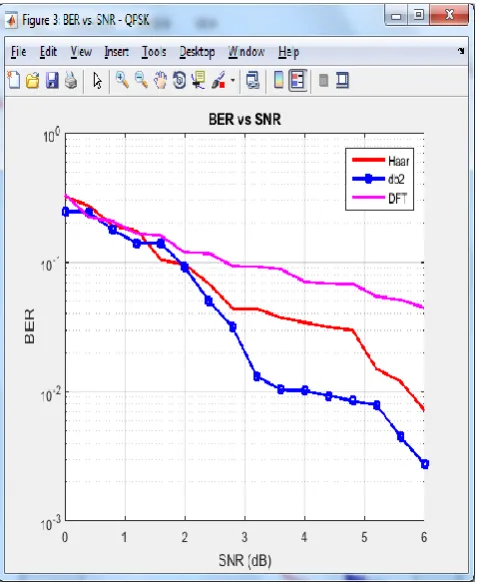
Fig.6 . BER performance of wavelets and DFT based OFDM system using QPSK modulation.
For the purpose of simulation, signal to noise ratio (SNR) of different values are introduced through AWGN channel. Data of 9600 bits is sent in the form of 100 symbols, so one symbol is of 96 bits. Averaging for a particular value of SNR for all the symbols is done and BER is obtained and same process is repeated for all the values of SNR and final BERs are obtained. Firstly the performance of DFT based OFDM and wavelet based OFDM are obtained for different modulation
Fig.7 BER performance of wavelets and DFT based OFDM system using 64-
ISSN(Online): 2319-8753 ISSN (Print): 2347-6710
I
nternational
J
ournal of
I
nnovative
R
esearch in
S
cience,
E
ngineering and
T
echnology
(A High Impact Factor, Monthly, Peer Reviewed Journal) Visit: www.ijirset.com
Vol. 8, Issue 8, August 2019
Techniques. Different wavelet types daubechies2 and haar is used in wavelet based OFDM for QPSK, 16-QAM, 64-QAM.It is clear from the fig. 3, fig. 4 and fig. 5 that the BE performance of wavelet based OFDM is better than the DFT based OFDM. Fig. 3 indicates that db2 performs better when QPSK is used. Fig. 4 shows that when 16-QAM is used db2and haar have similar performance but far better than DFT.Fig. 5, where 64-QAM is used haar and db2 performs better than DFT To measure the boundary SNR regions for adaptive modulation, the OFDM system has been implemented with different fixed modulation schemes such as BPSK, QPSK, 16 QAM and 64 QAM, which is shown in Figure 3.2. Figure 3.2 shows the comparison of SNR vs BER for different modulation techniques. It shows that the BER rate mainly depends on the constellation size M. BPSK provides good BER performance, but its spectral efficiency is only 1bps/Hz, which is very low compared to other modulation schemes
Fig. 8 BER performance of wavelets and DFT based OFDM system using 16- QAM modulation.
At the same time 64QAM will able to provide better spectral efficiency that is 6bps/Hz, but it fails to maintain good BER performance and thus low QoS. These modulation techniques are fixed modulation techniques. It provides fixed data rate irrespective of channel conditions. To maximize the spectral efficiency with achieving target BER, adaptive modulation technique is used in practice.
V. CONCLUSION
ISSN(Online): 2319-8753 ISSN (Print): 2347-6710
I
nternational
J
ournal of
I
nnovative
R
esearch in
S
cience,
E
ngineering and
T
echnology
(A High Impact Factor, Monthly, Peer Reviewed Journal) Visit: www.ijirset.com
Vol. 8, Issue 8, August 2019
show the performance of the system. results will show that performance is improved by using lower order modulation formats e.g. Binary Phase Shift Keying (BPSK) and Quadrature Amplitude Modulation (4-QAM), compared to the higher modulation schemes e.g. 64-QAM; as they offer lower data rates but are more robust in the presence of noise. The performance study of OFDM scheme is also examined with and without presence of noise and application of FEC.
REFERENCES
1.SU HU et.al : “Training Sequence Design for Efficient Channel Estimation in MIMO-FBMC Systems” IEEE access Vol 5 2017.
2.Yu Zhu et.al : “Robust Single Carrier Frequency Domain Equalization With Imperfect Channel Knowledge” iee transactions on wireless communications, vol. 15, no. 9, september 2016.
3.Charles U. Ndujiuba et.al : “Dynamic Differential Modulation of Sub-Carriers in OFDM” Journal of Wireless Networking and Communications 2016, 6(1): 21-28.
4.Pallavi Suryawanshi et.al : “Underwater communication by using OFDM system” International Journal of Scientific and Research Publications, Volume 3, Issue 12, December 2013
5.Alessandro Tomasoni, Member et.al: “Efficient OFDM Channel Estimation via an Information Criterion” ieee transactions on wireless communications, vol. 12, no. 3, march 2013.
6.Hardeep Kaur et.al : “ Analyzing the Performance of Coded OFDM based WiMax System with different Fading Conditions” International Journal of Advanced Science and Technology Vol.68 (2014), pp.01-10.
7.Sanjana T et.al : “comparison of channel estimation and equalization techniques for ofdm systems” Circuits and Systems: An International Journal (CSIJ), Vol. 1, No. 1, January 2014.
8.Sunho Park : “”Iterative Channel Estimation Using Virtual Pilot Signals for MIMO-OFDM Systems” ieee transactions on signal processing, vol. 63, no. 12, june 15, 2015.
10.Petros S. Bithas et.al : “An Improved Threshold-Based Channel Selection Scheme for Wireless Communication Systems” ieee transactions on wireless communications, vol. 15, no. 2, february 2016.
11.Dimitrios Katselis et.al: “Preamble-Based Channel Estimation for CP-OFDM and OFDM/OQAM Systems: A Comparative Study” ieee transactions on signal processing, vol. 58, no. 5, may 2010.
12.Yuan Ouyang et.al : “Performance Analysis of the Multiband Orthognal Frequency Division Multiplexing Ultra-Wideband Systems for Multipath Fading and Multiuser
Interference Channels” Hindawi Publishing Corporation Mathematical Problems in Engineering Volume 2015, Article ID 190809, 9 pages.