Collapse Behaviour of a Calcareous Soil Using
Oedometer Test
T. Nalini
1, Suresh Kommu
2P.G. Student, Department of Civil Engineering, VNR Vignana Jyothi Institute Of Engineering & Technology,
Hyderabad, Telangana, India1
Assistant Professor, Department of Civil Engineering, VNR Vignana Jyothi Institute Of Engineering & Technology,
Hyderabad, Telangana, India2
ABSTRACT: Collapsible soils are the most widely distributed and costly of geologic hazards. These soils are subjected to change in volume and settlement in response to wetting and drying, often resulted in severe damage to structures. Collapsing soils are generally characterized by sudden and large volume decrease at constant stress when inundated with water. These are very sensitive to changes its porosity and water content. Suffusion i.e. grain movement in a ground layer from one horizon to another during wetting up is one of the main causes of collapse. Man- made fills, which were compacted at the optimum water content, may also develop a collapsible or metastable-structure at low density. A sound understanding of the mechanical behaviour of this type of material is thus required so that the engineer can devise safe and cost-effective solutions to these problems. A geotechnical engineer needs to be able to identify readily the soils that could collapse and to determine the amount of collapse that may occur. Most compacted soils have collapsible soil behaviours when, subjected to wetting or loading. Collapse potential increases with decrease in compaction water content, high void ratio and low dry density. The main theme of this study is to know the influence of variations in compaction dry density, initial water content, inundation stress, and void ratio on the collapse behaviour of the soil. Also, to determine the collapse behaviour of soils under wetting conditions by using oedometer test and control of collapse behaviour of soil.
KEYWORDS:Collapsible soils, Water content, dry density, Oedometer test, Metastable structure.
I. INTRODUCTION
COLLAPSE MECHANISM
The decrease in total volume of a soil resulting from wetting-induced breakdown of its structure at essentially unchanging total vertical stress is commonly referred to “collapse”. The main factors that contribute the collapse behaviour are
An open, partially unstable and unsaturated soil.
A high enough value of net total stress is applied to develop a metastable structure
A high enough value of soil suction (or other bonding or cementing agent) to stabilize inter granular contacts, and whose reduction on wetting will lead to collapse.
The addition of water to the soil, which causes the bonding or cementing agent to be reduced and the interaggregate contacts to fail in shear, resulting in a reduction in total volume of the soil mass.
Collapsible soils are generally associated with an open structure formed by fine grains, low initial density, low natural water content, low plasticity, relatively high stiffness and strength in the dry density. The larger pores are the ones that collapse at the low stress level and the smaller pores are the ones that collapse at the high stress level. The collapse problem was initially thought to be only with silt and sands of low dry density. However, it is now recognized that the phenomenon can occur with other soil materials ranging from gravel to fine clays under certain conditions of applied stress, density and degree of saturation. Generally collapsible soils are unsaturated conditions in the dry state, with negative pore water pressure resulting in high effective stresses and greater shear strength. Additionally, cementing agents such as Caco3 can also contribute to maintaining open „honey combed‟ structure. Upon wetting, the
pore pressure becomes less negative and the effective stresses are reduced causing a decrease in shear strength. Additionally, the water can dissolve or soften the bonds between the particles allowing them to take a denser packing. This mechanism, referred to as wetting induced collapse or hydro compression can take place with or without extra loading.
II. LITERATURE REVIEW
Several researchers examined the role of soil structure in the collapse behaviour of compacted soils by varying the compacted dry density and clay content of the soil specimens. The amount of collapse is expected to increase with the increase in magnitude of the external stress (dry density and moisture being constant), at which the unsaturated specimen is wetted. Jennings and Knight [1] were the first propose a method to quantify the amount of collapse by means of oedometer test. One of the most common problems associated with unsaturated soils is that of collapse on wetting of materials with open fabrics such as loess and loosely compacted fills. These materials undergo significant settlements once wetted at relatively large over-burden pressures. They have shown that a single effective stress variable is not capable of completely describing partly saturated soil behaviour, especially the volumetric behaviour. As per Basma [2], 138 single-oedometer tests were conducted on eight different soils. The results indicate that well-graded soils tend to collapse more than poorly well-graded ones under same conditions. Jotisankasa [3] introduced a methodology to investigate the collapse behaviour of unsaturated soils using suction-monitored oedometer tests. The proposed method has been used to investigate the collapse behaviour of compacted silty clay and to confirm the uniqueness of the loading-collapse surface as identified from loading and wetting paths. T.Ayadat and A.M. Hanna [4] had introduced the various methods of predicting collapse from simple and rapidly performed index have been suggested by several workers in the field. In his investigation, most of the well known collapses identifying criteria are reviewed and evaluated. D.G. Fredlund and J.K.M.Gan [5] studied the collapse behaviour of a compacted soil was studied in the laboratory using a modified conventional oedometer and a tensiometer for the measurement of matric suction. The results shown that collapse is a transient and continuous process.
III.MATERIALANDMETHODOLOGY
to fail in shear which leads to reduction in total volume of soil mass. Calcareous or lime-rich, may pose limitations not only to buildings and also to tree growth and their productivity because of physical and chemical properties.This soil is analysed for their properties and the relevant testing procedures have been included in the following.
The specific gravity test has been conducted as per the [7]. The sieve analysis and hydrometer tests are carried out to determine the particle size distribution of the soils according to [8] and classification [9]. The Liquid limit and plastic limit of the soil are determined according to the [10]. The standard proctor test was conducted to determine the OMC according to [11] and maximum dry density of the soil. The oedometer test [12] is used to determine the collapse behaviour of the soil and controlness of the soil by adding cement to the soil in proportions.
Oedometer test
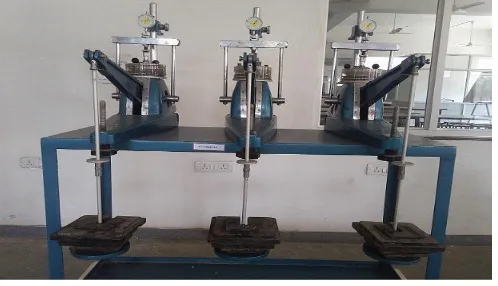
A collapsible calcareous soil may withstand relatively large applied vertical stress with small settlement while at a low water content, but this soil will exhibit settlement (that could be large) after wetting with no additional increase in stress. Large applied vertical stress is not necessary for collapse. The oedometer test procedure is performed by taking the weight of soil is equal to the volume of cylindrical specimen ring .The oedometer specimen ring diameter 60mm and height 20mm. The specimen ring cleaned and weighed it empty. The soil is compacted in specimen ring to the required OMC and the flush off the sample smoothly with the top and the bottom of the ring. The specimen ring cleaned from outside and weighed with the specimen. The porous stones are saturated for 24 hours. The specimen is assembled as the porous stone are arranged at the top and bottom of the specimen providing filter papers in between. The pressure pad is placed centrally on the top porous stone. The assembly is placed in the loading frame and adjusted to centre such that the load is applied axially. The dial gauge is positioned to measure the vertical compression of the specimen. The first load of intensity 0.2 kg/cm2 and the initial dial gauge reading is noted. The dial gauge reading is recorded at various time intervals. The test is repeated for successive load increments of 0.2, 0.8, 1.8, 3.0, 6.4 and 8 kg/cm2. The specimen is saturated at different loads for example: sample 1 should be saturated at 0.2kg/cm2, sample 2 should be at 0.8kg/cm2, sample 3 should be at 1.8kg/cm2, sample 4 should be at 3.0kg/cm2, sample 5 should be at 6.4kg/cm2 and sample 6 should be at 8kg/cm2. The collapse point and the load of intensity of the sample noted. The sample is mixed with 1% of cement and the specimen is saturated at the point of load intensity collapsed. Thus the cement admixture controls the collapse of the soil specimen.
It has been found that the inundation stress of 6.4 kg/cm2 is found to be critical for the calcareous soil. Hence, cement in various proportions, viz., 1%, 2%, 4% and 6% has been added by weight and the collapse studies have been performed on the cement mixed soil.
The vertical stress at which a compacted specimen is inundated is termed as the flooding pressure then swell/collapse potential was calculated from the equation
Swell/collapse potential = ± ∆h/H*100%
Where
∆h = Increase (swell) or decrease (collapse) in height of the compacted specimen on wetting under the applied
stress.
H = Height of the compacted specimen before water was added at the particular stress.
A positive sign was assigned to the swell potential to denote increase in specimen thickness from swelling. A negative sign was assigned to the collapse potential to denoted reduction in specimen thickness from collapse.
Void ratio of the soil can be calculated from the following equation
γb = G γw/1+e
Where
γb =Bulk density
G = Specific gravity γw = Unit weight of water
Change in void ratio can be defined by ∆h/h = ∆e/1+e
∆e = ∆h (1+e)/h
Where
∆e = Change in void ratio
∆h = Decrease (collapse) in height of the compacted specimen on wetting under the applied stress. h = Height of the specimen
Fig.1. Oedometer test
IV.RESULTSANDDISCUSSIONS
Extensive laboratory investigations are conducted to evaluate the index and engineering properties of the calcareous soil. The results obtained from the tests are presented in the Table 1. It can be observed that the selected soil have good variance in the properties and also their characteristics, which give good selection criteria for the study. Also, it can be noticed that the calcareous soil considered fir the study consists of the fine-grained soil. The details of the results are discussed below.
Table -1: Index properties
PROPERTIES CALCAREOUS SOIL
Specific gravity 2.42
Gravel % 0
Sand % 37
Silt % 44
Clay % 19
Liquid limit % 33
Plastic limit % 21
Plasticity index % 12
Optimum moisture content ( OMC ) %
13.13
Maximum dry density ( MDD) gr/cc
Oedometer test has been performed for the calcareous soil and inundation was done at normal stress of 0.2 kg/cm2, the results obtained from the test are plotted in Fig. 2 (a) from the figure, it can be observed that no collapse has been found. Hence, it can be concluded that the calcareous soil is stable at a given pressure of 0.2 kg/cm2 under inundation condition. Oedometer test has been performed for the calcareous soil and inundation was done at normal stress of 0.8 kg/cm2, the results obtained from the test are plotted in Fig. 2 (b) from the figure, it can be observed that 1.35% collapse has been found. Hence, it can be concluded that the calcareous soil is susceptible to collapse at a pressure of 0.8 kg/cm2 under inundation condition.
V.
Fig.2 (a) Collapse condition for inundation stress of 0.2kg/cm2 (b) Collapse condition for inundation stress of 0.8kg/cm2
Oedometer test has been performed for the calcareous soil and inundation was done at normal stress of 1.8 kg/cm2, the results obtained from the test are plotted in Fig.3 (a) from the figure, it can be observed that 2.10% collapse has been found. Hence, it can be concluded that the calcareous soil is susceptible to collapse at a pressure of 1.8 kg/cm2 under inundation condition. Oedometer test has been performed for the calcareous soil and inundation was done at normal stress of 3.0 kg/cm2, the results obtained from the test are plotted in Fig. 3 (b) from the figure, it can be observed that 3.19% collapse has been found. Hence, it can be concluded that the calcareous soil is susceptible to collapse at a pressure of 3.0kg/cm2 under inundation condition.
Fig.3. (a) Collapse condition for inundation stress of 1.8 kg/cm2 (b) Collapse condition for inundation stress of 3.0 kg/cm2
(a) (b)
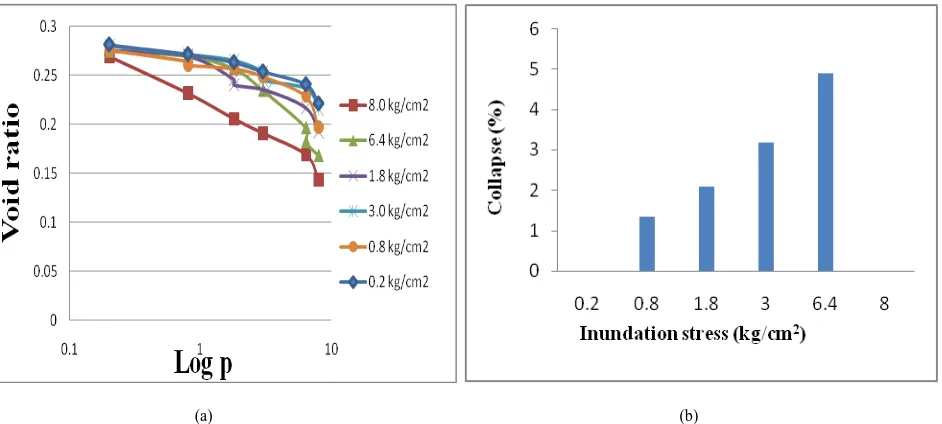
Oedometer test has been performed for the calcareous soil and inundation was done at normal stress of 6.4 kg/cm2, the results obtained from the test are plotted in Fig. 4 (a) from the figure, it can be observed that 4.9% collapse of the sample has been found. Hence, it can be concluded that the calcareous soil is susceptible to collapse at a pressure of 6.4kg/cm2 under inundation condition. Oedometer test has been performed for the calcareous soil and inundation was done at normal stress of 8.0 kg/cm2, the results obtained from the test are plotted in Fig. 4 (b) from the figure, it can be observed that no collapse of the sample has been found. Hence, it can be concluded that the calcareous soil is stable at a given pressure of 8.0 kg/cm2 under inundation condition.
Fig. 4 (a) Collapse condition for inundation stress of 6.4kg/cm2 (b) Collapse condition for inundation stress of 8.0kg/cm2
Fig.5(a) shows that collapse condition at different inundation stress and from fig.5(b), it can be observed that collapse percentage increased with the increase of inundation stress and the soil did not show any collapse at higher inundation stress of 8 kg/cm2. The maximum collapse for calcareous soil is observed at 8 kg/cm2.
(a) (b)
EFFECT OF ADDITION OF CEMENT
From the above tests, it has been found that the inundation stress of 6.4kg/cm2 is found to be critical for the calcareous soil. Hence, cement in various proportions, viz., 1%, 2%, 3% and 6% has been added by weight and the collapse studies have been performed on the cement mixed soil. The results obtained are discussed in the following.
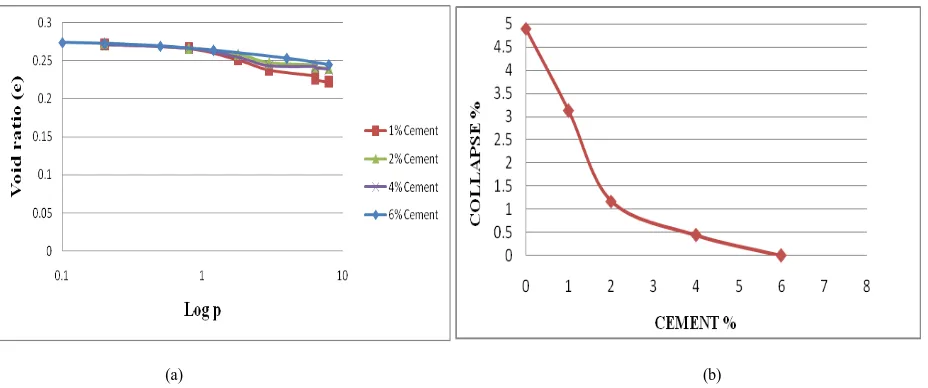
Oedometer test has been performed for the soil mixed with 1% of cement by weight and inundation was done at 6.4 kg/cm2, the results obtained from the test are plotted in Fig.6 (a) from the figure, it can be observed that 3.13% collapse of the sample has been found. Hence, it can be concluded that the percentage collapse of soil mixed with 1% cement is comparatively less than that of only soil at the pressure of 6.4 kg/cm2 under inundation condition. Similarly, soil is mixed with 2%, 4% and 6% of cement by weight and inundation was done at 6.4kg/cm2. The results obtained 1.18%, 0.45% of collapse at 2% and 4% cement. And no collapse of the sample has been found at 6% cement. Hence, it can be concluded that the soil does not collapse at the inundation stress of 6.4 kg/cm2 with the addition of 6% cement. The same effect has been observed with the increase of addition of cement. Therefore, it can be concluded that 6% of the cement can be mixed with soil to control the collapsibility of the soil at any inundation stress.
(a) (b)
Fig. 6 (a) Collapse condition at different cement percentages (b) Comparison of collapse at different cement percentages
V. CONCLUSION
From the oedometer test performed for the calcareous soil it can be observed that maximum collapse of the sample has been found to be 4.9% at inundation stress of 6.4 kg/cm2 and no collapse have been observed for stress more than that. Hence, it can be concluded that the soil is collapsible at a given pressure of 6.4 kg/cm2 under inundation condition. It has been observed that the collapse increases with the increase in the inundation stress and the values tend to zero above 6.4 kg/cm2.From the above tests; it has been found that the inundation stress of 6.4 kg/cm2 is found to be critical for the soil. Hence, cement in various proportions, viz., 1%, 2%, 4% and 6% has been added by weight and the collapse studies have been performed on the cement mixed soil. The collapse of the soil can be controlled by addition of even 1% of cement and percentage collapse is found to reduce with the increase in cement content. However, no collapse has been observed for more than 6% addition of cement, hence, in order to control the collapse, an optimum amount of 6% of cement should be added to the soil.
REFERENCES
[1] Jennings, J.E. and Knight, “The additional settlement of foundations due to collapse of structure of sandy subsoils on wetting”, proceeding of the fourth international conference on soil mechanics and foundation engineering, London, Vol.1, pp.316-319, 1957.
[2] Basma, A. A., and Tuncer, E.R., “Evaluation and control of collapsible soils”, Journal of geotechnical engineering, Vol.118, No.10, pp.1491-1504, 1992.
[3] Apiniti Jotisankasa, Andrew Ridley and Matthew Coop, “Collapse behavior of a compacted silty clay”, Journal of geotechnical and geoenvironmental engineering, ASCE, Vol.133, No.7, pp. 867-877, 2007.
[4] Ayadat, T. and Hanna, A.M., “Assessment of soil collapse prediction methods”, IJE transactions B: Applications,Vol. 25, No. 1, pp.19-26, 2012.
[5] D.G.Fredlund and J.K.M.Gan, “The collapse mechanism of a soil subjected to one dimensional loading and wetting”, kluwer academic publishers. Printed in Netherlands, pp.173-205, 1995.
[6] Barden, L., Collins, K. Mc Gown, A: “The Collapse Mechanism in Partly Saturated Soils”, Eng. Geol., Vol.7, pp. 49 – 60, 1973. [7] IS 2720-Part 3, (1980), Determination of specific gravity, Bureau of Indian Standards, New Delhi, India.
[8] IS 2720-Part 4, (1985), Grain size analysis, Bureau of Indian Standards, New Delhi, India.
[9] IS 1498, (1970), Classification and identification of soils for general engineering purposes, Bureau of Indian Standards, New Delhi, India. [10] IS 2720-Part 5, (1985), Determination of Liquid and plastic limit, Bureau of Indian Standards, New Delhi, India.
[11] IS 2720-Part 7, (1980), Determination of water content-dry density relation using light compaction, Bureau of Indian Standards, New Delhi, India.
[12] IS 2720-Part 15, (1986), Determination of collapse behavior, Bureau of Indian Standards, New Delhi, India.
BIOGRAPHY
T.Nalini completed her B.TECH degree in Civill Engineering from CVSR college of Engineering and Technology, Ghatkesar,Rangareddy (Dist), affiliated to JNTUH. She is currently pursuing M.Tech Geotechnical engineering in VNR vignana jyothi college of Engineering and Technology (Autonomous), Bachupally, Rangareddy (Dist), affiliated to JNTUH.