Improved Parallel Mask Refreshing Algorithms
Generic Solutions with Parametrized Non-Interference &
Automated Optimizations
Gilles Barthe1, Sonia Bela¨ıd2, Fran¸cois Dupressoir3, Pierre-Alain Fouque4, Benjamin Gr´egoire5, Fran¸cois-Xavier Standaert6, and Pierre-Yves Strub7
1
IMDEA Software Institute, Spain 2 CryptoExperts, France 3
University of Surrey, United Kingdom 4 Universit´e de Rennes 1, France 5
Inria Sophia-Antipolis – M´editerran´ee, France 6
Universit´e catholique de Louvain, ICTEAM Institute, Belgium 7
Ecole Polytechnique, France.
Abstract. Refreshing algorithms are a critical ingredient for secure mask-ing. They are instrumental in enabling sound composability properties for complex circuits, and their randomness requirements dominate the performance overheads in (very) high-order masking. In this paper, we improve a proposal of mask refreshing algorithms from EUROCRYPT 2017, that has excellent implementation properties in software and hard-ware, in two main directions. First, we provide a generic proof that this algorithm is secure at arbitrary orders – a problem that was left open so far. We introduce Parametrized Non-Interference as a new technical ingredient for this purpose, that may be of independent interest. Second, we use automated tools to further explore the design space of such al-gorithms and provide the best known parallel mask refreshing gadgets for concretely relevant security orders. Incidentally, we also prove the security of a recent proposal of mask refreshing with improved resistance against horizontal attacks from CHES 2017.
Keywords: Side-channel attacks, masking countermeasure, refreshing algo-rithms, composability.
1
Introduction
value into several shares so that the adversary needs to collect and combine information about all the shares to extract secrets from the leakages. One key reason for the success of masking is the good theoretical understanding it allows. In particular, the security of masking is now shown in various security models, ranging from the abstract probing model of Ishai et al. [20], the noisy leakage model of Prouff and Rivain [23], and the bounded moment model of Barthe et al. [5]. Additionally, fundamental steps have been made in the connection of these models. In particular, the work of Duc et al. showed that security in the most abstract (but easiest to manipulate) probing model implies security in the most practically relevant (but more involved) noisy leakage model [12]. One important consequence of this work is that it is now possible to verify the security of masked implementations based on their abstract description, and to translate these abstract guarantees into concrete security [13], by checking two additional conditions: the independence of the shares’ leakages (which is typically assessed in the bounded moment model) and a sufficient noise level (which is naturally assessed in the noisy leakage model). The latter results suggest that obtaining masking schemes that are secure in the (abstract) probing model is anyway a good preliminary (if not a strict requirement) for the design of secure masked implementations.
Yet, and despite its appealing conceptual simplicity, reasoning about security in the probing model is challenging, because the number of possible observation sets in a masked implementation incurs an exponential growth when the number of shares increases. This difficulty is typically illustrated by subtle bugs in early works and hand-made proofs on masking [25,24], corrected in [10,11]. As a result, the state-of-the-art proofs of masked implementations now generally combine two types of approaches.
The first one is to rely exclusively oncomposable gadgets, as formalized by Barthe et al. [4]. The latter made a significant step towards sound compositional reasoning, by introducing Strong Non-Interference (SNI). Informally,SNIrefines previous notions of probing security, by separating between external and internal observations and by requiring that the number of shares needed to simulate an observation set is upper bounded by the number of internal observations. It provably allows connecting masked gadgets without risks of compositional flaws (at the cost of performance overheads and randomness requirements), and therefore simplifies the analysis of full implementations.
The second one is to carry out moreglobal compositional proofs. It generally allows improving the performances and reducing the randomness of masked implementations, this time at the cost of a more challenging analysis. In this case, the implementations typically mix SNI gadgets with (less demanding) NIgadgets (i.e., a relaxation of SNIwhere the the number of shares needed to simulate an observation set is upper bounded by the total number of observations). Evaluations can then take advantage of formal methods to better deal with the large number of cases to be covered by the proofs [3].
“splitting” a masked implementation in small (enough) parts that can then be analyzed globally. Recent implementations of (very) high-order masking schemes have shown that the (randomness) cost of these refreshing algorithms now ac-counts for a significant part of the global performance overheads [17,21]. In this paper, we therefore tackle the generic improvement and automated optimization of such refreshing algorithms.
Contribution.Our starting point is a parallel mask refreshing algorithm which was conjectured to beSNIin [5] and has good implementation features for software (and hardware [18]) implementations. In particular, it can easily be implemented with simple operations such as rotations and XORs that are available on most devices. Our contributions in this respect are threefold.
First, we observe that existing notions of NIandSNImay lack in granularity to analyze the security of this refreshing. We therefore introduce a novel notion of Parametrized Non-Interference (f-NI). Informally,f-NImaintains the distinction fromSNIbetween external and internal observations, but requires that the number of shares needed to simulate an observation set is bounded by a functionf of the number of internal observations. The definition of f-NIsubsumes SNI(by settingf to be the identity function on naturals smaller than the masking order) andNI(by settingf to be the function that maps all naturals smaller than the masking order to the masking order).
Second, we leverage this new notion off-NI in order to answer in the positive the conjecture from [5], and show that their (iteration of) parallel mask refreshing gadget(s) is indeedSNI.
Third, we amplify our results on efficient mask refreshing gadgets using synthesis-based techniques to explore the design space of parallel mask refresh-ing gadgets. The synthesis approach exploits recent works on automatically proving security of masked implementations in the probing model [3,4]. It uses a combination of ideas from program synthesis: intuition-guided templates to selectively reduce the space of gadgets to explore, a scoring system to prioritize the search, a partial order reduction to analyze only once gadgets that differ in inessential details, and efficient data structures to improve the verification of individual gadgets. The overall approach delivers gadgets that outperform the state-of-the-art for (concretely useful) security orders between 5 and 10 (and for larger orders if plugged in the recursive construction of Battistello et al. [6]).
2
Parametrized Non-Interference
2.1 Definition and Discussion
In the following, we adopt the “non-interference” style of definitions for probing security introduced by Barthe et al. [4], but also further clarify their relationship with more standard definitions of probing security, such as those of Faust et al. [14], which are also composable, or those of Prouff and Rivain [23] and Ishai, Sahai and Wagner [20], which are not.
We first recall some basic definitions on gadgets.
Given a setKequipped with at least a group structure, we callm-encodings
inK vectors ofm elements inK. In practice, such encodings are related to a
particular encoding scheme, which we often assume to be additive (that is, an encodingais an encoding of some value a∈Kiffa=Pm−i=01a
i, wherePis the
iterated addition in Kandai is the ith element in vector a). However, many
of the techniques and arguments can be generalised to other encoding schemes. We often work in the scenario where m = t+ 1 and prefer t-based notation throughout, except where we deviate from this scenario.
Agadget Gis a probabilistic algorithm that takes as input n m-encodings (wherenis thearityof the gadget) and returns a single m-encoding, its output. (All our definitions and results can be generalised, at some formal cost, to multi-output gadgets.) We define the semantics of ann-ary gadgetGas the function JGKthat, on inputn m-encodingsa1, . . . ,an, returns the joint distribution ofall intermediate variables (including those used to form the output encoding). In the following, we assume that all intermediate variables are given a distinctindex
in the gadget (for example, the line at which they are defined), and use that index to refer to wires. We calloutput positions those indices that correspond to variables that are used as outputs, andinternal positions those indices that correspond to wires that do not serve as outputs.
Given an indexed set of values or joint distributionΩ and a set of indices I, we finally denote withΩ|I the projection or marginal distribution of those
elements ofΩselected byI. For example, the set{a, b, c}indexed by (0-indexed) position, could be restricted as follows{a, b, c}|{1,2}={b, c}.
Based on these definitions, we formalizef-NIas follows:
Definition 1 (Parameterised Non-Interference) A gadget G is (t, ft)-NI, withft:
N2→N, whenever, for any set of probesΩ=O ∪ Ob withOb a set of variables internal toG, andO a set of output variables ofGsuch that|Ω| ≤t, there exists a set of input indices I such that:
1. kIk ≤ft(| b
O|,|O|), and
2. for any two sets of inputs(ai)0≤i<n,(bi)0≤i<n toG, we have
(ai)|I = (bi)|I=⇒(JGK(ai))|Ω = (JGK(bi))|Ω.
on variables indthroughG. When clear from context, we will often omit thet
parameter, simply writing (t, f)-NI, or even f-NI.
We note in particular that this property must be establishedwithout prior knowledge or assumptions on the distribution of input shares. This makes it distinct (and indeed strictly stronger, as demonstrated in the long version of Barthe et al. [2]) from more local notions such as thetth-order security by Rivain and Prouff [24]. The latter simply requires that any t-tuple of intermediate variables in an implementation is independent of any sensitive variable. For simplicity, we next denote this basic security requirementt-probing security.
We note also that Ishai, Sahai and Wagner, in their proofs, make use of an intermediate notion, that Carlet et al. [8] also callperfectt-probing security, and which they define based on one’s ability to simulate observations based on a subset of an algorithm’s input shares. More precisely, they prove on gadgets and algorithms that “any set of d < tprobes can be simulated with at most
t shares of each input”. The meaning of simulation, if taken in the traditional cryptographic sense of an interactive algorithm that should be indistinguishable from the real one, requires specifying which information is made available to the distinguisher. Compositional reasoning requires that the distinguisher can access both the (simulated) probes and input shares. We use a simpler interpretation of the word to denote a (mathematical) function that takes at most t inputs and calculates a joint distribution that is perfectly equal to that produced on its probes by the gadget or algorithm under study,for any set of input encodings that coincide on those shares given to the simulator.
Simulation and Non-Interference. When interpreted in this sense, perfect t -probing security is in fact equivalent to (t, f0t)-NI, withf0t(t1, t2) = max(t1+t2, t). Going further, and using the non-interference-based notions, Bela¨ıd et al. [7] prove that (t, f0t)-NI(and thus perfectt-probing security) is in fact equivalent to Barthe et al.’s baseline non-interference notion,t-NI[4]. We note here thatf-NI is a strict generalisation of t-NIandt-SNI.
Remark 1 A gadget ist-NIiff it is(t, fNIt)-NIwith
fNIt : (t1, t2)7→
(
t1+t2 ift1+t2≤t ∞ otherwise.
Remark 2 A gadget ist-SNIiff it is(t, fSNIt )-NIwith
fSNIt : (t1, t2)7→
(
t1 if t1+t2≤t ∞ otherwise.
2.2 First Compositional Results
Proposition 1 Let F1, F2 be two single input/single output gadgets. If Fi is
(t, fi)-NI, then the sequential compositionF1;F2 is such that, for any observation
setΩ=I1]I2]O, whereIi contains observations internal toFi andO contains output observations and such that |Ω| ≤t, the joint distribution of Ω can be predicted using at mostf1(|I1|, f2(|I2|,|O|))shares of the circuit’s input.
Proof. Observations inI2∪O can be simulated using at mostf2(|I2|,|O|) shares of F2’s input. We now need to simulate observations in I1, jointly with the
f2(|I2|,|O|) shares ofF1’s output we need in order to simulateF2. SinceF1 is
f1-NI, this can be done using at mostf1(|I1|, f2(|I2|,|O|)) shares of the circuit’s inputs. We conclude that observations inF1;F2 can be simulated using at most
f1(|I1|, f2(|I2|,|O|)) shares of its input. ut Proposition 1 is central to some of the compositional proofs given in the rest of this paper. However, it does not clearly show that the composition of twof-NI gadgets is alsof-NIfor some well chosenf. The following Corollary clarifies this, and justifies our claim that (t, f)-NIis composable. It is a direct consequence of Proposition 1.
Corollary 1 LetF1, F2 be two single input/single output gadgets. IfFi isfi-NI, then the sequential compositionF1;F2 is(t, f1;2)-NI, where
f1;2(t1, t2) = max{f1(u1, f2(u2, t2))|u1+u2=t1}.
We note that the mere existence of this compositional result does not make
f-NI an immediate replacement for NI orSNI: indeed, the composition result shown here exhibits a combinatoric growth in the number of cases to consider when performing a compositional analysis on a circuit (growing with the number of composed gadgets). When composing gadgets that are onlyNIorSNI, analysis is more efficient but slightly coarser.
2.3 A Closure Property
In addition to composition, (t, f)-NIalso enjoys an interesting closure property, similar to that enjoyed by Barthe et al.’s more general notion of (I,O)-NI[4]. Proposition 2 If a gadgetGis bothf1-NI andf2-NI, then it is also(f1∩f2)-NI
with
(f1∩f2)(t1, t2) = min(f1(t1, t2), f2(t1, t2)).
3
Generic Parallel Mask Refreshing
In this section, we formally analyze, for allt the iteration of regular (parallel) refreshing gadgets proposed and verified at low orders by Barthe et al. [5]. In particular, we prove that the refreshing gadget that successively adds dt/3e independent encodings of 0 to its encoded input is in factt-SNIfor allt.
Our security proof leverages the notion off-NIand its compositional properties. Specifically, we first prove that the core additive mask refreshing isf-NIfor some appropriatef, and then apply the composition result to conclude that the gadget itself is t-SNI. Beyond its intrinsic interest, this example illustrates the value of thef-NInotion as a generalization of both NIandSNI, but also as a fine-grained property that can be used to compositionally analyse the probing security of gadgets.
3.1 The RefreshBlock Gadget.
Our starting point is the RefreshBlockalgorithm shown in Algorithm 1, where indexing is modulot+ 1, and which corresponds to the building block proposed by Barthe et al. [5] (i.e., Algorithm 1 in this reference). Our description of this algorithm uses slightly different notations, and reorders some of the computation, but we note that our algorithm and Barthe et al.’s [5] compute exactly the same intermediate values and output expressions, and therefore have equivalent probing security (includingf-NIandSNI) and functionality. For clarity, we also describe this functionality by giving the expressions for each of the output shares cı in terms of the input sharesaı and fresh random masksrı:
c0 =a0 ⊕ r0 ⊕ rt,
c1 =a1 ⊕ r1 ⊕ r0, c2 =a2 ⊕ r2 ⊕ r1,
.. .
ct =at ⊕ rt ⊕ rt−1.
Alg. 1 Refresh block algorithm [5]. functionRefreshBlock(a)
fori= 0totdo ri $
←K fori= 0totdo
In addition to its obvioust-NIqualities, we prove that this gadget enjoys a slightly stronger security property, which intuitively constrains an adversary to always place at least two internal probes in order to preserve any information it may have obtained about the gadget’s output shares. However, and importantly, even when this condition on the adversary’s choice of probes is fulfilled, the adversary will always lose information corresponding to one probe through this gadget.
Proposition 3 GadgetRefreshBlock isfRB-NI where:
fRB: (t1, t2)7−→
(
t1 ift1∈ {0,1} or t2= 0,
t1+t2−1 otherwise.
Proof. Gadget RefreshBlock has four kinds of intermediate variables: {ri} i≤t,
{ai}
i≤t, {ai⊕ri}i≤t (denoted bybi), and {ai⊕ri⊕ri−1}i≤t (denoted byci).
The first three categories gather internal intermediates variables while the last one refer to output variables.8
Ift2= 0 then the observations are only internal variables that contain each at most one input share. Therefore, we can perfectly simulate them using the corresponding input share. We thus need at mostt1 input shares to simulatet1 internal observations.
Assume now thatt1≤1. We denote bynon-input observationany observation that is not an input share. We start by assigning, to any possible non-input observation m, a set of indicesm:
rk,{k}, bk ,{k}, ck ,{k, k−1}.
We extend this notion canonically to sets of observations as follows:O,S m∈Om
for any set of non-input observations O. We now prove that if O is a set of non-input observations that contains at most an internal observation, thenO
can be simulated using no input shares and using randoms in{ri |i ∈O}. If
O =∅, we are done. Otherwise, assume first that there exists m ∈ O and an indexk∈ms.t.k /∈Om, where Om=O\ {m}. By induction hypothesis,Om can
be simulated using no input shares and using randoms inR,{ri|i∈O m}. By
a direct case analysis onm, it is clear thatmcan be simulated using the random rk ∈ R/ . Hence, we obtain thatO can be simulated using no input shares and
using randoms in{ri|i∈O}. We now prove that there always exists such an
observationm. IfO is a singleton set, then we take the unique element ofOfor m. Otherwise,O contains at least two observations and at least one of them must be an external observation. This, coupled with |O| ≤ t, implies the existence of an external observation ck ∈O s.t. ck+1∈/ O. Ifk /∈O
ck, we take ck for m.
Otherwise, for k to occur in Ock, since ck+1 ∈/ O, it must be that O contains
one (and exactly one by assumption onO) internal observation of the formbk
or rk. Consider the maximal chainck−i, . . . ,ck of external observations of O.
8
SinceO is of maximum sizet, the length i+ 1 of this chain is at mostt. Hence,
k−i−16=k andk−i−1 cannot be inbk orrk. Hence, fork−i−1 to be
inOck−i, ck−i−1must be in O, which is impossible by maximality of the chain.
If follows thatk−i−1∈/Ock−i, and we can useck−i form. We now conclude the caset1 ≤1. Ift1= 0 ort1= 1 with the internal observation not being an observation of an input share, we conclude by directly applying the fact we just proved. Ift1 and we observe an input shareak, we first simulate the input share using ak and no randoms, and then, applying again the previously proven fact,
simulate the outputs using only randoms.
Now, assume that 2≤t1 and 1≤t2. To any observationm, we attach an optional input share dependencymb s.t.mcan be perfectly simulated frommb by simply using the arithmetical expression ofm:
b
rk ,⊥, cak ,bck ,cck ,ak.
Again, we extend this notion canonically to sets of observations as follows:
b
O ,{mb |m ∈ O,mb 6=⊥} for any set of observations O. It is clear that if m1 andm2are two observations that we simulate in isolation using their respective arithmetical expressions and the input-sharesm1c andm2c, then{m1,m2}, as a set of observations, can be simulated using their respective arithmetical expressions and the input-shares mc1 andmc2. Hence, if our set of observations is s.t.|Ob|< t1+t2, we can simulateO using at most t1+t2−1 input shares. Otherwise, since|O| ≤t1+t2, it must be that we have exactlyt1+t2 observations, that we do not observe any random, and that for any two distinct observations m1k1 and
m2k2 ofO, we havek16=k2— we say thatO is injective. Assume that we know an observationm that does not depend on any observed input shares and s.t. there existsk∈m\Om. Then, we can simulateOby first simulatingmusing the
randomrk and then, like in the previous case, by simulating all the observations Om using their respective arithmetical expressions — this last simulation step
only depends on randoms different from rk and, as we have just seen, uses at mostt1+t2−1 input shares. We conclude the proof by showing that there always exists such an observationm. Let mk be any non-input share s.t. no non-input observation of form thenk+1 belongs toO— such an observation always exists by cardinality contraint onO. We have thatk∈mk andmkmay at most depend
on the input shareak. For kto occur inO
mk, it must be that a non-input share
of the form nk occurs in O
mk or that ck+1 ∈O. However, both condition are unsatisfied: the first one by injectivity ofO, the second one by definition ofmk.
Last, again by injectivity of O, we have that ak∈/ O, hence mk do not depend
on any input share ofO. ut
Remark 3 The boundt1+t2−1is reached with the following kind of observations,
and is therefore tight:{bt,c0, . . . ,ck,rk}.
3.2 t-SNI Mask Refreshing by Iterating RefreshBlock.
constructs a t-SNI mask refreshing gadget. This coincides with the intuition obtained from the low-order observations made in previous work [5]. We note that Coron [9] had also proposed to iterate a similar additive mask refreshing gadget t times in order to support secure composition. This result is a strict refinement of his.
Proposition 4 Forx≥1GadgetRefreshBlockxisfx
RB-NI wheref
x
RB: [0, . . . , t]−→ [0, . . . , t]:
(t1, t2)7−→
(
t1 if t1≤2x−1 or t2= 0,
t1+t2−x otherwise.
Proof (Proposition 4). We first note thatfRBis such thatfRB(t1, t2)≤t1+t2. The proof is by induction onx. Forx= 1, we note thatfx
RB(t1, t2) =fRB(t1, t2) for allt1,t2 and conclude by Prop. 3. Assume now that the property holds forx. We prove that it also holds for x+ 1. We consider the composition:
RefreshBlockx+1=RefreshBlockx;RefreshBlock.
We consider a set Ωof observations in RefreshBlockx+1 such that|Ω| ≤t, and partition it into sets oftxobservations internal toRefreshBlockx,t1observations inRefreshBlock, andt2output observations. We therefore need to show that any suchΩcan be simulated using at mostfRBx+1(tx+t1, t2) shares of its input. By Propositions 1 and 3, it is sufficient to provefx
RB(tx, fRB(t1, t2))≤fRBx+1(tx+t1, t2). Let us first consider the case t2= 0. In this case, we have:
fRBx (tx, fRB(t1, t2)) =fRBx (tx, t1)
≤tx+t1=fRBx+1(tx+t1, t2) We now havet2≥1.
Ift1≤1, we havefRBx (tx, f(t1, t2)) =fRBx (tx, t1).
– Iftx≤2x−1, thenfRBx (tx, t1) =tx andtx+t1 ≤2x+ 1 since t1 ≤1. So
fRBx+1(tx+t1, t2) =tx+t1 and we can conclude;
– Else 2x≤tx. Therefore, we havefRBx (tx, t1) =tx+t1−xandfRBx+1(tx+t1, t2) is eithertx+t1 ortx+t1+t2−(x+ 1) (depending on the value oftx+t1). The conclusion is trivial in the first case, and follows from t2 ≥1 in the second case.
We now havet2≥1 andt1≥2. So fRBx (tx, fRB(t1, t2)) =fRBx (tx, t1+t2−1). – Iftx+t1≤2x+ 1, and sincet1≥2, we have fRBx+1(tx+t1, t2) =tx+t1and
tx≤2x−1. So
fRBx (tx, t1+t2−1) =tx≤fRBx+1(tx+t1, t2)
– Else, we havetx+t1>2x+ 1 andtx >2x−1 sincet1 ≥2. Therefore we have
fRBx (tx, t1+t2−1) =tx+t1+t2−1−x=fRBx+1(tx+t1, t2),
Corollary 2 RefreshBlockdt/3e ist-SNI.
Proof (Corollary 2). We prove that RefreshBlockx is t-SNI if x ≥ dt/3e. By Remark 2 and Proposition 4 it is sufficient to prove fRBx (t1, t2)≤t1. If t2= 0, then fx
RB(t1, t2) =t1 be definition of fRBx and we can conclude. If t1 ≤2x−1 then fx
RB(t1, t2) = t1 by definition offRBx and we can conclude. Else, we have
fx
RB(t1, t2) =t1+t2−x, and it is thus sufficient to prove t2 ≤x. In this case, we havet1+t2≤t(by global constraint),t1≥2x(since we are not in the case wheret1≤2x−1) andx≥ dt/3e(by hypothesis), and we conclude that:
t2≤t−t1≤t−2x≤x.
Table 1 summarizes the concrete results Corollary 2 yields for some low orders. To the best of our knowledge, these are currently the best knownparallel SNI mask refreshing algorithms. We further improve them next.
Ordert 2 3 4 5 6 7 8 9 10 11 12 #RefreshBlock 1 1 2 2 2 3 3 3 4 4 4
# randoms 3 4 10 12 14 24 27 30 44 48 52
Table 1: Number of required instances ofRefreshBlock and random values for several small orders
4
Optimized Parallel Mask Refreshing
The previous proof followed the identification by Barthe et al. [5] of a pattern lead-ing to low-order secure mask refreshlead-ing gadgets. A more systematic exploration of the design space may therefore further reduce the randomness complexity of such gadgets. In this section, we highlight two particular observations that may be of independent interest in other search efforts, and yield particularly interesting performance gains.
4.1 Avoiding Repeated Pairs
A first interesting pattern we identified is that the most efficient mask refreshing gadgets at low orders rarely involve repeated pairs of random variables (i.e., they rarely include both the patternai⊕rj⊕rk andaj⊕rj⊕rk fori6=j). However,
looking at the definition of our RefreshBlockdt/3e mask refreshing algorithm in Section 3.2, we observe that the same pairs of shares are involved in the same way in all iterations ofRefreshBlock.
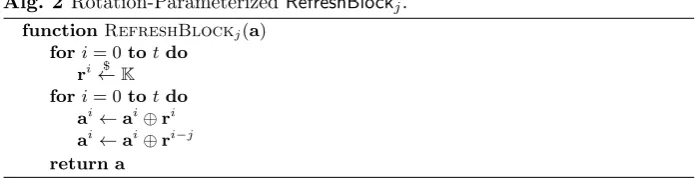
We thus consider a slight variant RefreshBlockj of RefreshBlock, shown as
composingRefreshBlock withRefreshBlockj for some well-chosen j, we therefore
avoid the repetition of patterns in the use of shares and randomness during successive iterations of the algorithm.
Alg. 2 Rotation-ParameterizedRefreshBlockj.
functionRefreshBlockj(a) fori= 0totdo
ri $
←K fori= 0totdo
ai←ai⊕ri ai←ai⊕ri−j return a
In this exploration experiment, we look for sequences of rotation offsets that allow us to reduce the randomness and time complexity of the mask refreshing gadget whilst still achievingt-SNI security.
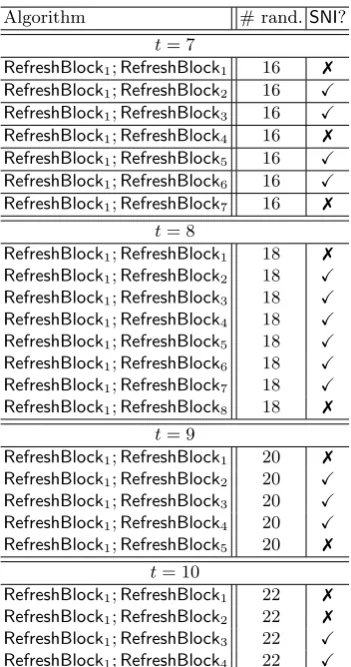
Table 2 summarizes the results of our exploration for 8, 9, 10, 11 and 12 shares. For all, we find solutions that require only two iterations of RefreshBlockj (with
different values ofj). This improves on the general result obtained by applying Corollary 2, but preserves the parallel nature of the mask refreshing algorithm. Our exploration in this setting further fails to find anySNIalgorithms with only 2 iterations of RefreshBlockj for 12 shares, although it notably finds an
algorithm for 12 shares with 3 iterations ofRefreshBlockj, i.e.,
RefreshBlock1;RefreshBlock2;RefreshBlock3 with a cost of 36 random field elements.
We note some interesting symmetries in the results due to the fact that a rotation of i positions in one direction is equivalent to a rotation of t+ 1−i
positions in the other. Interestingly, it also appears that, at ordert, the gadget RefreshBlock1;RefreshBlock(t+1)/2 is nevert-SNIwhent+ 1 is even.
4.2 Breaking Chains
Algorithm # rand.SNI? t= 7
RefreshBlock1;RefreshBlock1 16 7
RefreshBlock1;RefreshBlock2 16 X
RefreshBlock1;RefreshBlock3 16 X
RefreshBlock1;RefreshBlock4 16 7
RefreshBlock1;RefreshBlock5 16 X
RefreshBlock1;RefreshBlock6 16 X
RefreshBlock1;RefreshBlock7 16 7 t= 8
RefreshBlock1;RefreshBlock1 18 7
RefreshBlock1;RefreshBlock2 18 X
RefreshBlock1;RefreshBlock3 18 X
RefreshBlock1;RefreshBlock4 18 X
RefreshBlock1;RefreshBlock5 18 X
RefreshBlock1;RefreshBlock6 18 X
RefreshBlock1;RefreshBlock7 18 X
RefreshBlock1;RefreshBlock8 18 7 t= 9
RefreshBlock1;RefreshBlock1 20 7
RefreshBlock1;RefreshBlock2 20 X
RefreshBlock1;RefreshBlock3 20 X
RefreshBlock1;RefreshBlock4 20 X
RefreshBlock1;RefreshBlock5 20 7 t= 10
RefreshBlock1;RefreshBlock1 22 7
RefreshBlock1;RefreshBlock2 22 7
RefreshBlock1;RefreshBlock3 22 X
c0 = [a0 ⊕ [r10] ⊕ r110 ⊕ [r20] ⊕ r29]
c1 = [a1 ⊕ r11 ⊕ r10 ⊕ [r21] ⊕ r210]
c2 =a2 ⊕ r12 ⊕ r11 ⊕ r22 ⊕ r20
c3 =a3 ⊕ r
13 ⊕ r12 ⊕ r23 ⊕ r21
c4 =a4 ⊕ r
14 ⊕ r13 ⊕ r24 ⊕ r22
c5 =a5 ⊕ r
15 ⊕ r14 ⊕ r25 ⊕ r23
c6 = [a6 ⊕ r
16] ⊕ r15 ⊕ r26 ⊕ r24
c7 = [a7 ⊕ r
17 ⊕ r16 ⊕ r27] ⊕ r25
c8 = [a8 ⊕ r
18 ⊕ r17 ⊕ r28] ⊕ r26
c9 = [a9 ⊕ r
19 ⊕ r18 ⊕ r29 ⊕ r27]
c10= [a10 ⊕ r110 ⊕ r19 ⊕ r210 ⊕ r28]
A key observation is that those intermediate observations that serve to construct the chain (a8⊕r18⊕r17⊕r28,a7⊕r17⊕r16⊕r27anda6⊕r16) do not simply
lock random variables to make them unusable by the simulator: they also let the adversary gain information about one additional input share, leading to the attack. In short: those intermediate observations give more information to the adversary by letting her observe an input-dependent distribution and remove power from the simulator by locking random variables away.
With this observation in mind, it seems natural to consider a slight twist on the construction: instead of immediately adding the sampled randomness onto the input, we could construct an encoding of 0 using the same rotation-based technique and only once enough randomness has been mixed in add it onto the input encoding a. The consequence of this modification (which we generalize below) on the attack above is that intermediate observations can remove power from the simulator by locking random variables, but will never give any information about input shares to the adversary.
We now define general algorithms embodying this approach to mask refreshing, and state some results. Consider Algorithm 3a, which corresponds to the input-free part of RefreshBlockj that computes an encoding of 0. We denote with
RefreshZerot`(a) (with`a list of rotation offsets for use inZeroBlock) the algorithm
that produces an initial encoding of 0 using ZeroBlock (with the appropriate rotation offset) and remasks it usingRefreshBlock(with the appropriate rotation offset) before adding the final value onto the input shares.9
Alg. 3 TheZeroBlockj algorithm and its usage.
functionZeroBlocktj(()) fori= 0totdo
ri $
←K fori= 0totdo
ci←ri ci←ci⊕ri−j return c
(3a)ZeroBlockj.
functionRefreshZero10[1;2]((a)) r←ZeroBlock10
1 () r←RefreshBlock102 (r) c←r⊕a
(3b) A modified parallel mask refreshing algorithm based onZeroBlockt
jfort= 10.
For example, fort= 10, the modified algorithm described above is defined as RefreshZero10[1;2], shown as Algorithm 3b. Using Barthe et al.’smaskVerif tool [4], we obtain the results shown in Table 3, demonstrating the existence of a parallel
t-SNImask refreshing algorithm that uses only 2(t+ 1) random elements inKfor
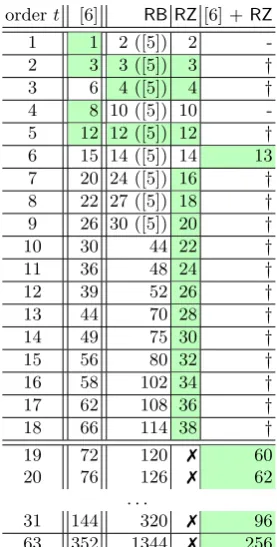
masking orders up tot= 16. In particular, this range includest= 7 andt= 15, which are particularly useful for masking bitsliced implementations. Due to the complexity of the verification problems, we do not know the minimal order for which a third encoding of 0 is required. Still, it is worth noting that, although our most effective improvements are limited to relatively low orders, they can be used to yield significant improvements also at very high orders. Indeed, if used in combination with Battistello et al’s recursive mask refreshing algorithm, our optimized low-order gadgets improve the state-of-the-art in randomness complexity for mask refreshing as shown in the last column of Table 4 (where a† is used to signify that theRefreshZero algorithm is used as a base case in the improved algorithm, and a−is used to denote the fact that Battistelo et al’s algorithm remains the best known at this order). We note in particular the significant reduction in randomness complexity for mask refreshing at order
t= 2n−1.
A note on horizontal attacks.We conclude by observing that theRefreshZero algorithm was suggested (without proof) for another purpose in [21]. Indeed, another advantage of this algorithm (which cannot be captured in the probing model) is that it increases the resistance to horizontal attacks, whereby an adversary may combine several time points from the leakage traces to learn more information about a sensitive variable. Since the sensitive variable is used only once in RefreshZero, it reduces the impact of such attacks at gadget level.
AlgorithmSNIVerif. OoM
RefreshZero2[1] X
RefreshZero3
[1] X
RefreshZero4[1] X
RefreshZero5
[1] 7
-RefreshZero5[2] 7
-RefreshZero5[1,2] X
RefreshZero6
[1,2] X
RefreshZero7[1,1] X
RefreshZero7[1,2] X
RefreshZero8
[1,1] X
RefreshZero8[1,2] X
RefreshZero9
[1,1] 7
-RefreshZero9
[1,2] X 2s
RefreshZero9[1,1,1] X 3s
RefreshZero10
[1,2] X 18s
RefreshZero11[1,2] X 49s
RefreshZero12[1,2] X 10min
RefreshZero13
[1,2] 7
-RefreshZero13[1,3] X 30min
RefreshZero14[1,3] X 1.5h
RefreshZero15
[1,3] X 2h
RefreshZero16[1,3] X 2d
RefreshZero17
[1,3] 7 2h
RefreshZero17[1,4] X 3d
RefreshZero18[1,4] X 1 month
ordert [6] RB RZ[6] +RZ
1 1 2 ([5]) 2
-2 3 3 ([5]) 3 †
3 6 4 ([5]) 4 †
4 8 10 ([5]) 10 -5 12 12 ([5]) 12 †
6 15 14 ([5]) 14 13 7 20 24 ([5]) 16 †
8 22 27 ([5]) 18 †
9 26 30 ([5]) 20 †
10 30 44 22 †
11 36 48 24 †
12 39 52 26 †
13 44 70 28 †
14 49 75 30 †
15 56 80 32 †
16 58 102 34 †
17 62 108 36 †
18 66 114 38 †
19 72 120 7 60
20 76 126 7 62
. . .
31 144 320 7 96
63 352 1344 7 256
References
1. Martin R. Albrecht and Kenneth G. Paterson. Lucky microseconds: A timing attack on amazon’s s2n implementation of TLS. In Marc Fischlin and Jean-S´ebastien Coron, editors,EUROCRYPT 2016, Part I, volume 9665 ofLNCS, pages 622–643. Springer, Heidelberg, May 2016.
2. Gilles Barthe, Sonia Bela¨ıd, Fran¸cois Dupressoir, Pierre-Alain Fouque, and Benjamin Gr´egoire. Compositional verification of higher-order masking: Application to a verifying masking compiler. Cryptology ePrint Archive, Report 2015/506, 2015. http://eprint.iacr.org/2015/506.
3. Gilles Barthe, Sonia Bela¨ıd, Fran¸cois Dupressoir, Pierre-Alain Fouque, Benjamin Gr´egoire, and Pierre-Yves Strub. Verified proofs of higher-order masking. In Elisabeth Oswald and Marc Fischlin, editors,EUROCRYPT 2015, Part I, volume 9056 ofLNCS, pages 457–485. Springer, Heidelberg, April 2015.
4. Gilles Barthe, Sonia Bela¨ıd, Fran¸cois Dupressoir, Pierre-Alain Fouque, Benjamin Gr´egoire, Pierre-Yves Strub, and R´ebecca Zucchini. Strong non-interference and type-directed higher-order masking. In Edgar R. Weippl, Stefan Katzenbeisser, Christopher Kruegel, Andrew C. Myers, and Shai Halevi, editors,ACM CCS 16, pages 116–129. ACM Press, October 2016.
5. Gilles Barthe, Fran¸cois Dupressoir, Sebastian Faust, Benjamin Gr´egoire, Fran¸ cois-Xavier Standaert, and Pierre-Yves Strub. Parallel implementations of masking schemes and the bounded moment leakage model. In Jean-S´ebastien Coron and Jesper Buus Nielsen, editors,EUROCRYPT 2017, Part I, volume 10210 ofLNCS, pages 535–566. Springer, Heidelberg, May 2017.
6. Alberto Battistello, Jean-S´ebastien Coron, Emmanuel Prouff, and Rina Zeitoun. Horizontal side-channel attacks and countermeasures on the ISW masking scheme. In Benedikt Gierlichs and Axel Y. Poschmann, editors,CHES 2016, volume 9813 ofLNCS, pages 23–39. Springer, Heidelberg, August 2016.
7. Sonia Bela¨ıd, Fabrice Benhamouda, Alain Passel`egue, Emmanuel Prouff, Adrian Thillard, and Damien Vergnaud. Randomness complexity of private circuits for mul-tiplication. In Marc Fischlin and Jean-S´ebastien Coron, editors,EUROCRYPT 2016, Part II, volume 9666 ofLNCS, pages 616–648. Springer, Heidelberg, May 2016. 8. Claude Carlet, Emmanuel Prouff, Matthieu Rivain, and Thomas Roche. Algebraic
decomposition for probing security. In Rosario Gennaro and Matthew J. B. Robshaw, editors,CRYPTO 2015, Part I, volume 9215 ofLNCS, pages 742–763. Springer, Heidelberg, August 2015.
9. Jean-S´ebastien Coron. Higher order masking of look-up tables. In Phong Q. Nguyen and Elisabeth Oswald, editors,EUROCRYPT 2014, volume 8441 ofLNCS, pages 441–458. Springer, Heidelberg, May 2014.
10. Jean-S´ebastien Coron, Emmanuel Prouff, and Matthieu Rivain. Side channel cryptanalysis of a higher order masking scheme. In Pascal Paillier and Ingrid Verbauwhede, editors,CHES 2007, volume 4727 ofLNCS, pages 28–44. Springer, Heidelberg, September 2007.
11. Jean-S´ebastien Coron, Emmanuel Prouff, Matthieu Rivain, and Thomas Roche. Higher-order side channel security and mask refreshing. In Shiho Moriai, editor,
13. Alexandre Duc, Sebastian Faust, and Fran¸cois-Xavier Standaert. Making masking security proofs concrete - or how to evaluate the security of any leaking device. In Elisabeth Oswald and Marc Fischlin, editors,EUROCRYPT 2015, Part I, volume 9056 ofLNCS, pages 401–429. Springer, Heidelberg, April 2015.
14. Sebastian Faust, Tal Rabin, Leonid Reyzin, Eran Tromer, and Vinod Vaikun-tanathan. Protecting circuits from leakage: the computationally-bounded and noisy cases. In Henri Gilbert, editor,EUROCRYPT 2010, volume 6110 ofLNCS, pages 135–156. Springer, Heidelberg, May 2010.
15. Wieland Fischer and Naofumi Homma, editors. Cryptographic Hardware and Embedded Systems - CHES 2017 - 19th International Conference, Taipei, Taiwan, September 25-28, 2017, Proceedings, volume 10529 ofLecture Notes in Computer Science. Springer, 2017.
16. Daniel Genkin, Lev Pachmanov, Itamar Pipman, Eran Tromer, and Yuval Yarom. ECDSA key extraction from mobile devices via nonintrusive physical side channels. In Edgar R. Weippl, Stefan Katzenbeisser, Christopher Kruegel, Andrew C. Myers, and Shai Halevi, editors,ACM CCS 16, pages 1626–1638. ACM Press, October 2016.
17. Dahmun Goudarzi and Matthieu Rivain. How fast can higher-order masking be in software? In Jean-S´ebastien Coron and Jesper Buus Nielsen, editors, EURO-CRYPT 2017, Part I, volume 10210 ofLNCS, pages 567–597. Springer, Heidelberg, May 2017.
18. Hannes Groß and Stefan Mangard. Reconciling d+1 masking in hardware and software. In Fischer and Homma [15], pages 115–136.
19. Daniel Gruss, Raphael Spreitzer, and Stefan Mangard. Cache template attacks: Automating attacks on inclusive last-level caches. In24th USENIX Security Sym-posium, USENIX Security 15, Washington, D.C., USA, August 12-14, 2015., pages 897–912, 2015.
20. Yuval Ishai, Amit Sahai, and David Wagner. Private circuits: Securing hardware against probing attacks. In Dan Boneh, editor,CRYPTO 2003, volume 2729 of
LNCS, pages 463–481. Springer, Heidelberg, August 2003.
21. Anthony Journault and Fran¸cois-Xavier Standaert. Very high order masking: Efficient implementation and security evaluation. In Fischer and Homma [15], pages 623–643.
22. Paul C. Kocher, Joshua Jaffe, and Benjamin Jun. Differential power analysis. In Michael J. Wiener, editor,CRYPTO’99, volume 1666 ofLNCS, pages 388–397. Springer, Heidelberg, August 1999.
23. Emmanuel Prouff and Matthieu Rivain. Masking against side-channel attacks: A formal security proof. In Thomas Johansson and Phong Q. Nguyen, editors,
EUROCRYPT 2013, volume 7881 ofLNCS, pages 142–159. Springer, Heidelberg, May 2013.
24. Matthieu Rivain and Emmanuel Prouff. Provably secure higher-order masking of AES. In Stefan Mangard and Fran¸cois-Xavier Standaert, editors,CHES 2010, volume 6225 ofLNCS, pages 413–427. Springer, Heidelberg, August 2010. 25. Kai Schramm and Christof Paar. Higher order masking of the AES. In David
Pointcheval, editor,CT-RSA 2006, volume 3860 ofLNCS, pages 208–225. Springer, Heidelberg, February 2006.