E
DRAX: A Cryptocurrency with Stateless Transaction Validation
Alexander Chepurnoy
Ergo Platform and IOHK
Charalampos Papamanthou
University of Maryland
Shravan Srinivasan
University of Maryland
Yupeng Zhang
Texas A&M University
Abstract
We present EDRAX, an architecture for cryptocurrencies with stateless transaction validation. In EDRAX, miners and validat-ing nodes process transactions and blocks simply by accessvalidat-ing a short commitment of the current state found in the most re-cent block. Therefore there is no need to store off-chain and on-disk, order-of-gigabytes large validation state. We present two instantiations of EDRAX, one in the UTXO model and one in the accounts model. Our UTXO instantiation usessparse Merkle trees, which are very fast and require no trusted setup. Our accounts instantiation uses adistributedvector commit-ment, a type of vector commitment that has state-independent updates, meaning it can be synchronized by accessing only update data (e.g., send 5 ETH from Alice to Bob). Towards this goal, we build a new succinct distributed vector commit-ment based on multiplexer polynomials and zk-SNARKs, that scales up to one billion accounts. We perform an extensive ex-perimental evaluation comparing to other (recently) proposed approaches for stateless transaction validation, showing that sparse Merkle trees and our new distributed vector commit-ment offer excellent tradeoffs in this application domain.
1
Introduction
Decentralized cryptocurrencies and smart contracts such as Bitcoin [32] and Ethereum [4] promise to remove trusted online parties (e.g., banks and escrows) in sake of faster and more secure financial transactions. Their underlying technol-ogy, the blockchain, is an ever-growing hashchain built on blocks of incoming transactions that is agreed upon by a dy-namic set of nodes participating in the peer-to-peer cryptocur-rency network. This ever-growing nature of the blockchain, however, can limit the cryptocurrency scalability, not only in terms of storage required to store all events since gene-sis, but also in terms of increasing overheads for transaction validation, blockchain verification and initial synchronization.
Most blockchain-based cryptocurrencies known to date consist of two kinds of parties,clientsthat own coins (e.g.,
a secret key to a Bitcoin address) andnodes1that validate transactions created by the clients. To decide if an incoming transaction is valid so that it can be included in the next block or propagated to a peer, nodes store all the history of transac-tions so far—namely the whole blockchain. For example, if a new transaction appears requiring 5 bitcoins to be sent from addressAto addressB, a node must query the blockchain to check whetherAhas at least 5 bitcoins in his account. Only if this is the case, this transaction is considered valid and is a candidate for appearing on the blockchain.
The blockchain data structure, however, is large (as of May 2020, Bitcoin blockchain is around 280 GB and Ethereum blockchain has exceeded 130 GB) and is growing contin-uously. Therefore naively querying it will simply take too long. For that reason, most cryptocurrency nodes are typically stateful, maintaining an appropriate index calledvalidation statethat is smaller than the blockchain and which is enough for deciding transaction validity. In some cryptocurencies (e.g., Bitcoin, ZCash, Komodo, Monero, Ergo) the validation state is a set of immutable coins called UTXO (unspent trans-action outputs), in Bitcoin jargon. In this UTXO model, a transaction is valid if it spends coins which belong in UTXO. Other cryptocurrencies (e.g., Nxt, Ethereum, Bitshares, NEM, Tezos) organize the validation state as a set of mutable (and potentially long-living) accounts. In this account model, a transaction is valid if it is trying to spend no more tokens than the available balance. Advantages and disadvantages of both approaches are the focus of an ongoing debate in the cryptocurrency community [41].
Challenges due to stateful validation. Locally maintain-ing the validation state, however, is quite cumbersome. In particular, the validation state is in the order of GBs (cur-rently the UTXO set in Bitcoin is around 3.7 GB [27] and the authenticated Patricia trie in Ethereum is around 14 GB) and could grow substantially in the coming years. For exam-ple, approximately 86,000 Ethereum new accounts/addresses
are currently generated every day [24] and at this rate the Ethereum validation state is expected to double in one year from now. For a new node to enter the network, the vali-dation state needs to be either downloaded and verified or computed from scratch, making such synchronization an ex-tremely slow process [25] (looking ahead, our approach en-ables incoming miners to validate transactions instantly, by just accessing the most recent block). Also, being in the order of GBs, the validation state is stored on disk (e.g., thegeth Ethereum implementation stores the authenticated Patricia Trie using Google’s levelDB [26]), leading to slow transac-tion validatransac-tion due to expensive I/Os [37]. This has facilitated various DoS attacks like the one that affected Ethereum in 2016 [40], where adversarially-crafted transactions required a large number of disk accesses causing block validation times to reach 60 seconds! Finally, having to store such large state to verify transactions can lead to disadvantaged miners that cannot dedicate large storage resources [9]. Other practical issues/system-level components (e.g., storage rent, sharding) that can benefit via erasure of the validation state have been extensively analyzed [25].
1.1
EDRAX
architecture
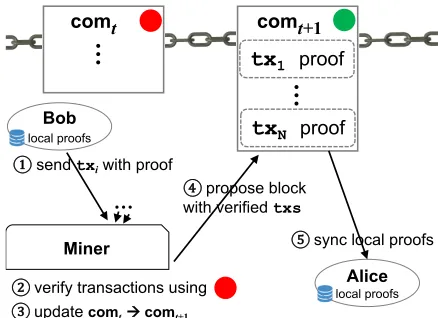
We address the above by designing and implementing EDRAX, a cryptocurrency protocol where all nodes cancheck the valid-ity of transactions without having to store any local validation state, i.e., validation state can be maintained, in the form of a short cryptographic commitment, as part of the cryptocur-rency blocks on-chain. EDRAXcomes in two versions, one supporting the UTXO model and one for the account model. EDRAX’s architecture can be seen in Figure1.
Block commitment, local proofs, transactions.In EDRAX, each blockbincludes a constant-sizeblock commitmentof the current validation state (the one that includes all transactions up to blockb). Clients, along with their coins, store short local proofsthat their coins can be spent with respect to the aforementioned block commitment. A local proof is included, with the traditional digital signature, in an EDRAXtransaction, enabling miners and validating nodes to verify transactions by accessing the latest commitment.
Local proofs & commitment synchronization.In EDRAX, Alice’s local proof for a coin with respect to commitmentcomt
at timet will be outdated at timet+1, after Bob’s transac-tions are incorporated in the blockchain andcomtchanges to
comt+1. EDRAXenables Alice to synchronize her local proofs efficiently by accessing, from the blockchain, the updates that took place betweent andt+1. (The synchronization cost can be large, in particular when Alice has been offline for a long time. In Section7where we discuss an optimization using “proof-serving nodes".) Similarly, EDRAXallows min-ers to easily synchronize the block commitment fromcomt tocomt+1to incorporate new transactions. The new commit-ment will be part of the new block.
comt+1
Alice
local proofs
①send txiwith proof
… ⑤sync local proofs
tx
1…
prooftx
N proofcomt
Bob
local proofs
Miner
③update comtàcomt+1
④propose block
with verified txs
…
…
②verify transactions using
Figure 1: EDRAXarchitecture. Transactions include proofs. Miners verify transactions using the block commitmentcomt stored at the last blockt, an updated version of which is in-cluded in the next blockt+1. Clients synchronize their local proofs after the new block is produced.
Bootstrapping & storage impact. To validate incoming transactions, a newly spawned node in EDRAXjust requires the latest block commitment. Thus bootstrapping in EDRAX just requires downloading block headers since the gene-sis, which is just in MBs (This is in contrast to Bitcoin or Ethereum where gigabytes must be downloaded to start veri-fying transactions.) We also remark that, unlike transaction signatures, proofs are not fundamentally necessary to verify the EDRAXblockchain—they serve as an efficiency optimiza-tion: A miner can simply use the proof to quickly verify an incoming transaction and later discard the proof from his local storage. Thus the size of the blockchain does not necessarily increase.
1.2
EDRAX
for UTXO via sparse Merkle trees
As warm-up, we show in Section3how to provide stateless transaction validation in the UTXO model by using Merkle trees. Recall that in the UTXO model, miners and validating nodes are maintaining a setSof unspent transaction outputs. Whenever a new transactiontxappears that has inputxand outputy, nodes must first check whether inputxbelongs inS, and if so, update setSby removingxand inserting the new outputy. Our construction representsSwith asparseMerkle tree of 2W leaves where 2W is the maximum number of out-puts that can ever be generated, e.g.,W=40. (In Section7
as commitment which is very large. In Section3we show how to append a new outputytoSby having nodes access only the local proof of themost recent outputever inserted inS(of sizeO(W)). Similarly, deletion of Alice’s spent input xfromScan be performed by having nodes process Alice’s local proof used to prove membership ofxinS.
1.3
EDRAX
for accounts via distributed vector
commitments
In the account model, nodes maintain a vector of all account balances which serves as validation state. Whenever Alice wishes to sendδtokens to Bob, she posts a transaction includ-ing this information. To verify this transaction, nodes must access the balances vector to check whether Alice has at least
δtokens in her account.
Why Merkle trees are insufficient.One could consider us-ing Merkle trees to provide stateless validation in the account model as well: Build a Merkle tree on top of the account balances, define the block commitment as the Merkle digest and have the owner of accountimaintain a Merkle proof for the balance at positionias her local proof. However, there is a fundamental problem with such an approach. Assume Alice’s balance isvAtokens and Bob’s balance isvBtokens. Whenever Alice wants to send, say, 5 tokens to Bob, Alice needs to include a Merkle tree proof proving her current bal-ance isvA≥5. Once the miner verifies the proof, the miner can process the verified proof to efficiently update the new digest so as to reflect Alice’s new account balance asvA−5. Unfortunately, due to the nature of Merkle trees, Alice’s local proof does not suffice to update Bob’s new balance tovB+5 as well unless Alice includes Bob’s local proof in her transac-tion. However, this would require Alice to contact Bob and ask for his proof every time she sends money to him which is not how cryptocurrencies work! (This is even worse if Alice’s transaction has many recipients.) Instead Alice should be able to send money to Bob by accessing a fixed public address.
Our approach: Distributed vector commitments.Our ob-servation is that any instantiation of, what we call,distributed vector commitments[17], [34], [29], addresses the above prob-lem. In a distributed vector commitment (DVC), Alice stores a constant-size commitmentCof ann-sized vectora. The vector aitself is not stored by Alice but is distributed amongnparties, each party holding a proofπiwith respect toC, in addition to elementai. When Alice wishes to update a vector element at indexubyδunits, she should be able to updateCtoC0easily
by having access only to the information(u,δ). That is, unlike
Merkle trees, updates arestate-independent. Similarly, when partyilearns about the update(u,δ), he should be able to
efficiently update his proof toπ0iwith respect to the new
com-mitmentC0, again only by accessing(u,δ). Distributed vector
commitments arefundamentally differentthan plain vector commitments such as Merkle trees and accumulator-based
vector commitments [14]—these have updates that arenot state-independent (for details see Section1.5and Section1.6).
Distributed vector commitments are perfect fit for imple-menting EDRAXin the account model by naturally viewing account balances as a vectorvand by storingC=com(v)as the block commitment: ASPENDtransaction is of the form [πi,vi,i→j,δ]meaning a clientiowningvitokens wants to sendδ≤vitokens to clientj; Proofπienable miners to check thatδ≤vi; Informationi→ j,δallows miners to updateC
to reflectvi=vi−δandvj=vj+δso as to include it in the
next block—it also allows all other clients to synchronize their proofsπkaccordingly. The detailed protocol is in Section5.
1.4
New DVC via multiplexers and SNARKs
A thorough literature review of distributed vector commit-ments revealed several inefficiencies of existing approaches (see Section1.6). Therefore we design and implement a new distributed vector commitment for EDRAX—see Section4. Our construction uses the`-variate “multiplexer" polynomialf(x)to represent a vector ofn=2`entries. For example, the multilinear extension for the vectorV= [5 2 8 3]is the polyno-mialf(x1,x2) =5·(1−x2)(1−x1) +2·(1−x2)x1+8·x2(1− x1) +3·x2x1. Which implies that, f(0,0) =V[0],f(0,1) = V[1],f(1,0) =V[2], andf(1,1) =V[3]. The commitment is then computed asgf(s), wheregis a generator of an EC group andsis a random point that is kept secret.
A proof for a vector element in the above construction has size` and takesO(`)time to verify. We reduce these costs to constant (which translate in a significant reduction in block sizes and miners and validating nodes computation) by using a zk-SNARK on the verification algorithm. While this sounds easy from a theory perspective, it is quite challenging in practice since the verification computation that must be “snarked" involves bilinear pairing operations.
Our construction finally features anO(`)-time algorithm2
for synchronizing proofπifor a pointi∈ {0,1}`given up-date(j,δ)wherejis another point in{0,1}`—see Algorithm
DELTAPOLin Section4.
1.5
Comparison with Boneh et al. [
14
]
The most closely-related work to EDRAXis the recent work by Boneh et al. [14] which built RSA-based accumulators for stateless transaction validation in the UTXO model. Unlike our sparse Merkle-tree approach, their construction supports proof batching, which can drastically decrease the block size (For all transactions in the block, one constant-size proof is required, while Merkle trees require one logarithmic-sized proof per transaction.) Their construction can also be instanti-ated with class groups, avoiding trusted setup, as our sparse Merkle trees do. RSA operations and class groups are how-ever costly compared to SHA-2 hashing and the practical
overhead can be large. In particular, RSA accumulators add an overhead close to 17×when compared to sparse Merkle trees. Also, when one focuses onno-trusted setup, the best approach for UTXO settings, then Merkle trees is a clear win-ner by a far bigger gap, since using class groups adds large overhead (In this regime, a Bitcoin block validation has an overhead of approximately 18×and miners have an over-head of 13600×compared to sparse Merkle trees.) Boneh et al. [14] also introduce a new vector commitment based on their RSA accumulator construction and propose to apply it for stateless transaction validation in the account model. However, their vector commitment isnota distributed vector commitment: To updateCtoC0, Alice requires, in addition to (u,δ), the proofπu(this is also indicated in their definition as “advice"τ). Therefore, their vector commitment is not suitable for stateless validation for accounts as we explained before. A detailed evaluation and comparison is presented in Section6.
1.6
Comparison to other DVCs
Succinctly representing vectors using multilinear extensions was introduced by Zhang et al. [42,43] for a different applica-tion, where proofs are larger and no efficient proof synchro-nization algorithms are presented.
Distributed vector commitments that can be used to imple-ment EDRAXwere also introduced by Catalano and Fiore [17], one based on elliptic curve groups and one based on the RSA cryptosystem. These approaches do not seem to scale. In particular, the EC-based construction [17] has public param-eters of quadratic size. Similarly while the RSA-based con-struction [17] has better verification complexities than our proposed commitment, it requires linear time for proof up-date (and so does a recent RSA-based work by Campanelli et al. [16]), leading to very slow proof synchronization (around 145 hours for 230accounts). The DVC scheme by Krupp et al. [28] is using [17] as a black-box (additionally offering a “Chameleon" property), thus inheriting its inefficiency. The
re-cent work of Gorbunov et al. [22] introduces POINTPROOFS, a DVC with update keys of linear size. Finally, subsequent to this work, Tomescu et al. [39] present a new DVC that supports aggregation of proofs and has short update keys.
All the above distributed vector commitments have trusted setup. To the best of our knowledge there are two distributed vector commitments with no trusted setup. The lattice-based Merkle tree by Papamanthou et al. [34] (polylogarithmic asymptotic costs) and the recent generalization of an RSA-based DVC [17] to hidden order groups by Lai and Mala-volta [29] (linear update proof costs). Both do not scale in practice due to costs associated with lattices and class groups respectively. We present a detailed comparison of the asymp-totic costs of our construction with other distributed vector commitments in Table1, as well as detailed experimental comparison of our distributed vector commitment with the RSA-based one [17] in Section6.
1.7
Implementation and evaluation
In Section6we implement both instantiations of EDRAXand evaluate the performance. Our evaluation has three main find-ings: First, for the UTXO setting, while sparse Merkle trees increase the size of the block by a logarithmic factor, they sig-nificantly (17×) outperform recently-proposed accumulator-based approaches [14] in terms of computation (e.g., block validation), especially when compared to their equivalent no-trusted setup instantiations based on class groups (18×). Sec-ond, for the accounts setting, while our vector commitment verification is slower (6s more to verify a block) compared to the only other practical distributed vector commitment [17], it features a logarithmic-time algorithm (as opposed to linear) for updating local coin proofs, which translates to several orders of magnitude savings (5825×) from a cryptocurrency client perspective.
2
Preliminaries
We now give background material on bilinear maps, multilin-ear extensions, sparse Merkle trees and vector commitments.
Bilinear pairings. We denote by (p,G,GT,e,g) ←
BilGen(1λ)generation of bilinear-map parameters, where
G, GT are groups of prime order p, withga generator ofG, and wheree:G×G→GTis an efficient map, i.e., for allP,Q∈G anda,b∈Zpit ise(Pa,Qb) =e(P,Q)ab. To prove security we will be using theq-Strong Bilinear Diffie-Hellman assump-tion [13] (q-SBDH) on the groupsGandGT that we formally define in the Appendix—see Assumption1.
Multilinear extension polynomial of vectors.Let Fbe a field (e.g.,Zp) and let n=2`. Let i∈ {0, . . . ,n−1} and let ik denote its bit at position k in binary. For a vector a= [a0, . . . ,an−1]with elements in the fieldF, we define its multilinear extension polynomialfa:F`→Fas a polynomial of`variables that servers as a multiplexer for the vectora, i.e.,
fa(x1, . . . ,x`) = n−1
∑
i=0 ai·
`
∏
k=1
selectik(xk) !
, (1)
where
selectik(xk) = (
xk ifik=1
1−xk ifik=0
. (2)
Note that polynomial fais the unique multilinear polynomial such that for alli with binary representationi`, . . . ,i1it is fa(i1, . . . ,i`) =ai. For example, fora= [5 2 8 3]the polyno-mialfa(x1,x2)equals
5·(1−x2)(1−x1) +2·(1−x2)x1+8·x2(1−x1) +3·x2x1.
Lemma 2.1. For any multilinear polynomial f :F`→F and fort∈F`, there exist polynomials qi such that f(x)− f(t) =∑`i=1(xi−ti)qi(x). Moreover, all qican be computed in O(2`) =O(|f|)time.
Preprocessing zk-SNARKs.Let
L
be an NP relation such thatx∈L
if and only if there exists a witnesswsuch thatL
(x,w) =1. A (zero-knowledge) Succinct Noninteractive ARgument of Knowledge (zk-SNARK) [36] forL
allows a verifier to efficiently verify thatx∈L
, without usingw, but via a small proof provided by an untrusted prover. A zk-SNARK consists of three polynomial-time algorithms,(G
,P
,V
):1. (PK,V K)←
G
(1λ,L
): Key generation algorithmgener-ates the proving and verifying key for the program
L
.2. π←
P
(PK,x,w): The prover generates a succinct proofπto prove that there existswsuch that
L
(x,w) =1.3. {0,1} ←
V
(V K,π,x): The verifier checks if the proofπis valid forxusing the verifying keyV K.
Informally, zk-SNARKs have two properties: First, zero-knowledge, meaning that a verifying proofπ does not
re-veal anything beyond the validity of the statement; Second, knowledge-soundness, meaning that if the verifier accepts a proof forx, the prover “knows" a witnesswforxand therefore x∈
L
(moreover the witnesswcan be extracted by inspecting the prover’s tape). For our application we will not be using the zero-knowledge property. We give the formal definition of knowledge-soundness in the Appendix—see Definition3.Sparse Merkle trees. Sparse Merkle trees are Merkle trees [30] built over key-value pairs (ki,vi)whose keys ki are drawn from a large domain[0,1, . . . ,2W−1]. In particu-lar, data item(ki,vi)is stored at theki-th leaf of the tree (the tree has a total of 2W leaves). We define a natural labeling for all nodes of the sparse Merkle tree: Root takes labelε, his left
child takes label 0, his right child takes label 1, his leftmost grandchild takes label 00 and so on.
ForW-bit leafkithat stores the data element(ki,vi)we de-fine the commitment of leafkiascom(ki) =ki||vi. For leaves
` that do not store a key we setcom(`) =null. For every internal nodeuof the Merkle tree we define the commitment ofuascom(u) =H(com(v)||com(w)), if eithercom(v)or
com(w)is not null andcom(u) =nullotherwise. Here,vis the left child ofuandwis the right child ofuandH is a collision-resistant hash function such as SHA-2.
Single item verification and deletion.For data item(k,v) let path(k)be the ordered set of nodes on the path fromk to the rootε and letsib(k) be the ordered set of siblings of nodes on path(k). Recall that the proofπ(k)for(k,v), with respect to the commitment of the rootcom(ε)is the set
com(k)∪ {com(v):v∈sib(k)}. In particular, to verify the proof, one can run a verification algorithm
d←verifyMerkle(k,v,π(k)) (3)
that recomputes the commitment of the root. Ifd=com(ε) the verification is successful and one can be assured (ex-cept with negligible probability) that(k,v)is thek-th leaf of the sparse Merkle tree. After a successful verification, the verification algorithm can also be used to updatecom(ε)
when(k,v)is deleted from the tree. In particular one can run
verify(k,null,π(k))to output the new commitmentd0. The proof size isO(W)and the verification complexity isO(W). Batch verification and deletion. The above approach can be generalized for verifying a set of data items S= {(k1,v1), . . . ,(kt,vt)} at once. In particular let path(S) be the union ofpath(ki)and letsib(S)be the union ofsib(ki). The proof π(S) for all (k1,v1), . . . ,(kt,vt) in S, with re-spect to the commitment of the root com(ε) is the set
∪icom(ki)∪ {com(v):v∈sib(S)}. In this case we can call
verifyMerkle(S,π(S))to recompute the commitment of the sparse Merkle tree and verify all elements inS, as well as
verifyMerkle({(k1,null), . . . ,(kt,null)},π(S)) for the batch deletion of all data elements inS.
Distributed vector commitments.We now give the defini-tion of a distributed vector commitment.
Definition 1(Distributed Vector Commitment). A distributed vector commitmentDVCconsists of sixPPTalgorithms:
1. pp←Gen(1λ,n): Given security parameter
λand vector
length n, it outputs public parameterspp.
2. C←Compp(a0, . . . ,an−1): Givena= (a0, . . . ,an−1), it outputs a commitmentC.
3. πi←Openpp(i,v,a): Given index i, value v anda, it
outputs proofπi.
4. {0,1} ←Verpp(C,i,v,π): Given commitmentC, an
in-dex i, a value v and a proofπit either accepts or rejects.
5. C0←UpdateCompp(u,δ,C): Given update(u,δ)3and commitmentC, it outputs the updated commitmentC0.
6. π0i←UpdateProofpp(u,δ,πi): Given update(u,δ)and a proofπi, it outputs the updated proofπ0i.
The correctness definition for DVC is in the Appendix— Definition4. We now present the soundness definition.
Definition 2(Soundness of distributed vector commitment). Consider the following experiment that takes as input the security parameterλand outputs vectora, index i, value a
and a bit b.
• Let n be output by the adversary
A
;• pp←Gen(1λ,n);
• Leta= [a0, . . . ,an−1]be output by
A
;3Value
• C←Compp(a);
• for i=1, . . . ,t=poly(λ)
–
A
outputs(u,δ)and letabe the updated vector;– C←UpdateCompp(u,δ,C);
•
A
outputs i,a,πand let b←Verpp(C,i,a,π).• return(a,i,a,b);
A distributed vector commitment scheme is sound if for all PPTadversaries
A
, the probability b=1and a6=ai, where aiis the value at i is negligible.3
EDRAX
in UTXO model
Recall the UTXO-based model follows the design of Bitcoin-like cryptocurrencies, where validating a transactiontx de-pends on whether its inputs belong to a set ofunspent trans-action outputs(or UTXO) that is maintained by the miners. Once this condition is verified, the spent inputs oftxare re-moved from UTXO and the new outputs oftxare added to UTXO. We first describe a version of EDRAXin this model.
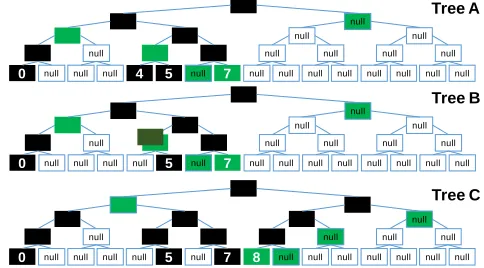
Representing UTXO as a sparse Merkle tree.We will rep-resent the UTXO set as a sparse Merkle hash tree. A similar approach has been used in Zcash [10]—unlike Zcash, how-ever, here we remove a transaction output from the Merkle tree after it is spent by marking is asnull, see Figure2. In particular each element of the UTXO is of the form(i,[pk,v]) where i is the an increasing timestamp/counter indicating when this output was added to the UTXO (and serves as the “key" in the sparse Merkle tree) and[pk,v]contains the public keypkand EDRAXunitsvthat this output can be spent to (and serves as the “value" in the sparse Merkle tree).
Block commitment.Every blockbat timet(trefers to the rank of the block in the blockchain) in UTXO EDRAX con-tains the following information as block commitment.
1. The UTXO commitmentcomt which is the root com-mitment of the sparse Merkle tree built on transaction outputs that have been generated up to blockb, blockb included (for outputs that have already been spent we mark them asnull);
2. The Merkle tree proof of the most recent entry in the UTXO, i.e., the Merkle tree proof corresponding to the last output of the last transaction in the last blockb. We call this proofmost recent proof and we denote it asπt.
Client state.A EDRAXclient stores the list
L
of his unspent transaction outputs(i,[pki,vi])(ones for which he knows re-spective secret keysski) and respective Merkle proofsπ(i).SPENDtransaction.For simplifying exposition, suppose Al-ice wants to create a transactiontxthat spends a transaction
0 null null null null
4 5 null 7 null null null
null null null null
null null null
null null null null null
0 null null null null
5 null 7 8 null null null null
null null null
null null null null
Tree A
Tree C
null
0 null null null null
5 null 7 null null null
null null null null
null null null
null null null null null
Tree B
null
Figure 2: Evolution of the sparse Merkle tree on the UTXO set. In Tree A, the UTXO set contains 4 unspent outputs that were added with timestamps 0, 4, 5 and 7. The outputs that were added with timestamps 1, 2, 3 and 6 have already been spent (and thus deleted/nullified). We highlight with green color the nodes that constitute the most recent proofπ(7). In Tree B a new transactiontxwith input 4 appears in the system (thus 4 must be deleted from the tree), causing the most recent proofπ(7)to change one of its hashes to H(null||dig(5)), indicated with dark green color. The output oftxis added in Tree C at the next position 8, causing the update of the most recent proof fromπ(7)toπ(8). Noteπ(8)in Tree C can be
computed fromπ(7)in Tree B using Algorithm3.
output(x,[pk,v])in her local list
L
to a specific public keyPK(we can trivially generalize theSPENDtransaction for multiple inputs and outputs). Letskbe the corresponding secret key to pk. Alice constructs and signs, usingsk, the transaction:
[(x,[pk,v]),π(x),PK].
To be valid,π(x)must refer to the last block, i.e., at timet.
New block creation.Suppose the last block that was com-puted is blocktand miners are competing for blockt+1. For that miners collect incomingSPENDtransactions of the type
[(x,[pk,v]),π(x),PK],sig
and decide using the block commitment at blocktwhether to include a transaction in blockt+1 as follows:
1. (transaction signature verification) Check that signature sigis valid under public keypk;
2. (verifying membership of transaction input in UTXO) Run
verifyMerkle(x,[pk,v],π(x))
as in Relation3to output a hashd. Ifd equalscomt (part of the block commitment), then the miner is assured (x,[pk,v])exists in the UTXO set and thus can be spent.
transactions that satisfy the above checks are candidates for the next block. The block has sizeO(m·W)wheremis the number of transactions in the block. Finally, in the new block t+1, miners must also include the updated UTXO commit-ment, i.e.,comt+1and the new most recent proofπt+1. We describe this procedure next.
Creating the new block commitment.We first show how to create the new block commitmentcomt,πtfor one transac-tion[(x,[pk,v]),π(x),PK]with one input and one output and then we generalize to multiple transactions—see Figure2. In particular, to computecomt+1andπt+1givencomtandπtthe miners perform the following steps:
1. (deleting transaction input from UTXO) Update the UTXO commitment comt to d0 to not contain spent input (x,[pk,v]) anymore by running d0 ← verifyMerkle(x,null,π(x))as we described in Section2;
2. (updating most recent proof due to deletion) Letcntbe the timestamp corresponding to the most recent proof
πt. For every nodev∈sib(cnt)∩path(x)replace every commitmentcom(v)in the most recent proofπt with the new commitmentscom(v)as computed by running algorithmverifyMerkle(x,null,π(x))above leading to a
new proofπ0—see Tree B in Figure2.
3. (adding transaction output to UTXO) The new transac-tion output should now be stored at leafcnt+1 as(cnt+ 1),[PK,v]). Because of the addition of the new leaf, the most recent proofπ0=π(cnt)computed above must be
updated toπt=π(cnt+1). Intuitively this can be done
sinceπtis “to the right" ofπ0—see UPDATEMOSTRE
-CENTPROOF(Algorithm3in the Appendix) for the
de-tailed pseudocode and Tree C in Figure3. Afterπt+1is computed, miners can finally update the UTXO commit-ment by runningverifyMerkle(cnt+1,[PK,v],πt)which will output the final commitmentcomt+1.
Processing multiple inputs and outputs.To process a block with more than one transactions with more than one inputs and outputs (as it typically happens in practice), miners must performbatch verificationandbatch deletionto verify and delete the inputs from the UTXO, as described in Section2. This not just an optimization, but it is needed for correctness (otherwise proofs will be out-of-sync). Finally, to add the new outputs to the UTXO, the miners run Step (3) above as many times as the number of new outputs generated in the block. Updating the block commitment with the above steps takes O(m·W) time wheremis the total number of transaction inputs and outputs in the block.
Proof computation & synchronization.For an unspent out-put(x,[pk,v])in the UTXO, letπ(x)be the proof stored
lo-cally by the client with respect to timet. To synchronizeπ(x)
for timet+1, the client must process all transactions in the
block at timet+1 by performing the same steps as the min-ers above. But instead of outputting commitmentcomt+1at timet+1 and most recent proofπt+1at timet+1, he just replaces the affected commitments inπ(x), due batch deletion and addition of the new outputs. In general, to synchronize betweent1andt2, he repeats this processt2−t1times.
4
DVC Construction
We now present our new distributed vector commitment construction used in the implementation of account-based EDRAX. We present all algorithms in detail, as defined in Def-inition1, then we show correctness as defined in Definition4
in Appendix and soundness, as required by Definition2.
4.1
Detailed construction
Our construction, among other things, will be using a zk-SNARK as a black box, on an NP relation of logarithmic size (therefore the prover will be quite efficient). We formally describe this relation in the following.
The NP relation
L
g.Let now(p,G,GT,e,g)be the output ofBilGen(1λ)and let`=logn. Let nowg= [g1, . . . ,g`]be` fixed group elements ofG. Consider now the following NP relation
L
gthat contains elements(C,i,v)∈(G×Zp×Zp) iff there exists group elementsw1, . . . ,w`inGsuch thate(C·g−v,g) = `
∏
k=1
e(gk·g−ik,wk)
i = `
∑
k=1 ik2k−1
ik(1−ik) = 0 fork=1, . . . , `
i.e.,i1, . . . ,i`is the binary representation ofi. Note now that the witness in the above relation is(w1, . . . ,wk,i1, . . . ,ik). We now describe the DVC algorithms in detail.
pp←Gen(1λ,n): Let (p,
G,GT,e,g) be the output of
BilGen(1λ). Let ` =logn and let
S
be the powerset of{1,2, . . . , `}. Selects1, . . . ,s`randomly fromFand set
prk=
g∏i∈Ssi:S∈
S
and g= [gs1, . . . ,gs`].Also for allu=0, . . . ,n−1, we define the update key for positionuto contain the following`group elements, i.e.,
upku=ng∏tk=1selectuk(sk):t∈[`]o=
upku,t:t∈[`] .
whereselectuk(sk)is by Equation2.4For example, for`=3, public parametersppwill contain
g,gs1,gs2,gs1s2,gs1s3,gs2s3,gs1s2s3,
4Note each update keyupk
ucan be constructed fromprkin linear time, so update keys need not be part of the public parameters. However, since
Genhas access tos1, . . . ,s`, each update key can be computed faster within
Algorithm 1Algorithm for computing the polynomials that are required to update the proof at positionion update(u,δ).
1: procedure[∆`(X), . . . ,∆1(X)]←DELTAPOL(u,δ,i, `) 2: if` >0then
3: ifmsb ofuis 0 and msb ofiis 1then returnh−δ·∏k=1`−1selectuk(xk),0, . . . ,0 i
;
4: ifmsb ofuis 1 and msb ofiis 0then returnh+δ·∏k=1`−1selectuk(xk),0, . . . ,0 i
;
5: ifmsb ofuis 0 and msb ofiis 0then returnh−δ·∏k=1`−1selectuk(xk),DELTAPOL(umod 2 `,
δ,imod 2`, `−1)
i ;
6: ifmsb ofuis 1 and msb ofiis 1then returnh+δ·∏k=1`−1selectuk(xk),DELTAPOL(umod 2
`,δ,imod 2`, `−1)i;
while the update keyupk0will contain
{g1−s1,g(1−s1)(1−s2),g(1−s1)(1−s2)(1−s3)}.
Let now(PK,V K)←
G
(1λ,L
g), where
G
generates public parameters of the zk-SNARK forL
g. All prk,upku (u = 0, . . . ,n−1) and(PK,V K)comprise the parameters ppof the distributed vector commitment.C←Compp(a0, . . . ,an−1): Set C =gfa(s1,...,s`), where fa is the multilinear extension polynomial of the vector a= [a0, . . . ,an−1]as defined in Equation1.
πi←Openpp(i,v,a): Leti`, . . . ,i1be the binary
representa-tion ofi. Asv=fa(i1, . . . ,i`), using polynomial decomposi-tion, compute polynomialsq1, . . . ,q`such that
fa(x)−v= `
∑
k=1
(xk−ik)qk(x).
Compute elements{gq1(s), . . . ,gq`(s)}. To compute
polynomi-alsq1, . . . ,q`, we dividefa(x)−fa(i1, . . . ,i`)byx`−i`and set q`as the quotient polynomial of the division, which is a multi-linear polynomial with variablesx1, . . . ,x`−1. The remainder is a multilinear polynomial with variablesx1, . . . ,x`−1, which we divide byx`−1−i`−1to getq`−1. We repeat recursively un-til we getq1. Let nowC=gfa(s1,...,s`). Note that(C,i,v)∈
L
g with witness{w1=gq1(s), . . . ,w`=gq`(s)}. The final proof isπi←
P
(PK,(C,i,v),{w1, . . . ,w`}).We note here that{w1, . . . ,w`}would suffice as proof ofvat indexibut consists of lognelements. zk-SNARKs allow us to compress the proof to a constant number of elements.
{0,1} ←Verpp(C,i,v,π): To verify thatvis the opening at
positioniofC, we verify the zk-SNARK proofπby invoking
{0,1} ←
V
(V K,π,(C,i,v)).C0←UpdateCompp(u,δ,C): Compute new commitment as
C0=C·hg∏k`=1selectuk(sk)i
δ
=dig·
upku,`δ .
From the above noteupku,`is sufficient to update the digest.
π0i←UpdateProofpp(u,δ,πi): Assume the witnesswused to generateπiis available asw1, . . . ,w`(in practice this can be proof metadata used only for updating the proof, but not for verification). Fori=1 to`set
w0i=wi·g∆i(s),
where∆`(x), . . . ,∆1(x)are the polynomials computed by call-ing DELTAPOL(u,δ,i, `)(see Algorithm 1). Note that it is
very easy to modify DELTAPOLto output the terms g∆i(s) directly by allowing it to access the update key upku of u (so instead for computing, for example, the polynomial −δ·∏`k=1−1selectuk(xk)it can just directly output[upku,`−1]
−δ).
To output the new proof, we can call
π0i←
P
(PK,(C0,i,v),{w01, . . . ,w0`}),whereC0is computedC0←UpdateCompp(u,δ,C).
4.2
Correctness and security analysis
To prove correctness of our scheme according to Definition4, we need to prove correctness of Algorithm DELTAPOL (Algo-rithm1). We give the proof in the Appendix—see Lemma7.1. Correctness of the rest of the scheme follows by inspection.
Concerning security, our distributed vector commitment can be viewed as an application of the selectively-secure verifiable polynomial delegation scheme in [33], for the mul-tilinear polynomial of Relation1. While selective security is very weak in general, we show it is enough for our application. This is because a vector commitment requires evaluating the polynomial on a fixed number of points, i.e., on the hypercube {0,1}`and not on arbitrary (exponentially-many) points in Z`p. We provide the detailed proof in the following.
Theorem 4.1. The distributed vector commitment scheme presented above is sound (according to Definition2) under Assumption1and assuming knowledge-soundness of the un-derlying zk-SNARK as defined in Definition3.
Proof. We now prove the soundness of the distributed vector commitment. First an`-SBDH instance
((p,G,GT,e,g),gs, . . . ,gs
Table 1: Comparison of our EDRAXDVC with existing DVCs that have short keys for updating proofs.nis the size of the vector.
Scheme Gen |π| Open UpdateComm UpdateProof Trusted Setup Aggregation
[17] (EC) O(n2) O(1) O(n) O(1) O(1) yes no
[17] and [16] (RSA) O(n) O(1) O(nlogn) O(1) O(n) yes yes
[39] (EC) O(nlogn) O(1) O(n) O(1) O(1) yes yes
[34] (lattices) O(1) O(logn) O(n) O(logn) O(logn) no no [29] (class groups) O(1) O(1) O(nlogn) O(1) O(n) no yes
EDRAX O(n) O(1) O(n) O(1) O(lognlog logn) yes no
is given to adversary
A
1. ThenA
1picks randomb∈ {0,1}` (such that 2`ispoly(λ)) and implicitly computess1=sand si=ri·(s−b1) +biwhereriare random. Now, givengs, . . . ,gs`,
A
1can easily computepp, which he all gives toA
2. Moreover, these keys are indistinguishable fromGen’s output since the ri’s have been picked at random. We now show that ifA
2 is able to break soundness as defined in Definition 2(by providing a forgery(x,a,π)toA
1) thenA
1will be able to use that forgery and break Assumption1.Indeed, given a vectoraand the corresponding commitment
C, suppose
A
2is able to output a forgery(x,a,π)such that itholds 1←Verpp(C,x,a,π)anda6=ax, whereaxis the current value at indexxofa after a possible sequence of updates. Let us assume that the indexxthat
A
2chose to forge is the indexb thatA
1 picked previously to compute the secrets si—namelyx=b. Note that the probability of that event is 1/2`=1/poly(λ). Now, since 1←V
(V K,π,(C,x,a)), by the knowledge-soundness of the zk-SNARK (see Definition3) there exists an extractor that can retrievew1, . . . ,w`such thate(gfa(s1,...,s`)−a,g) =
`
∏
i=1
e(gsi−bi,w i)
⇔e(gfa(s1,...,s`)−ax+(ax−a),g) = `
∏
i=1
e(gsi−bi,w i)
⇔e(g∑`i=1(si−bi)qi(s1,...,s`)+(ax−a),g) = `
∏
i=1
e(gsi−bi,w i)
⇔e(g,g)ax−a= `
∏
i=1 e
g, wi
gqi(s1,...,s`)
si−bi
=e
g, w1
gq1(s1,...,s`)
s−b1 `
∏
i=2 e
g, wi
gqi(s1,...,s`)
ri(s−b1)
⇔e(g,g)ax
−a s−b1 =e
g, w1
gq1(s1,...,s`)
`
∏
i=2 e
g, wi
gqi(s1,...,s`)
ri .
Therefore
A
1 can compute e(g,g)1/(s−b1) with probability 1/poly(λ)which breaks Assumption1.4.3
Asymsptotics of vector commitment
Gen runs is time O(n), since some elements ofprk share parts of the exponent and some update keys across indices are the same. E.g., indices that differ only in the msb will share
`−1 update keys. Producing the public parameters of the zk-SNARK does not add to the asymptotic cost ofGensince the NP relation used is of logarithmic size.Comruns in timeO(n) since one exponentiation per vector element is required. The size ofppisO(n), again due to overlap of update keys. Now, due to the use of zk-SNARKs, verification costs (verification key, proof size and verification time) are allO(1). The running time ofOpenisO(n), due to Lemma2.1.UpdateComruns inO(1)time andUpdateProofruns inO(lognlog logn)time in the worst case (the extra log lognfactor come from the SNARK prover). We present a detailed comparison of the asymptotics of our construction with other DVCs in Table1.
4.4
Fixed update key for updating all proofs
Note that as in the EC distributed vector commitment con-struction of Catalano and Fiore [17] (that has public param-eters of quadratic size), ourUpdateProofalgorithm allows forfixed update keyfor an indexi, that can be used to update all proofsπj, irrespective of the index j. This is contrast to other constructions, such as the RSA-based construction of Calalano and Fiore [17] and the recent one by Lai and Mala-volta [29], where for each combination ofiand ja different update key is required. This would be cumbersome in our application of stateless validation: When one would wish to post a transaction, he would have to include thenupdate keys for the sender andnupdate keys for the recipient, so that any party jcan update their proofsπjto reflect the decrease in the sender’s balance and the increase in the recipient’s bal-ance. Since this is not possible, to update the proofπj, partyj would have to compute his “custom" update key, which leads to linear computation time for synchronizing the local proofs (as opposed to ourUpdateProof’s logarithmic).5
EDRAX
in account model
database with balances and transaction validity is checked against this database (instead of UTXO). To implement EDRAXin the account-based model, we can in theory use any distributed vector commitment scheme (as given in Def-inition1) as a black box. Our evaluation uses the scheme described in Section4, which, to the best of our knowledge, is the most efficient both asymptotically and in practice.
Setup. Just like Zcash [10], EDRAX requires an one-time setup phase. In particular given an upper boundn on the number of accounts that EDRAXcan support5and the secu-rity parameterλ, algorithmGen(1λ,n)is executed outputting
the public parameterspp. Recall that the public parameters contain prover keyprk, the verification keyvrkand update keysupki—all these are hardcoded into the EDRAXreference software client. As an optimization one can just hardcode a Merkle tree digest of these parameters (since they can be quite large) and retrieve them as required during the build—this technique is used in Zcash, for example. Finally, to mitigate the risk of trapdoor leakage during execution ofGen, we can use a secure multiparty computation protocol as in [15]. Block commitment.For each blockbat timetEDRAX min-ers include, along with transaction data, two constant-size values, that comprise theblock commitment:
1. The account commitmentcomt which is a summary (hash) of the account balances in the system up to blockb, blockbincluded. It is computed using a DVC scheme as in Definition1. It is initialized by running
C←Compp(0, . . . ,0)which, in our implementation, is
g0=1, where1denotes the identity element of group G. In general the commitmentcomtwill be on a vector athat stores mappings of public keys to balances. Our implementation does that by storing mappings of the type
i→[h(PK)||balance]
whereiis in{0,1, . . . ,n−1}and is assigned by miners for a specific public keyPK—this assignment is triggered via a specialINITtransaction serving as “registration" for a new user and is described in the following.6 7
2. The account counter cntt that indicates how many INIT transactions have occurred up to blockb, block bincluded—roughly speaking this indicates how many accounts are in the system. It is initialized as 0.
5E.g., for Ethereum the number of accounts now is approximately 30 million; we will show experiments for 1 billion accounts.
6EDRAXcannot map public keys directly to balances as the vector com-mitment supports only a polynomial number of indices and the domain of public keys is exponential.
7EDRAXstores the mappingi→[h(PK)||nonce||balance], wherenonce
shows how many payments have been made out fromPK, as in Ethereum.
This is necessary to distinguish between two separate payments from the same public key and a replay attack of the same payment. For simplicity, we do not includenoncein our exposition.
Client state.Apart from a public and a secret key required in other cryptocurrencies, an EDRAXclient is required to store the local proofπfor the value of his balance with respect to the account commitmentcomt. Since this is a zk-SNARK proof for the relation
L
g, the client also stores the NP witness w1, . . . ,w`. In our implementation, proofπis small, around268 bytes. Also in our implementation each proof is initialized by running the zk-SNARK prove algorithm on the witness (1, . . . ,1)where1is the group identity element.
INITtransaction.Just like in Bitcoin and Ethereum, the first time Alice ever wants to use EDRAX, she creates a pair of pri-vate and public keys(ska,pka)(e.g., using elliptic curve cryp-tography). Recall however that EDRAXrepresents accounts as integers in{0,1, . . . ,n−1}(where, in our implementationnis around 230) and therefore a mechanism to map Alice’s public keypkato an integeri∈ {0, . . . ,n−1}must exist. To achieve that, EDRAXoffers anINITtransaction for Alice to map her public keypkato the next available indexi. In particular Alice constructs and signs, usingska, the transaction
[INIT,pka].
Looking forward, after registering a mapping of an indexito pk, this transaction will implicitly define Alice’s public key
PKaas[pka||i||upki,l]where recall thatupki,`is the update key of the distributed vector commitment scheme. For example, for`=2 andi=0,upk0,`=g(s1−1)(s2−1).
SPENDtransaction.Let us assume that Alice has public key
PKa= [pka||i||upki,l], corresponding secret keyskaand cur-rent balance equal tov0EDRAXunits. She wants to sendv≤v0 EDRAXunits to Bob with public keyPKb= [pkb||j||upkj,l]. Alice constructs and signs the following transaction:
[PKa,PKb,v,πi,v0],
meaning that public keyPKawishes to sendvEDRAXunits to public keyPKbandπiis her local proof proving thatPKahas enough fundsv0≥v(wrt the latest account commitmentcomt) to support this transaction. Note the transaction overhead is independent of the accounts numbern.
New block creation.Again, assume the last block that was computed is blocktand miners compete for blockt+1. Min-ers then collect newINITandSPENDtransactions of the type
[INIT,pk],sigand[PKa,PKb,v,πi,v0],sig
respectively. For anINITtransaction to be candidate for inclu-sion in blockt+1, it is enough that its signature verifies. To decide if aSPENDtransaction[PKa,PKb,v,πi,v0],sigcan be included in the next block the miner performs the following:
1. ParsePKaas[pka||i||upki,l]and check whethersigis a valid signature underpka;
3. Check whether 1←Verpp(comt,i,h(PKa)||v0,πi)where
comtis the account commitment of the block at timet.
The new block has sizeO(m)wheremis the number of trans-actions included in the block. Finally, in the new blockt+1, miners must also include the updated account commitment
comt+1and the new account countercntt+1. We describe how miners compute these values next.
Creating the new block commitment.To update the block commitment the miners initially setcnt←cntt andcom←
comt. Then they considerINITtransactions first andSPEND transactions later. In particular for every verifiedINIT trans-action[INIT,pk],sigsent by Alice to be included in block t+1 the miners setcnt=cnt+1 and implicitly assign the updated indexcnttopk8. Then they set
com←UpdateCompp(com,cnt,δ)
whereδ=h(PK)||0 (we assume Alice begins with 0 balance) and wherePK= [pk||cnt||upkcnt,l]. This operation essentially registers Alice’s public key to a specific indexcnt. Then for every verifiedSPENDtransaction[PKa,PKb,v,πi,v0],sigthe miners set
com←UpdateCompp(com,i,−v),
and then again
com←UpdateCompp(com,j,+v).
Note from the public parameterspponlyupki,`andupkj,`
are required to perform the above, already contained in the transactions. The above operation updates the sender and receiver balances. Finally the miners setcntt+1←cnt and
comt+1←comand output the new block commitment.
Proof synchronization.Letπbe Alice’s local proof that
cor-responds to the state of the system up until blockt. Now assume some transactions are taking place and blockt+1 is created. Alice’s local proofπis no longer valid and Alice
must synchronize her proof to make sure it incorporates all updates(u1,δ1),(u2,δ2), . . . ,(up,δp)that were included in blockt+1. To do that she executes Algorithm2by running
π←SYNCPROOF((u1,δ1), . . . ,(up,δp),π)and outputs a new synchronized proofπ. Note that since theSPENDtransactions only contains elementupki,`, Alice can fetch the rest of the update keys (e.g.,upku
i,1, . . . ,upkui,`−1) from an untrusted server, verify them using the hash of the reference software, and then update the local proof. Note also that Alice does not have to synchronize her proof at every new block. She just has to synchronize her proof whenever she wants to spend some EDRAXunits to someone else in which case she must process all the blocks since her proof was last synchronized in the same way as above. Note that the time to synchronize afterp updates isO(plogn), due to the efficiency of DELTAPOL.
8This defines Alice’s public key as[pk||cnt||upk cnt,l].
6
EDRAX
Evaluation
In this section, we present the evaluation of EDRAXin both UTXO and accounts model. In subsection6.1, we compare the Sparse Merkle Tree (SMT) of EDRAXwith RSA groups and class groups used in [14]. And in subsection 6.2, we compare the performance of our distributed vector commitment scheme used in the accounts model with other DVCs.
Experimental setup.We implement the sparse Merkle tree scheme in Scala using the Scrypto library [8]. And we imple-ment our DVC in C++ using standard cryptographic and arith-metic precision libraries. Recall that our distributed vector commitment scheme comprises of multiplexer polynomials and zk-SNARKs. We implement the multiplexer polynomial using the GMP library [5] and the libff [2] for field arithmetic and elliptic curve pairings. We implement the zk-SNARK for the NP language
L
gdefined in Section4, using the zk-SNARK by Groth [23], implemented in libsnark [12].We perform the experiments of our schemes on an Amazon EC2 c4.4xlarge machine with 30GB of RAM and an Intel Xeon E5-2666v3 CPU with 16 2.9GHz virtual cores. We perform 10 runs and report their average for each data point of running time, unless stated otherwise.
zk-SNARK for NP language
L
g.A zk-SNARK consisting of(G
,P
,V
)instantiated by an elliptic curveEdefined over a field Fq proves satisfiability of NP statements over Fr, whereFr=#E(Fq). But recall that membership verificationL
ginvolves pairing computations overFqand therefore our SNARK logic should encode operations over fieldFq, rather thanFr. As noted in prior works [11], it is impossible to find a curve whereq=r. We adopt the MNT curves approach from [11] and thus we instantiate the polynomial evaluation scheme with a curveE1overFq1 and the SNARK scheme with a curveE2overFq2 such that #E2(Fq2) =Fq1. In particu-lar, in our implementation, the polynomial evaluation scheme produces witnesses that are elements over the MNT6 curve and our zk-SNARK scheme is instantiated over MNT4 curve.Arithmetic circuit for verifying membership in
L
g.It can been seen from Section4that verifying membership inL
g consists of performing pairing operations (whose primary components are the Miller algorithm and the final exponen-tiation), exponentiating group elements to valuesi1, . . . ,ik, checking to see thati1, . . . ,ikare bits and in particular that they constitute the binary representation of valuei. . Theen-Algorithm 2Algorithm for synchronizing the proof so that updates(u1,δ1), . . . ,(ut,δt)are included.
1: procedureπ←SYNCPROOF((u1,δ1), . . . ,(up,δp),π) 2: fori=1, . . . ,pdo
3: π←UpdateProofpp(ui,δi,π);
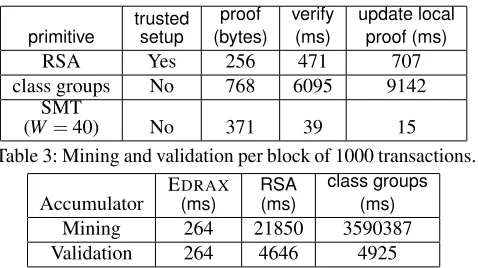
Table 2: Sparse merkle trees vs. groups of unknown order. (Time taken for 1000 runs of the same operation)
primitive
trusted setup
proof (bytes)
verify (ms)
update local proof (ms)
RSA Yes 256 471 707
class groups No 768 6095 9142
SMT
(W =40) No 371 39 15
Table 3: Mining and validation per block of 1000 transactions.
Accumulator
EDRAX
(ms)
RSA (ms)
class groups (ms)
Mining 264 21850 3590387
Validation 264 4646 4925
tire verification consists of 787K multiplication gates and the peak memory usage is 2,214 MB even for`=30.
6.1
Evaluation of sparse Merkle tree
A sparse Merkle tree (SMT) can be considered as a form of cryptographic accumulator. In this subsection, we com-pare our construction with other accumulators proposed by the concurrent work of Boneh et al. [14] which is based on groups of unknown order (RSA and class groups). We com-pare the performance of bare-bone primitives that make up the accumulators (micro-benchmarks) and the performance of the accumulators in the blockchain setting with available optimizations enabled (macro-benchmarks).
In all our experiments, we set the height of the SMT toW= 40, as this value is sufficient to support the total number of transaction outputs ever generated in Bitcoin—right now this number is about 765 million (computed using the BlockSci tool [6]). We also instantiate the RSA accumulator and the class group accumulator at accepted 2048-bit security level across all experiments. Also in our experiments, we assume a block size of 1000 transactions, each with single input and single output coin.
Microbenchmarks.In Table2, we micro-benchmark the per-formance of SMT with other primitives. The accumulators based on RSA and class groups are space efficient, as a mem-bership proof is just one group element. Thus they add mini-mal storage overhead when compared to sparse Merkle trees. However, it is computationally cheaper to verify the mem-bership of an element in SMT over other primitives, as the overhead of hashing using a lightweight SHA-2 hash function is lower than the cost exponentiating in RSA or class group. Similarly it is cheaper to update the local membership proofs in SMT than other primitives. Note that in our experiments, we consider an update as either an addition of element to the accumulated set (requires one exponentiation) or deletion of an element from the set (requires two exponentiations). Moreover, SMTs do not require trusted setup, unlike RSA-based accumulators. Even though class groups do not require a trusted setup, it is simply too expensive to perform group operations. Due to the lack of a standard library to perform
Table 4: One-time setup in our DVC for various values of`. The notation∗means estimation due to long running times. Time taken can be reduced by a factor of 10×using Lim-Lee exponentiation [7]. Alternative EC representations can reduce the size of the keys [23].
` KeyGen memory prk vrk&upk
usage size size
25 5,519s 20GB 5.3GB 11.8KB
26 11,122s 30GB 10.5GB 12.3KB
28 45,556s 30GB 41.4GB 13.2KB
29 96,965s 30GB 83.6GB 14.2KB
30 230,453s∗ 40GB 165GB 14.7KB
operations using class groups, we use the VDF implemen-tation from Chia Network to estimate the overhead of class group [3]. Thus the numbers reported in Table2is a conser-vative evaluation (lower bound) of the overhead of classgroup operations.
Macrobenchmarks.In Table3, we macro-benchmark the performance of EDRAXwith the accumulator construction proposed by Boneh et al. [14] in the blockchain setting with optimizations such as batching and aggregation. We extend the implementation of the rust accumulators library [1] to measure the performance of RSA accumulators [14].
Note that the mining costs are substantially higher (com-pared to validation) in groups of unknown order as every miner must: (i) verify every transaction in the block first (re-quires expensive group exponentiations); (ii) aggregate the proofs using the batching techniques (requires multiplication of large primes and computing Bezouts coefficients for every TX); (ii) add new coins to the accumulated set; (iv) generate membership proofs for element added to the set by factorizing the aggregate membership proof.
6.2
Evaluation of our vector commitment
In this section, we evaluate the performance of our new dis-tributed vector commitment scheme and justify its practical-ity over other DVC schemes listed in Table1. Due to the impracticality of class group objects, we exclude [29] from our comparison. Thus we limit the comparison only with the lattice-based vector commitment from [38] and the RSA-based vector commitment from Catalano et al. [17].One-time setup.The costliest part of our vector commitment scheme is the one-time setup to generate the prover, update, and verification keys. Such an expensive setup is not present in the lattice-based scheme (whose setup involves just a constant-time sampling of two lattice-based hash functions) but is required for the RSA-based DVC [17] whose linear-time setup involves generating primes for each vector index. Moreover using Lim-Lee [7] exponentiation techniques, setup time can be reduce by a factor of 10×.
24 26 28L 30 32 100
101 102
Proof Size (KB)
Vector Commitment Lattice-based Hidden order (RSA)
24 26 28L 30 32 100
101 102
Verification Time (ms)
Vector Commitment Lattice-based Hidden order (RSA)
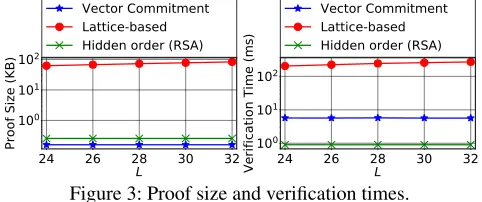
Figure 3: Proof size and verification times.
32 million elements, which is close to the current number of accounts in Ethereum [18]. Most of the time in key generation is spent on computing exponentiations in the base group, which can be easily parallelized.
Moreover, our implementation stores the prover key on disk, so it can scale to a larger`as long as the disk size is larger than the proving key size. The overhead for disk I/O is already included in the key generation time reported in Table4. We remark that EDRAXnodes do not require the multilinear polynomial evaluation scheme’s prover key—just the update key and verification key are sufficient to function in the distributed setting. Both the verification key and the update key for one element are less than 15KB for`≤30 and grow logarithmically with the elements in the vector.
Proof size and verification time.Figure3shows the com-parison of proof size and the verification time. Our scheme is asymptotically better than the lattice scheme and comparable to the RSA scheme. In practice, the proof size is less than 0.15KB for`≤32 in our scheme, while it is 62–78KB in the lattice scheme and it is 0.256 KB in the RSA scheme. This is because the the SNARK proof is three group elements whereas the proof of the RSA scheme is one group element.
For verification time, our scheme outperforms lattice-based schemes both in asymptotics and practice (7ms vs 210ms). However, despite the comparable asymptotics with the RSA-based scheme, in practice RSA-RSA-based schemes fare better than our approach. This is because our verifier performs expensive pairings to verify the proof, whereas the RSA based scheme performs cheaper modular exponentiations to verify the proof.
Digest update and proof synchronization.Figure4shows the time to update the digest and to synchronize a local proof. Our scheme requires 35µs to update the digest and 89µs (amor-tized) to synchronize the proof for one element. Recall that our proof update algorithm islogarithmicin the vector size. In the lattice based schemes, both updating the digest and the proof takes around 790 ms for`=25 and grows logarithmi-cally with`. On the contrary, proof update in RSA-based VC is very expensive: It features a linear-time algorithm, which involves computing the product of primes associated with each position of the vector and performing modular exponen-tiations. In reality the RSA-based VC requires around 14.5 hours to update the proof of a single position in the vector of size 230(which is the number of accounts in eth now).
Main finding. To summarize, our DVC is the pragmatic
24 26 28L 30 32 102
100 102
Update Digest Time (ms)
Vector Commitment Lattice-based Hidden order (RSA)
24 26 28L 30 32 10 1
100 101 102 103
Update Proof Time (ms)
Vector Commitment Lattice-based
Figure 4: Time for digest update and proof synchronization. RSA scheme [17] is not shown: it takes 14.5 hr to synchronize. choice, as it outperforms other DVCs both asymptotically and practically in one of the most crucial operations in the stateless blockchain setting, the proof update. Our DVC also has comparable asymptotic proof size and verification time.
6.3
Security of EDRAX
The security of EDRAXis based on the security of the un-derlying sparse Merkle tree (for UTXO) and the unun-derlying vector commitment (for accounts setting). In particular we note that EDRAXsatisfies the security definition presented in Section 2 of [20] (which appeared in EUROCRYPT [21]): The only difference between EDRAXand the protocol proved secure in [20] is the way the validation predicateV(XC)(page 13) is implemented: Instead of maintaining a large state vari-able for accounts/UTXO to implementV(XC), EDRAXsaves space by maintaining just a small digest of accounts/UTXO and validatesXCusing client provided proofs. Clearly, for the sameXC, both implementations ofV(XC)output the same bit with overwhelming probability, due to DVC/SMT soundness. Therefore, EDRAX’s real-world execution almost never devi-ates from the protocol proved secure in [20] and as such it is secure based on [20].
7
Conclusions and discussion
In this paper we presented EDRAX, an architecture (and two different implementations) for stateless transaction validation in cryptocurrencies. Our concrete implementations are first steps —in future more practical authenticated structures or vector commitments can be used as replacement, leading to even better performance. Here we outline future research.
have a number of leaves that are powers of two, depending on the current size of UTXO.
Proof-serving nodes. Unlike existing cryptocurrencies, EDRAXclients are required to synchronize their proof before posting a new transaction. This changes the user experience for clients and introduces a modest cost. To alleviate this cost, we can extend the EDRAXarchitecture to contain untrusted proof-serving nodes9(e.g., an Amazon machine) thatdo not participate in the blockchain consensus, which are responsi-ble for storing and servingup-to-dateproofs. Note that there is no requirement that they serve correct proofs: If the provided proof is correct (which can be checked by using blockchain digest), then this proof can be readily used, otherwise the client can always use the “default" setting and synchronize his proof by using the algorithms presented before.
Supporting smart contracts in the stateless setting. In the smart contract setting, the flow of money will depend of the execution of some contract code on the current contract state. Hence for Alice to post a contract-triggering transaction she must provide a proof of correctness of the current contract state for EDRAXnodes to execute on. Two challenges are: (i) who is storing the contract state as any client can post transactions to trigger a contract execution; (ii) how to avoid including the contract state as part of the transaction (the contract state might be too large). We leave this a future work.
References
[1] “Accumulators with class groups,”https://github.com/
cambrian/accumulator.
[2] “C++ library for finite fields and elliptic curves,”https: //github.com/scipr-lab/libff.
[3] “Chia vdf challange,”https://github.com/Chia-Network/ oldvdf-competition.
[4] “Ethereum white paper,”
https://github.com/ethereum/wiki/wiki/white-paper.”
[5] “The GNU multiple precision arithmetic library,”https: //gmplib.org/.
[6] “https://github.com/citp/blocksci.”
[7] “Libra zk reference implementation,” https: //github.com/sunblaze-ucb/Libra/blob/Libra/
implementation/src/VPD/inputvpd.cpp.
[8] “Scrypto,”https://github.com/input-output-hk/scrypto.
[9] “Utxo uh-oh...," http://gavinandresen.ninja/utxo-uhoh.”
9These nodes could be incentivized through cryptocurrency rewards.
[10] E. Ben-Sasson, A. Chiesa, C. Garman, M. Green, I. Miers, E. Tromer, and M. Virza, “Zerocash: Decentral-ized anonymous payments from bitcoin,” in2014 IEEE Symposium on Security and Privacy, SP 2014, Berkeley, CA, USA, May 18-21, 2014, 2014, pp. 459–474.
[11] E. Ben-Sasson, A. Chiesa, E. Tromer, and M. Virza, “Scalable zero knowledge via cycles of elliptic curves,” inAnnual Cryptology Conference. Springer, 2014, pp. 276–294.
[12] ——, “Succinct non-interactive zero knowledge for a von neumann architecture,” in Proceedings of the 23rd USENIX Conference on Security Symposium, ser. SEC’14. USA: USENIX Association, 2014, p. 781–796.
[13] D. Boneh and X. Boyen, “Short signatures without random oracles,” in International Conference on the Theory and Applications of Cryptographic Techniques. Springer, 2004, pp. 56–73.
[14] D. Boneh, B. Bünz, and B. Fisch, “Batching techniques for accumulators with applications to iops and stateless blockchains,” inCRYPTO, 2019.
[15] S. Bowe, A. Gabizon, and M. Green, “A multi-party protocol for constructing the public parameters of the pinocchio zk-snark,” in International Conference on Financial Cryptography and Data Security. Springer, 2018.
[16] M. Campanelli, D. Fiore, N. Greco, D. Kolonelos, and L. Nizzardo, “Vector commitment techniques and applications to verifiable decentralized storage,”IACR Cryptol. ePrint Arch., vol. 2020, p. 149, 2020. [Online]. Available:https://eprint.iacr.org/2020/149
[17] D. Catalano and D. Fiore, “Vector commitments and their applications,” inPublic-Key Cryptography - PKC 2013 - 16th International Conference on Practice and Theory in Public-Key Cryptography, Nara, Japan, Febru-ary 26 - March 1, 2013. Proceedings, 2013, pp. 55–72.
[18] E. U. A. G. Chart, “https://etherscan.io/chart/address.”
[19] T. Dryja, “Utreexo: A dynamic hash-based accumulator optimized for the bitcoin utxo set,” Cryptology ePrint Archive, Report 2019/611, 2019.
[20] J. Garay, A. Kiayias, and N. Leonardos, “The bitcoin backbone protocol: Analysis and applications,” Cryp-tology ePrint Archive, Report 2014/765, 2014,https: //eprint.iacr.org/2014/765.