c e-ISSN: 2348-6848, p- ISSN: 2348-795X Volume 2, Issue 12, December 2015
International Journal of Research (IJR)
Available at http://internationaljournalofresearch.org
Implementing of Auditing Scheme for Enhancing data
Reliability in Could Computing
Rajeswari
#1& Dr.M.S.S.Sai
#2#1
PG Scholar, Dept of CSE, KKR & KSR Institute of Technology & Sciences, Guntur, A.P, India. #2
Professor & HOD, Dept of CSE, KKR & KSR Institute of Technology & Sciences, Guntur, A.P, India
Abstract:-
Cloud computing is estimated as the cutting edge structure design of IT enterprises, giving effective remote access to greatly adaptable data storage and application services. While this outsourced storage and computing procedure can conceivably bring awesome economical savings for data owners and clients, its advantages may not be completely acknowledged because of wide uncertainties of data proprietors that their private data may be suddenly uncovered or took care of by cloud suppliers. Despite the fact that end-to-end encryption procedures have been proposed as secure answer for secure cloud data storage, an essential test toward building a full-fledged cloud data
administration remains how to successfully
augment adaptable data usage services, for example, look over the data in a privacy preserving manner. In this paper, we distinguish the framework prerequisites and difficulties toward accomplishing privacy preserving outsourced cloud data services, usable configuration and basically effective quest plans for scrambled cloud storage. We are exhibiting a general approach for these utilizing searchable encryption methods, which permits scrambled data to be sought by clients without leaking data about the data itself and client's solicitation. Empowering open review capacity for cloud storage is of discriminating significance with the goal that clients can utilize something like a
third party auditor (TPA) to check the
trustworthiness of outsourced data and can be effortless. To proficiently present a compelling TPA, the examining procedure ought to get no new vulnerabilities towards client data protection, and help to evade extra online weight to client. We propose a protected and productive cloud storage framework supporting privacy preserving open reviewing. We will further extend our outcome to
empower the TPA to perform reviews for various clients at the same time and productively.
Index Terms—
Trusted third party auditor; Cloud Service provider; data integrity;1. INTRODUCTION
c e-ISSN: 2348-6848, p- ISSN: 2348-795X Volume 2, Issue 12, December 2015
International Journal of Research (IJR)
Available at http://internationaljournalofresearch.org
real cloud foundation suppliers, for example, Amazon, Google, and Microsoft, more third-party cloud data administration suppliers are developing which are committed to offering more available and easy to understand storage services to cloud clients. Secondly, to ensure data protection and battle spontaneous access in the cloud and beyond, delicate data, e.g., messages, personal health indexs, duty reports, money related transactions, and so on may must be encoded by data proprietors before outsourcing to the business open cloud.
2. RELATED WORK
Literature survey Traditional searchable encryption has been widely studied as a cryptographic primitive, with a focus on security definition formalizations and efficiency improvements. Song et al. first introduced the notion of searchable encryption. They proposed a scheme in the symmetric key setting, where each word in the file is encrypted independently under a special two-layered encryption construction. Thus, a searching overhead is linear to the whole file collection length. Goh developed a Bloom filter-based per-file index, reducing the workload for each search request proportional to the number of files in the collection. Chang and Mitzenmacher also developed a similar per-file index scheme. To further enhance search efficiency, Curtmola et al. proposed a per-keyword-based approach, where a single encrypted hash table index is built for the entire file collection, with each entry consisting of the trapdoor of a keyword and an encrypted set of related file identifiers. Searchable encryption has also been considered in the public-key setting. Boneh et al. presented the first public key- based searchable encryption scheme, with an analogous scenario. In their construction, anyone with the public key can write to the data stored on the server but only authorized users with the private key can search. As an attempt to enrich query predicates, conjunctive keyword search over encrypted data have also been proposed. Aiming at tolerance of both minor typos and format inconsistencies in the user search input, fuzzy keyword search over encrypted cloud data has
been proposed by Li et al. in [9]. Very recently, a privacy-assured similarity search mechanism over outsourced cloud data has been explored by Wang et al. in [11]. Note that all these schemes support only Boolean keyword search, and none of them support the ranked search problem which we are focusing on in this paper. Following our research on secure ranked search over encrypted data, very recently, Cao et al. [10] propose a privacy-preserving multi keyword ranked search scheme, which extends our previous work in [1] with support of multi keyword query. They choose the principle of “coordinate matching,” i.e., as many matches as possible, to capture the similarity between a multi keyword search query and data documents, and later quantitatively formalize the principle by a secure inner product computation mechanism. One disadvantage of the scheme is that cloud server has to linearly traverse the whole index of all the documents for each search request, while ours is as efficient as existing SSE schemes
III.SYSTEM STUDY
3.1. EXISTING SYSTEM
Traditional searchable encryption schemes permit a user to safely search over encrypted data through keywords without first decrypting it, these procedures bolster only conventional Boolean keyword search, without catching any pertinence of the indexes in the search result. At the point when
straightforwardly connected in extensive
communitarian data outsourcing cloud environment, they may experience the ill effects of the accompanying two principle downsides. On the one hand, for every search demand, users without preknowledge of the encrypted cloud data need to experience each recovered document keeping in mind the end goal to discover ones most coordinating their advantage, which demands perhaps expansive measure of post-preparing overhead, On the other hand, perpetually sending
back all indexes singularly based on
c e-ISSN: 2348-6848, p- ISSN: 2348-795X Volume 2, Issue 12, December 2015
International Journal of Research (IJR)
Available at http://internationaljournalofresearch.org
which is completely undesirable in today's pay-as-you-use cloud paradigm.
3.2. PROBLEM STATEMENT
Presenting a general methodology for searchable encryption techniques, which allows encrypted data to be searched by users without leaking information about the data itself and user’s request with Security.
3.3. OBJECTIVE AND SCOPE
Paillier algorithm for encryption the schemes based on RSA related assumptions take advantage of the fact that RSA is a (Conjunctive) trapdoor function. Implementation of following functions.
Secure search
Secure View with Upload & Download Log
maintained by time.
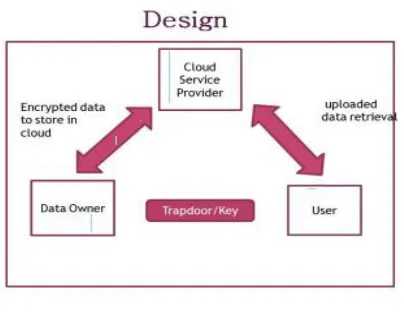
SYSTEM DESIGN
Fig 1: System Design
3.4. PROPOSED SYSTEM
Design Goals to empower privacy-preserving public auditing for cloud data storage under the specified model our convention outline ought to
accomplish the accompanying security and
performance ensures.
1) Public audit ability: to permit TPA to check the
accuracy of the cloud data on interest without
recovering a duplicate of the entire data or acquainting extra online weight with the cloud clients.
2) Storage Precision: to guarantee that there exists
no duping cloud server that can pass the TPA's audit without to be sure putting away clients' data in place.
3) Privacy-preserving: to guarantee that the TPA
can't get clients' data content from the information gathered amid the auditing procedure.
4) Batch auditing: to empower TPA with secure
and effective auditing capability to adapt to various auditing appointments from perhaps a substantial number of distinctive clients all the while.
5) Lightweight: to permit TPA to perform auditing
with least correspondence and calculation overhead.
c e-ISSN: 2348-6848, p- ISSN: 2348-795X Volume 2, Issue 12, December 2015
International Journal of Research (IJR)
Available at http://internationaljournalofresearch.org
Broad security and performance investigation demonstrate the proposed plans are provably secure and very proficient.
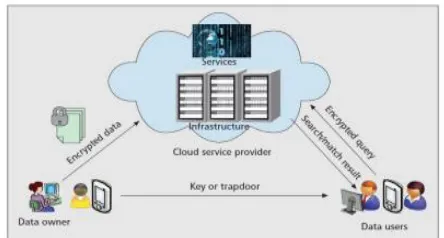
Fig 2: Third Party auditing system
The System and Threat Model Cloud data storage service involving three different entities, as illustrated in Fig. 1: the cloud user(U), who has large amount of data files to be stored in the cloud; the cloud server (CS), which is managed by the cloud service provider(CSP) to provide data storage service and has significant storage space and computation resources (we will not differentiate CS and CSP ) the third party auditor(TPA),who has expertise and capabilities that cloud users do not have and is trusted to assess the cloud storage service reliability on behalf of the user upon request. Users rely on the CS for cloud data storage and maintenance. They may also dynamically interact with the CS to access and update their stored data for various application purposes. To save the computation resource as well as the online burden, cloud users may resort to TPA for ensuring the storage integrity of their outsourced data, while hoping to keep their data private from TPA.
Privacy-Assured Searchable Cloud Storage
Architecture
Fig 3: Privacy-Assured Searchable Cloud Storage Architecture
Storage services. A general cloud data storage service architecture involving three (types of) entities Data Owner (Data Contributor)
Data User
Cloud service provider (CSP)
The data owner (or data contributor)
c e-ISSN: 2348-6848, p- ISSN: 2348-795X Volume 2, Issue 12, December 2015
International Journal of Research (IJR)
Available at http://internationaljournalofresearch.org
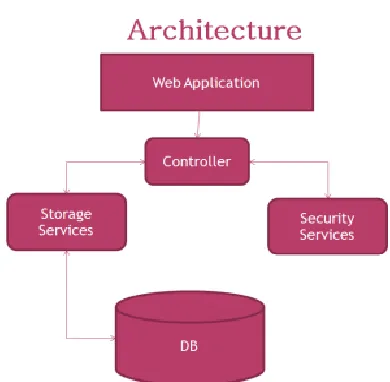
IV.PROPOSED ARCHITECTURE
Fig 4: Proposed Architecture
4.1. ALGORITHM
Parlier algorithm for encryption the schemes based on RSA related assumptions take advantage of the fact that RSA is a (conjectured) trapdoor function. The underlying idea is then to conjugate the feasibility of extracting roots of polynomials over finite fields when the trapdoor information is available with the intractability of the same problem when such information is not available. The discrete log, on the other hand, is conjectured to be just a one-way function, and the underlying idea of the schemes that rely on such assumption is, in general, to use Diffie-Hellman variants to securely encrypt and decrypt
Step 1: User encrypts the files & stores them on cloud server.
Step 2: User creates index of File name, Date Time
of upload Modification date and encrypts the table & uploads it. For Encryption user chooses a random value r € Z* N Cipher text c= gm r N mod N2 --- (4)
Step 3: User construct equality and comparison
queries and sends it to gateway server.
Step 4: Gateway server encrypts the query, Values
and query sends to the server it encrypts query using eqn (4)
Step 5: Cloud server executes encrypted query on
table using eqn (3)
Step 6: Cloud server sends back matched values to
user.
Step 7: User decrypts received values by M= mod
N The proposed scheme Key Generation
V.RESULT ANALYSIS
Fig 5: Data Upload performance report
c e-ISSN: 2348-6848, p- ISSN: 2348-795X Volume 2, Issue 12, December 2015
International Journal of Research (IJR)
Available at http://internationaljournalofresearch.org
VI.CONCLUSION
Cloud clients can remotely store their data on a common pool of configurable computing assets in cloud. Searchable Symmetric Encryption plan is used to give storage and recovery security. Request Saving Symmetric Encryption plan is upgraded in reversible component. The framework is enhanced with result authentication and comparability based positioning model. The data storage and search procedure is done with encrypted query model. The framework performs index operations on encrypted data values. The framework additionally secures the
search results. The framework underpins
incremental. Searchable Symmetric Encryption plan is used to give storage and recovery security Request Protecting Symmetric Encryption plan, Result authentication and comparability based positioning model. The data storage and search procedure is done with encrypted question model. File operations on encrypted data values. The framework additionally secures the search results.
REFERENCES
[1] S. Zerr, D. Olmedilla, W. Nejdl, and W. Siberski,Top-k Retrieval from a Confidential Index,” Proc. Int’l Conf. Extending Database Technology: Advances in Database Technology (EDBT ’09), 2009.
[2] J. Li, Q. Wang, C. Wang, N. Cao, K. Ren, and W. Lou, “Fuzzy Keyword Search over Encrypted Data in Cloud Computing,” Proc. IEEE Infocom ’10, 2010.
[3] N. Cao, C. Wang, K. Ren, and W. Lou, “Privacy Preserving Multi-Keyword Ranked Search over Encrypted Cloud Data,” Proc. IEEE Infocom ’11, 2011.
[4] C. Wang, K. Ren, S. Yu, K. Mahendra, and R. Urs, “Achieving Usable and Privacy-Assured Similarity Search over Outsourced Cloud Data,” Proc. IEEE INFOCOM, 2012.
[5] Cong Wang, Ning Cao, KuiRen and Wenjing Lou, “Enabling Secure and Efficient Ranked
Keyword Search over Outsourced Cloud Data” IEEE Transactions On Parallel And Distributed Systems, Vol. 23, No. 8, August 2012.
[6] Cong Wang, Qian Wang, KuiRen, and Wenjing Lou, "Towards Secure and Dependable Storage Services in Cloud Computing," To appear, IEEE Transactions on Service Computing (TSC).
[7] A. Boldyreva, N. Chenette, Y. Lee, and A. O’Neill. Order-preserving symmetric encryption. In Proceedings of Eurocrypt'09, volume 5479 of LNCS. Springer, 2009.
[8] M. Li, S. Yu, N. Cao, and W. Lou. Authorized private keyword search over encrypted data in cloud computing. In Distributed Computing Systems (ICDCS), 2011 31st International Conference on, pages 383–392. IEEE, 2011. International Journal of Application or Innovation in Engineering & Management (IJAIEM) Web Site: www.ijaiem.org Email: [email protected] Volume 3, Issue 7, July 2014 ISSN 2319 - 4847 Volume 3, Issue 7, July 2014 Page 72
[9] Qian Wang, Cong Wang, Kui Ren, Wenjing Lou, and Jin Li. Enabling public auditability and data dynamics for storage security in cloud computing. Parallel and Distributed Systems, IEEE Transactions on, 22(5):847 –859, may 2011.
[10] M. A. Shah, R. Swaminathan, and M. Baker, “Privacy preserving audit and extraction of digital contents,” Cryptology ePrint Archive, Report 2008/186, 2008.