A Data Driven Approach to Query Expansion in Question Answering
Leon Derczynski, Jun Wang, Robert Gaizauskas and Mark A. Greenwood Department of Computer Science
University of Sheffield Regent Court, 211 Portobello
Sheffield S1 4DP UK
{aca00lad, acp07jw}@shef.ac.uk
{r.gaizauskas, m.greenwood}@dcs.shef.ac.uk
Abstract
Automated answering of natural language questions is an interesting and useful prob-lem to solve. Question answering (QA) systems often perform information trieval at an initial stage. Information re-trieval (IR) performance, provided by en-gines such as Lucene, places a bound on overall system performance. For example, no answer bearing documents are retrieved at low ranks for almost 40% of questions.
In this paper, answer texts from previous QA evaluations held as part of the Text REtrieval Conferences (TREC) are paired with queries and analysed in an attempt to identify performance-enhancing words. These words are then used to evaluate the performance of a query expansion method.
Data driven extension words were found to help in over 70% of difficult questions. These words can be used to improve and evaluate query expansion methods. Sim-ple blind relevance feedback (RF) was cor-rectly predicted as unlikely to help overall performance, and an possible explanation is provided for its low value in IR for QA.
1 Introduction
The task of supplying an answer to a question, given some background knowledge, is often con-sidered fairly trivial from a human point of view, as long as the question is clear and the answer is
c
2008. Licensed under the Creative Commons
Attribution-Noncommercial-Share Alike 3.0 Unported
li-cense (http://creativecommons.org/licenses/by-nc-sa/3.0/). Some rights reserved.
known. The aim of an automated question answer-ing system is to provide a sanswer-ingle, unambiguous re-sponse to a natural language question, given a text collection as a knowledge source, within a certain amount of time. Since 1999, the Text Retrieval Conferences have included a task to evaluate such systems, based on a large pre-defined corpus (such as AQUAINT, containing around a million news articles in English) and a set of unseen questions.
Many information retrieval systems perform document retrieval, giving a list of potentially rel-evant documents when queried – Google’s and Ya-hoo!’s search products are examples of this type of application. Users formulate a query using a few keywords that represent the task they are trying to perform; for example, one might search for “eif-fel tower height” to determine how tall the Eif“eif-fel tower is. IR engines then return a set of references to potentially relevant documents.
In contrast, QA systems must return an exact an-swer to the question. They should be confident that the answer has been correctly selected; it is no longer down to the user to research a set of doc-ument references in order to discover the informa-tion themselves. Further, the system takes a natural language question as input, instead of a few user-selected key terms.
Once a QA system has been provided with a question, its processing steps can be described in three parts - Question Pre-Processing, Text Re-trieval and Answer Extraction:
1. Question Pre-Processing TREC questions are grouped into series which relate to a given target. For example, the target may be “Hinden-burg disaster” with questions such as “What type of craft was the Hindenburg?” or “How fast could it travel?”. Questions may include pronouns
erencing the target or even previous answers, and as such require processing before they are suitable for use.
2. Text Retrieval An IR component will return a ranked set of texts, based on query terms. At-tempting to understand and extract data from an entire corpus is too resource intensive, and so an IR engine defines a limited subset of the corpus that is likely to contain answers. The question should have been pre-processed correctly for a useful set of texts to be retrieved – including anaphora reso-lution.
3. Answer Extraction (AE) Given knowledge about the question and a set of texts, the AE sys-tem atsys-tempts to identify answers. It should be clear that only answers within texts returned by the IR component have any chance of being found.
Reduced performance at any stage will have a knock-on effect, capping the performance of later stages. If questions are left unprocessed and full of pronouns (e.g.,“When did it sink?”) the IR com-ponent has very little chance of working correctly – in this case, the desired action is to retrieve documents related to the Kursk submarine, which would be impossible.
IR performance with a search engine such as Lucene returns no useful documents for at least 35% of all questions – when looking at the top 20 returned texts. This caps the AE component at 65% question “coverage”. We will measure the performance of different IR component configura-tions, to rule out problems with a default Lucene setup.
For each question, answers are provided in the form of regular expressions that match answer text, and a list of documents containing these answers in a correct context. As references to correct doc-uments are available, it is possible to explore a data-driven approach to query analysis. We deter-mine which questions are hardest then concentrate on identifying helpful terms found in correct doc-uments, with a view to building a system than can automatically extract these helpful terms from un-seen questions and supporting corpus. The avail-ability and usefulness of these terms will provide an estimate of performance for query expansion techniques.
There are at least two approaches which could make use of these term sets to perform query ex-pansion. They may occur in terms selected for
blind RF (non-blind RF is not applicable to the TREC QA task). It is also possible to build a cata-logue of terms known to be useful according to cer-tain question types, thus leading to a dictionary of (known useful) expansions that can be applied to previously unseen questions. We will evaluate and also test blind relevance feedback in IR for QA.
2 Background and Related Work
The performance of an IR system can be quanti-fied in many ways. We choose and define mea-sures pertinent to IR for QA. Work has been done on relevance feedback specific to IR for QA, where it is has usually be found to be unhelpful. We out-line the methods used in the past, extend them, and provide and test means of validating QA relevance feedback.
2.1 Measuring QA Performance
This paper uses two principle measures to describe the performance of the IR component. Coverage is defined as the proportion of questions where at least one answer bearing text appears in the re-trieved set. Redundancy is the average number of answer bearing texts retrieved for each ques-tion (Roberts and Gaizauskas, 2004).
Both these measures have a fixed limitnon the number of texts retrieved by a search engine for a query. As redundancy counts the number of texts containing correct answers, and not instances of the answer itself, it can never be greater than the number of texts retrieved.
The TREC reference answers provide two ways of finding a correct text, with both a regular expres-sion and a document ID. Lenient hits (retrievals of answer bearing documents) are those where the re-trieved text matches the regular expression; strict hits occur when the document ID of the retrieved text matches that declared by TREC as correct and the text matches the regular expression. Some doc-uments will match the regular expression but not be deemed as containing a correct answer (this is common with numbers and dates (Baeza-Yates and Ribeiro-Neto, 1999)), in which case a lenient match is found, but not a strict one.
matches can occur out of context, without a sup-porting document; performance based on lenient matches can be viewed as an approximate upper bound (Lin and Katz, 2005).
2.2 Relevance Feedback
Relevance feedback is a widely explored technique for query expansion. It is often done using a spe-cific measure to select terms using a limited set of ranked documents of sizer; using a larger set will bring term distribution closer to values over the whole corpus, and away from ones in documents relevant to query terms. Techniques are used to identify phrases relevant to a query topic, in or-der to reduce noise (such as terms with a low cor-pus frequency that relate to only a single article) and query drift (Roussinov and Fan, 2005; Allan, 1996).
In the context of QA, Pizzato (2006) employs blind RF using the AQUAINT corpus in an attempt to improve performance when answering factoid questions on personal names. This is a similar ap-proach to some content in this paper, though lim-ited to the study of named entities, and does not attempt to examine extensions from the existing answer data.
Monz (2003) finds a negative result when apply-ing blind feedback for QA in TREC 9, 10 and 11, and a neutral result for TREC 7 and 8’s ad hoc re-trieval tasks. Monz’s experiment, using r = 10 and standard Rocchio term weighting, also found a further reduction in performance when r was reduced (from 10 to 5). This is an isolated ex-periment using just one measure on a limited set of questions, with no use of the available answer texts.
Robertson (1992) notes that there are issues when using a whole document for feedback, as opposed to just a single relevant passage; as men-tioned in Section 3.1, passage- and document-level retrieval sets must also be compared for their per-formance at providing feedback. Critically, we will survey the intersection between words known to be helpful and blind RF terms based on initial retrieval, thus showing exactly how likely an RF method is to succeed.
3 Methodology
We first investigated the possibility of an IR-component specific failure leading to impaired coverage by testing a variety of IR engines and
configurations. Then, difficult questions were identified, using various performance thresholds. Next, answer bearing texts for these harder ques-tions were checked for words that yielded a per-formance increase when used for query expansion. After this, we evaluated how likely a RF-based proach was to succeed. Finally, blind RF was ap-plied to the whole question set. IR performance was measured, and terms used for RF compared to those which had proven to be helpful as extension words.
3.1 IR Engines
A QA framework (Greenwood, 2004a) was origi-nally used to construct a QA system based on run-ning a default Lucene installation. As this only covers one IR engine in one configuration, it is prudent to examine alternatives. Other IR engines should be tested, using different configurations. The chosen additional engines were: Indri, based on the mature INQUERY engine and the Lemur toolkit (Allan et al., 2003); and Terrier, a newer en-gine designed to deal with corpora in the terabyte range and to back applications entered into TREC conferences (Ounis et al., 2005).
We also looked at both passage-level and document-level retrieval. Passages can be de-fined in a number of ways, such as a sentence, a sliding window of k terms centred on the tar-get term(s), parts of a document of fixed (and equal) lengths, or a paragraph. In this case, the documents in the AQUAINT corpus contain paragraph markers which were used as passage-level boundaries, thus making “passage-passage-level” and “paragraph-level” equivalent in this paper. Passage-level retrieval may be preferable for AE, as the number of potential distracters is some-what reduced when compared to document-level retrieval (Roberts and Gaizauskas, 2004).
The initial IR component configuration was with Lucene indexing the AQUAINT corpus at passage-level, with a Porter stemmer (Porter, 1980) and an augmented version of the CACM (Jones and van Rijsbergen, 1976) stopword list.
Indri natively supports document-level indexing of TREC format corpora. Passage-level retrieval was done using the paragraph tags defined in the corpus as delimiters; this allows both passage- and document-level retrieval from the same index, ac-cording to the query.
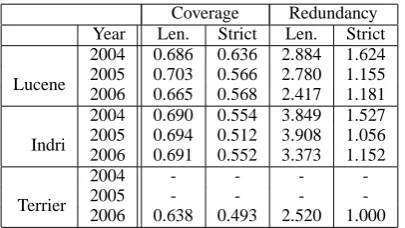
Coverage Redundancy Year Len. Strict Len. Strict
Lucene
2004 0.686 0.636 2.884 1.624 2005 0.703 0.566 2.780 1.155 2006 0.665 0.568 2.417 1.181
Indri
2004 0.690 0.554 3.849 1.527 2005 0.694 0.512 3.908 1.056 2006 0.691 0.552 3.373 1.152
Terrier
2004 - - -
-2005 - - -
[image:4.595.82.285.70.184.2]-2006 0.638 0.493 2.520 1.000
Table 1: Performance of Lucene, Indri and Terrier at para-graph level, over top 20 documents. This clearly shows the limitations of the engines.
stemmer and the same CACM-derived stopword list.
The top n documents for each question in the TREC2004, TREC2005 and TREC2006 sets were retrieved using every combination of engine, and configuration1. The questions and targets were processed to produce IR queries as per the default configuration for the QA framework. Examining the top 200 documents gave a good compromise between the time taken to run experiments (be-tween 30 and 240 minutes each) and the amount one can mine into the data. Tabulated results are shown in Table 1 and Table 2. Queries have had anaphora resolution performed in the context of their series by the QA framework. AE compo-nents begin to fail due to excess noise when pre-sented with over 20 texts, so this value is enough to encompass typical operating parameters and leave space for discovery (Greenwood et al., 2006).
A failure analysis (FA) tool, an early version of which is described by (Sanka, 2005), provided reporting and analysis of IR component perfor-mance. In this experiment, it provided high level comparison of all engines, measuring coverage and redundancy as the number of documents re-trieved,n, varies. This is measured because a per-fect engine will return the most useful documents first, followed by others; thus, coverage will be higher for that engine with low values ofn.
3.2 Identification of Difficult Questions
Once the performance of an IR configuration over a question set is known, it’s possible to produce a simple report listing redundancy for each ques-tion. A performance reporting script accesses the
1Save Terrier / TREC2004 / passage-level retrieval;
passage-level retrieval with Terrier was very slow using our configuration, and could not be reliably performed using the same Terrier instance as document-level retrieval.
Coverage Redundancy Year Len. Strict Len. Strict
Indri
2004 0.926 0.837 7.841 2.663 2005 0.935 0.735 7.573 1.969 2006 0.882 0.741 6.872 1.958
Terrier
[image:4.595.318.517.71.155.2]2004 0.919 0.806 7.186 2.380 2005 0.928 0.766 7.620 2.130 2006 0.983 0.783 6.339 2.067
Table 2: Performance of Indri and Terrier at document level IR over the AQUAINT corpus, withn= 20
FA tool’s database and lists all the questions in a particular set with the strict and lenient redun-dancy for selected engines and configurations. En-gines may use passage- or document-level config-urations.
Data on the performance of the three engines is described in Table 2. As can be seen, the cover-age with passcover-age-level retrieval (which was often favoured, as the AE component performs best with reduced amounts of text) languishes between 51% and 71%, depending on the measurement method. Failed anaphora resolution may contribute to this figure, though no deficiencies were found upon vi-sual inspection.
Not all documents containing answers are noted, only those checked by the NIST judges (Bilotti et al., 2004). Match judgements are incomplete, leading to the potential generation of false nega-tives, where a correct answer is found with com-plete supporting information, but as the informa-tion has not been manually flagged, the system will mark this as a failure. Assessment methods are fully detailed in Dang et al. (2006). Factoid per-formance is still relatively poor, although as only 1.95 documents match per question, this may be an effect of such false negatives (Voorhees and Buck-land, 2003). Work has been done into creating synthetic corpora that include exhaustive answer sets (Bilotti, 2004; Tellex et al., 2003; Lin and Katz, 2005), but for the sake of consistency, and easy comparison with both parallel work and prior local results, the TREC judgements will be used to evaluate systems in this paper.
zero are marked difficult, and subjected to further analysis. Reducing the question set to just diffi-cult questions produces a TREC-format file for re-testing the IR component.
3.3 Extension of Difficult Questions
The documents deemed relevant by TREC must contain some useful text that can help IR engine performance. Such words should be revealed by a gain in redundancy when used to extend an ini-tially difficult query, usually signified by a change from zero to a non-zero value (signifying that rele-vant documents have been found where none were before). In an attempt to identify where the use-ful text is, the relevant documents for each difficult question were retrieved, and passages matching the answer regular expression identified. A script is then used to build a list of terms from each passage, removing words in the question or its target, words that occur in the answer, and stopwords (based on both the indexing stopword list, and a set of stems common within the corpus). In later runs, num-bers are also stripped out of the term list, as their value is just as often confusing as useful (Baeza-Yates and Ribeiro-Neto, 1999). Of course, answer terms provide an obvious advantage that would not be reproducible for questions where the answer is unknown, and one of our goals is to help query ex-pansion for unseen questions. This approach may provide insights that will enable appropriate query expansion where answers are not known.
Performance has been measured with both the question followed by an extension (Q+E), as well as the question followed by the target and then extension candidates (Q+T+E). Runs were also executed with just Q and Q+T, to provide non-extended reference performance data points. Ad-dition of the target often leads to gains in perfor-mance (Roussinov et al., 2005), and may also aid in cases where anaphora resolution has failed.
Some words are retained, such as titles, as in-cluding these can be inferred from question or tar-get terms and they will not unfairly boost redun-dancy scores; for example, when searching for a “Who” question containing the word “military”, one may want to preserve appellations such as “Lt.” or “Col.”, even if this term appears in the an-swer.
This filtered list of extensions is then used to cre-ate a revised query file, containing the base ques-tion (with and without the target suffixed) as well
as new questions created by appending a candidate extension word.
Results of retrievals with these new question are loaded into the FA database and a report describ-ing any performance changes is generated. The extension generation process also creates custom answer specifications, which replicate the informa-tion found in the answers defined by TREC.
This whole process can be repeated with vary-ing question difficulty thresholds, as well as alter-nativenvalues (typically from 5 to 100), different engines, and various question sets.
3.4 Relevance Feedback Performance
Now that we can find the helpful extension words (HEWs) described earlier, we’re equipped to eval-uate query expansion methods. One simplistic ap-proach could use blind RF to determine candidate extensions, and be considered potentially success-ful should these words be found in the set of HEWs for a query. For this, term frequencies can be measured given the toprdocuments retrieved us-ing anaphora-resolved query Q. After stopword and question word removal, frequent terms are ap-pended to Q, which is then re-evaluated. This has been previously attempted for factoid ques-tions (Roussinov et al., 2005) and with a limited range of r values (Monz, 2003) but not validated using a set of data-driven terms.
We investigated how likely term frequency (TF) based RF is to discover HEWs. To do this, the proportion of HEWs that occurred in initially re-trieved texts was measured, as well as the propor-tion of these texts containing at least one HEW. Also, to see how effective an expansion method is, suggested expansion terms can be checked against the HEW list.
We used both the top 5 and the top 50 documents in formulation of extension terms, with TF as a ranking measure; 50 is significantly larger than the optimal number of documents for AE (20), without overly diluting term frequencies.
Engine Year Lucene
Para
Indri Para
Indri Doc
Terrier Doc
2004 76 72 37 42
2005 87 98 37 35
[image:6.595.84.281.69.132.2]2006 108 118 59 53
Table 3: Number of difficult questions, as defined by those which have zero redundancy over both strict and lenient mea-sures, atn = 20. Questions seem to get harder each year. Document retrieval yields fewer difficult questions, as more text is returned for potential matching.
Engine
[image:6.595.325.510.70.133.2]Lucene Indri Terrier Paragraph 226 221 -Document - 121 109
Table 4: Number of difficult questions in the 2006 task, as de-fined above, this time withn= 5. Questions become harder as fewer chances are given to provide relevant documents.
4 Results
Once we have HEWs, we can determine if these are going to be of significant help when chosen as query extensions. We can also determine if a query expansion method is likely to be fruitful. Blind RF was applied, and assessed using the helpful words list, as well as RF’s effect on coverage.
4.1 Difficult Question Analysis
The number of difficult questions found at n =
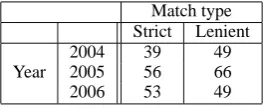
20 is shown in Table 3. Document-level retrieval gave many fewer difficult questions, as the amount of text retrieved gave a higher chance of finding lenient matches. A comparison of strict and lenient matching is in Table 5.
Extensions were then applied to difficult ques-tions, with or without the target. The performance of these extensions is shown in Table 6. Results show a significant proportion (74.4%) of difficult questions can benefit from being extended with non-answer words found in answer bearing texts.
4.2 Applying Relevance Feedback
Identifying HEWs provides a set of words that are useful for evaluating potential expansion terms.
Match type Strict Lenient
Year
2004 39 49 2005 56 66 2006 53 49
Table 5: Common difficult questions (over all three engines mentioned above) by year and match type;n= 20.
[image:6.595.311.519.199.242.2]Difficult questions used 118 Variations tested 6683 Questions that benefited 87 (74.4%) Helpful extension words (strict) 4973 Mean helpful words per question 42.144 Mean redundancy increase 3.958
Table 6: Using Terrier Passage / strict matching, retrieving 20 docs, with TREC2006 questions / AQUAINT. Difficult ques-tions are those where no strict matches are found in the top 20 IRT from just one engine.
2004 2005 2006 HEW found in IRT 4.17% 18.58% 8.94% IRT containing HEW 10.00% 33.33% 34.29% RF words in HEW 1.25% 1.67% 5.71%
Table 7: “Helpful extension words”: the set of extensions that, when added to the query, move redundancy above zero.r =
5,n= 20, using Indri at passage level.
Using simple TF based feedback (see Section 3.4), 5 terms were chosen per query. These words had some intersection (see Table 7) with the exten-sion words set, indicating that this RF may lead to performance increases for previously unseen ques-tions. Only a small number of the HEWs occur in the initially retrieved texts (IRTs), although a no-ticeable proportion of IRTs (up to 34.29%) contain at least one HEW. However, these terms are prob-ably not very frequent in the documents and un-likely to be selected with TF-based blind RF. The mean proportion of RF selected terms that were HEWs was only 2.88%. Blind RF for question an-swering fails here due to this low proportion. Strict measures are used for evaluation as we are inter-ested in finding documents which were not pre-viously being retrieved rather than changes in the distribution of keywords in IRT.
Document and passage based RF term selection is used, to explore the effect of noise on terms, and document based term selection proved marginally superior. Choosing RF terms from a small set of documents (r = 5) was found to be marginally better than choosing from a larger set (r = 50). In support of the suggestion that RF would be
un-r
5 50 Baseline
Rank Doc Para Doc Para
5 0.253 0.251 0.240 0.179 0.312 10 0.331 0.347 0.331 0.284 0.434 20 0.438 0.444 0.438 0.398 0.553 50 0.583 0.577 0.577 0.552 0.634
[image:6.595.106.257.210.251.2] [image:6.595.311.520.667.739.2] [image:6.595.116.248.686.740.2]Question:
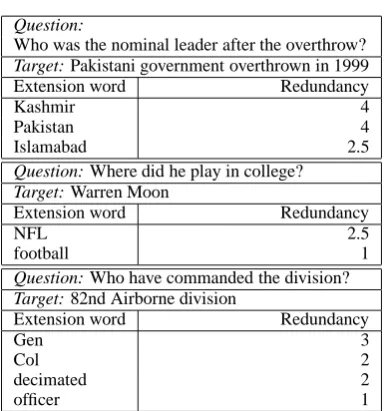
Who was the nominal leader after the overthrow?
Target: Pakistani government overthrown in 1999
Extension word Redundancy
Kashmir 4
Pakistan 4
Islamabad 2.5
Question: Where did he play in college? Target: Warren Moon
Extension word Redundancy
NFL 2.5
football 1
Question: Who have commanded the division? Target: 82nd Airborne division
Extension word Redundancy
Gen 3
Col 2
decimated 2
[image:7.595.86.280.64.270.2]officer 1
Table 9: Queries with extensions, and their mean redundancy using Indri at document level withn = 20. Without exten-sions, redundancy is zero.
likely to locate HEWs, applying blind RF consis-tently hampered overall coverage (Table 8).
5 Discussion
HEWs are often found in answer bearing texts, though these are hard to identify through sim-ple TF-based RF. A majority of difficult questions can be made accessible through addition of HEWs present in answer bearing texts, and work to deter-mine a relationship between words found in initial retrieval and these HEWs can lead to coverage in-creases. HEWs also provide an effective means of evaluating other RF methods, which can be de-veloped into a generic rapid testing tool for query expansion techniques. TF-based RF, while finding some HEWs, is not effective at discovering exten-sions, and reduces overall IR performance.
There was not a large performance change between engines and configurations. Strict paragraph-level coverage never topped 65%, leav-ing a significant number of questions where no useful information could be provided for AE.
The original sets of difficult questions for in-dividual engines were small – often less than the 35% suggested when looking at the coverage fig-ures. Possible causes could include:
Difficult questions being defined as those for which average redundancy is zero: This limit
may be too low. To remedy this, we could increase the redundancy limit to specify an arbitrary num-ber of difficult questions out of the whole set.
The use of both strict and lenient measures: It
is possible to get a lenient match (thus marking a question as non-difficult) when the answer text oc-curs out of context.
Reducing n from 20 to 5 (Table 4) increased the number of difficult questions produced. From this we can hypothesise that although many search engines are succeeding in returning useful docu-ments (where available), the distribution of these documents over the available ranks is not one that bunches high ranking documents up as those im-mediately retrieved (unlike a perfect engine; see Section 3.1), but rather suggests a more even dis-tribution of such documents over the returned set.
The number of candidate extension words for queries (even after filtering) is often in the range of hundreds to thousands. Each of these words creates a separate query, and there are two varia-tions, depending on whether the target is included in the search terms or not. Thus, a large number of extended queries need to be executed for each question run. Passage-level retrieval returns less text, which has two advantages: firstly, it reduces the scope for false positives in lenient matching; secondly, it is easier to scan result by eye and de-termine why the engine selected a result.
Proper nouns are often helpful as extensions. We noticed that these cropped up fairly regularly for some kinds of question (e.g. “Who”). Espe-cially useful were proper nouns associated with locations - for example, adding “Pakistani” to a query containing the word Pakistan lifted re-dundancy above zero for a question on President Musharraf, as in Table 9. This reconfirms work done by Greenwood (2004b).
6 Conclusion and Future Work
in particular circumstances using a single ranking measure, though this has not been based on analy-sis of answer bearing texts. The presence of HEWs in IRT for difficult questions shows that guided RF may work, but this will be difficult to pursue. Blind RF based on term frequencies does not increase IR performance. However, there is an intersection be-tween words in initially retrieved texts and words data driven analysis defines as helpful, showing promise for alternative RF methods (e.g. based on TFIDF). These extension words form a basis for indicating the usefulness of RF and query expan-sion techniques.
In this paper, we have chosen to explore only one branch of query expansion. An alternative data driven approach would be to build associations be-tween recurrently useful terms given question con-tent. Question texts could be stripped of stopwords and proper nouns, and a list of HEWs associated with each remaining term. To reduce noise, the number of times a particular extension has helped a word would be counted. Given sufficient sample data, this would provide a reference body of HEWs to be used as an aid to query expansion.
References
Allan, J., J. Callan, K. Collins-Thompson, B. Croft, F. Feng, D. Fisher, J. Lafferty, L. Larkey, TN Truong, P. Ogilvie, et al. 2003. The Lemur Toolkit for Lan-guage Modeling and Information Retrieval.
Allan, J. 1996. Incremental Relevance Feedback for Information Filtering. In Research and Development
in IR, pages 270–278.
Baeza-Yates, R. and B. Ribeiro-Neto. 1999. Modern
Information Retrieval. Addison Wesley.
Bilotti, M.W., B. Katz, and J. Lin. 2004. What Works Better for Question Answering: Stemming or Mor-phological Query Expansion. Proc. IR for QA
Work-shop at SIGIR 2004.
Bilotti, M.W. 2004. Query Expansion Techniques for Question Answering. Master’s thesis, Massachusetts Institute of Technology.
Dang, H.T., J. Lin, and D. Kelly. 2006. Overview of the TREC 2006 QA track. Proc. 15th Text REtrieval
Conf..
Greenwood, M.A., M. Stevenson, and R. Gaizauskas.
2006. The University of Sheffield’s TREC 2006
Q&A Experiments. In Proc. 15th Text REtrieval
Conference
Greenwood, M.A. 2004a. AnswerFinder: Question Answering from your Desktop. In Proc. 7th Annual
Colloquium for the UK SIG for Computational Lin-guistics (CLUK ’04).
Greenwood, M.A. 2004b. Using Pertainyms to Im-prove Passage Retrieval for Questions Requesting Information about a Location. In Proc. Workshop
on IR for QA (SIGIR 2004).
Jones, K.S. and C.J. van Rijsbergen. 1976. IR Test Collections. J. of Documentation, 32(1):59–75.
Lin, J. and B. Katz. 2005. Building a Reusable Test Collection for Question Answering. J. American
So-ciety for Information Science and Technology.
Monz, C. 2003. From Document Retrieval to Question Answering. ILLC Dissertation Series 2003, 4.
Ounis, I., G. Amati, V. Plachouras, B. He, C. Macdon-ald, and D. Johnson. 2005. Terrier IR Platform.
Proc. 27th European Conf. on IR (ECIR 05), San-tiago de Compostela, Spain, pages 517–519.
Pizzato, L.A., D. Molla, and C. Paris. 2006. Pseudo-Relevance Feedback using Named Entities for Ques-tion Answering. Australasian Language Technology
Workshop (ALTW2006), pages 83–90.
Porter, M. 1980. An Algorithm for Suffix Stripping Program. Program, 14(3):130–137.
Roberts, I and R Gaizauskas. 2004. Evaluating Passage Retrieval Approaches for Question Answering. In
Proc. 26th European Conf. on IR.
Robertson, S.E., S. Walker, M. Hancock-Beaulieu, A. Gull, and M. Lau. 1992. Okapi at TREC. In
Text REtrieval Conf., pages 21–30.
Roussinov, D. and W. Fan. 2005. Discretization Based
Learning Approach to Information Retrieval. In
Proc. 2005 Conf. on Human Language Technologies.
Roussinov, D., M. Chau, E. Filatova, and J.A.
Robles-Flores. 2005. Building on Redundancy:
Fac-toid Question Answering, Robust Retrieval and the ‘Other’. In Proc. 14th Text REtrieval Conf.
Sanka, Atheesh. 2005. Passage Retrieval for Question Answering. Master’s thesis, University of Sheffield.
Tellex, S., B. Katz, J. Lin, A. Fernandes, and G. Marton. 2003. Quantitative Evaluation of Passage Retrieval Algorithms for Question Answering. Proc. 26th
An-nual Int’l ACM SIGIR Conf. on R&D in IR, pages
41–47.
Voorhees, E. and L. P. Buckland, editors. 2003. Proc.