Flexible Composition and Delayed Tree-Locality
David Chiang
USC Information Sciences Institute
4676 Admiralty Way, Suite 1001
Marina del Rey, CA 90292 USA
[email protected]
Tatjana Scheffler
Department of Linguistics
619 Williams Hall
University of Pennsylvania
Philadelphia, PA 19104-6305 USA
[email protected]
Abstract
Flexible composition is an extension of TAG that has been used in a variety of TAG-analyses. In this paper, we present a dedicated study of the formal and linguis-tic properties of TAGs with flexible com-position (TAG-FC). We start by presenting a survey of existing applications of flexi-ble composition. In the main part of the pa-per, we discuss a formal definition of TAG-FCs and give a proof of equivalence of TAG-FC to tree-local MCTAG, via a for-malism called delayed tree-local MCTAG. We then proceed to argue that delayed tree-locality is more intuitive for the analysis of many cases where flexible composition has been employed.
1
Introduction
Flexible composition (FC) is a way of viewing TAG derivations so that the operation of adjoining of a treeβinto a treeγcan be alternatively viewed as attachment ofγtoβ. That is,γsplits at the ad-junction site and wraps around β(see Figure 1b). This “flexible” view of the attachment operation does not have much effect on standard TAG, but has been used in multicomponent TAG (MCTAG) analyses of various linguistic phenomena in order to preserve tree-locality of an otherwise non-local derivation.
First, it has been employed in (Joshi et al., 2003) to derive quantifier-scope restrictions in nested quantifications such as:
(1) Two politicians spy on someone from every city. (Joshi et al., 2003, ex. (6))
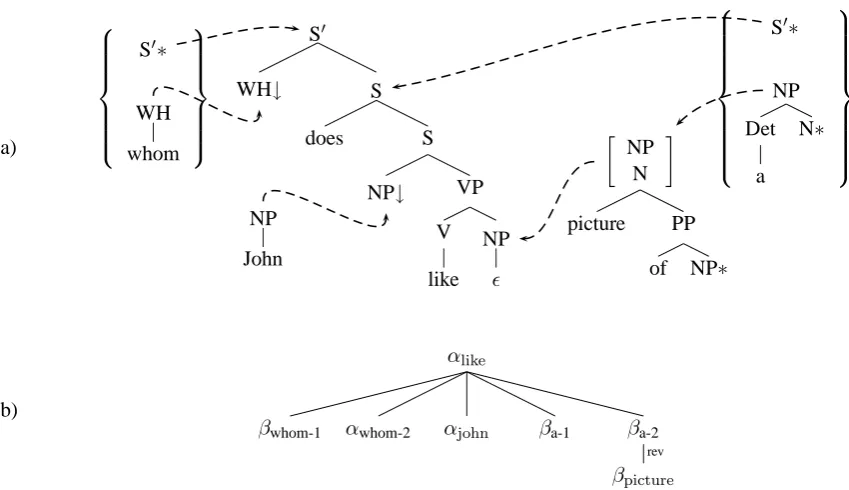
Other applications of flexible composition in-clude the modelling of complex noun phrases in pied-piping and stranding of wh-phrases (Kallmeyer and Scheffler, 2004), an analysis of anaphor binding (Ryant and Scheffler, 2006), dis-course semantics (Forbes-Riley et al., 2006), and scrambling patterns (Chen-Main and Joshi, 2007). With the proposal of unification-based seman-tics for TAG, noun phrase quantifiers have been analysed as multi-component sets, where one com-ponent is the lexical quantifier and the other is just an S-node carrying the scopal information for the quantifier. But this kind of analysis can be prob-lematic for tree-local MCTAG, since the two com-ponents will in general attach to different elemen-tary trees. For example, see Figure 2a for the sen-tence
(2) Whom does John like a picture of?
(Kallmeyer and Scheffler, 2004, ex. (2a))
Flexible composition has been used to avoid this problem (Joshi et al., 2003; Kallmeyer and Schef-fler, 2004), as shown in Figure 2b. In this deriva-tion, the edge label “rev” (to be defined more pre-cisely in the following section) indicates that the adjunction of βa-2 into βpicture is reversed. This turns the nonlocal derivation in Figure 2a into a tree-local derivation..
Operation Derivation Action Result
(a) adjunction γadj@η
β
β γ
η
(b) reverse-adjunction βrev@η γ
γ β
[image:2.595.113.506.108.288.2]η
Figure 1: TAG-FC composition operations. (a) Adjunction. (b) Reverse-adjunction.
(a)
S′∗
WH
whom
NP
John S′
WH↓ S
does S
NP↓ VP
V
like NP
ǫ
S′∗
NP
Det
a N∗
NP N
picture PP
of NP∗
(b)
αlike
βwhom-1 αwhom-2 αjohn βa-1 βa-2 rev βpicture
[image:2.595.101.526.384.629.2]linguistic analyses using flexible composition can be instantiated in our new formalism and argue that in many cases this new formulation is better.
2
Flexible composition
We present here a formal definition of TAG-FC, to our knowledge the first such definition.
Definition 1. A TAG with flexible composition
(TAG-FC) is a TAG with two composition opera-tions: adjunction and reverse-adjunction. A deriva-tion of a TAG-FC is represented by a tree with la-beled edges: each edge is lala-beled with an operation (adj for adjunction or rev for reverse-adjunction) and an adjunction site η. An edge labeled adj@η
with γ above andβ below, where η is a node of γ (see Figure 1a), represents adjunction at η. An edge labeled rev@η with β above and γ below,
whereηis again a node ofγ(see Figure 1b), rep-resents reverse-adjunction atη, in whichγ is split atηand wraps aroundβ.
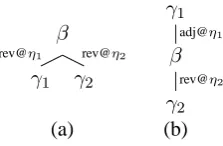
Ambiguity arises in TAG-FC derivations when-ever two elementary trees rwhen-everse-adjoin around the same elementary tree, or when an elementary tree both adjoins and is reverse-adjoined around (see Figure 3). In these cases a different derived tree will result depending on the order of opera-tions. Thus, we simply rule out the former case,1 and in the latter case, we stipulate that the reverse-adjunction occurs first.
Flexible composition generalizes to tree-local multicomponent TAG (Weir, 1988) in the obvi-ous way. Note that there are two ways of defining tree-local MCTAG derivation trees: one in which the derivation nodes are elementary tree sets (as in Weir’s definition), and the other in which the derivation nodes are elementary trees. We use the latter notion.
Definition 2. A multicomponent TAG (with
flexi-ble composition) is a TAG (with flexiflexi-ble compo-sition) whose elementary trees are partitioned into elementary tree sets. In a derivation of a multicom-ponent TAG, the nodes of the derivation are also partitioned into sets such that each partition is an instance of a complete elementary tree set. Definition 3. A tree-local multicomponent TAG
(with flexible composition) is a multicomponent
1We are not aware of any examples of this case in the
lit-erature. If this case should prove to be useful, the definitions and results in this paper would need to be modified. We leave this possibility for future work.
β rev@η2
rev@η1
γ1 γ2
γ1 adj@η1
β rev@η2
γ2
[image:3.595.345.457.77.150.2](a) (b)
Figure 3: Ambiguity in TAG-FC derivations. (a) Multiple reverse-adjunction is disallowed. (b) The reverse-adjunction ofγ2takes place before the ad-junction ofβ.
TAG (with flexible composition) whose deriva-tions have the following property: for each ele-mentary tree set instance, all the member deriva-tion nodes are sisters.
In other words, all the members of an elemen-tary tree set must adjoin at the same time, and must adjoin into the same elementary tree.
3
Delayed tree-locality
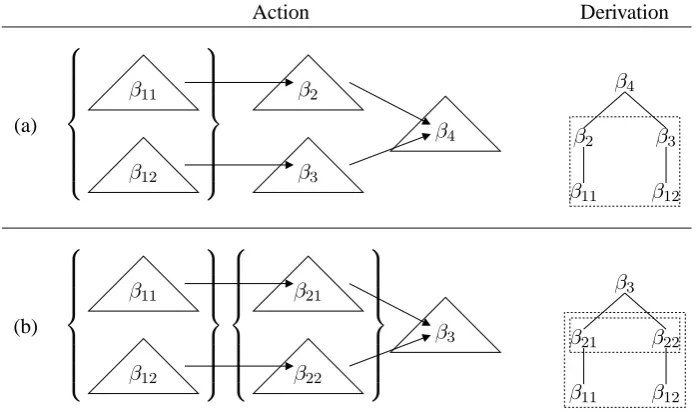
Action Derivation (a) β11 β12 β2 β3 β4 β4
β2 β3
β11 β12 (b) β11 β12 β21 β22 β3 β3
β21 β22
[image:4.595.136.485.75.281.2]β11 β12
Figure 4: Delayed tree-locality. Nonlocal adjunction of an elementary tree set is allowed as long as the members eventually compose into the same elementary tree. The dashed boxes mark the delays. (a) One simultaneous delay. (b) Two simultaneous delays are allowed in 2-delayed tree-local MCTAG but not 1-delayed tree-local MCTAG.
4
Formal results
In this section, we show the equivalence of both tree-local MCTAG-FC and delayed tree-local MC-TAG to standard MC-TAG.
Proposition 1. Any tree-local MCTAG with
flex-ible composition G can be converted into a 2-delayed tree-local MCTAG G′ that is weakly
equivalent toGand has exactly the same elemen-tary structures asG.
The fact thatG′has the same elementary
struc-tures as G means that if we convert an analysis from tree-local MCTAG-FC to delayed tree-local MCTAG, its domains of locality will be preserved. However, the dependencies between them will in general be different.
Proof. The conversion is trivial: G′ has exactly
the same elementary structures as G. In order to demonstrate weak equivalence, we show how to convert any TL-MCTAG-FC derivation into a non-local MCTAG derivation, and then show that this derivation is a 2-delayed TL-MCTAG derivation.
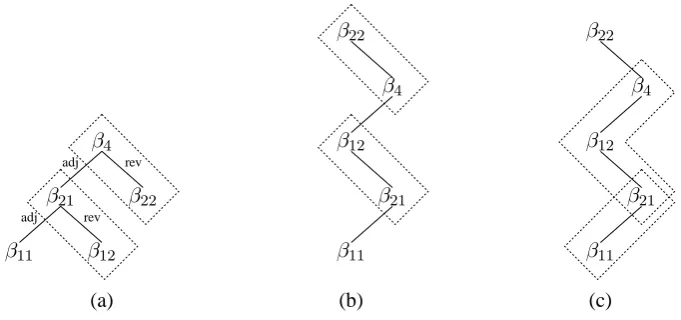
Given a TL-MCTAG-FC derivation, consider the subgraph formed by erasing all adjunction edges and keeping only the reverse-adjunction edges. Call the components of this subgraph the reverse chains (see Figure 5a).
It is easy to see from the definition of TAG-FC that reverse chains are all subpaths; thus, to con-vert the derivation to a nonlocal MCTAG deriva-tion, we simply invert all the reverse chains. We continue to refer to the inverted reverse chains in the new derivation as reverse chains, even though they are only definable with reference to the origi-nal derivation (see Figure 5b).
Now we must show that this derivation is a 2-delayed TL-MCTAG derivation. Actually, we prove a stronger claim, by induction on the height of the derivation tree: (i) no node belongs to more than two delays, and moreover (ii) the nodes in the root’s reverse chain belong to no more than one delay. (See Figure 5c for an example.)
Let Rbe the root’s reverse chain, and letC be those nodes which are children of nodes inRbut are not themselves inR. Apply the transformation to the subderivations rooted by nodes in C. By the induction hypothesis, the transformation cre-ates (i) no more than two delays for the nodes in those subderivations, and (ii) no more than one de-lay for the reverse chains of the nodes inC.
β4
β21 β22
β11 β12 adj rev
adj rev
β22
β4
β12
β21
β11
β22
β4
β12
β21
β11
(a) (b) (c)
Figure 5: (a) Example tree-local MCTAG-FC derivation tree with reverse chains marked. (b) Result of conversion to delayed tree-local MCTAG derivation tree, again with reverse chains marked. (c) Same derivation tree but with delays marked.
But by (ii), the nodes in those reverse chains be-longed to no more than one delay already, so even after creating this new delay, they still belong to no more than two delays.
Thus, (i) holds for all nodes in the derivation. The nodes inRthat belong to an elementary tree set belong to only one delay, satisfying (ii), and the other nodes inRdo not belong to any delays, also satisfying (ii).
Next we show thatk-delayed tree-local MCTAG is, in turn, weakly equivalent to standard TAG. Proposition 2. Any k-delayed tree-local MCTAG can be converted into a weakly equivalent TAG.
Proof. The construction is a generalization of the conversion of tree-local MCTAG to TAG. We consider 1-delayed tree-local MCTAG first. First, we normalize the grammar so that all adjunc-tion is obligatory and no adjuncadjunc-tion is allowed at root/foot nodes, following Lang (1994): for each auxiliary tree, create new null-adjunction root and foot nodes; and for each nonterminal X, create a trivial auxiliary tree with a single null-adjunction X that is both root and foot. Next, create a new feature tree whose values are of the form S• or S•, whereSis a multiset of elementary trees. We replace each elementary tree γ with copies of γ that have thetree feature set in all possible ways that satisfy the following properties:
• The top of each interior node has tree =
S• and the bottom of each interior node has
tree = S
•, where S is a nonempty proper
subset (without duplicates) of an elementary tree set.
• If γ is an auxiliary tree, the top/bottom of the root node of γ has tree = S• and the
top/bottom of the foot node has tree = S •,
whereSis as above, and is equal to:
– {γ},
– plus the union of the values of thetree features of all the interior nodes, – minus any complete elementary tree
sets.
• Ifγ is an initial tree, we defineSas for aux-iliary trees, but require thatSbe empty.
The effect of the tree feature is to keep track of any incomplete elementary tree sets that have been used in a subderivation. Each elementary tree com-bines thetreefeatures of the elementary trees ad-joining into it, and discharges any complete ele-mentary tree sets that are formed. If the resultingS contains elementary trees from more than one set, there would be more than one simultaneous delay, so the construction rules out this case. In an initial tree,S is required to be empty because there can be no outstanding delays at the top of the deriva-tion.
[image:5.595.111.452.73.233.2]5
Discussion
As noted above, flexible composition has been used in TAG analyses of linguistic phenomena when the description necessitated by the linguis-tic facts would lead to a non-local (or set-local) derivation. As we have shown, this move is use-ful because adding flexible composition increases the descriptive power of TL-MCTAG, but not the weak generative power.
In a linguistic analysis, flexible composition can be used to reverse a non-local attachment edge (or path) and thus make the derivation tree-local. However, this process also makes the derivation hard to read and linguistically unintuitive if it cre-ates attachment edges between non-dependent lex-ical items in the derivation tree. As we have shown above, any derivation that uses flexible composi-tion can alternatively be expressed in a 2-delayed tree-local MCTAG. The advantage of using this al-ternative formalism directly is that the linguistic dependencies can be retained. In effect, we have shown that non-local MCTAG derivations are be-nign in many cases that are needed for linguistic analyses of certain phenomena, such as complex noun phrases, binding, and scrambling. This kind of non-locality is handled by a delayed tree-local MCTAG.2
It might be objected that 2-delayed tree-local MCTAG imposes an somewhat arbitrary limit on the number of simultaneous delays. We would agree that 1-delayed tree-locality is a more natu-ral constraint, and believe that it is probably suf-ficient in practice, and that the example of Fig-ure 5, which requires two simultaneous delays, is unusual.
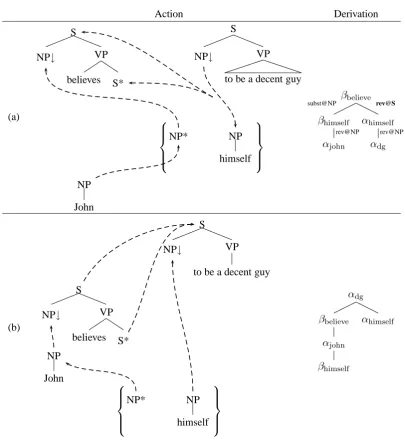
On the other hand, there may be some cases where there is a 1-delayed tree-local analysis, but no analysis using TL-MCTAG with flexible com-position. For example, consider the following sen-tence (3):
(3) John believes himself to be a decent guy. (Ryant and Scheffler, 2006, ex. (10))
In the TAG-FC derivation previously proposed (see Figure 6a), αdg is attached to αhimself by
2
It needs to be tested more thoroughly how well the addi-tional descriptive power of delayed tree-local MCTAG fares for other linguistic analyses, in particular those cases that have been claimed to necessitate non-local analyses in reg-ular MCTAG (Bleam, 2000, for clitic climbing, for example).
reverse-substitution, and the result of this is at-tached to βbelieve by reverse-adjunction. How-ever, the reverse-adjunction site (S) does not come fromαhimself, and therefore the reverse-adjunction of αhimself intoβbelieve is not allowed according to our definition of flexible composition (Defini-tion 1), since reverse-adjunc(Defini-tion ofγintoβat node ηrequiresγ to be split atη, which must be a node inγ.
This operation was not explicitly excluded un-der previous definitions of flexible composition.3 But if we tried to modify our definition of TAG-FC to allow such an operation, it is not clear how one would write the derivation trees, or whether the results obtained above would still hold.
In contrast, there is a straightforward 1-delayed TL-MCTAG derivation for the example. This derivation is shown in Figure 6b. In addition to readability, all the intuitive dependencies are re-tained explicitly in this derivation, for example the dependency betweenβbelieveandαdg.
6
Conclusion
This paper takes a closer look at the mechanism of flexible composition, which has been employed in TAGs for linguistic analysis for some time. Based on a survey of existing applications of flexible composition, we provide a formal definition of TAG-FC. We then prove the weak equivalence of tree-local MCTAG-FC to standard TAG via a vari-ant called delayed tree-local MCTAG introduced here. Finally, we argue that delayed tree-local MC-TAG is more intuitive than flexible composition for linguistic analyses that need slightly more de-scriptive power than tree-locality.
It remains for future work to reformulate exist-ing analyses that use TAG-FC to use delayed tree-locality instead, and to compare the resulting anal-yses against the originals. On the formal side, it is also possible to give a formulation of TAG-FC as a special case of regular-form two-level TAG (Dras, 1999; Dras et al., 2003; Rogers, 2004; Rogers, 2006), a connection that deserves to be explored further.
3The definition in (Joshi et al., 2003) merely requires that
Action Derivation
(a)
S
NP↓ VP
believes S*
S
NP↓ VP
to be a decent guy
NP* NP
himself
NP
John
βbelieve
rev@S
subst@NP βhimself
rev@NP αjohn
αhimself rev@NP αdg
(b)
S
NP↓ VP
to be a decent guy S
NP↓ VP
believes S*
NP
John
NP* NP
himself
αdg
βbelieve
αjohn
βhimself
[image:7.595.85.491.156.597.2]αhimself
Acknowledgements
The first author would like to acknowledge the per-son who first suggested delayed tree-locality. He thought it was Seth Kulick, but Seth thinks it must be somebody else.
The second author would like to thank the mem-bers of the XTAG weekly meeting at Penn, in particular Aravind Joshi, Joan Chen-Main, Lucas Champollion, and Joshua Tauberer, for comments and discussion about flexible composition.
References
Bleam, Tonia. 2000. Clitic climbing and the power of tree-adjoining grammar. In Abeill´e, A. and O. Rambow, editors, Tree Adjoining Grammars: Formalisms, Linguistic Analysis and Processing. CSLI Publications, Stanford.
Chen-Main, Joan and Aravind K. Joshi. 2007. Some observations on a “graphical” model-theoretical ap-proach and generative models. In Proceedings of the Workshop on Model-Theoretic Syntax, pages 53–62, Trinity College, Dublin. European Summer School in Logic, Linguistics, and Information.
Dras, Mark, David Chiang, and William Schuler. 2003. On relations of constituency and dependency gram-mars. Research on Language and Computation, 2:281–305.
Dras, Mark. 1999. A meta-level grammar: redefining synchronous TAG for translation and paraphrase. In Proceedings of ACL 1999, pages 80–87.
Forbes-Riley, Katherine, Bonnie Webber, and Aravind Joshi. 2006. Computing discourse semantics: The predicate-argument semantics of discourse connec-tives in D-LTAG. Journal of Semantics, 23(1):55– 106.
Joshi, Aravind K., Laura Kallmeyer, and Maribel Romero. 2003. Flexible composition in LTAG: Quantifier scope and inverse linking. In Bunt, Harry, Ielka van der Sluis, and Roser Morante, ed-itors, Proceedings of the Fifth International Work-shop on Computational Semantics (IWCS-5), pages 179–194, Tilburg, Netherlands.
Kallmeyer, Laura and Tatjana Scheffler. 2004. LTAG analysis for pied-piping and stranding of wh-phrases. In Proceedings of the Seventh International Workshop on Tree Adjoining Grammar and Related Formalisms (TAG+7), pages 32–39, Vancouver, BC, Canada.
Lang, Bernard. 1994. Recognition can be harder than parsing. Computational Intelligence, 10(4):484– 494. Special Issue on Tree Adjoining Grammars.
Rogers, James. 2004. One more perspective on seman-tic relations in TAG. In Proceedings of TAG+6.
Rogers, James. 2006. On scrambling, another perspec-tive. In Proceedings of TAG+7.
Ryant, Neville and Tatjana Scheffler. 2006. Binding of anaphors in LTAG. In Proceedings of the Eighth International Workshop on Tree Adjoining Gram-mar and Related Formalisms (TAG+8), pages 65– 72, Sydney, Australia.