An Annotated Corpus Outside Its Original Context: A Corpus-Based
Exercise Book
Barbora Hladk´a and Ondˇrej Kuˇcera
Institute of Formal and Applied Linguistics, Charles University Malostransk´e n´am. 25
118 00 Prague Czech Republic
[email protected], [email protected]
Abstract
We present the STYX system, which is de-signed as an electronic corpus-based exercise book of Czech morphology and syntax with sentences directly selected from the Prague Dependency Treebank, the largest annotated corpus of the Czech language. The exercise book offers complex sentence processing with respect to both morphological and syntactic phenomena, i. e. the exercises allow students of basic and secondary schools to practice classifying parts of speech and particular mor-phological categories of words and in the pars-ing of sentences and classifypars-ing the syntactic functions of words. The corpus-based exer-cise book presents a novel usage of annotated corpora outside their original context.
1 Introduction
Schoolchildren can use a computer to chat with their friends, to play games, to draw, to browse the Inter-net or to write their own blogs - why should they not use it to parse sentences or to determine the mor-phological categories of words? We do not expect them to practice grammar as enthusiastically as they do what is mentioned above, but we believe that an electronic exercise book could make the practicing, which they need to do anyway, more fun.
We present the procedure of building an exercise book of the Czech language based on the Prague Dependency Treebank. First (in Section 2) we present the motivation for building an exercise book of Czech morphology and syntax based on an an-notated corpus – the Prague Dependency Treebank (PDT). Then we provide a short description of the PDT itself in Section 3. Section 4 is the core of
our paper. Section 4.1 is devoted to the filtering of the PDT sentences in such a way that the complity of sentences included in the exercise book actly corresponds to the complexity of sentences ex-ercised in traditional Czech textbooks and exercise books. Section 4.2 documents the transformation of the sentences – more precisely a transformation of their annotations into the school analysis scheme as recommended by the official framework of the ed-ucational programme for general secondary educa-tion (Jeˇr´abek and Tup´y, 2005). The evaluaeduca-tion of the system is described in Section 4.3. Section 5 sum-marizes this paper and plans for the future work.
2 Motivation
From the very beginning, we had an idea of us-ing an annotated corpus outside its original context. We recalled our experience from secondary school, namely from language lessons when we learned morphology and syntax. We did it ”with pen and pa-per” and more or less hated it. Thus we decided to build an electronic exercise book to learn and prac-tice the morphology and the syntax ”by moving the mouse around the screen.”
dis-appear. It is expected that the texts in a corpus are already selected to provide a well-balanced corpus reflecting the real usage of the language, the hard an-notation work is also done and the size of such cor-pus is thousands or tens of thousands of annotated sentences. The task that remains is to transform the annotation scheme used in the corpus into the sen-tence analysis scheme that is taught in schools. In fact, a procedure based on an annotated corpus that we apply is semi-automatic, since the annotation scheme transformation presents a knowledge-based process designed manually - no machine-learning technique is used.
We browsed the Computer-Assisted Language Learning (CALL) approaches, namely those con-centrated under the teaching and language cor-pora interest group (e.g. (Wichmann and Fligel-stone (eds.), 1997), (Tribble, 2001), (Murkherjee, 2004), (Schultze, 2003), (Scott, Tribble, 2006)). We realized that none of them actually employs manually annotated corpora – they use corpora as huge banks of texts without additional linguistic information (i.e. without annotation). Only one project (Keogh et al., 2004) works with an automat-ically annotated corpus to teach Irish and German morphology.
Reviewing the Czech electronic exercise books available (e.g. (Terasoft, Ltd., 2003)), none of them provides the users with any possibility of analyzing the sentence both morphologically and syntactically. All of them were built manually.
Considering all the facts mentioned above, we find our approach to be novel one. One of the most exciting aspects of corpora is that they may be used to a good advantage both in research and teach-ing. That is why we wanted to present this system that makes schoolchildren familiar with an academic product. At the same time, this system represents a challenge and an opportunity for academics to pop-ularize a field with a promising future that is devoted to natural language processing.
3 The Prague Dependency Treebank
The Prague Dependency Treebank (PDT) presents the largest annotated corpus of Czech, and its second edition was published in 2006 (PDT 2.0, 2006). The PDT had arisen from the tradition of the successful
Prague School of Linguistics. The dependency ap-proach to syntactic analysis with the main role of a verb has been applied. The annotations go from the morphological layer through to the intermedi-ate syntactic-analytical layer to the tectogrammati-cal layer (the layer of an underlying syntactic struc-ture). The texts have been annotated in the same direction, i. e. from the simplest layer to the most complex. This fact corresponds with the amount of data annotated on each level – 2 million words have been annotated on the lowest morphological layer, 1.5 million words on both the morphological and the syntactic layer, and 0.8 million words on all three layers.
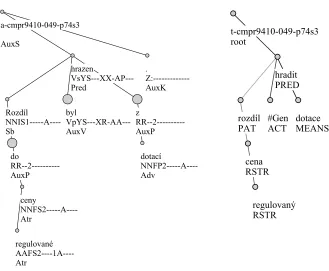
Within the PDT conceptual framework, a sen-tence is represented as a rooted ordered tree with la-beled nodes and edges on both syntactic (Hajiˇcov´a, Kirschner and Sgall, 1999) and tectogrammatical (Mikulov´a et al., 2006) layers. Thus we speak about syntactic and tectogrammatical trees, respectively. Representation on the morphological layer (Hana et al., 2005) corresponds to a list of (word token and morphological tag) pairs. Figure 1 illustrates the syntactic and morphological annotation of the sam-ple sentenceRozd´ıl do regulovan´e ceny byl hrazen z dotac´ı. [The variation of the regulated price was made up by grants.] One token of the morphological layer is represented by exactly one node of the tree (rozd´ıl [variation], do [of], regulovan´e [regulated], ceny [price], byl [was], hrazen [made up], z [by], dotac´ı[grants], ‘.’) and the dependency relation be-tween two nodes is captured by an edge bebe-tween them, i. e. between the dependent and its governor. The actual type of the relation is given as a func-tion label of the edge, for example the edge (rozd´ıl, hrazen) is labeled by the functionSb(subject) of the node rozd´ıl. Together with a syntactic function, a morphological tag is displayed (rozd´ıl, NNIS1---A----).
DFPSUSV
$X[6
5R]GtO 11,6$ 6E
GR
55 $X[3
UHJXORYDQp $$)6$ $WU
FHQ\
11)6$ $WU
E\O
9S<6;5$$ $X[9
KUD]HQ
9V<6;;$3 3UHG
]
55 $X[3
GRWDFt
11)3$ $GY
= $X[.
Figure 1: A PDT syntactic tree of the sentenceRozd´ıl do regulovan´e ceny byl hrazen z dotac´ı.
tree, e. g. (hradit,PRED).
In the following text, we will be using the term the PDT approachwhen having in mind the conceptual framework of PDT annotation, and the school ap-proachwhen having in mind the conceptual frame-work of a sentence analysis as it is taught in schools.
4 Exercise book composition
With regards to our idea, the electronic exercise book is an electronic system that consists of
• a database of sentences with their morphologi-cal and syntactic analyses automatimorphologi-cally gener-ated from an annotgener-ated corpus,
• a user interface
– to select sentences from the database or, in other words, to compose the exercises, – to simultaneously analyze the selected
sentences both morphologically and syn-tactically,
root
t-cmpr9410-049-p74s3
rozdíl PAT
cena RSTR
regulovaný RSTR
#Gen ACT
hradit PRED
dotace MEANS
Figure 2: A PDT tectogrammatical tree of the sentence Rozd´ıl do regulovan´e ceny byl hrazen z dotac´ı.
– to check the analyses.
More specifically, the composition of the PDT-based exercise book of Czech morphology and syn-tax implies the selection of those sentences from PDT that are annotated morphologically and syntac-tically. However, there emerge some syntactic phe-nomena that are handled differently in the PDT ap-proach than in the school apap-proach. The data an-notated tectogrammatically has to be taken into ac-count to process these phenomena properly. Given that, the data annotated on all three layers (0.8 mil-lion words in 49,442 sentences) become the candi-date setof sentences from which the exercise book is to be composed.
Unfortunately, the sentences from the candidate set cannot be merely taken as they are because of two factors:
beyond the complexity of sentences in text-books;
• some syntactic phenomena are handled differ-ently in the PDT approach than in the school approach.
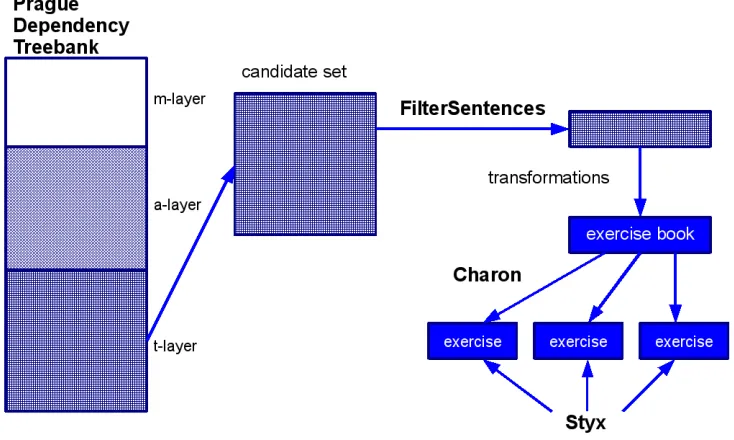
This means that some of the sentences have to be completely discarded (sentence filtering, see 4.1) and syntactic trees of the remaining sentences have to be transformed to match the school analysis of syntax (see 4.2). Luckily, the school approach to the morphology does not coincide with the PDT ap-proach. Therefore the PDT morphological annota-tions do not need any special handling. It is impos-sible to browse the candidate set of sentences man-ually with regard to its volume. Both sentence fil-teringandannotation transformationmust be done automatically. The whole process is shown in Fig-ure 3.
To summarize, our work on the electronic ex-ercise book covers the data and the software components ((Hladk´a, Kuˇcera, 2005), (Kuˇcera, 2006), (STYX, 2008)):
• Annotated Sentence Database Almost 12,000 annotated sentences generated by the FilterSen-tencescomponent.
• FilterSentences. A component used to prepare the annotated sentence database suitable for us-age in the exercise book. The end user will never have to use this.
• Charon. An administrative tool, used for view-ing all of the available sentences and for com-posing the exercises. We assume that mostly teachers will use it.
• Styx. The electronic exercise book itself. It uses the exercises composed with Charon. An ac-tive sentence is analyzed both morphologically and syntactically as shown in Figure 4. Dur-ing the morphological analysis, the user moves word by word, and for each word selects its part of speech. According to the selected part of speech, the combo boxes for the relevant mor-phological categories appear and let the user choose one of several choices they consider
the proper one. During the syntactic analy-sis, the user moves nodes using the traditional drag and drop method to catch the dependent-governor relation. Afterwards, the syntactic functions are assigned, technically via pop-up menus. Once the analyses are finished, the cor-rect answers are provided separately for mor-phology and syntax.
4.1 Sentence filtering
The candidate set consists of many sentences that are not appropriate for schoolchildren to analyze. They contain phenomena that authors of textbooks either do not consider at all or sometimes do not agree upon. The following seven filtering criteria have been formulated to exclude problematic sentences. For each filter, we provide a brief description.
1. SimpleSentences. The most complex filter that excludes compound and complex sentences.
2. GraphicalSymbols. Excludes sentences with various graphical symbols (except for the dot sign) because they imply more complex phe-nomena than the school analyses operate with.
3. EllipsisApposition. Excludes sentences con-taining an ellipsis or an apposition.
4. OnePredicate. Excludes sentences without a predicate (sentences with more than one predi-cate are already excluded bySimpleSentences).
5. LessThanNWords. Excludes sentences that are too long.
6. MoreThanNWords.Excludes sentences that are too short (usually simple headlines).
7. AuxO. Excludes sentences containing emotio-nal, rhythmic particles carrying theAuxO syn-tactic function.
Figure 3: Exercise book composition
(54.4 %). As it is highlighted in the last row of the table, almost 12,000 sentences were preserved after processing the candidate set with all the filters.
Filter # input # preserved sentences sentences (%) SimpleSentence 49,442 22,552 (45.6) GraphicalSymbols 22,552 20,384 (90.4) EllipsisAposition 20,383 13,633 (66.9) OnePredicate 13,633 13,617 (99.9) LessThanNWords 13,617 13,010 (95.5) MoreThanNWords 13,010 11,718 (90.1) AuxO 11,718 11,705 (99.9)
overall 49,442 11,718 (23.7)
Table 1: Quantitative overview of sentence filtering
4.2 Annotation transformation
In the school approach, a sentence is represented as a tree-like structure with labeled nodes. Unlike PDT syntactic trees, the structures of the school approach have no root node or, in another point of view have two roots: a subject and a predicate (see Figure 5 – rozd´ıl, byl hrazenrespectively).
Besides the above-mentioned difference in analy-sis schemes, the PDT and the school approach differ in the following aspects:
• Many of the PDT syntactic functions do not have counterparts in the school approach.
• The school approach does not have the direct 1:1 correspondence between nodes of the mor-phological layer and the syntactic layer, i. e. a node can contain more than just one word as visible in Figure 5 – the pair of wordsbyl, hrazen form one node as well as the pair z, dotac´ı. The words inside each node are listed in accordance to the surface word order of the sentence.
With regards to the discussed differences, we sys-tematically went through the PDT annotation guide-lines (Hajiˇcov´a, Kirschner and Sgall, 1999), ana-lyzed all specified phenomena and designed their transformations into the school analysis scheme. Three elementary operations on syntactic trees and the rules mapping syntactic functions have been for-mulated. Then a transformation is understood as a sequence of these operations and mapping rules.
Figure 4: Styx—practicing
2. AbsorbTheChildNodes The words at all child nodes of the node are moved into the node. The child nodes are removed and their child nodes become the child nodes of the node. This op-eration is equivalent to theJoinTheParentNode operation applied to all child nodes of the node.
3. RemoveTheNodeThe node-leave is removed.
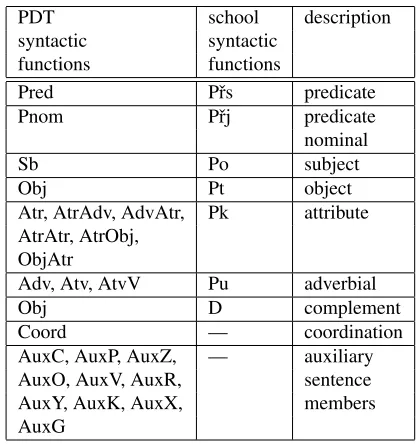
Mapping PDT syntactic functions follows these operations on trees. Given the complexity of syn-tactic phenomena and the differences between the approaches, it is not possible to map all functions in a straightforward way as is evident from Table 2. While the school approach works with seven syn-tactic functions (listed in the second column) the PDT approach labels with 25 functions1 (listed in the first column). The PDT functions indicating the subject, the predicate, the attribute and the adver-bial (in italics) are simply mapped to their school counterparts. The other functions are changed into the school functions in accordance with the type of operation the nodes they belong to pass. After the AbsorbTheChildNodesoperation, the node is mostly labeled by the direct school counterpart of its ”most important child node”, i.e. the child node bearing one of the simply-mapped functions, vaguely noted. After the JoinTheParentNodeoperation, the parent
1
The total number of the PDT syntactic functions is actually higher. Here we list those functions that appear in sentences included in the exercise book.
node does not change its function in most cases.
PDT school description
syntactic syntactic functions functions
Pred Pˇrs predicate
Pnom Pˇrj predicate
nominal
Sb Po subject
Obj Pt object
Atr, AtrAdv, AdvAtr, Pk attribute AtrAtr, AtrObj,
ObjAtr
Adv, Atv, AtvV Pu adverbial
Obj D complement
Coord — coordination
AuxC, AuxP, AuxZ, — auxiliary AuxO, AuxV, AuxR, sentence AuxY, AuxK, AuxX, members AuxG
Table 2: School vs. PDT syntactic functions
For illustration, a PDT syntactic tree in Figure 1 is transformed into a school structure displayed in Figure 5. Needed transformations include, for ex-ample. merging the nodes(do, AuxP)and(ceny, Atr) into the node(do ceny, Pk)or similarly merging(byl, AuxV)and(hrazen, Pred)into(byl hrazen, Pˇrs).
4.3 Evaluation
Figure 5: A school syntactic tree of the sentenceRozd´ıl do regulovan´e ceny byl hrazen z dotac´ı.
numerical figures only. The only number we can provide presents the sentence count included in the exercise book: We believe that almost 12,000 sen-tences bring enormous diversity to the practicing of morphology and syntax.
To find out the real value of our system, we sented it to two different audiences. First we pre-sented it to academics, who really appreciated the idea of corpus assimilation for morphology and syn-tax learning in schools. Their discussions were mainly concerned with the transformation of anno-tations.
Then we presented the exercise book during Czech classes in secondary schools. We found out that both the teachers and the students were imme-diately able to use the system and they were excited about it. They agreed that such exercises would be a nice addition to their classes. Given the experience we acquired during the presentations, we created a sample class (a methodological guide) for teachers, and we collected some interesting ideas that may help us improve the system. These improvements concern i) the annotation transformations (1, 2, 3); ii) the variety of exercises (4); iii) the user interface (5):
1. We do not distinguish between the different types of adverbials. Thus we will provide the possibility of marking a node as being a place adverbial or time adverbial etc.
2. We do not distinguish concordant and
discor-dant attributes yet.
3. Dealing with coordination needs revision, es-pecially when it comes to a difference between dependents of the coordination as a whole and dependents of members of the coordination.
4. • During the morphological analysis, the user selects only the part of speech of the given word and STYX itself provides the relevant morphological categories to ana-lyze. In this fashion, the exercises are too simplistic. To master the morphology, the user must know which categories are rele-vant to the given part of speech.
• The Charon module will give the user the option of selecting sentences that con-tain some specific phenomena. Cur-rently, an administrator goes through all the sentences ”manually” and if they ful-fill her/his selection criteria, (s)he includes them in the exercises.
5. The user interface has to be changed to be more ”crazy,” or dynamic, to attract not only the ”A” pupils but the rest of them as well. Much more comfortable controls, for example by adding keyboard shortcuts for the most common ac-tions, will be offered too.
5 Conclusion
The PDT-based exercise book has completed its ini-tial steps. The theoretical aspects have been ana-lyzed, the system has been implemented and demon-strated to schoolchildren. Their feedbacks motivates us to improve the system in such a way that it will become a real educational tool.
References
Hana Jiˇr´ı and Dan Zeman and Hana Hanov´a and Jan Hajiˇc and Barbora Hladk´a and Emil Jeˇr´abek. 2005. A Manual for Morphological Annotation, 2nd edition.
´
UFAL Technical Report 27, Prague, Czech Republic. Hajiˇcov´a Eva and Zdenˇek Kirschner and Petr Sgall.
1999. A Manual for Analytic Layer Annotation of the Prague Dependency Treebank (English translation).
´
Hladk´a Barbora and Ondˇrej Kuˇcera. 2005. Prague De-pendency Treebank as an exercise book of Czech. In Proceedings of HLT/EMNLP 2005 Interactive Demon-strations, pp. 14-15. Vancouver, British Columbia, Canada.
Jeˇr´abek Jaroslav and Jan Tup´y 2005. The official frame-work educational programme for general secondary education. Research pedagogical institute, Prague. Keogh Katrina and Thomas Koller and Monica Ward and
Elaine U´ıDhonnchadha and Josef van Genabith 2004. CL for CALL in the Primary School. In Proceed-ings of the International Workshop in Association with COLING 2004, Geneva, Switzerland.
Kuˇcera Ondˇrej. 2006. Praˇzsk´y z´avislostn´ı korpus jako cviˇcebnice jazyka ˇcesk´eho. Master thesis. Charles University, Prague, Czech Republic.
Mikulov´a Marie et al. 2006. A Manual for Tectogram-matic Layer Annotation of the Prague Dependency Treebank. UFAL Technical Report´ , Prague, Czech Republic.
Mukherjee, J. 2004. Bridging the gap between ap-plied corpus linguistics and the reality of English lan-guage teaching in Germany. In U. Connor and T. Up-ton (eds.)Applied Corpus Linguistics: A Multidimen-sional Perspective. Amsterdam: Rodopi, pp. 239-250. PDT 2.0 [online]. 2006. Prague Dependency Treebank,
2nd edition.http://ufal.mff.cuni.cz/pdt2.0
Scott Mike and Christopher Tribble 2006. Textual Pat-terns: keyword and corpus analysis in language edu-cation. Amsterdam: Benjamins.
Schultze Mathias 2003. AI in CALL: Artficially Inated or Almost Imminent? InProceedings of the World-CALL Conference, Banff, Canada.
STYX [online]. 2008. The STYX electronic exercise book of Czechhttp://ufal.mff.cuni.cz/styx
Terasoft, Ltd. 2003.TS ˇCesk´y jazyk 2 - jazykov´e rozbory. http://www.terasoft.cz.
Tribble Christopher 2001 Corpora and teaching: ad-justing the gaze. InProceedings of the ICAME 2001 Conference, Louvain, Belgium.