Volume 8, No. 5, May-June 2017
International Journal of Advanced Research in Computer Science
REVIEW ARTICLE
Available Online at www.ijarcs.info
ISSN No. 0976-5697
Cloud Computing Interoperability: Introduction, Concerns and Challenges
Simranjit Kaur
Research Scholar, Department of Research Innovation & Consultancy IKG PTU, Kapurthala – 144601, India
Dr.Sumesh Sood
Assistant Professor IKG PTU Dinanagar Campus, India
Gurminder Kaur
Student, Department of Computer CKD Institute of Management & Technology
Amritsar – 143001, India
Abstract: Cloud computing is emerging paradigm for provisioning services over the internet. It is the area of research where a cloud is used to access data, files, software etc. It allows sharing of networks servers, data applications, storage and services as computing resources. In cloud computing there is an interaction among various heterogeneous independent cloud platforms. This is possible only through interoperability which plays a key role in providing access to cloud computing in different environments. In other simple words it means the user needs interoperability to ship their assets from one cloud to other cloud. This paper emphasizes upon concerns and challenges emerging in Cloud Computing.
Keywords: Cloud computing, Interoperability.
.
1.INTRODUCTION
1.1 Cloud Computing
Cloud Computing is transmogrified field of the information technology (IT), which provides web-based services to the users through internet. According to the US National Institute of Standards and Technology (NIST) [1], “Cloud Computing is a model for enabling convenient, on-demand network access to a shared pool of configurable computing resources (e.g., networks, servers, storage, applications and services) that can be rapidly provisioned and released with minimal management effort or service provider interaction”. Thus cloud computing provides shared resources, applications, software and resources over the internet and also helps in improving the availability of IT resources. Computing technologies have developed to a great extent since the merging of Internet/ Web. This has led to various computing methods like Grid Computing, Cloud Computing.
1.2 Types of Cloud
There are various types of clouds used that are as follows [1] [2] [3]:
Public Cloud: The cloud that is managed by the service provider and can be used by anyone like General public or a large industry group. The Feasibility, Utility as well as Scalability increase with the usage of public clouds, but the main demerit existing here is very low security and encryption. But, this doesn’t mean that the user’s data will be publically visible. It will be particularly secured by the cloud servers by the use of typical authentication strategies.
Private Cloud: A Private Cloud is owned by a particular Person or an organization that can only be accessed by that client. It leads to more privacy and security whereas; it lessens the exploration capability as it is limited to a
particular area only. In other words, it is frontier to that organization only.
Hybrid Cloud: The cloud that is, “Merged from” or “Combination” of “Private” and “Public” clouds, is termed as “Hybrid Cloud”. It is used to achieve maximum cost reduction through outsourcing while maintaining control over the sensitive data in the private clouds.
Special Purpose Cloud: These are the clouds with some sort of, “Modifications”. In other words, these are same like other clouds, except some features that they consist which are particularly added in these for working of Client(s).
1.3 Cloud Delivery Models
This section of the paper describes the various cloud delivery models namely SaaS, PaaS, and IaaS provided by NIST [1].
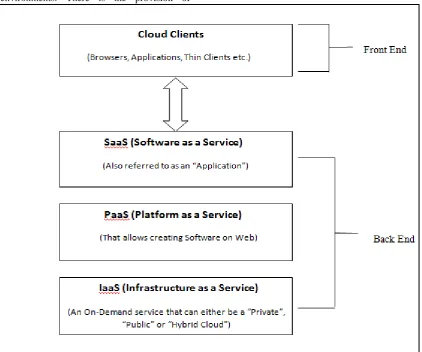
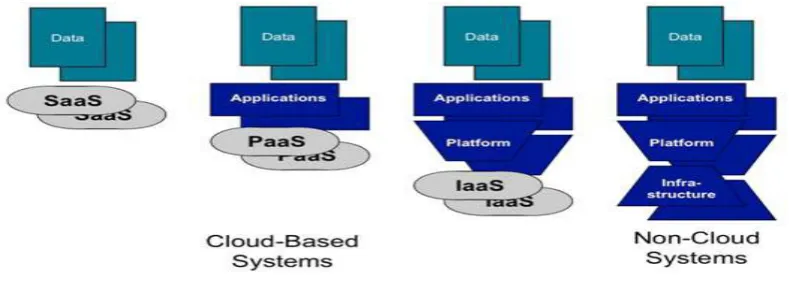
Software as a Service (SaaS): The capability is provided to the consumer to use the applications running on a cloud infrastructure with little or no customizations. A client interface such as browser or program interface is used to easily access the applications. It is closely related to “Application Service Providers” where the application to be used has same source code for all users and the user’s data/ information may be stored locally or both locally and in the cloud. [4] [5] The Software is made available through the internet and is maintained by service provider(s). SaaS applications are very cost effective as Zero maintenance is required.
using programming languages, libraries, services, and tools supported by the provider. Built in web services, security, tools and scalability are various integrations provided by PaaS.
Infrastructure as a Service (IaaS): IaaS is an on-demand service, which can either be “Private Cloud” or “Public Cloud” or a combination of both (“Hybrid Cloud”). [5] The capability is provided to the consumer to create customized application environments. There is the provision of
processing, storage, networks, and other fundamental computing resources. In this, the consumer can deploy and run arbitrary software that includes operating systems and applications.
1.4 Cloud Computing Architecture: The, “Front End” and “Back End” components are merged together to form the Cloud Computing Architecture as visualized below-
[image:2.595.89.512.154.506.2]
Figure 1.1- Cloud Computing Architecture
2. CLOUD COMPUTING INTEROPERABILITY
As the resources are shared in cloud computing the major obstacle in the adoption of cloud computing is the heterogeneity of hardware and software solutions which limit the possibility from one cloud provider to another. Cloud interoperability refers to the ease of migration and integration of applications/ data among different providers interoperability is the only way to provide the solution to this problem. There are several attempts in the literature to scope, address and define Cloud computing interoperability.
Interoperability in the area of Cloud computing refers to the ability to write code that works with more than one Cloud provider simultaneously, regardless of the differences between the provider [6] [7] [8]. So in cloud computing interoperability the users are concerned about the capability to communicate between two or among multiple clouds. Interoperability is related with the ability of the systems to communicate. In this it is required that the communicated information is being understood by the receiving system.
Typically interoperability means the ability of different heterogeneous systems to be able to interact together. It could be defined in clouds as the ability to understand each other’s application formats, Service Level Agreement (SLA) templates, authentication and authorization token formats and attribute data.
2.1 Layers of interoperability in Cloud Computing
Exchange of information between two systems is provided through the following layers of interoperability [3]:
Technical interoperability is associated with the protocol used for information exchange – for example the use of the REST HTTP protocol over TCPIP. The concern is the basic exchange of data between some endpoints.
Syntactic interoperability concerns the format of the data that is exchanged – examples here include XML data structures. The concern is the data being exchanged.
XML schemas (for the structuring) alongside directories that describe the meaning of elements in the structures.
Organizational interoperability concerns the context in which the data is exchanged – that is, the sending system has an expectation that the receiving system will use the exchanged data in a specific way, typically as part of some larger overall process.
Layer Objective
Technical
Provides security to technical data transfer
Syntactic
Received data is processed.
Semantic
Interpretation of received data.
[image:3.595.30.255.168.289.2]Organizational Automatically linked among different systems
Figure 1.2- Interoperability model for cloud computing
2.2 Need for Cloud Computing Interoperability
In the context of the cloud service, they have their own way of, “how a user or cloud application interacts with their cloud?” There may be different Application Programming interfaces available. This kills the cloud environment by limiting cloud choice because of vendor locking, portability, ability to use the cloud services provided by multiple vendors including the ability to use an organization’s own existing data center resources seamlessly [9]. So there is a need for complex developed business applications on the clouds to be interoperable. If there is not a good way of integrating data and applications across clouds then its
adoption will be hampered and so the basic need for interoperability arises in organization.
There are many scenarios that are desired to make use of cloud interoperability [10]:
• To move entire infrastructure to new cloud provider
• To change the cloud providers
• To move across boundaries
2.3
Levels of cloud computing interoperabilityInteroperability has become one of the critical factors. Cloud interoperability helps in easy migration and integration process of applications and data between cloud service providers. There are several attributes of interoperability between systems classified by LISI (Levels of Information System Interoperability) [11] [12][13]:
Procedure: Several standards such as application development regulation, product development guidance, hardware and software standards could impact the interoperability level.
Applications: The critical aspect for application attribute is, “how well application running on different systems and platforms in accordance with its functionality?”
Infrastructure: Infrastructure attribute shows the level of connectivity between systems and applications and, “how systems interact with other applications?"
Data: This attribute means ability and flexibility of data format that run across systems environment became the main concern of interoperability. Figure below shows the levels of Interoperability [12].
Figure 1.3- Levels of interoperability
2.4
Major Concerns in Cloud ComputingInteroperability
The section focuses on the major perspective for Cloud Computing Interoperability [14] [15]:
Technique Perspective: The current situation is that each manufacture’s cloud environment supports one or more operating systems and databases, and each environment includes a variety of hypervisor, security standard, storage mode, networking mode, cloud API and so on. But it rarely happens when two different cloud providers use identical strategy and standard in all aspects for migration. For those
concerns, there is need to consider the following suggestions:
• Ensure that applications and support components don't have to rely upon the operating system and infrastructure.
• Users need to be authorized in a unique way.
• Protection in storage/ exchange of messages.
• Data and Information needs to be protected. [2]
[image:3.595.101.496.467.608.2]• Looking for a management platform that can be supported in any cloud environments.
Economic Perspective: There are many other issues which alter the effectiveness of interoperability, and the first is economy issue. Besides the obvious costs for switching technology, the time consumption and management costs play no less important roles when considering the overall economical efficiency. Some concerns are as followings:
• The problems regarding migration of large collections of data.
• The problem of delay exists because data migration needs time.
• The management among different clouds is another problem. Achieving a deployment strategy among clouds requires high operating cost.
Management Perspective: The substance issue of management lies in how to manage computing resources between public and private clouds. The following issues must be considered for management teams:
• What is the principal solution for the enterprise’s administration?
• According to what standards and policies, an enterprise determines the assignment of applications to a public cloud or to a private cloud?
• What demands are associated with Service Level Agreement (SLA), Security and availability?
• For what reasons the enterprise migrates its applications to Amazon or Rackspace? Just because of lower operating costs?
• How much data needs to migrate among the clouds, and how about the costs and risks?
Security Perspective: The concerns for security will hamper one corporation’s data migration from private cloud to a public one, which weakens the value and fruits of conversion technology. What users concern most is the lack of control over physical infrastructures and a better control over data by corporation or government can be realized if data are stored at a strategic location. Besides these concerns, some of security related problems are listed as followings:
• The security vacuum between two systems with different security vulnerabilities will be utilized by hackers.
• No attack can be executed on cloud, no matter of what type. [2]
• The difference between policies in different levels will be utilized by malicious attackers.
Political Perspective: It is the most complicated issue. The regulation at local, national and international level is one of the biggest deterrents to the full realization of conversion. Thus, the negotiation and compromise are needed in local, national and international level to reach some consensus, which may include the negotiation between countries, between country and company and even between economies.
2.5
Cloud Interoperability ChallengesIn this section, we discuss some of the challenges in making clouds interoperable [15] [16]:
Portability and Mobility: Portability and Mobility are the prime indicators of the degree of interoperability between clouds. Interoperability needs advancement in both. Portability is defined as the ability to move an image from one host to another. Mobility is defined as the ability to move a workload from one host to another without losing client connections.
Cloud-Service Integration: To maintain control over critical operations in an enterprise, there is a need to integrate both on-premise and the “software-as-a-service” (SaaS) applications to meet the needs of the business. The practice of merging software applications through an API and maintenance due to frequent modification and updates requires significant amount of coding.
Security, Privacy and Trust: The cloud adopters also expect assurances from service providers that the security and privacy should be maintained at different levels. The controlling access by users through cloud services to personal information should be monitored carefully. Thus, some methods of authentication and authorization for the user are needed to efficiently and effectively provide quality of service through cloud interoperability.
Management, Monitoring, and Audit: Companies need a uniform tool set for applying a single security and user identity- management to applications, running on different cloud platforms, to automatically provision services, manage VM instances, and work with both cloud-based and enterprise based applications. The users need assurance that the security and privacy policies are consistently applied and also the service level agreements (SLA) are met as the cloud services migrate across cloud boundaries.
2.6
Approaches to solve interoperability issuesThe different approaches to solve the interoperability problem in the enterprises [9] [12] are as follows:
Integrated approach: There is a common format to which all the cloud providers agree to follow.
Unified approach: The common format exists at meta-level where the cloud provider has the equivalence model to map other standards.
Federated Approach: There is no common format available and there exists an agreement between or among the cloud vendors to share the working semantics.
3. CONCLUSION
REFERENCES
[1] Mell, P., and Grance, T., The NIST Definition of Cloud Computing, US Nat’l Inst. Of Standards and Technology, 2011.
[2] Dr. A. Vinaya Babu, Dr. B. Padmaja Rani and B. Kezia Rani, “Cloud Computing and Inter-Clouds- Types, Topologies and Research Issues”. Elsevier .In 2nd International Symposium on Big Data and Cloud Computing (ISBCC’15). Procedia Computer Science 50 (pp. 24-29)
[3] Retrieved from:
[4] Retrieved from:
[5] Retrieved from:
[6] Loutas, N., Kamateri, E., Bosi, F., & Tarabanis, K. (2011, November). Cloud computing interoperability: the state of play. In
[7] Cloud Computing Use Case Discussion Group, “Cloud Computing Use Cases V.4," in DOI: http://www.scribd.com /doc/18172802/Cloud- Computing-Use-Cases-Whitepaper, 2010.
Cloud Computing Technology and Science IEEE Third International Conference (CloudCom), (pp. 752-757).
[8] Harsh, P., Dudouet, F., Cascella, R. G., Jégou, Y., & Morin, C. (2012, October). Using open standards for interoperability issues, solutions, and challenges facing cloud computing. In IEEE 8th international conference on network and service management (cnsm) and workshop on systems virtualiztion management (svm)
[9] Parameswaran, A. V., & Chaddha, A. (2009). Cloud interoperability and standardization.
(pp. 435-440).
SETlabs briefings,
[10]Machado, G. S., Hausheer, D., & Stiller, B. (2009, October). Considerations on the Interoperability of and between Cloud Computing Standards. In
(7), (pp. 19-26).
[11]Zahara, S., Pratomo, I., & Rahardjo, D. S. (2015, November). Application and data level interoperability on virtual machine in cloud computing environment. In IEEE 1st International Conference on Wireless and Telematics (ICWT)
27th Open Grid Forum (OGF27), G2C-Net Workshop: From Grid to Cloud Networks.
[12]The Open Group (2013), Cloud Computing Portability and Interoperability, ISBN:1-937218-30-0.
(pp. 1-5).
[13]Arunkumar, G. & Neelnarayanan, V. (2015). A Novel Appraoch to Address Interoperability Concern in Cloud Computing. Elsevier .In 2nd International Symposium on Big Data and Cloud Computing (ISBCC’15). Procedia Computer Science 50 (pp. 554 – 559)
[14]Yu, Z. (2012, November). Cloud Computing-Conversion Technology for Interoperability. In IEEE Fourth International Conference on Multimedia Information Networking and Security
[15]Dowell, S., Barreto, A., Michael, J. B., & Shing, M. T. (2011, June). Cloud to cloud interoperability. In 6th International Conference on
( qspp. 179-182).
[16]Istva n Mezg & Ursula Rauschecker, The challenge of networked enterprises for cloud computing interoperability, Elsevier, Computers in Industry, Volume 65, Issue 4, (pp. 657-674)