Volume 3, No. 3, May-June 2012
International Journal of Advanced Research in Computer Science
RESEARCH PAPER
Available Online at www.ijarcs.info
ISSN No. 0976-5697
Retailing in India: A Study of Current Trends and Future Perspectives with reference to
Global Meltdown
Vinay Ojha*
Research Scholar, Dept of Management CMJ University Shillong (Meghalaya) [email protected],
Rahat Ali
Assistant Professor, MBA dept. VITS, Ghaziabad, Uttar Pradesh, INDIA
Abstract: Retail industry in India is at the crossroads. Accounting for over 10 per cent of the country's GDP, retail is coming as the most upcoming industry in India. It contributes to around eight per cent of the employment. It dwells in a finest position in the life of all modern societies as it is often stated that only stable thing in retailing is “change” and we can say it as a positive statement that the momentum of growth within retailing appears to be accelerating. Organized retailing & Mall concept is emerging as one of the sunrise industries in India and luring many foreign players to enter into the market. Recent trends shows that the market is growing, having untapped potential market; government policies are becoming more favourable and emerging technologies are facilitating operations. Global meltdown has significantly created problems for Indian retailers. The fact is that lots of research organizations have revised their predictions about retailing future in India. Present paper is based on secondary data and the information presents a significant view regarding changing business environment and retailing in India.
Keywords: Retailing, Global, Meltdown. GDP
I. INTRODUCTION
Retailing occupies a pre-eminent position in the economics of all modern societies as it is often stated that only constant in retailing is change and it is certainly true that the pace of development within retailing appears to be accelerating. More than ever before in the opening of 21st century there is evidence of new forms of retailing, in part in response to demand from increasingly sophisticated consumers. The retail market is becoming more segmented with retail formats focusing on the needs of particular consumers groups. The results are the development of a more complex retail environment.
Retailing includes all the activities involved in selling goods or services directly to final consumers for personal or non-business use. Final consumers could be manufacturer, wholesaler or retailers. Whereas wholesaling includes all those activities involved in selling goods or services to those who buy for resale or business use. Wholesaling excludes manufactures and retailers. Wholesalers are also called distributors David (1997). The Concept retail which includes the shopkeeper to customer interaction, has taken many forms and dimension, from the traditional retail outlet and street local market shops to upscale multi brand outlets, especially stores or departmental stores. Hence, research focuses on two aspects of retail marketing i.e. Store Retailing and Non-store Retailing Barry (2000). Levy (2002) found that retailing is the departmental Store, Super markets, Chain Stores and Mall offering an array of products and product lines in various categories under one roof, trying to cater to not one or two but many segments of the society and Non-store Retailing (Gilbert 1999), defend it as the direct selling, direct marketing, automatic vending. My study concentrates on organized retailing which consists of stores in shopping Malls coming up
in a big way in India and has now started attracting debtor investment and talent. Things changed permanent because the rising expectation of Indian consumers and the corporate respond quickly. The objective being to assess the various parameters that influences a buyer to visit or shops in Malls thereby contributing to its turnover (in terms of sales and profits) hence leading to its overall success.
II. INDIANRETAILSECTOR-ANOUTLOOK (2005-2010)
According to this year’s Global Retail Development Index India is positioned as the leading destination for retail investment. This followed from the saturation in western retail market and we find big western retail like Wal-mart and Tesco entering into Indian market. India’s retail industry accounts for 10 percent of its GDP and 8 percent of the employment to reach $ 17 million by 2010. There are about 300 new malls, 1500 supermarket and 325 departmental stores being built in the cities very soon.
“Indian Retail Sector- An outlook (2005-2010)” analyzes in the report the divided Indian retail market and their trends in its business. Issues such as foreign investment restrictions, modern merchandizing in India, logistics and payment terms for distribution, role of channel members and growth trends in different regions are discussed. The market research report further analyzes the sustainability of the Indian retail sector and on the basis of 25 domestic and international companies the report has given a suitable business model.
which are also termed as Mom and Pop stores, they are very popular because of their convenience). Big malls like Big Bazaar are retailers as re local large stores in Indian cities. Any activity that brings a product or service to a customer falls under the ambit of retailing. However, in this book we will consider only product retailers-people who sell products to the final customer. In India, it is one of the largest industries and generates employment for millions. In the last five years, retailing has seen unprecedented growth in India, largely at the corporate level.
III. ORGANISEDANDUNORGANISEDRETAILING
Organised or unorganized retailing in India is more defined by the retail formats. There are some formats which come under unorganized retailing and the others come under organized retailing. In India (as defined earlier) Mom and Pop Stores (Kirana Shops) and Chai and Paan Shops, Haats, (A series of small shops selling the things to satisfy day to day needs) Melas (These are occasional and in the form of group of lots of shops selling many different types of products usually FMCG and other days to day requirement products like food, Groceries, apparels etc) and Mandis (Mandis are sepcialised for a particular type of product, In India Mandis are very popular for Vegetables etc.) are considered the unorganized formats of retailing.
In India the retail sector is the second largest employer after agriculture. The retailing sector in India is highly fragmented and consists predominantly of small, independent and owner managed shops The current player in the industry are all geared up to scale up their operation by expanding their reach, and new global retail giant are looking up to tap the untapped potential. The Indian retail market, which is the fifth largest retail destination globally, according to industry estimates is estimated to grow from the US$ 330 billion in 2007 to US$ 427 billion by 2010 and US$ 637 billion by 2015. Simultaneously, modern retail is likely to increase its share in the total retail market to 22 per cent by 2010. Continuing the vigorous growth of the organized retail in India, the industry raked in US$ 25.44 billion turnover in 2007-08 as against US$ 16.99 billion in 2006-07, an immense growth rate of 49.73 per cent.
In a surprise finding that organized retail is growing faster than expected in India, a study has forecast that this segment could account for a quarter of the total retail revenues by 2011 from the current 8% share.
The following kinds of retail formats are found in India:
a. Mom-and-pop stores: These are generally family-owned
businesses catering to small sections of society. They are small, individually run and handled retail outlets.
b. Category killers: Small specialty stores have expanded to offer a range of categories. They have widened their vision in terms of the number of categories. They are called category killers as they specialize in their fields, such as electronics (Best Buy) and sporting goods (Sport Authority).
c. Department stores: These are the general merchandise
retailers offering various kinds of quality products and services. These do not offer full service category products and some carry a selective product line. K Raheja's Shoppers Stop is a good example of department stores. Other examples are Lifestyle and Westside. These stores
have further categories, such as home and décor, clothing, groceries, toys, etc.
d. Malls: These are the largest form of retail formats. They provide an ideal shopping experience by providing a mix of all kinds of products and services, food and entertainment under one roof. Examples are Sahara Mall, TDI Mall in Delhi.
e. Specialty Stores: The retail chains, which deal in specific categories and provide deep assortment in them are specialty stores. Examples are RPG's Music World, Mumbai's bookstore Crossword, etc.
f. Discount stores: These are the stores or factory outlets
that provide discount on the MRP items. They focus on mass selling and reaching economies of scale or selling the stock left after the season is over.
g. Hypermarkets/ Supermarkets: These are generally large
self-service outlets, offering a variety of categories with deep assortments. These stores contribute 30% of all food and grocery organized retail sales. Example: Big Bazaar.
h. Convenience stores: They are comparatively smaller
stores located near residential areas. They are open for an extended period of the day and have a limited variety of stock and convenience products. Prices are slightly higher due to the convenience given to the customers.
i. E-tailers: These are retailers that provide online facility of buying and selling products and services via Internet. They provide a picture and description of the product. A lot of such retailers are booming in the industry, as this method provides convenience and a wide variety for customer. But it does not provide a feel of the product and is sometimes not authentic. Examples are Amazon.com, Ebay.com, etc.
j. Vending: This kind of retailing is making incursions into the industry. Smaller products such as beverages, snacks are some the items that can be bought through vending machines. At present, it is not very common in India. Traditionally three factors have plagued the retail Industry: a) Unorganized: Vast majority of 12 million stores are small
“Mom and Pop Stores”.
b) Fragmented: Mostly small individually owned business average size of outlets equal 50 Sq. Ft. through the India has the highest number of retail outlets per capita in the world, the retail space per capita at 25 Sq. Ft. per person amongst the lowest.
c) Rural Bias: Nearly 2/3 of the stores are located in rural areas. Rural retail industry has typically two forms “Haats” & “Melas”. Haats are the weekly market serve group of 10-50 villages and sell day-to-day necessities. Melas are longer in size and more sophisticated in terms of the goods sold (like T.V.)
IV. LITERATUREREVIEW
the middle class segments. The market trend indicates tremendous growth opportunities especially for the organized retailers. Global majors are also showing a keen interest in the Indian Retail Market. The Indian consumer is today expecting the same or at least the same level of service in the retail sector- akin to that available in the developed nations. Additionally when one sees the increasing trend of working women, it is clear that today’s customers are demanding that all the needs must be available under one roof. In view of the above changing customer needs/ expectations, the unorganized retail stores will also have to undergo a sea change in the stores format - movement from the unorganized to the organized
P. Vaidyanathan (2008) explained, “Retail sector in India in 2006 was estimated to be Rs 1200000 Crores ($ 270 billion), out of which only Rs. 55,000 cr ($ 12.4 bn) constitute the organized retail sector. This means that only 3 per cent of retail sector is organized and remaining 97 per cent is untapped. Organized retailing is projected to grow at the rate of about 37 per cent in 2007 and 42 per cent in 2008 to approximately Rs. 200000 cr. ($ 45 bn) by 2010.
Rahul and Rahil (2007) explored that organized retail represents a large untapped market in India that likely to see tremendous growth in the coming years. New entrants are bound to see large return. However, they must adapt themselves to the unique state of retail in India where infrastructure and regulations provide little support. They must also understand the taste of the Indian consumer who has only recently started treating retail. Subodh, Kant Sahai (2007) stressed the need to involve the small shopkeepers as a part of the supply chain management. He said that the mechanism should be such that the small shopkeepers become a part of the retail industry and it should also provide economic opportunities to the farmers.
P Narayan Reddy (2004), study draws the inferences that large and medium size retailers get their requirements directly from the manufactures and producers. As a result, margins intermediaries get on MRP naturally will be an additional profit to them.
Agarwal, M.L. (1989) Distribution marketing for profits of productivity emphasized on the various types of retailing emerging in the new era. He predicted in coming years retailers will have brands and products with major competitors, e.g. Wal-mart and Target store. In late Jan. 2002, but at the same time he scares that like Kmart stores should not go for bankruptcy.
V.V. Gopal (2005) summed in his study that importance of professionalism in retailing enhances their businesses to attract thirsty shoppers. He believed shopping behavior of the consumers could be a powerful trigger to drive creative thinking about new formats.
Modona Devasahayam (1998) studied different forms of retailing in India, he suggested that India needs to have more organized and professional large retail formats than small retailers which are no longer remain the primary source for the basic monthly shopping basket KSA Technopak (2000) Chariman, Mr. Arvind Singhal said growth in organized retail was on par with expectation and projection of the last five years. He said major improvements are in women’s wear and children’s wear in apparel, processed food, fashion accessories,
health and nutrition among other things. Mr. Nagesh (2002)96 in its same article say that business especially in apparel is faring well. Indians are looking shopping malls and discounts stores. Retailers are not setting up large format stores between 40,000 sq feet to 60,000 sq. feet.
Raju M. Rathod (2005) presents the various challenges and strengths of supermarket. He made a comparison of old traditional kiranwalas with supermarket and found that because of number of benefits customers would like to buy from supermarket. But apart from the various benefits, supermarkets still have not proved to be successful. Raju narrated the challenges and strengths of supermarket. It has been professed that idea has gathered a flavor able impression that supermarket stores offer member of reasoning to purchase goods from supermarket instead of purchasing from traditional Kirana walas. This new group of discount stores redefined value and varieties with low prices and meds inventories. He made a comparison between kirana retail stores and supermarket retail stores and frames benefit offered to customers are more in case of supermarket as compared to kirana retail stores. The benefits indicated were personal service, convenient hors, payment methods product range, quality and price. But even then there is greater need to pay attention for imbibing its retail devotees into sectors and provide full satisfaction to customers in connection to other services.
Rajiv Benerjee (2003) revealed that changing customer Behavior is impacting on Retail Growth. He mentions that the retail market space witnessed growth; market research agencies feel that retail players would now require to research more on consumer pattern and behaviors to fuel the growth further. The agencies opine that building customer loyalty based on research will be the key for retail players to stay ahead of competition. In the same article, Sarong Paschal (2003) quoted that facet like evaluation of customer service, altitude and perception towards products, brands, stores, customer segmentation and shopping observation have to be looked into to ensure customer loyalty. He feels the turn of the twenty first century witnessed many changes in distribution channels in India. Smaller sized convenience stores encounter challenges from large chains.
V. OBJECTIVESOFTHESTUDY
A. To study the current retailing trends and structure in Indian markets
B. To analyse the opportunities of growth and future perspectives
C. To identify the challenges created by global meltdown for Retailing in India.
VI. RESEARCHMETHODOLOGY
The present study is exploratory in nature and will be conducted to gain an insight into the problem viz. Indian Retailing. The study will identify the possibilities, current trends and future issues and challenges in Indian Retailing. For the purpose, various studies will be reviewed from trade and professional journals, retail surveys conducted by various organizations such as IMAGES India, KPMG etc.
Nature of Data to be used: Secondary Data Sources of Secondary Data:
a. KPMG Indian Retail Report, 2005
b. KPMG Report, 2009 on Indian Retail: Time to Change: Lanes
c. Retailers Association of India (http://www.rai.net.in/) d. Indian Retail Database (http://datalive.in/)
Methodology for Analysis and Reasons for Choosing this Methodology:
The methodology has been chosen for research because of its nature. The study includes a thorough analysis of Indian Retailing environment and trends. As secondary data will be used to accomplish the aims and objectives of the study, such methodology has been preferred for analysis of data.
Tools and methods to be used in analyzing the data: The data will be analyzed with the help of statistical tools such as percentile and mean. The presentation of data will include proper tabulation with their relevant sources, diagrammes, pie charts etc.
VII. LIMITATIONSOFTHESCOPEOFTHESTUDY
The study will be conducted to take deep insights of Retailing in India, which has a scope to understand the current trends and future perspectives of retailing in India. The study will further try to reveal the facts about the transformation of Indian retailing from unorganized to organized with the help of secondary data.
Major limitations of the study will be the use of only secondary data to study. Further time constraints may stop to go in much deep insights of the research problem. Other limitations are the lack of very good quality research in the area concern, lack of updated survey and databases in Indian retailing.
VIII. GLOBALMELTDOWNANDINDIANRETAIL INDUSTRY
A. Locating Impact on Retail of Global Meltdown:
[image:4.612.330.569.121.276.2]Sourse: Cartesian Economic Meltdown Survey, Dec 2008
Figure: 1 Global Meltdown and Indian Industries
Figure shows that retail has been on number 7th number in the most affected industries in by global meltdown in India with 31 points.
B. Organized retail penetration - Gap created by
Slowdown:
Figure: 2 Estimated Organised Retail Penetration-Revision and Gap
It is very clear form the above figure that KPMG has revised estimation done by AT Kearney, India of organized retail penetration in India because of the Global Meltdown only. Organized retail penetration, which was expected to touch 16 percent by 2012 from the current 5 percent, is likely to trace 10.4 percent only.
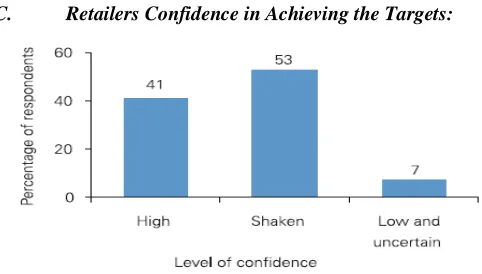
As per KPMG’s survey, even though almost all retailers believe that the current uncertainty is only near term and is likely to persist for 12-18 months, there exists certain degree of skepticism in achieving targets. This is clearly indicated by the Cartesian study where 53 percent of retailer’s confidence levels have been shaken.
[image:4.612.327.568.445.582.2]C. Retailers Confidence in Achieving the Targets:
Figure: 3 Retailers’ Confidence in Achieving Targets
A large number of retailers have experienced a drop in footfalls which is mirrored by slowing Same Store Sales (SSS) growth figures. This also adversely impacts the time taken to break-even for new stores. SSS at some of India’s biggest retail groups have become negative for the first time in six years.
[image:4.612.51.278.523.687.2]day. According to KPMG’s Survey 70% of the respondents stated that the slowdown has adversely affected their footfalls.
D. Impact on Retailers Working Capital:
[image:5.612.359.544.108.225.2]The slowing sales are resulting in lower inventory turnover and increasing working capital requirements for retailers. This in turn has resulted in liquidity pressures for many retailers. To free the cash that has been locked, a large number of companies have been trying to reduce the inventory on their books and shorten working capital cycles.
Figure 4 Working Capital Trend of Retailers (Figures in Average)
Source: KPMG Analysis, Retailers Average
E. Impact on Inventory Turnover:
Figure: 5 Impact on Inventory Turnover
F. Impact on Profits:
On their part, retailers have been trying to compensate for falling sales by curtailing expenses. This has countered the effect of the topline on operating margins leaving it largely unaffected. However, with working capital requirements and expansion capital being financed through sizeable debt, interest costs have significantly dented the bottom-line. A large number of retailers are highly leveraged and rely on fresh equity funding for growth, which is difficult to come by in the current market. Banks are increasingly hesitant to finance retailers in the context of falling demand and low profitability. Working capital requirements have also been difficult to meet as 60% of KPMG’s survey respondents confirmed the drying up of credit.
G. Rental Expenses and Profit Margins of Retailers:
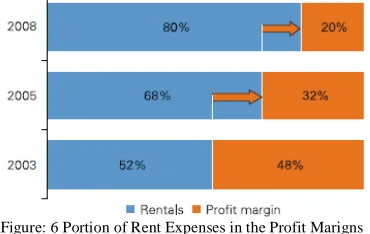
[image:5.612.57.279.192.280.2]As real estate prices sky rocketed, retail rentals also touched unsustainable levels eating directly into the profits margins of retailers.
Figure: 6 Portion of Rent Expenses in the Profit Marigns
Source: Jones Lang Lasalle Meghraj Report on India Retail 2008, KPMG Analysis.
The rapid expansion in retail space in recent years was largely debt funded. This has resulted in substantial leverage, which has added to retailers financing risks in the recent scenario. The declining interest coverage clearly indicated that a large number of retailers are highly leveraged and are battling high interest payments.
IX. REFERENCES
[1]. Berman, Barry and Joel R. Evans (2001). Retail
Management: A strategic Approach 8th ed. Englewood Cliffs, NJ: Prentice Hall
[2]. Levy Michael J (2002). Retail store planning and design
manual. 2nd edition Cicninatti, OH: ST publications, Inc.
[3]. IMAGES-KSA Technopak INDIA RETAIL REPORT 2005
[4]. P. Narayana Reddy (2004), “Efficiency benefits pass on to
consumers: New development in retail market environment in India, Indian Journal of Marketing, pp 23-25
[5]. Rahul and Rahil on Retail (STVP 2007-002) June 12, 2007
[6]. Sahai, Subodh Kant., (2007) India Retail forum,September
4,5,6.
[7]. P. Narayana Reddy (2004), “Efficiency benefits pass on to
consumers: New development in retail market environment in India, Indian Journal of Marketing, pp 23-25
[8]. Agarwal, M.L. (1989), “Distribution Marketing for profits of
productivity”, Journal of Product and Brand Management, pp 139-142
[9]. VV Gopal (2005), “Professionalism in retail management “,
The ICFAI Journal of Service Marketing, pp14-18
[10]. Arvind Singhal, KSA Technopak (2000), “Changing
gears-retailing in India”. Economics Times.
[11]. Raju M Rathod (2005), “Challenges and strengths of
supermarket, Indian Journal of Marketing, pp28-30.
[12]. Rajiv Benerjee (2003), “Changing customers behavior
[image:5.612.47.287.338.464.2]