3221
Educational Mining in Igher Studies Prediction
through Decision Tree Algorithm:
P.Anitha Vairamany, Dr.K.Subramaniyan
P.hD Research Scholar, Bharathiyar University,
Professor,Department of Computer Govt arts and science college Pudhukottai
Abstract: The Educational mining is the subject to suggest right path to the students to get right carrier in their life. The aim of this paper is to discover of new patterns in higher education. The number of students did not know about the right progress in their higher studies .The lot of data mining approach could be used to solve this problem, likewise this paper tried to discover new patterns in higher education from hidden data using decision tree algorithm .the decision tree approach to classify by the records. The decision tree algorithm is used to predict number of chances in the higher education field in various disciplines .Predicting interest of students in a particular field is also important. it is also a key factor of the educational mining.
Keywords: Educational mining; decision tree; higher studies sector rank; category
1. INTRODUCTION
Education system is one the main system which is progressing our society .The better higher education studies is required for growth and development of country. Professional education is very important in higher education. In real world, predicting the performance of the candidates is a highly challenging task. Data mining, which is the science of searching deeply into databases for information and knowledge retrieval, has recently developed new applications and emerging discipline. These Educational Data mining techniques are applied to interpret the information about the candidates and explore the hidden knowledge from their resumes.One of the biggest challenges that higher education faces today is predicting the right paths to the candidates. Institutions would like to know, who will get placement first and who must be educate first for example, there are number candidates could enrol in particular course programs, but the institution should select the candidates who must need to go to post graduation if the candidate have interested to do his post graduation and his job simultaneously ,the institutions must support to and motivate to continue the higher education in the same institutions for better solutions.
One way to effectively suggest the advice to these candidates, through the analysis and presentation of data, or decision. Data mining enables institutions to report the capabilities to uncover and understand hidden patterns in vast databases. These patterns are then built into data mining models and used to predict individual status in higher education progress with high accuracy. As a result of, institutions are able to allocate resources to more effectively. Decision tree in Data mining, give n the information necessary to take action to efficiently allocate resources with an
accurate estimate of how many candidates will take a particular course.
To establish appropriate typologies for the number of candidates, in this research use Decision tree, the powerful clustering algorithm. They first applied the algorithms to the general groupings identified above, with mixed results. The boundaries among sets were unclear and dispersed, and even after repeated testing on holdout datasets, as well as the removal of suspected outliers
2. PREVIOUS WORK
Thiyaga rajan(1) explains about data mining in higher education in his research. The discovery of hidden patterns in educational data is a promising research in Educational DataMining.The students achievement rate were reduced continuously is the major problem in higher education. To increase the success rate of students the early forecast technique will help the management to counsel the poor students at right time. To discover the new patterns from various data the data mining approach is widely used. Likewise here the data mining is used in educational field to extract hidden patterns. Classification is used to classify the records based on the preparation set and also it uses the pattern to categorize the new records.This paper aims to show the various techniques of Educational data mining that guides the management to take better action on students at risk.
3222
request, the college should concentrate on those 20 percent. If data mining can quickly identify potential donors by a ratio of two to four (correctly predicting two out of four who will donate), then the university can achieve results by mailing only to the indicated 40 percent of the alumni population, thus saving considerable time and money.
According to Ghadeer S. Abu-Oda and Alaa M. El-Halees,Faculty of Information Technology, Islamic University of Gaza – Palestine[3],to study the student dropout in computer science major in ALAQSA University for the purpose of improving the current teaching procedures and education strategies. Technologically, we do not propose new methods like FB-growth or decision-tree. However, we only use the mature classification and approaches in this study, cannot present more competitive algorithms or improve the existing algorithms. The study finds that mastering “digital design”and “algorithm analysis” courses has a great affect on predicting student persistence in the majorand decrease student likelihood of dropout.Dina A.Aziz AlHammadi ,Mehmet Sabih Aksoy[4] have described in their paper is to discuss the need for data mining in all levels of any educational institute. An effective data mining cycle was presented to clarify the educational process.
3. PROBLEM DESCRIPTION
The previous researches have described data mining in higher studies. There is no prediction about over to discover proper data from the data ware houses . it would match the right choice to the student to select their higher studies according to his or her interest . decision tree algorithm would match each and every scope of the discipline like a flowchart. The students can easily finding out their scope. The rural students could not understand many things in existing system. But decision tree structure give deliberate structure to each and every student who applied higher studies
2.To use right pattern to extract from the hidden data 3 .To predict right choice to the students
4..To utilise decision tree algorithm to classify and all categories of students.
Decision tree structure
Decision trees is an approach which have set of rules that lead to a class or value. Decision tree algorithm is the most popular Data Mining technique. It is a flow-chart-like tree structure, where each internal node denotes a test on an attribute, each branch represents an outcome of a test, and leaf nodes represent classes or class distributions, the topmost node in a tree is the root node . Decision Tree is method of constructing a model from a dataset in the form of a decision tree or (equivalently) a set of decision rules by using very powerful.A table could be created in which the higher education chance for eachpossible input combination was stored. For e.g., SECT (U) r RANK (1-200) CAT (GEN), the percentage of candidates who had actually got placement in history database was computed. If this percentage is greater than 95%, this combination was classified as “exell chance. This decision tree has stored as an adjacency list. As an example, the partial view of the decision tree given in here. This process is repeated recursively for all cases. For all iterations, When this work is implemented as a web application, the candidate would enter his search criteria through the user interface screen and then a query is constructed, which are passed to get particular attributes which are used to search the decision tree.
5. PREDICTION OF HIGHER STUDIES
CHANCES USING DECISION TREE
ALGORITHM
Decision algorithm is the best prediction technique to choose the higher education. The candidate who has the interest in the higher education must go for it. So, this study give suggestion to that using decision tree. They can get priority of their status. It will help to get post graduation of relevant topic. It may give advantage to get job. But, there must be a plan in E-governance how many of them should be graduated. All the people should get the job. According to the need of vacancies, the seat must be allotted to getting higher education.
Table 1: predictors for higher education chance:
Criteria Predictors Priority Chance
3223
Rank Pass Low No
Category SC High yes
Sector Rural High yes
Rank >90 High yes
Category SC High yes
Sector Rural High yes
Category rank >90 High yes
Sector Urban Low No
Rank Pass Low No
Category OBC Low No
Sector Rural High yes
Category SC Low No
Rank >90 High yes
ENTROPY FOR HIGHER STUDIES
Entropy (Higher studies) 2 1
log
c
i
pi
pi
Entropy (Higher studies) = entropy (5, 9) The adjacency = entropy (0.36, 0.64) =
0.36 log 0.36
2
0.64 log 0.64
2
= 0.94
Entropy using the frequency table of two attributes
( ,
)
( ) ( )
C X
T X
P c E c
TABLE :2 HIGER STUDIES NUMBER OF ATTRIBUTES
Higher Studies
Yes No Total
Chance
Sect 1 4 5
Rank 2 2 4
Cat 3 2 5
14
E(Higher studies, Chance) = P(Sector) * E(3, 2) + P(Rank) * E(4, 0) + P(category) * E(2, 3)
(5 / 14) *0.971 (4 / 14) *0 (5 / 14) *0.971
0.693
Information Gain
The information gain based on the decrease in entropy after a data set is break on attribute. Constructing is all about finding attribute that return most higher information.
Step I calculate entropy of the target
Entropy(higher studies) = entropy (higher studies) – E(chance to higher studies, higher studies)
= 0.94 – 0.6993 = 0.247
Step 3
Choose attribute with largest information the decision node divide dataset by its branches and repeat the process for every branch.
Higher Studies
Attributes Yes No
Sector 3 2
Rank 4 0
Category 2 3
Higher Studies
Yes No
3224 Gain = 0.247
Example applying decision tree algorithm Sector Rural High Yes
Sector Rural High Yes Sector Urban Low No Sector Rural High Yes Sector Urban Low No
Example of prediction Rank Average High Yes Rank Average High Yes Rank Average High Yes Rank Average High Yes
Chances of prediction
Criteria Predictors Priority Chance Category OBC Low No Category SC High Yes Category OC Low No Category OBC Low No Category SC High Yes
Step 4 a branch all must be yes, there are no branches.
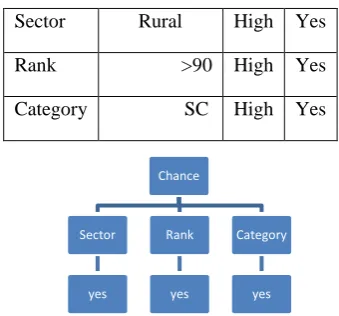
Sector Rural High Yes Rank >90 High Yes Category SC High Yes
The various predictors can give different results. The priority may be in the recurring procedures. If the priority must be given for the first position in the list,
the
Predictors make the important decision of the tree.
DECISION TREE DECISION ALGORITHM If Sector = Rural AND Rank = Pass AND Category = High then Chance = yes
If Sector = Urban AND Rank = High AND Category = low, then Chance = yes
If Sector Urban AND Rank = Pass, AND Category = low, Then Chance = No
If Sector Rural, Rank = High AND Category = low, Then Chance = yes
If Sector = Urban, Rank = Avg AND Category = low, Chance = No
Chance to HIgher EDucation Sector
Rural
yes
Rank
High Avg
P2 yes
Pass
Category
SC
Yes
Chance
Sector
yes
Rank
yes
Category
yes
3225 Figure prediction chances 1
6. CONCLUSION
The educational progress of candidates of any professional Institution has become the major issue of today. Predicting candidate interest in a particular discipline based on their Rank of test result components which are applying in the decision tree. Future work must include applying data mining techniques on an expanded data set which consider additional activities like diploma course and other vocational courses completed by candidates, which we believe may have a significant effect on the overall performance of the candidates.
REFERENCES
[1] Dina A.Aziz AlHammadi Department of Information Sciences College of Computer and information Sciences King Saudi University P.O.Box 2454, Riyadh 11451 Saudi Arabia [email protected] Mehmet Sabih Aksoy Department of Information Sciences College of Computer and Information Sciences King Saudi University P.O.Box 2454, Riyadh 11451 Saudi Arabia [email protected]
[2] Amirah Mohamed Shahiria, WahidahHusaina and Nuraini AbdulRashida – “A Review on Predicting Students Performance using DataMining Techniques” - The Third Information Systems InternationalConference, Procedia Computer Science 72( 2015 ) 414 – 422
[3] Heba Mohammed Nagy, Walid Mohamed Aly, Osama FathyHegazy –“An Educational Data Mining System for Advising Higher
EducationStudents” - International Journal of Computer, Electrical, Automation,Control and Information Engineering Vol:7, No:10, 2013 [4] Monika Goyal and Rajan Vohra - “Applications
of Data Mining inHigher Education” - IJCSI International Journal of Computer ScienceIssues, Vol. 9, Issue 2, No 1, March 2012
[5] U. K. Pandey and S. Pal - “A Data mining view on class room teaching language” International Journal of Computer Science Issue,Vol. 8, Issue 2, pp. 277-282, ISSN:1694- 0814,2011
[6] Dr. MohdMaqsood Ali - “Role of data mining in education sector” -International Journal of Computer Science and Mobile ComputingVol. 2, Issue. 4, April 2013
[7] Dr. P. Nithya, B. Umamaheswari, A. Umadevi – “A Survey onEducational Data Mining in Field of Education” – International Journal of Advanced Research in Computer Engineering & Technology (IJARCET) Volume 5 Issue 1, January 2016
[8] KalpanaRangra, Dr. K. L. Bansal-“Comparative Study of Data Mining Tools” -International Journal of Advanced Research in ComputerScience .
Chance Sector
Rural Yes
Rank High
yes Avg yes
Pass No
Category BC
yes SC yes