Volume 7, No. 6(Special Issue), November 2016
International Journal of Advanced Research in Computer Science REVIEW ARICLE
Available Online at www.ijarcs.info
Cloud Computing
Sukhvir kaur
Student of MCA-III Department of Computer Science
Guru Nanak College Budhlada Heron khurd , India [email protected]
Abstract— Cloud computing is an approach to expend (enhance) the capacity or include abilities progressively without putting resources into new infrastructure, training new personnel, or licensing new softwares . In the most recent couple of years, cloud computing has developed from being a promising business idea to one of the quickly developing segments of the IT business .We first discuss about cloud computing and related technologies. We then identify several challenges from the Cloud computing adoption.
In May 2008, Merrill Lynch (2008) evaluated the cost points of interest of Cloud Computing to be three to five times for business applications and more than five times for consumer applications.
Keywords—Cloud Computing , Virtualization ,Cloud Adoption challenges.
I.
INTRODUCTION
Over the past few years, the expanding accessibility of rapid Internet and corporate IP connections is enabling the delivery of new network-based services. While Internet-based mail administrations have been working for a long time, service offerings have recently expanded to incorporate network based storage and network-based computing. These new services are being offered both to corporate and individual end users. Services of this type have been nonexclusively called cloud computing services [5].
As a major application model in the period of the Internet, Cloud Computing has become a significant research topic of the scientific and industrial communities following 2007.As per a Gartner official statement from June 2008, Cloud Computing will be "no less influential than e-business”.
IICloud Computing: Overview
A.
Definition
“Cloud computing is a style of computing in which massively scalable IT-related capabilities are provided “as a service” using Internet technologies to multiple external customers”[1].
Cloud computing is a model for enabling convenient, on-demand network access to a shared pool of configurable computing resources (e.g., networks, servers, storage, applications, and services) that can be rapidly provisioned and
released with minimal management effort or service provider interaction [2].
“Cloud Computing refers to both the applications delivered as services over the Internet and the hardware and systems software in the data centers that give those services. At the point when a Cloud is made accessible in a pay-as-you-go way to the overall population, we call it a Public Cloud, the service being sold is Utility Computing. We utilize the term Private Cloud to refer to inner datacenters of a business or other organization, not made available to the general public.
B.Essential elements of cloud computing are:-
On-demand self-service:
A consumer with an immediate need at a specific Times lot can avail computing resources (such as CPU time, network storage, software use, and so forth) in an automatic (i.e. convenient, self-serve) style without turning to human connections with providers of these resources.
Broad network access:
These processing resources are conveyed over the Internet and utilized by various customer applications with heterogeneous stage (such as mobile phones, laptops, and PDA ) arranged at a consumer's site.
Resource pooling:
A cloud service provider’s computing resources are 'pooled' together with an end goal to serve various consumers utilizing either the multi-tenancy or the virtualization model, with various physical and virtual resources dynamically assigned and reassigned according to consumer demand. The result of a pool-based model is that physical computing resources get to be imperceptible to consumers, who all in all don’t have control or knowledge over the area, arrangement, and originalities of these resources.
Rapid elasticity:
For consumers, computing resources become Immediate rather than persistent . There are no in advance responsibility and contract as they can utilize them to scale up at whatever point they need, and discharge them once they complete to scale down.
Measured Service:
usage of these resources for every users through its metering capabilities.
C. Cloud Computing Service Models
Cloud Providers provide(offer) services that can be grouped into following three categories:
1. Infrastructure as a Service (IaaS) 2. Platform as a Service (PaaS) 3. Software as a Service (SaaS)
Fig:- Cloud Computing Service Models
1.Infrastructure as a Service (IaaS)
IaaS gives basic storage and computing capacities as standardized services over the network. The consumer has control over working frameworks, storage, deployed applications, and possibly limited control of select networking components [7]. Examples of Infrastructure as a service is the Amazon .com [3,4,5],GoGrid[2,6].
2. Platform as a Service (PaaS)
The customer has the freedom to build his own applications, which run on the provider‟s infrastructure. To meet sensibility and versatility prerequisites of the applications, , PaaS suppliers offer a predefined mix of OS
and application servers, such as LAMP platform (Linux, Apache, MySql and PHP), restricted J2EE, Ruby etc.Some Examples of PaaS Google‟s App Engine,Microsoft Azure, Force.com[6,7].
3. Software as a Service (SaaS)
At the largest amount of the pecking order, the application layer comprises of the actual cloud applications. Different from traditional applications, cloud applications can influence the programmed scaling highlight to accomplish better execution, accessibility and lower working cost. . Examples of SaaS include SalesForce.com, Google Mail, Google Docs, and so forth [2,4].
D. Types of clouds
Clouds can generally be classified according to who the owner of the Cloud data centres is. A Cloud environment can comprise either a single Cloud or multiple Clouds.
There are follwing three types of cloud computing:- 1. Public clouds
2. Private clouds 3. Hybrid clouds
1.Public clouds:
A cloud in which service providers offer their resources as services to the overall public. Public clouds offer many key advantages to service providers, including no underlaying capital investment on infrastructure and and moving of dangers to infrastructure providers[6].
Public Cloud permits systems and services to be effectively available to overall public e.g. Google and Amazon. A Public Cloud is not restricted to a limited clients base: it “…is made available in a pay-as-you-go manner to the general public” .
Fig:-Types of Cloud Computing
2.Private cloud:
Private cloud (or internal cloud) refers to cloud computing on private networks. Private clouds are built for the exclusive use of one client, providing full control over data, security, and quality of service. Private clouds can be built and managed by a company’s own IT organization or by a cloud provider[8].
3.
Hybrid clouds:
A hybrid cloud is a combination of muliple public and private cloud models that efforts to address the limitations of every methodology. In a hybrid cloud, part of the service infrastructure keeps running in private clouds while the rest of part keeps runinng in public clouds[6,7]. In the other words ,hybrid clouds introduce the complexity of determining how to allocate applications across both a public and private cloud.
E. Services On-Demand
Service that are offerings in cloud computing show in following table:
Services On-Demand
Company/Product Service type Concept
Amazon EC2 Computation,
Storage
Box.net Storage Applications Google App Engine Infrastructure,
Web Applications
Infrastructure
Gmail Drive Storage, Email Applications
Network.com Infrastructure Infrastructure/ Platform-as-a-Service
OpSource Billing Applications
Salesforce.com Platform
Platform-as-a-Service/ Applications
MS SkyDrive Storage Applications
Process Maker Live Business Process Management
Applications
[image:3.612.28.301.54.246.2]XDrive Storage Applications
Table 1:-Service On-Demand.
III.Related Technologies
There are certain technologies that are working behind the cloud computing platforms making cloud computing flexible reliable, usable. These technologies are Virtualization, Service-Oriented Architecture (SOA), Grid Computing,Utility Computing.
1.Virtualization
Virtualization is a technology that abstracts away the details of physical hardware and provides virtualized resources for high-level applications. A virtualized server is known a virtual machine (VM). Virtualization is the base of cloud computing, as it gives the capacities of pooling
computing resources from clusters of servers and dynamically assigning or reassigning virtual resources to applications on-demand[9].
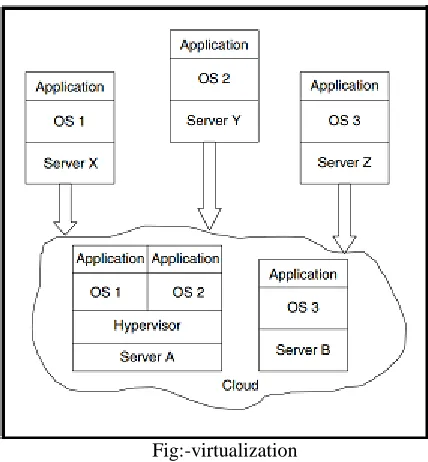
Virtualization is a rapidly evolving technology that gives a number of advantages to computing systems, such as improved resource utilization and management, application privacy and portability, and system reliability.Benefit of cloud computing is the capability to virtualize and share resources among different applications with the purpose for better server utilization. In non-cloud computing three independent platforms exist for three different applications running on its own server.
Virtualization technologies include virtual machine techniques such as VMware and Xen, and virtual networks, such as VPN. Virtual machines provide virtualized IT-infrastructures on demand, while virtual networks support users with a customized network environment to access cloud resources[8].
In the cloud, servers can be shared, or virtualized, for operating systems and applications resulting in fewer servers (in specific example two servers). An example of virtualization: in non-cloud computing there is a need for three servers; in the cloud computing, two servers are used.
Fig:-virtualization
One of the approaches to decrease power utilization by a data center is to apply virtualization technology. This technology permits one to combine a few servers to one physical node as Virtual Machines (VMs) decreasing the amount of the equipment being used. . Recently emerged Cloud computing paradigm leverages virtualization and provides on-demand resource provisioning over the Internet on a pay-as-you go basis.This allows industry to drop the costs of
preservation of their own computing environment and outsource the computational needs to the Cloud. It is
significant for Cloud providers to offer reliable Quality of Service for the customers without minimize Service Level Agreements (SLA), e.g. throughput, response time.
Allocation of VMs can be partitioned in two: the first part is admission of new requests for VM provisioning and position VMs on hosts, while the second part is optimization of current allocation of VMs.[14] The first part of allocation of VM can be considered as a bin packing problem with variable bin sizes and costs.The complexity of the allocation part of the algorithm is n·m, where n is the number of VMs that have to be allocated and m is the number of hosts[14].
2.
Web
Service
and
Service-Oriented
Architecture
Service-Oriented Architecture helps to use
[image:3.612.351.565.63.294.2]which follow industry standards including WSDL, SOAP, and UDDI. A Service Oriented Architecture organizes and manages Web services inside clouds. A SOA also includes a set of cloud services, which are available on various distributed platforms.
3.Grid Computing
Grid computing is a distributed computing paradigm that coordinates networked resources to gain general computational purpose. Cloud computing is similar to Grid computing in that it also employs distributed resources to achieve application-level objectives. However, at multiple levels (hardware and application platform) cloud computing takes one step further by leveraging virtualization technologies to realize resource sharing and dynamic resource provisioning [6].
Grid computing is a hardware and software infrastructure motivated by real problems appearing in advanced scientific research. The Grid is distributed computing ‘middleware’ that provides ‘coordinated cross-organizational resource sharing’ to high-end computational applications such as science and engineering[2].
4. Utility Computing
Utility computing is based on Pay per Use model. It offers computational resources on demand as a metered service. Cloud computing, grid computing, and managed IT services are based on the concept of Utility computing. Cloud computing can be understand as a realization of utility computing. It adopts a utility-based pricing scheme entirely for economic reasons. With on-demand resource provisioning and utility based pricing, service providers can truly maximize resource utilization and minimize their operating costs[6].
IV.Cloud
Computing
Adoption
Challenges
According to a survey that are conducted by IDC in 2008, the many challenges that prevent Cloud Computing from being adopted are recognized by organizations:
Fig:- Results of IDC survey ranking security challenges, 2008 [10]
Security:
Most critical point for the subsequent acceptance of Cloud innovation in business industries will be the security of critical data, both in transfer as in storage. Vast enterprises will not be willing to support the Cloud idea as long as there is not more straightforwardness accessible at which geographical
location the data is stored away and how it is protected[3]. Without uncertainty, putting your information, running your software on other person's hard disk using other person's CPU appears daunting to many. Well-known security issues such as information misfortune, phishing, botnet posture genuine dangers to association's information and software. In addition, the multi-tenancy model and the pooled computing resources in cloud computing has introduced new security challenges that require novel procedure to handle with. For instance, hackers can utilize Cloud to sort out botnet as Cloud frequently gives more reliable infrastructure services at a relatively expensive cost for them to begin an attack [11].
Costing Model :
Cloud consumers must consider the tradeoffs amongst computation, communication, and integration. While migrating to the Cloud can essentially decrease the infrastructure cost, it raise the cost of data communication, i.e. the cost of transferring exchanging an association's information to and from the public and the cost per unit of computing resource used is likely to be higher. This issue is especially prominent if the consumer uses the hybrid cloud deployment model where the organization's data is distributed amongst a number of public/private clouds. Intuitively, on demand computing makes sense only for CPU intensive jobs [11].
Furthermore, the cost of data integration can be considerable as different clouds often use proprietary protocols and interfaces. This requires the cloud consumer to interact with different clouds using cloud provider-specific APIs and to develop adhoc adaptors in order to distribute and integrate heterogeneous resources and data assets to and from various clouds.
Charging Model:
Traffic management and analysis:
Analysis of data traffic is critical for today’s server frams. For instance, numerous web applications depend on analysis of traffic data to optimize client experiences. Network operators also need to know how movement courses through the network with a specific end goal to make focuses.
Service Level Agreement:
One of the essential requirements for a Cloud computing environment is giving reliable QoS. It can be characterized as far as Service Level Agreements (SLA) that describe such characteristics as minimal throughput, maximal response time or latency delivered by the deployed system [12].
It is impractical to satisfy all consumer expectations from the service provider perspective and hence a balance needs to be made via a negotiation process. At the end of the negotiation process, provider and consumer commit to an agreement. This agreement is referred to as a SLA.
At the end of the day, it is essential for consumers to acquire ensures from providers on service delivery. Commonly, these are provided through Service Level Agreements (SLAs) negotiated between the providers and consumers [2]. This SLA serves as the foundation for the expected level of service between the consumer and the provider[13]. The QoS attributes that are generally part of an SLA , however change continually and to enforce the agreement, these parameters need to be closely monitored. Because of the complex nature of consumer demands, a straightforward ”measure and trigger” procedure may not work for SLA enforcement .Four distinct types of monitoring demands made by consumers. One situation is a consumer demands the data exposed by a service provider without further re-finement for example, exchange number, which is a raw metric. Second situation is consumer asks that gathered data should put into significant context. This situation creates the requirement for a process which gathers data from various sources and applies suitable appropriate for calculating meaningful results. The third scenario is the consumer requests certain customized data to be collected. In the fourth scenario the consumer even specifies the way how data should be collected .Cloud providers have to deal with energy-performance trade-off – minimization of energy consumption, while meeting QoS requirements.
V.
CONSLUSION
Cloud computing has recently emerged as a paradigm for managing and delivering services over the Internet .Cloud Computing essentially represents the increasing trend towards the external deployment of IT resources, such as computational power, storage or business applications, and obtaining them as
services. There are many new technologies emerging at a rapid rate, each with technological advancements and with the potential of making human’s lives easier. In this paper , we have overview of cloud computing , covering its essential concepts, related Technologies, Cloud Computing Adoption
Challenges. We need technology to support or improve the economical processes. The small and mid-size companies have less complex processes, they should be the first category of businesses to use cloud computing services
VI. REFERENCES
[1] Katarina Stanoevska-Slabeva, Thomas Wozniak” Cloud Basics – An Introduction to Cloud Computing”, Springer, pp.47-52.
[2] Tharam Dillon , Chen Wu and Elizabeth Chang ,” Cloud Computing: Issues and Challenges”, 2010 24th IEEE International Conference on Advanced Information Networking and Applications.
[3] http://link.springer.com/article/10.1007/s125990090071-2/fulltext.html.
[4] Han Qi, Abdullah Gani, Faculty of Computer Science and Information Technology ,University of Malaya” Research on Mobile Cloud Computing: Review, Trend and Perspectives” .
[5] By Jayant Baliga, Robert W. A. Ayre, Kerry Hinton, and Rodney S. Tucker,” Green Cloud Computing: Balancing Energy in Processing, Storage, and Transport”, IEEE,pp.149-152.
[6] Qi Zhang · Lu Cheng · Raouf Boutaba,” Cloud computing: state-of-the-art and research challenges”,springer,pp.7-17. [7] Dimitrios Zissis, Dimitrios Lekkas,” Addressing cloud
computing security issues”, Elsevier,pp.583-586.
[8] Borko Furht ,Armando Escalante,” Handbook of Cloud Computing”.springer,pp.3-19.
[9] Haikun Liu, Cheng-Zhong Xu , Hai Jin , Jiayu Gong , Xiaofei Liao,” Performance and Energy Modeling for Live Migration of Virtual Machines”,pp.1-2.
[10] F. Gens. (2009, Feb.). “New IDC IT Cloud Services Survey: Top Benefits and Challenges”, IDC eXchange, Available: [Feb. 18, 2010].
[11]Kuyoro S. O., Ibikunle F., Awodele O.,” Cloud Computing Security Issues and Challenges”, International Journal of Computer Networks (IJCN), Volume (3) : Issue (5) : 2011 [12] Anton Beloglazova, Rajkumar Buyya,” Energy Efficient
Resource Management in Virtualized Cloud Data Centers”, 2010 10th IEEE/ACM,pp.826-828.
[13] Pankesh Patel, Ajith H. Ranabahu, Amit P. Sheth,” Service Level Agreement in Cloud Computing”, Kno.e.sis Publications