R E S E A R C H
Open Access
Generalized combination complex
synchronization of new hyperchaotic
complex Lü-like systems
Cuimei Jiang and Shutang Liu
**Correspondence: [email protected]
College of Control Science and Engineering, Shandong University, Jinan, 250061, P.R. China
Abstract
In this paper, a new hyperchaotic complex system is presented and its dynamical properties are discussed by phase portraits, bifurcation diagrams, and the Lyapunov exponents spectra. Noticeably, based on two drive complex systems and one response complex system with different dimensions, we propose generalized combination complex synchronization and design a general controller. Additionally, we investigate generalized combination complex synchronization between real systems and complex systems via two complex scaling matrices. Two examples, which include two chaotic complex systems driving one new hyperchaotic complex system and two new hyperchaotic complex systems driving one chaotic real system, are shown to demonstrate the effectiveness and feasibility of the schemes.
Keywords: hyperchaotic complex systems; chaotic attractors; Lyapunov exponents; generalized combination complex synchronization
1 Introduction
In , Fowleret al.[] proposed the complex Lorenz equations, which is the pioneer-ing work in the domain of complex systems. After that, chaotic and hyperchaotic com-plex systems have been extensively studied owing to their important applications in phys-ical systems, image processing and in particular in secure communication [–]. And re-searchers presented many chaotic and hyperchaotic complex systems, such as the complex Lorenz system [], the complex Chen system [], the complex Lü system [], the hyper-chaotic complex Lorenz system [], the hyperhyper-chaotic complex Lü system [], and so on. Compared with chaotic systems, the behavior of hyperchaotic complex systems is more complex and richer. Hence, when applying the hyperchaotic complex systems to secure communication, it is better to increase the complexity and the security of the transmitted information.
On the other hand, with the development of complex systems, synchronization of chaotic complex systems has gained a great deal of attentions. Some synchronization schemes of chaotic real systems were extended to the complex space, such as complete synchronization [], anti-synchronization [, ], projective synchronization [],etc.
Recently, many authors have studied some new kinds of synchronization for complex dy-namical systems, for example, complex complete synchronization [], complex projective synchronization [], complex modified projective synchronization [, ], and so forth.
Since complex variables increase the diversity and the security of the transmitted signals, these synchronization methods of chaotic complex systems have potential applications in secure communication and image processing.
However, most of the above-mentioned works mainly focus on the usual drive-response synchronization which has one drive system and one response system. To improve the ability of anti-attack and anti-translated of the transmitted information, Luoet al.[] pro-posed combination synchronization which has two drive real systems and one response real system. Subsequently, Wu and Fu [] studied increased-order and reduced-order combination synchronization in the real space concerning two specific examples. Soon af-terwards, Zhouet al.[] introduced combination synchronization to the complex space and carried out synchronization of three identical or different nonlinear complex hyper-chaotic systems. Very recently, Sunet al.[] investigated combination complex synchro-nization between two drive chaotic complex systems and one response chaotic complex system. These synchronization schemes occur in chaotic complex systems with the same dimensions.
To the best of our knowledge, there are few papers discussing combination synchro-nization among two drive systems and one response system with different dimensions in the complex space. As a matter of fact, for nonlinear systems with different dimensions, a lot of synchronization phenomena exist in reality, especially in the chemical and biolog-ical sciences. For instance, we can observe the physiologbiolog-ical synchronization phenomena between higher-dimensional and lower-dimensional thalamic neurons as well as between the circulatory and respiratory systems []. Therefore, it is meaningful and valuable to study synchronization between two drive systems and one response system with different dimensions from the application point of view.
Inspired by the above discussion, we introduce a new hyperchaotic complex system to investigate generalized combination complex synchronization between two drive complex systems and one response complex system with different structures. Meanwhile, a general controller is designed to synchronize chaotic complex systems in the sense of generalized combination complex synchronization. By virtue of two complex scaling matrices, we es-tablish a link between real chaos and complex chaos. The proposed generalized combi-nation complex synchronization will contain complex projective synchronization, com-bination synchronization, and comcom-bination complex synchronization. Consequently, our work will extend the previous results.
The remainder of this paper is organized as follows. In Section , we present a hyper-chaotic complex Lü-like system and study its dynamical properties including symmetry, equilibria and stability, Lyapunov exponents and fractal dimensions, as well as hyper-chaotic attractors. Section introduces generalized combination complex synchroniza-tion and designs a general controller. Two typical examples are treated to exhibit the ef-fectiveness and correctness of the proposed methods. Finally, a concluding remark is given in Section .
2 A new hyperchaotic complex Lü-like system
In , Zhouet al.[] studied the Lü-like or Pan system which can be described as
⎧ ⎪ ⎨ ⎪ ⎩ ˙
x=a(y–x),
˙
y=cx–xz,
˙
z=xy–bz,
(a) (b)
(c) (d)
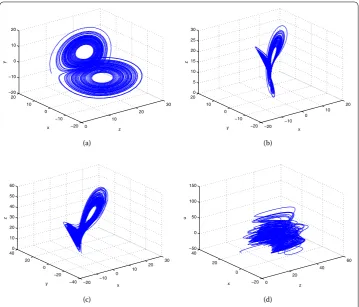
Figure 1 Attractors of chaotic system (1) and hyperchaotic system (2).
wherea,b, andcare real constants. When the parameters are chosen asa= ,b= , and
c= , the Lü-like system () is chaotic as shown in Figure (a)-(b).
Recently, a new modified hyperchaotic Lü-like or Pan system [] has been constructed by introducing a state feedback controller, which can be expressed by
⎧ ⎪ ⎪ ⎪ ⎨ ⎪ ⎪ ⎪ ⎩ ˙
x=a(y–x),
˙
y=cx–xz+u,
˙
z=xy–bz,
˙ u= –dy,
()
wherea,b,c, anddare real constants, (x,y,z,u)Tis a real state vector. The hyperchaotic
attractors of system () are plotted in Figure (c)-(d) witha= ,b= /,c= , andd= . In this work, the complex extension of the modified hyperchaotic Lü-like system is firstly designed by
⎧ ⎪ ⎪ ⎪ ⎨ ⎪ ⎪ ⎪ ⎩ ˙
x=a(x–x),
˙
x=cx–xx+x,
˙
x=(x¯x+xx¯) –bx,
˙
x= –d(x¯+x),
()
Lü-like system can be rewritten as follows:
In what follows, we investigate the basic dynamical properties of system ().
2.1 Symmetry and invariance
Note that the symmetry of system (): It is symmetric about them-axis, which means it is invariant for the coordinate transformation of (m,m,m,m,m,m)→(–m, –m, –m, –m,m, –m).
2.2 Dissipation
System () is dissipative under the condition a+b> , since
∇V= , ). To study the stability of the zero equilibrium pointE, we have the Jacobian of system () atEas follows:
By a simple computation, the characteristic polynomial of the Jacobian matrixJEis
ob-tained as
(λ+b)λ+aλ–acλ+aλ– (ac–d)λ+ad= .
According to the Routh-Hurwitz theorem, we deduce thatEwill be stable whena> ,
b> ,c< , andd> . Otherwise, it is an unstable fixed point. Similarly, we can discuss the stability of the equilibrium pointsEandE.
2.4 Lyapunov exponents and fractal dimensions
Figure 2 Lyapunov exponents spectrum of system (4) with (a,b,c,d) = (10, 8/3, 28, 10).
initial conditionx() = ( +j, +j, , ); see Figure . Here, the six Lyapunov exponents of system () areλ= .,λ = .,λ= –.≈,λ= –.,
λ= –., andλ= –.. Sinceλandλare positive values, system () is
hyperchaotic for this choice ofa,b,c, andd. Thus, we can calculate the fractal dimension [] as follows:
D=j+
|λj+|
j
i=
λi= +
λ+λ+λ+λ
|λ|
= ..
2.5 Hyperchaotic behavior and attractors
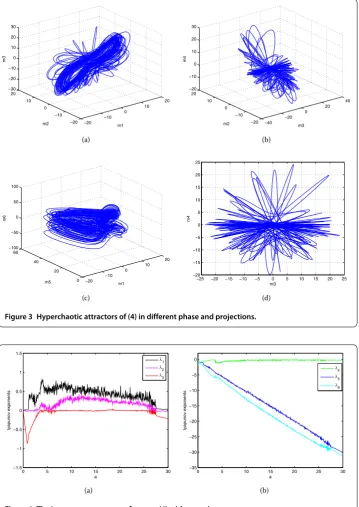
System () is hyperchaotic when (a,b,c,d) = (, /, , ) andx() = ( +j, +j, , ). Figure shows the hyperchaotic attractors of system () in different phase planes and projections.
Next, we calculate numerically the values of the parameters of () at which chaotic at-tractors exist under the above conditions. Now we consider the following two cases.
(i) Fixb= /,c= ,d= , and letavary: To observe the Lyapunov exponents spec-trum clearly, we plot the values ofλ,λ, andλin Figure (a), while the values ofλ,λ, andλare shown in Figure (b). From Figure (a), it is obvious that system () has hy-perchaotic attractors fora∈[., .], while it has chaotic attractors whena∈[., .]. The above results can be demonstrated by the bifurcation diagram which is displayed in Figure (a), while Figure (b)-(d) describe attractors of system ().
(ii) Fixa= ,c= ,d= , and letbvary: The values ofλ,λ, andλare plotted in Figure (a), while the values ofλ,λ, andλare shown in Figure (b). From Figure (a), we see that system () has hyperchaotic attractors forb∈[., .], chaotic attractors forb∈[., .] and [., .], and solutions of system () that approach fixed points forb∈[., .]. Corresponding bifurcation diagram with the step size of . is plotted in Figure (a). Meanwhile, the attractors of system () are depicted in Figure (b)-(c).
3 Generalized combination complex synchronization
(a) (b)
(c) (d)
Figure 3 Hyperchaotic attractors of (4) in different phase and projections.
(a) (b)
Figure 4 The Lyapunov exponents of system (4) withavarying.
3.1 Scheme of generalized combination complex synchronization Consider an-dimensional chaotic complex system as the first drive system
˙
x=Ax+f(x), ()
the second drive chaotic complex system withndimensions is given as
˙
(a) Bifurcation diagram of system () withavarying (b)a=
(c)a= (d)a=
Figure 5 Bifurcation diagram and attractors of system (4) withavarying.
(a) (b)
Figure 6 Lyapunov exponents of system (4) withbvarying.
while an-dimensional response chaotic complex system is assumed to obey
˙
z=Cz+h(z) +U(x,y,z), ()
wherex=xr+jxi∈Cn×,y=yr+jyi∈Cn×, andz=zr+jzi∈Cn×are the state complex
vectors,A∈Rn×n,B∈Rn×n, andC∈Rn×nare parameter matrices, whilef,g, andh
(a) Bifurcation diagram of system () withbvarying (b)b= .
(c)b= . (d)b= .
Figure 7 Bifurcation diagram and attractors of system (4) withbvarying.
Remark Many chaotic and hyperchaotic complex systems can be described by (), such as the complex Lorenz system, the complex Chen system, the complex Lü system, the hyperchaotic complex Lorenz system, the hyperchaotic complex Lü system,etc.
The definition of generalized combination complex synchronization is introduced be-low.
Definition For two drive systems (), (), and one response system (), they are said to be in generalized combination complex synchronization if there exist two complex matrices
M=Mr+jMi∈Cn×nandM=Mr+jMi∈Cn×n, such that
lim
t→∞e=tlim→∞z–Mx–My= ,
where · is the matrix norm,e=er+jeiis called the error vector,er=zr–Mr
xr+Mixi–
Mr
yr+Miyi,ei=zi–Mrxi–Mixr–Mryi–Miyr, the complex matricesMandMare called the scaling matrices.
Remark If the dimensions of the two drive systems () and () are equal to that of the re-sponse system (),i.e.,n=n=n, then the proposed synchronization will be combination complex synchronization.
Remark If the scaling matrixM=On×norM=On×n, then we can achieve complex
projective synchronization. IfMi=On×norM
i
synchroniza-tion can be carried out. IfM=On×nandM=On×n, then the synchronization problem
will be turned into a chaos control problem.
Remark Definition can be applicable to three or more chaotic complex systems. Ad-ditionally, drive systems and response systems can be identical or different.
The following lemma is useful in this paper.
Lemma [] For a matrix D∈Cn×n,all of the real parts of whose eigenvalues are nega-tive,i.e.,Re(λi(D)) < (i= , , . . . ,n),thenlimt→∞exp(Dt) = .
Theorem If the control law is chosen as follows:
U= –C(Mx+My) –h(z) +M
Ax+f(x)+M
By+g(y)–Ke, ()
where K is a complex control gain matrix,then generalized combination complex synchro-nization between the two drive systems(), (),and the response system()can be achieved if and only if all eigenvalues of C–K satisfyRe(λi(C–K)) < (i= , , . . . ,n).
Proof From Definition , we obtain the error vector between two drive systems (), (), and one response system () as follows:
e(t) =z–Mx–My. ()
Calculating the derivative of the error vector () and with the designed controller (), we conclude that
˙
e(t) – (C–K)e(t) = . ()
Multiplyingexp((–C–K)t) on both sides of (), it follows that
d(exp(–(C–K)t)e(t))
dt = . ()
Integrating equation () from tot, it is straightforwardly found that
e(t) =exp(C–K)te(), ()
where e() is an initial condition. Thus, taking the limit on both sides of (), since
Re(λi(C–K)) < , by Lemma , we have
lim
t→∞e(t) =tlim→∞exp
(C–K)te() = .
Therefore, generalized combination complex synchronization is realized between the two drive systems (), (), and the response system () with the controller (). This completes
the proof.
Corollary Suppose that two drive systems()and()are chaotic real systems,i.e.,x∈
Rn×,y∈Rn×,and the response system is a chaotic complex system(),i.e.,z∈Cn×.
Then generalized combination complex synchronization between two drive real systems
(), (),and one response complex system()can occur with the designed controller
U= –C(Mx+My) –h(z) +M
Ax+f(x)+M
By+g(y)–Ke,
where K∈Cn×n,all eigenvalues of C–K satisfyRe(λ
i(C–K)) < (i= , , . . . ,n).
Corollary Assume that two drive systems()and()are chaotic complex systems,i.e.,
x∈Cn×,y∈Cn×,and the response system()is a chaotic real system,where z∈Rn×.
Since z(t)is real,we choose a real controller U to ensure combination synchronization of real parts and avoid increasing the imaginary parts of the response system.Consequently,
the error vector is defined as
e=z–Mrxr+Mixi–Mryr+Miyi.
If the real controller is designed as
U= –h(z) –CMrxr–Mixi+Mryr–Miyi+MrAxr+fr(x)–MiAxi+fi(x)
+MrByr+gr(y)–MiByi+gi(y)–Ke,
where K ∈Rn×n,all eigenvalues of C–K satisfyRe(λi(C–K)) < (i= , , . . . ,n),then the two drive complex systems(), (),and the response real system()are in generalized combination complex synchronization of real parts.
In addition, from Theorem , some corollaries can easily be obtained and their proofs are omitted.
Corollary (I)Suppose M=On×n.If the controller is designed as follows:
U= –CMy–h(z) +M
By+g(y)–Ke,
where K is a control gain matrix,then complex projective synchronization between two different dimensional systems()and()can be realized if and only if all eigenvalues of C–K satisfyRe(λi(C–K)) < (i= , , . . . ,n).
(II)Suppose M=On×n.If the controller is designed as follows:
U= –CMx–h(z) +M
Ax+f(x)–Ke,
where K is a control gain matrix,then complex projective synchronization between two different dimensional systems()and()can occur if and only if all eigenvalues of C–K satisfyRe(λi(C–K)) < (i= , , . . . ,n).
Corollary Assume two scaling matrices M =On×n and M=On×n. If the complex
controller is given as
where K is a control gain matrix and all eigenvalues of C–K satisfyRe(λi(C–K)) <
(i= , , . . . ,n),then the equilibrium point of the response system()is asymptotically stable.
3.2 Numerical examples
In this subsection, we provide two examples to illustrate the feasibility and effectiveness of the proposed schemes. Firstly, synchronization between two -dimensional chaotic com-plex systems and a -dimensional new hyperchaotic comcom-plex system is studied.
.. Synchronization between two drive chaotic complex systems and a response hyperchaotic complex system
Now, we consider that the complex Lü system and the complex Lorenz system drive a hyperchaotic complex Lü-like system. Thus, the two drive systems are given as
⎧
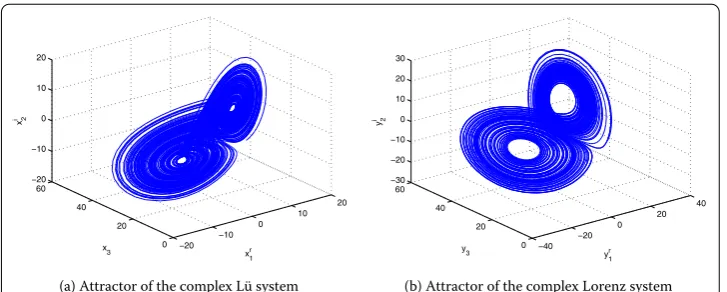
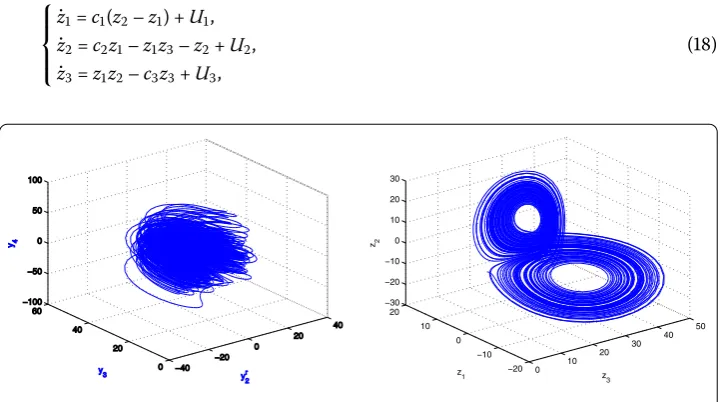
yare real variables. Systems () and () behave chaotically with the given parameters (a,a,a) = (, , ) and (b,b,b) = (, , .), respectively; see Figure .
(a) Attractor of the complex Lü system (b) Attractor of the complex Lorenz system
The response system is the proposed hyperchaotic complex Lü-like system:
Here, we select two complex scaling matricesMandMas
M=
A control matrix is chosen as
(a) (b)
(c) (d)
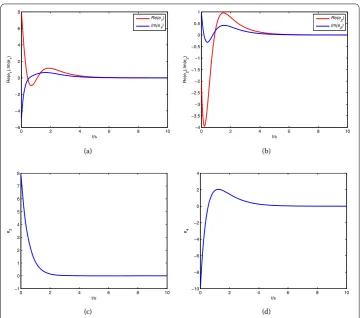
Figure 9 The time evolution of synchronization errors between systems (13), (14), and (15).
According to Theorem , a complex controller is designed as follows:
⎧ ⎪ ⎪ ⎪ ⎪ ⎪ ⎪ ⎪ ⎪ ⎪ ⎪ ⎪ ⎪ ⎪ ⎨ ⎪ ⎪ ⎪ ⎪ ⎪ ⎪ ⎪ ⎪ ⎪ ⎪ ⎪ ⎪ ⎪ ⎩
U= (a+c)x+ (c– )y+ (a– c)x+ (b– c)y–cx
+ (b+ c)y–xx– xrxr– xixi –yy–yryr–yiyi+ e– e + ( +j)e+j((c–a)x+ (b–c)y– (b+c)y+ (a+c)x),
U= (a–c)x– (c+ b)y+ (c– –a)x+ (c– –b)y–ax + by+zz+xrxr+xixi+yryr+yiyi – e– e+ ( +j)e +j(xx–yy+ (b+c)y–cx–y–ax),
U= (a–c)x+ (c–b)y–zrzr–zizi– xrxr– xixi+yryr+yiyi+e,
U= zr–ax– by+xrxr+xixi+yryr+yiyi+ e–e.
In the numerical simulations, the initial values of the drive and response systems are cho-sen asx() = ( + j, + j, )T,y() = ( +j, + j, )T, andz() = ( +j, +j, , )T,
respec-tively. Figure displays that the errors of synchronization tend to zero,i.e., synchroniza-tion between two drive chaotic complex systems and a response hyperchaotic complex system is realized.
.. Synchronization between two drive hyperchaotic complex systems and a response chaotic real system
Lü-like systems drive the real Lorenz system []. Thus, two drive systems are described
see Figure and Figure (a), respectively. The real Lorenz system reads
⎧
(a) Attractor of hyperchaotic complex Lü-like system (b) Attractor of the real Lorenz system
where
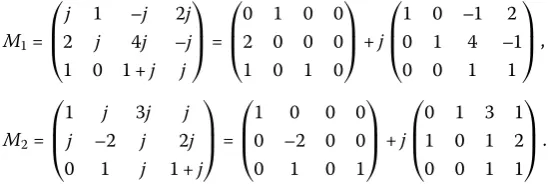
Assume two complex scaling matricesMandMas follows:
M=
A real control matrix is chosen as
K=
According to Corollary , the real controller is designed as
(a) (b)
(c)
Figure 11 The time evolution of synchronization errors between systems (16), (17), and (18).
In the numerical simulations, the initial values of the drive and response systems are
x() = ( +j, +j, , )T,y() = (– +j, – j, , )T, andz() = (, –, )T, respectively. All
eigenvalues ofC–Kareλ= – +j,λ= – –j, andλ= –, which satisfyRe(λi(C–K)) <
(i= , , ). The errors of synchronization converge asymptotically to zero, which is shown in Figure . Therefore, synchronization between two drive hyperchaotic complex systems and a response chaotic real system is achieved in the real parts.
4 Conclusions
un-known parameters and external disturbances exist in practical chaotic synchronization. Consequently, we will make an endeavor to investigate robust generalized combination complex synchronization considering unknown parameters and external disturbances in our future work.
Competing interests
The authors declare that they have no competing interests.
Authors’ contributions
The two authors contributed equally to this work. They all read and approved the final version of the manuscript.
Acknowledgements
The authors would like to thank the editors and anonymous referees for their constructive comments and suggestions. The research was supported by the National Natural Science Foundation of China (numbers 61273088, 10971120) and the Natural Science Foundation of Shandong Province (number ZR2010FM010).
Received: 17 November 2014 Accepted: 29 April 2015 References
1. Fowler, AC, Gibbon, JD, McGuinness, MJ: The complex Lorenz equations. Physica D4, 139-163 (1982) 2. Gao, TG, Chen, ZQ: A new image encryption algorithm based on hyper-chaos. Phys. Lett. A372, 394-400 (2008) 3. Mahmoud, GM, Mahmoud, EE, Arafa, AA: On projective synchronization of hyperchaotic complex nonlinear systems
based on passive theory for secure communications. Phys. Scr.87, 055002 (2013)
4. Liu, ST, Zhang, FF: Complex function projective synchronization of complex chaotic system and its applications in secure communications. Nonlinear Dyn.76, 1087-1097 (2014)
5. Mahmoud, GM, Al-Kashif, MA, Aly, SA: Basic properties and chaotic synchronization of complex Lorenz system. Int. J. Mod. Phys. C18, 253-265 (2007)
6. Mahmoud, GM, Bountis, T, Mahmoud, EE: Active control and global synchronization of the complex Chen and Lü systems. Int. J. Bifurc. Chaos17, 4295-4308 (2007)
7. Mahmoud, GM, Ahmed, ME, Mahmoud, EE: Analysis of hyperchaotic complex Lorenz systems. Int. J. Mod. Phys. C19, 1477-1494 (2008)
8. Mahmoud, GM, Mahmoud, EE, Ahmed, ME: On the hyperchaotic complex Lü systems. Nonlinear Dyn.58, 725-738 (2009)
9. Mahmoud, GM, Mahmoud, EE: Complete synchronization of chaotic complex nonlinear systems with uncertain parameters. Nonlinear Dyn.62, 875-882 (2010)
10. Liu, P, Liu, ST: Anti-synchronization of chaotic complex nonlinear systems. Phys. Scr.83, 065006 (2011) 11. Liu, P, Liu, ST: Adaptive anti-synchronization of chaotic complex nonlinear systems with unknown parameters.
Nonlinear Anal., Real World Appl.12, 3046-3055 (2010)
12. Mahmoud, GM, Mahmoud, EE: Synchronization and control of hyperchaotic complex Lorenz systems. Math. Comput. Simul.80, 2286-2296 (2010)
13. Mahmoud, EE: Complex complete synchronization of two non-identical hyperchaotic complex nonlinear systems. Math. Methods Appl. Sci.37, 321-328 (2014)
14. Wu, ZY, Duan, JQ, Fu, XC: Complex projective synchronization in coupled chaotic complex dynamical systems. Nonlinear Dyn.69, 771-779 (2012)
15. Zhang, FF, Liu, ST: Full state hybrid projective synchronization and parameters identification for uncertain chaotic (hyperchaotic) complex systems. J. Comput. Nonlinear Dyn.9, 021009 (2013)
16. Mahmoud, GM, Mahmoud, EE: Complex modified projective synchronization of two chaotic complex nonlinear systems. Nonlinear Dyn.73, 2231-2240 (2013)
17. Luo, RZ, Wang, YL, Deng, SC: Combination synchronization of three classic chaotic systems using active backstepping design. Chaos21, e043114 (2011)
18. Wu, ZY, Fu, XC: Combination synchronization of three different order nonlinear systems using active backstepping design. Nonlinear Dyn.73, 1863-1872 (2013)
19. Zhou, XB, Jiang, MR, Huang, YQ: Combination synchronization of three identical or different nonlinear complex hyperchaotic systems. Entropy15, 3746-3761 (2013)
20. Sun, JW, Cui, GZ, Wang, YF, Shen, Y: Combination complex synchronization of three chaotic complex systems. Nonlinear Dyn.79, 953-963 (2015)
21. Bazhenov, M, Huerta, R, Rabinovich, MI, Sejnowski, T: Cooperative behavior of a chain of synaptically coupled chaotic neurons. Physica D116, 392-400 (1998)
22. Zhou, WN, Xu, YH, Lu, HQ, Pan, L: On dynamic analysis of a new chaotic attractor. Phys. Lett. A372, 5773-5777 (2008) 23. Alazzawi, SF: Study of dynamical properties and effective of a stateufor hyperchaotic Pan systems. Al-Rafiden J.
Comput. Sci. Math.10, 89-99 (2013)