R E S E A R C H
Open Access
Fuzzy logic-based integrity-oriented file
transfer for highway vehicular communications
Quyuan Luo
1, Xuelian Cai
1*, Tom H. Luan
2and Qiang Ye
3Abstract
Effective file transfer is fundamental to many applications in highway Vehicular Ad Hoc Networks (VANETs), e.g., social network applications, advertisement distributions, road traffic report, etc. However, due to the sparse development of roadside units (or access points) and the limited connection time between fast-moving vehicles, file transfer is susceptible to frequent interruptions, and accordingly resulting in incomplete file transfers. The incomplete file transfer leads to not only poor user performance with application playback failures, but also a colossal waste of bandwidth. To tackle this issue, in this paper, we consider a bi-directional highway vehicular network scenario where request vehicle and source vehicle are in the opposite direction, and propose a fuzzy logic-based cooperative file transfer scheme (FL-CFT). With the proposed scheme, the request file can be transferred completely from the source vehicle to request vehicle through multiple relay cluster members. As for the selection of relays, in general, finding an optimal relay subject to multiple constrains is an NP-complete problem that cannot be exactly solved in polynomial time. Accordingly, a fuzzy logic approach is utilized to optimally selects relays to help transfer the file and ensure the file integrity, which considers the relative velocity, distance, and predicted connection time among vehicles. The proposed scheme is self-organized and fully distributed, which does not require any assistance from roadside units (or access points). Simulation results show that FL-CFT outperforms the state-of-the-art file transfer schemes in file integrity on highway VANETs.
Keywords: VANETs, Fuzzy logic, Cooperative file transfer, Connection time prediction, Cluster
1 Introduction
An important application of vehicular ad hoc networks (VANETs) is to provide media-rich entertainment, such as video streaming, social communications and multime-dia advertisements, and traffic-engaged service applica-tions, such as road reports, navigation, etc., to travelers on the road to enhance their road safety, comfort, and convenience [1, 2]. Under such applications lays the fun-damental requirements of transmitting data files effi-ciently and reliably to fast-moving vehicles using either vehicular-to-vehicle (V2V) communications or vehicle-to-infrastructure (V2I) communications. For example, a social network page may consist of multiple short video/audio files and image files.
File transmissions in VANETs have been studied in a variety of contexts in vehicular networks. Deng et al. [3]
*Correspondence: [email protected]
1State Key Laboratory of Integrated Services Networks, Xidian University, 710071 Xi’an, China
Full list of author information is available at the end of the article
propose a Prior-Response-Incentive-Mechanism to stim-ulate vehicles to take part in cooperative downloading in VANETs-LTE heterogeneous networks. W. Huang et al. [4] develop a cell-based clustering scheme and a strategy of inter-cluster relay selection to construct a peer-to-peer network of scale-free property, which greatly pro-motes the information spread. G. Ali et al. [5] propose an enhanced CLB (ECLB) approach which reduces the num-ber of deadline conflict requests and helps improve the overall system performance. C. Lai et al. [6] propose a secure incentive scheme to achieve fair and reliable coop-erative (SIRC) downloading in highway VANETs. J. Liu et al. [7] propose a cooperative downloading method for VANET using digital fountain code (DFC) to increase the amount of downloaded data and enable the transmission to be more robust in a vehicular environment. Ota et al. [8] propose a cooperative downloading algorithm called max-throughput and min-delay cooperative downloading, in which the roadside units (RSUs) intelligently select vehi-cles to serve towards the minimal average delivery delay
of file transfer. Yang et al. [9] propose a cooperation-aided max-rate first method, in which the roadside unit always selects the node with the highest data rate as the receiver to serve.
Existing file transfer schemes mainly focus on the pro-visioning of quality of service to users, such as mini-mal packet delays and maximini-mal network throughput. The integrity of file transfer, which is crucial to the quality of experience perceived by the end users is, however, not sufficiently studied. Specifically, the vehicular communi-cations are challenged by the short-lived connection time due to the fast node mobility. File transfers are there-fore susceptible to frequent interruptions, and incomplete transmissions which cannot be finished during the vehi-cle’s connection time. The incomplete transmissions of files lead to unusable partial files to upper-layer appli-cations. As a result, users may tolerate a long wait, but cannot play the contents by the end. The transmissions of the partial and incomplete files would also raise a sig-nificant waste of bandwidth. Luan et al. [10] has studied the integrity-oriented content transmissions in highway vehicular networks and show that about one third of bandwidth can be wasted in the simulated scenario. How-ever, [10] considers a simplified scenario with single-hop file transfer only; if the file that cannot be completely transmitted during the connection time will be simply discarded. In contrast to its potential theoretic value, the proposal in [10] is over-simplified and insufficient for the real-world deployment. Moreover, most existing file transfer schemes just focus on the file transfer along uni-directional road.
In this paper, we consider a bi-directional highway sce-nario and develop a fuzzy logic-based file transfer (FL-CFT) scheme towards high-integrity file transfer over bi-directional highway VANETs. FL-CFT adopts a coop-erative approach between vehicles without the assistance of roadside units or access points. As for the selection of relays, since many factors (such as distance, relative speed, and connection time between two vehicles) have influence on the selection of relays, in general, find-ing an optimal relay subject to multiple constrains is an NP-complete problem that cannot be exactly solved in polynomial time [11]. Accordingly, we propose a fuzzy logic approach to optimally select relays. In FL-CFT, when the requested file cannot be completely transferred from the source vehicle to the request vehicle over a single direct V2V transmission, a cluster of neighbor-ing vehicles is formed to collaboratively transmit the rest part of the file along multi-hop relays. To facilitate the multi-hop file transfer, a connection time prediction modeland apieces-based file transfer modelare developed that can guarantee the connection time and transmission performance towards the complete file transfer. Using the above models, cluster members and intermediate
relay nodes are optimally selected using a practical fuzzy logic approach.
The main contributions of the paper are threefold.
• High-integrity file transfer: a high-integrity file transfer scheme over the highly dynamic vehicular networks is developed. A cluster will be established to finish the file transfer and a fuzzy logic-based
algorithm is developed to select the most eligible vehicle as the cooperative cluster member. The proposed scheme is fully distributed which does not require any assistance from roadside units or access points.
• Bi-directional traffic: we consider a bi-directional traffic case where files can be originated from an opposite driving direction efficiently. This scenario can be typical in practice, but has rarely been investigated in previous literature before.
• Validation: we conduct extensive simulations to verify our proposed scheme. Simulation results show that our proposed scheme can achieve high-integrity file transfer as compared to the schemes in [10] and [12].
The reminder of the paper is organized as follows: Section 2 presents the related works and Section 3 presents the models adopted in FL-CFT. Section 4 describes the details of the proposed high-integrity fuzzy logic-based cooperative file transfer scheme. Section 5 includes our experimental results, and Section 6 con-cludes the paper with closing remarks.
2 Related works
This section reviews the related works on cooperative file transfer schemes and some other methods exploiting the fuzzy logic system.
cooperative mechanisms: (i) a DC-ARQ to recover packet losses due to the harsh physical conditions and (ii) a carry and forward mechanism to improve throughput and total transfer delay.
In terms of cooperative file transfer, T. Wang et al. [26] propose a cooperative approach based on coalition for-mation games, in which OBUs exchange their possessed pieces by broadcasting to and receiving from their neigh-bors. D. Yue et al. [27] study how to minimize the cost of cooperative content downloading under the hybrid VANETs and meet the requirement of the vehicular users and propose a basic meet algorithm (BMA) and a heuris-tic algorithm-time slot algorithm (TSA). In [28], H. Liang et al. investigate the utilization of roadside wireless local area networks (RS-WLANs) as a network infrastructure for data dissemination and present a two-level cooper-ative data dissemination approach. With the network-level cooperation, the resources in the RS-WLANs are used to facilitate the data dissemination services for the nomadic users. The packet-level cooperation is exploited to improve the packet transmission rate to a nomadic user. Zhou et al. [29] propose ChainCluster, a cooper-ative drive-thru Internet scheme. ChainCluster selects appropriate vehicles to form a linear cluster on the high-way. During content forwarding phase, C. M. Hon et al. [30] propose a general dynamic optimal random access (DORA) algorithm to compute the optimal access policy, where time is divided into equal time slots. Each time slot consist of four parts. The first part is AP broadcasting period, the second part is transmission requesting period, the third part is AP sending ACK period, and the last part is data transmission period. After collecting the requests from all vehicles in its coverage range, the AP assigns the time slot to one of these vehicles by sending ACK to it. Therefore, how to select the eligible vehicle is challenging. For the selection of relay nodes, R. Cai et al. [31] pro-pose an adaptive routing protocol based on forwarding angle (ARPBFA) in VANETs, where forwarding angle and the average distance of one-hop progress are the two
key parameters of the routing protocol. For fuzzy logic being suited for decision-making techniques and used for VANETs, in [32], the nodes parameters, such as residual energy, node mobility, and number of hop counts, are fed through a fuzzy inference system to compute the value of the node trust level, which can be used as a metric to construct an optimal path from source to destination. K. Ashish et al. [33] propose a heuristics for highly effi-cient selection of multipoint relays (MPR) in optimized link state routing (OLSR) protocol. The node parameters, such as energy, stability, and buffer occupancy, are input into fuzzy logic system to deal with the MPR selection. G. Golnoosh et al. [11] propose a reliable routing algorithm based on fuzzy-logic (RRAF) for finding a reliable reactive protocol. Their proposal combines two parameters bat-tery power or trust of a node to discover a reliable route between the source and request vehicles.
3 System model
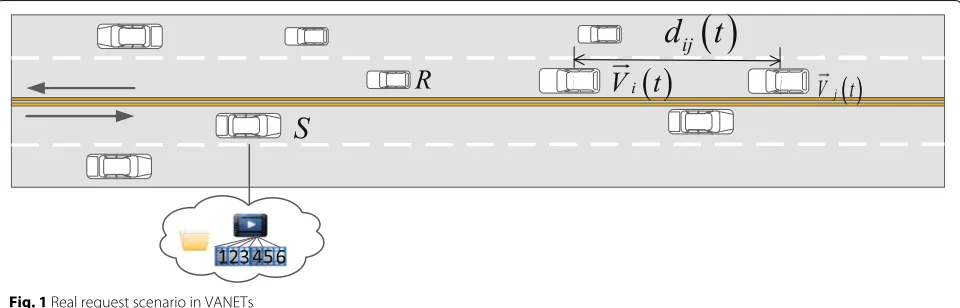
In this paper, we consider the scenario in which vehi-cles travel on a bi-directional highway with two lanes per direction. As a motivating example shown in Fig. 1, assuming that the request vehicle1(denoted asR) requests the content file and the source vehicle2(denoted asS) in the opposite direction has the the requested file, a coop-erative transfer scheme is applied to complete the file transfer. We always assume that the request vehicle and the resource vehicle run in the opposite directions. To enable collaborative download, a multi-party scheme is applied, in which a file is divided into multiple pieces. Each piece is transmitted through V2V communication. The file distribution is completed when all the pieces of the file are collected by the request vehicle.
It is assumed that all vehicles are equipped with the on-board global positioning system (GPS), and all vehi-cles have the knowledge of their geographical locations. We just consider pure V2V communications without the assistant of roadside infrastructures, e.g., RSUs or access points (APs). This is due to the reason that the large-scale
deployment of RSUs or APs on highways tend to be a slow process. However, our protocol can be easily extended when the road infrastructure is available.
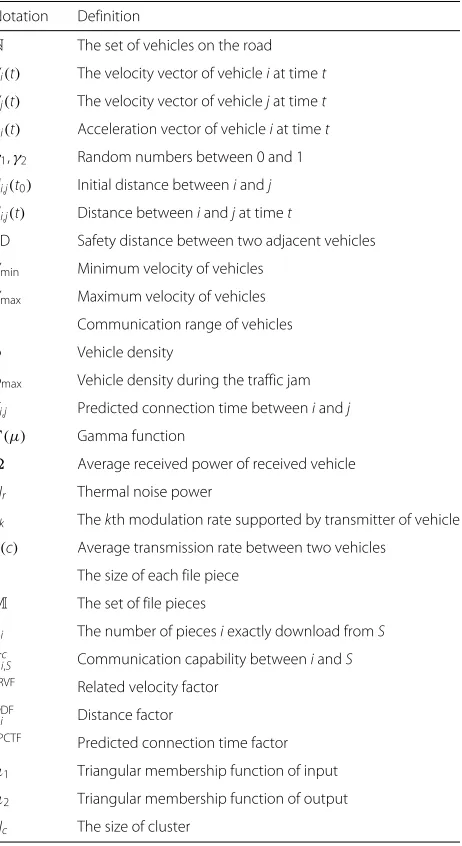
In this work, four models are applied to characterize the system: vehicle mobility model, connection time predic-tion model, vehicle-to-vehicle communicapredic-tion model, and pieces-based file transfer model [29]. We first present the first three models in details. For convenience, the major notations used in this paper are listed in Table 1.
3.1 Vehicle mobility model
Considering the mobility features on practical highways, we apply the free mobility model [34] to model the mobil-ity of vehicles on highways.
The mobility features of vehicles on highway are char-acterized as follows: (1) the speed range of vehicle is
Table 1Major notations
Notation Definition
N The set of vehicles on the road
SD Safety distance between two adjacent vehicles Vmin Minimum velocity of vehicles
Vmax Maximum velocity of vehicles r Communication range of vehicles
ρ Vehicle density
ρmax Vehicle density during the traffic jam Ti,j Predicted connection time betweeniandj
(μ) Gamma function
Average received power of received vehicle Nr Thermal noise power
ck Thekth modulation rate supported by transmitter of vehicle
E(c) Average transmission rate between two vehicles s The size of each file piece
M The set of file pieces
ni The number of piecesiexactly download fromS
Cc
i,S Communication capability betweeniandS
rRVF
i Related velocity factor
dDF
i Distance factor
tPCTF
i Predicted connection time factor
μ1 Triangular membership function of input
μ2 Triangular membership function of output Nc The size of cluster
specified by a minimum velocity and a maximum velocity. (2) We define a safety distance (SD). Namely, two adja-cent vehicles on the same lane should keep the safety distance for safety purposes. If the distance between two adjacent vehicles is less than the safety distance, the rear vehicle slows down until the distance between them meets the safety distance requirement. (3) A vehicle only travels along one lane of the highway without overtaking and lane change.
In the mobility model adopted in our work, both the velocity of vehicles and the distance between two adjacent vehicles are known in priori. Figure 1 shows the case for two vehicles (i.e.,iandj).
LetNdenote the set of vehicles on the road. Accord-ing to the mobility model defined, the velocities of two vehicles meet the following equations:
⎧
number between 0 and 1,ai(t) denotes the acceleration
vector of vehicle i at timet, dij(t) denotes the distance
between vehicleiand vehiclej(j∈N) at timet. SD denotes the safety distance between two adjacent vehicles.
Accordingly, a highway mobility model can be repre-sented approximately in terms of both time and space with these velocity equations. Let dij(t0) denote the
ini-tial distance between vehiclesiandj. LetV(t0)denote the
initial velocity of vehicles, andγ1andγ2are random
num-bers between 0 and 1. The velocity and distance can be expressed as
dij(t0)=(1+γ1)×SD,
| V(t0)| =Vmin+γ2×(Vmax−Vmin). (2)
The maximum number of vehicles that can be accom-modated within the coverage ofSis [30]
Nmax= 2r×ρmax, (3)
where· denotes the floor function,ris the communi-cation range of S, ρmaxis the vehicle density during the
traffic jam.
3.2 Connection time prediction model
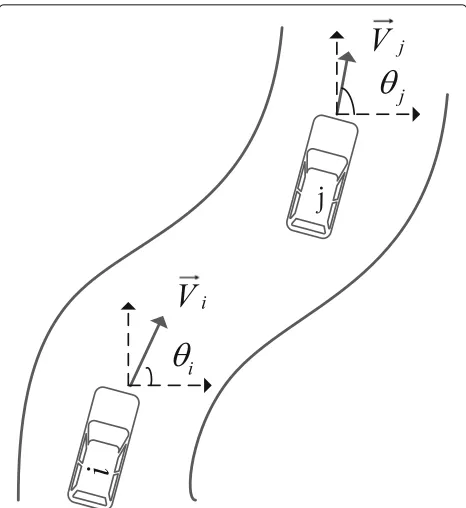
It is assumed that the communication range of each node isr. Assume two nodesiandjare within the transmission range of each other. The position, velocity, and moving direction of nodei(i ∈ N) at timetare (xi,yi),Viandθi,
respectively. Similarly, the position, velocity, and moving direction of nodej(j ∈ N) at timetare (xj,yj),Vjandθj,
j
Fig. 2Prediction model for communication connection time
For simplicity, it is assumed that the speed and direc-tion of vehicle that is during communicadirec-tion period keeps unchanged in order to predict the connection time between two vehicles, let Ti,j denote the connection
time between two vehicles, and according to kinematics theory, the following formulas hold [35]:
⎧
Then from formula (4),Tijis derived as
Ti,j=
−A+
Br2−(vydx−vxdy)2
B , (5)
whereAandBare two intermediate variables, which are formulated as
A=vx×dx+vy×dy,
B=vx2+vy2, (6)
Specially, if the connection period starts at the moment when the distance between nodesiandjdecreases to r and ends at the moment when their distance increases to r, i.e., communication link is established once node i is entering the communication range of nodejuntil nodeiis out of the communication range of nodej, the connection
time can be simplified asTi,jaccording to the following formulas:
In this part, we evaluate the transmission rate of V2V communication. Duo to the fast-fading highway vehicular environment, we model the probability density function (pdf ) of signal amplitude by the Nakagami(μ,) distribu-tion as [10, 29, 36]
where(μ)denotes the gamma function, which is defined as
(μ)= ∞
0
tμ−1e−tdt, (10)
where μ denotes the signal fading index related to the distance between two communication vehicles and the surroundings. In our work, we adopt the following ref-erence values [36]:μ=0.74 ifdij ∈[ 90.5, 230.7];μ=0.84 if
dij ∈[ 230.7, 588].is the average received power before
envelope detection, which is defined as
=PtGtGr
h2th2 r
dαijL, (11)
where Pt denotes the transmission power. Gt and Gr
denote the transmission and reception antenna gain, respectively.htandhrdenote the transmission and
recep-tion antenna length, respectively,Ldenotes the loss coeffi-cient of the system, andαdenotes the path loss exponent. With (9), we can calculate the probability density func-tion of the signal to noise ratio (SNR) using the following formula:
whereNr is the thermal noise power,
denotes the kth modulation rate (c1 < c2 < · · · < ck,
1 ≤ k ≤ K). Letvk denote the pre-set threshold, and
if the current SNR meets the following condition:vk ≤
Nr ≤vk+1, the module velocity is set tock. In addition, we setvK+1 = ∞. Consequently, according to the equations
mentioned previously, the transmission rateckis selected
with the probability:
Therefore, the average transmission rate is derived through the following formula:
4 FL-CFT: a high-integrity fuzzy logic-based cooperative file transfer scheme
4.1 Overview of FL-CFT
An overview of FL-CFT is presented as follows. When a vehicle, e.g., R, needs a file, it broadcasts a resource request message to its neighboring vehicles. If a neighbor vehicle has the file, e.g., S, it sends a response message back and prepares for the file transfer. Before the file trans-fer, evaluation of the transmission capability fromStoR is accomplished to decide whether cooperative vehicles are needed or not. If two vehicles can complete the file transfer within their connection time,Rdownloads the file directly without establishing a cluster. Otherwise, a cluster of vehicles in a linear topology along the road are formed for relay; the fuzzy logic is adopted to select the most eligi-ble cooperative vehicle as the cluster members according to their relative velocity, distance, and predicted connec-tion time. Figures 3 and 4 illustrate the case in which three cluster members are used to collect the file pieces and forward toR.
Figure 5 shows the operations of protocol. The key of the proposal is to select the optimal relay path fromStoR. The fuzzy logic approach is applied due to the efficiency of the algorithm; to select appropriate cluster members using the fuzzy logic scheme, the connection time between two vehicles is evaluated and used as the input to the scheme. In what follows, we present the details of the protocol.
4.2 Transmission capability between two vehicles
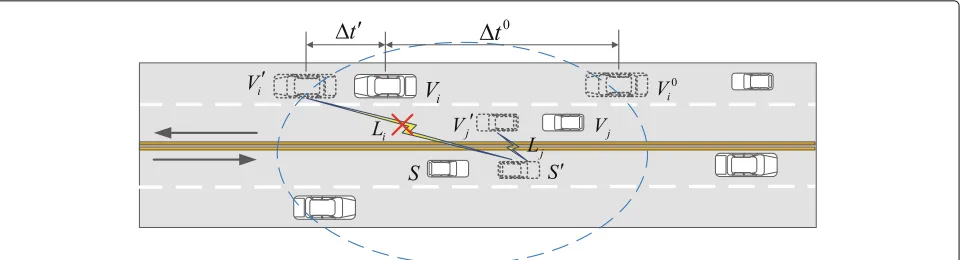
In order to evaluate the transmission capability between two vehicles, the pieces-based file transfer model is first developed in our work, which is illustrated in Fig. 6.
It is assumed that the file content is equally divided into mpieces denoted byM = {g1,g2, ...,gm}with the size of
each piece s. During the whole connection time Ti,S,
vehiclei(i ∈N) can not exactly download integral pieces since it is out of the communication range of S, result-ing in the failed connectionLibetweeniandSwhile the
nth piece is transferring. Therefore, according to the pre-dicted connection timeTi,S, the number of piecesniis
where · denotes the floor function, E(c) denotes the average transmission rate which can be obtained by for-mula (17). Besides, in Fig. 6,t0denotes the time spent on downloading ni pieces completely, t denotes the
time Ti,S minus t0 and during which the nth piece
can not be downloaded completely. Their relationship is formulated as
t+t0=Ti,S, (19)
t0= ni×s
E(c) . (20)
In our proposed scheme, once finishing transferring the nthi piece,Sselects another cooperative vehiclej(j∈N) to transfer file pieces and establishes the linkLj. Through this
method, such data lossDloss = t×E(c)will be
trans-mitted to vehiclejand it is of great importance for fully utilizing the wireless resource and saving transfer time. Consequently, the communication capabilityCic,Sbetween any vehicleiandSis formulated as
Cic,S=s·
In the cooperative phase, if several vehicles are in the communication range ofS, it will transfer the file pieces to the vehicle with the highest eligible value calculated by fuzzy logic system.
4.3 Fuzzy logic-based cooperative vehicle selection
In this subsection, we introduce the fuzzy logic system in detail. Since data rateCis given by
C=Wlog2
whereW denotes the channel bandwidth,Pdenotes the transmit power of the vehicle, d denotes the distance betweenSand cooperative vehicle,αdenotes the path loss exponent, andN0denotes the white Gaussian noise [30].
a
b
c
d
Fig. 4Cluster members forward file pieces to request vehicle
the relative velocity also has a great influence onCsince high mobility leads to unstable connection. More impor-tantly, we also consider the connection time as an impact factor. However, finding an optimal relay subject to the three constrains is an NP-complete problem that cannot be exactly solved in polynomial time. The relay selection problem can benefit from fuzzy logic method due to the efficiency of the method to solve the NP-complete prob-lem. The three parameters of vehicles, i.e., the relative velocity, distance, and predicted connection time, are fed through a fuzzy inference system to compute the value of eligible level, which can be used as a metric to select the most eligible relay.
4.3.1 Fuzzy logic
A fuzzy logic system describes the relationship between crisp inputs and output variables with the help of fuzzy control rules provided by the fuzzy system designer. A fuzzy logic system, as shown in Fig. 7, mainly includes fuzzification, fuzzy control rule base, fuzzy inference, and defuzzication. Fuzzification is responsible for the con-version of numerical input variable into linguistic input using input fuzzy membership functions, while defuzzifi-cation converts the fuzzy output to decisive value based on output membership functions and corresponding
Fig. 5Block diagram of various models
membership degrees. And the fuzzy inference maps the fuzzy value to pre-defined IF-THEN-based rules and cal-culates the fuzzy output.
4.3.2 Calculation of multiple factors
As described above, three vehicle parameters having impact on the system performance are considered as fuzzy logic inputs. In order to utilize fuzzy membership func-tion, we first calculate the three impact factors:
Related velocity factor: upon reception of the velocity information included in the request from a neighboring cooperative vehicle,S calculates a related velocity factor (RVF) as
viRVF=
Vi− VS
2Vmax
, (23)
where Vi and VS denote the velocities of neighboring
cooperative vehicle and S, respectively,Vmaxdenote the
vehicle’s maximum speed.
Distance factor: upon reception of the location informa-tion included in the request from a neighbor cooperative vehicle,Scalculates a distance factor (DF) as
diDF=
(xi−xS)2+(yi−yS)2
r , (24)
where(xi,yi)and(xS,yS)denote the location of
neighbor-ing cooperative vehicle andS, respectively.
Predicted connection time factor: upon reception of the velocity and location information included in the request from a neighboring cooperative vehicle,S calculates the predicted connection timeTiRaccording to formula (5),
and further calculates a predicted connection time factor (PCTF) as
tiPCTF =
TiS
˜
Fig. 6Pieces-based file transfer model.Sselects another vehicle (Vj) to transfer pieces once the predicted amount of pieces have been transferred to the current vehicle (Vi)
whereT˜ is formulated by
˜
T = 2r Vi− VS
. (26)
4.3.3 Fuzzification
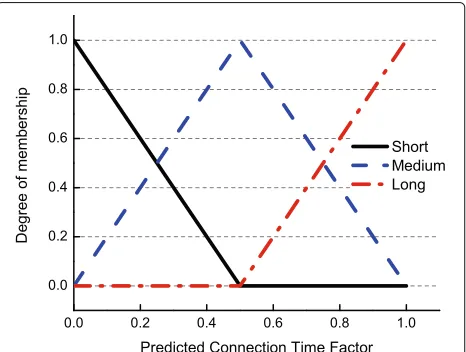
The process of converting a numerical value to a fuzzy value using a fuzzy membership function is called fuzzifi-cation. We use triangular membership function to convert the three numerical inputs to linguistic variables, which is formulated as formula (27). The membership functions of RVF, DF, and PCTF are described in formula (28), formula (29), and formula (30), respectively. Correspond-ingly, their fuzzy membership functions are as shown in Figs. 8, 9, and 10.Suses the membership functions to cal-culate which degree the RVF, DF, and PCTF belongs to {fast, medium, slow}, {small, medium, large}, and {short, medium, long}, respectively.
μ1(x)= ⎧ ⎨ ⎩
x−a
b−a,a≤x≤b
c−x
c−b,b≤x≤c
0, otherwise.
(27)
μ1(RVF)=
(a,b,c)|a,b,care the coefficients for FRVFS,FRVFM,FRVFF
= {(-0.5,0,0.5),(0,0.5,1), (0.5,1,1.5)}
(28)
Fuzzification Fuzzy Defuzzication Inference
Fuzzy Control Rule Base
Vehicle Parameters (Crisp Inputs)
Eligible Value (Crisp Outputs)
Fig. 7Fuzzy logic system
μ1(DF)= {(a,b,c)|a,b,care the coefficients for FDFS,FDFM,FDFL} = {(-0.5,0,0.5), (0,0.5,1), (0.5,1,1.5)}
(29)
μ1(PCTF)= {(a,b,c)|a,b,care the coefficients
forFPCTFS,FPCTFM,FPCTFL
= {(-0.5,0,0.5), (0,0.5,1),(0.5,1,1.5)}
(30)
4.3.4 Fuzzy inference
The fuzzy inference engine is based on fuzzy IF-THEN-based rules, which are ultimately written by a professional designer in the related field. The design of the knowledge-based rules is knowledge-based on our understanding of the characteristics of VANETs [37]. Once the fuzzy values of related velocity factor, distance factor, and predicted con-nection time factor have been calculated and converted to linguistic variables,Suses the IF-THEN rules, as defined
Fig. 9Membership function of the distance input
in Table 2, to calculate the eligible value of each cooper-ative vehicle. The linguistic variables of the eligible value are belong to the fuzzy sets as {very high, high, medium, low, very low}. For example, in Table 2, Rule 2 may be expressed asIFrelated velocity is slow, distance is small, and predicted connection time is medium,THENeligible value is high.
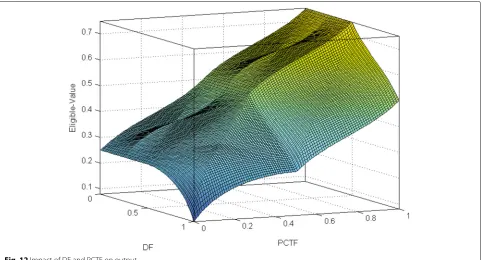
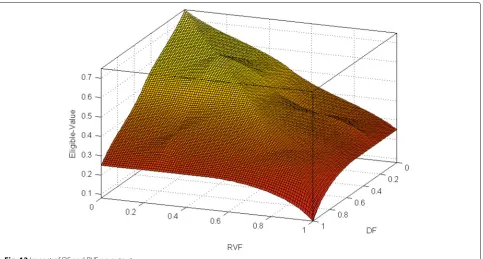
Through the fuzzy logic tool in Matlab, the relationships between output and any two inputs are depicted in the form of 3D, as shown in Figs. 11, 12, and 13.
4.3.5 Defuzzication
A mathematical method that extracts a crisp output value from the aggregation of the fuzzy output represen-tation is called defuzzification. Centroid defuzzification method is applied in this work, which is the most com-monly used technique and is very accurate. The centroid defuzzification technique can be expressed as
Fig. 10Membership function of the predicted connection time input
Table 2If-then rules base
Rule no. If (And) Then
Related velocityDistance factorPredicted connection
Eligible value Factor (RVF) (DF) time factor (PCTF)
1 Slow Small Short Medium
2 Slow Small Medium High
3 Slow Small Long Very high
4 Slow Medium Short Low
5 Slow Medium Medium Medium
6 Slow Medium Long High
7 Slow Large Short Very low
8 Slow Large Medium Low
9 Slow Large Long Medium
10 Medium Small Short Low
11 Medium Small Medium Medium
12 Medium Small Long High
13 Medium Medium Short Low
14 Medium Medium Medium Medium
15 Medium Medium Long High
16 Medium Large Short Very low
17 Medium Large Medium Low
18 Medium Large Long Medium
19 Fast Small Short Very low
20 Fast Small Medium Low
21 Fast Small Long Medium
22 Fast Medium Short Very low
23 Fast Medium Medium Low
24 Fast Medium Long Medium
25 Fast Large Short Very low
26 Fast Large Medium Very low
27 Fast Large Long Low
EV=
μ2(x)×xdx μ2(x)dx
, (31)
whereμ2(x)represents the output membership function,
which is also triangular, as defined in formula (32) and formula (33), and is depicted in Fig. 14,xdenotes the out-put variable,EV denotes the dufuzzified output, i.e., the numerical eligible value.
μ2(x)= ⎧ ⎪ ⎨ ⎪ ⎩
x−d
e−d,d≤x≤e
f−x
f−e,e≤x≤f
0, otherwise.
(32)
μ2(RVF)= {(d,e,f)|d,e,f are the coefficients for FEVVS,FEVS,FEVM,FEVH,FEVVH}={(-0.25,0,0.25), (0,0.25,0.5),(0.25,0.5,0.75),(0.5,0.75,1),(0.75,1,1.25).}
Fig. 11Impact of RVF and PCTF on output
4.4 Cluster establishment
With FL-CFT, if a vehicle cannot download the required content file completely fromSwithin the connection time between them, the vehicle will establish a linear cluster and cooperate with other cluster members to download the file.
There exist many methods to establish a cluster in VANETs. The key problem is how to find the vehicles that have similar characteristics as cluster members [29]. The proposed scheme establishes a cluster according to the following steps.
Fig. 13Impact of DF and RVF on output
Step 1: the request vehicle first broadcasts a request packet for cooperative file transfer, then a neighboring vehicle which is within the communication range and will-ing to assist sends back an ACK. If the request vehicle receives the ACK, it will request the basic information, such as velocity and location from the neighboring vehi-cle. Thereafter, the appropriate neighboring vehicle will be invited to join the cluster and become one of cluster members.
Step 2: the neighboring vehicle that joins the cluster con-tinues to broadcast the request packet for cooperative file transfer and invites its neighbors to join the cluster. Then
Fig. 14Output membership function of eligible value
the basic information about the newly added cluster mem-ber is forwarded to the request vehicle. Step 2 is repeated until enough cluster members have jointed the cluster.
Step 3: after finishing the file piece transfer to the present cooperative vehicle, Scalculates the EV (eligible value) of each cooperative vehicle that is within it’s com-munication range through fuzzy logic system, and then transfers file pieces to the vehicle with the highest EV value.
According to the vehicle-to-vehicle communication model mentioned previously, we are able to calculate the amount of file size each cooperative member can down-load. Therefore, the number of vehicles that should be contained in the cluster can be derived. Assuming that the size of the file to be transferred isVfile, the size of all file
pieces that vehicleiin can download isVdatai and the num-ber of the required vehicles (i.e., the size of the cluster) is Nc, thenVdatai andNcare derived by using the following
formulas:
Vdatai =Cic,S, (34)
Nc=
min{n} |
n
i=1
Vdatai ≥Vfile,n=1, 2,· · ·
. (35)
4.5 Cooperative vehicle transfer file pieces to request vehicle
protocol of the network and the RTS/CTS mechanism is employed to avoid the hidden terminal problem. Further-more, we set the back-off time as a constant back-off win-dow size. Therefore, the average transmission probability of each vehicle is formulated as
ζ = 2
W+1. (36)
In order to calculate the success probability of packet transmission, it is assumed that n nodes compete for one channel wherenobeys Poisson distribution and its probability mass function is formulated as
fn(x)= (ρ
Rcs)x
x! exp(−ρRcs), (37) whereρdenotes the traffic density parameter,Rcsdenotes
the diameter of carrier sense range of a vehicle. Then the probability that a node successfully sends packets in any slot can be derived as
Psuc=
nζ(1−ζ)n−1
1−(1−ζ)n. (38) Accordingly, the throughput between two vehicles can be derived as
where Vpayload denotes the payload information volume
transmitted successfully in a slot time, Lp denotes the
average length of a packet, andT is the average length of a slot which is formulated in [10].
Consequently, the size of file that can be transferred between cooperative vehicleiand request vehicleRwithin their connection time can be calculated using the connec-tion timeTi,R that can be obtained using formula (5),
and the throughputRthr that can be obtained using
for-mula (17).
5 Simulation
In our work, we study the performance of FL-CFT via extensive theoretical analysis and Matlab-based simula-tions. Our detailed experimental results are presented in this section. Specifically, the performance of FL-CFT is investigated in terms of average connection time, average throughput, average transmission capability, maximum file transfer volume, and cluster size. We also compare FL-CFT with two of the state-of-the-art schemes, IOCT [10] and CFT [12], to understand the advantages and disadvan-tages of FL-CFT. What follows, the detailed experimental results are presented in this section.
5.1 Simulation settings
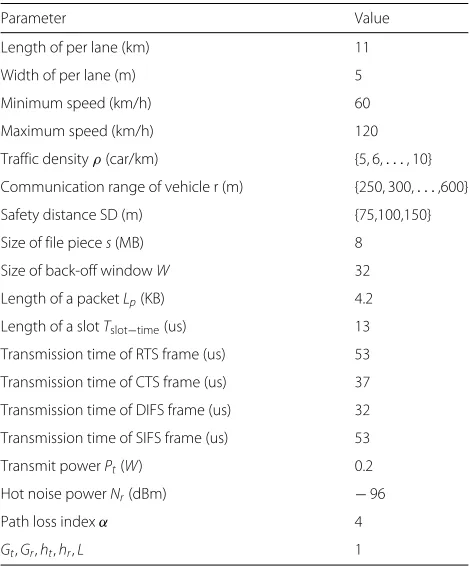
In our simulations, a freeway model [38] is adopted where vehicles travel on a bi-directional highway with two lanes
per direction. The major parameters are summarized in Table 3. We use the IEEE 802.11b DCF mechanism as the MAC protocol and V2V communication proto-col as the wireless communication protoproto-col. In addition, the RTS/CTS mechanism is adopted to avoid the hidden terminal problem.
5.2 Simulation results 5.2.1 Average connection time
Figure 15 shows the impact of different traffic densities and communication ranges on the average connection time when SD = 150 m. Note thatρdenotes the number of vehicles per kilometer. We can observe that, with the communication range increases, the average connection time increases. When the communication range is 250 m, the average connection time is 5.3 s. When the commu-nication range is 600 m, the average connection time is about 12.7 s. And the average connection time does not vary significantly with the densities.
5.2.2 Average throughput
The impact of traffic density and communication range on the average throughput between two vehicles is shown in Fig. 16. We can observe that whenρ = 5 and the communication range varies from 250 to 600 m, the aver-age throughput of CFT varies from 6.6 to 8.0 Mbps while the average throughput of FL-CFT varies from 6.75 to 8.1 Mbps; whenρ = 6, the average throughput of CFT
Table 3Simulation parameters
Parameter Value
Length of per lane (km) 11
Width of per lane (m) 5
Minimum speed (km/h) 60
Maximum speed (km/h) 120
Traffic densityρ(car/km) {5, 6,. . ., 10} Communication range of vehicle r (m) {250, 300,. . .,600} Safety distance SD (m) {75,100,150} Size of file pieces(MB) 8
Size of back-off windowW 32 Length of a packetLp(KB) 4.2 Length of a slotTslot−time(us) 13 Transmission time of RTS frame (us) 53 Transmission time of CTS frame (us) 37 Transmission time of DIFS frame (us) 32 Transmission time of SIFS frame (us) 53 Transmit powerPt(W) 0.2 Hot noise powerNr(dBm) −96
Path loss indexα 4
Fig. 15Average connection time
varies form 6.9 to 8.2 Mbps while the average throughput of FL-CFT varies from 7.24 to 8.3 Mbps; whenρ = 7, the average throughput varies form 7.2 to 8.4 Mbps while the average throughput of FL-CFT varies from 7.4 to 8.5 Mbps. In summary, with the increase of either the traffic density or the communication range, the average throughput increases, and the proposed FL-CFT outper-forms the CFT in terms of average throughput under the same conditions.
5.2.3 Average transmission capability
The impact of communication range and traffic density on the average transmission capability between two vehicles when SD = 150 m is shown in Fig. 17. We can observe from the figure that whenρ = 5 and the communication range varies from 250 to 600 m, the average transmission capa-bility of CFT varies from 35.0 to 102.9 MB while the aver-age transmission capability of FL-CFT varies from 35.7 to 104 MB; whenρ = 6, the average transmission capability
Fig. 16Average throughput
Fig. 17Average transmission capability
varies from 37.1 to 104.8 MB while the average transmis-sion capability of FL-CFT varies from 38.1 to 106.9 MB; whenρ = 7, the average transmission capability varies from 38.1 to 107.9 MB while the average transmission capability of FL-CFT varies from 39.2to 108.5 MB. The result shown in Fig. 17 reveals that the average transmis-sion capability of both CFT and FL-CFT increases with the increase of traffic density. And with the increase of communication range, the average transmission capabil-ity of both CFT and FL-CFT linearly increases. Under the same condition, the proposed FL-CFT has a higher average transmission capability than CFT.
5.2.4 Maximum file transfer volume
Figure 18 shows the maximum file transfer volume of IOCT, CFT, and FL-CFT under different traffic densities whenr = 250m. Our experimental result indicate that when ρ varies from 5 to 10, the maximum file transfer volume of IOCT varies from 35 to 45 MB, the maximum file transfer volume of CFT varies from 297 to 415 MB,
Fig. 19Average cluster size
the maximum file transfer volume of FL-CFT varies from 307 to 425 MB. The reason why the maximum file trans-fer volume of CFT and FL-CFT is much greater is that a file can be transferred through multiple cluster members. More importantly, we can observe from Fig. 18 that the maximum file transfer volume of IOCT is not sensitive to traffic density, which is because IOCT only involves two vehicles. The proposed FL-CFT has a higher maximum file transfer volume than CFT as a result of adopting the fuzzy logic to select the most eligible vehicle as coopera-tive vehicle for improving the throughput thus improving the maximum file transfer volume. The consideration of the utilizing of fuzzy logic method contributes to the high maximum file transfer volume.
5.2.5 Cluster size
Figure 19 shows the impact of file size on the average cluster size whenr = 250m. Our experimental results reveals that the average cluster size increases with the increase of file size. When ρ = 5, the average clus-ter size of CFT varies from 2.8 to 22.9 while the average cluster size of FL-CFT varies from 2.4 to 20.5. When
ρ = 10, the average cluster size of CFT varies from 1.8 to 13.2 while the average cluster size of FL-CFT varies from 1.7 to 13.0. Given the same file size, lower traffic density leads to a greater required cluster size. Due to the higher transmission capability, the proposed FL-CFT involves less vehicles in cooperative file transfer than CFT.
6 Conclusions
Small- and medium-size file transfers are fundamental to the infotainment applications in highway vehicular
networks. This however is challenged by the dynamic connections among vehicles. This paper tackles the issue by developing a fuzzy logic-based collaborative forward scheme for integrated file transfer in VANET. In specific, a cluster of vehicles, based on the evaluation of transmission capability, are selected using a fuzzy logic-based scheme. Using both analysis and simulations, we have shown that our proposal outperforms the state-of-the-art file trans-fer scheme in terms of the maximum file transtrans-fer volume. The detailed experimental results of FL-CFT in terms of average connection time, average throughput, average transmission capability, maximum file transfer volume, and cluster size have been presented.
In the future, we shall concentrate on developing a the-oretical model for analyzing the impact of the size of file piece on the performances of the proposed scheme.
Endnotes
1The vehicle which issues the download request of the
file is called the request vehicle in this paper.
2The vehicle which owns the file requested from
request vehicle is called the source vehicle in this paper.
Acknowledgements
This work was supported by the National Natural Science Foundation of China under Grant No. 61401334 and No. 61571350, Key Research and Development Program of Shaanxi (Contract No. 2017KW-004, 2017ZDXM-GY-022), and the 111 Project (B08038).
Authors’ contributions
Competing interests
The authors declare that they have no competing interests.
Publisher’s Note
Springer Nature remains neutral with regard to jurisdictional claims in published maps and institutional affiliations.
Author details
1State Key Laboratory of Integrated Services Networks, Xidian University,
710071 Xi’an, China.2School of Cyber Engineering, Xidian University, 710071 Xi’an, China.3School of Mathematical and Computational Sciences, University of Prince Edward Island, C1A 4P3 Charlottetown, Prince Edward Island, Canada.
Received: 17 July 2017 Accepted: 15 December 2017
References
1. H Gong, L Yu, N Liu, X Zhang, Mobile content distribution with vehicular cloud in urban VANETs. China Commun.13(8), 84–96 (2016)
2. H Zhou, N Cheng, N Lu, L Gui, D Zhang, Q Yu, F Bai, X Shen, WhiteFi infostation: Engineering vehicular media streaming with geolocation database. IEEE J. Sel. Areas Commun.34(8), 2260–74 (2016)
3. G Deng, F Li, L Wang, inProceedings of the IEEE International Conference on Computer Communications (INFOCOM) Workshops. Cooperative downloading in vanets-lte heterogeneous network based on named data (INFOCOM, San Francisco, 2016), pp. 233–8
4. W Huang, L Wang, Ecds: Efficient collaborative downloading scheme for popular content distribution in urban vehicular networks. Comput. Netw.
101, 90–103 (2016)
5. GMN Ali, PHJ Chong, SK Samantha, E Chan, Efficient data dissemination in cooperative multi-RSU vehicular ad hoc networks (VANETs). J. Syst. Softw.
117, 508–527 (2016)
6. C Lai, K Zhang, N Cheng, H Li, X Shen, SIRC: A secure incentive scheme for reliable cooperative downloading in highway VANETs. IEEE Trans. Intell. Transp. Syst.18(6), 1559–74 (2017)
7. J Liu, W Zhang, Q Wang, S Li, H Chen, X Cui, Y Sun, A cooperative downloading method for VANET using distributed fountain code. Sensors.16(10), 1685 (1685)
8. K Ota, M Dong, S Chang, et al., MMCD: Cooperative downloading for highway VANETs. IEEE Trans. Emerg. Top. Comput.3(1), 34–43 (2015) 9. S Yang, C Yeo, B Lee, MaxCD: Efficient multi-flow scheduling and
cooperative downloading for improved highway drive-thru Internet systems. Comput. Netw.57(8), 1805–20 (2013)
10. TH Luan, X Shen, F Bai, inProceedings of the IEEE International Conference on Computer Communications (INFOCOM). Integrity-oriented content transmission in highway vehicular ad hoc networks (INFOCOM, Turin, 2013), pp. 2562–70
11. G Ghalavand, A Ghalavand, A Dana, M Rezahosieni, inProceedings of the IEEE International Conference on Advanced Computer Theory and Engineering (ICACTE). Reliable routing algorithm based on fuzzy logic for Mobile Ad hoc Network (ICACTE, Chengdu, 2010), pp. V5-606-V5-606 12. Q Luo, C Li, Q Ye, TH Luan, L Zhu, X Han, inProceedings of the IEEE
International Conference on Communication (ICC). CFT: A cluster-based file transfer scheme for highway VANETs (ICC, Paris, 2017), pp. 1–6 13. N Liu, M Liu, W Lou, G Chen, J Cao, inProceedings of the IEEE International
Conference on Computer Communications (INFOCOM). PVA in VANETs: Stopped cars are not silent (INFOCOM, Shanghai, 2011), pp. 431–435 14. N Liu, M Liu, G Chen, J Cao, inProceedings of the IEEE International
Conference on Computer Communications (INFOCOM). The sharing at roadside: Vehicular content distribution using parked vehicles (INFOCOM, Orlando, 2012), pp. 2641–5
15. D Eckhoff, C Sommer, R German, F Dressler, inProceedings of the IEEE Global Telecommunications Conference (GLOBECOM). Cooperative awareness at low vehicle densities: How parked cars can help see through buildings (GLOBECOM, Kathmandu, 2011), pp. 1–6 16. F Malandrino, C Casetti, C-F Chiasserini, C Sommer, F Dressler, in
Proceedings of the IEEE International Symposium on Personal, Indoor and Mobile Radio Communications (PIMRC). Content downloading in vehicular networks: Bringing parked cars into the picture (PIMRC, Sydney, 2012), pp. 1534–9
17. H Gong, L Yu, X Zhang, Social contribution-based routing protocol for vehicular network with selfish nodes. Int. J. Distrib. Sens. Netw.10(4), 1–12 (2014)
18. Y Jin, H Hu, X Liu, Y Wen, inProceedings of the IEEE International Conference on Sensing, Communication and Networking (SECON). MUTAS: Multi-screen TV experience as a service through cloud centric media network, (Singapore, 2014), pp. 146–148
19. H Hu, Y Wen, Y Gao, T-S Chua, X Li, Toward an SDN-enabled big data platform for social TV analytics. IEEE Netw.29(5), 43–49 (2015) 20. Y Jin, Y Wen, H Hu, M-J Montpetit, Reducing operational costs in cloud
social tv: an opportunity for cloud cloning. IEEE Trans. Multimed.16(6), 1739–51 (2014)
21. H Hu, Y Wen, H Luan, T-S Chua, X Li, Toward multiscreen social TV with geolocation-aware social sense. IEEE Multi.21(3), 10–19 (2014)
22. H Hu, Y Wen, T-S Chua, J Huang, W Zhu, X Li, Joint content replication and request routing for social video distribution over cloud CDN: a
community clustering method. IEEE Trans. Circ. Syst. Video Technol.26(7), 1320–33 (2016)
23. M Whaiduzzaman, M Sookhak, A Gani, R Buyya, A survey on vehicular cloud computing. J Netw Comput Appl.40, 325–344 (2014)
24. J Liu, Y Ge, J Bi, L Guo, inProceedings of the IEEE International Conference on Computer and Information Technology (CIT). Cooperative downloading strategy on highway scenario, (Chengdu, 2012), pp. 828–832
25. O Trullols-Cruces, J Morillo-Pozo, JM Barcelo, J Garcia-Vidal, inProceedings of the IEEE International Conference on Communication (ICC). A cooperative vehicular network framework (ICC, Dresden, 2009), pp. 1–6
26. T Wang, L Song, Z Han, B Jiao, Dynamic popular content distribution in vehicular networks using coalition formation games. IEEE J. Sel. Areas Commun.31(9), 538–47 (2013)
27. D Yue, P Li, T Zhang, J Cui, Y Jin, Y Liu, Q Liu, inProceedings of IEEE International Conference on Smart Cloud. Cooperative content
downloading in hybrid VANETs: 3G/4G or RSUs downloading, (New York, 2016), pp. 301–306
28. H Liang, W Zhuang, Cooperative data dissemination via roadside WLANs. IEEE Commun. Mag.50(4), 68–74 (2012)
29. H Zhou, B Liu, TH Luan, F Hou, L Gui, Y Li, Q Yu, XS Shen, Chaincluster: Engineering a cooperative content distribution framework for highway vehicular communications. IEEE Trans. Intell. Transp. Syst.15(6), 2644–57 (2014)
30. MH Cheung, F Hou, VWS Wong, J Huang, DORA: Dynamic optimal random access for vehicle-to-roadside communications. IEEE J. Sel. Areas Commun.30(4), 792–803 (2012)
31. R Cai, G Zhang, Y Ji, inProceedings of the IEEE International Conference on Computational Intelligence and Communication Networks (CICN). Adaptive routing protocol based on forwarding angle in VANETs (CICN, Jabalpur, 2015), pp. 61–66
32. NI Abbas, M Ilkan, Fuzzy approach to improving route stability of the AODV routing protocol. EURASIP J. Wirel. Commun. Netw.2015(1), 1–11 (2015)
33. A Kots, M Kumar, The fuzzy based QMPR selection for OLSR routing protocol. Wirel. Netw.20(1), 1–10 (2014)
34. J Yoon, M Liu, B Noble, inProceedings of the IEEE International Conference on Computer Communications (INFOCOM). Random waypoint considered harmful (INFOCOM, San Francisco, 2003), pp. 1312–21
35. W Su, S-J Lee, M Gerla, Mobility prediction and routing in ad hoc wireless networks. Int. J. Netw. Manag.11(1), 3–30 (2001)
36. L Cheng, BE Henty, DD Stancil, F Bai, P Mudalige, Mobile vehicle-to-vehicle narrow-band channel measurement and characterization of the 5.9 GHz dedicated short range communication (DSRC) frequency band. IEEE J. Sel. Areas Commun.25(8), 1501–16 (2007) 37. L Altoaimy, I Mahgoub, inProceedings of the IEEE Symposium on
Computational Intelligence in Vehicles and Transportation Systems (CIVTS). Fuzzy logic based localization for vehicular ad hoc networks (CIVTS, Orlando, 2014), pp. 121–128