Effects of latitudinal distributions of particle density and wave power on
cyclotron resonant diffusion rates of radiation belt electrons
Danny Summers and Binbin Ni
Department of Mathematics and Statistics, Memorial University of Newfoundland, St. John’s, Newfoundland, Canada
(Received February 8, 2008; Revised March 25, 2008; Accepted March 26, 2008; Online published August 4, 2008)
We evaluate cyclotron resonant interactions of radiation belt electrons with VLF chorus, plasmaspheric ELF hiss and electromagnetic ion cyclotron (EMIC) waves. We assume that the Earth’s magnetic field is dipolar and that each wave mode has a Gaussian spectral density. The dependence of the resonant electron diffusion rates on the latitudinal distributions of particle density and wave power is examined. We find that while the diffusion rates can be sensitive to the latitudinal distributions of density and wave power, in general the sensitivity depends on wave mode, equatorial pitch-angle, electron energy andL-shell. We determine the effects of the latitudinal distributions of density and wave power on the electron precipitation loss timescale due to combined scattering by VLF chorus, ELF hiss and EMIC waves. Accurate modeling of radiation belt electron dynamics requires observational data on the global distributions of particle number density and wave power.
Key words:Earth’s radiation belt, wave-particle interactions, magnetospheric plasma waves, electron precipita-tion.
1.
Introduction
Electrons in the Earth’s outer radiation belt(3<L <7) undergo cyclotron resonant interactions with various modes of plasma wave including whistler-mode chorus, plasma-spheric hiss and electromagnetic ion cyclotron (EMIC) waves, e.g., see Summerset al.(2007a, b) and references therein. Whistler-mode (VLF) chorus waves are observed in the lower-density region outside the plasmasphere, typ-ically in the frequency range 0.05–0.8e, whereeis the electron gyrofrequency (Meredithet al., 2001; Santoliket al., 2004). Hiss is a broadband whistler-mode ELF emis-sion occurring inside the plasmasphere and drainage plumes in the frequency range ∼100 Hz–several kHz (Meredith et al., 2004). EMIC waves in the frequency range 0.1– 5.0 Hz are observed in the plasmasphere, typically along the duskside plasmapause, and in drainage plumes (Fraser and Nguyen, 2001). Energy diffusion due to cyclotron reso-nance with VLF chorus is an effective mechanism for gen-erating relativistic (>1 MeV) electrons in the outer radi-ation belt during magnetic storms (Summerset al., 1998, 2002; Rothet al., 1999; Summers and Ma, 2000; Miyoshiet al., 2003; Horneet al., 2005; Omura and Summers, 2006). VLF chorus, ELF hiss, and EMIC waves can each cause pitch-angle scattering of electrons into the loss cone lead-ing to precipitation losses from the outer zone (Summers and Thorne, 2003; Albert, 2003; Thorneet al., 2005).
Quasi-linear theory provides useful techniques for deter-mining the average properties of cyclotron-resonant diffu-sion (e.g., Lyons, 1974; Summers, 2005; Albert, 2007). Summers et al.(2007a, b) calculate quasi-linear diffusion
Copyright cThe Society of Geomagnetism and Earth, Planetary and Space Sci-ences (SGEPSS); The Seismological Society of Japan; The Volcanological Society of Japan; The Geodetic Society of Japan; The Japanese Society for Planetary Sci-ences; TERRAPUB.
rates to determine timescales for radiation belt electron ac-celeration and loss due to cyclotron resonance with VLF chorus, ELF hiss and EMIC waves. Resonant diffusion rates depend on the assumed distributions of background particle density and wave power. The present investigation extends the work of Summerset al.(2007a, b) by examining the effects of latitudinal distributions of particle density and wave power on the resonant diffusion rates of radiation belt electrons for the aforementioned wave modes. In Section 2 we provide a short account of the quasi-linear theory re-quired to calculate resonant diffusion rates. In Section 3 we present our calculations of the (bounce-averaged) electron diffusion rates for individual wave modes, and we also de-termine the effects of the latitudinal distributions of density and wave power on electron precipitation loss timescales due to combined scattering by VLF chorus, ELF hiss and EMIC waves. Finally, in Section 4 we summarize our re-sults.
2.
Cyclotron Resonant Diffusion Rates
We assume a homogeneous collisionless plasma im-mersed in a uniform background magnetic field in the pres-ence of superposed electromagnetic waves. The relativistic quasi-linear diffusion equation for the gyrophase-averaged phase space densityis
764 D. SUMMERS AND B. NI: RESONANT DIFFUSION RATES OF RADIATION BELT ELECTRONS
where Dαα, Dαp = Dpα, and Dpp are the cyclotron
res-onant diffusion coefficients which depend on the proper-ties of the waves; p = γmv is the particle momen-tum wherev is the particle speed andm is the rest mass; γ = 1−v2/c2−1/2is the Lorentz factor (cis the speed of light);αis the pitch-angle, andtdenotes time. The dif-fusion coefficients,
Dαα =(α)2/(2t),
Dαp=(α)(p)/(2t), (2)
Dpp=(p)2/(2t)
are determined from the ensemble-averaged particle-orbit corrections. Explicit formulae for Dαα, Dαp, Dpp
corre-sponding to field-aligned (R-mode and L-mode) electro-magnetic waves have been derived by Summers (2005) and Summerset al.(2007a). We assume that the waves have a Gaussian spectral density of the form,
˜
whereωis the wave frequency,ω1 is the lower frequency limit,ω2is the upper frequency limit,ωmis the frequency of maximum wave power,δωis a measure of the bandwidth, and erf is the error function. The wave spectral density (3) has been normalized so that
(B)2
whereBis the mean wave amplitude.
In the present study we consider electron interaction with (R-mode) VLF chorus, (R-mode) ELF hiss, and (L-mode) EMIC waves. We assume a hydrogen plasma and we con-sider only field-aligned waves. Under the conditions of field-aligned wave propagation, all cyclotron harmonicsn are omitted exceptn = −1 andn = +1 which correspond respectively to R-mode and L-mode waves. In many cases first-order-harmonic diffusion rates provide a good approx-imation to diffusion rates for oblique waves calculated us-ing higher-order resonances. For a given wave mode, the local diffusion coefficients can be expressed as functions of particle kinetic energy, E = Ek/
m c2 = γ −1, and pitch-angleα. The diffusion coefficients depend further on the electron gyrofrequencye, the cold-plasma parameter α∗ =2
e/ω2pewhereωpeis the electron plasma frequency, and the wave parametersω1, ω2,ωm, δω, andB (Sum-mers, 2005; Summers et al., 2007a). In order to calcu-late diffusion rates in a magnetic mirror geometry such as the Earth’s magnetic field, the local diffusion coefficients Dαα, Dαp, Dpp must be bounce-averaged, i.e., averaged
over particle bounce orbits. Summerset al.(2007a) have carried out this procedure assuming a dipole magnetic field to obtain the bounce-averaged diffusion coefficientsDαα,
Dαp
, Dpp
as functions of the kinetic energy E and the
equatorial pitch-angle αeq of the particle. In the follow-ing section we utilize the bounce-averaged diffusion coef-ficients given by Summerset al.(2007a) to determine how diffusion rates for radiation belt electrons depend on the lat-itudinal distributions of particle density and wave power.
3.
Results
3.1 Electron interaction with whistler-mode chorus
Whistler-mode chorus comprises short (∼10−1 sec) dis-crete emissions that are quasi-monochromatic (e.g., San-toliket al., 2004). Electron interaction with such narrow-band phase-coherent emissions cannot strictly be treated by quasi-linear theory. Nevertheless, herein we average over a specified band of chorus, and we assume that chorus can be represented by a weakly turbulent continuous spectrum. Accordingly, quasi-linear theory can be expected to pro-vide an overall description of cyclotron resonant diffusion, though a quasi-linear treatment cannot take account of non-linear effects such as phase trapping by the wave field.
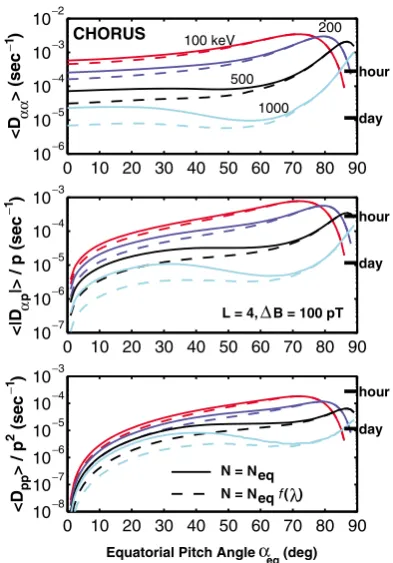
In Fig. 1 we plot the bounce-averaged pitch-angle diffu-sion rateDαα, mixed (pitch-angle/momentum ) diffusion rate|Dαp|/pand momentum diffusion rateDpp
/p2for whistler-mode chorus for electron energies 100, 200, 500, 1000 keV atL = 4. We adopt a Gaussian wave spectral density withω1 = 0.05e,ω2 = 0.65e,ωm = 0.35e, δω = 0.15e, B = 100 pT, and we assume that the wave amplitude is constant along the field line. We com-pare the case of particle density N(λ) =constant= Neq with that in which N varies as the dipole magnetic field strength, namely, N(λ)/Neq = B(λ)/Beq = f(λ) =
Fig. 1. Bounce-averaged diffusion coefficients for whistler-mode chorus for the indicated electron energies atL=4. Two latitudinal distribu-tions of particle density are specified: (a)N(λ) =Neq=constant, (b)
Fig. 2. Bounce-averaged pitch-angle diffusion rates (top) and momentum diffusion rates (bottom) for whistler-mode chorus for the indicated electron energies andL-values. The two chosen latitudinal distributions of particle density are as specified in Fig. 1.
Fig. 3. Five models for the latitudinal distribution of chorus wave ampli-tude.
(1+3 sin2λ)1/2/cos6λ whereλis the magnetic latitude. We take Neq=39 cm−3andαeq∗ =(2e/ω2pe)eq =0.058 at L = 4. The effect of increasing particle density with lati-tude changes all three diffusion rates, the magnilati-tude of the change depending on equatorial pitch-angle and electron kinetic energy. Larger changes occur at lower equatorial pitch-angles. This is because electrons with small values of αeqbounce to higher latitudes where the density increases substantially in the case N(λ)∝ f(λ). At all energies, an increase in particle density with latitude reduces the pitch-angle scattering rates near the loss cone but barely affects momentum diffusion rates for electrons with high
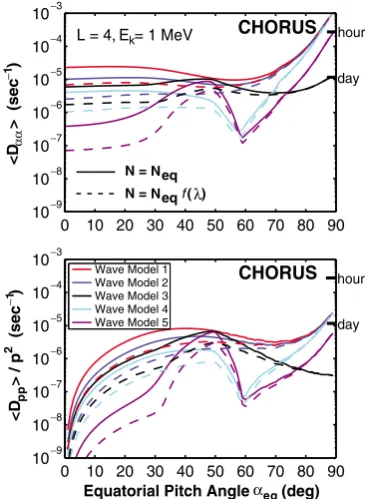
equato-Fig. 4. Bounce-averaged pitch-angle diffusion rates (top) and momentum diffusion rates (bottom) for whistler-mode chorus for 1 MeV electrons atL = 4. The two chosen latitudinal distributions of particle density are as specified in Fig. 1, and the five wave models are as specified in Fig. 3.
766 D. SUMMERS AND B. NI: RESONANT DIFFUSION RATES OF RADIATION BELT ELECTRONS
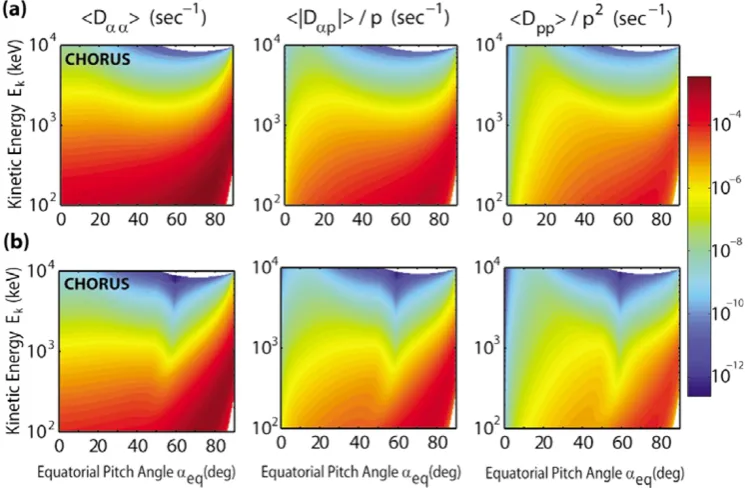
Fig. 5. Two-dimensional plots of bounce-averaged diffusion coefficients for whistler-mode chorus atL = 4 as functions of equatorial pitch-angle and kinetic energy. The assumed latitudinal density distribution isN(λ)= Neqf(λ)where f(λ) =(1+3 sin2λ)1/2/cos6λ. For the latitudinal
distribution of chorus we adopt Wave Model 1 in the top panels and Wave Model 4 in the bottom panels (see Fig. 3).
In Fig. 2 for the same latitudinal distributions of particle number density used in Fig. 1 we calculate the pitch-angle and momentum diffusion rates for whistler-mode chorus for electron energies 200 keV, 1 MeV at a specified range ofL -shells. We adopt the same chorus wave parameters used in Fig. 1 and we assume that the wave amplitude is constant along field lines. We use the equatorial “trough” particle density modelNeq=124(3/L)4cm−3due to Sheeleyet al. (2001). Figure 2 shows generally that as L decreases, for both 200 keV and 1 MeV electrons, diffusion rates decrease. As an exception, for 1 MeV electrons momentum diffusion rates are largely independent of L-shell at large values of equatorial pitch-angle (70◦ < αeq < 90◦), as was also found by Summerset al.(2007b).
In a study of the substorm dependence of chorus wave amplitudes Meredith et al. (2001) identifies equatorial (|λ| < 15◦)and high-latitude (15◦ < |λ| < 90◦) cho-rus emissions outside the plasmasphere. We choose a set of five models of latitudinal distribution of wave amplitude to represent equatorial and high-latitude source strengths of chorus emissions of differing magnitudes. These models are illustrated in Fig. 3. For Model 1,B(λ) =constant
=100 pT. Models 2 and 3 respectively represent an equa-torial source only and a high-latitude source only. Models 4 and 5 include both equatorial and high-latitude sources, but with different relative strengths. In Fig. 4 we plot bounce-averaged pitch-angle diffusion rates (top) and mo-mentum diffusion rates (bottom) for whistler-mode chorus for 1 MeV electrons atL = 4. We adopt the same cho-rus wave parameters and latitudinal density distributions as used in Fig. 1, and we calculate the diffusion rates for each of the wave models given in Fig. 3. We see from Fig. 4 that the diffusion rates are influenced by the high-latitude wave distributions for small equatorial pitch-angles, and
by the low-latitude wave distributions for large equatorial pitch-angles. For small (large) equatorial pitch-angles the diffusion rates increase as the overall strength of the high-latitude (low-high-latitude) wave distribution increases. In Fig. 4 the dependence of the diffusion rates on the latitudinal den-sity distributions is similar to that found in Figs. 1 and 2.
In Fig. 5 we provide two-dimensional plots of the bounce-averaged diffusion coefficients for whistler-mode chorus at L = 4, versus equatorial pitch-angle αeq and kinetic energy Ek. We assume the density distribution N(λ) = Neqf(λ), and for the waves we adopt Model 1 in the top panels and Model 4 in the bottom panels. Fig-ure 5 shows how a change in the latitudinal wave distribu-tion can produce significant changes in the diffusion coeffi-cients over broad regions of(αeq, Ek)-space.
3.2 Electron interaction with plasmaspheric hiss
con-Fig. 6. Four models for the latitudinal distribution of plasmaspheric electron density atL = 4.
stant, and we specify four latitudinal distributions of hiss wave power. The wave models comprise Wave Model I: [B =10 pT,|λ| <90◦]; Wave Model II: [B =40 pT,
|λ| < 15◦; B = 50 pT, 15◦ < |λ| < 30◦; B = 0, 30◦ < |λ| < 90◦]; Wave Model III: [B = 40 pT,
|λ| < 15◦;B = 50 pT, 15◦ < |λ| <90◦]; Wave Model IV: [B = 100 pT,|λ| < 90◦]. Wave Models I–IV rep-resent a range of hiss distributions from weak (I) to rela-tively strong (IV). No drift-averaging is carried out in Fig. 7. In the top panel of Fig. 7 we see that as the density dis-tributions become stronger, diffusion rates become weaker at lower equatorial pitch-angles, for all energies, while at higher equatorial pitch-angles diffusion rates are largely in-dependent of density distribution (as we found in Fig. 1 for chorus). Similarly, in the middle panel of Fig. 7, as the wave distributions become stronger the diffusion rates in-crease over a wide range of equatorial pitch-angles except those toward 90◦. We note also in Fig. 7 (middle panel) that there is no distinction between the diffusion rates at ener-gies 200 keV and 500 keV for the Wave Models II and III, whereas such a distinction exists at 1 MeV. The explanation is that MeV electrons are in resonance at higher latitudes (|λ| > 30◦)whereas 200 keV, 500 keV electrons are not. Thus, the difference between Wave Models II and III is ir-relevant for lower energy electrons.
In the bottom panel of Fig. 7 we show a two-dimensional plot of the bounce-averaged pitch-angle diffusion rate for hiss at L = 4, as a function of equatorial pitch-angle and kinetic energy. For this plot we adopt Wave Model III, which represents a fairly strong hiss distribution, and den-sity model 2 withσ =0.6 (see Fig. 6).
3.3 Electron interaction with EMIC waves
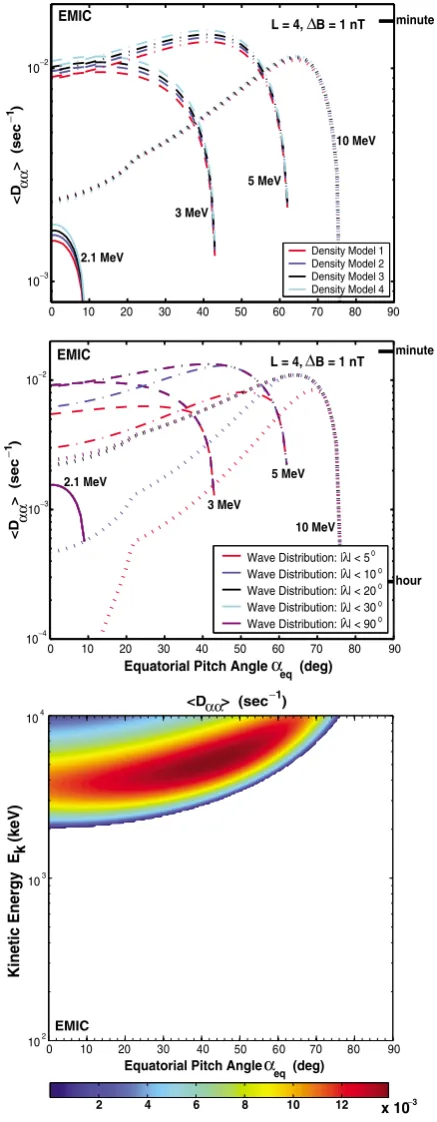
In the top and middle panels of Fig. 8 we present bounce-averaged pitch-angle diffusion rates for EMIC waves for electron energies 2.1 MeV, 3 MeV, 5 MeV, 10 MeV at L = 4. A Gaussian wave spectral density is assumed with ω1 = p/6, ω2 = p/2, ωm = p/3, δω = p/6 (wherep is the proton gyrofrequency), andB =1 nT. We setNeq=346 cm−3andα∗eq=0.0066. In the top panel
Fig. 7. In the top and middle panels, bounce-averaged pitch-angle diffu-sion rates for whistler-mode hiss for the indicated electron energies at
L = 4. The plasmaspheric density models are as specified in Fig. 6. The four wave models are specified in the text. In the bottom panel, two-dimensional plot of the bounce-averaged pitch-angle diffusion rate for hiss atL =4, corresponding to Wave Model III and Density Model 2.
768 D. SUMMERS AND B. NI: RESONANT DIFFUSION RATES OF RADIATION BELT ELECTRONS
Fig. 8. In the top and middle panels, bounce-averaged pitch-angle diffu-sion rates for EMIC waves for the indicated electron energies atL = 4. The plasmaspheric density models are as specified in Fig. 6. In the bottom panel, two-dimensional plot of the bounce-averaged pitch-angle diffusion rate for EMIC waves atL = 4, corresponding to Wave Dis-tribution|λ|<20◦and Density Model 2.
wave power indicated in the figure. No drift-averaging is carried out in Fig. 8. In Fig. 8 (top) for electron ener-gies 2.1 MeV, 3 MeV, 5 MeV, diffusion rates increase as the density distribution becomes stronger (in contrast to the hiss diffusion rates in Fig. 7 (top)). At such energies EMIC
wave-electron resonance occurs relatively close to the equa-tor; a density increase then increases the region of reso-nance causing a corresponding increase in diffusion rate. However, for 10 MeV electrons, whose resonance region extends to higher latitudes, there is little distinction in the diffusion rate curves as the density distribution changes. For wave-particle interactions, in general, an increase in parti-cle density causes a decrease in diffusion rate at any point. However, an increase in density may increase the latitudinal region of resonance and hence increase the diffusion rate. Whether or not a net increase in diffusion rate occurs de-pends partially on the competition between these processes. In Fig. 8 (middle), for 2.1 MeV electrons the diffusion rate curves are coincident for all five chosen wave distributions. This is because the region of resonance for 2.1 MeV elec-trons is approximately|λ| < 5◦. However, for 10 MeV electrons, whose resonance region extends to|λ| ∼30◦, the diffusion rates increase substantially as the latitudinal range of the wave distribution increases. The differences and sim-ilarities between Fig. 7 and Fig. 8 regarding the influence on the diffusion rates of the density distributions and the wave distributions are largely controlled by the latitudinal regions of resonant electron-wave interaction.
In the bottom panel of Fig. 8 we show a two-dimensional plot of the bounce-averaged pitch-angle diffusion rate for EMIC waves at L = 4, for Wave Distribution|λ| < 20◦ and density model 2. The bottom panels of Fig. 7 and Fig. 8 provide a ready comparison between the scattering properties of hiss and EMIC waves for the adopted wave and density distributions.
In the present study we consider electron interaction with EMIC waves in a hydrogen plasma only. Electron scattering by EMIC waves can, in fact, be sensitively dependent on the ion composition of the plasma (Summers and Thorne, 2003; Summerset al., 2007b). The influence of latitudinal distributions of particle density and wave power on electron scattering by EMIC waves in a multi-ion (H+, He+, O+) plasma is left as an interesting topic for future study.
3.4 Electron loss timescales due to combined scatter-ing by VLF chorus, ELF hiss and EMIC waves
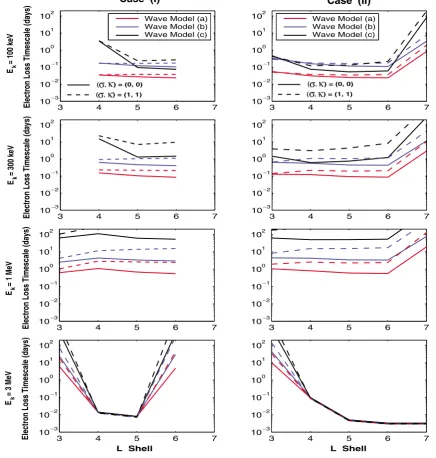
Fig. 9. Schematic distributions of chorus, plasmaspheric hiss and EMIC waves in the case of low geomagnetic activity and expanded plasmasphere (Case (I)) and following high geomagnetic activity during the evolution of plasmaspheric plumes (Case (II)). For each case, the corresponding table shows the approximate percentage of an electron drift orbit that traverses each wave mode for a givenL-value.
Table 1. The three wave models adopted in association with Figs. 9 and 10. Wave Model (a) Wave Model (b) Wave Model (c) Chorus B(λ)=100 pT Wave Model 4 Wave Model 5 Hiss B(λ)=100 pT Wave Model III B(λ)=10 pT
EMIC B(λ)=1 nT B(λ)=1 nT B(λ)=1 nT
N(λ)= Neq[f(λ)]σ,Neq =1390(3/L)4.83cm−3, and that outside the plasmasphere (/plumes) N(λ) = Neq[f(λ)]κ, Neq =124(3/L)4cm−3. We adopt three sets of latitudinal distributions of wave power, namely, Wave Models (a), (b), (c) as specified in Table 1. We further assume that the cho-rus, hiss and EMIC waves have Gaussian spectral densities with the same parameters as used in the respective Figs. 1, 7, and 8. We calculate the total electron loss timescaleτtot using the method described by Summerset al.(2007b) (sec-tion 5). The method involves expressing the total electron scattering rate as the sum of the scattering rates due to each wave mode, each rate being evaluated at the equatorial loss cone angle. We estimate electron loss timescales by using the scattering rate at the edge of the loss cone only in those cases in which the pitch-angle diffusion rate is small over a high pitch-angle range narrower than 75◦ < αeq <90◦. Use of this criterion should ensure that electron lifetimes are controlled by scattering rates near the edge of the loss cone (e.g., Shpritset al., 2006). In Fig. 10 the influence on the total electron loss timescaleτtot(which is inversely pro-portional to the total scattering rate) of the latitudinal dis-tributions of density and wave power in general reflects the results obtained in Figs. 1, 2, 4, 7, and 8. For example, with some exceptions, the loss timescale increases as the
770 D. SUMMERS AND B. NI: RESONANT DIFFUSION RATES OF RADIATION BELT ELECTRONS
Fig. 10. Corresponding to Fig. 9, total electron loss timescales due to combined scattering by chorus, plasmaspheric hiss and EMIC waves in Case (I) and Case (II). The wave models (a), (b), (c) are given in Table 1 and the particle density models specified byσandκare described in the text.
4.
Summary
We have examined the cyclotron resonant bounce-averaged diffusion rates of radiation belt electrons for VLF chorus, ELF hiss and EMIC waves, and we have adopted various latitudinal distributions of particle density and wave power. The diffusion rates can depend sensitively on the specified distributions of density and wave power. In gen-eral, however, the extent to which the distributions of den-sity and wave power influence the diffusion rates depends on wave mode, equatorial pitch-angle, electron energy, and L-value. The bounce-averaged diffusion rates fundamen-tally depend on the spatial region over which cyclotron res-onant wave-particle interaction can take place for any par-ticular wave mode. The regions for resonance depend on wave band, electron energy, equatorial pitch-angle, and the local values of particle number density and magnetic field. Accurate determination of the cyclotron resonant diffusion
rates of radiation belt electrons clearly requires detailed data on the global distribution of particle density and wave power. This study confirms the need for the acquisition of such data from future satellite missions.
Acknowledgments. This work is supported by the Natural Sci-ences and Engineering Research Council of Canada under grant A-0621.
References
Albert, J. M., Evaluation of quasi-linear diffusion coefficients for EMIC waves in a multispecies plasma,J. Geophys. Res.,108(A6), 1249, doi: 10.1029/2002JA009792, 2003.
Albert, J. M., Simple approximations of quasi-linear diffusion coefficients,
J. Geophys. Res.,112, A12202, doi:10.1029/2007JA012551, 2007. Denton, R. E.,et al., Distribution of density along magnetospheric field
lines, J. Geophys. Res., 111, A04213, doi:10.1029/2005JA011414, 2006.
region of electromagnetic ion cyclotron waves in the magnetosphere?,
J. Atmos. Sol. Terr. Phys.,63, 1225–1247, 2001.
Horne, R. B., et al., Timescale for radiation belt electron accelera-tion by whistler mode chorus waves,J. Geophys. Res.,110, A03225, doi:10.1029/2004JA010811, 2005.
Lyons, L. R., Pitch angle and energy diffusion coefficients from resonant interactions with ion-cyclotron and whistler waves,J. Plasma Phys.,12, 417–432, 1974.
Meredith, N. P., R. B. Horne, and R. R. Anderson, Substorm dependence of chorus amplitudes: Implications for the acceleration of electrons to relativistic energies,J. Geophys. Res.,106, 13165–13178, 2001. Meredith, N. P., R. B. Horne, R. M. Thorne, D. Summers, and R. R.
Anderson, Substorm dependence of plasmaspheric hiss,J. Geophys. Res.,109, A06209, doi:10.1029/2004JA010387, 2004.
Miyoshi, Y.,et al., Rebuilding process of the outer radiation belt during the 3 November 1993 magnetic storm: NOAA and Exos-D observations,J. Geophys. Res.,108(A1), 1004, doi:10.1029/2001JA007542, 2003. Omura, Y. and D. Summers, Dynamics of high-energy electrons
interact-ing with whistler mode chorus emissions in the magnetosphere,J. Geo-phys. Res.,111, A09222, doi:10.1029/2006JA011600, 2006.
Reinisch, B. W., et al., Plasma density distribution along the magne-tospheric field: RPI observations from IMAGE,Geophys. Res. Lett., 28(24), 4521–4524, 2001.
Roth, I., M. Temerin, and M. K. Hudson, Resonant enhancement of rela-tivistic electron fluxes during geomagnetically active periods,Ann. Geo-phys.,17, 631–638, 1999.
Santolik, O., D. A. Gurnett, J. S. Pickett, M. Parrot, and N. Cornilleau-Wehrlin, A microscopic and nanoscopic view of storm-time chorus on 31 March 2001, Geophys. Res. Lett., 31, L02801, doi:10.1029/2003GL018757, 2004.
Sheeley, B. W., M. B. Moldwin, H. K. Rassoul, and R. R. Anderson, An empirical plasmasphere and trough density model: CRRES obser-vations,J. Geophys. Res.,106, 25631–25642, 2001.
Shprits, Y. Y., W. Li, and R. M. Thorne, Controlling effect of the pitch angle scattering rates near the edge of the loss cone on electron lifetimes,
J. Geophys. Res.,111, A12206, doi:10.1029/2006JA011758, 2006.
Spasojevic, M., et al., Global response of the plasmasphere to a geo-magnetic disturbance,J. Geophys. Res.,108(A9), 1340, doi:10.1029/ 2003JA009987, 2003.
Summers, D., Quasi-linear diffusion coefficients for field-aligned electro-magnetic waves with applications to the magnetosphere,J. Geophys. Res.,110, A08213, doi:10.1029/2005JA011159, 2005.
Summers, D. and C. Ma, A model for generating relativistic electrons in the Earth’s inner magnetosphere based on gyroresonant wave-particle interactions,J. Geophys. Res.,105, 2625–2640, 2000.
Summers, D. and R. M. Thorne, Relativistic electron pitch angle scattering by electromagnetic ion cyclotron waves during geomagnetic storms,J. Geophys. Res.,108(A4), 1143, doi:10.1029/2002JA009489, 2003. Summers, D., R. M. Thorne, and F. Xiao, Relativistic theory of
wave-particle resonant diffusion with application to electron acceleration in the magnetosphere,J. Geophys. Res.,103, 20487–20500, 1998. Summers, D.,et al., Model of the energization of outer-zone electrons by
whistler-mode chorus during the October 9, 1990 geomagnetic storm,
Geophys. Res. Lett.,29(24), 2174, doi:10.1029/2002GL016039, 2002. Summers, D., B. Ni, and N. P. Meredith, Timescales for radiation belt
electron acceleration and loss due to resonant wave-particle interactions: 1. Theory,J. Geophys. Res.,112, A04206, doi:10.1029/2006JA011801, 2007a.
Summers, D., B. Ni, and N. P. Meredith, Timescales for radiation belt elec-tron acceleration and loss due to resonant wave-particle interactions: 2. Evaluation for VLF chorus, ELF hiss, and electromagnetic ion cyclotron waves, J. Geophys. Res., 112, A04207, doi:10.1029/2006JA011993, 2007b.
Thorne, R. M., T. P. O’Brien, Y. Y. Shprits, D. Summers, and R. B. Horne, Timescale for MeV electron microburst loss during geomagnetic storms,J. Geophys. Res., 110, A09202, doi:10.1029/2004JA010882, 2005.