R E S E A R C H
Open Access
Enhanced beamforming design and
sum-rate maximization for two-way
multi-relay networks
Wei Duan
1, Yier Yan
3, Han Hai
1, Xueqin Jiang
2*, Haiyang Yu
1and Moon Ho Lee
1Abstract
In this paper, we investigate an enhanced relay beamforming design for two-way relay networks (TWRN). In order to reduce the computational complexity, we derive a sum of the inverse of the signal-to-noise ratio (SI-SNR) problem equivalent to the objective sum-rate (SR) problem. The SI-SNR problem can be reformulated as a simple optimization problem by using the Cholesky decomposition and Cauchy-Schwarz inequality, and solved by the interior-point method. The numerical results show that the proposed SI-SNR method can not only reduce the computational complexity but also have the same SR performance as that of the conventional works.
Keywords: Two-way relay channel, Sum-rate, Cholesky decomposition, Cauchy-Schwarz inequality, Amplify-and-forward
1 Introduction
Recently, the two-way relaying (TWR) has attracted sig-nificant interests in improving the spectral efficiency for wireless communication systems. Various cooperative two-way relaying schemes have been proposed, such as denoise-and-forward (DNF) [1, 2], compress-and-forward (CF) [3], decode-and-forward (DF) [4, 5], amplify-and-forward (AF) [1, 6, 7], and cooperative relaying protocols. Because of a less processing power requirement and effi-ciency, the AF scheme is the most widely used in the two-way relay channel (TWRC).
Relay precoder design methods have been investigated in [7–10]. In [7], the authors considered multi-user two-way relay networks (TWRN) with distributed single-antenna relays, where two approaches are considered, i.e., (1) null out all interference contributions at each user sep-arately and (2) treat the interferences at each user as a whole and null out the power of the total interferences. In addition, a closed-form upper bound of the achiev-able sum-rate (SR) is derived and the same multiplexing gain is achieved when the number of relays is sufficiently
*Correspondence: [email protected]
2School of Information Science and Technology, Donghua University, Shanghai, China
Full list of author information is available at the end of the article
large for the considered two approaches. For these two approaches, in order to null every interference (approach 1) and null the total interference (approach 2), the conditionsN<2K2+KandN≥2K(K−1)+1 should be satisfied, whereNis the number of relay nodes andKis the number of the pairs of user nodes. In [8], the authors propose an optimization problem for the TWR system by using a signal-to-noise ratio (SNR) balancing result. In [9], the optimal structure of the source and relay precoding matrices for a two-way linear non-regenerative multiple-input multiple-output (MIMO) relay system is studied. In [10], the authors showed the global optimal solution can be obtained by the branch-and-bound algorithm. Never-theless, the computational complexity is extremely high to find the orthogonal complement to solve the optimiza-tion problem in the above existing works. In order to reduce the computational complexity, [11–14] are inves-tigated by using some effective ways. In [11], the authors derived the achievable SR upper bound of AF beamform-ing scheme and proposed the achievable SR maximizbeamform-ing relay beamforming scheme when the destination and the relay node have perfect knowledge of the channel state information (CSI) for forward and backward channels. A general power iterative algorithm is proposed which can solve the global optimization problem with low compu-tational complexity when the object function form is a
product of fractional quadratic functions. In [12], a deter-minant maximization problem of an AF based on the TWR by using QL-QR decomposition is investigated. In [13], the authors proposed a distributed TWR selection scheme which possesses low implementation complex-ity and the same diverscomplex-ity-multiplexing trade-off (DMT) performance as that of the conventional work. In [14], a channel norm (CN) scheduling scheme is proposed to reduce the complexity and computational cost at the relay. To further reduce the computational complexity, we propose a novel and general distributed relay beamform-ing scheme for the TWR. Since the channel state informa-tion has to be exchanged between relays, the processing usually changes on a slow timescale and needs not create significant overhead. Therefore, following the distributed manner, the weight matrix is diagonal which guarantees that the relays transmit only their own received signal and there is no data exchange among the relays. Since the SR maximization problem is non-convex, we convert the objective problem into a sum of the inverse of the signal-to-noise ratio (SI-SNR) problem. By employing the Cholesky decomposition and Cauchy-Schwarz inequality, the SI-SNR problem can be approximately reformulated as a convex optimization problem which can be solved by using the interior-point method.
The rest of this paper is organized as follows. Section 2 describes a system model of the TWRC. In Section 3, we propose an SI-SNR problem and derive the semi-closed-form solution. The numerical results are presented to show the excellent performance of our proposed method for the TWRC in Section 4. Section 5 concludes this paper.
Notations:AT,A−1,A†, and tr{A}denote the transpose, the inverse, the pseudo-inverse and the trace of matrixA.
diag(·) denotes a diagonal matrix and anN ×N iden-tity matrix is denoted byIN. ·2, E(·), andstand for
the Euclidean norm, the statistical expectation, and the Hadamard product.a,bis the inner product ofaandb.
2 System model
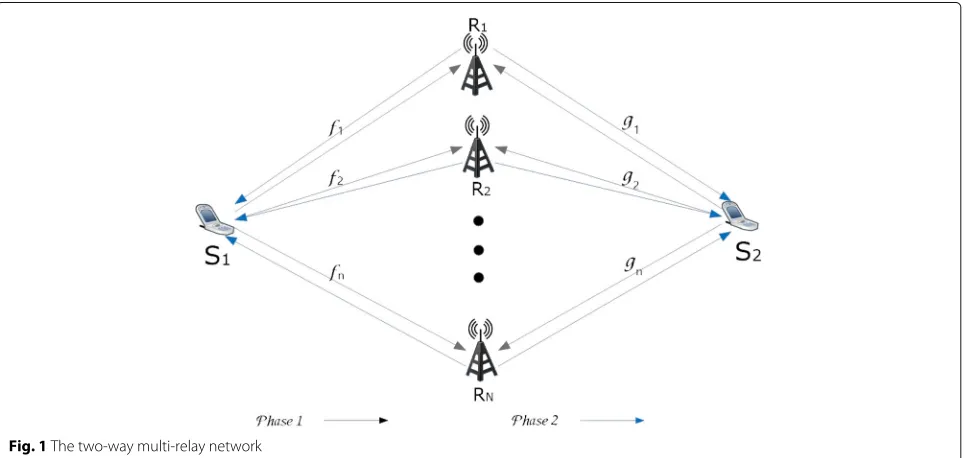
We consider a TWRC consisting of two source nodesS1
andS2andNrelay nodeRNas shown in Fig. 1. Each node
is equipped with a single antenna. We assume that the channels are reciprocal, i.e., the source-to-relay channel coefficients are the same as the relay-to-source channel coefficients. Assume fi andgi denote the channel
coeffi-cients from source 1 and source 2 to relay nodei, respec-tively. Thus, for the total system, we have the channel vec-torsf =[f1,f2, ...fN]T andg =[g1,g2,. . .gN]T. In the first
time slot, for the source nodeSt, fort ∈ {1, 2}, the
infor-mation signalxtis transmitted to the relay nodes. In this
paper, we assume that each transmit antenna satisfies the unity transmission power constraint, which is tr{xtxHt} =1.
The received signals at relay nodes can be expressed as
kR=
P1fx1+
P2gx2+nR, (1)
where Pt denotes the transmit power,kR ∈ CN×1
indi-cates the received signal vector, and nR ∼ CN(0,IN)
represents the additive white Gaussian noise (AWGN) vector with zero mean and the varianceIN at relay nodes.
In the second time slot, the relay nodeRilinearly
ampli-fieskRwith anN×Nbeamforming matrixW=diag(w),
wherew=[w1,w2, ...,wN], and then broadcasts the
ampli-fied signal vector xR to source nodes 1 and 2. Since
the transmit power of souse node St is given as Pt, by
assumingnRwith zero mean and the varianceIN and the
transmitted signals x1 andx2 are independent, in order
to normalize the relay transmit power, we propose the following power normalization vector:
ρ=1/P1+P2+1. (2)
The signal transmitted from relay node can be expressed as
xR=ρWkR. (3)
As shown in [7], to guarantee that the relays transmit only their own received signal and there is no data exchange among the relays, the weight matrix is diagonal which fol-lows the distributed manner. From (3), the total transmit power used by the relay nodes can be expressed as
PR = E
andG=diag(g). In TWRN, since the signal transmitted by the transceiver nodes reappear as self-interference, by employing the successive interference cancellation (SIC), the self-interference can be completely eliminated with perfect channel state information (CSI) [15]. Based on this principle and assuming the CSIs are perfectly known at each source nodei, the self-interference components can be efficiently canceled. After the self-interference cancel-lation, the received signal vectors at S1 and S2 can be
written as
where nt is the noise vector at St with mean zero and
variance 1. From (5), the SNR at sources 1 and 2 can be expressed as
section, we will propose an enhanced beamforming design to efficiently obtain SR.
3 Enhanced beamforming design and sum-rate
maximization
The SR of the two source nodes in the proposed system model can be written as:
Rsum=R1+R2. (8)
Our goal is to find the relay amplification matrixWwhich maximizes the sum-rate Rsum subject to a power
con-straint at the relay. Under the definition of the mutual information, we have
Rt=
1
2log2(1+SNRt), (9)
where 12 is due to the half-duplex relay. Synthesizing (8)–(9), the sum-rate can be expressed as
Rsum=
Therefore, the optimization problem of the sum-rate respect to the total relay power constraint can be formulated as:
2log(x)is a monotonic function, consider the high
trans-mit SNR case, (11) can be approximately converted into
min in the denominator is extremely negligible compared to the other term in the denominator. On the other hand, the approximation(a)is completely necessary, which can help us to obtain the semi-closed-form expression ofw. In order to efficiently obtain the optimal solution, (14) can be converted into partsRAandRBas shown in(b). Now, we
have the equivalent optimization problemQ2as
Q2: min
w RA+RB (15)
s.t. wDwH ≤PR. (16)
Proposition 1. The optimization problem Q2 is equivalent to Q3which is given as
Q3: min
w RA+R
∗
B (17)
whereRA = tr
RB, respectively.
ProofSimilar to [17], by introducing the auxiliary opti-mization variables τA and τB, the optimization
prob-lem (15) can be recast in the epigraph form [18] as {min (τA+τB)},s.t. RA ≤ τA,RB ≤ τB. For the term
RA in the second equality of (14), since D1 and 1αD2
are hermitian and positive definite, by applying Cholesky decomposition [19], we have
D1+
1
αD2=H, (19)
where denotes a lower triangular matrix. We can
rewriteRAas Interestingly,RAhas nothing to relate to the minimum
solution ofRsumwhich serves as the upper bound ofRA.
On the other hand, consider that the SNR at each relay is identically distributed, the term ofRBcan be relaxed as
RB= second-order derivatives ofRB with respect to the relay
beamforming factorwican be respectively derived as
∂RB
a increasing function forwi <−
, there exists maximumR∗Bassociated with
min|wi|, which can be efficiently solved by the
interior-point method [18]. By replacingRA=τAandR∗B=τB, we
have the problemQ3. This completes the proof.
According to Proposition 1, the optimization problem
Q3can be finally expressed as
Q4: min
w R
∗
B (24)
s.t. wDwH ≤PR. (25)
The Lagrangian function associated with problems (24) and (25) is given by
Lv = tr(RB)+μtr wDwH−PR
, (26)
where μ ≥ 0 is the Lagrange multiplier. Making the
derivative ofLvwith respect towHbe zero, we have
∂LV
(which follows from the matrix inversion lemma) for any
N×MmatrixA, we can rewrite (29) as
Synthesizing Proposition 1 and (31), when
ς = w2holds, the solutions ofRAandRBare always
optimum. Finally, we have the solution as
L∗v tr RA+R∗B
+μtr wDwH−PR
. (32)
Now, we summarize the proposed beamforming method in Algorithm 1.
Comparing with the conventional algorithm in [10], the proposed beamforming Algorithm 1 significantly reduces the computational complexity. This is because, to obtain the maximum solution of SR in [10], the iterative branch-and-bound algorithm is used which is problematic in practical systems. In contrast, in our proposed beamform-ing Algorithm 1, the near (at least local) optimal solution ofwcan be obtained without iterations. In addition, in the proposed beamforming method, we efficiently convert the objective SR problem into a convex and low-computation-cost one, i.e., maxRsum−→minR∗B.
4 Numerical results
In this section, we measure the performance of the pro-posed Algorithm 1 in terms of sum-rate compared with the branch-and-bound algorithm in [10]. In all simula-tions, the channel estimates fand g are assumed to be reciprocal and identically distributed complex Gaussian random variables. We further assume that the noise vari-ances ofnR,nt fort = 1, 2, are equally given asσ2 = 1.
In addition, the upper bound solution of SR is obtained by using the exhaustive search algorithm. Comparisons are made with the branch-and-bound algorithm [10] in two different system setups: (1)N =2 and (2)N=3.
In Fig. 2, we compare the average SR performance for the proposed method with the optimal and one-iteration solutions of branch-and-bound method [10] versus
trans-mit SNR, i.e., P1 = P2, with RN = 2 and RN = 3
relay nodes. The optimal solution by using the exhaustive search method serves as the upper bound. It is found that the proposed method is closed to the optimum of [10] and has a remarkable improvement than the one iteration solution. This is because the Cauchy-Schwarz inequality is employed to obtainRAin (20) which leads to the extreme
loss of the performance. In addition, the solution of our
0 2 4 6 8 10 0.5
1 1.5 2 2.5 3 3.5 4 4.5 5 5.5
SNR [dB]
Average Sum−Rate [bps/Hz]
Exhaustive optimal Optimal [10] Proposed algorithm 1 One iteration [10] Exhaustive optimal Optimal [10] Proposed algorithm 1 One iteration [10]
N=3
N=2
Fig. 2Average SR performance versus transmit SNR,P1=P2
0 5 10 15 1
1.5 2 2.5 3 3.5 4 4.5
P2 [dB]
Average Sum−Rate [bps/Hz]
Optimal [10] Proposed algorithm 1 One iteration [10] Optimal [10] Proposed algorithm 1 One iteration [10]
N=3
N=2
Fig. 3Average SR performance versusP2with fixedP1=5
proposed method is closed to the one in [10] with increas-ing transmit power. This is because the approximation of (a)in (14) is negligible at high SNR.
Figure 3 exhibits the average SR performance for the proposed method with the optimal and one-iteration solu-tions of branch-and-bound method [10] versus P2 with
fixedP1=5. It is clear from Fig. 3 that the solution of our
proposed method shows better performance than that of the one iteration [10], and the advantage is increased with greater number of relayN. In addition, it is easy to see that the performances of our proposed scheme and the optimal one in [10] are close at high SNR, which supports
2 3 4 5 6
1 2 3 4 5 6 7 8 9 10
The number of the relay nodes N
Average Sum−Rate [bps/Hz]
Exhaustive optimal Proposed algorithm 1 Exhaustive optimal Proposed algorithm 1
P1=P2=10
P1=P2=5
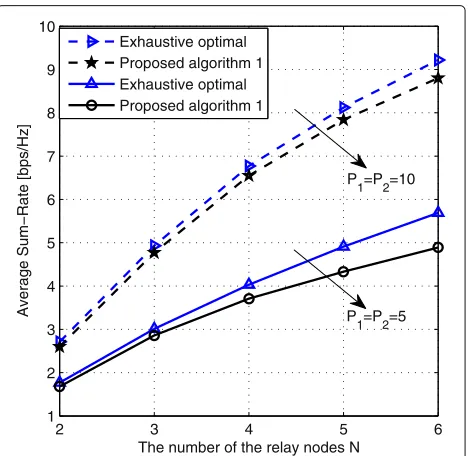
Fig. 4Average SR performance versus the number of the relay nodes
the practical utility of our design. In Fig. 4, we compare the average SR performance for our proposed scheme by
using Algorithm 1 versus the number of relay node N
with the optimal one, where the casesP1 = P2 = 5 and P1 = P2 = 10 are considered. Remarkably, the
perfor-mance gap between the proposed one and the optimal one is smaller for the higher SNR case.
5 Conclusions
In this paper, we considered the TWRN with the enhanced relay beamforming design and proposed a low computational complexity method to solve the SR maxi-mization problem. The objective problem was efficiently converted into a SI-SNR problem which is a simple and low-computation-cost one. Finally, the semi-closed-form solution of SI-SNR problem is derived. Numerical results showed that the performance of the proposed SI-SNR is improved compared to the existing one.
Acknowledgments
This work was supported by MEST 2015R1A2A1A05000977, NRF, South Korea, National Natural Science Foundation of China (61671143), Shanghai Rising-Star Program (15QA1400100), Innovation Program of Shanghai Municipal Education Commission (15ZZ03), and Key Lab of Information Processing & Transmission of Guangzhou 201605030014.
Competing interests
The authors declare that they have no competing interests.
Author details
1Division of Electronic and Information Engineering, Chonbuk National University, Jeonju, South Korea.2School of Information Science and Technology, Donghua University, Shanghai, China.3School of Mechanical and Electrical Engineering, Guangzhou University, Guangzhou, China.
Received: 21 March 2016 Accepted: 7 October 2016
References
1. P T Koike-Akino, V Popovski, Tarokh, Optimized constellations for two-way wireless relaying with physical network coding. IEEE J. Sel. Areas Commun.27(5), 773–787 (2009)
2. Z Zhao, M Peng, Z Ding, W Wang, H Chen, Denoise-and-forward network coding for two-way relay MIMO systems. IEEE Trans. Veh. Technol.63(2), 775–788 (2014)
3. S Simoens, O Medina, J Vidal, A Coso, Compress-and-forward cooperative MIMO relaying with full channel state information. IEEE Trans. Signal Pross.58(2), 781–791 (2010)
4. X Liang, S Jin, X Gao, K Wong, Outage performance for
decode-and-forward two-way relay network with multiple interferers and noisy relay. IEEE Trans. Commun.61(2), 521–531 (2013)
5. A Sheikh, A Olfat, New beamforming and relay selection for two-way decode-and-forward relay networks. IEEE Trans. Veh. Technol.65(3), 1354–1366 (2016)
6. C Lameiro, J Via, I Santamaria, Amplify-and-forward strategies in the two-way relay channel with analog TxCRx beamforming. IEEE Trans. Veh. Technol.62(2), 642–654 (2013)
7. HC Wang, Q Yin, A Feng, AF Molisch, Multi-user two-way relay networks with distributed beamforming. IEEE Trans. Wirel. Commun.10(10), 3460–3471 (2011)
8. V Nassab, S Shahbazpanahi, A Grami, Optimal distributed beamforming for two-way relay networks. IEEE Trans. Signal Process.58(3), 1238–1250 (2010)
9. Y Rong, Joint source relay optimization for two-way linear
nonregenerative MIMO relay communications. IEEE Trans. Signal Process. 60(12), 6533–6546 (2012)
10. W Cheng, M Ghogho, Q Huang, D Ma, J Wei, Maximizing the sum-rate of amplify-and-forward two-way relaying networks. IEEE Commun. Lett. 18(11), 635–638 (2011)
11. N Lee, HJ Yang, J Chun, inProc. IEEE ICC. Achievable sum-rate maximizing AF relay beamforming scheme in two-way relay channels (IEEE, Beijing, 2008), pp. 300–305
12. W Duan, Y Jiang, Y Guo, K Yan, MH Cho, MH Lee, Low-complexity QL-QR decomposition based beamforming design for two-way MIMO relay networks. EURASIP J. Wirel. Commun. Networking.Article ID 246(2015) 13. J Shi, J Ge, J Li, Low-complexity distributed relay selection for two-way AF
relaying networks.Electron. Lett.48(3), 186–187 (2012)
14. Y Wang, H Gao, C Yuen, T Lv, inProc.the 81th. IEEE Veh. Technol. Conf. Low complexity user scheduling design for multi-pair two-way relay channels (IEEE, Glasgow, 2015), pp. 1–5
15. A Gupta, A Singer, Successive interference cancellation using constellation struc- ture. IEEE Trans. Signal Process.55(12), 5716–5730 (2007) 16. K Xu, D Zhang, Y Xu, W Ma, The equivalence of two optimal
power-allocation schemes for a-TWRC. IEEE Trans. Veh. Technol.63(4), 2478–2489 (2014)
17. P Ubaidulla, S Aissa, Robust two-way cognitive relaying: precoder designs under interference constraints and imperfect CSI. IEEE Trans. Wirel. Commun.13(5), 2478–2489 (2014)
18. S Boyd, L Vandenberghe,Convex Optimization. (Cambridge University Press, Cambridge, 2004)
19. GH Golub, CFV Loan,Matrix Computations. 3rd edition. (Johns Hopkins University Press, Baltimore, 1996)
20. J Choi, MMSE-based distributed beamforming in cooperative relay networks. IEEE Trans. Commun.59(5), 1346–1356 (2011)
Submit your manuscript to a
journal and benefi t from:
7 Convenient online submission 7 Rigorous peer review
7 Immediate publication on acceptance 7 Open access: articles freely available online 7 High visibility within the fi eld
7 Retaining the copyright to your article