R E S E A R C H
Open Access
Two-round contributory group key exchange
protocol for wireless network environments
Tsu-Yang Wu, Yuh-Min Tseng
*and Ching-Wen Yu
Abstract
With the popularity of group-oriented applications, secure group communication has recently received much attention from cryptographic researchers. A group key exchange (GKE) protocol allows that participants cooperatively establish a group key that is used to encrypt and decrypt transmitted messages. Hence, GKE protocols can be used to provide secure group communication over a public network channel. However, most of the previously proposed GKE protocols deployed in wired networks are not fully suitable for wireless network environments with low-power computing devices. Subsequently, several GKE protocols suitable for mobile or wireless networks have been proposed. In this article, we will propose a more efficient group key exchange protocol with dynamic joining and leaving. Under the decision Diffie-Hellman (DDH), the computation
Diffie-Hellman (CDH), and the hash function assumptions, we demonstrate that the proposed protocol is secure against passive attack and provides forward/backward secrecy for dynamic member joining/leaving. As compared with the recently proposed GKE protocols, our protocol provides better performance in terms of computational cost, round number, and communication cost.
Keywords:Group key exchange, Dynamic, Wireless network, Diffie-Hellman assumption
Introduction
Wireless communication technology has widely been applied to many mobile applications and services such as e-commerce applications, mobile access services, and wireless Internet services. Nowadays, people use their cellular phone or PDA (personal digital assistant) to access these mobile services. However, most of such security schemes and protocols deployed in wired net-works are not fully applicable to wireless netnet-works (i.e., wireless local area networks [1], mobile ad hoc networks [2], cellular mobile networks [3], and wireless sensor networks [4]) because of the network architecture and the computational complexity of mobile devices. In addition, an intruder is easy to intercept the transmitted messages over a wireless network because wireless com-munications use radio waves to transmit messages. Meanwhile, most cryptographic algorithms require many expensive computations, thus it will be a nontrivial chal-lenge to design security schemes and protocols for
wireless network environments with low-power com-puting devices [5,6].
With the popularity of group-oriented applications such as collaboration works and electric conferences, secure group communication has received much atten-tion from cryptographic researchers. A group key exchange (GKE) protocol allows that participants estab-lish a group key to encrypt/decrypt the transmitted mes-sages. Thus, GKE protocols can be used to provide secure group communication. In 1982, Ingemaresson et al. [7] proposed the first GKE protocol relied on the two-party Diffie-Hellman scheme [8]. Subsequently, dif-ferent types of GKE protocols were presented such as constant-round GKE [9-13] and linear-round GKE [14-17]. However, these previously proposed GKE proto-cols did not deal with the computing capability of mobile devices in wireless mobile networks.
Actually, considering wireless network environments such as wireless local area networks [1] and cellular mobile networks [3], they may be regarded as asym-metric (imbalanced) wireless networks. An imbalanced wireless network consists of mobile clients and a power-ful node. Generally, mobile clients may use some mobile * Correspondence: [email protected]
Department of Mathematics, National Changhua University of Education, Jin-De Campus, Chang-Hua 500, Taiwan
devices (i.e., cellular phone or PDA) to access mobile applications through the powerful node. If such mobile clients want to perform a secure conference using their mobile devices through cellular mobile networks or wireless local area networks, they must establish a secure group key to encrypt/decrypt the transmitted messages. Considering the computing capability of mobile devices, a flexible approach is to shift the com-putational burden from the mobile devices to the powerful node. This approach reduces the computa-tional costs on mobile nodes. Consequently, several group key agreement protocols [18-22] for the imbal-anced wireless network have been proposed.
In 2003, Boyd and Nieto [18] presented a one-round GKE protocol. Their protocol is efficient for imbalanced wireless networks, but it lacks forward secrecy. Bresson et al. [19] proposed a two-round GKE protocol for imbalanced wireless networks. Unfortunately, their pro-tocol provides only partial forward secrecy [20]. This partial forward secrecy means that leaking the mobile nodes’private keys do not reveal any information about the previous establishment group keys, but leaking the powerful node’s private key will enable an adversary to reconstruct the previous group keys. Subsequently, Nam et al. [20] also presented an improvement on the proto-col proposed by Bresson et al. In 2007, Tseng [21] demonstrated that the Nam et al.’s protocol has a secur-ity weakness. In their protocol, the powerful node can pre-determine the group key. That is, Nam et al.’s pro-tocol is not a contributory GKE propro-tocol. For repairing this weakness, Tseng also proposed a secure group key exchange protocol for imbalanced wireless networks.
However, Tseng’s GKE protocol does not deal with
dynamic member joining/leaving functionality. Note that the dynamic joining/leaving functionality means that other participants need not to re-run the protocol when a participant joins or leaves the group. For a GKE proto-col, it is important to provide this dynamic functionality, especially for wireless network environments. For pro-viding dynamic joining/leaving functionality, Chuang and Tseng [22] recently proposed a dynamic group key exchange protocol for imbalanced wireless networks. However, their protocol requires three rounds to estab-lish a group key.
Since the recently proposed GKE protocols [20-22] for wireless network environment are non-authenticated ones. By its very nature, a non-authenticated group key exchange protocol cannot provide participant and mes-sage authentication, so it must rely on the authenticated network channel [1,3] or use other schemes [23-25] to provide authentication in advance. Here, as like the recently proposed GKE protocols [20-22], we assume that each mobile client and the powerful node have
already authenticated mutually. Here, we focus on the design of a non-authenticated GKE protocol. In this article, we propose a new group key exchange protocol with the dynamic property for wireless network environ-ments. Under several security assumptions, we will prove that the proposed protocol is secure against passive attack and provides forward/backward secrecy for dynamic member joining/leaving. Meanwhile, we demonstrate that the proposed protocol also satisfies the contributiveness property. As compared with the recently proposed GKE protocols, our protocol provides better performance in terms of computational cost, round number, and communication cost.
The remainder of this article is organized as follows. In the next section, we present the security assumptions and the security requirements for a dynamic GKE proto-col. In‘A concrete dynamic GKE protocol’section, we propose a concrete dynamic GKE protocol. Security analysis of the proposed protocol is demonstrated in
‘Security analysis’section. In ‘Performance analysis and discussions’section, we make performance analysis and comparisons. The conclusions are given in‘Conclusions’ section.
Preliminaries
In this section, we present the security requirements of dynamic group key exchange protocol, as well as several security assumptions.
Notations
The following notations are used throughout the article:
•p,q: two large primes satisfyingp= 2q+ 1.
•Gq: a subgroup ofZp* with the orderq.
•g: a generator of the groupGq.
•H: a one-way hash function,H:{0, 1}*®Zq*.
•SID: a session identity is public information. Note that each session is assigned a uniqueSID.
Security requirements for dynamic GKE protocol
Here, we define the security requirements of a dynamic GKE protocol as follows:
•Passive attack: This attack means that a passive adversary cannot compute the group key by eaves-dropping on the transmitted messages over a public channel or efficiently distinguish the group key from a random string.
•Backward secrecy: When an old member leaves the group, he/she cannot compute the subsequent group keys to decrypt the future encrypted messages.
•Contributiveness: In the group, any participants cannot predetermine or predict the resulting group key. In other words, each participant can confirm that her/his contribution has been involved in the group key.
Security of a dynamic GKE protocol
We say that a dynamic group key exchange protocol is secure, if (1) it is secure againstpassive attack; (2) it
providesforward/backward secrecy for joining/leaving;
(3) it satisfiescontributiveness.
Security assumptions
For the security of our proposed dynamic group key exchange protocol, we need the following hard problems and assumptions [26,27].
• Decision Diffie-Hellman (DDH) problem: Given ya=gxamodp and yb=gxb modp for some xa, xbÎ Zq*, the DDH problem is to distinguish two tuples (ya,yb, gxaxb modp) and (ya,yb,RÎ Gq).
• DDH assumption: There exists no probabilistic polynomial-time algorithm can solve the DDH pro-blem with a non-negligible advantage.
• Computational Diffie-Hellman (CDH) problem: Given a tuple (g, gxamodp,gxb modp) for somexa,
xbÎ Zq*, the CDH problem is to compute the value gxaxb modp∈G
q.
• CDH assumption: There exists no probabilistic polynomial-time algorithm can solve the CDH pro-blem with a non-negligible advantage.
•Hash function assumption: A secure one-way hash function H:X={0, 1}∗→Y =Z∗q must satisfy fol-lowing requirements [28]:
(i) For any yÎ Y, it is hard to find xÎ Xsuch that H(x) =y.
(ii) For any xÎX, it is hard to find x’ÎX such that x’≠xand H(x’) =H(x).
(iii) It is hard to find x, x’Î X such thatx ≠x’and H(x) =H(x’).
A concrete dynamic GKE protocol
In this section, we present a new group key exchange protocol with the member joining/leaving functionality. Without loss of generality, let {U0,U1, U2,..., Un} be a
set of participants who want to generate a group key in an imbalanced wireless network, whereU0is a powerful
node andU1,..., Unarenmobile clients with the limited computing capability. Our proposed dynamic GKE
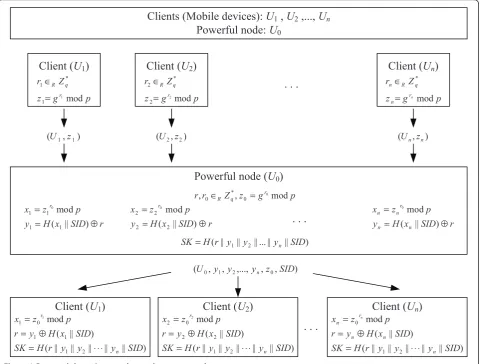
protocol is depicted in Figure 1 and the detailed steps are described as follows.
Step 1: Each client Ui (1 ≤ i ≤ n) selects a random valueri∈Z∗q and computes zi=gri modp.. Then, each
Uisends (Ui,zi) to the powerful node U0.
Step 2: The powerful nodeU0 first selects two random
values r0,r Î Zq* and computes z0=gr0modp.. Upon
receiving n pairs (Ui, zi) (1 ≤ i ≤ n), U0 computes
xi=zir0 modp and yi =H(xi||SID)⊕r for i= 1, 2,..., n. Finally, the powerful nodeU0 computesSK =H(r||y1||
y2||...||yn||SID) and broadcasts (U0,y1, y2,...,yn, z0,SID)
to all clients.
Step 3: Upon receiving the messages (U0, y1,y2,...,yn,
z0, SID), each client Ui (1 ≤ i ≤ n) can compute
yi=H(xi||SID)⊕rand uses r to obtain the group key
SK=H(r||y1||y2||...||yn||SID).
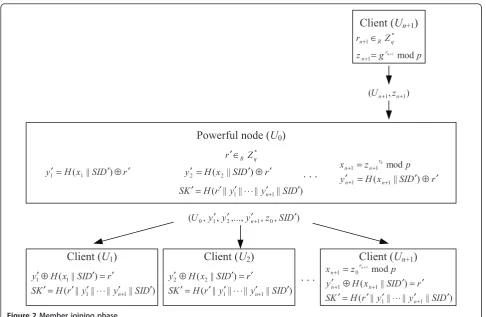
Member joining phase.Assume that a new client Un
+1want to join the group. This phase is depicted in
Fig-ure 2 and the detailed steps are described as follows. Step 1: Only the clientUn+1 randomly selects a value
rn+1∈Zq∗ and computes zn+1=grn+1 modp. Then,Un+1
sends (Un+1,zn+1) to the powerful nodeU0.
Step 2: Upon receiving the pair (Un+1, zn+1), the
powerful node U0 computes xn+1=zn+1r0 modp and
selects a new value r’ ÎR Zq*. Then, U0 computes
yi⊕H(z0ri||SID) =r for i = 1, 2,..., n+1 and
SK=H(r||y1||y2|| · · · ||yn+1||SID). Finally, the powerful node U0 broadcasts (U0,y1,y2,. . .,yn+1,z0,SID) to all
clients.
Step 3: Upon receiving the messages
(U0,y1,y2,. . .,yn+1,z0,SID), each client Ui (1 ≤ i ≤ n) can compute yi⊕H(xi||SID) =r and uses r’ to obtain
a new group key SK=H(r||y1||y2|| · · · ||yn+1||SID).
The client Un+1 first computes xn+1=z0rn+1 modp and
yn+1⊕H(xn+1||SID) =r to obtain the group keySK’.
Member leaving phase.Without loss generality, we
assume that the client Un+1 would like to leave the
group. This phase is depicted in Figure 3 and the detailed steps are described as follows.
Step 1: The powerful node U0first selects a new
ran-dom value r ∈ Z∗q. Then, U0 computes
yi =H(xi||SID)⊕r for i = 1, 2,..., n and
SK=H(r||y1||y2|| · · · ||yn||SID). Finally, the powerful nodeU0 broadcasts (U0,y1,y2,. . .,yn,SID) to all other
clients.
Step 2: Upon receiving the message
(U0,y1,y2,. . .,yn,SID), each client Ui(1 ≤i ≤ n) can compute yi⊕H(xi||SID) =r and uses r″ to obtain a
Security analysis
In this section, we demonstrate that our proposed GKE protocol can achieve the security requirements defined
in ‘Security requirements for dynamic GKE protocol’
subsection that include withstanding passive attack,
satisfying contributivenessand providing forward/back-ward secrecy.
Passive attacks
Theorem 1. Under the decision Diffie-Hellman assump-tion, the proposed group key exchange protocol is secure against passive attacks.
Proof. Assume that there exists an adversary A who tries to obtain the information about the group key by eavesdropping the transmitted messages over a public channel. Suppose that the adversary A may obtain all transmitted messages (z0, zi, yi, SID) fori = 1, 2,..., n,
where z0=gr0 modp, zi=gri modp, and
yi=H(xi||SID) ⊕ r=H(z0ri||SID) ⊕ r. Here, we want
to prove that the adversary A cannot get any informa-tion about the group key SK=H(r||y1||y2||...||yn||SID).
Under the decision Diffie-Hellman assumption, we
prove that two tuples (zi, yj, SK =H(r||y1||y2||...||yn||
SID)) and (zi, yj, R1) are computationally
indistinguish-able for 0≤i≤nand 1≤j≤n, whereR1 ÎGq.
By contradiction proof, we assume that the adversary A within a polynomial-time can efficiently distinguish (zi,yj,SK=H(r||y1||y2||...||yn||SID)) and (zi,yj,R1) for 0
≤ i≤n and 1≤j≤ n. Then, we can construct an algo-rithm A1 that can efficiently distinguish a decision
Dif-fie-Hellman (DDH) problem (ua, ub, grarb modp) from
3RZHUIXOQRGH
8
S
3RZHUIXOQRGH
8
S
&OLHQW
8
S
Now, the algorithm A1 has constructed all (zi,yj) and
then computes R1 = H(y1⊕H(R2||SID)||y1||y2||...||yn||
SID) for 0≤i ≤nand 1≤j≤n. Finally, A1 sends (zi,yj,
R1) to the adversary A.
The adversary A can determine whetherSKis equal to
R1. If it is true, then grarb modp=R2. This means that
the algorithm A1 can run A as a subroutine to efficiently
distinguish two tuples (ua,ub, grarb modp) from (ua, ub,
R2). It is a contradiction for the decision Diffie-Hellman
assumption. Thus, the proposed dynamic key exchange protocol is secure against passive attacks.■
Contributiveness
Theorem 2. By running the proposed group key
exchange protocol, an identical group key is established
8Q+ ]Q+
3RZHUIXOQRGH
8
Figure 2Member joining phase.
3RZHUIXOQRGH
8
by the group participants. Then, each participant may ensure that her/his contribution has been involved in the group key.
Proof. In the proposed protocol, after the powerful nodeU0broadcasts (U0,y1,y2,...,yn,z0,SID) to all clients,
each clientUi(1≤i≤n) can use its own secretrito com-pute the valuerand then obtains an identical group key SK. Thus, this means that the following equations hold:
SK=H(ry1y2|| · · ·ynSID) =H(y1⊕H(zr01||SID)y1y2|| · · ·ynSID)
=H(y2⊕H(zr02||SID)y1y2|| · · ·ynSID)
=H(yn⊕H(z0rn||SID)y1y2|| · · ·ynSID).
Set V=y1⊕H(z0r1||SID) =y2⊕H(zr02||SID) =· · ·=yn⊕H(zrn0||SID).
It implies
y1=H(z0r1||SID)⊕V,y2=H(z0r2||SID)⊕V,. . .,yn=H(z0rn||SID)⊕V. Obviously, each yi includes the participant Ui’s secret
value ri for i = 1, 2,..., n. By the group key
SK=H(ry1y2|| · · ·ynSID) =H(yi⊕H(zri0||SID)y1y2|| · · ·ynSID),
each participant may ensure that her/his contribution
has been involved in the group key SK. Therefore, our
proposed GKE protocol provides contributiveness.■
For convenience to prove the forward/backward secrecy for member joining/leaving, we first prove a lemma as follow.
Lemma 3. Assume that three secret parameters a, b, and c are randomly selected from Zp*. If a passive adver-sary knows two values H(a)⊕b and H(a)⊕c, then the secret b is un-computable under the hash function assumption. Furthermore, the secret a is also un-compu-table under the same assumption.
Proof. Note that if the passive adversary can get the secret b from U = H(a)⊕b and V = H(a)⊕c, then it implies that the adversary can obtainH(a) from Uand V. In the following, we want to prove that the passive adversary is unable to getH(a) fromUandVunder the hash function assumption.
By the contradiction proof, assume that there exists an algorithm A can obtain the valueH(a) fromH(a)⊕bandH (a)⊕cwithin a polynomial-time. If the algorithm A cannot geta, then it is hard to findx=asuch thatH(x) =H(a) and x≠asuch thatH(x) =H(a) by the hash function assump-tion (ii). Thus, the algorithm A must geta. That is, there exists an algorithm A which is able to obtain the secreta fromH(a)⊕bandH(a)⊕cwithin the polynomial-time.
Based on the algorithm A, we can construct another algorithm A1 which is able to get x fromH(x) within
the polynomial-time as follows. Set the value H(x) as input of the algorithm A1. A1 executes the following
procedures to obtainx:
(1) The algorithm A1 calls the algorithm A with the
input H(x)⊕R, whereRis a nonce.
(2) The algorithm A1 can obtain x from the
algo-rithm A.
According to the above procedures, the algorithm A1
can getxfromH(x) within the polynomial-time. This is a contradiction for the one-way property of the hash function assumption. Therefore, no passive adversary can compute the secret b from H(a)⊕b and H(a)⊕c under the hash function assumption. Certainly, the
secret a is also un-computable under the same
assumption.■ Forward secrecy
Theorem 4. Under the computation Diffie-Hellman
(CDH) and the hash function assumptions, the proposed group key exchange protocol provides forward secrecy for member joining.
Proof. Assume that a new clientUn+1would like to join
the group. According to the proposed protocol,Un+1
sends(rn+1∈Zq∗, zn+1=grn+1 modp)to the powerful node
U0. Then, U0 selects r∈Zq∗ and computes
yi(1≤i≤n+ 1)with a newSID’. Finally,U0broadcasts (U0,y1,y2,. . .,yn+1,z0,SID) to all other clients. Hence,
all participants can compute a new group key SK=H(r||y1|| · · · ||yn+1||SID), where r=yi⊕H(z
ri
0||SID).
Here, we want to prove that the client Un+1 cannot
compute the previous group key SK= H(r||y1||...||yn||
SID). We may assume that Un+1 has recorded the
pre-vious transmitted messages
(z0=gr0 modp, zi=grimodp, yi=H(xi||SID)⊕r,SID)
fori = 1, 2,...,n. Obviously, if Un+1 can get the valuer
or xifor some i Î {1, 2,..., n}, then the key SK can be computed. Hence, we want to prove that the following two cases do not occur.
Case I.Un+1 can obtainxifromzi(0≤ i≤n). Due to xi=zri0 modp=g
r0rimodp, given a tuple
(g,z0=gr0 modp, zi=gri modp), it is hard to compute
gr0ri modp=x
i, by the computational Diffie-Hellman
(CDH) assumption. Thus,Un+1 obtainingxi fromzi is impossible.
Case II. Un+1 can get the valuer orxi from (yi, yi,
SID, SID’) for i = 1, 2,..., n, where yi=H(xi||SID)⊕r
and yi=H(xi||SID)⊕r. Without loss generality, we set
a=xi||SID=xi||SID’, b=r, andc = r’such thatyi=H (a)⊕band yi=H(a)⊕c. By Lemma 3, we have proven
that the values a and b are un-computable under the
hash function assumption. Thus, to obtain the valuer
orxiis also impossible.
Therefore, the client Un+1 cannot compute the
pre-vious group key SKby Cases I and II. This means that
the proposed group key exchange protocol provides for-ward secrecy.■
Backward secrecy
Theorem 5. Under the computation Diffie-Hellman
dynamic group key exchange protocol provides backward secrecy for member leaving.
Proof. Without loss generality, we assume that an old clientUn+1wants to leave the group. According to the
proposed protocol, the powerful node U0 selects a new
random value r∈Z∗qand computes yi (1 i n)
with a new SID“. Then, U0 broadcasts
(U0,y1,y2,. . .,yn,SID) to all other participants. Hence,
all participants can compute a new group key SK=H(r||y1|| · · · ||yn||SID).
Here, we prove that the client Un+1 cannot compute
the later group key SK=H(r||y1|| · · · ||yn||SID). We may assume thatUn+1has recorded all transmitted
mes-sages
(z0=gr0modp,zi=grimodp,yi=H(xi||SID)⊕r,yi =H(xi||SID)⊕r,SID)
for i = 1, 2,..., n, where xi=zr0i modp. Due to the key
SK=H(r||y1|| · · · ||yn||SID) and r=yi ⊕H(xi||SID), if Un+1can get the valuer″or xi
for some i Î {1, 2,..., n} then SK″ can be computed.
However,Un+1 cannot obtain the valuesr″andxi from
(z0,zi,yi,yi,SID) by the similar method in the proof of
Theorem 4. Thus, the client Un+1 cannot compute the
later group key SK″. Finally, the proposed group key
exchange protocol provides backward secrecy.■
Performance analysis and discussions
For convenience to analyze the performance of our pro-posed dynamic GKE protocol, we first define the follow-ing notations:
•Texp: The time of executing a modular
exponentia-tion operaexponentia-tion.
• Tinv: The time of executing a modular inverse
operation.
•Tmul: The time of executing a modular
multiplica-tion operamultiplica-tion.
•TH: The time of executing a one-way hash function operation.
•|m|: the bit length of a transmitted messagem.
Here, let us discuss the computational cost for each clientUi(1 ≤ i≤ n). In Step 1, the clientUi computes zi, thus it requires Texp. Upon receiving (U0,y1, y2,...,yn,
z0, SID), the client Ui computes r and then uses r to obtain the group key SK, thusTexp+2TH is required in Step 3. The required computational cost for each client Ui is 2Texp+ 2TH. Considering the computational cost
of the powerful node, the powerful node might be regarded as a wired gateway with less computing-restric-tion. In Step 2 of the proposed protocol, the powerful node U0 computes z0, xi andyifor i = 1, 2,..., n. Then the powerful nodeU0 computesSK. In total, it requires
(n+ 1)Texp+ (n+ 1)TH. Furthermore, let us discuss the
computation cost required for member joining/leaving.
The powerful node’s computation cost for joining and
leaving requiresTexp+ (n+ 2)THand (n+ 1)TH, respec-tively. Each client’s computation costs for joining/leaving requires 2TH, except for the joining client.
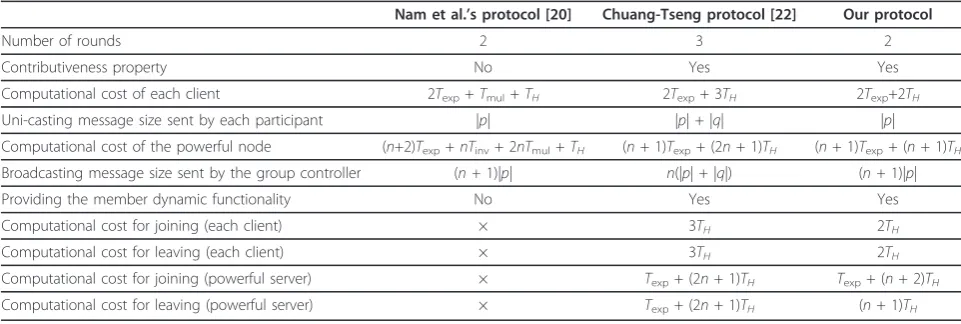
In Table 1, we demonstrate the comparisons between our GKE protocol and the recently proposed GKE pro-tocols [20,22] in terms of the number of rounds, the computational cost and the communication complexity required for each client, the powerful node, and the dynamic member joining/leaving, respectively. It is easy to see that the performance of our GKE protocol is
bet-ter than Nam et al.’s [20] and the Chuang-Tseng [22]
GKE protocols. Meanwhile, our GKE protocol also pro-vides the member dynamic joining/leaving functionality and satisfies contributiveness.
Since Nam et al.’s protocol [20], the Chuang-Tseng
protocol [22], and our proposed protocol are non-authenticated GKE ones, they must rely on an authen-ticated channel or apply other schemes to provide authentication like the Katz-Yung complier [12].
Table 1 Comparisons between our protocol and the recently proposed protocols
Nam et al.’s protocol [20] Chuang-Tseng protocol [22] Our protocol
Number of rounds 2 3 2
Contributiveness property No Yes Yes
Computational cost of each client 2Texp+Tmul+TH 2Texp+ 3TH 2Texp+2TH
Uni-casting message size sent by each participant |p| |p| + |q| |p|
Computational cost of the powerful node (n+2)Texp+nTinv+ 2nTmul+TH (n+ 1)Texp+ (2n+ 1)TH (n+ 1)Texp+ (n+ 1)TH
Broadcasting message size sent by the group controller (n +1)|p| n(|p| + |q|) (n +1)|p|
Providing the member dynamic functionality No Yes Yes
Computational cost for joining (each client) × 3TH 2TH
Computational cost for leaving (each client) × 3TH 2TH
Computational cost for joining (powerful server) × Texp+ (2n+ 1)TH Texp+ (n+ 2)TH
Using their complier into a non-authenticated GKE protocol, the protocol can be transformed into an authenticated GKE. Nevertheless, it will additionally
increase a new round, one signature generation, and n
- 1 signature verifications for each client. Thus, the computational cost is too expensive for each mobile client. The other option is that each client needs not to authenticate the other clients. It only authenticates the powerful node. Certainly, the powerful node must be trusted. Then, it requires single signature genera-tion and verificagenera-tion for each client. Naturally, the powerful server will additionally add one signature
generation and n - 1 signature verifications.
Fortu-nately, some known wireless network environment such as cellular mobile networks [3] and wireless local area networks [1], these clients must be authenticated before they want to connect to their network systems. In addition, the powerful node may apply some exist-ing authentication protocols [23-25] to authenticate the mobile client in advance.
Conclusions
In this article, we have proposed a new dynamic GKE protocol for wireless network environments. Under the decision Hellman (DDH), the computation Diffie-Hellman (CDH), and the hash function assumptions, we have proven that the proposed protocol is secure against passive attacks and provides forward/backward secrecy for member joining/leaving. Meanwhile, we have proven that the proposed protocol satisfies contributiveness. As compared with the recently presented GKE protocols, we have demonstrated that our protocol provides better performance in terms of computational cost, round number, and communication cost.
List of Abbreviations
CDH: computation Diffie-Hellman; DDH: decision Diffie-Hellman; GKE: group key exchange; PDA: personal digital assistant.
Acknowledgements
This research was partially supported by National Science Council, Taiwan, ROC, under contract no. NSC97-2221-E-018-010-MY3.
Competing interests
The authors declare that they have no competing interests.
Received: 1 December 2010 Accepted: 14 June 2011 Published: 14 June 2011
References
1. ANSI/IEEE. Wireless LAN media access control (MAC) and physical layer (PHY) specifications. ANSI/IEEE Std, (1999) 802.11: 1999 (E) Part 11, ISO/IEC 8802-11
2. C Perkins,Ad Hoc Networking. (Addison-Wesley, MA, 2001)
3. GPRS, General packet radio services (GPRS) service description (stage 2). (2002) TS 122 060, ETSI
4. I Akyildiz, W Su, Y Sankarasubramaniam, E Cayirci, A survey on sensor networks. IEEE Commun, Mag.40(8):102–114 (2002). doi:10.1109/ MCOM.2002.1024422
5. T Phan, L Huang, C Dulan, Challenge: integrating mobile wireless devices into the computational grid. Proceedings of MOBICOM’02. 271–278 (2002) 6. H Yang, H Luo, F Ye, S Lu, L Zhang, Security in mobile ad hoc networks:
challenges and solutions. IEEE Wireless Commun.11(1):38–47 (2004). doi:10.1109/MWC.2004.1269716
7. I Ingemaresson, TD Tang, CK Wong, A conference key distribution system. IEEE Trans Inform Theory.28(5):714–720 (1982). doi:10.1109/
TIT.1982.1056542
8. W Diffie, ME Hellman, New directions in cryptography. IEEE Trans. Inform. Theory.22(6):644–654 (1976)
9. E Bresson, M Manulis, Contributory group key exchange in the presence of malicious participants. IET Inform Security.2(3):85–93 (2008). doi:10.1049/iet-ifs:20070113
10. M Burmester, Y Desmedt, A secure and efficient conference key distribution system.Inform. Process. Lett.94(3):137–143 (2005)
11. J Katz, JS Shin, Modeling insider attacks on group key exchange protocols. Proceedings of CCS’05. 180–189 (2005)
12. J Katz, M Yung, Scalable protocols for authenticated group key exchange. J Crypt.20, 85–113 (2007). doi:10.1007/s00145-006-0361-5
13. YM Tseng, A robust multi-party key agreement protocol resistant to malicious participants. Comput J.48(4):480–487 (2005). doi:10.1093/comjnl/ bxh111
14. G Ateniese, M Steiner, G Tsudik, New multiparty authentication services and key agreement protocols. IEEE J Select Areas Commun.18(4):628–639 (2000). doi:10.1109/49.839937
15. E Bresson, O Chevassut, D Pointcheval, Dynamic group Diffie-Hellman key exchange under standard assumptions. Proceedings of EUROCRYPT’02 321–336 (2002). LNCS 2332
16. M Steiner, G Tsudik, M Waidner, Diffie-Hellman key distribution extended to group communication. Proceedings of CCS’96. 31–37 (1996)
17. M Steiner, G Tsudik, M Waidner, Key agreement in dynamic peer groups. IEEE Trans. Parallel Distribut. Syst.11(8):769–780 (2000)
18. C Boyd, G Nieto, Round-optimal contributory conference key agreement. Proceedings of PKC’03 161–174 (2003). LNCS 2567
19. E Bresson, O Chevassut, A Essiari, D Pointcheval, Multual authentication and group key agreement for low-power mobile devices. Comput. Commun.
27(7):1730–1737 (2004)
20. J Nam, J Lee, S Kim, D Won, DDH-based group key agreement in a mobile environment. J Syst Softw.78(1):73–83 (2005)
21. YM Tseng, A resource-constrained group key agreement protocol for imbalanced wireless networks. Comput Security.26(4):331–337 (2007). doi:10.1016/j.cose.2006.12.001
22. YH Chuang, YM Tseng, An efficient dynamic group key agreement protocol for imbalanced wireless networks. Int J Netw Manage.20(4):167–180 (2010) 23. J Arkko, H Haverinen, EAP AKA authentication.
Draft-Arkko-Pppext-Eap-Aka-11, IETF. (2003)
24. YM Tseng, GPRS/UMTS-aided authentication protocol for wireless LANs. IEE Proc Commun.153(6):810–817 (2006). doi:10.1049/ip-com:20050366 25. YM Tseng, USIM-based EAP-TLS authentication protocol for wireless local
area networks. Comput Stand Interfaces.31(1):128–136 (2009). doi:10.1016/j. csi.2007.11.014
26. D Boneh, The decision Diffie-Hellman problem. Proceedings of 3rd Algorithmic Number Theory Symposium. 48–63 (1998)
27. V Shoup, Lower bounds for discrete logarithms and related problems. Proceedings of Advances in Cryptology - Eurocrypt’97. 256–266 (1997) 28. NIST/NSA FIPS 180-2,Secure Hash Standard (SHS). (NIST/NSA, Gaithersburg,
MD, 2005)
doi:10.1186/1687-1499-2011-12