R E V I E W
Open Access
Output feedback stabilization of nonlinear
discrete-time systems with time-delay
Yali Dong
*and Jun Wei
* Correspondence: [email protected]. com
School of Science, Tianjin Polytechnic University, Tianjin 300387, China
Abstract
This article considers both the static output feedback stabilization issue and output-feedback guaranteed cost controller design of a class of discrete-time nonlinear systems with time-delay. First, by static output feedback controller, the new sufficient conditions for static output feedback stabilization of a class of discrete-time nonlinear systems with time-delay are presented. Then, we establish the new
delay-independent sufficient conditions for existence of the guaranteed cost control by static output-feedback controller in terms of matrix inequalities. Finally, two examples are given to show the effectiveness of our proposed approaches.
2000 MSC93D15; 93C55; 34K20; 34D23.
1. Introduction
Time delay exists commonly in dynamic systems due to measurement, transmission and transport lags, computational delays, or unmodeled inertia of system components, which has been generally regarded as a main source of instability and poor perfor-mance. Therefore, considerable attention has been devoted to the problem of analysis and synthesis for time-delayed systems, and many research results have been reported in the literature. To mention a few, the stability analysis result is reported in [1,2], the stabilization problem for switched nonlinear time-delay systems is solved in [3], and the model filtering problems are solved in [4], and the design problem of a hybrid out-put feedback controller is also considered in [5].
The static output feedback problem for linear and nonlinear systems is an important problem not yet completely solved and continuously investigated by many people. In prac-tice, it is not always possible to have full access to the state vector and only the partial information through a measured output is available. Introducing all of the results is not easy because there exist various unconnected approaches. However, among the proposed results, we can distinguish stability conditions expressed in terms of linear matrix inequal-ities for discrete-time switched linear systems with average dwell time [6], constructive approaches based on the resolution of Riccati equations [7], linear matrix inequality approach to static output-feedback stabilization of discrete-time networked control sys-tems [8] or optimization techniques [9,10], pole or eigenstructure assignment techniques [11,12].
Recently, much effort has been directed towards finding a feedback controller in order to guarantee robust stability, see [13,14]. On the other hand, when controlling a real plant, it is also desirable to design a control systems which is not only
asymptotically stable, but also guarantees an adequate level of performance index. One way to address the robust performance problem is to consider a linear quadratic cost function. This approach is the so-called guaranteed cost control [15,16]. In recent years, with the development of robust control theory andH∞control theory, the robust guaranteed cost control approach to the design of state feedback control laws for uncertain systems has been a subject of intensive research [17]. Quadratic guaranteed cost control for linear systems with norm-bounded uncertainty was dealt with in [18]. However, all this research has been done on uncertain system without time delay or continuous-time delay systems. Little attention has been paid towards discrete-time systems with delay.
This article is concerned with both the static output feedback stabilization and out-put-feedback guaranteed cost controller design for a class of discrete-time nonlinear systems with time-delay. The new sufficient conditions for static output feedback stabi-lization of a class of discrete-time nonlinear systems with time-delay are presented. Then, sufficient LMI conditions for guaranteed cost control by static output feedback are given. Finally, examples are given to show the effectiveness of our proposed approaches.
The rest of the article is organized as follows. In Section 2, we present the main results concerning the static output feedback stabilization problem for a class of non-linear discrete-time systems with time-delay. In Section 3, we deal with the problem of guaranteed cost control via static output feedback for a class of nonlinear discrete-time systems with time-delay. Two numerical examples are given in Section 4 to illustrate the proposed results. Finally, we draw some conclusions in Section 5.
The following notations will be used throughout this article. Ris the set of all real numbers.Z+is the set of all non-negative integers.Z+ is the set of all positive integers.
Rndenotes then-dimensional Euclidean space.Rn×m is the set of all (n×m)-dimensional real matrices. Idenotes an identity matrix with appropriate dimension. The superscript
‘T’represents the matrix transposition. If a matrix is invertible, the superscript ‘-1’ represents the matrix inverse. X> 0(X ≥0) means thatXis a real symmetric and posi-tive-definite (semi-definite) matrix. The notation ||·|| refers to the Euclidean norm. For
an arbitrary matrix Band two symmetric matricesAandC, the symmetric term in a
symmetric matrix is denoted by an asterisk, i.e.,
A B
∗C
=
A B BTC
.
2. Static output feedback
Consider the following nonlinear discrete-time systems with time-delay described by
xk+1=Axk+Adxk−d+Buk+f(xk) +g(xk−d), xk=φk, −d≤k≤0,
yk=Cxk+Cdxk−d,
(2:1)
where xkÎRnis the system state;ukÎRm is the input,ykÎRpis the measured output;
∂f(xk)
∂xk ∈
CoF1,F2,. . .,Fv1
, ∂g(xk−d)
∂xk−d ∈
CoT1,T2,. . .,Tv2
, (2:2)
where the symbol “Co” stands for the convex hull, (Fi)1≤i≤v1 and (Ti)1≤i≤v2 are the
associated convex hull matrices. We say that the Jacobian ∂f(xk) ∂xk
belongs to a convex
polytopic set defined as
1=
1(β1) = v1
i=1
β1iFi, v1
i=1
β1i= 1,β1i≥0
, (2:3)
and ∂g(xk−d) ∂xk−d
belongs to a convex polytopic set defined as
2=
2(β2) = v2
i=1
β2iTi, v2
i=1
β2i= 1,β2i≥0
. (2:4)
Our first objective is to give sufficient linear matrix inequality conditions for stabili-zation of system (2.1) by a static output controller uk=KykWe introduce the following key lemmas which will be used in setting the proofs of the next statements.
Lemma 2.1[19]. Given the matricesX, Y, andZ of appropriate dimensions whereX =XT>0, andZ=ZT>0, then the following linear matrix inequality holds:
−X YT Y −Z−1
<0,
if there exists a positive constant asuch that
⎛ ⎝−X αY
T 0
αY −2αI Z
0 Z −Z
⎞ ⎠<0.
Lemma 2.2 [20]. For any pair of symmetric positive definite constant matrixGÎRn×n and scalar r>0, if there exists a vector function [0,r]®Rn such that integrals
r
0 ϕ
T(s)Gϕ(s)ds and r
0 ϕ
(s)ds are well definite, then the following inequality holds:
r r
0
ϕT(s)Gϕ(s)ds≥ r 0
ϕ(s)ds T
G r
0
ϕ(s)ds
.
Theorem 2.3. System (2.1) satisfying (2.3) and (2.4) is globally asymptotically stable under the action of the static output feedback uk=
˜
Kαyk provided that there exist
a scalar a>0, and a real matrix K˜, and positive definite matricesP > 0 andQ> 0 such that the following linear matrix inequalities hold:
⎛ ⎜ ⎜ ⎝
Q−P 0 α(AT+ 2FTi) +CTK˜TBT 0
0 −Q αAT
d+CTdK˜TBT 0 α(A+ 2Fi) +BKC˜ αAd+BKC˜ d −2αI P
0 0 P −P
⎞ ⎟ ⎟
⎠<0, 1≤i≤v1,
⎛ ⎜ ⎜ ⎝
Q−P 0 αAT+CTK˜TBT 0 0 −Q α(AT
d+ 2TiT) +CTdK˜TBT 0 αA+BKC˜ α(Ad+ 2Ti) +BKC˜ d −2αI P
0 0 P −P
⎞ ⎟ ⎟
⎠<0, 1≤i≤v2,
where v1 andv2 are the numbers of the convex hull matrices of the Jacobian off(xk) and g(xk), respectively.
Proof. Consider the discrete-time nonlinear-time system (2.1) under the action of the
feedback uk =Kyk. Using the mean-value theorem, the closed-loop dynamics can be
written as
Choosing the Lyapunov-Krasovskii functional candidate as
Vk=xTkPxk+
Using Lemma 2.2, we have
Vk+1−Vk≤
Then, we can write thatVk+1-Vk<0, if the following holds
which is equivalent by the Schur complement lemma to the following matrix
are norm-bounded and continuous for all kÎZ+ and all
the matrices involved in (2.9) are real, then the integration in (2.9) is well defined. Using the fact that
⎛
after replacing the Jacobian matrix by its convex hull matrices, sufficient conditions for fulfilling (2.9) are
(2.11) is equivalent to
⎛
⎝(Q−P) 0
AT+CTKTBT+ 2FT i ∗ −Q AT
d+CTdKTBT
∗ ∗ −P−1
⎞
⎠<0, 1≤i≤v1,
⎛
⎝(Q−P) 0
AT+CTKTBT ∗ −QAT
d+CTdKTBT
+ 2TT i
∗ ∗ −P−1
⎞
⎠<0, 1≤i≤v2.
(2:12)
Then, from the result of Lemma 2.1, we can get (2.12) are satisfied if conditions (2.5) are verified. This ends the proof.
Similar to the proof of Theorem 2.3, we can easily get the following corollary for sys-tem (2.1).
Corollary 2.4. Consider system (2.1) withg(xk-d)=0 System (2.1) satisfying (2.3) is globally asymptotically stable under the action of the static output feedback
uk=
˜
K
αyk provided that there exist a scalara> 0 and a real matrix K˜, and positive
definite matricesP> 0 andQ> 0 such that the following linear matrix inequalities hold:
⎛ ⎜ ⎜ ⎝
Q−P 0 α(AT+FT
i) +CTK˜TBT 0
0 −Q αAT
d+C T dK˜
TBT 0
α(A+Fi) +BKC˜ αAd+BKC˜ d −2αI P
0 0 P −P
⎞ ⎟ ⎟
⎠<0, 1≤i≤v1, (2:13)
Remark 2.5. In [21], the stabilization problem for a class of discrete-time linear sys-tems with time-delay is investigated by state feedback. But, the state vector is not often available for feedback. In this article, the static output feedback is used and the system is nonlinear. Compare to [21], the results obtained in this article have a greater range of applications.
3. Guaranteed cost control via static output feedback
In this section, we consider the optimal control problem of system (2.1) under the feedback uk=KykOur objective is to find the gainKsuch that for all initial conditions
jkÎRn,-d≤k≤0
J∞= ∞
k=0
xTkUxk+uTkRuk
<xT0Px0+ d
i=1
(xT−iQx−i), (3:1)
whereU =UT ≥ 0 andR=RT> 0 are some prescribed real matrices and P=PT,Q =QTare positive definite matrices to be determined.
Theorem 3.1. Consider the system (2.1) and let UT ≥ 0, andR =RT > 0 be given symmetric real matrices. If there exist scalarsa1> 0 and a2 > 0, and a matrix K, and symmetric and positive definite matrices P > 0 and Q > 0 such that the following matrix inequalities hold:
⎛ ⎜ ⎜ ⎝
Q−P+U+CTKTRKC CTKTRKC
d α1(AT+CTKTBT+ 2FiT) 0
CT
dKTRKC −Q+CTdKTRKCd α1(ATd+CTdKTBT) 0
α1(A+BKC+ 2Fi) α1(Ad+BKCd) −2α1I P
0 0 P −P
⎞ ⎟ ⎟
⎠<0, 1≤i≤v1,
⎛ ⎜ ⎜ ⎝
Q−P+U+CTKTRKC CTKTRKC
d α2(AT+CTKTBT) 0
CT
dKTRKC −Q+CTdKTRKCd α2(ATd+CTdKTBT+ 2TTi) 0
α2(A+BKC) α2(Ad+BKCd+ 2Ti) −2α2I P
0 0 P −P
⎞ ⎟ ⎟
⎠<0, 1≤i≤v2,
then system (2.1) is asymptotically stable under the static output feedbackuk=Kyk,
Proof. Choose the Lyapunov-Krasovskii functional candidate as
Vk=xTkPxk+ d
i=1
(xTk−iQxk−i).
For a given natural numberN, we have
HN=
This implies that if
⎛
is verified then the static output feedback uk =Kyk minimizes the criterion (3.1). From result of Lemma 2.1, we can get that (3.3) are satisfied if conditions (3.2) are ver-ified. So, we get
J∞=
This ends the proof.
⎛
then system (2.1) is asymptotically stable under the static output feedback uk=Kyk, and
Proof. By Theorem 3.1 and the Schur complement lemma, the condition of the cor-ollary follows readily.
Remark 3.3. The study [19] considered the static output feedback and guaranteed cost control for a class of discrete-time nonlinear systems. But, the time-delay system did not deal with in [19]. In this article, we investigated the static output feedback sta-bilization and output-feedback guaranteed cost controller design for a class of discrete-time nonlinear systems with discrete-time-delay. So, the results obtained in this article have a greater range of applications.
4. Illustrative examples
Example 1. Consider the following system
xk+1=
One can easily verify that the vertices of the Jacobian of the system nonlinearity are
Let K = 1
αK˜ = 1, α= 0.01, d= 1 After solving the LMIs (2.5) with respect to their variables, we find
P= ⎛
⎝0.0002 0.01600.0102 0.0002 00
0 0 0.0153
⎞ ⎠, Q=
⎛
⎝0.00500 0.01210 00
0 0 0.0085
⎞ ⎠.
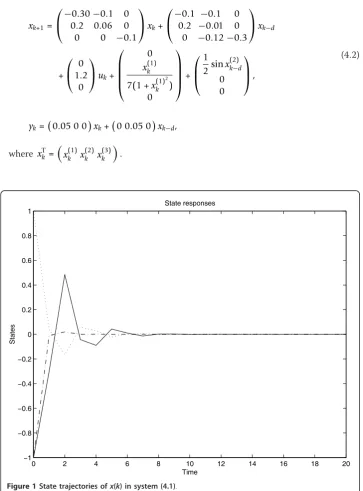
Under the action of the static output feedback, uk=yk, the state response of closed-loop system (4.1) with x(-1) = (1 -1 1)T, x(0) = (-1 1 -1)T is shown in Figure 1, from which one can see that the state vector is globally asymptotically stable.
Example 2. Consider the following system
xk+1= ⎛
⎝−0.20.30−0.060.1 00
0 0 −0.1
⎞ ⎠xk+
⎛
⎝−0.20.1−−0.010.1 00 0 −0.12−0.3
⎞ ⎠xk−d
+ ⎛ ⎝1.20
0 ⎞ ⎠uk+
⎛ ⎜ ⎜ ⎜ ⎝
0 x(1)k
7(1 +x(1) 2
k ) 0
⎞ ⎟ ⎟ ⎟ ⎠+
⎛ ⎜ ⎝ 1 2sinx
(2) k−d 0 0
⎞ ⎟ ⎠,
(4:2)
yk=
0.05 0 0xk+
0 0.05 0xk−d,
where xTk =x(1)k x(2)k x(3)k
.
0 2 4 6 8 10 12 14 16 18 20
−1 −0.8 −0.6 −0.4 −0.2 0 0.2 0.4 0.6 0.8 1
Time
States
State responses
One can easily verify that the vertices of the Jacobian of the system nonlinearity are
F1=
⎛
⎝−1056 0 00 0
0 0 0
⎞ ⎠, F2=
⎛ ⎝10 0 07 0 0
0 0 0
⎞ ⎠, T1=
⎛
⎝00−102 00
0 0 0
⎞ ⎠, T2=
⎛ ⎝0 10 0 02 0
0 0 0
⎞ ⎠.
Let
α1= 4, α2= 4, R= 5, U= ⎛
⎝1.5 0.20.2 2 −20.6 2 −0.6 5
⎞
⎠. (4:3)
Using LMI Toolbox for (3.4), it is computed that there is a feasible solution and one set of feasible solution is given by
P=
⎛
⎝6.8449 0.6611 0.26780.6611 6.2166 0.2628 0.2678 0.2628 7.0728
⎞ ⎠, Q=
⎛
⎝ 2.3875 0.1161 - 0.99520.1161 2.5594 0.6901 - 0.9952 0.6901 1.5301
⎞
⎠, K= 1.1517. (4:4)
According to Corollary 3.2, then system (4.2) is asymptotically stable under the static output feedbackuk= 1.1517yk, and
J∞= ∞
k=0
xTkUxk+uTkRuk
<xT0Px0+ d
i=1
(xT−iQx−i),
for all initial conditions jkÎRn,-d≤ k≤ 0, whereU, R,P, andQare given by (4.3) and (4.4).
5. Conclusion
Both the problems of the static output feedback stabilization and output-feedback guaranteed cost controller design for a class of discrete-time nonlinear systems with time-delay are investigated in this article. The new static output feedback stabilization conditions are proposed, which are independent of the time delay. We develop a quad-ratic guaranteed cost control method for stabilization via static output feedback. Two numerical examples are provided to show the applicability of the developed results.
Acknowledgements
This study was supported by the Natural Science Foundation of Tianjin under Grant 11JCYBJC06800.
Authors’contributions
YD carried out the main part of this manuscript. JW participated discussion and gave the examples. All authors read and approved the final manuscript.
Competing interests
The authors declare that they have no competing interests
Received: 24 December 2011 Accepted: 31 May 2012 Published: 31 May 2012
References
1. Dong, Y, Mei, S, Wang, X: Novel stability criteria of nonlinear uncertain systems with time-varying delay. Abst Appl Anal. 2011, 1–16 (2011)
2. Dong, Y: Robust stability analysis for uncertain switched discrete-time systems. J Appl Math.2011, 1–20 (2011) 3. Dong, Y, Liu, J, Mei, S, Li, M: Stabilization for switched nonlinear time-delay systems. Nonlinear Anal: Hybrid Syst.5,
78–88 (2011). doi:10.1016/j.nahs.2010.09.001
4. Gao, H, Wang, C: Robust L2-L1 filtering for uncertain systems with multiple time-varying state delays. IEEE Trans Circ Syst (I).50(4), 594–599 (2003). doi:10.1109/TCSI.2003.809816
6. Ding, DW, Yang, GH:H∞static output feedback control for discrete-time switched linear systems with average dwell time. IET Control Theory Appl.4, 381–390 (2010). doi:10.1049/iet-cta.2008.0481
7. Kucera, V, De Souza, C: A necessary and sufficient condition for output feedback stabilizability. Automatica.10, 1357–1359 (1995)
8. Hao, F, Zhao, X: Linear matrix inequality approach to static output-feedback stabilisation of discrete-time networked control systems. IET Control Theory Appl.4, 1211–1221 (2010). doi:10.1049/iet-cta.2009.0164
9. Fujimori, A: Optimization of static output feedback using substitutive LMI formulation. IEEE Trans Autom Control.49, 995–999 (2004). doi:10.1109/TAC.2004.829633
10. Ghaoui, LE, Oustry, F, AitRami, M: A cone complementarity linearization algorithm for static output feedback and related problems. IEEE Trans Autom Control.42, 1171–1176 (1997). doi:10.1109/9.618250
11. Kabamba, P, Longman, R: Exact pole assignment using direct and dynamic output feedback. IEEE Trans Autom Control. 27, 1244–1246 (1982). doi:10.1109/TAC.1982.1103105
12. Syrmos, V, Lewis, F: Output feedback eigenstructure assignment using two Sylvester equations. IEEE Trans Autom Control.38, 495–499 (1993). doi:10.1109/9.210155
13. Ho, W, Chen, S, Liu, T, Chou, J: Design of robust-optimal output feedback controllers for linear, uncertain systems using LMI-based approach and genetic algorithm. Inf Sci.180, 4529–4542 (2010). doi:10.1016/j.ins.2010.08.004
14. Park, JH: Robust stabilization for dynamic systems with multiple time-varying delays and nonlinear uncertainties. J Optim Theory Appl.108, 155–174 (2001). doi:10.1023/A:1026470106976
15. Yang, D, Cai, K: Reliable guaranteed cost sampling control for nonlinear time-delay systems. Math Comput Simul.80, 2005–2018 (2010). doi:10.1016/j.matcom.2010.03.004
16. Yoneyama, J: Robust guaranteed cost control of uncertain fuzzy systems under time-varying sampling. Appl Soft Comput.11, 249–255 (2011). doi:10.1016/j.asoc.2009.11.015
17. Moheimani, SOR, Petersen, IR: Optimal quadratic guaranteed cost control of a class of uncertain time-delay systems. IEE Proc Control Theory Appl.144(2), 183–188 (1997). doi:10.1049/ip-cta:19970844
18. Moheimani, SOR, Petersen, IR: Quadratic guaranteed cost control with robust pole placement in a disc. IEE Proc Control Theory Appl.143, 37–43 (1996). doi:10.1049/ip-cta:19960058
19. Ibrir, S: Static output feedback and guaranteed cost control of a class of discrete-time nonlinear systems with partial state measurements. Nonlinear Anal.68, 1784–1792 (2008). doi:10.1016/j.na.2007.01.011
20. Lirong, H, Xuerong, M: Robust delayed-state-feedback stabilization of uncertain stochastic systems. Automatica.45, 1332–1339 (2009). doi:10.1016/j.automatica.2009.01.004
21. Liu, Z, Lü, S, Zhong, S, Ye, M: Stabilization analysis for discrete-time systems with time delay. Appl Math Comput.216, 2024–2035 (2010). doi:10.1016/j.amc.2010.03.033
doi:10.1186/1687-1847-2012-73
Cite this article as:Dong and Wei:Output feedback stabilization of nonlinear discrete-time systems with
time-delay.Advances in Difference Equations20122012:73.
Submit your manuscript to a
journal and benefi t from:
7 Convenient online submission 7 Rigorous peer review
7 Immediate publication on acceptance 7 Open access: articles freely available online 7 High visibility within the fi eld
7 Retaining the copyright to your article