
R E S E A R C H
Open Access
LMI-based robust exponential stability
criterion of impulsive integro-differential
equations with uncertain parameters via
contraction mapping theory
Ruofeng Rao
1*, Shouming Zhong
2and Zhilin Pu
3*Correspondence: [email protected] 1Department of Mathematics, Chengdu Normal University, Chengdu, 61130, China Full list of author information is available at the end of the article
Abstract
By formulating a new contraction mapping on a product space, the authors originally employed Banach fixed point theorem to derive the LMI-based robust exponential stability criterion for impulsive BAM neural networks with distributed delays and uncertain parameters. Numerical example illuminates that the new criterion is not worse than the existing results derived by Lyapunov functional method. Hence both the methods and the results of this paper are really novel to a certain extent.
Keywords: contraction mapping theory; integro-differential equations; impulsive BAM neural networks; robust exponential stability; parameters uncertainty
1 Introduction
In [], Kosko proposed originally the time-delay differential equations as follows:
dxi(t)
dt = –aixi(t) +
n
j=cijfj(yj(t–τj)) +Ii, dyi(t)
dt = –biyi(t) +
n
j=dijgj(xj(t–ρj)) +Ji,
i= , , . . . ,n,t> , (.)
which belongs to the so-called bidirectional associative memory (BAM) neural networks. Here, the parametersai> ,bi> denote the time scales of the respective layers of the network. The first term in each of the right sides of system (.) corresponds to a stabiliz-ing negative feedback of the system which acts instantaneously without time delay. These terms are known as forgetting or leakage terms [, ]. Since then, various generalized BAM neural networks have become a hot research topic due to their potential applications in associative memory, parallel computation, artificial intelligence, and signal and image pro-cesses [, ]. However, the above successful applications often depend on whether the system has a certain stability, and the robust stability always plays an important role. In recent decades, stability analyses of neural networks have attracted the attention of many
researchers (seee.g.[–]). The Lyapunov function method was always employed in the
existing literature to obtain stability criteria. But any method has its limitations. As one of the alternative methods, fixed point theorems played positive roles in the stability analysis
of BAM neural networks (seee.g.[, ]). Some stability criteria of BAM neural networks
without impulse were derived by fixed point theorems. But the impulsive model of BAM neural networks has rarely been investigated. Besides, there are a lot of other factors and problems in practical engineering. In fact, there exist parameter errors unavoidable in factual systems due to aging of electronic components, external disturbance, and param-eter perturbations. It is very important to ensure that the system is stable with respect to these uncertainties. So, in this paper, the contraction mapping principle and linear matrix inequalities (LMIs) technique are applied to generate the LMI-based exponential robust stability criterion for the impulsive BAM neural networks model with distributed delays and uncertain parameters. Finally, a numerical example and two comparable tables are presented to show the novelty and effectiveness of the derived result.
For the sake of convenience, we introduce the following standard notations.
• L= (lij)n×n> (< ): a positive (negative) definite matrix,i.e.,yTLy> (< ) for any =y∈Rn.
• L= (lij)n×n≥(≤): a semi-positive (semi-negative) definite matrix,i.e., yTLy≥(≤)for anyy∈Rn.
• L∈[–L∗,L∗]implies that|lij| ≤l∗ijfor alli,jwithL= (lij)n×nandL∗= (l∗ij)n×n. • L≥L(L≤L): this means matrix(L–L)is a semi-positive (semi-negative)
definite matrix.
• L>L(L<L): this means matrix(L–L)is a positive (negative) definite matrix. • λmax(),λmin()denotes the largest and smallest eigenvalue of matrix, respective. • Denote|L|= (|lij|)n×nfor any matrixL= (lij)n×n.
• |u|= (|u|,|u|, . . . ,|un|)Tfor any vectoru= (u,u, . . . ,un)T∈Rn.
• u≤(≥)vimplies thatui≤(≥)vi,∀i, andu< (>)vimplies thatui< (>)vi,∀i, for any vectorsu= (u,u, . . . ,un)T∈Rnandv= (v,v, . . . ,vn)T∈Rn.
• I: the identity matrix with compatible dimension. • Denote vectorμ= (, , . . . , )T∈Rn.
Remark The main purpose of this paper is to obtain the LMI-based robust stability criteria of BAM neural networks with uncertain parameters by using the Banach fixed point theorem. To overcome mathematical difficulties, it is necessary to formulate a novel contraction mapping. Therefore, the following main task is to construct a new contraction mapping on the space suitable, and prove that the fixed point of this mapping is the robust stability solution of the BAM neural network.
2 Preliminaries
The physical background of the following integro-differential equations is in the BAM
neural networks (seee.g.[, ]):
⎧ ⎪ ⎪ ⎪ ⎪ ⎪ ⎪ ⎨ ⎪ ⎪ ⎪ ⎪ ⎪ ⎪ ⎩
dx(t)
dt = –(A+A(t))x(t) + (C+C(t))f(y(t))
+ (M+M(t))tt–τ(t)f(y(s))ds, t≥,t=tk, dy(t)
dt = –(B+B(t))y(t) + (D+D(t))g(x(t))
+ (W+W(t))tt–ρ(t)g(x(s))ds, t≥,t=tk, x(t+
k) –x(t–k) =φ(x(tk)), y(tk+) –y(tk–) =ϕ(y(tk)), k= , , . . . ,
(.)
with the initial condition
wherex= (x,x, . . . ,xn),y= (y,y, . . . ,yn)∈Rnwithxi(t),yj(t) being the state variables of the ith neuron and thejth neuron at timet, respectively. Alsof(x) = (f(x(t)),f(x(t)),
. . . ,fn(xn(t)))T, g(x) = (g(x(t)),g(x(t)), . . . ,gn(xn(t)))T ∈Rn are the neuron active func-tions. BothA=diag(a,a, . . . ,an) andB=diag(b,b, . . . ,bn) are (n×n)-dimension
posi-tive definite matrices withaiandbjdenoting the rate with which theith neuron and the
jth neuron will reset their potential to the resting state in isolation when disconnected
from the networks and the external inputs, respectively.CandDdenote the connection
weight matrices with (n×n) dimensions.MandWare the distributively delayed
connec-tion weight matrices with (n×n) dimensions. The parameter uncertainties considered
here are norm-bounded and of the following forms:
A(t)∈[–A∗,A∗], B(t)∈[–B∗,B∗], C(t)∈[–C∗,C∗],
D(t)∈[–D∗,D∗], M(t)∈[–M∗,M∗], W(t)∈[–W∗,W∗],
(.)
whereA∗,B∗,C∗,D∗,M∗,W∗all are nonnegative matrices.
Assume, in addition, distributed delaysτ(t),ρ(t)∈[,τ]. The fixed impulsive moments
tk(k=, , , . . .) satisfy <t<t<· · · withlimk→+∞tk= +∞.x(tk+) andx(tk–) stand for the right-hand and left-hand limit ofx(t) at timetk, respectively. Further, suppose that
x tk–= lim t→t– k
x(t) =x(tk), yt–k
= lim
t→t– k
y(t) =y(tk), k= , , . . . . (.)
Throughout this paper, we assume that f() =g() =φ() =ϕ() = ∈Rn, andF=
diag(F,F, . . . ,Fn), G=diag(G,G, . . . ,Gn), H=diag(H,H, . . . ,Hn), and H=diag(H,
H, . . . ,Hn) are positive definite diagonal matrices, satisfying (H) |f(x) –f(y)| ≤F|x–y|,x,y∈Rn;
(H) |g(x) –g(y)| ≤G|x–y|,x,y∈Rn; (H) |φ(x) –φ(y)| ≤H|x–y|,x,y∈Rn; (H) |ϕ(x) –ϕ(y)| ≤H|x–y|,x,y∈Rn;
(H) there exist nonnegative matricesA∗,B∗,C∗,D∗,M∗,W∗, satisfying (.).
Definition . System (.) with initial condition (.) shows globally exponential robust stability in mean square for all admissible uncertainties if for any initial condition ηξ((ss))∈ C([–τ, ],Rn), there exist positive constantsaandbsuch that
x(t;s,ξ,η) y(t;s,ξ,η)
≤be–at, for allt> ,
for all admissible uncertainties in (.), where the norm xy((tt)) = (ni=|xi(t)| +
n
i=|yi(t)|)
, andx= (x, . . . ,xn),y= (y, . . . ,yn)∈Rn.
Lemma .(Contraction mapping theorem []) Let P be a contraction operator on a
complete metric space,then there exists a unique pointθ∈for which P(θ) =θ.
3 Global exponential robust stability via contraction mapping
For convenience, we may denote
Before giving the LMI-based robust stability criterion, we may firstly present the follow-ing fact.
Lemma . The impulsive system(.)with initial condition(.)is equivalent to the
fol-lowing integral equations with initial condition(.):
x(t)
y(t)
=
e–At{ξ() +t e
As[–A(s)x(s) +C
sf(y(s)) +Ms
s
s–τ(s)f(y(r))dr]ds+
<tk<te Atkφ(xt
k)}
e–Bt{η() +t e
Bs[–B(s)x(s) +D
sg(x(s)) +Ws
s
s–ρ(s)g(x(r))dr]ds+
<tk<te Btkϕ(x
tk)}
,
(.)
for all t≥,and x(s) =ξ(s),y(s) =η(s),s∈[–τ, ].
Proof Indeed, we only need to prove that each solution of system (.) with initial
con-dition (.) is a solution of the impulsive system (.) with initial concon-dition (.), and the converse is also true.
On the one hand, suppose that yx((tt))is a solution of (.) with initial condition (.). Then we have
eAtx(t) =ξ() +
t
eAs
–A(s)x(s) +Csf y(s)
+Ms
s
s–τ(s)
f y(r)dr
ds
+
<tk<t
eAtkφ(x
tk).
Fort≥,t=tk, taking the derivative in both sides of the above equation results in
eAtdx(t)
dt +Ae
Atx(t) = d
dt e
Atx(t)=eAt
–A(t)x(t) +Ctf y(t)
+Mt
t
t–τ(t)
f y(r)dr
,
or
dx(t)
dt +Ax(t) = –A(t)x(t) +Ctf y(t)
+Mt
t
t–τ(t)
f y(r)dr,
which is the first equation of system (.). Similarly, we can also derive the second equation of (.).
Moreover, ast→t–
j, we can get by (.)
x tj–= lim
ε→+x(tj–ε) =x(tj), yt
–
j
= lim
ε→+y(tj–ε) =y(tj), j= , , . . . ,
and
x tj+= lim
ε→+x(tj+ε) =x(tj) +φ x(tj)
,
y tj+= lim
ε→+y(tj+ε) =y(tj) +φ y(tj)
, j= , , . . . .
On the other hand, suppose that yx((tt))is a solution of (.) with initial condition (.).
Then multiplying both sides of the first equation of system (.) witheAtresults in
eAtdx(t)
Throughout this paper, we assume thatεis a sufficient small positive number. Now, taking
t=tk–εin (.) one obtains
Combining (.) and the above equation generates
eAtx(t
) =eAtx(t) + t
t
eAs
–A(s)x(s) +Csf y(s)
+Ms
s
s–τ(s)
f y(r)dr
ds
+eAtφ x(t
)
,
eAtx(t
) =φ() + t
eAs
–A(s)x(s) +Csf y(s)
+Ms
s
s–τ(s)
f y(r)dr
ds.
Synthesizing the above analysis results in the first equation of system (.). Similarly, the second equation of system (.) can also be derived by system (.) with initial condition (.). Hence, we have proved that each solution of (.) with initial condition (.) is that
of (.) with initial condition (.). This completes the proof.
Theorem . The impulsive system(.)with initial condition(.)shows globally
ex-ponential robust stability in mean square for all admissible uncertainties if there exists a positive numberα< ,satisfying the following two LMIs conditions:
A∗+ |C|+C∗F+τ |M|+M∗F+
δH+AH–αA< ,
B∗+ |D|+D∗G+τ |W|+W∗G+
δH+BH–αB< ,
whereδ=infk=,,...(tk+–tk) > ,and A∗,B∗,C∗,D∗,M∗,W∗ are real matrices defined in (.).
Proof To apply the contraction mapping theorem, we firstly define the complete metric
space=×as follows.
Leti(i= , ) be the space consisting of functionsqi(t) : [–τ,∞)→Rn, satisfying (a) qi(t)is continuous ont∈[, +∞)\{tk}∞k=;
(b) q(t) =ξ(t),q(t) =η(t), fort∈[–τ, ]; (c) limt→t–
kqi(t) =qi(tk), andlimt→t+kqi(t)exists, for allk= , , . . .;
(d) eγtq
i(t)→∈Rnast→+∞, whereγ> is a positive constant, satisfying
γ <min{λminA,λminB}.
It is not difficult to verify that the product spaceis a complete metric space if it is
equipped with the following metric:
dist(q,q) = max i=,,...,n–,n
sup t≥–τ
q(i)(t) –q(i)(t), (.)
where
q=q(t) =
q(t) q(t)
= q()(t),q()(t), . . . ,q(n)(t)T∈,
q=q(t) =
q(t) q(t)
= q()(t), . . . ,q(n)(t)T∈,
Next, we want to formulate the contraction mappingP:→as follows:
From Lemma ., it is obvious that each fixed point ofP is a solution of system (.)
with initial condition (.), and each solution of system (.) with initial condition (.) is
a fixed point ofP.
Below, we only need to prove that the mappingPdefined as (.)-(.) is truly a
con-traction mapping frominto, which may be divided into two steps.
Step .We claim thatP()⊂. That is, for any xy((tt))∈, we shall prove thatP yx((tt))
satisfies the conditions (a)-(d) of.
Indeed, it follows by the definition ofPthatP yx((tt))satisfies the conditions (a)-(b).
Be-we can conclude directly from (.) that
lim
which implies thatP(·) satisfies the condition (c).
Finally, we verify thatP(·) satisfies the condition (d). In fact, we can conclude from
eγtx(t)→ andeγty(t)→ that, for any givenε> , there exists a corresponding con-stantt∗>τsuch that
Next, we get by (H)
eγte–At
t
eAsCsf y(s)
ds
≤e–(A–γI)t
t∗
eAs|Cs|Fy(s)ds+e–(A–γI)t
t
t∗
eAs|Cs|Fy(s)ds. (.)
On the one hand, the boundedness assumption (.) produces|Cs|μ≤(|C|+C∗)μ, and then
e–(A–γI)t
t∗
eAs|Cs|Fy(s)ds
≤t∗e–(A–γI)teAt∗ |C|+C∗F
max
i
sup s∈[,t∗]
yi(s)μ→∈Rn, t→ ∞. (.)
Remark that the convergence in (.) is in the sense of the metric defined as (.). Below, all the cases of convergence are in the sense of the metric defined as (.), and we need not repeat it anywhere else.
Due to (.), obviously there exists a positive numberasuch that
|Cs|+|Ms|
Fμ≤aμ.
So we have
e–(A–γI)t
t
t∗
eAs|Cs|Fy(s)ds
≤εe–(A–γI)t
t
t∗
e(A–γI)s|C s|Fμds
≤εae–(A–γI)t ⎛ ⎜ ⎜ ⎜ ⎜ ⎜ ⎝
e(a–γ)t
a–γ · · ·
e(aa–γ)t
–γ · · ·
. ..
· · · e(an–γ)t an–γ
⎞ ⎟ ⎟ ⎟ ⎟ ⎟ ⎠ μ
=εa
a–γ
,
a–γ
, . . . , an–γ
T
. (.)
Now, the arbitrariness ofεtogether with (.)-(.) implies that
eγte–At
t
eAsCsf y(s)
ds→∈Rn, t→+∞. (.)
Similarly as the proof of (.), we can prove from (.) that
eγte–At
t
eAs –A(s)x(s)ds→∈Rn, t→+∞. (.)
Further, the definition ofγ gives
Combining (.)-(.) and (.) results in
Similarly, we can prove and obtain
eγte–Bt η() +
In fact, on the one hand,
eγt
Below we shall prove
eγt
which together with the arbitrariness of the positive numberεimplies that
e–At
t∗<tk<t
eAtkφ(x
tk)→∈R
Similarly, we can also obtain
So we have proved (.). Moreover, combining (.)-(.) implies that
where we assumetj<t≤tj+withj= , , , . . . . Here,t= . Hence
whereA–andB–are the inverse matrices ofAandB, respectively.
Therefore,P:→is a contraction mapping such that there exists the fixed point
x(t)
impulsive equations (.)-(.) show globally exponential robust stability in mean square
for all admissible uncertainties.
Remark It is the first time one employs the contraction mapping theory to derive
the LMI-based exponential robust stability criterion for BAM neural networks with dis-tributed delays and parameter uncertainties. So the obtained criterion is novel against existing results (see below Remarks - and Tables and ).
If impulse behaviors are ignored, we can derive the following corollary from Theo-rem ..
Corollary . The following system with initial condition(.)shows globally exponential robust stability in mean square for all admissible uncertainties:
⎧
if there exists a positive numberα< ,satisfying the following two LMIs conditions:
A∗+ |C|+C∗F+τ |M|+M∗F–αA< ,
B∗+ |D|+D∗G+τ |W|+W∗G–αB< ,
where A∗,B∗,C∗,D∗,M∗,W∗are the real matrices defined in(.).
4 Numerical example
Example Equip the impulsive system (.)-(.) with the following parameters:
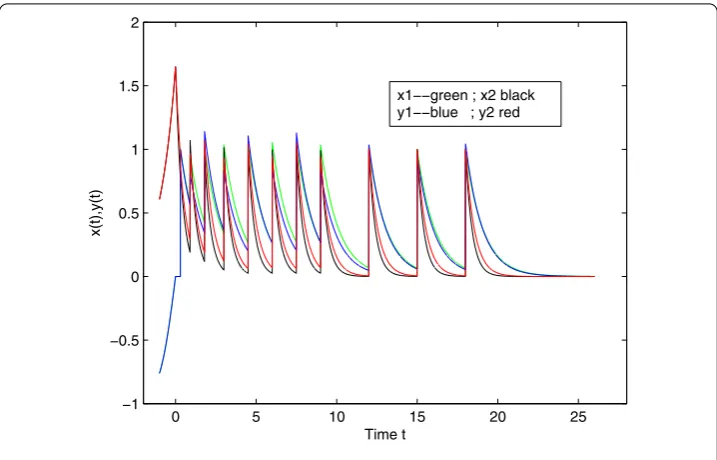
Figure 1 State trajectory of the system for Example 1.
D=
. .
–.
, M=
. –.
. .
,
W=
. –.
. .
, F=
.
.
,
G=
.
.
, H=
.
.
=H,
A∗=
. .
.
, B∗=
.
. .
, C∗=
.
. .
,
D∗=
. .
.
, M∗=
.
. .
, W∗=
. .
.
.
Taket= .,tk=tk–+ .k, andδ= .,τ(t) =ρ(t) =τ = .. Let x(s) =tanhs,x(s) =
es+.,y
(s) = sins,y(s) = cos(s+ .). Then we can use the matlab LMI toolbox to solve
the two LMI conditions in Theorem ., obtaining the following datum feasible:
α= .,
satisfying <α< . Thereby, we can conclude from Theorem . that the impulsive
equa-tions (.)-(.) show globally exponential robust stability in mean square for all admissible uncertainties (see Figure ).
Table 1 Numerical comparison of Theorem 3.2 with [36], Theorem 2, in Example 1
Impulse Distributed delays Upper bound of time-delays
[36], Theorem 2, Example 1 yes yes 1.9 Theorem 3.2, Example 1 yes yes 2.1
Table 2 Comparing our Theorem 3.2 with other existing results about BAM neural networks models
Our Th. 3.2 [37], Th. 4.1 [31], Th. 3.1 [32], Thms. 2-4
[38], Th. 3 [34], Thm. 1
Impulse yes yes no no no no
Distributed delays yes no no no no yes
Parameter uncertainty yes yes no no no no
Using fixed point theory yes no yes yes no no
BAM neural networks model
yes yes yes yes yes yes
Equations type integro-differential
differential differential differential differential integro-differential
LMI-based criterion yes yes no no no yes
Robustness of stability yes yes no no no no
Stability type robust exponential
robust asymptotical
exponential exponential exponential exponential
Remark In Example , our upper bound of time-delaysτ= . while the upper bound of time-delays of [], Example , is ., which implies that our obtained result is close to some of the current good results. For this purpose, below we give another table to verify it.
Remark From Table , we can synthetically analyze the criteria involved to various
mathematical models, main methods, and the effectiveness of the conclusions. In sum-mary, the different methods and models imply that our Theorem . is really novel against existing results.
5 Conclusions
Impulsive uncertain BAM neural networks modeling brings about some mathematical dif-ficulties to the applications of the contraction mapping theorem. Thereby, the contraction mapping theorem has never been employed to derive the robust stability of the impulsive uncertain BAM neural networks before our Theorem .. Moreover, our new criterion can easily be applied to the computer Matlab LMI toolbox. Example illustrates the effec-tiveness and feasibility by using the Matlab LMI toolbox. In addition, Tables and are presented to show the novelty of our Theorem . (see Remarks -).
Competing interests
The authors declare that they have no competing interests.
Authors’ contributions
All authors typed, read, and approved the final manuscript.
Author details
Acknowledgements
All the authors thank the anonymous reviewers for their constructive suggestions and pertinent comments, which actually improve this paper. This work was supported by National Basic Research Program of China (2010CB732501), Scientific Research Fund of Science Technology Department of Sichuan Province (2010JY0057, 2012JY010), Sichuan Educational Committee Science Foundation (08ZB002, 12ZB349, 14ZA0274), and the Initial Founding of Scientific Research for Chengdu Normal university introduction of talents.
Received: 20 August 2016 Accepted: 6 December 2016 References
1. Kosko, B: Adaptive bi-directional associative memories. Appl. Opt.26(23), 4947-4960 (1987) 2. Kosko, B: Neural Networks and Fuzzy Systems. Prentice Hall, New Delhi (1992)
3. Haykin, S: Neural Networks. Prentice Hall, New Jersey (1999)
4. Mathai, G, Upadhyaya, BR: Performance analysis and application of the bidirectional associative memory to industrial spectral signatures. In: Proceedings of the IJCNN, 1989, pp. 33-37 (1989)
5. Liu, B, Huang, L: Global exponential stability of BAM neural networks with recent-history distributed delays and impulses. Neurocomputing69(16-18), 2090-2096 (2006)
6. Song, Q, Zhao, Z, Liu, Y: Impulsive effects on stability of discrete-time complex-valued neural networks with both discrete and distributed time-varying delays. Neurocomputing168(30), 1044-1050 (2015)
7. Zhao, H: Exponential stability and periodic oscillatory of bi-directional associative memory neural network involving delays. Neurocomputing69(4-6), 424-448 (2006)
8. Wang, L, Zhang, Z, Wang, Y: Stochastic exponential stability of the delayed reaction-diffusion recurrent neural networks with Markovian jumping parameters. Phys. Lett. A372(18), 3201-3209 (2008)
9. Li, B, Xu, D: Exponentialp-stability of stochastic recurrent neural networks with mixed delays and Markovian switching. Neurocomputing103, 239-246 (2013)
10. Rao, R, Zhong, S, Pu, Z: On the role of diffusion factors in stability analysis forp-Laplace dynamical equations involved to BAM Cohen-Grossberg neural networks. Neurocomputing223, 54-62 (2017)
11. Xu, D, Yang, Z: Impulsive delay differential inequality and stability of neural networks. J. Math. Anal. Appl.305(1), 107-120 (2005)
12. Du, Y, Zhong, S, Zhou, N, Nie, L, Wang, W: Exponential passivity of BAM neural networks with time-varying delays. Appl. Math. Comput.221, 727-740 (2013)
13. Xu, D, Zhao, H, Zhu, H: Global dynamics of Hopfield neural networks involving variable delays. Comput. Math. Appl. 42(1-2), 39-45 (2001)
14. Chen, H, Zhong, S, Shao, J: Exponential stability criterion for interval neural networks with discrete and distributed delays. Appl. Math. Comput.250, 121-130 (2015)
15. Song, Q, Cao, J: Global exponential stability and existence of periodic solutions in BAM networks with delays and reaction-diffusion terms. Chaos Solitons Fractals23(2), 421-430 (2005)
16. Rao, R, Zhong, S, Wang, X: Stochastic stability criteria with LMI conditions for Markovian jumping impulsive BAM neural networks with mode-dependent time-varying delays and nonlinear reaction-diffusion. Commun. Nonlinear Sci. Numer. Simul.19(1), 258-273 (2014)
17. Zhao, H: Global stability of bidirectional associative memory neural networks with distributed delays. Phys. Lett. A 297(3-4), 182-190 (2002)
18. Wang, L, Zhang, R, Wang, Y: Global exponential stability of reaction-diffusion cellular neural networks with S-type distributed time delays. Nonlinear Anal., Real World Appl.10(2), 1101-1113 (2009)
19. Li, B, Song, Q: Some new results on periodic solution of Cohen-Grossberg neural network with impulses. Neurocomputing177, 401-408 (2016)
20. Song, Q, Zhao, Z, Li, Y: Global exponential stability of BAM neural networks with distributed delays and reaction-diffusion terms. Phys. Lett. A335(2-3), 213-225 (2005)
21. Li, X, Fu, X: Global asymptotic stability of stochastic Cohen-Grossberg-type BAM neural networks with mixed delays: an LMI approach. J. Comput. Appl. Math.235(12), 3385-3394 (2011)
22. Chen, X, Song, Q, Zhao, Z, Liu, Y: Globalμ-stability analysis of discrete-time complex-valued neural networks with leakage delay and mixed delays. Neurocomputing175A, 723-735 (2016)
23. Li, X, Rakkiyappan, R, Pradeep, C: Robustμ-stability analysis of Markovian switching uncertain stochastic genetic regulatory networks with unbounded time-varying delays. Commun. Nonlinear Sci. Numer. Simul.17(10), 3894-3905 (2012)
24. Li, D, Li, X: Robust exponential stability of uncertain impulsive delays differential systems. Neurocomputing191, 12-18 (2016)
25. Xu, D, Li, S, Pu, Z, Guo, Q: Domain of attraction of nonlinear discrete systems with delays. Comput. Math. Appl.38(5-6), 155-162 (1999)
26. Song, Q, Zhao, Z, Liu, Y: Stability analysis of complex-valued neural networks with probabilistic time-varying delays. Neurocomputing159, 96-104 (2015)
27. Xu, D, Li, B, Long, S, Teng, L: Moment estimate and existence for solutions of stochastic functional differential equations. Nonlinear Anal. TMA108, 128-143 (2014)
28. Li, X, Bohner, M, Wang, C: Impulsive differential equations: periodic solutions and applications. Automatica52, 173-178 (2015)
29. Xu, D, Li, B, Long, S, Teng, L: Corrigendum to ‘Moment estimate and existence for solutions of stochastic functional differential equations’ [Nonlinear Anal.: TMA 108 (2014) 128-143]. Nonlinear Anal. TMA114, 40-41 (2015) 30. Zhou, W, Teng, L, Xu, D: Mean-square exponentially input-to-state stability of stochastic Cohen-Grossberg neural
networks with time-varying delays. Neurocomputing153, 54-61 (2015)
31. Liu, B: Global exponential stability for BAM neural networks with time-varying delays in the leakage terms. Nonlinear Anal., Real World Appl.14(1), 559-566 (2013)
33. Yang, X, Wang, X, Zhong, S, Rao, R: Robust stability analysis for discrete and distributed time-delays Markovian jumping reaction-diffusion integro-differential equations with uncertain parameters. Adv. Differ. Equ.2015, 186 (2015)
34. Bao, H, Cao, J: Exponential stability for stochastic BAM networks with discrete and distributed delays. Appl. Math. Comput.218, 6188-6199 (2012)
35. Smart, DR: Fixed Point Theorems. Cambridge University Press, Cambridge (1980)
36. Zhu, Q, Huang, C, Yang, X: Exponential stability for stochastic jumping BAM neural networks with time-varying and distributed delays. Nonlinear Anal. Hybrid Syst.5, 52-77 (2011)
37. Sayli, M, Yilmaz, E: Global robust asymptotic stability of variable-time impulsive BAM neural networks. Neural Netw. 60, 67-73 (2014)
![Table 1 Numerical comparison of Theorem 3.2 with [36], Theorem 2, in Example 1](https://thumb-us.123doks.com/thumbv2/123dok_us/969166.1118978/14.595.118.478.183.331/table-numerical-comparison-theorem-theorem-example.webp)
