SIMULTANEOUS ESTIMATION OF CURCUMINOIDS, PIPERINE, AND GALLIC ACID IN
AN AYURVEDIC FORMULATION BY VALIDATED HIGH-PERFORMANCE THIN LAYER
CHROMATOGRAPHIC METHOD
NIRAJ VYAS*, SEJAL PATEL
Department of Pharmacognosy, Ramanbhai Patel College of Pharmacy, Charotar University of Science and Technology, CHARUSAT Campus, Changa - 388 421, Gujarat, India. Email: [email protected]
Received: 28 May 2016,Revised and Accepted: 20 June 2016 ABSTRACT
Objective: The present study was proposed to quantitatively estimate the amount of three marker compounds; curcuminoids, piperine, and gallic acid in a multicomponent ayurvedic formulation using high-performance thin layer chromatographic (HPTLC) method for routine analytical work. Methods: TLC separation was performed on silica gel 60 F254 plates using toluene:ethyl acetate:formic acid:methanol (5.6:2.2:1.2:1.0 v/v/v/v) as
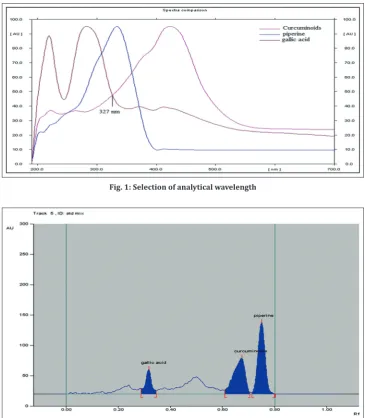
mobile phase. Plate was developed by to a distance of 90 mm at ambient room temperature with 20 minutes saturation time. Densitometric analysis was performed at 327 nm. Method was validated as per International Conference on Harmonization Q2 (R1) guideline also.
Results: Piperine, curcuminoids, and gallic acid were separated on TLC at retention factor values of 0.71, 0.61, and 0.29, respectively. The described method was linear over the range of 300-700 ng/spot, 100-300 ng/spot, and 250-550 ng/spot, respectively, for curcuminoids, piperine, and gallic acid. The accuracy of the method was assessed by recovery studies and was found to be 101.71%, 99.67%, and 99.59% for curcuminoids, piperine, and gallic acid, respectively. The amount of curcuminoids, piperine, and gallic acid in the ayurvedic formulation was found to be 3.99% w/w, 1.9% w/w, and 0.8% w/w, respectively, when analyzed quantitatively by developed validated HPTLC method.
Conclusion: The method can be used as a tool for quality control of herbal formulation.
Keywords: Curcuminoids, Piperine, Gallic acid, High-performance thin layer chromatographic.
INTRODUCTION
Curcuminoids present in turmeric is used as antiseptic in cut, wounds, inflammations, sore throat, urticaria, and skin allergies, whereas piperine, a constituent of black and long pepper, is used as bioavailability enhancer. Piperine is also reported to have antiallergic, antiasthmatic, hepatoprotective, antimalarial, and antiamoebic action. Gallic acid is used in dyspepsia, constipation, piles, enlarged liver, and spleen and also as an antioxidant [1].
Ayurvedic formulation “Haridrakhand” is used to treat urticaria and may skin diseases, and it contains these three herbs together. Thus, it is essential to ascertain the amount of each active phytoconstituent of plant present in the formulation. A literature survey revealed that high-performance thin layer chromatographic (HPTLC) [2-8], high-performance liquid chromatography [9-11], ultraviolet-visible spectroscopic [12], and spectrofluorimetric [13] methods had been developed for the determination of curcuminoids, piperine, and gallic acid individually. So, the present study is aimed to develop a validated HPTLC method for estimation of curcuminoids, piperine, and gallic acid simultaneously.
METHODS
Plant materials and formulation
Raw powdered plant materials mentioned in the formula for the preparation of ayurvedic formulation were procured from local market. Plant powders were identified and authenticated by taxonomist, Dr. A. M. Patel, J. and J. Science College, Nadiad, Gujarat, India. Sample specimens of plant powders were retained and submitted to the Department of Pharmacognosy, Ramanbhai Patel College of Pharmacy with voucher
specimen No. 2010/PG/QA/SP. Ayurvedic formulation “Haridrakhand” was prepared as per the method described in Ayurvedic Formulary of India [14].
Chemicals and materials
All solvents and reagents used were of analytical grade and purchased from LOBA, India. Precoated silica gel 60 F254 TLC plates were obtained
from Merck, Mumbai, India. Curcuminoids (95%), piperine (98%), and gallic acid (99%) were obtained from Loba Chemie - Ahmedabad, Sigma-Aldrich - USA, and Himedia - Mumbai, respectively.
Instrumentation
Chromatographic separation was performed with CAMAG Linomat V sample applicator equipped with Hamilton Syringe and CAMAG TLC Scanner IV. Software win CATS version 1.4.7 was used for data acquisition.
Preparation of ayurvedic lab formulation (Haridrakhand) All ingredients listed below in Table 1 were accurately weighed as per required quantity, powdered, mixed well, and passed through sieve. Starch paste and water were added to prepare sticky mass. Then sticky mass was passed through sieve 80#, and granules were collected, air dried, and packed in air tight container.
Preparation of standards and sample solutions
About 10 mg of each curcuminoid, piperine, and gallic acid were accurately weighed and transferred separately to a 10 ml volumetric flask and dissolved in 10 ml of methanol. The flask was sonicated in ultra sonicator bath for 15 minutes, and volume was made up to 10 ml with methanol to give a stock solution containing 1000 µg/ml
Research Article
(=1000 ng/µl) each of curcuminoids, piperine, and gallic acid. From above stock solutions, working standards solutions of curcuminoids (50 µg/ml), piperine (50 µg/ml), and gallic acid (50 µg/ml) were prepared in methanol.
About 40 g of formulation was extracted with methanol at 60°C for 3 hrs. Extract was cooled, filtered through Whatman filter paper, and diluted to 200 ml with methanol. This solution served as sample solution for determination of the three marker compounds.
Optimized chromatographic conditions
• Stationary phase: 20 cm × 10 cm silica gel 60 F254 TLC plates of 0.2
mm layer thickness
• Mobile phase: Toluene:ethyl acetate:formic acid:methanol (5.6:2.2:1.2:1.0 v/v/v/v)
• Development technique: Ascending double development technique in same mobile phase
• Chamber saturation time: 20 minutes for each development • Run distance: 90 mm for each development
• Scanning wavelength: 327 nm
• Temperature: Ambient room temperature • Band length: 8 mm.
The identity of bands of sample extracts was confirmed by the retention factor values (Fig. 1) and by overlaying the absorption spectrum with that of standards using the CAMAG TLC Scanner IV.
Method validation
The developed HPTLC method was validated as per International Conference on Harmonization (ICH) guideline Q2 (R1) with respect to selectivity, linearity, precision, accuracy, limit of detection (LOD), limit of quantification (LOQ), and robustness [15].
Linearity and range (n=6)
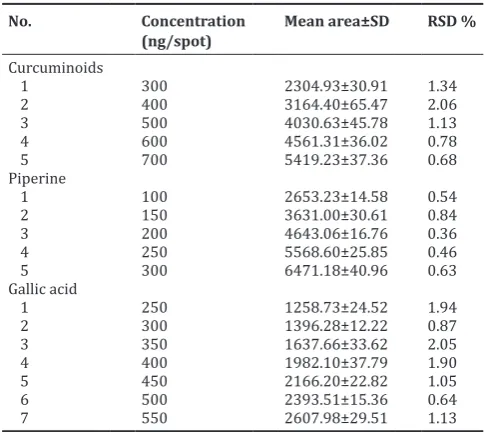
Different volumes of standard solutions of curcuminoids, piperine, and gallic acid (2-15 µl) were applied to the plate (Table 2). Calibration curves were plotted, and linear response of concentration versus absorbance was observed over a concentration range of 300-700 ng/spot, 100-300 ng/spot, and 250-550 ng/spot for curcuminoids, piperine, and gallic acid, respectively.
Precision (n=3)
Precision of the developed method was studied by performing intra-day precision and inter-intra-day precision studies.
The intra-day precision was determined by analyzing three different concentrations of curcuminoids (300, 500, and 700 ng/spot), piperine (100, 200, and 300 ng/spot), and gallic acid (250, 400, and 550 ng/spot) 6 times in a day. Inter-day precision was determined by analyzing three different concentrations of curcuminoids (300, 500, and 700 ng/spot), piperine (100, 200, and 300 ng/spot), and gallic acid (250, 400, and
550 ng/spot) 6 times on six consecutive days. The results are shown in Table 3.
Accuracy (n=3)
The accuracy was measured by performing recovery study. It was performed in triplicate by standard addition method at 80%, 100%,
Table 1: Composition for preparation of ayurvedic lab formulation (Haridrakhand)
11 Starch paste 18.5 g
12 Water (vehicle) 75 ml
Table 2: Linearity and range for curcuminoids, piperine, and gallic acid (n=6)
No. Concentration
(ng/spot) Mean area±SD RSD %
Curcuminoids
RSD: Relative standard deviation, SD: Standard deviation
Table 3: Intra- and inter-day precision (n=6)
Name of the
compounds Amount(ng/spot) Intra-day precision Inter-day precision
SD RSD % SD RSD %
Curcuminoids 300 29.672 1.241 37.597 1.689
500 28.760 0.689 40.612 1.285
700 48.194 0.856 51.187 1.221
Piperine 100 38.339 1.463 40.193 1.535
200 17.079 0.369 53.554 1.159
300 62.952 0.984 66.386 1.039
Gallic acid 250 14.169 1.025 17.854 1.219
400 19.964 1.004 17.587 1.122
550 9.163 0.449 16.494 1.287
RSD: Relative standard deviation, SD: Standard deviation
Table 4: Results of accuracy study (n=6)
Name of the
compounds Amount of standard spiked (ng)
Curcuminoids 0 1605.28 -
-40 1627.19 99.46±1.119 1.125
and 120% of the standards. Known amount of standards were added to pre-analyzed samples, and the total amount of each of the markers was determined by the developed method. Average percentage recovery of each marker is reported in Table 4.
LOD and LOQ
The LOD and LOQ of the developed method were calculated from the standard deviation of the response and slope of the calibration curves of curcuminoids, piperine, and gallic acid using the formulae as given below.
LOD = 3.3 σ/S and LOQ = 10 σ/S
Where σ is the standard deviation of the response and S is the slope of the calibration curve.
Results are indicated in Table 5.
Specificity
The specificity of the method was ascertained by analyzing standard drug and sample. The method was found to be specific for curcuminoids, piperine, and gallic acid because it resolved the peaks of the drugs in the presence of other excipients as shown in Figs. 2-4.
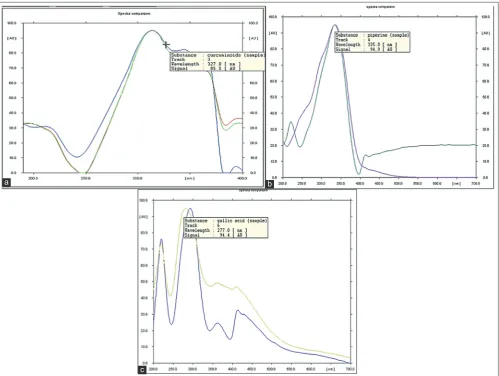
The specificity was also confirmed by superimposition of UV spectra of standard and sample recorded by scanner IV. The spectra are shown in Fig. 5.
Correlation between these spectra confirmed the purity of the curcuminoids peak correlation (r (s,m)=0.9996, r (m,e)=0.9997), piperine peak correlation (r (s,m)=0.9999, r (m,e)=0.9998), and for gallic acid peak correlation (r (s,m)=0.9999, r (m,e)=0.9998), respectively. Thus, it can be concluded that the excipients did not interfere with the peaks from standard drug solutions.
Robustness study
The robustness of the method was checked by introducing small deliberate changes in various method parameters such as mobile phase
Fig. 1: Selection of analytical wavelength
Fig. 2: Chromatogram obtained from the standard mixture, piperine, curcuminoids, and gallic acid are present in at retention factor (Rf) ~ 0.71, Rf ~ 0.61, and Rf ~ 0.29, respectively
Table 5: LOD and LOQ (ng/spot) (n=6)
Name of the compounds (ng/spot)
Curcuminoids Piperine Gallic
acid
LOD 1.388 4.784 14.770
LOQ 4.207 14.497 44.759
volume, duration of saturation, pre-treatment of plate with methanol, and the results are examined and described in (Table 6). The relative standard deviation (RSD) [%] obtained after a small change in the parameters was used as an indicator of the robustness of the method. The RSD values <2 indicate the robustness of the method.
Quantification of markers in ayurvedic formulation
The developed method was applied to the determination of curcuminoids, piperine, and gallic acid in the ayurvedic formulation.
Fig. 3: Chromatogram obtained from the ayurvedic formulation, piperine, curcuminoids, and gallic acid are present in at retention factor (Rf) ~ 0.71, Rf ~ 0.61, and Rf ~ 0.29, respectively
Table 6: Robustness of HPTLC method (n = 6)
Parameter Curcuminoids Piperine Gallic acid
SD of peak
area RSD% SD of peak area RSD% SD of peak area RSD%
Mobile phase volume (20±3 ml) 348.750 1.968 51.934 0.478 2.732 0.105
Pretreatment of plate with methanol 139.124 0.787 124.345 1.177 7.399 0.092
Durationof saturation (20±5 minutes) 81.251 1.166 119.290 1.153 93.427 1.669
HPTLC: High-performance thin layer chromatographic, RSD: Relative standard deviation, SD: Standard deviation
From test solution, 8 µl/spot was applied on HPTLC plate, and results were obtained which described in Table 7.
RESULTS AND DISCUSSION
The developed HPTLC method provides a simple, precise, and accurate analytical method for simultaneous estimation of curcuminoids, piperine, and gallic acid in the ayurvedic formulation. A good separation of analytes was achieved using mobile phase composed of Fig. 4: Thin layer chromatographic profile obtained from the ayurvedic formulation, curcuminoids, piperine, and gallic acid standards
(a) at λ=366 nm (b) at λ =254 nm. 1 and 6 are sample track, 5 is standard mixture track, 2, 3, and 4 are track of standard gallic acid,
curcuminoids, and piperine, respectively
toluene:ethyl acetate:formic acid:methanol (5.6:2.2:1.2:1.0 v/v/v/v) on precoated silica gel 60 F254 plates. % RSD value <2 in every parameter
of validation procedures described in ICH Q2 (R1) guideline indicates that the method is validated. The present HPTLC method is found to be relatively specific, precise, and accurate. The developed, validated method was also employed to estimate the amount of markers quantitatively in the ayurvedic formulation. Thus, this method can be used as a tool for routine analysis of these three marker compounds in any multicomponent herbal or ayurvedic formulation for quality control.
CONCLUSION
The amount of curcuminoids, piperine, and gallic acid in the ayurvedic formulation was found to be 3.99% w/w, 1.9% w/w, and 0.8% w/w, respectively. Further, this method can be effectively used for routine quality control of herbal materials as well as ayurvedic and herbal formulations containing any of these three compounds.
ACKNOWLEDGMENT
The authors wish to express their thanks to Ramanbhai Patel College of Pharmacy, for providing the necessary facilities for performing this research work.
REFERENCES
1. Anonymous. Indian Herbal Pharmacopoeia, Revised New Edition. New Delhi: A Joint Publication of RRL and Indian Drug’s Manufacturer’s Association; 2002.
2. Gupta AP, Gupta MM, Kumar S. Simultaneous determination of curcuminoids in Curcuma samples using high performance thin layer chromatography. J Liq Chromatogr Relat Technol 1999;22(10):1561-9. 3. Khan S, Makhija IK, Khamar D, Rani S. Development and
standardization of turmeric cream by HPTLC. Int J Biomed Adv Res 2010;1(4):109-16.
4. Tapadiya G, Metku M, Deokate U, Khadabadi S, Saboo S, Sahu K. Quantitative estimation of piperine from pharmaceutical dosage form by HPTLC. Asian J Pharm Clin Res 2009;2(2):47-50.
5. Hamrapurkar PD, Jadhav K, Zine S. Quantitative estimation of piperine in Piper nigrum and Piper longum using high performance thin layer chromatography. J Appl Pharm Sci 2011;1(3):117-20.
6. Sawant L, Pandita N, Prabhakar B. Determination of gallic acid in Phyllanthus emblica Linn. Dried fruit powder by HPTLC. J Pharm Bioallied Sci 2010;2(2):105-8.
7. Rakesh SU, Salunkhe VR, Dhabale PN, Burade KB. HPTLC method for quantitative determination of gallic acid in hydroalcoholic extract of dried flowers of Nymphaea stellata Willd. Asian J Res Chem Table 7: Content of curcuminoids, piperine, and gallic acid in
ayurvedic formulation (n=6)
Name of the
compounds Curcuminoids (%) Piperine Gallic acid Average content
(%w/w) 3.99 1.9 0.80
Fig. 5: Selectivity- superimposed spectra of curcuminoids (a), piperine (b), and gallic acid (c) from standard and sample solution
a b
2009;2(2):131-4.
8. Vyas N, Gamit K, Khan MY, Panchal S, Pundarikakshudu K. Simultaneous estimation of curcumin and piperine in their crude powder mixture and ayurvedic formulation using high performance: Thin layer chromatography. Int J Res Pharm Biomed Sci 2011;2(1):231-6. 9. Heath DD, Pruitt MA, Brenner DE, Rock CL. Curcumin in plasma
and urine: Quantitation by high-performance liquid chromatography. J Chromatogr B Analyt Technol Biomed Life Sci 2003;783(1):287-95. 10. Sunita S, Menon S, Singh A. Quantitative analysis of piperine
from ayurvedic polyherbal formulations using reverse phase high performance liquid chromatography. Int J Pharm Bio Sci 2010;1:1-10. 11. Deshmukh H, Prabhu PJ. Development of RP-HPLC method for
qualitative analysis of active ingredient (gallic acid) from stem bark of Dendrophthoe falcata Linn. Int J Pharm Sci Drug Res 2011;3(2):146-9. 12. Gupta V, Jain UK. Quantitative estimation of piperine in Pancasama
churna by RP-HPLC. Der Pharm Lett 2011;3(1):400-6.
13. Gupta NK, Nahata A, Dixit VK. Development of a spectrofluorimetric method for the determination of curcumin. Asian J Tradit Med 2010;5(1):51-7.
14. Mishra B. Bhaisajya Ratnavali of Govinda Dasji Bhisagratna. New Delhi: Chaukhambha Publication 2008, 1,703.