R E S E A R C H
Open Access
LLR-based coded performance analysis
of cognitive dual-hop BICM systems
Anas Fedoul
1*and Mustapha Benjillali
2Abstract
In this work, we analyze the performance of a cooperative two-hop cognitive relaying system using the
“detect-and-forward” strategy. The cooperation between secondary users, in the underlay spectrum sharing mode, is under an interference constraint imposed by the primary network. The proposed analytical method is based on the probabilistic characterization of the bits reliability metrics given under the form of logarithmic likelihood ratios (LLRs). First, we use closed-form expressions for the probability density function of the LLRs to calculate the theoretically achievable rates and compare them with the practical throughput of a simulated turbo-coded transmission. Then, we derive tight approximations for the end-to-end coded bit error rate (BER) of the secondary transmissions, compare them with simulation results using convolutional coding schemes, and discuss their application using turbo-codes. The derivations accuracy and the system behavior are evaluated for different cooperation configurations and under different spectrum sharing conditions.
1 Introduction
Cognitive relay networks (CRN), particularly with the underlay approach, have been considerably investigated as a potential way to improve secondary users throughput with optimal spectrum use. In this paper, we consider a secondary communication network consisting of a source, multiple parallel relays, and a destination, all in interaction with a primary user. We analyze the scenario where the relays communicate with the destination over indepen-dent (orthogonal) channels. Each source-relay-destination link can thus be seen as a two-hop relay channel. Relays transmit over the primary spectrum under a maximum interference temperature1constraint.
Compared to the analysis of uncoded transmis-sions (based on signal-level outage probability and ergodic capacity), understanding coded systems gives more insight into the practical limits of communication schemes, with error correcting capabilities, and espe-cially over mobile fading channels. Soft-metrics (or L
values)-based analysis—which consists on calculating bits reliabilities—is one of the most common, and most effi-cient, approaches. In addition, the adoption of soft met-rics, like the logarithmic likelihood ratios (LLR) [1], allows
*Correspondence: [email protected]
1National Institute of Telecommunications (INPT), Rabat 10100, Morocco Full list of author information is available at the end of the article
for an iterative processing at the receiver side and results in practical performance gains.
Hence, the probabilistic description of LLRs is neces-sary and offers a powerful analytical tool to the analysis and design of optimal end-to-endcoded modulation(CM) communications and, in particular, “bit interleaved coded modulation” (BICM) schemes [2]. Previous works in the literature adopted this LLR-based approach to derive end-to-end performance metrics such as bit error rate (BER) and throughput [3], and constrained capacity (both CM and BICM capacities) [2].
More recently, the probabilistic characterization of reliability metrics in the context of conventional relay-ing schemes was presented in [4]. On the other hand, the coded performance analysis of two-hop underlay cognitive relay channels was mostly focused on the outage probability, mainly with “decode-and-forward” relaying [5–8]. In [9], the soft-metrics-based analysis has been generalized to the more general spectrum shar-ing “interference-limited” cognitive context. However, the analysis remained limited to the uncoded performance. In this work, revisiting and completing the contributions in [9], we present and highlight a new analytical frame-work for the end-to-end coded performance of underlay dual-hop transmissions in terms of constrained capacity
and coded error rates. We also assess the practical perfor-mance, particularly with turbo and convolutional coding schemes, in light of the presented framework.
The contributions in this work are the following. First, we apply the closed-form expressions obtained for the probability density function (PDF) of the decoding met-rics in the elementary two-hop secondary network link, to derive new expressions for the BICM capacity, and a very tight upper-bound approximation of the end-to-end coded BER. Then, we present simulation results to demonstrate the accuracy of the analytical results and the performance gap between practical implementation and theoretical limits. By adressing various scenarios, the anal-ysis provides an interesting insight into the effect of the primary user position, the relays position, and the inter-ference limit on the end-to-end performance and, more generally, opens a new direction in the design of multihop cognitive relay systems.
The rest of this paper is organized as follows. In Section 2, we introduce the system model and assump-tions. We present the PDFs of the decoding metrics in Section 3. In Section 4, we analyze the coded transmission performance as an application of the obtained results, and numerical examples illustrating the analysis are presented in Section 5. Section 6 concludes the paper.
2 System model
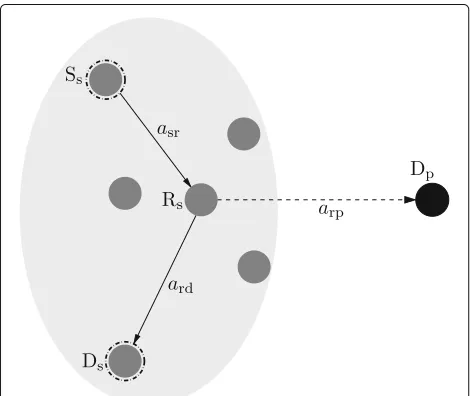
The adopted system model of the underlay cognitive relay system is shown in Fig. 1. We assume that the primary source Sp does not cause any interference on the
sec-ondary network reception. For each single-hop link, the received signalzij(where i∈ {s, r}, j∈ {r, p, d}) is given by
Fig. 1System model of an underlay dual-hop system, where Ss, Rs, Ds, and Dpdenote the secondary source, secondary relay, secondary destination, and the primary destination, respectively
xiaszij=aij·xi+n, whereaij=hij/dν/ij2denotes the
chan-nel coefficient, the amplitude of the fading coefficient|hij|
follows a Rayleigh distribution with average unit energy,
dijis the distance between i and j,nis a zero-mean additive
white Gaussian noise (AWGN) with a varianceN0, andν
is the path loss exponent. In the underlay mode, secondary transmissions are allowed as long as no harmful interfer-ence impacts the primary destination Dp. This is enforced
by a transmit power constraint at the secondary relay2Rs
given by
whereIis theinterference temperatureandPis the max-imum transmit power available at Rs. At the source, a
sequence of information bits3care mapped onto symbols
xs = μ[c]∈ {−1,+1} from a binary phase-shift keying
(BPSK) constellation and broadcasted to the relay. The average received signal-to-noise ratio (SNR) of the Ss–Rs
link is thus given byγsr = dν1
srN0 and the instantaneous
SNR γsr = γsr|hsr|2 follows an exponential
distribu-. At the secondary relay, the received signal ysr is demodulated, and the
result-ing binary wordcˆis re-modulated creating a new signal
xr = μrˆc ∈ {−,} that is forwarded to the
destina-tion, where2=min I |arp|2,P
. The instantaneous SNR
is thus given byγrd = 2|ard| 2
N0 , and its cumulative
den-sity function (CDF) can be deduced from ([6], Eq. (14)) applied to the special Rayleigh fading case (m1=m2=1).
The PDF of the instantaneous SNR is thus obtained by differentiation as
At the destination, the bit-level reliability metrics can be computed under the form of LLRs as
l=log
3 CDFs and PDFs of the reliability metrics
As derived in [9], the averaged CDF overγsris obtained as:
PL(λ|c)=1[λ≥0]+[F(λ,α,β,c)−F(λ,α,β,c)]·Usr(|λ|)
which can be simplified for positive arguments as
Usr(λ)=
the cognitive two-hop reliability metric is obtained in [9] by differentiating (4) with respect toλas:
pL(λ|c)=
Expressions (4) and (7) provide a powerful analytical tool that will simplify the analysis of the end-to-end coded performance of the analyzed system as will be shown in the next section.
4 Application: analysis of coded transmissions
In this section, we propose two applications of the obtained analytical expressions. For instance, we derive analytical and numerically tractable (compared to exhaus-tive Monte-Carlo simulations) expressions, for both the constrained capacity and the coded BER.
4.1 Achievable information rates
One of the most common theoretical references for coded systems is the BICM capacity [2] which corresponds to the normalized (by the number of channel uses) mutual information between coded bitscat the source and the reliability metricsLat the destination. In our case, it can be expressed, as in [4], under the form
Using the expressions obtained in (7), we are able to cal-culate (8) using a numerical Gaussian quadrature instead of Monte-Carlo simulations as shown in [2].
4.2 Coded BER analysis
To evaluate the performance of the presented underlay scheme from a practical point of view, we use the follow-ing union bound ([1], Sec. 4.4) to approximate the coded BER as
where dfree and β are, respectively, the minimum
code, and PEP(dH)is the pairwise error probability (PEP).
Assuming that an all-ones sequence is transmitted, the PEP is given by:
PEP(dH)=Pr
where the random variablesL(j)model the decoding met-rics and j is a dummy variable. Using the saddlepoint approximation, the PEP can be approximated by ([4], and references therein):
PEP(dH)≈
exp(dH·κ(σ))
σ√2πdHκ(σ)
, (11)
whereκ(·)is the cumulant generating function (CGF) of
L,σis its “saddlepoint”, andκ(·)is the second derivative (12) can be calculated using a Gauss-Hermite quadrature. As shown in the next section, this expression gives an accurate tool to analytically evaluate the performance of underlay coded systems.
5 Numerical results
To illustrate the analysis, we assume that the relay is posi-tioned on the line between the source and the destination and we identify its position by the ratio δr = dsr/dsd.
The position of the primary receiver Dp is identified by
the ratio δp = drp/drd. Considering power normalized
constellations, we assume thatP=1 andν=4 for all paths. To compare meaningfully the theoretical limits pre-sented in [9] with the performance of practical coded schemes, we calculate—from a simulated transmission— the average throughput (normalized by the number of channel use) of this source-relay-destination channel given by coding rate (i.e., 12·m·ρis the target spectral efficiency), and BLER(γsd,δr,δp)is the block error rate at the desti-nation when the relay is at a position given byδr and the primary receiver is at a position given byδp. Blocks of 4000 information bits are encoded using a turbo-code obtained by concatenating two recursive systematic convolutional encoders with generating polynomials {1, 13/15}8 and a random inner interleaver. A puncturing (the parity-bit is alternatively taken out of the first and second encoder) is performed to obtain a code rateρ=1/2 from the original
rate-1/3 code. At the destination, the decoder is based on soft-input soft-output BCJR algorithm with 7 iterations.
The first analyzed scenario, depicted in Fig. 2, shows a comparison between the BICM capacity and the obtained practical throughput for different distance ratiosδp, while the relay position remains fixed at the middle point between the source and the destination δr = 0.5. It can be seen that the theoretical capacity limit increases when the distance ratioδpis increased, with a more noticeable impact at lower ratios (δp<1). Furthermore, and starting from a ratio δp > 2, the obtained capacity is compara-ble to the performance in the conventional case with no spectrum sharing constraints. As the practically achiev-able throughput follows the same behavior, the interesting parameter for the comparison is the SNR γsd at which the throughput attains 99% of the targeted spectral effi-ciency (i.e., 1/2 in the illustrated case). As an example, we can see that the analyzed secondary triplet source-relay-destination performs between 1.6 and 2.3 dB forδp = 2 and δp = 0.5, respectively, from its theoretical BICM capacity. This comparison between the BICM capacity and the throughput is presented as an illustrative exam-ple of the application of the proposed analysis approach. The gaps between theoretical and practical performance are within standard (using turbo-codes) and the optimiza-tion of the coding scheme to reduce these gaps is beyond the scope of the paper.
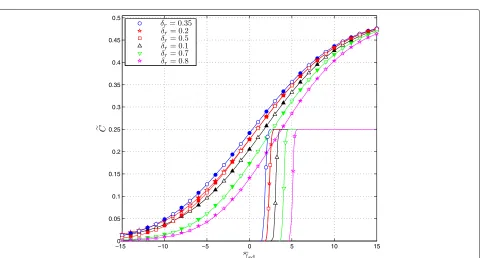
The second analyzed scenario, illustrated in Fig. 3, shows a comparison between the BICM capacity and the obtained practical throughput for different relay position δr, while fixing the distance ratio identifying the primary receiver relative position at δp = 1. It is remarked that the best BICM capacity and throughput performance is reached atδrvalues around 0.35, while the capacity curves with δr = 0.2 and δr = 0.5 merge together at high SNR, and the corresponding throughput performance is identical as well. This is distinctly different from the con-ventional case where the best performance is reached whenδr=0.5. The interference constraint makes the sec-ondary triplet source-relay destination more dependent and more sensitive to the source-relay hop channel qual-ity. On the other hand, as long as the system migrates to the low SNR regime; the impact of interference constraint becomes negligible against the hard radio conditions of the whole system. Consequently, the system behavior tends towards the conventional case as we can see from the BICM capacity curves.
Fig. 2Throughputs and BICM capacities of a two-hop cognitive relay channel as a function ofγsd, for different ratiosδp=drp/drdand fixed relay positionδr=0.5. For different ratiosδp=drp/drd, lines correspond to the analytical results, filled markers correspond to simulation results obtained using the exact L-values, and hollow markers correspond to simulation results obtained using the max-log approximation ofLvalues ([9], Eq. (8)). The capacity of the conventional two-hop source-relay-destination link is shown as a reference (dashed line)
Fig. 3Throughputs and BICM capacities of a two-hop cognitive relay channel as a function ofγsd, for different relay positionsδrand fixed ratio
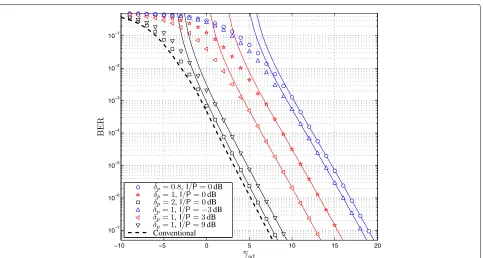
Fig. 4BER of a two-hop cognitive relay channel as a function ofγsdusing a convolutional coding scheme. For different ratiosδp=drp/drdand I/P, lines correspond to the analytical results, hollow markers correspond to simulation results. The BER of the conventional two-hop
source-relay-destination link is shown as a reference (dashed line)
The encoder was implemented as a rate—1/2 feedforward convolutional code with generating polynomials(5, 7)8, so dfree=5 andβ(d)=2(d−5)(d−4). We adopt the value of
the saddlepointσ =1/2. From the figure, we can see that the approximation in (9) gives a tight upper-bound of the BER in the range of interest for all illustrated scenarios. Also, it is clear from the figure that the effect of the pri-mary user’s distance ratio is more notable than the impact of the interference temperature constraint.
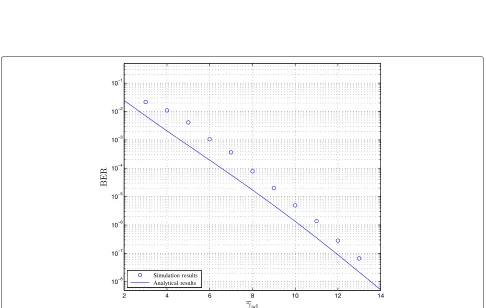
The upper-bound analytical approach can be applied to other coding schemes provided that the minimum dis-tance and the weight distribution spectrum are available. With turbo-codes, although tabulated results are not as abundant as with convolutional codes, the minimum dis-tance and the weight distribution spectrum functions can be obtained based on algorithms in the literature [10]. In Fig. 5, we applied the same approach to a different scenario using UMTS encoder which has two recursive systematic convolutional encoders. Each convolutional encoder is an 8-state and rate 1/2, and the rate of the resulting turbo-code is 1/3. A block interleaver with length
N=320 is used. The distance spectrum of UMTS turbo-codes is reported in ([11], Table 3) considering only the first term; sodfree = 24 andNfree = β(dfree) = 1. With
this limitation, we can see that the approximation in (9) gives a tight upper-bound of the BER starting from an SNR value higher than 13 dB which corresponds to a BER lower than 10−9(which is a range of interest corresponding to
typical practical/industrial performance). While the dif-ference between simulation and analytical curves in low SNR regime is mainly due to the neglected contribu-tion of the rest terms of the weight spectrum, the bound matches perfectly with the simulation in the high SNR regime which in fact is dominated, as well known, by the minimum distance.
Another scenario, more adapted to research purposes rather than to field application, is illustrated in Fig. 6. We used the complete weight distribution of a turbo code with blocks of 16 information bits and a 1/2 code rate (obtained via puncturing) using the encoder structure of the turbo code standardized by the Consultative Committee for Space Data Systems (CCSDS) in telemetry links [12]. The interleaver used for permutation has been randomly gen-erated; then, the weight spectrum was computed using a brute force matlab code (generating all the possible coded sequences from the 216input block possibilities, and
Fig. 5BER of a two-hop cognitive relay channel as a function ofγsdusing an UMTS turbo-coding scheme. With interleaver sizeN=320, and for δp=drp/drd=0.5 and I/P=0 dB, lines correspond to the analytical results, hollow markers correspond to simulation results
As an extension of this work, more illustrative examples can be developed with standard longer block lengths using special algorithms for generating the complete weight spectrum.
6 Conclusion
In this paper, a soft-metrics-based analysis of BICM cognitive underlay dual-hop systems was presented. The statistics of the LLRs were expressed in closed-form when detect-and-forward is the adopted relaying strategy. Achievable information rates and coded BER expressions—numerically computable and more tractable than heavy Monte-Carlo simulations—were also pre-sented as applications of the obtained analytical statistical tools. For different scenarios, the accuracy of the deriva-tions was confirmed by simulation results and the gap between practical performance and theoretical rates was assessed. The proposed analysis method provides a pow-erful tool for the design and optimization of coded coop-erative systems. It can also be adopted in the more gen-eral context of multihop communications, very present in the future device-to-device and machine-type 5G communications.
Endnotes
1In the underlay mode, interference temperature
(expressed in dBm) refers to the maximum received inter-ference signal strength tolerated by the primary destina-tion to authorize secondary transmissions.
2We suppose that the secondary source transmission
does not impact the primary node reception; only the sec-ondary relay transmits under the cognitive interference constraint. In practice, this assumption can be adopted when the secondary source Ss is located far away from
the primary destination Dp; when there is an
obstruc-tion between Ss and Dp; when Ss uses a beamforming
transmission away from Dp; or when Ss uses a different
frequency band than Rs.
3For the sake of brevity, although we consider a BICM
transmission, the analysis will consider the information bits directly even though it is the interleaved version of the bits that is in direct contact with the channel. How-ever, since the interleaver is assumed to be deterministic and known from both sides, making abstraction of the interleaving does not impact the generality of the analysis.
Funding
The authors declare that there has been no special funding given to this work.
Authors’ contributions
AF (first author) made substantial contributions to the conception and design, acquisition of data, and analysis and interpretation of data and has been involved in drafting the manuscript. MB (second author) made substantial
contributions to the conception and design and analysis and interpretation of data and has been involved in revising the manuscript critically for important intellectual content. Both authors read and approved the final manuscript.
Competing interests
The authors declare that they have no competing interests.
Publisher’s Note
Springer Nature remains neutral with regard to jurisdictional claims in published maps and institutional affiliations.
Author details
1National Institute of Telecommunications (INPT), Rabat 10100, Morocco. 2Communication Systems Department at the National Institute of
Telecommunications (INPT), Rabat 10100, Morocco.
Received: 4 November 2015 Accepted: 23 October 2017
References
1. AJ Viterbi, JK Omura,Principles of Digital Communications and Coding. (Mack Graw Hill, New York, 1979)
2. G Caire, G Taricco, E Biglieri, Bit-interleaved coded modulation. IEEE Trans. Inf. Theory.44(3), 927–946 (1998)
3. L Szczecinski, F-K Diop, M Benjillali, A Ceron, R Feick, inProc. IEEE Global Commun. Conf. (GLOBECOM). BICM in HARQ with mapping
rearrangement: capacity and performance of practical schemes (IEEE, Washington, D.C, 2007), pp. 1410–1415
4. M Benjillali, L Szczecinski, Detect-and-forward in two-hop relay channels: a metrics-based analysis. IEEE Trans. Commun.58(6), 1729–1736 (2010) 5. J Lee, H Wang, JG Andrews, D Hong, Outage probability of cognitive relay
networks with interference constraints. IEEE Trans. Wireless Commun. 10(2), 390–395 (2011)
6. C Zhong, T Ratnarajah, K-K Wong, Outage analysis of decode-and-forward cognitive dual-hop systems with the interference constraint in Nakagami-mfading channels. IEEE Trans. Veh. Technol.60(6), 2875–2879 (2011)
7. Z El-Moutaouakkil, K Tourki, KA Qaraqe, S Saoudi, inProc. IEEE Vehicular Technology Conference (VTC-Fall). Exact outage probability analysis for relay-aided underlay cognitive communications (IEEE, Québec City, 2012), pp. 1–5
8. L Luo, P Zhang, G Zhang, J Qin, Outage performance for cognitive relay networks with underlay spectrum sharing. IEEE Commun. Lett.15(7), 710–712 (2011)
9. A Fedoul, M Benjillali, inProc. International Workshop on Codes, Cryptography, and Communication Systems (IWCCCS’14). Cognitive detect-and-forward relay channels: soft metrics and performance analysis (IEEE, El Jadida, 2014), pp. 113–117
10. L Szczecinski, A Alvarado,Bit Interleaved Coded Modulation: Fundamentals, Analysis and Design. (Wiley, Hoboken, 2015)
11. MAU Bhuiyan, MS Hosain, S Rahman, inProc. 5th WSEAS International Conference on Applied Electromagnetics, Wireless and Optical
Communications. Distance spectrum analysis of third generation turbo codes (WSEAS, 2005), pp. 69–74