Cite as: Can Urol Assoc J 2013;7(7-8):e462-6. http://dx.doi.org/10.5489/cuaj.204 Published online July 2, 2013.
Abstract
Introduction: We present the outcomes and long-term follow-up of patients who underwent conversion to an ileal conduit urinary diversion using the retubularized patch from the initial augmenta-tion ileocystoplasty.
Methods: We reviewed the charts of all patients who underwent this surgery at our centre. The indications for surgery, workup, clinical outcomes and complication rates were assessed. Patient-reported symptom response based on global response assessment (GRA) was determined and used as a subjective measure of overall treatment effectiveness.
Results: Thirteen patients with either bladder pain syndrome/inter-stitial cystitis (BPS/IC) (n = 11) or neurogenic bladder (n = 2) were followed for a mean of 80 months. The most common indication for surgical conversion was persistent lower urinary tract symptoms (LUTS) or bladder pain. Late complications were frequent, typically low-grade, and usually manageable with conservative therapy; the most common were urinary tract infections (n = 6) and parastomal hernias (n = 5). Two patients developed ureteric strictures. Nine of 13 patients required additional surgery to manage complications or persistent symptoms. Only 5 of 11 GRA respondents reported a successful therapeutic outcome and BPS/IC patients who under-went concurrent cystourethrectomy tended to be most satisfied (2/3). Nevertheless, several patients still achieved symptom control when no other treatment options were available to them.
Conclusion: Conversion to an ileal conduit using the retubular-ized ileocystoplasty patch offers several technical and therapeutic advantages over creating a urinary diversion from a new bowel seg-ment. It should therefore be considered a viable treatment option in patients who have exhausted more conservative management of their LUTS.
Introduction
A small volume, poorly compliant bladder with or without detrusor overactivity can arise from a number of urological
disorders, ranging from structurally contracted bladders (such as those seen with radiation cystitis) to neurogenic bladder (such as those associated with spinal dysraphisms).1 These
conditions can be associated with high bladder pressures, damage to the upper urinary tract, and severe lower urinary tract symptoms (LUTS).2 Patients with bladder pain syndrome/
interstitial cystitis (BPS/IC) can also have debilitating storage LUTS and pelvic pain exacerbated by bladder filling.3 Despite
conservative management, some patients will have unresolved symptoms or high pressure bladders and require more inva-sive treatment in the form of an augmentation cystoplasty.2
For a number of reasons (including patient dissatisfaction, unresolved or recurrent LUTS1,4 or pain,5,6 bladder cancer,7-9
recurrent urinary tract infections,1,10,11 or failure to manage
self-catheterizations12,13), a bladder augmentation may not
adequately treat the condition and conversion to an ileal conduit may be warranted. An alternative to a de novo ileal conduit with an additional segment of the small bowel is to form the conduit from the retubularized ileocystoplasty patch. We present our experience with this surgery and assess patient-reported symptom responses as a subjective measure of treatment outcome.
Methods
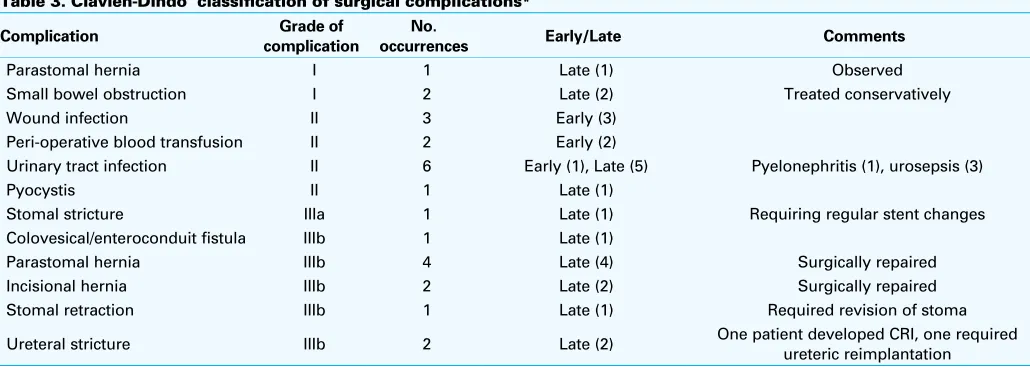
A total of 13 patients who underwent conversion to an ileal conduit after failed augmentation ileocystoplasty were included in this study. After Research Ethics Board approval, a chart review of all included patients was completed. The patient demographics and comorbidities, indications for and time to surgical conversion, previous workup and thera-pies, and surgical and clinical outcomes were reviewed. Complications were graded based on the Clavien-Dindo classification of surgical complications.14 To quantify the
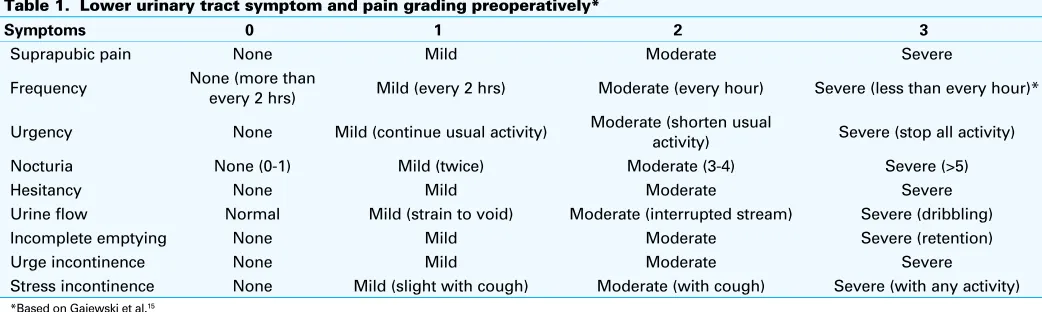
severity of symptoms preoperatively, the LUTS and pain of each patient were graded using a scale from 0 to 3 (Table 1) and as outlined in previous studies.15
Patient-reported symptom response was assessed postop-eratively using the global response assessment (GRA) scale
Peter A. Massaro, MD, MASc; Jerzy B. Gajewski, MD, FRCSC; Greg Bailly, MD, FRCSC
Department of Urology, Dalhousie University, Halifax, NS
as a subjective measure of clinical outcomes (Table 2). After their most recent clinical follow-up, patients were asked to retrospectively rate the change in their symptoms with conversion to an ileal conduit after failure of their prior augmentation ileocystoplasty (Table 2). The GRA scale has become a standard method of patient-symptom assessment in clinical trials of BPS/IC, particularly because success-ful treatment of the condition requires adequate symptom management.16 Therefore, in this study treatment success
or failure was based on each patient’s response to the GRA scale. Patients who graded their therapeutic response as significantly worse, somewhat worse or unchanged were considered treatment failures, while patients who reported some or significant improvement in their symptoms were considered treatment successes.
Results
Of the 13 patients included in this study, 3 were male and 10 were female; the mean age was 56 years. The primary diagnoses included BPS/IC (11 patients) and neurogenic bladder (2 patients). Of the patients with neurogenic blad-der, 1 had spina bifida and the other had a traumatic spinal cord injury. Two patients died from non-urologic causes prior to carrying out the study.
On preoperative LUTS and pain grading (Table 1), all patients reported at least 1 symptom as severely bothersome (Grade 3), and 3 or more symptoms as at least moderately bothersome (Grade ≥2). The indications for conversion from an augmentation ileocystoplasty to an ileal conduit in all patients with BPS/IC were persistent or recurrent severe storage LUTS or pelvic pain despite several prior therapies. Attempted therapies included dietary modifica-tion, oral medications (anticholinergics, pentosan poly-sulfate, amitriptyline, and/or analgesics), hydrodistension, intravesical therapies (clorpactin, dimethyl sulfoxide, and/ or exogenous glycosaminoglycans), neuromodulation, and eventually augmentation ileocystoplasty. Excluding dietary modification, all patients with BPS/IC had failed at least 4 of
the aforementioned therapies. In the 2 patients with neuro-genic bladder, the indications for conversion after augmen-tation ileocystoplasty were intolerance of clean intermittent self-catheterization or indwelling catheter with persistent incontinence.
The mean time between the initial bladder augmentation and conversion to an ileal conduit was 55 months (range: 4 to 220 months). In the BPS/IC and neurogenic bladder populations, the mean time to conversion was 68 months (range: 4 to 220 months) and 37 months (range: 9 to 69 months), respectively.
During the surgery, the abdomen and peritoneum were entered through a midline suprapubic incision. Adhesions were sharply dissected to mobilize any overlying small bowel and to identify the ileocystoplasty patch. The patch was dissected free from the bladder using electrocautery and was retubularized along its original incision using running 3-0 braided, absorbable sutures. The posterior wall of the bladder was closed and the ureters were subsequently identi-fied, divided and anastomosed to the proximal end of the retubularized ileal segment in a Wallace fashion. The distal end of the conduit was brought out through the abdominal wall and the stoma was created. Four patients with BPS/IC also underwent simple cystectomy and urethrectomy at the time of surgery. The only intra-operative complication was a blood transfusion required in 1 patient (Table 3).
Table 1. Lower urinary tract symptom and pain grading preoperatively*
Symptoms 0 1 2 3
Suprapubic pain None Mild Moderate Severe
Frequency None (more than every 2 hrs) Mild (every 2 hrs) Moderate (every hour) Severe (less than every hour)*
Urgency None Mild (continue usual activity) Moderate (shorten usual activity) Severe (stop all activity)
Nocturia None (0-1) Mild (twice) Moderate (3-4) Severe (>5)
Hesitancy None Mild Moderate Severe
Urine flow Normal Mild (strain to void) Moderate (interrupted stream) Severe (dribbling)
Incomplete emptying None Mild Moderate Severe (retention)
Urge incontinence None Mild Moderate Severe
Stress incontinence None Mild (slight with cough) Moderate (with cough) Severe (with any activity)
*Based on Gajewski et al.15
Table 2. Global response assessment scale
Number Response Grading (%) Outcome
1 Significantly worse 0 Failure of the therapy
2 Somewhat worse >0 to 25 Failure of the therapy
3 Unchanged (neither worse nor better) >25 to 50 Failure of the therapy
4 Somewhat improved >50 to 75 Successful therapy
The mean follow-up from date of surgical conversion to administration of the GRA scale, or, in the case of deceased patients, last clinic visit was 80 months (75 and 103 months in the BPS/IC and neurogenic bladder groups, respectively). We tallied intra-operative, early (prior to discharge from hos-pital) and late (after discharge from hoshos-pital) postoperative complications and classified them using the Clavien-Dindo classification system (Table 3).14 The most common
com-plications were urinary tract infections (n = 6), parastomal hernias (n = 5), and wound infections (n = 3). Of the highest grade complications, there were 2 patients who developed ureteric strictures. One patient required a ureteric reimplan-tation, and the other proceeded to develop ipsilateral renal atrophy and subsequent chronic renal insufficiency. The lat-ter patient also developed colovesical and enlat-teroconduit fistulae due to a small bowel anastomotic leak. One patient developed a refractory stomal stricture requiring regular bilateral ureteric catheter changes, and another developed stomal retraction requiring surgical revision.
Of the 10 patients with BPS/IC, 4 underwent concur-rent simple cystourethrectomy at the time of conversion to an ileal conduit. Nine out of 10 of the BPS/IC patients required additional surgery including: simple cystourethrec-tomy (n = 3), stomal revision (n = 4), incisional hernia repair (n = 2), conversion to an Indiana Pouch (n = 1), conversion back to an ileocystoplasty, ureteric reimplantation (n = 1), and dilatation of a ureteric stricture. The 2 patients with neurogenic bladder did not require additional surgery.
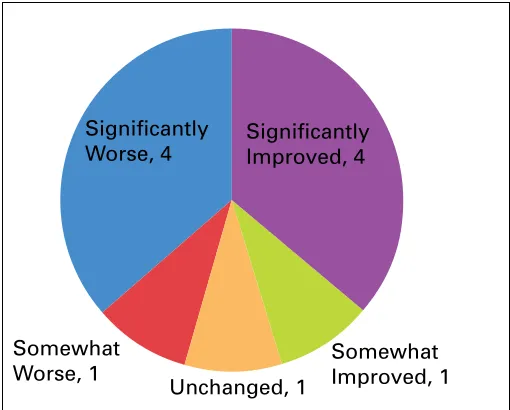
Patient responses to the GRA scale are summarized in Fig. 1. Two patients died prior to administering the GRA scale, so there were only 11 respondents. Based on their responses, 5
patients had a successful therapeutic outcome (4 significant-ly improved, 1 somewhat improved), and 6 failed to respond to surgical conversion (4 significantly worse, 1 somewhat worse, 1 unchanged). The symptoms of the one living neuro-genic bladder patient were unchanged. In the BPS/IC group, GRA responses were evenly split (4 significantly improved, 1 somewhat improved, 4 significantly worse, 1 somewhat worse). However, when the BPS/IC group was stratified to whether they had a concurrent cystourethrectomy, there was a trend towards superior symptom response with concur-rent cystourethrectomy (2/3 improved) versus delayed or no cystourethrectomy (3/7).
Discussion
Patients with neurogenic bladder and BPS/IC can have debilitating symptoms despite conservative therapy, and may require surgical intervention in the form of an aug-mentation ileocystoplasty or a urinary diversion. We have presented the second series in the urological literature of patients converted to a urinary diversion utilizing the patch from the original bladder augmentation.
The first case report of this surgery was by Emmert and colleagues. In their case, the male paraplegic with a neuro-genic bladder maintained renal function and normal upper urinary tracts after 2 years of follow-up.12 In a multicentre
case series, Bissada and colleagues described successful clinical outcomes after 42 months; they tallied the mean follow-up of 29 patients who underwent urinary conduit creation using retubularized bowel from continent urinary diversions or enterocystoplasty.13 A sub-study of the patients
Table 3. Clavien-Dindo classification of surgical complications*
Complication complicationGrade of occurrencesNo. Early/Late Comments
Parastomal hernia I 1 Late (1) Observed
Small bowel obstruction I 2 Late (2) Treated conservatively
Wound infection II 3 Early (3)
Peri-operative blood transfusion II 2 Early (2)
Urinary tract infection II 6 Early (1), Late (5) Pyelonephritis (1), urosepsis (3)
Pyocystis II 1 Late (1)
Stomal stricture IIIa 1 Late (1) Requiring regular stent changes
Colovesical/enteroconduit fistula IIIb 1 Late (1)
Parastomal hernia IIIb 4 Late (4) Surgically repaired
Incisional hernia IIIb 2 Late (2) Surgically repaired
Stomal retraction IIIb 1 Late (1) Required revision of stoma
Ureteral stricture IIIb 2 Late (2) One patient developed CRI, one required ureteric reimplantation
*Based on Dindo et al.14 CRI: chronic renal insufficiency.
Grade I: Deviation from normal post-op course without pharmacological, surgical, endoscopic, or radiological intervention
Grade II: Requiring pharmacological treatment other than those allowed for grade I complications (e.g. analgesics); including TPN and blood transfusions Grade IIIa: Surgical/endoscopic/radiological intervention not under general anesthesia
with IC was subsequently completed.17 The authors
conclud-ed that conversion from an enterocystoplasty or continent urinary diversion to a urinary conduit utilizing the original bowel segment yielded acceptable patient outcomes in this population, with no intraoperative or early postoperative complications.
The two populations of patients included in our series differed in terms of their indications for surgical conversion, but all had at least 1 symptom rated as severely bothersome. The primary indications for conversion in the neurogenic bladder and BPS/IC groups were intolerance of catherization with persistent incontinence, and ongoing LUTS or recurrent pelvic pain, respectively. Intra-operative and early compli-cations were rare, with most complicompli-cations being late-pre-senting and generally amenable to conservative or minor surgical therapy. The higher frequency of long-term compli-cations in this series may reflect the longer follow-up period (mean 80 months), as well as the use of the Clavien-Dindo classification which more rigorously categorizes complica-tions.14 There were no Grade IV or V complications, and of
the complications requiring subsequent surgical manage-ment (Grade IIIa or IIIb), most were related to stomal or incisional complications. Two patients developed ureteral strictures requiring operative intervention, with 1 developing resultant chronic renal insufficiency. All other patients had preserved renal function at last follow-up.
Of importance is the frequency of subsequent surgery required by the BPS/IC population. Nine of 11 patients required additional surgical intervention either due to complications or ongoing symptoms, particularly persistent pelvic pain. In addition, based on GRA responses, only half of these patients were satisfied with their postopera-tive symptom response. This reflects the general difficulty
in symptom control in the most severely affected subset of an already challenging BPS/IC population. In addition, these findings may be confounded by other factors perceived by the patient as bothersome, such as postoperative complica-tions, or the day-to-day challenges of ostomy management, which are not reflected in the GRA responses. Complicating matters further is the finding that there may be up to a 50% incidence of temporary remission unrelated to therapy in the BPS/IC population for a mean duration of 8 months.18
Nevertheless, the outcomes for the BPS/IC population emphasizes the importance of thorough preoperative coun-selling to inform patients of the potential complications and the need for additional surgery, and to assess their general satisfaction with the procedure.
Although the numbers in this series are small, there may be a trend towards superior symptom response in BPS/IC patients who undergo concurrent cystourethrectomy ver-sus delayed or no cystourethrectomy (2/3 and 3/7 reporting symptom improvement, respectively). This may reflect an inadequate symptom response arising from the remaining pathological bladder and the resulting perception that the initial conversion surgery failed to treat the underlying con-dition. However, it has been shown that BPS/IC patients may still have persistent pelvic pain after bladder remov-al,19 which makes it difficult to draw conclusions from the
observed trend.
There are several advantages to creating a urinary diver-sion from the prior augmentation cystoplasty patch. It elim-inates the intravesicle mucous accumulation associated with a residual bladder patch and minimizes the potential metabolic and nutritional consequences of additional bowel shortening.12,13,17 The latter benefit is of particular
impor-tance in patients who have undergone or will undergo fur-ther bowel surgery for their current or future conditions.20,21
Utilizing a retubularized cystoplasty patch also eliminates the need to mobilize a new segment of bowel and create a new bowel anastomosis, a process made more difficult by adhesions and the altered intra-peritoneal anatomy stem-ming from the previous intra-abdominal surgery. This also minimizes the risk of anastomotic leak, peritonitis and intra-abdominal abscess.13 In our study, new uretero-ileal
anas-tomoses were created; however, there is also the potential to eliminate new uretero-enteric anastomoses in suitable patients.13
Conclusion
Late complications are common, but typically low grade, in patients with neurogenic bladder and BPS/IC converted to an ileal conduit utilizing the retubularized patch from the initial augmentation ileocystoplasty. However, most patients will require subsequent surgical intervention and only half will be satisfied with their symptom response. Nevertheless, Significantly
Worse, 4
Somewhat
Worse, 1 Unchanged, 1 Somewhat Improved, 1
Significantly Improved, 4
several patients still achieve symptom control when no other treatment option is available to them. Therefore, in this population, surgical conversion offers several therapeutic advantages over creation of a de novo conduit and should be considered as a viable treatment option when other less invasive therapies have failed.
Competing interests: None declared.
This paper has been peer-reviewed.
References
1. Greenwell TJ, Venn SN, Mundy AR. Augmentation cystoplasty. BJU Int 2001;88:511-25. http://dx.doi.org/10.1046/j.1464-4096.2001.001206
2. Reyblat P, Ginsberg DA. Augmentation cystoplasty: what are the indications? Curr Urol 2008;9:452-8. http://dx.doi.org/10.1007/s11934-008-0078-0
3. Dahl DM, McDougal WS. Use of Intestinal Segments in Urinary Diversion. In: Campbell-Walsh Urology. 9th Edition. Edited by AJ Wein, LR Kavoussi, AC Novick et al. Elsevier Inc.]; 2007:2564-70.
4. Herschorn S, Hewitt RJ. Patient perspective of long-term outcome of augmentation cystoplasty for neu-rogenic bladder. Urology 1998;52:672-8. http://dx.doi.org/10.1016/S0090-4295(98)00220-9 5. Rossberger J, Fall M, Jonsson O, et al. Long-term results of reconstructive surgery in patients with
bladder pain syndrome/interstitial cystitis: subtyping is imperative. Urology 2007;70:638-42. http://dx.doi.org/10.1016/j.urology.2007.05.028
6. Peeker R, Aldenborg F, Fall M. The treatment of interstitial cystitis with supratrigonal cystectomy and ileocystoplasty: difference in outcome between classic and nonulcer disease. J Urol 1998;159:1479-82. http://dx.doi.org/10.1097/00005392-199805000-00018
7. Golomb J, Klutke CG, Lewin KJ, et al. Bladder neoplasms associated with augmentation cystoplasty: report of 2 cases and literature review. J Urol 1989;142:377-80.
8. Stone AR, Davies N, Stephenson TP. Carcinoma associated with augmentation cystoplasty. Br J Urol 1987; 60:236-8. http://dx.doi.org/10.1111/j.1464-410X.1987.tb05490.x
9. Lane T, Shah J. Carcinoma following augmentation ileocystoplasty. Urol Int 2000;64:31-2. http://dx.doi.org/10.1159/000030479
10. Mitchell ME, Kulb TB, Backes DJ. Intestinocystoplasty in combination with clean intermittent catheterization in the management of vesical dysfunction. J Urol 1986;136:288-91.
11. Khoury JM, Timmons SL, Corbel L, et al. Complications of enterocystoplasty. Urology 1992;40:9-14. http://dx.doi.org/10.1016/0090-4295(92)90428-Y
12. Emmert GK Jr, Bissada NK. Formation of ileal conduit utilizing ileal patch from augmentation cystoplasty. Urology 1993;42:190-2. http://dx.doi.org/10.1016/0090-4295(93)90645-Q
13. Bissada NK, Herschorn S, Elzawahri A, et al. Urinary conduit formation using retubularized bowel from continent urinary diversion or intestinal augmentations: I. A multi-institutional experience. Urology 2004;64:485-7. http://dx.doi.org/10.1016/j.urology.2004.04.076
14. Dindo D, Demartines N, Clavien PA. Classification of surgical complications: a new proposal with evaluation in a cohort of 6336 patients and results of a survey. Ann Surg 2004;240:205-13. http://dx.doi.org/10.1097/01.sla.0000133083.54934.ae
15. Gajewski JB, Al-Zahrani AA. The long-term efficacy of sacral neuromodulation in the management of intrac-table cases of bladder pain syndrome: 14 years of experience in one centre. BJU Int 2011;107:1258-64. http://dx.doi.org/10.1111/j.1464-410X.2010.09697.x. Epub 2010 Sep 30.
16. Peters KM, Killinger KA, Ibrahim IA, et al. The relationship between subjective and objective assessments of sacral neuromodulation effectiveness in patients with urgency-frequency. Neurourol Urodyn 2008;27:775-8. http://dx.doi.org/10.1002/nau.20592
17. Elzawahri A, Bissada NK, Herchorn S, et al. Urinary conduit formation using a retubularized bowel from continent urinary diversion or intestinal augmentations: ii. Does it have a role in patients with interstitial cystitis? J Urol 2004;171:1559-62. http://dx.doi.org/10.1097/01.ju.0000116772.74358.39 18. Held PJ, Hanno PM, Wein AJ. Epidemiology of Interstitial Cystitis. In: Interstitial Cystitis.
Edited by PM Hanno, DR Staskin, RJ Krane, et al. London: Springer-Verlag; 1990:29-48. http://dx.doi.org/10.1007/978-1-4471-3293-6_4
19. Baskin LS, Tanagho EA. Pelvic pain without pelvic organs. J Urol 1992;147:683-6.
20. Cruz DN, Huot SJ. Metabolic complications of urinary diversions: an overview. Am J Med 1997;102:477-84. http://dx.doi.org/10.1016/S0002-9343(97)00020-X
21. Mills RD, Studer UE. Metabolic consequences of continent urinary diversion. J Urol 1999;161:1057-66. http://dx.doi.org/10.1016/S0022-5347(01)61590-8