© 2015, IRJET.NET- All Rights Reserved
Page 59
ANALYSIS OF G+15 RCC AND COMPOSITE STRUCTURE HAVING A SOFT
STOREY AT GROUND LEVEL BY RESPONSE SPECTRUM AND EQUIVALENT
STATIC METHODS USING ETABS 2013
Umesh P. Patil
1, Suryanarayana M
21. Associate Professor, Dept. of Civil Engineering, KLE Dr .MSSCET, Belagavi – 590008 (Karnataka). 2. M-Tech Student in Dept. of Civil Engineering, KLE Dr. MSSCET, Belagavi – 590008(Karnataka).
………..……***……….………
ABSTRACT
Comparing to RCC structures, steel concrete composite system are being more popular due to the various advantages they offer. Both speed and economy can be achieved in case of composite systems. An attempt was made in this work to evaluate and compare the seismic performance of G+ 15 storey’s made of RCC and composite structures ETABS 2013 software was used for the purpose. Both steel and concrete composite structures and RCC structures were having soft storey at ground level, structures were located in the region of earthquake zone III on a medium soil. Equivalent static and response spectrum method is used for analysis. Storey drift, self weight, bending moment and shear force, are considered as parameters. When compared composite structures shows better performance than RCC.
Key words:
Composite steel-concrete systems, Soft
storey, Equivalent static method, Response spectrum
method, Base shear.
1.
INTRODUCTION
Composite members are made up of two different materials such as steel and concrete which are used for beams and columns. The steel and concrete structures have wide applications in multistory commercial buildings and factories as well as in case of bridges. Steel and concrete have almost the same thermal expansion, concrete is efficient in taking compression loads and steel is subjected to tensile loads. Composite structures are becoming popular and preferred choice of structural Engineers as disadvantages of using purely steel or purely concrete structures can be minimized. In composite construction initial construction loads will be carried out
by steel frame sections including the self weight during construction and then concrete is cast around the section or concrete is poured inside the tubular section.
In this work, an attempt was made to compare the study of seismic performance of RCC and composite structures with soft storey at ground floor with different height using ETABS 2013. Storey drift, self weight, bending moment and shear force in columns are considered as parameters.
1.1 Components of composite structures
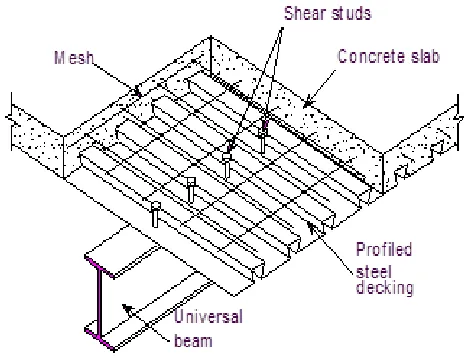
Composite slab
A composite slab in which steel sheets are connected to the composite beam with the help of shear connectors, initially steel sheets act as permanent shuttering and also act as bottom reinforcement for steel deck slab and later it is combined with hardened concrete.
© 2015, IRJET.NET- All Rights Reserved
Page 60
Shear connectors
Shear connectors (studs) are used to connect the concrete and structural steel and they give the sufficient strength and stiffness to the composite member.
Fig 2: Installation of Shear Studs
Composite beam
A composite beam is a steel beam or partially encased beam which is mainly subjected to bending and it supports the composite deck slab.
Fig 3: composite beam
Composite column
Composite columns are a composite compression members or bending and compression members with steel encased sections partially or fully and concrete filled tubes.
Fig 4: Composite Column
Plastic resistance of a composite column of a cross section will be determined by following equation
For concrete encased and partially concrete encased sections
PPC = Aa*fyd + 0.85Ac*fcd + As*fsd Eq-1
For concrete filled sections
PPC = Aa*fyd + Ac*fcd + As*fsd Eq-2
Aa – cross sectional area of structural steel
Ac – cross sectional area of concrete
As – cross sectional area of reinforcing steel
fyd – design value of yield strength of structural steel
fcd – design value of yield strength of cylindrical
compressive strength of concrete
fsd – design value of yield strength of reinforcing steel
1.2 Behavior of Soft Storey
Due to the presence of soft storey in the buildings large stress concentration will be developed at the joints which lead to formation of plastic hinges these plastic hinges will leads to collapse of structure. It may be soft storey at ground storey level or may be upper storey level the frame structures will undergo large sway mechanism. This sway will leads to formation of plastic hinges at top and bottom ends of the columns therefore these columns will subjected to large deformation.
Fig 5: Behavior of Soft Storey
2.
MODELING AND BUILDING DATA
© 2015, IRJET.NET- All Rights Reserved
Page 61
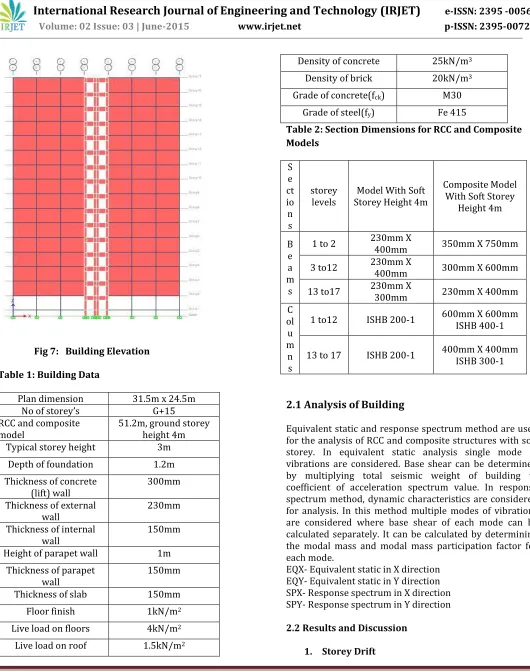
Fig 7: Building ElevationTable 1: Building Data
Plan dimension 31.5m x 24.5m
No of storey’s G+15
RCC and composite model
51.2m, ground storey height 4m Typical storey height 3m
Depth of foundation 1.2m
Thickness of concrete
Height of parapet wall 1m
Thickness of parapet wall
150mm
Thickness of slab 150mm
Floor finish 1kN/m2
Live load on floors 4kN/m2
Live load on roof 1.5kN/m2
Density of concrete 25kN/m3
Density of brick 20kN/m3
Grade of concrete(fck) M30
Grade of steel(fy) Fe 415
Table 2: Section Dimensions for RCC and Composite Models
2.1 Analysis of Building
Equivalent static and response spectrum method are used for the analysis of RCC and composite structures with soft storey. In equivalent static analysis single mode of vibrations are considered. Base shear can be determined by multiplying total seismic weight of building to coefficient of acceleration spectrum value. In response spectrum method, dynamic characteristics are considered for analysis. In this method multiple modes of vibrations are considered where base shear of each mode can be calculated separately. It can be calculated by determining the modal mass and modal mass participation factor for each mode.
EQX- Equivalent static in X direction EQY- Equivalent static in Y direction SPX- Response spectrum in X direction SPY- Response spectrum in Y direction
2.2 Results and Discussion
© 2015, IRJET.NET- All Rights Reserved
Page 62
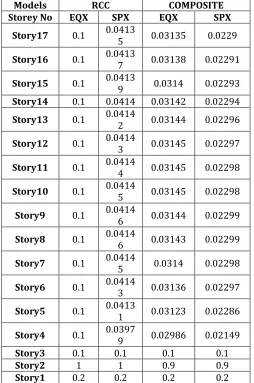
Table 3: Storey Drift (in mm) for Equivalent Static andResponse Spectrum Methods
Models RCC COMPOSITE
Storey No EQX SPX EQX SPX
Story17 0.1 0.0413
5 0.03135 0.0229
Story16 0.1 0.0413
7 0.03138 0.02291
Story15 0.1 0.0413
9 0.0314 0.02293 Story14 0.1 0.0414 0.03142 0.02294
Story13 0.1 0.0414
2 0.03144 0.02296
Story12 0.1 0.04143 0.03145 0.02297
Story11 0.1 0.04144 0.03145 0.02298
Story10 0.1 0.0414
5 0.03145 0.02298
Story9 0.1 0.0414
6 0.03144 0.02299
Story8 0.1 0.0414
6 0.03143 0.02299
Story7 0.1 0.0414
5 0.0314 0.02298
Story6 0.1 0.0414
3 0.03136 0.02297
Story5 0.1 0.0413
1 0.03123 0.02286
Story4 0.1 0.0397
9 0.02986 0.02149
Story3 0.1 0.1 0.1 0.1
Story2 1 1 0.9 0.9
Story1 0.2 0.2 0.2 0.2
Storey drift is reduced by 10% in composite models compared to RCC in soft storey level. In other storey’s using equivalent static case, storey drift is reduces by 70% and the same reduces by 50% using response spectrum case.
2. Self Weight
Table 4: Self Weight (in kN) For RCC and Composite Models
Models
Self Weight (in KN)
RCC
208524.3
Composite
188811.1
Chart 1:Self Weight For RCC and Composite Models
Self weight is reduced by 10% in composites compared to RCC.
3. Bending Moments
Table 5: Bending Moment (in kN – m) for Corner Column
Models Bending moment in X direction
bending moment in Y direction
RCC 95.6772 10.3626
Composite 84.2998 39.7226
© 2015, IRJET.NET- All Rights Reserved
Page 63
Chart 2:Bending Moment for Corner Column4. Shear Force
Table6: shear force (in kN) for corner column
Models Shear Force in X direction
shear force in Y direction
RCC 38.5561 4.4534
Composite 32.6495 15.2413
Chart 3:shear force for Corner Column
Shear force in X direction in composites is reduced by 16% compared with RCC, but in Y direction increases by 65%.
3.
CONCLUSION
Two structures G+15, one made of composite steel concrete material and other one is made up of RCC, situated in the earth quake zone III, having a medium soil were investigated analytically for their performance using ETABS software. Following are the broad conclusions
Storey drift reduces in composite structures as compared to RCC, because composite structures have higher stiffness than that of RCC. In both RCC and composite structures, storey drift is within permissible limit, i.e., 0.004 times the height of storey.
Storey drift is different in both X and Y direction because of the difference in moment of inertia in the column sections.
It is possible to control the drift in soft storey by providing 1) Shear walls 2) Bracings 3) Stiffer column 4) Lateral load resisting system.
The beams and columns in the soft storey are designed 2.5 times of obtained bending moments and shear forces. And shear walls are designed by a factor of 1.5 times the storey shear.
Self weight of composite structures reduces as compared to RCC which in turn reduces the foundation cost. Due to the reduction of self weight of composite structures, it induces fewer amounts of lateral forces.
Bending moments and shear forces in columns for composite structures are less as compared with RCC structures in X direction, but in Y direction RCC have more bending moments.
Composite structures are being more ductile, resist lateral load better than RCC structures.
ACKNOWLEDGEMENT
The authors would like to thank Shri S C Metagud Chairman Governing council and Dr. Basavaraj G Katageri principal of Dr. M. S. Sheshgiri college of Engineering and Technology, Belgavi for their kind support and providing good infrastructure. The authors are grateful to Prof. (Smt) Bharti Chnivalar Head of Department for encouragement and support.
REFERENCES
[1] D.R Panchal and P.M. Marthe (December, 2011) “Comparative Study of RCC, Steel and Composite (G+30) Storey Building” Institute Of Technology, Nirma University, Ahmedabad – 382 481, pp 1-6
[2] Mahesh Suresh Kumawat And L.G.Kalurkar (May 2014) “Analysis And Design Of Multistory Building Using Composite Structure” International Journal Of Structural And Civil Engineering Research Vol. 3, No. 2 pp 126-137.
[3] Nitin M Wared and P.J.Salunke December, 2013 “Comparative Study On Analysis And Design Of Composite Structure” International Journal Of Advance Research In Science And Engineering Vol. No.2, Issue No.12, pp 41-50.
© 2015, IRJET.NET- All Rights Reserved
Page 64
Lateral Loading” Chemical, Civil And MechanicalEngineering Tracks Of The 3rd Nirma University International Conference On Engineering pp 259-265.
[5] Mehmet Inel and Hayri B Ozmen(October 2008) “Effect Of Infill Walls On Soft Story Behavior In Mid-Rise RC Buildings” The 14th World Conference On Earthquake Engineering ,Beijing, China.
[6] Amish N. Shah 1, Dr. P.S. Pajgade(March -April 2013) “ Comparison Of R.C.C. And Composite Multistoried Buildings” International Journal Of Engineering Research And Applications (IJERA) ISSN: 2248-9622 Vol. 3, Issue 2, pp .534-539.
[7]” Euro code 4” Design Of Composite Steel and Concrete Structures - Part 1-1: General Rules and Rules for Buildings BS EN 1994-1-1:2004 EN 1994-1-1:2004
[8] “IS 1893(Part 1): 2002”Criteria for Earthquake Resistant Design Of Structures Part 1 General Provisions and Buildings (Fifth Revision) Bureau of Indian Standards New Delhi.
[9] Dr. Vinod Hosur “Earth Quake Resistant Design of Building Structures” Wiley India Pvt. Ltd. Publications, first edition 2013