CUAJ • April 2018 • Volume 12, Issue 4(Suppl1) © 2018 Canadian Urological Association
table of contents
S2
S1 Introduction – Transitioning children with
urological issues into adulthood P.A.M Anderson, A. Cox
Cite as: Can Urol Assoc J 2018;12(4Suppl1):S1. http://dx.doi.org/10.5489/cuaj.5312
S3 Spina bifida
A.A. Saavedra, D. MacLellan, G.J. Gray
Cite as: Can Urol Assoc J 2018;12(4Suppl1):S3-9. http://dx.doi.org/10.5489/cuaj.5272
S10 All grown up: A transitional care perspective on
the patient with posterior urethral valves M.A. Keays, K. McAlpine, B. Welk
Cite as: Can Urol Assoc J 2018;12(4Suppl1):S10-4. http://dx.doi.org/10.5489/cuaj.5228
S15 Contemporary issues relating to transitional care
in classical bladder exstrophy
F. O’Kelly, D. Keefe, A.J. Lorenzo, S. Herschorn Cite as: Can Urol Assoc J 2018;12(4Suppl1):S15-23. http://dx.doi.org/10.5489/cuaj.5313
S24 Augmented bladders and urinary diversions
P. Metcalfe, S. De, G. Bailly
Cite as: Can Urol Assoc J 2018;12(4Suppl1):S24-6. http://dx.doi.org/10.5489/cuaj.5226
S27 Transitioning patients with hypospadias and
other penile abnormalities to adulthood: What to expect?
K. Rourke, L.H. Braga
Cite as: Can Urol Assoc J 2018;12(4Suppl1):S27-33. http://dx.doi.org/10.5489/cuaj.5227
S34 Varicocele
K. Afshar, T. Domes
Cite as: Can Urol Assoc J 2018;12(4Suppl1):S34-6. http://dx.doi.org/10.5489/cuaj.5231
S37 Urological issues arising after treatment of
pediatric malignancies R.L.P Romao, A. Cox
Cite as: Can Urol Assoc J 2018;12(4Suppl1):S37-41. http://dx.doi.org/10.5489/cuaj.5279
S42 Dysfunctional voiding: Challenges of disease
transition from childhood to adulthood
F. Morin, H. Akhavizadegan, A. Kavanagh, K. Moore
Cite as: Can Urol Assoc J 2018;12(4Suppl1):S3-9. http://dx.doi.org/10.5489/cuaj.5272
Background
Neural tube defects (NTDs) are a group of diverse anoma-lies of the central nervous system caused by faulty closure of the neural tube during embryological development. The most common NTDs are spina bifida, anencephaly, and encephalocele. Due to dietary folic acid supplementa-tion, the prevalence of all NTDs (including spina bifida) in Canada declined after 1996. Increased prenatal screening and diagnosis may have also contributed to the decline of NTDs. In 2007, spina bifida accounted for 2.7 per 10 000
births (live and still births) in Canada.1
The goals for management of the urological system in children with spina bifida change with age. For the newborn, preservation of renal function is the primary goal. Urine and fecal continence are added to the list of objectives in
school-aged children. For the adolescent, independence and sexual
function become important goals.2 Reconstructive
proce-dures that may require ongoing urological followup include bladder augmentation, continent catheterizable channels, incontinent diversions, antegrade continence enema chan-nels, or buttons.
Spina bifida results in a variable amount of insult to somatic, sympathetic, and parasympathetic systems. Bladder and bowel function are adversely affected and patients may have lifelong issues with urinary and bowel incontinence, constipation, urinary tract infections (UTIs), urinary stones, renal dysfunction, and sexual and reproductive function.
Lifelong followup by a urologist is recommended.3 Close
to 90% of adult spina bifida patients report an active
uro-logical issue.3,4 Of these, up to 80‒97% require some form
of diagnostic, medical, or surgical intervention.3,4 The most
common urological problems identified in adult patients
with spina bifida include: incontinence (29‒52%), recurrent
UTI (24‒34%), catheterization troubles (6‒12%), and calculi
(9‒19%).3,4 One of the most frequently unaddressed issues
prior to transition is sexual and reproductive function.5 Thus,
active urological issues are common and frequently require
intervention, mandating frequent followup.3
What are the challenges in transitioning these patients?
Pediatric perspective
The responsibility of the pediatric urologist is to identify an adult/transitional care provider and prepare the child for transition, that is to ensure that they can manage their own healthcare, such as being able to take and order medicines, use medical supplies, and communicate with healthcare
providers.6 It is estimated that less than one-quarter of adults
with spina bifida will live independently in early adulthood.7
Thus, it may be unrealistic for all young adults to achieve all of these markers of independence prior to transition.
Some studies have shown dismal rates of successful
transi-tion, as low as 40%.8,9 Those that did not transition to adult
Alvaro A. Saavedra, MD
1; Dawn MacLellan, MD, FRCSC
2; Gary J. Gray, MSc, MD, FRCSC
11Division of Urology, Department of Surgery, University of Alberta, Edmonton, AB; 2Department of Urology, Dalhousie University, Halifax, NS; Canada
Spina bifida
Case
You received the following referral from one of your pediatric
colleagues:
Please see this 19-year-old G1P0 female who had been referred to your office approximately two years ago. Unfortunately, she did not attend her scheduled appointment. Currently, she has a singleton pregnancy at 30 weeks gestation. Past
medical history includes: myelomeningocele (L5‒
CUAJ • April 2018 • Volume 12, Issue 4(Suppl1) S4
saavedra et al
urology care had a higher rate of emergency department use.8
Transitioned spina bifida patients have identified a lack of assessment of financial/employment issues and not visiting the
adult clinic prior to transition as barriers in transitional care.10
The multisystem nature of spina bifida results in transition issues that are specific to this population that differ greatly from other adolescents transitioning to adult care, including increased rates of obesity, sexual dysfunction, impaired cog-nition, depression, decreased mobility, incontinence, aging caregivers, lack of insurance coverage, loss of the school
support system, and loss of peer groups.2
An effective transition process can be supported by pro-viding an opportunity to visit the adult clinic prior to
tran-sition10 and ongoing communication between the
pediat-ric and adult caregiver, even after transfer of care.11 Trust
and personal relationship with their pediatric urologist was reported by patients to be one of the most important factors
in successful transition.5
Adult perspective
Over the last decades, there has been an enormous improve-ment in spina bifida patients’ survival rates to adulthood,
from around 25% in the 1960s12 to as high as 82% in 2011.13
These changes can be explained by the introduction of anti-biotic improvements, along with ventriculoperitoneal shunts in the mid 20th century and clean intermittent
catheteriza-tion (CIC) in the 1970s.14
The first step in order to properly transition a pediatric patient into an adult-oriented healthcare system is to state clear goals to be achieved. In this regard, it seems that the objectives of the health system, caregivers, and patients are
not always aligned.15,16
Clinical urological challenges in spina bifida patients
transitioning to adulthood
Urological outcomes of adults with spina bifida are greatly affected by several non-urological aspects of the disease, i.e., mental compromise, spinal deformities, decreased mobil-ity, Charcot’s arthropathy, eating disorders, obesmobil-ity, and decreased respiratory and bowel function, all of which are beyond the scope of this article. There are also many critical psychological issues secondary to spina bifida and its
treat-ments.5 Therefore, the literature is consistent in expressing
the importance of creating clinics led by multidisciplinary and transition-trained teams.
In regard to urological issues in transitioning patients with spina bifida, different authors have consistently stated
spe-cific goals or fields to be managed.15,17-19
Self-esteem and sexuality
In order to achieve satisfactory sexual development, individu-als need neurological, functional, and anatomical features that work reasonably well. Decreased mobility and anatomical deformities may be incompatible with sexual activity, while sensory disturbances can make these experiences less satisfac-tory. Additionally, a highly dependent daily life often causes reduced privacy, and difficulties with both bowel and bladder
control reduce self-esteem.20 Ultimately, these issues become
barriers to adolescents becoming capable of intimacy.17
If these barriers are overcome, women are much more
likely to enage in sexual activity than men,21 probably due
to a multifactorial erectile dysfunction rate that can be as
high as 86%.22 This rate is dependent on the compromised
spinal cord level.23 Risk factors for sexual issues have been
found to be low self-confidence, hydrocephalus, and urinary
incontinence.24 In addition to the obvious effects of erectile
dysfunction and ejaculatory disorders on impaired fertility, some studies have also shown a high frequency of poor
semen quality and azoospermia.25,26
Issues concerning female fertility and pregnancy will be discussed below.
Renal function
From an overall survival perspective, preservation of renal function is the mainstay of the management of spina bifida
patients.27-29 In one study, around one-third of all spina bifida
patients who died by 35 years old did so due to renal fail-ure.29 In the same way that they affect other non-urological
spina bifida-associated problems, both the severity (spina
bifida occulta, meningocele, or myelomeningocele) and the spinal level at which the lesion is located, also affect risk to renal function. Higher lesions entail more risk of detrusor-external sphincter dyssynergia (DSD) and of an elevated detrusor leak point pressure (DLPP), which can ultimately impair the kidneys.30 High bladder pressures due to
neuro-genic bladder, vesicoureteral reflux, and UTI have typically been described as main causes of renal damage in this set-ting. However, problems secondary to urinary diversions, like either bladder/reservoir, ureteral or kidney stones, ure-teroileal anastomosis stricture, high reservoir pressure, poor compliance with self-catheterization and unknown causes, have been described as well.31 Hypertension can be as
fre-quent as 23% of patients >20 years old,32 while other factors,
such as sedentary lifestyle, can contribute to increased risk of hyperfiltration and subsequent renal damage progression.18
prevent or to treat secondary renal failure when conservative
management has failed.33
Bladder management
A cornerstone issue to be managed in individuals with spina bifida is bladder function, namely filling and emptying phas-es in both native and reconstructed bladders.
Native bladders
As previously discussed, a “low-pressure bladder” is criti-cal for renal function protection. Several factors can affect spina bifida patients’ bladder at the same time: pelvic floor or sphincteric deficiency, impaired compliance, and detrusor hyperreflexia. Unfortunately, it seems that bladder pressure,
along with outlet resistance, increases during puberty.34,35
Continence is also a critical aim in patients transitioning to adulthood because it is highly associated with psychosocial outcomes and self-confidence. In neurogenic native blad-ders, conservative management should be initiated early, including anticholinergic agents and CIC as first-line
treat-ment or botulinum toxin A,36 depending on patient
charac-teristics. However, adolescent adherence to any long-stand-ing treatment is low, and it is even lower with regard to CIC
and clinic appointments.37 In addition, some complications
also arise during adolescence, such as urethral strictures or
injuries, UTIs,18,38 and bladder stones.
Reconstructed bladders
When conservative management has failed, patients often undergo surgery to create a low-pressure reservoir and achieve continence. This can be accomplished by means of a bladder augmentation or a bladder substitution, which in turn can be continent or incontinent, usually constructed using ileum or colon. Bladder neck surgery and catheter-izable channels may be needed as well. Although these surgeries are the best way to create low-pressure-continent reservoirs in failed patients, they can carry numerous long-term complications related to the bowel tissue used, i.e., bladder/resevoir stones in >50% of patients, permanent
mucous production,39 vitamin B12 deficiency,18
hyperchlore-mic metabolic acidosis, recurrent UTI, and reservoir
perfora-tion. There is also higher malignancy risk between 1.2‒5.5%
in the reconstructed reservoir, depending on the
gastrointes-tinal segment used,40,41 although it remains unclear whether
this risk is due to the reconstruction itself or other factors.42
In summary, the main goals for these individuals are: 1) to achieve a compliant patient with 2) a compliant/non-obstructed/continent bladder or reservoir; and 3) to mini-mize the associated complications.
Urolithiasis and chronic UTIs
In the setting of adult patients with neurogenic bladder, there are several situations resulting in increased incidence
(between 9.2 and 20.8%) of urinary stones.3,4,43 These include
indwelling catheters, urinary diversion, immobilization,
incomplete emptying, stasis, and UTIs.44 When comparing
spina bifida with non-spina bifida patients treated for uro-lithiasis, the former were younger, needed more complex treatment, and had more severe complications than the
lat-ter.44 There is an estimated rate of UTIs as high as 34%,4
while stones or UTIs were involved in about 50% of spina
bifida patients who were hospitalized.45
The main aims in this regard are to 1) prevent formation and to make a timely diagnosis of urinary stones; 2) devel-op a cost-effective method to detect UTIs in spina bifida patients; and 3) create a protocol to determine who benefits from treatment and who does not.
Recommendations for management of these challenges
General recommendations
Although there are no currently available clinical guide-lines for the ongoing management of transitioned adult spina bifida patients, we recommend close followup of the upper and lower urinary tract to anticipate and intervene prior to significant complications where possible.
In general, these patients are followed at our centre according to European Association of Urology (EAU) guide-lines for followup of neurogenic lower urinary tract
dys-function (NLUTD).46 This stipulates annual history, physical
examination, blood biochemistry, and urine microbiology. We do not perform upper tract imaging every six months, but do so annually. We also lack the capacity to perform annual urodynamic testing, but will perform this whenever there is a change in baseline lower urinary tract function or upper tract deterioration (either radiological or biochemical).
Planning a transitional urology clinic
The health transition concept has been defined and widely standardized by the Society for Adolescent Medicine in the U.S. as, ‘‘a purposeful, planned process that addresses the medical, psychosocial, and educational/vocational needs of adolescents and young adults with chronic physical and medical conditions as they move from child-centred to
adult-oriented healthcare systems.”47 This wide definition can be
applied to a transition process of any kind. Having a poor transition system has consistently been shown to decrease
CUAJ • April 2018 • Volume 12, Issue 4(Suppl1) S6
saavedra et al
In 2008, Viner stated three mainstays when planning a transitioning process as, “Firstly, prepare young people and their families well in advance for moving from pediatric to adult services and ensure they have the necessary skill set to survive and thrive there. Secondly, prepare and nur-ture adult services to receive them. Thirdly, listen to young
people’s views.”50
The transitional urology clinic should be part of a tertiary referral centre. We suggest the creation, to the extent that it is possible, of a comprehensive database including all spina bifida patients being seen in every family medicine and pedi-atric clinic that will potentially refer patients. Collaboration between adult and pediatric urologists, as well as primary care providers, is needed to define the future network sys-tem design. Some approaches may include: 1) the pediatric urologist continues caring for the patient until adulthood; 2) the joint clinics are housed in a pediatric or adult centre; and 3) the adult urologist periodically visits the pediatric clinic while the transition process begins.
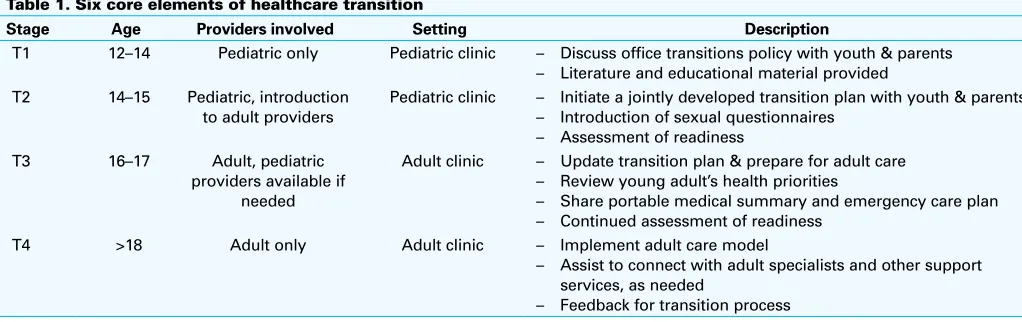
After basic statistics and the burden of disease are prop-erly determined, the main plan can be then drafted. Starting from the very clear and well-designed transition plan
cre-ated by the REACH clinic15 as a baseline, we suggest some
minor modifications taken from one of the most widely
accepted frameworks,51 namely the “Six core elements of
healthcare transition”52 (Table 1).
What I tell my patient to prepare for transition
(pediatric urologist)
I suggest introducing the topic of transition several years before it is planned and at multiple visits. We offer families an opportunity to visit the adult clinic prior to transition. Age at transfer is determined by the personal development and intellectual capacity of the child. It may take place as early as 16 years in a cognitively normal and independent
child. In children with significant cognitive delay, the transi-tion is often delayed until they have completed high school. Approximately one-half of patients feel the appropriate age
for transfer is 18 years.11
At our centre, we are very fortunate to have a dedicated adult spina bifida clinic, thus, in preparing families for transi-tion, I focus on the similarities between the two clinics (i.e., both are multi-disciplinary, have a similar structure, and a dedicated clinic nurse to contact if problems arise between visits). It is helpful to highlight the importance of attending scheduled appointments with adult care provider and the need for lifelong urological followup to avoid significant complications, including renal dysfunction.
As few young adults with spina bifida live independently, I reassure families it is acceptable and encouraged for parents to continue to attend medical appointments with the tran-sitioned adolescent, if that is their preference. I encourage parents to gradually provide their child with opportunities to become more proactive in their healthcare, for example, having early school age children perform their own cath-eterizations or teenagers call the pharmacy to refill their own prescriptions.
I reassure families that there will be an ongoing dialogue between the pediatric centre and the adult care provider. I inform them that I provide all relevant medical records to the adult care provider (all clinic notes, reports of imaging studies, urodynamic reports, and operative notes) and will be available to the adult care provider for discussion should the need arise. Most patients feel that written information
about the transition process would be helpful.11 One-fifth of
patients perceive the adult hospital to be an inappropriate
environment for young adults.11 This lends support to the
concept of a transitional or adolescent clinic to meet the specific needs of this population straddling the pediatric and adult domains of healthcare.
Table 1. Six core elements of healthcare transition
Stage Age Providers involved Setting Description
T1 12–14 Pediatric only Pediatric clinic – Discuss office transitions policy with youth & parents – Literature and educational material provided
T2 14–15 Pediatric, introduction
to adult providers
Pediatric clinic – Initiate a jointly developed transition plan with youth & parents – Introduction of sexual questionnaires
– Assessment of readiness
T3 16–17 Adult, pediatric
providers available if needed
Adult clinic – Update transition plan & prepare for adult care – Review young adult’s health priorities
– Share portable medical summary and emergency care plan – Continued assessment of readiness
T4 >18 Adult only Adult clinic – Implement adult care model
– Assist to connect with adult specialists and other support services, as needed
Case followup
If not already performed, the patient will require the following information to be obtained: 1. Renal function
a. Serum creatinine, electrolytes, BUN
b. Imaging of the upper urinary tract, ultrasound 2. Bladder management
a. Clinical evaluation: lower urinary tract symptons, urine leakage, bowel function, voiding diary b. Imaging of the lower urinary tract, ultrasound
Challenges
There is no evidence supporting the contention that spina bifida, by itself, can significantly reduce fertility in
women,53 however, there are many factors producing a lower pregnancy rate. Social and psychological issues
(low self-esteem), along with reduced mobility and obesity, are probably the main reasons. Since spina bifida
patients are at 4.1% risk of having myelomeningocele (MMC) children,54 special care must be considered as
patients consider pregnancy. These patients require a higher dose of folic acid during the prenatal period. Obesity (a frequent condition in this setting) is also a risk factor for fetal MMC.
Pregnancy problems in SB women can be divided into:
Due to underlying SB: Lumbosacral scoliosis and pelvic abnormalities secondary to muscular atrophy can
occur,55,56 increasing the risk of abnormal fetus presentation, and make vaginal delivery much more difficult.57
Achieving adequate hip abduction may be imposible, owing to an ankylosed joint, ultimately forcing the decision
to perform a cesarean.58,59 An incidence of latex allergy as high as 60% has been found in MMC patients and the
number of prior surgeries is associated with an even greater incidence.60-62 As in the case presented, a
consid-erable proportion of SB patients have undergone ventriculoperitoneal shunting for hydrocephalus during early childhood. Pregnancy entails an elevated intra-abdominal pressure, while an enlarged uterus can compress the
peritoneal catheter so that a shunt malfunction syndrome can develop.54,63,64 Some authors favour vaginal delivery
and to perform extraperitoneal cesarean only for obstetric reasons among individuals with a ventriculoperitoneal
shunt because of the risk of bacterial contamination of cerebrospinal fluid.65 During labour, MMC patients may
have normal uterine contractions, however, the neurological abnormality may cause unnoticed onset of labour,
along with uncoordinated pelvic floor contractions, leading to an obstetric emergency.55
Due to urinary diversion/cystoplasty: Issues during pregnancy can be associated with the reconstruction previ-ously performed and with the subsequent anatomic changes, i.e., abdominal adhesions, uterine retroflexion, fixation of the bowel segment used (at three different sites: ureteral anastomosis, mesentery, and efferent segment); compres-sion of the ureters; and mesentery stretching, which may affect blood supply. However, all of these risk factors are
mainly theoretical and without empirical support.66 Stenosis or prolapse of the stoma,53,67,68 along with catheterizable
tube elongation making catheterization imposible, have been described, with 16‒60% of individuals with
conti-nent diversions needing an indwelling catheter.53,66 Leakage has been reported from stretched conduit stomas when
appliances do not stick properly.23,53 Hydronephrosis may occur in up to 75% of patients with continent diversions,
33% of them ultimately requiring a nephrostomy tuve.53 Pyelonephritis occurs in approximately 30% of diverted
pregnant patients,53 which is higher than in the general population and strongly associated with hydronephrosis.66
Despite many surgeons favouring elective cesarean section, there is a lack of evidence supporting this, and it is generally true that patients with ventriculoperitoneal shunts, augmentations, and MACE reconstructions are best
served by vaginal delivery when posible.53,65 Our patient in particular is at risk of injury to both the vascular supply
of her many orthotopic bowel segments and to the segments themselves in the event of cesarean section, and will require close urological support in this instance. We prefer to be in attendance for all of these procedures.
CUAJ • April 2018 • Volume 12, Issue 4(Suppl1) S8
saavedra et al
What I tell my patient now that they have transitioned
(adult urologist)
In general terms, these patients are often quite individual in their approach to health management due to their exten-sive interactions with the healthcare system throughout their young lives. As such, a degree of negotiation is frequently required to reach agreement on management goals.
When patients are first seen in the clinic, all clinical infor-mation is reviewed and any deficits in knowledge are filled in with appropriate investigations, including history and physical examination, blood work (particularly looking at renal function and metabolic disturbance), urinalysis, imag-ing (particularly kidneys/ureters/bladder [KUB] ultrasound) and urodynamic testing, as appropriate.
If we are able to determine that the patient’s upper tracts are not at risk of deterioration, then management of all other urological concerns is discussed in terms of degree of bother as it relates to risk of intervention. Frequently, the decision will be made to simply follow a concern, as it causes no immediate bother to the patient and no risk to their longevity.
Close collaboration with the pediatric urologist is desired to ensure that we are not missing any prior concerns that may be ongoing.
Competing interests: Dr. Gray has been a sponsored CME speaker for Allergan, Astellas, and Pfizer; and has participated in a clinical trial supported by Bioness. The remaining authors report no competing personal or financial conflicts related to this work.
This paper has been peer reviewed.
References
1. Congenital Anomalies in Canada 2013: A Perinatal Health Surveillance Report. Public Health Agency of Canada. Published Sept 2013. Public Health Agency of Canada. Congenital Anomalies in Canada 2013: A Perinatal Health Surveillance Report. Ottawa, 2013.
2. Snow-Lisy DC, Yerkes EB, Cheng EY. Update on urological management of spina bifida from prenatal diagnosis to adulthood. J Urol 2015;194:288-96. https://doi.org/10.1016/j.juro.2015.03.107 3. Duplisea JJ, Romao RL, MacLellan DL, et al. Urological followup in adult spina bifida patients: Is there an
ideal interval? Urology 2016;97:269-72. https://doi.org/10.1016/j.urology.2016.06.025 4. Summers SJ, Elliott S, McAdams S, et al. Urologic problems in spina bifida patients transitioning to adult
care. Urology 2014;84:440-4. https://doi.org/10.1016/j.urology.2014.03.041
5. van der Toorn M, Cobussen-Boekhorst H, Kwak K, et al. Needs of children with a chronic bladder in preparation for transfer to adult care. J Pediatr Urol 2013;9:509. https://doi.org/10.1016/j.jpu-rol.2012.05.007
6. Grimsby GM, Burgess R, Culver S, et al. Barriers to transition in young adults with neurogenic bladder. J Pediatr Urol 2016;12:258.e1-5. https://doi.org/10.1016/j.jpurol.2016.04.015
7. Bellin MH, Dicianno BE, Levey E, et al. Interrelationships of sex, level of lesion, and transition outcomes among young adults with myelomeningocele. Dev Med Child Neurol 2011;53:647. https://doi.org/10.1111/j.1469-8749.2011.03938.x
8. Szymanski KM, Cain MP, Hardacker TJ, et al. How successful is the transition to adult urology care in spina bifida? A single-centre, seven-year experience. J Pediatr Urol 2017;13:40e1-6.
9. Timberlake MD, Corbett ST, Costabile RA, et al. Identification of adolescent and adult patients receiving pediatric urologic care and establishment of a dedicated transition clinic. J Pediatr Urol 2015;11:62.e1-6.
10. Cox A, Breau L, Connor L, et al. Transition of care to an adult spina bifida clinic: Patient perspectives and medical outcomes. J Urol 2011;186:1590-4. https://doi.org/10.1016/j.juro.2011.04.011 11. Shalaby MS, Gibson A, Granitsiotis P, et al. Assessment of the introduction of an adolescent transition
urology clinic using a validated questionnaire. J Pediatr Urol 2015;11:89.e1-5.
12. Oakeshott P, Hunt GM, Poulton A, et al. Expectation of life and unexpected death in open spina bifida: A 40-year complete, non-selective, longitudinal cohort study. Dev Med child Neurol 2010;52:749-53. https://doi.org/10.1111/j.1469-8749.2009.03543.x
13. Wang Y, Hu J, Druschel CM, et al. Twenty-five-year survival of children with birth defects in New York State: A population-based study. Birth Defects Res A Clin Mol Teratol 2011;91:995-1003. https://doi.org/10.1002/bdra.22858
14. Mukherjee S. Transition to adulthood in spina bifida: Changing roles and expectations. Sci World J
2007;7:1890-5. https://doi.org/10.1100/tsw.2007.179
15. Martinez LM, Slobodov G, Lewis J, et al. Transition of care for adults with congenital urological conditions.
Curr Treat Options Peds 2016;2:35-42. https://doi.org/10.1007/s40746-016-0040-1 16. Wilson C, Christie D, Woodhouse CR. The ambitions of adolescents born with exstrophy: A structured survey.
BJU Int 2004;94:607-12. https://doi.org/10.1111/j.1464-410X.2004.05010.x
17. Woodhouse CR. Myelomeningocele in young adults. BJU Int 2005;95:223-30. https://doi.org/10.1111/j.1464-410X.2005.05374.x
18. Wood D. Adolescent urology: Developing lifelong care for congenital anomalies. Nat Rev Urol 2014;11:289-96. https://doi.org/10.1038/nrurol.2014.71
19. Mourtzinos A, Stoffel JT. Management goals for the spina bifida neurogenic bladder: A review from infancy to adulthood. Urol Clin North Am 2010;37:527-35. https://doi.org/10.1016/j.ucl.2010.06.009 20. Moore C, Kogan BA, Parekh A. Impact of urinary incontinence on self concept in children with spina bifida.
J Urol 2004;171:1659-62. https://doi.org/10.1097/01.ju.0000117865.98229.e5
21. Cardenas DD, Topolski TD, White CJ, et al. Sexual functioning in adolescents and young adults with spina bifida. Arch Phys Med Rehabil 2008;89:31-5. https://doi.org/10.1016/j.apmr.2007.08.124 22. Diamond DA, Rickwood AM, Thomas DG. Penile erections in myelomeningocele patients. Br J Urol
1986;58:434-5. https://doi.org/10.1111/j.1464-410X.1986.tb09099.x
23. Cass AS, Bloom DA, Luxenberg M. Sexual function in adults with myelomeningocele. J Urol 1986;136:425-6. https://doi.org/10.1016/S0022-5347(17)44891-9
24. Verhoef M, Barf HA, Vroege JA, et al. Sex education, relationships, and sexuality in young adults with spina bifida. Arch Phys Med Rehabil 2005;86:979-87. https://doi.org/10.1016/j.apmr.2004.10.042 25. Glass C, Soni B. Sexual problems of disabled patients. Br Med J 1999;318:518-21.
https://doi.org/10.1136/bmj.318.7182.518
26. Reilly JM, Oates RD. Preliminary investigation of the potential fertility status of postpubertal males with myelodysplasia. J Urol 1992;147:75.
27. Hunt GM. Open spina bifida: Outcome for a complete cohort treated unselectively and followed into adulthood.
Dev Med Childhood Neurol 2000;32:108-18. https://doi.org/10.1111/j.1469-8749.1990.tb16910.x 28. Hunt GM, Lewin WS, Gleave J, et al. Predictive factors in open myelomeningocele with special reference
to sensory level. Br Med J 1973;4:197-201. https://doi.org/10.1136/bmj.4.5886.197 29. Hunt GM, Oakeshott P. Outcome in people with open spina bifida at age 35: Prospective community-based
cohort study. BMJ 2003;326:1365-6. https://doi.org/10.1136/bmj.326.7403.1365
30. McGuire EJ, Woodside JR, Borden TA, et al. Prognostic value of urodynamic testing in myelodysplastic patients. J Urol 2002;167:1049-53. https://doi.org/10.1016/S0022-5347(02)80338-X 31. Fontaine E, Leaver R, Woodhouse CR. The effect of intestinal urinary reservoirs on renal function: A 10-
year followup study. BJU Int 2000;86:195-8. https://doi.org/10.1046/j.1464-410x.2000.00769.x 32. Rickwood AM, Hodgson J, Lonton AP, et al. Medical and surgical complications in adolescent and young
adult patients with spina bifida. Health Trends 1984;16:91-5.
33. Scales CD Jr, Wiener JS. Evaluating outcomes of enterocystoplasty in patients with spina bifida: A review of the literature. J Urol 2008;180:2323-9. https://doi.org/10.1016/j.juro.2008.08.050 34. Almodhen F, Capolicchio JP, Jednak R, et al. Postpubertal urodynamic and upper urinary tract
changes in children with conservatively treated myelomeningocele. J Urol 2007;178:1479-82. https://doi.org/10.1016/j.juro.2007.05.171
35. Persun ML, Ginsberg PC, Harmon JD, et al. Role of urologic evaluation in the adult spina bifida patient.
Urol Internationalis 1999;62:205-8. https://doi.org/10.1159/000030396
36. Altaweel W, Jednack R, Bilodeau C, et al. Repeated intradetrusor botulinum toxin type A in children with neurogenic bladder due to myelomeningocele. J Urol 2006;175:1102. https://doi.org/10.1016/ S0022-5347(05)00400-3
37. Hunt GM. Open spina bifida: Outcome for a complete cohort treated unselectively and followed into adulthood. Dev Med Child Neurol 1990;32:108-18. https://doi.org/10.1111/j.1469-8749.1990. tb16910.x
39. Hamid R, Robertson WG, Woodhouse CR. Comparison of biochemistry and diet in patients with enterocysto-plasty who do and do not form stones. BJU Int 2008;101:1427-32. https://doi.org/10.1111/j.1464-410X.2008.07492.x
40. North AC, Lakshmanan Y. Malignancy associated with the use of intestinal segments in the urinary tract.
Urol Oncol 2007;25:165-7. https://doi.org/10.1016/j.urolonc.2006.09.008
41. Vemulakonda VM, Lendvay TS, Shnorhavorian M, et al. Metastatic adenocarcinoma after augmentation gastrocystoplasty. J Urol 2008;179:1094-6. https://doi.org/10.1016/j.juro.2007.10.089 42. Higuchi TT, Granberg CF, Fox JA, et al. Augmentation cystoplasty and risk of neoplasia: Fact, fiction, and
controversy. J Urol 2010;184:2492-6. https://doi.org/10.1016/j.juro.2010.08.038
43. Chan R, Scovell J, Jeng Z, et al. The fate of transitional urology patients referred to a tertiary transitional care centre. Urology 2014;84:1544-8. https://doi.org/10.1016/j.urology.2014.08.022 44. Wang HH, Wiener JS, Ferrandino MN, et al. Complications of surgical management of upper tract
calculi in spina bifida patients: Analysis of nationwide data. J Urol 2015;193:1270-4. https://doi. org/10.1016/j.juro.2014.09.095
45. Kinsman SL, Doehring MC. The cost of preventable conditions in adults with spina bifida. Eur J Pediatr Surg 1996;6:s17-20. https://doi.org/10.1055/s-2008-1071031
46. Groen J, Pannek J, Castro Diaz D, et al. Summary of European Association of Urology (EAU) guidelines on neuro-urology. Eur Urol 2016;69:324-33. https://doi.org/10.1016/j.eururo.2015.07.071 47. Rosen DS, Blum RW, Britto M; for Society for Adolescent Medicine. Transition to adult health care
for adolescents and young adults with chronic conditions: Position paper of the Society for Adolescent Medicine. J Adolesc Health 2003;33:309-11. https://doi.org/10.1016/S1054-139X(03)00208-8 48. Department of Health/Child Health and Maternity Services Branch. Transition: Getting it right for young
people. Improving the transition of young people with long term conditions from children’s to adult health services. London, Department of Health, 2006.
49. Sommerville J. Near misses and disasters in the treatment of grown-up congenital heart patients. J R Soc Med 1997;90:124-7. https://doi.org/10.1177/014107689709000303
50. Viner RM. Transition of care from paediatric to adult services: One part of improved health services for adolescents. Arch Dis Child 2008;93:160-3. https://doi.org/10.1136/adc.2006.103721 51. American Academy of Pediatrics; American Academy of Family Physicians; American College of Physicians;
Transitions Clinical Report Authoring Group, Cooley WC, Sagerman PJ. Clinical report — supporting the healthcare transition from adolescence to adulthood in the medical home. Pediatrics 2011;128:182-200. https://doi.org/10.1542/peds.2011-0969
52. GotTransition.org. Washington DC. Available at http://www.GotTransition.org/. Accessed Jan. 25, 2018. 53. Huck N, Schweizerhof S, Honeck P, et al. Pregnancy after urinary diversion at young ages — risks and
outcome. Urology 2017;104:220-4. https://doi.org/10.1016/j.urology.2017.01.033
54. Rietberg CC, Lindhout D. Adult patients with spina bifida cystica: Genetic counselling, pregnancy and delivery. Eur J Obstet Gynaecol Reprod Biol 1993;52:63-70. https://doi.org/10.1016/0028-2243(93)90227-4
55. Daw E. Pregnancy problems in a paraplegic patient with an ileal conduit bladder. Practitioner
1973;211:781-4.
56. Fujimoto A, Ebbin A, Wilson MG, et al. Successful pregnancy in a woman with meningomyelocele. Lancet
1973;13:104. https://doi.org/10.1016/S0140-6736(73)90502-3
57. Richmond D, Zabarievski I, Bond A. Management of pregnancy in mothers with spina bifida. Eur J Obstet Reprod Biol 1987;25:341-5. https://doi.org/10.1016/0028-2243(87)90146-8
58. Ellison FE. Term pregnancy in a patient with myelomeningocele, ureteroileostomy, and partial parapareses.
Am J Obstet Gynecol 1975;123:33-4. https://doi.org/10.1016/0002-9378(75)90939-4 59. Takagi H, Matsunami K, Imai A. Satisfactory pregnancy outcome in a patient with meningomyelocele. J
Obstet Gynecol 2004;24:824-5. https://doi.org/10.1080/01443610400009634
60. Ellsworth PI, Merguerian PA, Klein RB, et al. Evaluation and risk factors of latex allergy in spina bifida patients: Is it preventable? J Urol 1993;150:691-3. https://doi.org/10.1016/S0022-5347(17)35587-8 61. Meeropol E, Kelleher R, Bell S, et al. Allergic reactions to rubber in patients with myelodysplasia. N Engl
J Med 1990;323:1072. https://doi.org/10.1056/NEJM199010113231516
62. Slater JE, Mostello LA, Shear C. Rubber specific IgE in children with spina bifida. J Urol 1991;146:578-9. https://doi.org/10.1016/S0022-5347(17)37860-6
63. Hanakita J, Suzuki T, Yamamoto Y, et al. Ventriculoperitoneal shunt malfunction during pregnancy. J Neurosurg 1985;63:459-60. https://doi.org/10.3171/jns.1985.63.3.0459
64. Cusimano MD, Meffe FM, Gentili F, et al. Ventriculoperitoneal shunt malfunction during pregnancy.
Neurosurgery 1990;27:969-71. https://doi.org/10.1227/00006123-199012000-00017 65. Kleinman G, Sutherling W, Martinez M, et al. Malfunction of ventriculoperitoneal shunts during pregnancy.
Obstet Gynecol 1983;61:753-4. https://doi.org/10.1097/00132582-198312000-00028 66. Hautmann RE, Volkmer BG. Pregnancy and urinary diversion. Urol Clin N Am 2007;34:71-88.
https://doi.org/10.1016/j.ucl.2006.10.001
67. Krisiloff M, Puchner PJ, Treter W, et al. Pregnancy in women with bladder exstrophy. J Urol 1978;119:478-9. https://doi.org/10.1016/S0022-5347(17)57522-9
68. Greenberg RE, Vaughn ED, Pitts WR. Normal pregnancy and delivery after ileal conduit urinary diversion.
J Urol 1981;125:172-3. https://doi.org/10.1016/S0022-5347(17)54951-4