IJEDR1502101
International Journal of Engineering Development and Research (www.ijedr.org)550
MMSE Channel Estimation for MIMO-OFDM Using
Spatial and Temporal Correlations
1Madhira Eswar Kumar, 2K .S.Rajasekhar
1M.Tech Scholar, Acharya Nagarjuna University, Andhra Pradesh, India 2
Assistant Professor, University College of Engineering &Technology, Acharya Nagarjuna University, Andhra Pradesh, India. ________________________________________________________________________________________________________
Abstract - This paper provide MMSE Channel estimation For MIMO-OFDM Using Spatial and Temporal Correlations. Generally there are a lot of methods for channel estimation of OFDM as well as MIMO OFDM. In this paper I first described about the latest MIMO OFDM channel estimation which is super resolution approach that explores spatial and temporal correlation of MIMO-OFDM. I then implemented it using MMSE channel estimation technique. I then plotted 2D Graph of the channel Response and the I compared the bit error rate performance of the channel estimation technique.
Keywords - Super sparse Resolution, MIMO OFDM channel estimation, MMSE
________________________________________________________________________________________________________ I.INTRODUCTION
MULTIPLE Input Multiple Output (MIMO) – OFDM is key technology for future wireless communication due to its high spectral efficiency and superior robustness to multipath fading channels[2]. For MIMO-OFDM systems, better channel estimation is essential for system performance[3]. Generally, there are two categories of channel estimation schemes for MIMO-OFDM systems . The first one is nonparametric approach, which utilizes orthogonal frequency domain pilots or time domain training sequence to convert the channel estimation in MIMO-OFDM system to single antenna system[3] .In this paper I proposed Time domain training based orthogonal pilot (TTOP) for example of this channel estimation approach.
However, these sort schemes suffers from high pilot overhead when number of transmit antennas increases. The second approach is parametric channel estimation which utilizes sparsity of wireless channels to reduce the pilot overhead[4],[5] .This is much useful for future advancement since it can achieve better higher spectral efficiency.
However, path delays of sparse channels are assumed to be located at the integer multiples of sampling period, Which is unrealistic in practice.In this paper ,a more practical saprse MIMO-OFDM channel estimation scheme based on spatial and temporal correlation of sparse wireless MOMO channels is proposed to deal with arbitrary path delays.
The proposed scheme can achieve super-resolution estimates of arbitrary path delays, Which is more suitable for wireless channels in practice. Due to the small scale of the transmit and receive antenna arrays compared to long signal transmission distance in typical MIMO antenna geometry, channel impulse responses (CIR) of different transmit receive antenna pairs share common path delays[6] ,which can be translated to as a common sparse pattern of CIRs due to spatial correlation of MIMO channels. Due to temporal correlation of such common sparse pattern doesn’t change along several adjacent OFDM symbols Previously the MIMO channel estimation schemes were proposed such that they exploit spatial correlation or temporal correlation. But by exploiting both correlations the estimation accuracy will be increases. In this method we reduce pilot overhead by utilizing Finite Rate Innovation (FRI) theory.This technique can recover the analog sparse signal with very low sampling rate, as a result channel sparsity level will decide average pilot overhead length per antenna instead of channel length.
II.SPARSEMIMOCHANNELMODEL
The MIMO channel is shown in Fig.1 ,its characteristics are 1) Channel Sparsity
In typical outdoor communication scenarios ,due to several significant characteristics CIR is intrinsically sparse..
For an X MIMO system , the CIR (t) between the ith transmit antenna and jth receive antenna can be modelled as [1]
(t) = ∑
), 1 ≤ i ≤ , 1 ≤ j ≤ (1)
Where δ ( • ) is the Dirac function, P is the total number of resolvable propagation paths , and and denote the path delay and path gain of pth path respectively.
2) Spatial Correlation
IJEDR1502101
International Journal of Engineering Development and Research (www.ijedr.org)551
3) Temporal CorrelationFor wireless channels , the path delays are not as fast varying as the path gains. And path gains vary continuously. Thus ,the channel sparse pattern is nearly unchanged during several adjacent 0FDM symbols, and the path gains are also correlated[8].
III.MMSEESTIMATION
A flat block-fading narrow-band MIMO system with Mt transmit antennas and Mr receive antennas is considered. Later on, Mr value is fixed to 4. The relation between the received signals and the training sequences is given by
Y = HP + V (2)
where Y is the x N complex matrix representing the received signals, P is the x N complex training matrix, which includes training sequences (pilot signals); H is the x complex channel matrix and V is the x N complex zero mean white noise matrix.
Assuming the training matrix is known, the channel matrix can be estimated using the minimum mean square error (MMSE) method, as
Ĥ = Y (3)
with MSE estimation error given by
= E{ } = tr { (4)
where p is the signal to noise ratio, E{.} is a statistical 2 expectation and tr {.} denotes the trace of matrix, stands for the Frobenius norm and = E { H} is the channel correlation matrix.
.
Using eigenvalues decomposition, can be expressed as = Q (5)
In (5) Q is the unitary eigenvector matrix and is the diagonal matrix with nonnegative eigenvalues. By substituting (5) into (4), one can get
= tr { ( } (6)
To minimize the estimation error (4) needs to be diagonal [3] [4] [5]. To satisfy this condition, the training sequence developed in [6] [7] can be used. Then using (6), the MSE can be expressed as:
(7)
where and are spatial correlation matrices at transmitter and receiver, respectively; is the power oftraining sequence
IV.SPARSEMIMO-OFDMCHANNELESTIMATION
In this section ,the widely used pilot pattern is briefly introduced first, based on which a super-resolution sparse MIMO –OFDM channel estimation method is then applied. Finally ,the required number of pilots is discussed under the the framework of the FRI theory.
A. pilot Pattern
The pilot pattern widely used in common MIMO –OFDM system is illustrated in Fig 3.
IJEDR1502101
International Journal of Engineering Development and Research (www.ijedr.org)552
Fig.3 Pilot pattern. Note that the specific =2 , D =4 , =4, and =8 are used for illustration purpose.In frequency domain pilots are uniformly spaced with pilot interval D ( e.g. D = 4 in Fig. 3 Meanwhile, every pilot is allocated with a pilot index l for 0 ≤ l ≤ −1, which is ascending with the increase of the subcarrier index. Each transmit antenna uses A Aubcarrier index to distingush MIMO channels associated with them.which has initial phase for 1 ≤ i ≤ and ( −1) zero subcarriers to ensure the orthogonality of pilot.Therefore for ith transmit antenna , the subcarrier index of the lth pilot is
(l) = + lD , 0 ≤ l ≤ −1 ( 8 )
Consequently , the total overhead per transmit antenna is = , and thus , can be also referred as the average pilot overhead per transmit antenna in the letter.
B Super – Resolution Chnnel Estimation
The eqivalent baseband channel frequency response (CFR) H(f) can be expressed at receiver as H ( f ) = ∑
, - /2≤ f ≤ /2 ( 9 )
Where superscript i and j in (1) are omitted for convienience =1/ is the system bandwidth, and Ts is the sampling period. Meanwhile, the N-point discrete Fourier transform (DFT) of the time-domain equivalent baseband channel can be expressed as [5], i.e.,
H[k] = H ( ) , 0 ≤ k ≤ N - 1 ( 10 )
Therfore for ( i , j )th transmit-receive antenna pair , according to (8)-(10) , the estimated CFRs over pilots can be written as [l] = H [
(l) ] = H ( )
= ∑
+ (l) ( 11 )
where [l] for 0 ≤ l ≤ − 1 can be obtained by using the conventional minimum mean square error (MMSE) or least square (LS) method, and (l) is the additive white Gaussian noise (AWGN).
Eq. (5) can be also written in a vector form as
[l] = + (l) ( 6 )
Where = [ , … ] = [ , ……. ] and ϓ =
.
Because the wireless channel is inherently sparse and the small scale of multiple transmit or receive antennas is negligible compared to the long signal transmission distance, CIRs of different transmit-receive antenna pairs share common path delays, which is equivalently translated as common sparse patter of CIRs due to the spatial correlation of MIMOchannels i.e. , =
= v[l] for 1 ≤ p ≤ P, ), 1 ≤ i , 1 ≤ j ≤ .Hence , by exploiting such spatially common sparse pattern shared among
IJEDR1502101
International Journal of Engineering Development and Research (www.ijedr.org)553
where measurement matrix isV = is a vandermonde matrix of size , = [ , and is an matrix with (l) in its jth column and the (l+1)th row.
When all transmit antennas are considered based on (12), wehave Ĥ = VA + W ( 13 )
Where Ĥ = [ , ……, ] of size , A = [ , ,………. ], and W =[ , ,………. ] . By Comparing the formulated problem and the classical direction-of-arrival (DOA) problem , I find out that they are mathematically equivalent. Traditional DOA problem is to estimate the DOAs of the P sources from a set of time-domain measurements, which are obtained from the sensors outputs at distinct time instants (time-domain samples).
In this case , we try to estimate the path delays of P multipaths from a set of frequency-domain measurements, which are acquired from pilots of distinct antenna pairs(antenna-domain samples). To efficiently estimate path delays with arbitrary values it has been verified by the total least square estimating signal parameters via rotational invariance techniques (MMSE) algorithm can be applied to (8).
we can obtain super resolution estimates of path delays, i.e., ̃ for1 ≤ p ≤ P, by using the MMSE algorithm and thus, ̌can be obtained accordingly. Then, path gains can be acquired by the LS method , i.e.,
(14)
For certain entry of  , i.e.( )^ ̃ , because is known at the receiver and ̃ has been estimated after applying the
TLS-ESPRIT algorithm ,we can easily obtain the estimation of the path gain .( )^ for 1 ≤ p ≤ P, 1 ≤ i ≤ , 1 ≤ j ≤ Finally, the complete CFR estimation over all OFDM subcarriers can be obtained based on (3) and (4).
Furthermore, to improve the accuracy of the channel estimation we can also exploit the temporal correlation of wireless channels. First, path delays of CIRs during several adjacent OFDM symbols are nearly unchanged which is equivalently referred as a common sparse pattern of CIRs due to the temporal correlation of MIMO channels.
Thus, the Vandermonde matrix V in (8) remains unchanged across several adjacent OFDM symbols. Moreover, path gains during adjacent OFDM symbols are also correlated due to the temporal continuity of the CIR, so As in (8) for several adjacent OFDM symbols are also correlated. Therefore, when estimating CIRs of the qth OFDM symbol, we can jointly exploit Ĥs of several adjacent OFDM symbols based on (8) ,i.e.,
∑
= ∑
+ ∑
(15)
where the subscript ρ is used to denote the index of the OFDM symbol, and the common sparse pattern of CIRs is assumed in 2R +1adjacent OFDM symbols, Hence effective noise can be reduced, so the improved channel estimation accuracy is expected. Our proposed scheme exploits the sparsity as well as the spatial and temporal correlations of wireless MIMO channels to first acquire estimations of channel parameters, including path delays and gains, and then obtain the estimation of CFR, which is contrast to non parametric schemes which estimates the channel by interpolating or predicting based on CFRs over pilots[1].
C. Discussion on Pilot Overhead
Compared with the model of the multiple filters bank based on the FRI theory , it can be found out that CIRs of transmit-receive antenna pairs are equivalent to the semi period sparse subspaces, and the Np pilots are equivalent to the Np multichannel filters. Therefore, by using the FRI theory, the smallest required number of pilots for each transmit antenna is Np =2P in a noiseless scenario. For practical channels with the maximum delay spread , although the normalized channel length L = / is usually very large, the sparsity level P is small, i.e., P << L
IJEDR1502101
International Journal of Engineering Development and Research (www.ijedr.org)554
V.SIMMULATIONRESULTS
From the previous studies we all well aware that Least Square( LS ) channel estimation won’t estimate MIMO OFDM channel. Hence by adopting MMSE with spatial and temporal correlation collaboration we can estimate MIMO OFDM channel more accurately.
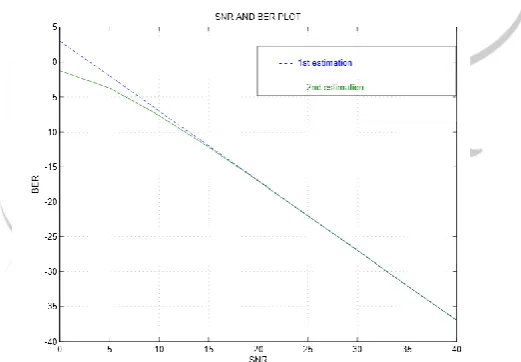
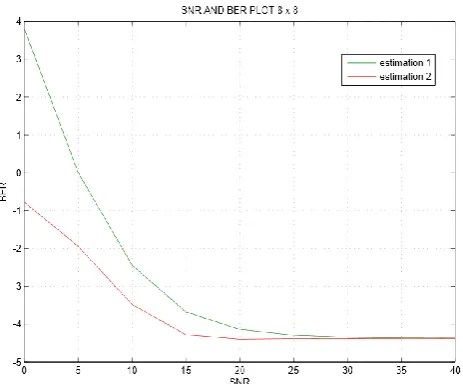
In this we first kept Number of subcarriers as 64 and we kept cyclic prefix length ( ) as 16 and delay spread as 5 and we took different SNR values ranges from 0 to 40 and we perform the channel estimation of 4 x 4 MIMO – OFDM by using MMSE channel estimation technique . In this we adopt FFT for performing channel estimation.
In the process of estimation we compare exact channel and estimated channel responses to get the errors and we plot those error signals here
The estimated error signal are also plotted on 2D plot which is as below
Fig. 4 Estimated Error Signal of MMSE channel Estimation
And finally for different SNR values we found the BER and we took SNR values on X-axis and BER values on Y-axis and we plot a 2D plot between SNR vs BER for two estimations which resulted as below
IJEDR1502101
International Journal of Engineering Development and Research (www.ijedr.org)555
Fig. 6 SNR vs BER plot of 8 x 8 MIMO OFDM channelVI. CONCLUSION
In this paper I first introduced the basic idea of channel estimation. Then I presented the basic channel estimation model and the proposed super sparse MIMO OFDM channel estimation using Minimum Mean Square Error estimation which incorporate FFT which will give much better channel description. And by coming the spatial and temporal correlation of MIMO OFDM with MMSE channel estimation we can guarantee much better channel estimation than already existing channel estimation techniques. Hence I can conclude that by incorporating this technique in 3G nad 4g technology we get much better results.
VII.REFERENCES
[1] Zhen Gao, Linglong Dai,, Zhaohua Lu, Chau Yuen, “Super- Resolution Sparse MIMO- OFDM Channel Estimation Based on Spatial and Temporal correlation ”,IEEE communications letters,vol. 18,no.7, july 2014.
[2] G. Stuber et al., “ Broadband MIMO-OFDM wireless communications,” Proc. IEEE, vol. 92,no. 2, pp. 271–294, Feb. 2004.
[3] I. Barhumi, G. Leus, and M. Moonen, “ Optimal training design for MIMO OFDM systems in mobile channels,” IEEE Trans. Signal Process.vol. 3, no. 6, pp. 958–974, Dec. 2009
[4] W . U. Bajwa, J. Haupt, A. M. Sayeed, and R.Nowak “Compressed channel sensing: A new approach to estimating sparse multipath channels,” Proc. IEEE, vol. 98, no. 6, pp. 1058 1076, Jun. 2010.
[5] L. Dai, Z. Wang, and Z. Yang, “ Spectrally efficient time-frequency training OFDM for Mobile large scale lMIMO systems ,” IEEE J. Sel. Areas commun vol. 31, no. 2, pp. 251– 263, Feb. 2013.
[6] Y. Barbotin and M. Vetterli,“ Estimation of sparse MIMO channels with common support IEEE trans Commun.,vol.60,no.12,pp.3705–3716, Dec. 2012.
[7] I.Telatar and D.Tse,“ Capacity and mutual information of wide band multipath fading channels,” IEEE Trans. Inf. Theory, vol. 46, no. 4, pp. 1384– 1400, Jul 2000
[8] L. Dai, J. Wang, Z. Wang, P. Tsiaflakis , and M. Moonen, “ Spectrum and energy - efficient OFDM based on simultaneous multi- channel reconstruction” IEEE Trans Signal process.,vol. 61, no. 23, pp. 6047–6059 ,Dec. 2013. [9] P. L. Dragotti, M. Vetterli, and T. Blu, “Sampling Moments and reconstructing signals of finite rate of
innovation: Shannon meets Strang-Fix,” IEEE Trans. Signal Process.,vol. 55,no. 5, PP.1741–1757,May 2007
[10] R.Roy and T.Kailath ,“ ESPRIT-estimation of signal Parameters via rotational Invariance techniques, ” IEEE Trans. Acoust., Speech, Signal Process., vol. 37, no. 7, pp. 984–995, Jul.198
VIII.BIOGRAPHY
M Eswar Kumar is presently pursuing M. Tech in Communication Engineering and Signal Processing in ACHARYA NAGARJUNA UNIVERSITY College of Engineering and Technology. His area of interest is signal processing.
K. S. Rajsekhar is Assistant Professor in Electronics and Communication Engineering (ECE) Dept. in ACHARYA NAGARJUNA UNIVERSITY College of Engineering and Technology. His area of interest is Embedded Systems