NCVER
experiences
Learner
examination of student
onl
in
e
l
earning
st
ud
en
t views
L
e
arner
expectations
examination
ex
pectations
Sarojni Choy
Cathy McNickle
Berwyn Clayton
Learner expectations and experiences
An examination of student views of support in online learning
support
student views
experiences
onlin
e
learning
Acknowledgements
The findings of this study are the result of collaboration between online students and teachers and co-ordinators of private and public providers throughout New South Wales, Victoria, Queensland, South Australia and the Australian Capital Territory. We would like to express our gratitude for their time and input, without which the study would not have been successful.
Background
In August 1999, the Australian National Training Authority Chief Executive Officers (ANTA CEOs) endorsed the Australian Flexible Learning Framework for the National Vocational Education and Training System 2000–2004 (AFL Framework). The AFL Framework has been developed by the Flexible Learning Advisory Group (FLAG) and represents a strategic plan for the five-year national project allocation for flexible learning.
The AFL Framework is supported by an annual implementation plan, and the plan for 2002, Strategy 2002, was endorsed by the ANTA CEOs in September 2001. It identifies specific initiatives and allocates resources within each of the five goals in the framework.
Role of the Flexible Learning Advisory Group
In broad terms, FLAG is a strategically focussed group of senior VET personnel advising ANTA CEOs, the ANTA Board, the Department of Education, Science and Training (DEST), the Australian Information and Communication Technology Education Committee (AICTEC—formerly known as the EdNA Reference Committee), on national issues relating to the directions and priorities for flexible learning in VET, with particular reference to online technologies.1
© Australian National Training Authority, 2002
This work has been produced with the assistance of funding provided by the Commonwealth Government through the Australian National Training Authority (ANTA). Copyright for this document vests in ANTA. ANTA will allow free use of the material so long as ANTA’s interest is acknowledged and the use is not for profit.
ISBN 1 74096 050 5 print edition TD/TNC 69.19
ISBN 1 74096 051 3 web edition TD/TNC 69.61
Published by NCVER ABN 87 007 967 311
252 Kensington Road, Leabrook, SA 5068 PO Box 115, Kensington Park, SA 5068, Australia www.ncver.edu.au
_____________
Contents
Executive summary 4
Introduction 9
Project description 10
Project aims 10
Research questions 10
Scope of the project 10
Methodology 10
Literature review 12
Background 12
Definitions 14
Traditional student services 14
Support services offered to online students 15 Student expectations and experiences 22
Findings 27
Survey of students 27
Level of expectation for learning and teaching 31 Level of expectation for technical support 33
Summary of survey results 34
Interviews with students 35
Most essential services for completion 35 Most beneficial services for completion 36 Best examples of online services 36 Services that are most in need of improvement 36 Survey of co-ordinators/teachers 38 Interviews with co-ordinators/teachers 42
Case studies 44
Summary of case studies 44
Innovative practices 45
Discussion 47
Pre-enrolment/enrolment 47
Technical 49
Conclusion 50
Summary of findings 51
Guidelines 52
Guidelines for online support and intervention strategies 52
References 55
Appendices 58
A: Procedures for the study 59
B: Student survey 64
C: Co-ordinators’ questionnaire 69 D: Students interview questions 74 E: Teachers’ interview questions 75
F: Case study proforma 76
Executive summary
Background
The integration of information technology into vocational education and training (VET) has dramatically enhanced flexible delivery within the sector by expanding and modernising their capabilities to include online learning. In doing so, learning services have been extended to meet the needs of a more diverse client group. With rapid growth in online innovations, research interests have also focussed on how the use of technology can enhance the delivery of courses.
The literature has shown that much of the emphasis has been on the technological component of online delivery as providers have grappled with the transfer of learning from traditional classroom mode to online. An examination of national databases, however, indicates a dearth of research undertaken in the area of support for students undertaking online learning. One area in particular that remains deficient relates to the nature of support that students expect. The full nature and range of services experienced by online students in the VET sector is also unknown. In view of this deficiency in research relating to services for online students, the National Research and Evaluation Committee (NREC) commissioned a study to explore the expectations and experiences of online students in the VET sector. This report contains the literature review, background to the study, methodology, findings and conclusions. A set of guidelines for providers is also included.
The benefits of online delivery have been perceived as including cost-effectiveness, just-in-time learning, student-controlled options, self-paced learning, interactivity, accessibility, uniformity of content, customised content, and regular and rapid update of content.
Through the use of technology, students have greater flexibility and control over the time, pace, place and resources for learning. Technology has enabled the development of interactive environments where the student is actively involved in the learning process. Students are now able to use technology to communicate effectively with many others for the purposes of learning. Web-based technology also provides access to databases and
homepages to which resources for learning could be referred. Online customisation enables the identification of the strengths or weaknesses of students and addresses their needs accordingly. Furthermore, changes to content are completed in real time.
The body of literature on the use of online technology for learning continues to grow in response to rapid advances in technology. Consequently, new systems and practices continue to advance at a rapid pace, presenting some difficulties with evaluations to measure its effectiveness.
The need for support for students has been highlighted by a number of authors including Brookfield (1984), Candy (1991), Mitchell and Bluer (1997), Warner, Christie and Choy (1998), van Stavaren, Beverley and Bloch (1999) and McNickle (1999). The requirement for
Aim
The aims of the study were to:
L explore the theoretical frameworks/models underpinning student support and intervention strategies in online learning
L examine the current assumptions and practices in the delivery of online VET programs
L investigate student expectations and experiences of current practices at various stages in their programs of study
L develop guidelines for online support for both practitioners and students
Methodology
The methods used to undertake the research included:
L a review of websites and other databases of online providers
L a survey of online students in a range of registered training organisations (RTOs)
L brief interviews with key staff responsible for online delivery within RTOs
L a review of the literature
Student survey responses
Two hundred and one responses were received from students who represented 23 private and public institutions across New South Wales, Queensland, Victoria, Australian Capital Territory and South Australia.
Summary of survey results—students
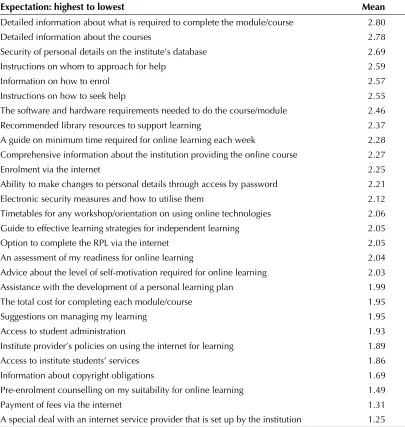
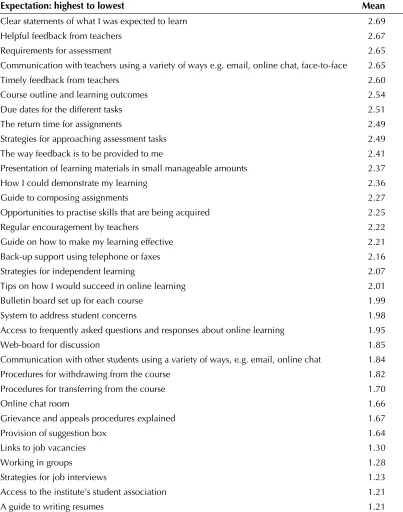
Analysis of the survey responses show that the top ten services that online students expect are:
L detailed information about what is required to complete the module/course
L detailed information about the courses
L security of personal details on the institute’s database
L clear statements of what they are expected to learn
L helpful feedback from teachers
L requirements for assessment
L communication with teachers using a variety of methods, for example, email, online chat, face to face
L timely feedback from teachers
L instructions on whom to approach for help
L information on how to enrol
Summary of interview findings—students
With a limited response to the interview questions, these findings should be considered as a sample of the group only.
The three key areas that students perceived as being essential were:
L quick responses from teachers/tutors
L regular support for learning
Services which had been established and which proved most beneficial:
L bulletin boards
L enrolment information with links to application forms
L course information including costs for each course
L the option to complete the assessment online
When asked which areas of online services were most in need of improvement, comments from students focussed mostly on facilitation by teachers and technical systems.
The interviewees identified several shortcomings in teachers and their practices. The most frequent among their comments related to the delay in response from teachers. They suggested that teachers should mark assignments quickly and provide feedback to students within a reasonable timeframe (two days was suggested by one student). Many added that teachers should inform their students if they plan to take holidays. One interviewee suggested that teachers should not be changed during the course time.
A common problem encountered by most students related to attempts to refer back (when working online) to content already completed when undertaking assessments. The following statement illustrates this problem:
When you are doing your assessments, it is handy to look back over the section you studied … Not to get the answers, but to make sure you have included what you intended. I found I had to hit the back button more often than not and lost track of where I was going. There was a lot of switching between areas that I found time-wasting.
Teacher/co-ordinator findings
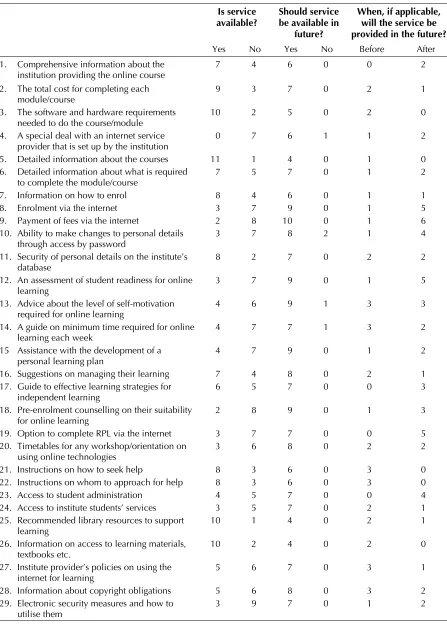
Results indicate that the participating institutions are providing online students with adequate information on the course material and on administrative procedures. There is a deficiency in processes whereby students assess their existing skills and suitability for online courses. This is an area becoming more significant and one which is also being correlated with completion rates and success in flexible learning. Furthermore, a lack of provision for students to pay fees and enrol online was identified.
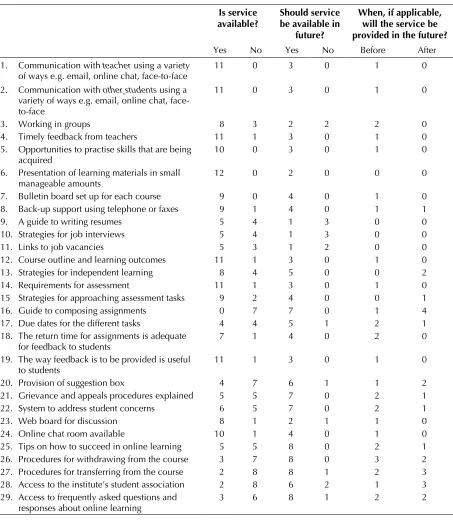
Providers have taken into account the need for effective and reliable communication and have provided opportunities for communication between teachers and students. Research has also shown that, by creating a learning community, students are more inclined to feel part of the institution and complete their course.
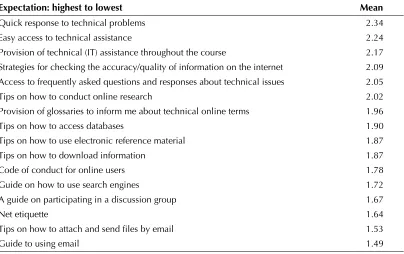
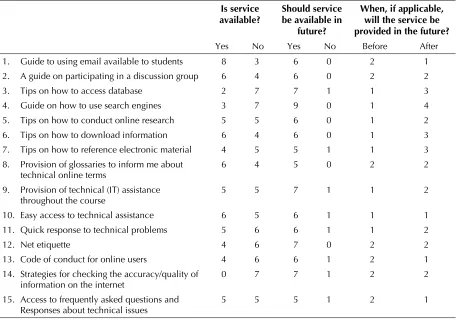
Again there is a lack of opportunity for students to complete all administrative procedures online. There is also a lack of guidance on how to prepare and write assignments. Little information is available to online students relating to net etiquette, code of conduct, frequently asked questions (FAQs), technical assistance and tips on referencing electronic material. There is little assistance provided on how to use search engines, how to access databases and on strategies for checking the accuracy/quality of information on the internet.
Comments from teachers/co-ordinators
At the completion of the survey, teachers/co-ordinators were asked if there were any services that they believed should be provided which had not been covered by other questions in the survey.
Teacher/co-ordinator interviews—findings
In summary, teachers/co-ordinators consider the most important student support services to be: a helpdesk with IT support, access to communication with tutorial support, an induction program and access to learning resources.
The five services that teachers/co-ordinators see students accessing most frequently are:
L Support: diverse off-line flexible learning structures tosupport the online program with facilitators being available 12.5 hours per day (0900–2100)
L Communication:phone/email contact needs to be available as part of the support mechanism and tutors should be in frequent contact with most students
L Resources:to includeexternal access to simulators and specialist resources, links to State networks using WebCT, lending services for learning resources
L Helpdesk: for general assistance
L Inductionprocesses: to include skilling students in written and IT literacy prior to starting and a self-assessment on learner readiness; for example, to enable students to operate software such as Windows and other platforms
Case studies—findings
The findings of the eight case studies, included the following:
L The online courses were either at certificate III or IV AQF level.
L There are specific teachers/tutors responsible for all student requirements in most courses studied. However, a number had IT support and in one case, a specific administration person responsible for online and distance students.
L Courses are very industry/practically oriented, with many students working in the specific industry discipline.
L Generally there are no prerequisites except in circumstance where students are expected to have computing skills and another where students are obliged to have certificate II in that discipline.
L The majority of providers require students to have access to at least a 486 PC with internet access—Internet Explorer or Netscape and Windows.
L In some circumstances the provider is linked to a central homepage which gives students access to a range of student services; however, if this is not the case, students are less able to access a variety of student services.
L Not all providers have an induction/orientation session available to students. The style of any such sessions varies. Sessions are mostly online with some face-to-face delivery.
L In one organisation students are assigned a mentor.
L Students are required to attend weekly online tutorials and perform specific assessment tasks.
L There is a range of communication modes available to students and teachers/facilitators for interaction and assistance.
L Most providers have an email response time (usually 24 hrs) for teachers and one provider has a response time for students as well.
L Communication between teachers/facilitators and students is seen as the most critical factor in the success of a course; completion is partly attributable to students ‘belonging’ to the online community brought about through good communication.
It should be noted that online delivery is in its infancy, with many courses either in the pilot identification stage or early stages of development. As a result identification of the
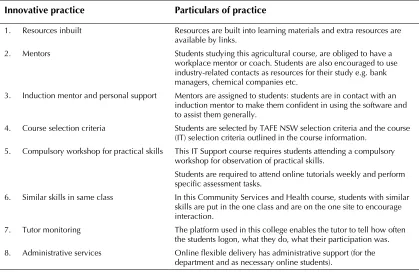
L Resources are built into learning materials and extra resources are available through links.
L Students studying an agricultural course, are required to have a workplace mentor or coach. Students are also encouraged to use industry-related contacts as resources for their study, for example, bank managers, chemical companies etc.
L Students are selected by TAFE NSW selection criteria and the course (IT) selection criteria outlined in the course information.
L One IT support course requires that students attend a compulsory workshop for observation of practical skills.
L In a community services and health course, students with similar skills are put in the one class and are located on the one site to encourage interaction.
L The platform used in one college enables the tutor to calculate how often the students log on, what they do and what their participation was.
Teachers/co-ordinators considered the three limitations of their current online services to be:
L information technology
L support/teaching
L resources
Conclusions
The key issues for RTOs to consider include:
L specific professional development for teachers/tutors who are involved in online delivery
L allocation of dedicated staff to support online students to enable them to provide rapid response to enquiries
L establishment of guidelines and directions for online students and teachers/tutors
L establishment of the roles and responsibilities of students as well as teachers/tutors
Introduction
The integration of information technology into vocational education and training has
dramatically enhanced flexible delivery within the sector by expanding and modernising the capabilities to include online delivery. In doing so, learning services have been extended to meet the needs of a more diverse client group. With rapid growth in online innovations, research into how the use of technology can enhance the delivery of courses has increased.
However, there is one area where little research has been undertaken—the nature of support that students expect during online learning. The nature and range of services experienced by online students in the VET sector vary from provider to provider. Each provider attempts to meet the needs of its students within the constraints of variables, such as infrastructure, staff, and learning resources. Furthermore, there are no minimum standards stipulated for the quality of online student services.
Project description
Project aims
The aims of this study were to:
L explore the theoretical frameworks/models underpinning student support and intervention strategies in online learning
L examine the current assumptions and practices in the delivery of online VET programs
L investigate student expectations and experiences of current practices at various stages in their programs of study
L develop guidelines for online support for practitioners
Research questions
The above aims were addressed through the following research questions:
L What are the key frameworks and models for student support in an online environment?
L Are online training providers meeting the support needs of their students?
L What support do online students expect from providers?
L What are the limitations in current support systems?
L What are the characteristics of best practice examples of student support in online delivery of VET?
L How can student support for online learning be enhanced in a cost-effective manner?
Scope of the project
The initial literature search for this study indicated the diversity of interpretation by RTOs of online learning. For example, many marketed their courses as being online, but had course materials posted on the internet. Their students accessed the web pages to read or download the content, but completed the learning and assessment tasks in a traditional distance education approach. In view of the diversity in interpretations of online learning, the project team developed its own definition to establish the scope of the study, being:
Students who were enrolled in online courses where they were required to interact with materials using a networked computer system and were required to complete summative or formative assessment tasks. Teachers and co-ordinators of these online students were also invited to participate.
Methodology
Most of the data were collected through the electronic medium, namely emails. This entailed sending the surveys to the teachers/co-ordinators of the 28 participating institutions for distribution. This method of distribution was used to maintain the privacy of participating students. As a result, it was not possible to record accurately the number of surveys distributed. More detailed account of the methodology is included at appendix A.
Literature review
Background
Online delivery is ‘looking at computer technology which enhances, extends and replaces traditional teaching and training practices’ (Brennan 2000). It is therefore critical that this mode of delivery provides support to online students. Essentially, the purpose of online learning is to offer students a more flexible, individual and independent mode of studying. In order to be successful, however, the providers must anticipate the difficulties students may encounter, and establish mechanisms to address these. This can be achieved through
technology support, having sufficient detail and information online, or even providing social interaction via facilities such as computer-mediated conferencing (CMC) or email.
Rapid advancements in current technology have meant that flexible delivery has progressed equally rapidly, offering the students a kaleidoscope of learning methods to explore. Through the development of online social networks and the ability to communicate with others on a regular basis, technology has helped to overcome the feelings of isolation experienced by many students. However, despite these technological advances, online providers must not leave behind those who are less technically capable. Computer illiteracy still exists, especially within the older student population, and needs to be addressed.
The overall transition between online and classroom education can be intimidating. The success of online delivery will be determined largely by the experiences of the students. Unless there is appropriate and adequate student support, success in learning using this technology will be difficult to achieve. It is therefore essential that providers become aware of the limitations in current services and address the student needs in a satisfactory manner to make this technology attractive to a wider community of students. One of the outcomes of this project will be the identification of support needs of students which will assist
practitioners in addressing these issues.
As the VET community is becoming more responsible for determining training for their own professional development needs, for retraining, ‘just in time’training and general training for employment purposes, it is equally important for students to have access to a range of
support services in the transition period. With the changes in the requirements of training has also come the need for:
L flexibility and an ‘anytime, anyplace’ philosophy
L changes to the role and responsibilities of the student
L the changing skill requirements of the student to self-directed learning
It must be noted that even though this mode enhances access to learning, not all students are suited to it, and even those who are suited still require some form of support in the initial stages of the transition (Salmon 2000; Harper et al. 2000; Smith 2000).
Harper et al. see online technologies attracting teachers and trainers to this delivery option because of the ‘anytime, anyplace’ philosophy and the diverse access opportunities this creates. However, this mode has necessitated a reconceptualisation of teaching and learning, with new skills required of both the teacher and the student to enable them to adapt to the pedagogical needs of the environment.
While there is a recognition of the changes taking place in the teaching and learning model and the skill base requirements of students adopting online delivery, as well as the
concomitant issues students face as they make this move, there has been limited research from the student perspective of what they expect and experience in the form of support for online learning. This report captures examples of some of those expectations and experiences, and analyses the juxtaposition of the student experiences and expectations with those of the teacher/co-ordinator perceptions of their provision. The section which follows outlines the support documented in the literature in the categories of: pre-enrolment, teaching and learning and technology support.
In the context of adults having the ability to be self-directed students Knowles (1980, cited in Long & Associates 1992) believes that it is not wise to ‘just throw them into the strange waters of self-direction and hope they swim’.The same could be said for online students and the need for them to be supported in the initial stages of transition. This opinion is further supported by Dewey (1938) with, ‘if we “replace external control with self control,” we must, in every self-directed learning situation, systematically prepare the student for this challenge’ (p.321).
Not only are there assumptions being made about the self-directed learning skills of the student, but there are many assumptions being made about students’ possession of information literacy, functional literacy and IT literacy skills required to usethe medium.
The novice online student not only has to manage the technological nuances, but also the often unreliable behaviour of the technology. Other issues faced by the student include:
L a new mode of learning in a different learning environment, often without access to readily available support
L information overload
L passive interaction
L no socialising
L the cost and time involved in printing downloads and technical malfunctions
These challenges, when not adequately supported, greatly influence retention rates and create or reaffirm a negative learning experience.
The recent rise in the flexible delivery of VET has been accompanied by a number of national and State-based research and development projects, the focus of which has often been on the technological innovations involved in transferring learning from mainstream to online. In addition, Learnscope, ANTA Toolbox, the Learning Systems and Resources Standing Committee projects in South Australia and EdNA (Education Network Australia) VET projects have focussed on the professional development of those formulating and delivering training online.
Another example is provided by the Australian National Training Authority ([ANTA] 1998) publication, Australia’s national strategy for vocational education and training, 1998–2003: A bridge to the future. This strategy has been designed to ensure that the skills of the Australian
workforce are sufficiently competitive to provide individuals with the skills necessary to optimise their potential. A further initiative of ANTA has been the creation of the Framework for National Collaboration in Vocational Education and Training (ANTA 2000). This
Other policy influences at State and Territory level include:
L TAFE Online 2001 (Victoria) provides State policy (cited in Harper et al. 2000).
L TAFE SA provides a comprehensive set of policies and procedures (cited in Harper et al. 2000).
L NSW, QLD, WA, and Tasmania have planning and vision documents that address the enterprise. Some of the policies are available on the TAFE websites (Harper et al. 2000).
An examination of VOCED, AEI (Australian Education Index) and other national databases, however, indicates limited research has been undertaken from the perspective of the student in relation to their experiences and expectations of support in online learning. There is also a lack of research on issues of concern to students in an online environment. Much of what has been written about flexible delivery and online learning is based on assumptions about student independence, assumptions, which are largely untested.
A study undertaken by Harper et al. (2000) outlined the national, State and Territory policies for the role of technology in the delivery of VET. These policies are instrumental in the development and implementation of online technologies within the VET sector. Examples of these policies include: the Commonwealth Government’s strategic framework for the informationeconomyreleased in 1999 which outlines government policies for lifelong learning and the use of technologies to enhance a more flexible approach to learning and providing people with the technological appropriate to workplace and community. Technology is also seen as a support strategy for flexible learning.
Definitions
The term ‘online’is defined as: ‘The use of cyber systems such as the intranet and internet for communication for the purpose of teaching and learning’ (Warner, Christie & Choy 1998).
Salmon (2000) sees the term online as covering a range of technologies and cites the definition of Santora (1995 cited in Salmon 2000) as:
L informatics
L computer-assisted instruction
L computer-mediated conferencing
By contrast, Brennan (2000) defines it as requiring situations where:
L Computers support teaching and learning.
L There is a mixture of computer support and online delivery.
L Computer technology alone delivers education and training.
(Adopted from the University of Illinois 1999 and cited in Brennan 2000)
In essence, Brennan reiterates this as: ‘looking at computer technology which enhances, extends and replaces traditional teaching and training practices’ (Brennan 2000, p.9).
Traditional student services
It has been identified by researchers (Carroll & McNickle 2000; Hampton 1997; James 1999) that online students need to have access to the same services as traditional students. These are categorised below and include:
L Teaching/learning support services: including induction and orientation, communication strategies, access to study and research skills (time management, learning-to-learn skills/independent learning skills) information literacy and general learning support. Researchers unanimously agree on the necessity of induction/orientation to flexible learning (online learning) in a variety of forms to accommodate distance and isolated students;
however, there are disparities in the contents of these programs (Webb & Gibson 2000; Snewin 1999).
L Technical support services: services relating to the IT support, providing students with a range of options for accessing assistance, including phone, fax, email, FAQs and helpdesk.
There is extensive literature in the area, and issues concerning technology use are seen as major influences in effective online teaching and learning. The following issues are emphasised in the literature:
– access to technology: this includes set-up problems, inadequate infrastructure,
unreliability of the system and inadequate software and hardware (Collis 1996; Corben 1997; Berge 1998; ANTA 1997b)
– prerequisite level of technical knowledge required by teacher and student (ANTA 1996; ANTA 1997; Corben 1997; Williams 1997)
– ease of understanding of web interface and technology and accessibility (Evans & Deschepper 1998)
– technology: clear, transparent and easily understood, user-friendly (Snewin 1999) – designed to the lowest common denominator in terms of available technology (Corderoy
& Lefoe 1997)
– technology: reliable, well-supported and ‘comfortable’ (Collis 1996)
Support services offered to online students
ANTA defines student services or student support as:
The services provided to enable students, however they are undertaking their training, to access learning support and other assistance to maximise their chances of successful completion. (ANTA 1996, p.53)
There is a considerable information available on student support requirements for flexible delivery (McNickle 1999; van Stavaren, Beverley & Bloch 1999; Misko 1999). This research strongly indicates the necessity for the provision of a range of support services to enhance the chances of completion for students undertaking flexible learning. A recent study, Online student services research report completed by Carroll and McNickle (2000) highlighted the necessity for all of the support services available to traditional face-to-face and distance education students to be made available to online students. The summary of literature below identifies the services defined as ‘traditional’ for students and thus, which are also seen as essential for online students.
Pre-enrolment support services
L The literature on career/course advice/counselling is limited, with authors (Hampton 1997; Prisk 1998; James 1999) indicating the requirement for up-to-date information to be available on courses and career pathways.
L There are limited actual career counselling and career advice opportunities available (Carroll & McNickle 2000). This study indicated that these areas are some of the more difficult areas to service effectively.
L McLendon and Cronk (1999) pose the question of the provision of enrolment documentation in hardcopy and the fact that this can slow the process of enrolment.
L There are vast amounts of information on courses available online. This information ranges in depth of information and in some instances, indicates career paths that students can choose as a result of a particular course of study.
L Some organisations have the provision of enrolling online and the facility for payment. This however, is mostly restricted to the university sector.
L Opportunities for recognition of current competencies (RRC) have also been addressed at some universities and this is done automatically at the time the student enrols. Again this appears to be confined mostly to the universities (Carroll & McNickle 2000).
L A number of institutions allow students to enrol online. At OTEN (Open Training and Distance Education Network, TAFE NSW), however, students fill in an application form for selection, which provides two purposes in that it gains student information and assesses their online competency. In other institutions students enrol on the usual hardcopy throughout the year (Golfers & James, 1999).
L Charles Sturt University was trialling online courses and sent enrolling students pamphlets, brochures and a disk as part of their marketing strategy.
L In relation to payment of fees, credit card facilities are available at a number of institutions and BPAY is used by a limited number (Carroll & McNickle 2000).
Online delivery has provided a platform for diversification and innovation in the delivery of learning in the workplace and in the general education sectors. Much of this innovation and flexibility relates directly to the changing needs of the different student client groups within the sector. This innovation and flexibility provides an ideal context for building social capital and developing community learning networks (Bruce 1998). Despite this, there has been very limited feedback gathered from the student’s perspective and the support mechanisms required to successfully undertake the transition from traditional to online learning.
The need for support for students has further been highlighted by studies conducted by Brookfield (1984), Candy (1991), Mitchell and Bluer (1997), Warner, Christie and Choy (1998), van Stavaren, Beverley and Bloch (1999) and McNickle (1999a).
George (1995) also reiterates the importance of support with:
Access to a comprehensive, systematic and coordinated network of support is … essential for students to learn independently … Without this level of support, the assumption of particular manifestations of independence among students has the potential to become yet another way of perpetuating social
injustices and setting some students up to fail. (George 1995)
A further study by van Stavaren, Beverley and Bloch (1999), found that initially, many students were unaware of the support services available. For instance, 60% of students in their study didn’t know of the counselling and library support available to them.
Van Stavaren, Beverly and Bloch (1999) recommended that support services be provided at all stages of delivery and that these services be actively promoted. In addition, this study found that the type and timing of support needs further examination.
Barker (2000) in her study of the student perspective on online learning of adult community education (ACE) students found that the focus on student skills, what the student needs to undertake the course and the role of the teacher in supporting the skill development were central to the success of the student making the transition to online learning as an
independent student. She elaborates on this by advocating that the following are prerequisites for this transition:
L basic and complex technical skills
L negotiating online relationships
L negotiating the language of the education system
Research undertaken by Brennan (2000), McKavanagh et al. (1999) and Carroll and McNickle (2000) has found that universities are offering some complete courses and individual units online. However, VET RTOs are offering only a limited selection of complete courses online, with most offering a designated selection of modules, mainly relating to information
course material online, with providers like Qantas College Online and Motorola offering specific course materials for their staff training.
Teaching/learning support services
L In the context of induction and orientation to online learning,there is extensive information and agreement on the necessity of induction/orientation in its varying forms, with the majority of organisations providing some form of induction. James (1999) found that even though students were ready to take advantage of online learning, they needed the extra support provided by attending an induction/orientation program.
L The content of induction/orientation programs varies, with the following requirements being seen as essential:
– functional computing and internet skills (Brown 1997; Brown 1998; Webb & Gibson 2000) – independent learning skills (Webb 1998)
– research on web skills (Murphy 1998)
– assistance with orientation available online (Williams, Lord et al. 1997; Brown 1998; Byrne & Pittwood 1998)
– assistance available by phone or face-to-face (establishing the right atmosphere and trust is essential) (Webb & Gibson 2000; Snewin 1999)
L Other researchers advocate that a variety of methods should be available to accommodate distance and isolated students, ensuring they are not disadvantaged (Twyford 1999; Snewin 1999; Wheeler 1999).
L Salmon believes that students need to use the new online medium to undergo induction and offers her five-stage model of computer-mediated conferencing to structure the support requirements (Salmon 1998).
L Brown’s (1998) ‘on-ramp’ concept which introduces students to using the internet
recommends the use of a range of mediums to achieve this, including CD-ROMs, telephone and printed materials.
L The use of CD-ROMs, videos and discs to provide information and assistance is recommended (Williams, Lord et al. 1997; Twyford 1999).
L In relation to ongoing communication with students, it has been found that follow-up contact with students after orientation using telephone helps to improve retention rates (Evans & Deschepper 1998; Twyford 1999).
L Gooley (1998) acknowledges the benefits of online learning, but hastens to highlight the main issue as access to technology.
L The concept of chat and email should be built early in the course (Brown 1998; Gofers & James 1999).
L Salmon advocates the development of a buddy system with more experienced students (Salmon 1998).
L The importance of personal contact with tutors and teachers is extensively highlighted (Williams, Lord et al. 1997; Gofers & James 1999; Snewin 1999).
L Research (Carroll & McNickle 2000) has found that the administrative services—student administration—is one of the more challenging areas to provide online, particularly in the areas of changing online courses, financial status, enrolling, payment and the provision of evidence/documentation for recognition of prior learning. Pittman (2000) reaffirms the importance of these facilities: ‘What is needed is a comprehensive platform for online
education, which includes not only presentation and education but also all the administrative functions required for student progress through the institution’ (Pittman 2000, p.12).
L The importance of access to personal contact and communication links—academic research— are paramount in supporting students (Williams, Lord et al. 1997; Snewin, 1999, Carroll & McNickle 2000)
L Wheeler (1999) proposes the model of the ‘learning case manager’ as a means of enabling students to move into the online learning role.
comprehensive website of study tips, stress and conflict management and links to a range of assistance.
L TAFE SA completed a Learnscope project on counselling in 2000, ‘Online counselling skills’ (cited in Carroll & McNickle 2000) which demonstrated that there is limited literature on supporting students online. Johnstone (1998) and Smith and Smith (1999) note that students at a number of educational institutions in Australia and New Zealand do have access to
counselling mainly via email. Carroll and McNickle (2000) argue that institutions need the capacity and resources to provide appropriate and supportive information.
L Sanders and Rosenfield (1998) outline the competencies needed for computer-mediated therapy sessions. The counsellor using the internet needs to:
– establish contact with the client
– establish a therapeutic relationship
– communicate with minimum loss or distortion
– demonstrate understanding and be able to frame empathetic responses
L In relation to academic resources, libraries have been working in the area of supporting distance education students for some time, especially the distance education providers. This experience appears to have made the transition to online support easier. The library, being very specialised and technically based, has an enormous amount of literature in the area of online support for students.
One of the positive outcomes of online learning is the opportunity for increasing the communication between students and support staff. This has been enhanced and made available through the implementation of email and other CMC facilities. CMC seems to be less intrusive than face-to-face or even telephone tutorials. Some students are more
comfortable not being identifiable when participating in this environment, whereas others are not able to contribute. This creates a challenge for the e-moderator. Asynchronous discussion allows students the time to reflect on their responses before they respond and time to reflect on topics between discussion times. This medium also provides the forum for ‘development of discussion and innovative ideas which creates intrigue not often found in the classroom … It is also a good medium for giving praise and constructive critiques’(Salmon 2000, p.17).
Some of the benefits of CMC include:
L The environment creates a freedom for students to express views and share experiences.
L Discrimination in any form is less apparent.
L The control of the conference is shared and can shift from teacher to student and student to student.
L Costs of purchasing equipment can be offset by not having to pay for travel and attendance.
L The medium provides an excellent environment for exploring different teaching strategies.
A disadvantage seen by Le Cornu (2000), is that students need to be trained in how to use the online learning facilities effectively. Many students don’t access electronic messages or online discussion, even though this medium is seen to be a beneficial environment for the quieter, less confident student, providing an opportunity for reflective and more considered
responses (Cashion 2000). Salmon (1998) asserts that it is the responsibility of the provider to ensure that the student is sufficiently comfortable with technology so that it becomes an ‘enabling device rather than a barrier’. She even questions whether ‘… theachievement of pre-learning and “just in time” online learning support to create student “comfort zones” is the key to success’, particularly in an environment where such support is rare.
A senior lecturer in higher education at Queensland University of Technology, Dr Yoni Ryan, admits that ‘students are not particularly good at learning independently and need teachers to ensure they work effectively online’. This comment is consistent with that of Sandra Wills, director of the Centre for Educational Development and Interactive Resources at the
Gee (2000) reports Ryan’s comments:
The best use of online teaching is a “hybrid approach using different media”, but admits most staff merely upload text of lectures. It’s hard to blame them. The time-consuming demands of juggling online and traditional teaching has [sic] created more work for educators who are hesitant to ditch the pedagogy of traditional strategies for unproven methods.
What doesn’t work in e-education, she says, are non-accredited virtual universities that offer 100 per cent online learning but have little infrastructure, staff or research agendas.
(Ryan cited in Gee 2000, pp.20–1)
Boote (1998) highlights the disparities between the available literature and what is actually being practised in the learning environment in the areas of student support and the development of lifelong learning skills. This is consistent with the views of authors such as Candy (1991) and Crombie (1995 cited in Boote 1998) who question whether students are adequately prepared and supported for the transition to VET, especially in relation to the development of their metacognitive skills and the implications of this. They believe further investigation is needed in these areas. There is a presumed level of self-directedness and assumptions made about the metacognitive skills of students, in particular, about adults with disabilities undertaking VET courses. Such assumptions are rarely tested prior to
commencement of delivery, often leading to difficulties faced by students.
Peoples (1999) cites the seven best practice principlesfor online learning as: 1. Developing a network of support
2. Ensuring a variety of learning styles and preferences 3. Designing interactive learning materials
4. Ensuring educationally driven learning 5. Providing organisational and financial support 6. Ensuring adequate security
7. Using a planning model (Peoples 1999, pp.10–12)
The Institute for Higher Education Policy (2000), sponsored by the National Education Association and Blackboard (Washington), prepared a report, The quality online benchmarks for success in internet-based distance education. These benchmarks fell into the following seven categories:
L institutional support
L course development
L teaching/learning process
L course structure
L student support (This includes all of the services found in the usual college campus such as, admissions, and student training and assistance that is easily accessible while using the internet, for the duration of their course.)
L faculty support
L evaluation and assessment (Institute for Higher Education Policy 2000, pp.9, 12)
Harper et al. (2000) recommended the following strategies to help prepare students for online learning:
L Students need to be prepared and supported through the initial stages.
L Not all students make effective use of the opportunities offered.
L Many institutions make assumptions about the resources and access available to students.
L Students need technical aid when starting to use technology.
L Learning materials need to be of a simple, consistent design.
L All learning support to be accessible online.
L Some organisations with a range of induction/orientation sessions to help students get started with the technology, become acquainted with online environment and what is expected of them.
L Students need access to counselling services and the provision of a mentoring program.
L There is a need for suitably qualified staff to assist students with technology and to create
resources. (Harper et al. 2000, pp.18–19)
In attending to these recommendations, Harper et al. alluded to the work done by Cornell and Martin (1997 cited in Harper et al. 2000), who suggested that challenges for facilitators and students include:
L maintaining motivation
L acceptance by teacher and student
L prior knowledge as a participant
L attitude towards technology
L content level
L degree of interactivity
L difficulty in using the system
L accessibility to the system
L ability of teacher and student
L communication skills
Brennan (2000), in her research on the effectiveness of online delivery of education and training in Australia, examines the contradictions and the ideological opinions, ideas and research associated with this topic. Some tensions highlighted by her literature include:
L Student isolation vs community of students.
L The medium promotes a transformational view of learning vs a transmission view.
L The medium encourages choice of information and student autonomy vs the medium strictly controlling information and learning.
L Online delivery facilitates communication between students and facilitators vs isolation due to socioeconomic circumstances, distance and ethnicity.
L Online delivery facilitates the growth of student independence vs student dependence.
L Online delivery focusses on quality of the learning vs online delivery achieves quantifiable and sometimes narrow outcomes.
L Online teaching requires completely new ways of teaching vs online delivery achieves small modifications to previous teaching and training methods. (Brennan 2000, p.42)
Students in Harper et al.’s (2000) study also indicated that support needs to become more self-regulated and should include techniques on maintaining motivation. The vast majority of issues faced by students relate to social interaction. They recommend that good online teaching is about building a community related to being responsive and caring for students.
Technology support is only a portion of the support requirements of the online student. A recent study by Carroll and McNickle (2000) shows that the education sector is grappling with the provision of a myriad of support services designed to fulfil the varying needs of their students. Providers tend to approach the provision of services in an individualistic manner, often reflecting the needs of their specific students. However, providers generally realise that a holistic approach is essential to providing students with the assistance necessary to make the transition to online learning.
Self-direction in learning is defined by Brockett and Hiemstra (1991 cited in Boote 1998, p.61) as ‘a combination of forces both within and outside the individual that stress the student accepting ever-increasing responsibility for decisions associated with the learning process’.
Boote (1998, p.61) elaborates on this by citing Guglielmino and Guglielmino (1991) who define the self-directed learning process as, ‘comprising a cycle of identification of learning needs; development of learning goals; preparation of learning plan; location of resources; implementation; evaluation of result and process’. She sees learning as requiring the
metacognitive skills of planning, deciding, monitoring, evaluating and terminating (Biggs & Moore 1993 cited in Boote 1998). These factors indicate that metacognitive skills are needed for self-directed learning; however, students need to know how to take responsibility for their own learning online, the average person taking approximately 70% of the responsibility for change, planning and implementation strategies. She recommends that:
L All students in VET need support in learning-to-learn, not just students with disabilities.
L The introduction of metacognitive skills should only be an interim issue until schools put this into practice.
L The student’s level of self-directedness should match the level of opportunity built into the learning situation.
L Teachers need to develop their skills and understand their own level of self-directedness.
Online learning requires ‘the use of cyber systems such as Intranet and Internet for
communication for the purpose of teaching and learning’ (Warner, Christie & Choy 1998) and includes correct use of technical, as well as pedagogical skills and knowledge to successfully undertake learning through this medium. Student or student support is critical for this technology, which is still unfamiliar to many. This is especially important at a time when most practitioners in the VET sector are experimenting with the new technology with few guidelines for its use for pedagogical purposes.
Cashion (2000) cited findings by Gazzard and Dalziel, showing that the perceptions of higher education students from the University of Sydney about online education included valuing interactivity in tutorials, whether it was face-to-face or computer-mediated. However, the study by Hara and King (in Cashion 2000) found students were very frustrated by some of the technological ambiguities, and in some cases dropped out because of this.
Technical support services
L In relation to IT support, helpdesk and FAQs,the literature raised a number of issues, with technology being the major issue. These consisted of:
– access to the technology (ANTA 1996, 1997b; Collis 1996; Corben 1997; Williams, Lord et al. 1997)
– inadequate hardware and software (Berge 1998) – set-up problems (Berge 1998)
– prerequisite level of technical knowledge required by both teacher and student (ANTA 1996, 1997a; Corben 1997; Williams 1997)
– inadequate infrastructure (ANTA 1997a; Berge 1998; Corben 1997) – inadequate technical support (Brown 1997; Berge 1998; ANTA 1997b) – unreliability of the system (Berge 1998)
– cost (Bennett, Priest et al. 1999): the cost appears to be moving from the institution to the student
– time investment (ANTA, 1997b): a combination of barriers and not totally a technical issue
L The web interface and technology should be easily understood and accessed (Evans & Deschepper 1998) and transparent, clear and user-friendly (Snewin 1999).
L The technology should be designed to suit the lowest common denominator in terms of available technology (Corderoy & Lefoe 1997) and should also be reliable, well-supported and make the students feel comfortable (Collis 1996).
Harper et al. (2000) noted that online learning provides students with contact with teachers and other students and also helps them overcome feelings of isolation felt when
communication was predominantly via post. They also reported that online learning might challenge students to develop new skills and to re-evaluate themselves as students.
Interviewees in this study indicated that flexibility of the mode was the main benefit, with other benefits being:
L familiarisation and confidence in the use of technology
L contact with teachers and other students
L faster responses to queries
L more motivating mode
Some of the limitations they experienced included:
L regular problems with reliability and speed of technology
L cost of equipment and access
L sometimes difficulty in adaptation to the self-directed nature of online learning
One of the first studies undertaken on the use of electronic mail for supporting students was undertaken by Doctor (1998) who indicated the potential of this mode especially for
counselling purposes; however, the main issue related to confidentiality.
Studies undertaken by Gabbard and Dillon, and Wallace in Harper et al. (2000) found that less confident students with low-level technological skills ‘find constructivist learning environments threatening and confusing’.
The Manager of Corporate Learning and Development at Qantas and keynote speaker for Networking 2000 conference, Felicity Mildon, writes of the challenges Qantas has faced since the implementation of Qantas College Online in 1997, to provide access for ‘just-in-time’ learning for 30 000 Qantas staff. Mildon says that it is a significant change process ‘and it takes up to 5 years to have it fully developed and embedded into a culture’. Mildon (2000) sees education and support for tutors as being essential in using the new technology, and notes that tutors themselves have had to go through a considerable change process. Qantas College spends a lot of time on induction, information, technical support and professional development for their 27 online tutors.
Qantas, according to Mildon (2000), sees the challenges for students consisting of:
L overcoming the fear of technology
L self-managed learning made more complex by technology
L overcoming isolation and participating in group learning
She also views the online support for students as including administrative systems and good, clear documentation to support students as well as technical support for students and tutors (Mildon 2000, p.6).
Student expectations and experiences
The necessity for intervention strategies and support for students has also been emphasised in studies of non-completions in VET programs, particularly by Baron, Thiele and Hintz (1995), James (1998), McNickle (1999b) and Misko (1999). Mitchell and Bluer (1997) shed some light on the complexity of the student support issue by stressing the need for the technology and the support provided by people to be interactive and integrated so that they become ‘mutually reinforcing’.
TAFE Virtual Campus. Since many are located in regional Victoria, they were previously unable to undertake this training, but are now able to access online delivery programs. The facilitator, explains the success of the program:
The major factor in this success was the support given to students at a local level … Where school mentoring was strong, students excelled. Program evaluation has also confirmed that approximately
90% of the students support online delivery. (Scott 2000, p.9)
Students from Sydney’s St George College of TAFE were asked what they expected when they went to a TAFE college. Their expectations included tutorial support (Scott 2000, p.18).
Brennan (2000, p.11) in her study, found the common issues students highlighted in the evaluations undertaken by Bennett, Priest and McPherson (1999), Bignum and Kenway (1998 cited in Brennan 2000), Laurillard (1993 cited in Brennan 2000) and McKavanagh et al. (1999) were:
L Students wanted contact with each other and their teachers.
L Learning about the technology, the information and the topic was dependent on the online activities being stimulating when designed.
L Limitations of the technology and its behaviour caused frustration.
L Online participation was time-consuming for teachers and students.
L It was time-consuming to download information and activities.
L These was a need for students to have well-developed information literacy skills.
Tutorials and residentials are seen as the only opportunity for students to meet peers and teachers, and to dispel the feeling of isolation associated with studying alone. The provision of CMC provides the opportunity for communication between students and tutors. Students in Cochrane’s (2000) study commented that support was initially highly bureaucratic, but the service was good. The students realised their responsibilities and had clearly defined
expectations of the services and responsibilities of the provider (Cochrane 2000). Support now takes a number of forms and students are able to access this information from different environments such as work, home and in transit.
Sturgill, Martin and Gay (1999) acknowledge that students find the flexibility of CMC positive. They also discovered, however, that students find some aspects frustrating, mainly due to a lack of feedback. The researchers stress the importance of ensuring that students realise that the problems they experience are often not attributable to their lack of knowledge but to the technology.
Feedback from students who participated in a study conducted by the Institute for Higher Education Policy (2000) included the following responses:
L Online courses require more discipline, but you can work at your own pace.
L I have only had two bad experiences with online classes, mainly because the course was not set up as completely or as well as other courses. They were more like correspondence courses and lacked feedback from the professors on assignments.
L I found that online advertisements and school services other than the course work is the real problem.
(Institute for Higher Education Policy 2000, pp.16, 19)
Initially, online delivery was the mode used in higher education for post-graduate courses, with this student group seen as not requiring the same support services as undergraduate or VET students. However, research has shown that students still require support as online students, especially in the initial stages. A study of student services for online students found that both universities and VET providers realise that a holistic approach to student services is necessary for effective learning to take place (Pittman 2000; Carroll & McNickle 2000).
VET students prefer a teacher-led learning environment that is structured, enjoying the social interaction of their peers, and where reading is of low importance. Smith also noted that it was necessary for students to acquire metacognitive skills in order to undertake independent learning.
Not all students are suited to online learning. Work undertaken by Smith (2000) indicates that the learning preferences of apprentices are not suited to flexible learning. His study indicates that apprentices prefer a more structured and community-based learning environment with teacher support. Many did not like learning on their own.
The findings in Smith’s (2000) study are consistent with those undertaken by Reading-Brown and Hadyn (1989 cited in Smith 2000) which showed that technical students had a preference for structured classes and had a passive approach to learning. The studies have indicated that the planning and structuring of learning in the workplace were deficient, unstructured and often unsupported.
These studies indicate that apprentices:
L prefer to learn about physical objects as opposed to reading
L prefer a hands-on experience
L are strongly influenced by the amount of structure in the content and the detail
L like greater interaction with their instructors and peers
L appreciate demonstration as a learning method
L feel threatened when asking for clarification, demonstration of tasks or asking questions
Although these findings apply specifically to apprentices, they also reflect the preferences of VET students undertaking studies utilising flexible delivery modes. It is therefore critical to address these concerns when designing and developing support mechanisms for online students.
Reushle’s (1998, cited in Smith & Smith 1999) study of students using web-based materials and electronic communication, found that there were major differences in the comfort level of students using electronic forums to discuss subject material.
Kilpatrick’s study (cited in Brennan 2000, p.31) indicates that students measure the conditions of success as dependent on lifestyle, preferred mode of learning, degree of comfort with the learning technologies, cost, workplace and educational demands and by comparisons with other forms of delivery.
Research material (Carroll & McNickle 2000; Warner, Christie & Choy 1998) on the VET student perspective of their preferences for learning indicates that many students are
expecting, and would prefer to have the traditional classroom delivery mode when they enter the learning sphere. They not only want this ‘comfortable’ teacher-led environment, but enjoy the opportunity of being able to interact with others (Cope & Kalantzis 1998 cited in Brennan, 2000).
Another perspective is that students expect the opportunity to make a choice of which mode they prefer for their studies. While it cannot be denied that there is a percentage of the student population that is adequately skilled, confident and sufficiently self-directed to be enable them to experience the advantages of online delivery, there are also students who would prefer and are more suited to the traditional mode of delivery.
A study undertaken by Misko (2000) determined the effects of the different modes of delivery on pass rates and module completions. Her report presented students’ opinions on the mode of delivery undertaken and concluded that flexible delivery students found the lack of interaction with teachers and other students to be the greatest disadvantage.
Louise Gee (2000, pp.20–2) reports different perspectives of online learning students as indicated below:
L ‘It can also protect a lifestyle’, reports Alan Green (a University of Southern Queensland external student who is also an Australian Defence Force photographer) who says: ‘I’m able to study subject by subject which means I can balance university, family and work
commitments’.
L American online student Kim Inganamort tells readers of the opinion website, Epinions.com, that although she enjoys not having to sit in class listening to a ‘boring voice drone on’, online study requires ‘more work than regular classes’.
Others complain of information overload, passive interaction, no socialising, the cost and time involved in downloading and technical malfunctions.
Salmon (1998) alludes to instances where students are initially enthusiastic about using CMC but then are quickly turned off when work pressures mount. Mason (cited by Salmon 1998) found that Duke University MBA students spent most of the first term ‘getting up to speed with the technology’. This comment causes concern in relation to the provision of adequate support for many VET students who are isolated, unfamiliar with technology and expected to complete modules/units within a specified timeframe. Rohfeld (1995 in Salmon 1998, p.2) suggests that ‘the amount of support novice users are likely to need cannot be overestimated’ (Rohfeld 1995 cited in Salmon 1998, p.3).
Else and Hicks (1998 cited in Brennan 2000) examined the technological feasibility in the delivery of vocational training to remote northwest Australia. Their study looked at the technological issues and the technology match with the predispositions and life conditions of the student group. The following barriers to learning for students using technology to learn were identified:
L low levels of computer literacy
L low levels of general literacy
L costs of technology and its unreliability
L restricted customising of the curriculum to suit the needs of the client
L low levels of tutor and mentor support
Another comment in this same report concluded: ‘The disparity between the technological capabilities of the institution and its students was referred to as “cutting edge, not bleeding edge” …’ (Else & Hicks 1998 cited in Brennan 2000).
Cochrane (2000) reflected on his 20-year distance learning experience and noted that the Caucus conferencing system was less than satisfactory due to a lack of sufficient training and the reluctance of most students to participate regularly. These observations imply that with the passage of time distance students are expected to possess a degree of computer literacy.
Other research (for example, by Mitchell & Bluer 1997; Palfreeman 1998) found that students were not convinced of the benefits of technology in learning and that it was impossible to replicate the same rapport from the classroom to the screen. Mitchell and Bluer (1997, p.3) advised that:
L There is a need to continually monitor students’ attitudes over a period of time.
L Some VET staff may have an idealised view of students wanting to gain more from their courses, while students may have more of an instrumentalist view.
L Different cohorts of students have different views of the technology.
L There may be a danger in assuming that adult students are computer literate or internet literate. L Students’ attitudes to courses involving new technologies may be influenced by the way their needs
(advice, access to learning materials, communication and administrative assistance) are addressed. L Student support services (such as tutors etc.) are often more significant than the learning technology.
(Mitchell & Bluer 1997, p.3)
This group also includes those people from a non-English-speaking background, Indigenous people and those with literacy problems. Brennan strongly suggests that ‘… student
outcomes will only improve if these changes are accepted and catered for in terms of curriculum content and pedagogy. Bigger language, literacy and numeracy demands make the vulnerable groups of students even more acutely vulnerable’.This further reaffirms findings studies undertaken of by Warner, Christie and Choy (1998), van Stavaren, Beverley and Bloch (1999) and McNickle (1999b).
Findings
The findings from each data source (survey, interviews and case studies) are presented separately.
Survey of students
In total, 201 completed survey responses were received from students who represented 23 public and private institutes across Queensland, New South Wales, Australian Capital Territory, South Australia and Victoria.
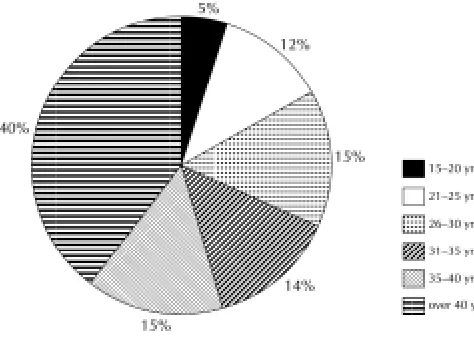
The sample was divided into 68% female and 32% male responses. A majority of the respondents (40%) were aged over 40 years. Only 5% were aged below 20 years, 12% were between the age of 21 and 25 years. There were 15% of the sample aged between 26 and 30 years, 13% were aged 31 to 35 years and 15% were between 36 and 40 years. The distribution of respondents within each age group is illustrated in figure 1.
Figure 1: Distribution of sample by age group
The majority of respondents (73%) did not belong to any of the stated target groups. Of the total sample, 2% were of Aboriginal or Torres Strait Islander (ATSI) origin; 6% were from a culturally and linguistically diverse background, while 19% were from rural or regionally isolated areas.
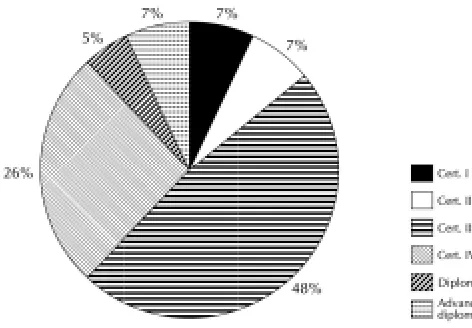
Online students who participated in this study were studying at a range of courses at certificate and diploma levels.
Figure 2: Distribution of the sample studying at the various AQF levels
The range of courses, at varying AQF levels, which people in the sample were studying included:
L Unknown in Business work processing Negotiation skills
Introduction to aquaculture
Microsoft certified systems engineer Anatomy & physiology 1 & 2 Personal growth & development 3D animation (studio max) Electronic mail
Flexible online learning/teaching
L Certificate I Short Story Writing I
L Certificate II Short Story Writing II Electronics
Information Technology
Information Technology Network Administration Library Studies
L Certificate III Client Services
Government Administration Government Client Services Government Software Application Government Information Technology
Information Technology (Software applications) Information Technology (Business applications) Workplace Assessor
Customer Services Relations
L Certificate IV Business Administration Information Technology Office Administration Small Business Management Access & Workplace Training
L Diploma Open & Distance Learning Business
Engineering
Business Management
L Advanced Accounting Diploma