Imitative and Nonimitative Social Learning In
Two - Object / Two - Action Procedure
Fiona M argaret Campbell University College London
ProQuest Number: 10609382
All rights reserved
INFORMATION TO ALL USERS
The qu ality of this repro d u ctio n is d e p e n d e n t upon the q u ality of the copy subm itted.
In the unlikely e v e n t that the a u th o r did not send a c o m p le te m anuscript and there are missing pages, these will be note d . Also, if m aterial had to be rem oved,
a n o te will in d ica te the deletion.
uest
ProQuest 10609382
Published by ProQuest LLC(2017). C op yrig ht of the Dissertation is held by the Author.
All rights reserved.
This work is protected against unauthorized copying under Title 17, United States C o d e M icroform Edition © ProQuest LLC.
ProQuest LLC.
789 East Eisenhower Parkway P.O. Box 1346
"But rats..." I objected.
"Rats are highly intelligent creatures. If we want to find out anything new about the human body we experiment on rats. Rats indeed are ahead of us indisputably in one respect - they live underground. We only began to live underground during the last war. Rats have understood the danger of surface life for thousands of years. When the atom bomb falls the rats will survive. What a wonderful empty world it will be for them, though I hope they will be wise enough to stay below. I can imagine them evolving very quickly. I hope they don't repeat our mistake and invent the wheel."
Acknowledgements
First and foremost, I would like to acknowledge the extent to which I am indebted to my supervisor, Dr Cecilia Heyes, whose firm and steady hand has guided me throughout the last three years. I am indebted also to my family; Judy Campbell, John Campbell, Siobhain Campbell, Sean Campbell, Joe Mackessy, Father Phil Barry, Margaret and Tom Halpenny. You have provided me with a tremendous reserve of emotional and practical support, and thereby eased me of so many burdens. I only hope that one day I might be able to go some way towards repaying your generosity.
Thanks also to the best friends that one person could ever hope for: John-Paul Pryor, Sarah Glencross, Christa Foster, Colleen Congel, and Dan McIntyre. Your constant encouragement and unwavering faith has seen me through the difficult patches, while your company has provided me with much solace and tremendous happiness.
I would also like to thank Phil Reed, Elizabeth Ray, and Mark Gardner for their invaluable advice; Roger Bunce for his technical support; Brian Bye, Alan Stewart, Rob Isles, Sadie Massie, and Shafi Sohail for their help in maintaining the animals used in this thesis. Not to mention Arthur Goldsmith, Simon Green, and Luc-Alain Giraldeau for providing me with much needed laboratory space. Finally, I would like to thank my examiners; Bennet Galef Jr and Simon Green. I hope that the task ahead is not too arduous.
Abstract
It is widely believed that observation of a conspecific performing an action on an object for food can facilitate acquisition of the observed response via imitative, in addition to, nonimitative social learning. Imitative social learning consists of response learning by observation (Heyes, 1993; Heyes & Ray, in press). It allows animals to learn responses, actions, or patterns of behaviour; how to execute them and what are their consequences (observational learning or imitation). Nonimitative social learning, on the other hand, consists of stimulus learning by observation (Heyes, 1993; Heyes & Ray, in press). It is the means by which animals acquire information about stimuli, objects, or events in the environment; their presence or location (stimulus enhancement), dynamic properties (emulation learning), and/or value (observational conditioning).
The experiments reported in this thesis used a two-object/two-action procedure in an attempt to distinguish these two forms of learning (Ray, 1997). In Experiment 1, naive rats observed from one side of an operant chamber while demonstrators manipulated either a left or a right lever by lifting up or pressing down. When subsequently allowed access to the levers on test and rewarded for all responses, regardless of location and direction, observer rats showed a reliable tendency to manipulate the same lever in the same direction as their demonstrator. Unfortunately, these effects were not particularly robust. Numerous attempts to replicate Experiment 1 yielded either the location effect, the direction effect, or no effect of conspecific observation. Only in the reported experiment were both effects obtained simultaneously.
a number of different of social influences may act upon the rat's behaviour in a two-object/two- action procedure, response learning by observation may not be one of them.
In Experiments 4-7, whether rats were exposed to the delivery of food following each of their demonstrator's responses was manipulated in order to examine the role played by demonstrator reinforcement in lever choice. These experiments confirmed previous findings by showing that rats are exposed to levers as a result of observing them pressed (Heyes, Ray, Mitchell, & Nokes, 1999), and, in addition, revealed that reinforcement of demonstrators' responses increased the probability that rats would approach and contact the lever which their demonstrator operated. Once in the vicinity of the lever, rats encountered odour cues deposited by demonstrators during the course of instrumental responding. These cues were found to be sufficient to bias rats' responses in favour of their demonstrator's direction (Experiments 2 and 3).
List of Figures
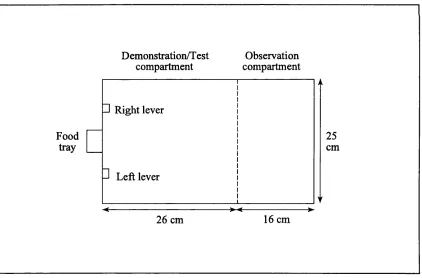
Figure 1. Plan of the two object/two action apparatus. 54
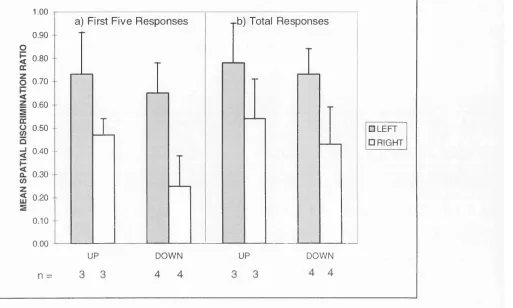
Figure 2. Mean spatial discrimination ratio (left responses/total responses) for a) the first five and b) the total responses made by each group of observers in Experiment 1. 61
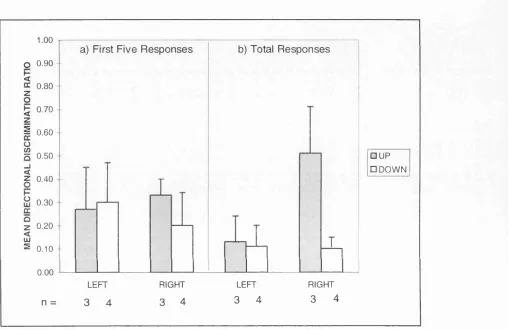
Figure 3. Mean directional discrimination ratio (up responses/total responses) for a) the first five and b) the total responses made by each group of observers in Experiment 1. 63
Figure 4. Mean directional discrimination ratio (up responses/total responses) of a) the first five and b) the total responses made by each group of observers in Experiment 2. 72
Figure 5. Mean directional discrimination ratio (up responses/total responses) for a) the first five and b) the total responses made by each group of observers in Experiment 3. 81
Figure 6. Mean spatial discrimination ratio (left responses/total responses) for a) the first five and b) the total responses made by each group of observers in Experiment 4. 93
Figure 7. Mean spatial discrimination ratio (left responses/total responses) for a) the first five and b) the total responses made by each group of observers in Experiment 5. 100
Figure 9. Median percentage reinforced responses [(number of reinforced responses/total number of responses) x 100%] for the observer rats that were rewarded for pressing either the left or the right lever during each of the five sessions of instrumental pretraining in Experiment 7. 123
Figure 10. Mean number of previously reinforced responses made by the rats in Groups SAME, DIFFERENT, and NONE that were rewarded during instrumental pretraining for pressing either
the left or the right lever. 126
Figure 11. Mean number of previously reinforced responses made by the rats in Groups SAME, DIFFERENT, and NONE that were rewarded during instrumental pretraining for pressing either
the left or the right lever. 128
Figure 12. Plan of the apparatus used in Experiment 8 showing the position of the food-finding
task. 138
Figure 13. Plan of the food-finding task used in Experiment 8 showing the position of the plugs and the brackets that were used to restrict movement of the plugs. 139
Figure 14. Mean number of responses made by the demonstrators during each of the seven
demonstration sessions in Experiment 8. 145
Figure 15. Mean number of responses made by the observers during each of the three test sessions
Groups RED and BLACK during each of the three test sessions in Experiment 8. 149
Figure 17. Median directional discrimination ratio (up responses/total responses) for the birds in Groups UP and DOWN during each of the three test sessions in Experiment 8. 151
Table 1. Median percentage correct responses [(number of correct responses/total number of responses) x 100%] and interquartile range for each group of demonstrators in Experiment 1.
59
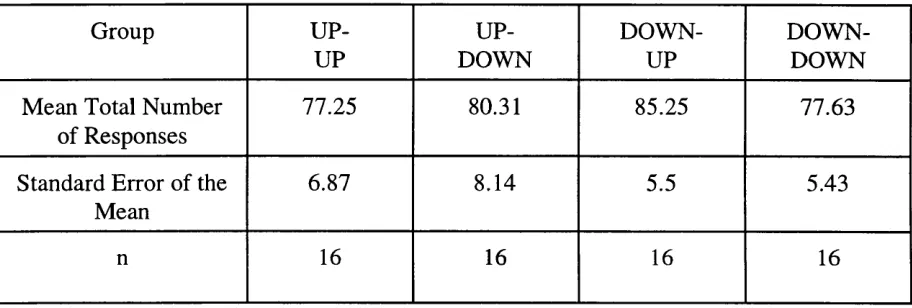
Table 2. Mean total number of responses and standard error of the means for each group of
observers in Experiment 1. 60
Table 3. Median percentage correct responses [(number of correct responses/total number of responses) x 100%] and interquartile range for each group of demonstrators in Experiment 2.
70
Table 4. Mean total number of responses and standard errors of the means for each group of
observers in Experiment 2. 71
Table 5. Median percentage correct responses [number of correct responses/total number of responses) x 100%] for each group of demonstrators in Experiment 3. 79
Table 6. Mean total number of responses and standard errors of the means for each group of
observers in Experiment 3. 80
Table 8. Median percentage correct responses [(number of correct responses/total number of responses) x 100%] and interquartile range for each group of demonstrators in Experiment 5.
98
Table 9. Median percentage correct responses [(number of correct responses/total number of responses) x 100%] and interquartile range for each group of demonstrators in Experiment 6.
109
Table 10. Median percentage correct responses [(number of correct responses/total number of responses) x 100%] and interquartile range for each group of demonstrators in Experiment 7.
Contents
Chapter 1. Imitative and Nonimitative Social Learning In Animals
1. Introduction 13
1.1 Social Enhancement 16
1.1.1 Contagion 16
1.1.2 Social facilitation 16
1.1.3 Local enhancement 18
1.1.4 Summary and conclusion 22
1.2 Social Learning 22
1.2.1 Nonimitative social learning 22
1.2.1.1 Stimulus enhancement 22
1.2.12 Emulation learning 25
1.2.1.3 Observational conditioning 25
1.2.1.4 Summary and conclusion 32
1.2.2 Imitative social learning 32
1.2.2.1 Imitation or observational learning 32
1.2.2.2 Summary and conclusion 34
1.3 Identifying Imitative Social Learning 36
1.3.1 Survey of imitation experiments 36
1.3.1.1 Shaping, non-exposed, and duplicate-cage control procedures 36
1.3.1.2 Two-action procedures 39
1.3.2 Summary and conclusion 44
1.4.1 The two-object/two-action procedure
1.4.2 Summary and conclusion
44 50
Chapter 2. Imitative and Nonimitative Social Learning In the Rat Using a Two-Object/Two-Action Procedure
2. Introduction 51
2.1 Experiment 1 53
2.2 Experiment 2 66
2.3 Experiment 3 76
2.4 General Discussion 83
Chapter 3. Nonimitative Social Learning In the Rat: Sensitivity to the Consequences of Demonstrators’ Responses I
3. Introduction 86
3.1 Experiment 4 87
3.2 Experiment 5 95
3.3 Experiment 6 106
3.4 General Discussion 113
Chapter 4. Nonimitative Social Learning In the Rat: Sensitivity to the Consequences of Demonstrators’ Responses II
4. Introduction 115
Chapter 5. Imitative and Nonimitative Social Learning In the European Starling Using a Two-Object/Two-Action Procedure
5. Introduction 132
5.1 Experiment 8 136
Chapter 6. The Two-Object/Two-Action Procedure: Theoretical and Methodological Significance
6. Introduction 157
6.1 Theoretical Significance of the Two-Object/Two-Action Procedure 159
6.1.1 The rat 159
6.1.2 The starling 169
6.1.2.1 The budgerigar 171
6.1.3 Summary and conclusion 173
6.2 Methodological Significance of the Two-Object/Two-Action Procedure 174
6.2.1 W hat are the psychological mechanisms of imitative and nonimitative social learning?
175
6.2.1.1 Nonimitative social learning 176
6.2.1.2 Imitative social learning 177
6.2.2 W hat are the distinctive conditions favouring imitative and nonimitative social
learning? 181
6.2.3 Summary and conclusion 183
Chapter 1
Imitative and Nonimitative Social Learning In Animals
1. Introduction
Social learning refers to those instances in which the behaviour of a naive animal, the 'observer', is modified by observation of or interaction with another animal (typically a conspecific), the 'demonstrator', or its products (Heyes, 1994). Since formal research on the subject began a century ago (for a review see Galef, 1988), psychologists and biologists have investigated whether nonhuman animals (henceforward 'animals') are capable of some form of social learning, most notably imitation. However, attempts to demonstrate imitation in animals have been made difficult by the failure to define criteria by which it can be empirically distinguished from other forms of social learning.
Heyes (1994) has argued that similar rules can be used to define categories of social learning, which favours the hypothesis that the two sets of phenomena are mediated by common mechanisms. On the one hand, there is nonimitative social learning which consists of stimulus learning by observation (Heyes, 1993; Heyes & Ray, in press). It allows animals to learn about stimuli, objects, or events in the environment; their presence or location (stimulus enhancement), dynamic properties (emulation learning), and/or value (observational conditioning). On the other hand, there is imitative social learning which consists of response learning by observation (Heyes, 1993; Heyes & Ray, in press). It is the means by which animals acquire information about responses, actions, or patterns of behaviour; how to execute them and what are their consequences (observational learning or imitation).
The study of imitation in animals has been obstructed not only by the fact that it is difficult to isolate imitative from nonimitative social learning, but also from those processes that, although they do not constitute learning, may result in the behaviour of one animal resembling that of another. These processes have been assigned the generic name 'social enhancement' by Galef (1988), and can be placed in one of three different categories depending on whether the mere presence and/or behaviour of a conspecific:( i) acted as a releaser for the same behaviour in others (contagion), (ii) increased the rate at which other animals performed a target response (social facilitation), or (iii) attracted animals to an object or a site (local enhancement).
to the object for the first time, a record is made of their responses. If animals engage in imitative social learning, or response learning by observation, then one would expect the observers to show a bias in favour of the demonstrator's action. Such an effect could not be due to social enhancement because, regardless of the topography of demonstrators' responses, the observers are exposed equally to the mere presence and/or behaviour of a conspecific. Nonimitative social learning, or stimulus learning by observation, is also an unlikely explanation because the observers differ only in their exposure to a stimulus array which is their demonstrator's behaviour.
Use of the two-action procedure is based on the assumption that in any given context it is possible to manipulate precisely the events to which animals are exposed in order to make strong inferences about which factors led to any change in the animal's behaviour (Zentall, 1996). It is likely that in most natural and experimental environments, providing animals with the opportunity to interact with demonstrators will result in both imitative and nonimitative social learning. By attempting to exclude all possibility of nonimitative social learning, two-action procedures may be creating situations far removed from the real world. Consequently, any paradigm which permits the simultaneous identification of behaviour which has been modified via response learning and stimulus learning by observation will be valuable. One potential example is the two-object/two-action procedure.
1.1 Social Enhancement
1.1.1 Contagion
Contagion refers to those instances in which "the performance of a more or less instinctive pattern o f behaviour by one [animal] will tend to act as a releaser for the same behaviour in others" (Thorpe, 1963, p. 133). Examples of contagious behaviour include yawning in humans, chorusing in roosters, manoeuvring in flocks of birds and schools of fish, and the 'flying up' of partridge or quail (Galef, 1988).
The term contagious behaviour was first used to describe innate responses to releasing stimuli. However, it has since been applied in reference to acquired responses made in the presence of conditioned stimuli (e.g. Galef, 1988; Zentall, 1996). For example, birds that forage in flocks are likely to have considerable experience of pecking in the presence of other birds that are also pecking. Thus, the sight of another bird feeding might be expected to acquire, through a process of classical conditioning, the capacity to elicit pecking in the observer, or to serve as a conditioned stimulus (Clayton, 1978).
Innate and acquired contagious behaviour is usually avoided in experiments on social learning by studying novel or sufficiently improbable responses (Thorpe, 1963; Zentall, 1988).
1.1.2 Social facilitation
is correct, performance will be improved by the presence of others. This may have been the case in a study by Bayer (1929), in which satiated hens resumed feeding when fed in the presence of a conspecific that had not eaten for 24 h. If, on the other hand, the dominant response is incorrect, performance will be impaired by the presence of others. For example, Gates & Allee (1933) found that groups of cockroaches trained to locate a dark shelter in a maze took longer to learn the task and made more errors than cockroaches trained in isolation.
Zajonc (1965) used the term social facilitation to describe the effects of passive spectators on a target individual's behaviour and coactors engaged in the same behaviour as the target individual. Both of which may have been demonstrated by Cadieu, Cadieu, & Lauga (1995). They found that juvenile canaries fed in the presence of their father ate more seed than juvenile canaries fed in isolation, and that this effect was particularly pronounced when the father had seed o f his own available than when he had none. This suggests that while the mere presence of an adult bird increased the juveniles' rate of feeding, the general activity and/or consummatory behaviour of adult birds produced an additional increment in the juveniles' feeding rate.
head-cocking and feeding rates were measured in individual woodpeckers that were foraging alone, with one or two other individuals, or in groups with three or more individuals (Sullivan, 1984). Sullivan found that head-cocking rate decreased with increasing group size, while feeding rate increased.
Thus, social facilitation refers to a heterogenous collection of phenomena that cannot be explained by a single underlying process. The mere presence and/or behaviour of a conspecific demonstrator may increase the rate at which an observer performs those responses most appropriate to the current stimulus situation in one of several different ways. The demonstrator may increase the observer's level of arousal, or reduce the observer's isolation-induced fear or the amount of time it devotes to vigilance.
1.1.3 Local enhancement
Local enhancement refers to "apparent imitation resulting from directing the animal's attention to a particular object or to a particular part of the environment" (Thorpe, 1963, p. 134). It has been used to account for the spread of a novel foraging behaviour, milk bottle opening, among populations of blue tits in England (Fisher & Hinde, 1949; Hinde & Fisher, 1951). If the spread o f this behaviour occurred because the presence of feeding birds at milk bottles increased the attention paid to those milk bottles by naive birds, then this would be an example of local enhancement.
which the flask and tub had been removed (Sherry & Galef, 1990). Sherry & Galef found that when birds observed tub-opening demonstrators they were no more likely to open tubs on test than when they observed demonstrators sitting passively in the vicinity of the stand. However, both groups were more likely to open tubs than birds that observed a stand but not a demonstrator during training. These findings suggest that the demonstrators drew the observers' attention to the stand and thereby facilitated acquisition of milk bottle opening.
The term local enhancement is usually reserved for those instances in which an animal's behaviour is modified by the opportunity to interact directly with one or more individuals. For example, individuals in groups forage more efficiently than isolates as measured by: (i) probability of finding food (great tit: Krebs, MacRoberts, & Cullen, 1972; dark-eyed junco: Baker, Belcher, Deutsch, Sherman, & Thompson, 1981; greenfinch: Ekman & Hake, 1988), (ii) mean food intake (downy woodpecker: Sullivan, 1984), (iii) rate of prey capture (cliff swallow: Brown, 1988; spider: Rypstra, 1989), (iv) food intake variability (cliff swallow: Brown, 1988; spider: Rypstra, 1989), and (v) time taken to find prey (osprey: Fleming, Smith, Seymour, & Bancroft, 1992). In each of these studies, the authors assumed that the advantages associated with group foraging resulted from local enhancement whereby animals were attracted to the site at which conspecifics were feeding. This assumption is supported by Knight & Knight (1983), who found that when arriving at an artificial food site bald eagles were more likely to land at patches attended by other eagles, crows, and/or ravens than at unattended patches. (See also Senar & Metcalfe, 1988 and Prior & Weatherhead, 1991 for a similar effect in siskins and turkey vultures).
1988). In Israel, black rats feed on the seeds of Jerusalem pine cones which they open using a complex spiralling technique. Aisner & Terkel (1992) found that naive rats were unable to open pine cones even after three months of trial-and-error learning, whereas naive rats that were provided with cones from which a progressively decreasing number of rows of scales had been removed, either manually or by a conspecific, readily learned to open fully intact cones. Similarly, Sherry & Galef (1984) found that black-capped chickadees allowed to drink from milk bottles that had previously been opened by a conspecific, were more likely to open and drink from sealed milk bottles than chickadees that had never been given this opportunity.
According to Galef (1988), local enhancement may result from a tendency on the part of naive individuals to approach conspecifics or alterations conspecifics have made in the environment. For example, as the result of their tendency to swim with conspecifics, fish may exploit the food discovered by other individuals (juvenile walleye pollock: Ryer & Olla, 1992, 1995). They may also acquire a feeding route preference (guppies: Laland & Williams, 1997). Similarly, rats eat the same food other rats are eating as the result of their tendency to approach conspecifics (Galef, 1971; Galef & Clark, 1971, 1972) or residual cues that conspecifics have deposited (Galef & Beck, 1985), and begin feeding in their presence.
increased exposure, rather than attention to, environmental stimuli.
Current use of the term local enhancement is consistent with the hypothesis that it facilitates learning about the stimulus to which demonstrators responded. However, if local enhancement is restricted to those periods in which two or more animals are interacting, or one animal is interacting with the products of another animal's behaviour, then it cannot conventionally be regarded as a form of learning. If, on the other hand, an animal continues to behave differentially towards stimuli when all traces of the demonstrator have gone, then local enhancement can be regarded as a form of learning, but it cannot be distinguished from stimulus enhancement (see Section 1.2.1.1). Thus, to retain local enhancement as a useful construct in research on social learning, it may be necessary to reserve the term for those instances in which an observer behaves differentially towards stimuli only in the presence of demonstrators or products o f the demonstrators' activity (Heyes, 1994). Stimulus enhancement can then indicate cases in which an observer behaves differentially towards stimuli when all traces of the demonstrator have gone.
the hand exposed pigeons to the key and thereby facilitated learning about the key-food relationship, but only if the pigeons had been pretrained to follow the hand around the chamber.
1.1.4 Summary and conclusion
Social enhancement refers to those processes that, although they do not constitute learning, may lead to changes in another animal's behaviour. The mere presence or behaviour of a demonstrator may: (i) serve as a releaser for the same behaviour in others (contagion), (ii) increase the rate at which other animals perform those responses most appropriate to the current stimulus situation (social facilitation), and/or (iii) direct the animals' behaviour toward a particular object or site (local enhancement).
1.2 Social Learning
1.2.1 Nonimitative social learning
1.2.1.1 Stimulus enhancement
To attribute a given instance of social learning to stimulus enhancement is to imply the operation of two learning processes. The first of which occurs during observation training when the demonstrator's behaviour renders attractive the stimuli with which it is interacting. The second process is instrumental learning and occurs in the presence or the absence of the demonstrator, when the observer gains access to stimuli of the same physical type as those to which the demonstrator was observed responding.
Stimulus enhancement differs from local enhancement in two respects. First, local enhancement refers to those instances in which animals behave differentially towards stimuli only in the presence of demonstrators or products of the demonstrators' activity. If animals behave differentially towards stimuli when all traces of the demonstrator have gone, stimulus enhancement can be said to have occurred. This may have been the case in a study by McQuoid & Galef (1992), in which naive Burmese red jungle fowl were allowed to observe conspecific demonstrators feeding from a bowl in one of four different locations. When subsequently allowed access to the bowls on test, observer fowl showed a reliable tendency to feed from the same location as their demonstrators. Local enhancement cannot account for this effect, because the demonstrators were not present when the observers were tested and testing was conducted 48h after the final demonstration trial, during which time any cues deposited by the demonstrators might be expected to have dissipated. Furthermore, the location of the four bowls was randomly interchanged between demonstration and testing such that any cues that were deposited by demonstrators and persisted during the 48h interval, would have been rendered irrelevant.
attracted to objects with the same physical appearance (i.e. numerically distinct) as that demonstrators contacted. Petit & Thierry (1993) studied the use of stones by a group of captive Guinea baboons to dig holes in the floor of their enclosure. They suggested that following the discovery o f stone use by a single individual, the behaviour spread to other group members by stimulus enhancement. However, for this interpretation to be supported it would be necessary to show that when first selecting a stone for use, baboons did not use the very same stone as the initiator o f the behaviour, but selected one of a number of physically similar but numerically distinct stones.
Duplicate-cage procedures, in which demonstrators and observers contact numerically distinct stimuli have the potential to isolate stimulus enhancement from local enhancement. Laland & Plotkin (1990) allowed rats to observe, from one side of an enclosure, while a demonstrator dug up pieces of carrot buried beneath a layer of soil that covered the floor. These rats unearthed more pieces of carrot from their own side of the enclosure than rats that were exposed to the mere presence of a passive conspecific. This effect is unlikely to have been due to local enhancement, because rats were tested in a different area to that in which the demonstrators were observed. Thus, it may provide evidence of stimulus enhancement.
trials to learn the discrimination than rats that were trained to enter the opposite door. These results are consistent with the hypothesis that response acquisition was influenced by the sight of the demonstrator contacting the door (stimulus enhancement). However, they fail to rule out the possibility that observer rats were attracted to the door on which demonstrators deposited odour cues (local enhancement). According to Kohn (1976), the apparatus was cleaned between observation and testing; although in the absence of information regarding the relative effectiveness of this procedure, local enhancement cannot be ruled out.
1.2.1.2 Emulation learning
Tomasello (1990) introduced the term emulation learning to refer to those instances in which a naive animal learns, as the result of observing the behaviour of another individual, about the affordances, or changes in state of, environmental stimuli. Tomasello, Davis-Dasilva, Comak, & Bard (1987) allowed juvenile chimpanzees to observe an adult female conspecific demonstrator using a metal T-bar to rake food into her cage. These chimpanzees subsequently learned to use the T-bar, whereas chimpanzees that had been allowed to observe the demonstrator in an unoccupied state throughout training trials did not. If this effect occurred because the chimpanzees learned by observation the affordances of the T-bar with respect to food, then this would be an example of emulation learning.
1.2.1.3 Observational conditioning
conspecific demonstrator behaving fearfully in the presence of real and toy snakes, and nonfearfully in the presence of neutral objects. When subsequently presented with the same stimuli on test, the observers became agitated in the presence of, and attempted to avoid, the snake stimuli. If this was because the observers learned a relationship between the demonstrator's fear display and the snake stimuli, then this would be an example of observational conditioning.
According to Heyes (1994), use of the term observational conditioning to describe situations in which a demonstrator's behaviour exposes an observer to the relationship between stimuli by acting as the source of the second stimulus, is inappropriately restrictive. There are numerous instances in the social learning literature where a demonstrator increases the likelihood that an observer will be exposed to an S-S relationship, but does not act as the source of the second stimulus. One example is provided by Palameta & Lefebvre (1985). They allowed pigeons to observe demonstrators piercing a hole in the paper lid covering a food bowl and eating from within. When provided with an intact food bowl on test, these pigeons solved the food-finding problem faster and with fewer pecks than pigeons that observed demonstrators either eating from a preexisting hole in the paper lid but not piercing it, or piercing a hole in the paper lid but not eating from it. This suggests that when pigeons observed pecking-and-eating demonstrators, they learned a relationship between the paper covered bowl and the availability of reward, and observational conditioning appears to be the most appropriate description of this effect.
one o f two distinctively marked cups and then exhibit signs of illness. When subsequently presented with the same food cups on test, observer birds did not approach that out of which demonstrators had fed. Instead, they showed a strong tendency to avoid the demonstrator's food cup.
Furtherm ore, if observational conditioning and classical conditioning are mediated by common mechanisms, then one would expect observational conditioning to result in a wider range of phenomena than that described by Cook et al. (1985). Varieties of classical conditioning can be distinguished according to the nature of the relationship between stimuli (excitatory/inhibitory). The relationship between stimuli is excitatory if the first event predicts that the second event will occur, and inhibitory if the first event predicts that the second event will not occur. They can also be distinguished according to the value of the second stimulus for the animal, which may be either attractive (e.g. the delivery of food) or aversive (e.g. the delivery of shock). If this is correct, then one would expect that demonstrators would be able to expose observers to four different types of relationship between stimuli.
dem onstrator making contact with the candle flame and getting burnt (see also Mason & Reidinger, 1982).
When the relationship between stimuli is inhibitory and the second stimulus is attractive, the first stimulus becomes less likely to elicit a response. This is called inhibitory appetitive conditioning and probably occurred in a study by Darby & Riopelle (1969), where rhesus monkeys observed demonstrators displacing one of two distinctive objects from above a hole in a tray. On half the trials the demonstrator's choice was rewarded with food, on the other half it was nonrewarded. When the demonstrator's choice was rewarded, the observers readily learned to select the object their demonstrator displaced. When the demonstrator's choice was nonrewarded, the observers selected the other object. This suggests that on nonrewarded trials the observers learned a negative relationship between the stimulus displaced by the demonstrator and food, and that on rewarded trials they learned a positive relationship between the same events.
Inhibitory aversive conditioning occurs when as a result of exposure to an inhibitory relationship between stimuli when the second stimulus is aversive, the first stimulus becomes more
re t r c l / o r
likely to elicit a response. In a study by Del Russo (1975), rats observed demonstrators running
A.
^ y ^ £ . I A y ' i . x r j C w . t t'f-from one side of a shuttlebox to the other whenever a tone sounded in-order4o- avoid shock. When subsequently tested for their response to the tone, these animals made more avoidance responses than rats that were exposed to the tone but not to a demonstrator running during
i f O t i ' o t c >a ’ j - 1 ( > * j v s l
The effect of exposure to a relationship among events cannot only be detected through changes in response evocation, but also through changes in the animal's ability to learn other relationships. Overshadowing occurs when exposure to an S r S2 relationship at the same time as an S3-S2 relationship reduces the degree to which the animal learns about the S3-S2 relationship. Blocking, on the other hand, refers to those instances in which previous experience of an S!-S2 relationship reduces the degree to which the animal learns about an S3-S2 relationship when it is presented at the same time as the S r S2 relationship. Overshadowing and blocking are characteristic of classical conditioning. Therefore, if observational conditioning and classical conditioning are mediated by similar mechanisms, one would expect to find examples of overshadowing and blocking in the social learning literature.
overshadowed learning about the S3-S2 relationship.
Blocking, on other hand, has yet to be demonstrated in experiments on social learning. Galef & Durlach (1993) allowed rats to interact with demonstrators that had recently been fed a distinctively flavoured diet. Rats that were exposed to the odour and/or flavour of marjoram- flavoured diet (S,) on a demonstrator's breath (S2), followed by cinnamon-flavoured diet (S3) on a demonstrator's breath, subsequently consumed the same amount of cinnamon flavoured diet as rats that had been exposed to the S3-S2 relationship, but not to the S,-S2 relationship. Therefore, there is no evidence of blocking in this experiment. However, this does not mean that blocking is not a characteristic of observational conditioning because these effects are not always found in experiments on classical conditioning and may depend on the administration of multiple trials rather than the single trial used by Galef & Durlach (1993).
had not been given the opportunity to observe any aspect of a demonstrator's performance, they did not differ from each other. This suggests that vicarious reinforcement did not exert an important influence on the observers' behaviour. However, it is likely that the observers could hear their demonstrators drinking, and that the sounds which accompanied drinking acquired reinforcing properties of their own during the observers' previous experience in the apparatus. If this is correct, then response acquisition may have been facilitated in both groups by a process depending on secondary, rather than on vicarious reinforcement.
In order to investigate the second assumption, it would be necessary to vary or abolish the contingency between demonstrators’ responses and their consequences. If any change in an animal’s behaviour following exposure to an Sr S2 relationship is a result of learning about that relationship, then one would expect degrading the relationship to have an aversive effect on performance. This manipulation was attempted by Palameta & Lefebvre (1985). They allowed pigeons to observe demonstrators piercing a hole in the lid of a food bowl (S[) and eating from within (S2), and found that these birds acquired the same response faster and with fewer pecks than birds that observed either S, or S2 alone.
1.2.1.4 Summary and conclusion
Nonimitative social learning consists of stimulus learning by observation. Animals that observe conspecific demonstrators interacting with an environmental stimulus may learn about: (i) the presence or location of that stimulus (stimulus enhancement), (ii) its dynamic properties (emulation learning), and/or (iii) its relationship to a second stimulus which may be attractive or aversive for the animal (observational conditioning). Finally, nonimitative social learning may facilitate acquisition of a response which resembles that exhibited by a demonstrator. However, it may also facilitate the acquisition of nonmatching behaviour.
1.2.2 Imitative social learning
1.2.2.1 Imitation or observational learning
Imitation (or observational learning) refers to acquisition of a topographically novel response through observation of a demonstrator making that response (Heyes, 1994). According to Galef (1988), imitation is an "onerous concept to be employed only when no other explanation of an observed social influence on behaviour is possible" (p. 10). Compelling examples of imitation in animals are rare, but one example may have been provided by Dawson & Foss (1965). They allowed naive budgerigars to observe demonstrators using either their feet or their beak to remove a card from a plastic bowl containing seed. When subsequently provided with a closed bowl on test, these birds showed a reliable tendency to remove the card using the same appendage as their demonstrator.
potential outcome (Heyes, 1993). In order to determine whether imitation is regulated in this manner, it would be necessary to manipulate the value of the outcome of demonstrators' responses for the observer. If imitation is goal-directed, then one would expect it to occur only when the observer assigns a positive value to the outcome of the demonstrators' responses. If imitation occurs when the observer assigns a negative value to the outcome of the demonstrators' responses, then this would suggest that it is automatic rather than goal-directed.
However, there are no known experiments in which evidence of goal-directed imitation has been sought in this manner. Furthermore, even if imitative behaviour was shown to be goal- directed, it would not be the only behaviour to be regulated in this manner. In the study by Darby & Riopelle (1959), rhesus monkeys observed demonstrators displacing one of two different objects from above a hole in a tray. During a subsequent test session, the observers were rewarded regardless of the choice that they made. If the demonstrator's choice had been rewarded, the observers tended to displace the same object, and if the demonstrator's choice had been nonrewarded, they tended to displace the other object. This suggests that the observers' behaviour was sensitive to changes in the value of the outcome of demonstrators' responses, or that it was goal-directed.
the o b s e rv e r (Heyes, 1994). This implies that observational learning is mediated by the same
mechanisms as instrumental conditioning, except that in the case of observational learning it is the
dem onstrator, rather than the learner, that m akes the response which is to be acquired.
If this is correct, and observational learning and instrumental conditioning are m ediated
by similar mechanisms, then one would expect there to be a num ber o f observational learning
phenomena in addition to imitation. In the case of imitation, learning occurs as a result of socially-
m ediated exposure to a positive relationship between a response and an appetitive reinforcer (a
o b s e r v e t c o 111 © rvt rvei
r e w a r d contingency). Thus, it might be expected to occur as a result of exposure to a positive
relationship involving an aversive reinforcer (a punishment contingency), a negative relationship
involving an appetitive reinforcer (an omission contingency), and a negative relationship involving
an aversive reinforcer (an avoidance contingency).
As in the case o f observational conditioning, the effect of exposure to these four possible
ty p es o f contingency may be detected as a change in response evocation. Exposure to either a
r e w a rd or an avoidance contingency is likely to lead to an increase in responsiveness, while
exposure to either a punishment or an omission contingency may lead to a decrease. Furtherm ore,
the response that the observer makes may or may not match that m ade by the dem onstrator, and
it m ay or m ay not form part of the observer's preexisting behavioural repertoire.
1.2.2.2 S um m ary and conclusion
Imitative social learning consists of response learning by observation. W hen perm itted to observe
the behaviour of a conspecific demonstrator, naive animals m ay learn: (i) what to do or how to
behaviour and a second event that may be either attractive or aversive for the observer (observational learning). Imitation increases the probability of matching behaviour. Observational learning, on the other hand, may lead to changes in an observer's behaviour that either do or do not match that of its demonstrator.
In the foregoing discussion of imitative social learning, two putative varieties were not considered: matched-dependent behaviour and vocal imitation (Galef, 1988). The term matched- dependent behaviour was first introduced by Miller & Dollard (1941) to explain the fact that rats can learn to follow a demonstrator into either the same arm of a T-maze or the opposite arm for food. In this instance, it was assumed that the demonstrator's behaviour served as a discriminative stimulus indicating to the observer which behaviour it would be rewarded for emitting. However, matched-dependent behaviour cannot conventionally be regarded as a form of social learning because once the demonstrator has been removed from the maze, all aspects of the observer's behaviour dependent on the demonstrator's behaviour are lost (Galef, 1988).
Finally, vocal imitation was also excluded from the foregoing discussion on the grounds that it may depend on a specialized process not seen in any other species of animal or in any other instance of social learning by birds (Galef, 1988).
1.3 Identifying Imitative Social Learning
1.3.1 Survey o f imitation experiments
For over a century, psychologists and biologists have investigated whether animals are capable of imitation. The current section is a discussion of some of the most instructive and widely-cited studies from this period, organized to reflect the fact that research on imitation in animals has become increasingly more rigorous and sophisticated.
1.3.1.1 Shaping, non-exposed, and duplicate-cage control procedures
These discrepant findings are likely to reflect differences in the skill and speed of the individual that was shaping the animals (Zentall, 1996). Moreover, the use of a shaping control group means that it is not possible to isolate the critical variables that were influencing the observers' behaviour and thus to determine what they learned, because the two groups of animals were exposed to radically different kinds of experience. These criticisms of the use of shaping control groups in studies of imitative learning led to the development of a new method for studying imitation, the non-exposed control procedure.
In studies employing the non-exposed control procedure, response acquisition by animals that observed demonstrators operating a manipulandum for food is compared with that of animals that observed the manipulandum but not a demonstrator during training. Typically, the target response is acquired more rapidly by observers of demonstrator action than by control animals (e.g. Jacoby & Dawson, 1969; Chesler, 1969; Oldfield-Box, 1970; Gardner & Engel, 1971). This suggests that exposure to demonstrators' responses results in more rapid learning than trial-and- error alone. However, it does not provide unequivocal evidence of imitation, because it may be due instead to social facilitation. Observers of demonstrator action may have acquired the target response faster than the non-exposed control group, because the mere presence and/or behaviour o f a conspecific increased the rate at which the animal performed those responses most appropriate to the current stimulus situation.
faster than a control group that were exposed to the mere presence of a passive conspecific. In the study by John et al. (1968), cats that observed demonstrators pressing a lever for food whenever a light was turned on acquired the same response faster than cats that observed demonstrators rewarded for approaching the food tray but not pressing the lever whenever a light was turned on.
These experiments indicate that social facilitation cannot account for the more rapid response acquisition shown by observers of demonstrator action in the non-exposed control procedure. However, they do not provide strong evidence of imitation because they may be due instead to local enhancement. The animals in these experiments were not tested in the presence of a demonstrator, although they were tested on the same object as that to which demonstrators responded. This raises the possibility that response acquisition was facilitated by products of the dem onstrator's activity deposited on or near the object rather than response learning by observation.
W hen the target response is well-learned performance may be improved by the presence of another animal (e.g. Levine & Zentall, 1974).
Although the duplicate-cage procedure mles out all possibility of local enhancement, it introduces another potential confound into studies of imitative learning. In the duplicate-cage procedure a demonstrator's activity may increase the likelihood that an observer will be exposed to stimuli of the same physical type as that to which the demonstrator responded (stimulus enhancement).
1.3.1.2 Two-action procedures
The two-action procedure in which naive animals observe conspecific demonstrators performing one of two or more alternative actions on a single object has been used to control for stimulus enhancement. Dawson & Foss (1965) allowed budgerigars to observe demonstrators removing a square piece of card from the top of a plastic bowl containing seed. The demonstrators used one of three different techniques to remove the card: they either edged it off with their beak, lifted it off with their beak, or used their foot to dislodge it. When subsequently presented with a covered bowl on test, observer birds showed a reliable tendency to use the same technique as their dem onstrator. Over twenty years after the original experiment, Galef, Manzig, & Field (1986) attem pted to replicate this effect. However, they found it to be small and transitory, rendering Dawson & Foss' (1965) procedure an unsuitable paradigm for analytic experiments on imitation.
chamber, while a demonstrator pushed a joystick either to the left or to the right. Once the demonstrator had made 50 reinforced responses it was removed from the chamber. Observer rats were transferred into the empty demonstration compartment and given a test session in which both left and right responses were rewarded. These rats showed a reliable tendency to push the joystick in the same direction, relative to their own bodies, as had their demonstrator.
This effect could not have been due to social facilitation, because observers of left- and right-pushing demonstrators were exposed equally to the mere presence, consummatory behaviour, and general activity of a conspecific. It is also unlikely that it was due to either local enhancement or stimulus enhancement, because the demonstrators were not present at the time of testing, and observation of left- and right-pushing should have rendered the joystick equally attractive.
The results of this experiment were interpreted as providing strong evidence of imitative learning in rats, or response learning by observation (Heyes, 1996). However, subsequent studies have cast doubt on the magnitude and provenance of the bidirectional control effect. A meta analysis o f bidirectional control data has indicated that at current parameters, the effect size is small (Gardner, 1997), and there is evidence that rats in the bidirectional control procedure are influenced by odour cues deposited on the joystick by demonstrators (Mitchell, Heyes, Gardner, & D awson, 1999). In the experiment by Mitchell et al. (1999), rats observed demonstrators pushing a joystick to the left or right for food. When subsequently allowed access to the joystick on test and rewarded for both left and right responses, these rats showed a reliable tendency to respond in the same direction as their demonstrator. However, when the joystick was rotated through an angle of 180 degrees within its mounting between observation and test, rats showed a reliable tendency to respond in the opposite direction to their demonstrator. This suggests that dem onstrators deposited attractive odour cues on the side of the joystick contralateral to its direction o f motion. When the joystick was in the standard position, exploration of these cues promoted demonstrator-consistent responding. However, when the joystick had been rotated through an angle of 180 degrees, exploration of odour cues promoted a demonstrator-inconsistent response bias.
treadle and none pecked at it. Similarly, Akins & Zentall (1996) reported that when Japanese quail observed pecking demonstrators they made more pecking than stepping responses, and when they observed stepping demonstrators they made more stepping than pecking responses. However, only the former effect was reliable.
In these experiments, pecking and stepping demonstrators had the same effect on the treadle. Therefore, the results cannot be attributed to the observers learning the dynamic properties of the treadle or a treadle movement-food relationship. However, while these experiments provide good evidence that observation of pecking promotes pecking in both pigeons and quail, evidence for a similar effect of stepping is not strong. Furthermore, since pecking forms part o f a bird's innate behavioural repertoire it is plausible that it was acquired via contagion acting in concert with stimulus enhancement. The sight of a pecking demonstrator may have acted as a releaser of pecking in an observer. If, in addition, the demonstrator's activity increased the probability that the observers would be exposed to the treadle, then this might result in the observers directing the majority of their pecking towards the treadle on test.
study that did see demonstrators contact the treadle. In the second study, Akins & Zentall (1998) found that when quail observed nonrewarded stepping, they made fewer stepping responses than when quail observed demonstrators stepping on a treadle and being rewarded with food. However, this effect was not reliable.
In a study by Lefebvre, Templeton, Brown, & Koelle (1997), Carib grackles observed either a conspecific or a Zenaida dove demonstrator using its beak to remove a plug from an opaque inverted test tube containing seed. Grackle demonstrators used an open beak probing and pulling technique to manipulate a horizontal stick that protruded from the base of the plug and open the tube, while dove demonstrators used a closed beak pecking technique. Lefebvre et al. (1997) found that when grackles observed conspecific demonstrators, they were more likely to remove the plug using an open beak technique than when they observed dove demonstrators. Unfortunately, the two types of demonstrator used in this study manipulated different regions of the stick. Grackle demonstrators probed and pulled the tip of the stick, and dove demonstrators pecked at the base of the stick. Thus, it is plausible that stimulus enhancement rather than imitation was responsible for the observers' bias. A possibility that Lefebvre et al. attempted to exclude by showing that there was no effect of demonstrator type on where the observers directed their responses.
chimpanzees showed a reliable tendency to use the same action as their demonstrator. In this experiment, the bolts could be removed using either a twisting or a poking action. Twists caused the bolts to rotate in a clockwise direction and move towards the demonstrator's body. Pokes did not cause the bolts to rotate, but did result in them moving away from the demonstrator's body. This raises the possibility that the chimpanzee in this experiment did not learn about their demonstrator's behaviour. Rather, they may have learned about the way in which the bolts moved as a result o f observing their demonstrator's behaviour (emulation learning).
1.3.2 Summary and conclusion
The foregoing survey indicates that the two-action procedure is important in two respects. First, it has substantially increased both the rigour and sophistication of research investigating imitation in animals. Second, it is potentially the most powerful method of isolating imitative from nonimitative social learning, or stimulus learning from response learning by observation.
1.4 Identifying Simultaneous Imitative and Nonimitative Social Learning
1.4.1 The two-object/two-action procedure
Ray (1997) has suggested that the problems faced by psychologists and biologists attempting to demonstrate imitation in animals are similar to those encountered by investigators o f asocial learning when determining whether an instrumental conditioning procedure involves learning about responses (instrumental conditioning) or learning about stimuli (classical conditioning). Prior to the 1970s, it was widely believed that all learning consisted of the association of a particular response with a particular outcome. However, this view was challenged by the results of a number of studies in which the importance was recognised of S-S relationships in controlling behaviour which had previously been regarded as instrumental.
In a study by Brown & Jenkins (1968), pigeons learned to peck a key, the illumination of which signalled the delivery of grain, even though keypecking had no effect on the probability of reward. Similarly, Williams & Williams (1969) found that pigeons learned to peck the key and continued to do so at a high rate, even though in this experiment keypecking postponed the delivery of grain. These "autoshaping" effects suggest that in those cases where pigeons are trained to peck a key through standard shaping procedures, or the method of successive approximations, this response was actually established by classical conditioning. The pigeons did not learn that keypecking resulted in the delivery of grain (instrumental conditioning). Rather, they learned that illumination of the key signalled the delivery of grain (classical conditioning), and as a consequence of which directed the majority of their foraging behaviour towards the key.
learned a lever-shock relationship (classical conditioning). In order to distinguish these possibilities, Bolles, Holtz, Dunn, & Hill (1980) trained rats to respond in two different directions on two different levers. Rats were trained to lift a left lever up, press a left lever down, lift a right lever up, and press a right lever down. Once the rats were responding reliably, one o f the four possible combinations of lever and direction was punished with foot shock.
According to Bolles et al. (1980), if rats learn a response-shock relationship, then rats punished for lifting the left lever, for example, should avoid lifting the left and the right lever, but press with equal frequency on both levers. If, on the other hand, rats learn a lever-shock relationship, then they should avoid the left lever and respond indiscriminately with lifts and presses on the right lever. In fact, evidence of both types of learning was obtained. From the start of training, rats responded less on the punished than on the unpunished lever, but responded equally in the punished and the unpunished direction. However, towards the end o f training, rats began to respond less in the punished than in the unpunished direction.
The two-object/two-action procedure used by Bolles et al. (1980) to distinguish the effects of classical conditioning and instrumental conditioning on a punished animal's behaviour, can be readily modified to distinguish imitative and nonimitative social learning. Ray (1997) allowed naive rats to observe, from one side of an operant chamber, while a conspecific demonstrator manipulated one of two different levers in one of two different directions. The demonstrators had been trained to lift a left lever up, press a left lever down, lift a right lever up,
bl
were rewarded with food. Observer rats showed a reliable tendency to manipulate the same lever in the same direction as their demonstrator, results which were interpreted as evidence that the rats in this procedure acquired information about both a stimulus and a response through conspecific observation.
Social facilitation cannot account for either of these effects because, regardless of which demonstrator rats observed, each rat was exposed equally to the mere presence, general activity, and consummatory behaviour of a conspecific. Local enhancement is also an unlikely explanation, because the demonstrators were not present when the observers were tested. However, the results of a recent experiment (Mitchell et al., 1999) raise the possibility that demonstrators deposited attractive odour cues on or around the surface of the manipulandum which they operated, and that exposure to these cues on test was sufficient to bias the observers towards responding on the same lever and in the same direction as their demonstrator.
if any, demonstrator-deposited odour cues have on lever choice when accompanied by compatible visual cues.
In a second experiment employing a box-swapping procedure, Heyes et al. (1999) examined the independent effects of visual cues and odour cues on lever choice in rats. Naive rats observed a conspecific (the 'viewed' demonstrator) pressing either a left or a right lever. The rats were then transferred into the demonstration compartment of a second operant chamber and given a test session in which responses on either the viewed demonstrator's lever (Group SAME) or the opposite lever (Group DIFFERENT) were rewarded. The demonstration compartment in which the observers were tested had just been vacated by another conspecific (the 'box' demonstrator), that had been pressing the reinforced lever during a demonstration session that had run concurrently with the one that the observers had viewed (Groups SAME+ and DIFFERENT+) or the nonreinforced lever (Groups SAME- and DIFFERENT-).
The finding that rats rewarded for responding on their viewed demonstrator's lever showed better discrimination than rats rewarded for responding on the opposite lever, provides evidence that lever choice is influenced by conspecific observation. This experiment also provided evidence that lever choice in rats is affected by demonstrator-deposited odour cues, although not in a manner as straightforward as originally predicted. Based on the assumption that demonstrators deposit more odour cues on or around the lever that they pressed, and that these odour cues are attractive to other rats, it was predicted that within Groups SAME and DIFFERENT rats rewarded for responding on their box demonstrator's lever would make more reinforced responses than rats rewarded for responding on the opposite lever. However, while this was found to be the case in Group SAME, the opposite effect was found in Group DIFFERENT.
Heyes et al. (1999) interpreted these results as evidence that rats are attracted to the lever on which they observed a demonstrator responding and on which a demonstrator deposited odour cues. However, in this example visual cues and odour cues served as discriminative stimuli indicating to the observer which lever it would be rewarded for pressing. In the case of Groups SAM E+ and DIFFERENT-, visual cues and odour cues were biased towards the same lever making it easy for the observers to discriminate between the reinforced and the nonreinforced lever. In the case of Groups SAME- and DIFFERENT+, visual cues and odour cues were biased towards different levers making the discrimination more difficult to make.
dynamic properties of this lever (emulation learning), and/or its relationship to the delivery of food (observational conditioning). The extent to which the direction of observer rats' responses in the two-object/tw o-action procedure are influenced by their observation of a demonstrator's behaviour in addition to demonstrator-deposited odour cues also remains to be determined. Moreover, even if it could be shown that rats learned about the direction in which demonstrators responded, then this would still leave open the possibility that this effect was the result of stimulus learning by observation rather than response learning by observation.
1.4.2 Summary and conclusion
Chapter 2
Imitative and Nonim itative Social Learning In the Rat Using a Tw o-O bject/Tw o-A ction Procedure
2. Introduction
In a two object/two action procedure used by Ray (1997), naive rats observed, from one side of
an operant chamber, while a conspecific demonstrator manipulated either a left or a right lever
by lifting up or pressing down. Once the demonstrator had made 50 reinforced responses it was
rem oved from the chamber. Observer rats were then transferred into the empty demonstration
compartment and given a test session in which all responses were rewarded with food regardless
of location and direction. Ray (1997) found that at the start of the testing, but not thereafter, the
observers showed a reliable tendency to manipulate the same lever in the same direction as their
demonstrator. These results were interpreted as evidence that the rats in this procedure acquired
information about both a stimulus (nonimitative social learning) and a response (imitative social
learning) through conspecific observation.
Since each rat was exposed equally to the mere presence, general activity, and/or
consum m atory behaviour of a conspecific, social facilitation cannot account for these results.
Local enhancement is also an unlikely explanation because the demonstrators were rem oved from
the apparatus before the observers were tested. However, it is possible that the demonstrators
deposited odour cues on or around the surface of the lever which they operated, and that
exposure to these cues on test biased both the location and the direction of observer rats'
In order to examine the hypothesis that demonstrator-deposited odour cues affect lever choice by rats, Heyes et al. (1999) used both a screening and a box-swapping procedure. In the screening procedure, rats that were allowed to observe demonstrators pressing either a left or a right lever showed a reliable tendency to press the same lever on test, whereas rats that had been prevented from observing demonstrators' responses by an aluminium screen did not. In the box- swapping procedure, rats were allowed to observe viewed demonstrators pressing either a left or a right lever, and were then tested in a second chamber in which box demonstrators had pressed either the same lever as the viewed demonstrator or the opposite lever. These rats showed a bias in favour of the lever viewed demonstrators pressed, both when box demonstrators had pressed this lever and when they had pressed the opposite lever. Taken together, these experiments provide good evidence of stimulus learning by observation, or nonimitative social learning. This is because they show that rats are attracted to the lever on which they observed demonstrators responding, rather than that on which demonstrators deposited odour cues.
However, one question remains to be addressed and that is whether the direction effect detected by Ray (1997) provides evidence of imitative social learning, or response learning by observation. To provide a positive answer to this question, it would be necessary to rule out two alternative explanations. The first possibility is that demonstrators deposit odour cues asymmetrically on or around the lever which they operated, and that exposure to these cues on test is sufficient to bias the direction of observer rats' responses. The second possibility is that the direction effect was mediated by visual observation, but that rats learned about the effect of the demonstrator's behaviour on the lever rather than the demonstrator's behaviour per se.
![Table 1. Median percentage correct responses [(number of correct responses/total number of responses) x 100%] and interquartile range for each group of demonstrators in Experiment 1.](https://thumb-us.123doks.com/thumbv2/123dok_us/8610590.1400298/61.612.25.480.26.175/percentage-correct-responses-responses-responses-interquartile-demonstrators-experiment.webp)

![Table 3. Median percentage correct responses [(number of correct responses/total number of responses) x 100%] and interquartile range for each group of demonstrators in Experiment 2.](https://thumb-us.123doks.com/thumbv2/123dok_us/8610590.1400298/72.612.23.473.179.332/percentage-correct-responses-responses-responses-interquartile-demonstrators-experiment.webp)


![Table 5. Median percentage correct responses [number of correct responses/total number of responses) x 100%] for each group of demonstrators in Experiment 3.](https://thumb-us.123doks.com/thumbv2/123dok_us/8610590.1400298/81.612.22.480.153.289/median-percentage-correct-responses-responses-responses-demonstrators-experiment.webp)