Measuring the Quality and Outputs of the Higher
Educational Process Optimization by Using Linear
Programming Method
"An Analytical Study in Some Al-Iraqia
University Faculties" Baghdad-Iraq
Zeyad Mustafa Hamed Khawka
Dept. of Business Administration, Faculty of Economic and Administration, Al - Iraqia University – Iraq
ABSTRACT: The current study aims at Measuring the Quality and Outputs of the Higher Educational Process Optimization as it is recognized by the Teaching Staff in Al Iraqiauniversity based on the quality level of graduates. The researcher conducted a measure concerning the quality of higher educational process. It consisted of eight domains containing 40 items. The study includes a sample about 120 faculty members in the Al -Iraqia University of different colleges under study within the scope of the university. The results were by SPSS (AMOS 19.0). This research focuses on one of the most important system components of university education "outputs", the goal is to measure the quality and optimization of higher education outcomes and identify strengths and weaknesses. Questionnaire are designed with eight axes represent the most important output of Iraq universities, and the sample is made up from within the university from teaching staff of some Iraqi university colleges. The use of appropriate statistical methods was to analyze the results of the sample. The study found a number of conclusions; the most important was the sample opinions agree that the quality of the qualitative level of the graduates which is the most important outputs in higher education institutions is in low level. Although the responsibility for that rests with the university, but they are not the shortened always, as the reasons for this go back to some of the factors affecting lecturers' decisions at the university, others are due to the factors affecting the university itself.
KEYWORDS: Educational Process Quality, Optimization, Linear Programming.
I. INTRODUCTION
The education is not just services but it becomes a national security, and investment in human being linked with people ability in production, economic, and military. The issue is became the preparation and rehabilitation of able young people armed with science, knowledge, and technology. The importance of education is no longer under debate today in any region of the world, the contemporary international tests proved beyond any reasonable doubt that the beginning of real progress but is the only education, and that the essence of the conflict is the global race to develop and improve the quality of education. The subject of the quality of education offered by educational institutions in the Arab world has long been the focus of attention of decision-makers throughout the Arab world. It has become clear that the prevailing education system unable to meet the development requirements of the region's to become able to compete on a global level. (Hussen: 2007:185).
The concept of Quality in Education
that meet the needs of the community and its requirements and desires of the learners and their needs and achieve those standards through the effective use of all the material and human elements.
Both (Jomtien& Dakar) focuses on learning characteristics in their definition of the quality of education, where pointed out that it represents "the introduction of desired learning characteristics by addressing the process based on the qualified teaching staff which familiar with the knowledge of pedagogy, and integrated and appropriate curricula under the governance of a fair system and equitable"(EFA,2005:29).
From the standpoint of (Al Khamisi,2007:5). The quality of education is the education system fulfillment to the standards and levels agreed upon of the efficiency of the educational system and the effectiveness of various elements of the process (inputs, processes, outputs, environment) so as to achieve the highest level of value, efficiency and effectiveness of each of the system goals and expectations of the asking educational service (students, community).(Hixon, 1992: 6)
Educational Process Quality
There is no doubt that any system of any size and type consists of three main components will not be built without an inputs, processes, outputs, and so is the case in education as well. Because our research focuses on the study of outputs, It can describe the quality of the educational process outputs as a strategy aimed at employment information and skills and capabilities to achieve the continuous improvement so as to contribute to the upgrading of the value of community institutions. The quality so stand out through the integrated interaction between what the educational process outputs contain of disciplines and expertise and accumulated knowledge and between the mechanisms and processes performed by the organizations and different sectors in accordance with their direction and philosophy. (Haksen& others, 2000: 76)
If we look closely at the reality of our educational institutions, we find it has the potential to be reckoned with aspirations high, both on a personal level for professors and teaching staff or at the institutional level and university leadership in the light of the surrounding social environment data, and because this study focused on outcomes that we believe are most important in our environment according to the current circumstances, it focuses on eight types of outputs that we will look below in some brief.
1- Qualitative level for graduates
The graduates are the most important types of outputs those educational institutions seeking to improve their quality. The focus of this type of output on the basic knowledge and information that make up the infrastructure of the quality of graduates. This knowledge and information based on two dimensions of empowerment and comprehension of the realities of the work of organizations and institutions of the core business, with professional knowledge related to the operations of these organizations.
Graduates qualitative level associated with the capabilities of students to follow and understand professional foundations and principles as well as understanding of the means of their application in the fields of employment, this coincides with the expansion of the overall perspective and the diversity of roles, as well as the expansion of the thought of the graduate to become a leader with Strategic perspective and holistic interest in processes and management practices to business organizations. (Tai et al., 2005: 192).
2- Training programs for community organizations
This type of outputs focuses on the skills and featured properties which have a direct impact in improving the behavior and performance of individuals and institutions in general. The training programs offered by the education institution are the important priorities for the improvement and development of functional staff skills of various educational and specialized levels. From the role of the university as an institution leading to the development of the community are invited to adopt the concept of the university as a center for serving community organizations. Accordingly, the quality of such programs depends on several principles which: (Hughes, 1998: 43).
- The training programs should Implementedcongruence or compatibility between theoretical ideas and
practices.
- Meet the professional needs of the trainees.
- Training programs directed towards the educational competencies.
- Continuous improvement of the process of training the trainees.
- Invest technological training programs for the results of scientific research and studies.
3- Scientific consultations
The scientific consulting is one of the main outputs that the efficient educational institutions are characterized, which is in the same time an important barometer of the quality of those institutions standards and the need of the necessities. Images and mechanisms of scientific consultations varied depending on the type and nature of their environment, and no matter how different they are it is incarnation scientific open window to the community and labor market institutions to provide their knowledge support and assistance and guidance cognitive theory and applied studies and others, as well as the scientific capacity which the advisory windows is characterized, it success depends on the level of awareness and culture of the community and its different institutions.
4- Scientific Projects
Scientific projects intended simply do a scientific point (scientific department or some of the teaching staff) a thorough examination of certain phenomenon in one or more components of the environment that are directly or indirect related to society, and develop plans to ensure the development and improvement or to get rid of the current and anticipated disadvantages. No matter what size scientific projects is, it is one of the most important scientific fruits produced by educational and research institutions, where the specialists in educational institution plays leading role in the scientific project and must prove it in a clear and convincing to all other community institutions. So the scientific project quality depends upon the depth of the relationship between the educational institution and society and the ability of the institution to follow-up data of the surrounding environment in all components.
5- Books and scientific literature addressed to community service
This component of the output focuses on the qualitative superiority of knowledge that is characteristic of the educational institution to other institutions producing knowledge so as to develop and understand the scientific and cultural levels needed by the members of the community. Authors and researchers in the educational institution must distinguish between books and literature addressed to community service and those directed to beneficiaries from within the institution, as the society usually is characterized by its diversity and intellectual disparity cognitive levels of its members while the beneficiaries within the institution tend to be educated and interested and specialists. Generally what is addressed to the society of books and literature must guarantee achieve the following dimensions in order to ensure the quality achievement of the society service:
- Creativity and innovation, societies are always looking for innovation and are not attracted to the traditional
product.
- Mental and intellectual flexibility that was able to attract the greatest possible intellectual levels to the product.
- Balanced attention to learn the cultures and customs, required to respond positively to the product of the
intellectual community requires the ability to adapt the product according to the wishes and aspirations of the members of the community.
- Self-knowledge of the accurate actual need for intellectual product specifications.
6- Scientific Research
Scientific research occupying priority of the educational institution, and we can say that the quality of scientific research is a major feature distinguishes the institution from other institutions. The relationship of scientific research institutions with the labor market come from fulcrum on theoretical and applied studies related to the society problems and their actual needs. As the scientific research a component of the educational process output, the quality indicators associated with it depends on the following:
- Provide an atmosphere of scientific research and encourage the teaching staff on doing scientific research
related to society need and the labor market.
- There is a priority to field scientific research withmonetary and economic benefit to society institutions.
- Research teams contribute to the service in different sectors of production in society.
- Expand the circle of relations with the various scientific research institutions where they exist.
7- Conferences and Seminars
Conferences and symposia play an important role in the exchange of knowledge and update information and cross ideas and clarifying visions in all disciplines, this is an important gauge of the educational institution efficiency standards, so it is one of the most important educational institution output addressed to internal and external beneficiary at the same time. Proper planning and flour for conferences and seminars play an important role depends on it the success of its goals and objectives. To ensure that, the specialists at the educational institution should paying the needs and problems of knowledge and cultural of various institutions of society great interest. Activation or applying the results of such programs provides clear evidence to ensure their quality.
8- The Institution Reputation and the Beneficiary Satisfaction
Educational institutions generally seeking to maintain its reputation and to achieve satisfaction beneficiary which his opinion represents an important decision must be taken into account when the quality of the output measure. This requires careful follow-up to the needs of beneficiaries and translate them properly to comply with the specified criteria, that the educational institutions exercise responsibility towards society through periodic follow-up and continuing to its reputation and maintain the positive indicators and adoption according to a strategic perspective, as well as handling weakness places in this relationship and to adopt solutions to exclusion of negative indicators. (Al-Hajj, et al., 2008:55).
II. RELATED WORK
1- Abdul Mail, and et al., (2014):"Critical Factor in Optimizing Quality Management System Process Implementation of Private Higher Education in Sulawesi – Indonesia". Quality issues in higher education have become an international concern. Therefore, Indonesian government, through National Accreditation Board for Higher Education (NAB-HE) asserted that college is obliged to keep education quality as a responsibility toward public. Quality in question is circumstances totality and characteristics of inputs, process, outputs, and outcomes are measured based on a number of standards that have been set. This study purpose is to determine factors that significantly affect on implementation optimization of quality management system process at private universities in Sulawesi - Indonesia. Research results showed that research hypotheses (H1a, H1b, H1c, H2, and H3) is accepted. It can be concluded that leadership effectiveness has a positive affect on organizational commitment, internal quality audits and quality culture. Similarly, there is considerable empirical evidence to suggest that organizational commitment and internal quality audits are also have positive and significant effect on quality culture. Relationship between variables of quality assurance optimization process at private universities in Sulawesi - Indonesia is very strong, with average of 83.8% variance extracted (estimate) can explain relationship of leadership effectiveness, organizational commitment and internal quality audits. This reinforces that conceptual model of leadership effectiveness, organizational commitment and internal quality audits simultaneously affect on quality culture.(Abdul Mail, 2014, 478
III. RESEARCH METHODOLOGY Research Problem
The output of any system represents the fundamental of its existence, and the outputs of higher education reflect the durability of the educational system and the evolution of or delay in the community. In this research is to focus on a set of the most important Iraqi university faculties output as an example for colleges in Iraqi universities. If our universities outcomes did not reach the level of standards ambition in the global universities, it receives the prestigious standing in
the Iraqi labor market institutions? The research problem becomes clear more through the following question:Do you
have the Outputs of Higher Education Quality Ingredients, which qualifies them to satisfy the needs and requirements of the Labor Market?
Research Aims
The researcher in this research seeks to achieve the following objectives:
1. Measure the quality of higher education and determine the strengths and weaknesses of the output.
2. To identify the point of view of the university (the producer) and their extent of satisfaction with the quality of
higher education outputs.
3. Identify the means that would contribute to the development of quality of higher education output and upgrade
them to the best in the light of global developments in this regard.
Research Importance
The importance of the research is obvious from the following:
1. Shed light on the reality of the higher education outputs quality and highlight their importance in achieving
employment opportunities for beneficiaries.
2. The appropriateness of the quality of education outputs to the needs and requirements of the labor market
Research Hypotheses
The research adopted the following hypothesis:
Colleges under study have high-quality outputs from the point of view of the producer(The Teaching Staff). Research Community and Sample
Research targeted sample of the university community, as follows:
Theteaching staff of Al- Iraqia university faculties, namely, (Faculty of Administration and Economics, Science College, faculty of Law, the Origins of Religion, College of Education for Women, and Media College) as a sample of the product. The reason for choosing this sample is the fact that the graduates of these colleges usually get work opportunities in suitable quantitative level compared to other colleges (according to the researcher believed). While the reason for the choice of the teaching staff and not others is because they have a good knowledge of the quality of higher education outcomes through direct close contact and they know the level of quality the university inputs and quality of operations.
Analytical framework of Research
For the purpose of the importance order of the variables of higher educationquality outputs (X), coefficient of variationwas used, depending on the arithmetic mean and standard deviation. Table (1)show that (training programs for community organizations) which have been coded (X2) ranked first, compared with the other dimensions, as the arithmetic mean (4.24) and standard deviation (0.48), and the coefficient of variation has reached (11.2%). The (scientific research) expressed as (X6) was ranked second with a mean reached (3.71) and a standard deviation (0.52) thus, the coefficient of variation was (14.1%), which indicates that the sample researched paid secondary attention to scientific research.
Table(1) shows that (scientific consulting) came the third important and that have been coded (X3), with a mean (3.92),
Table (1) in order of importance according to the difference and mean and standard deviation of the variable quality of higher education output coefficient
Dimensions Arithmetic Mean
Standard Deviation
Coefficient of Variation
Order of Importance X1 Quality of qualitative level
for graduates. 3.54 0.62 17.4% Fifth X2 Training programs for
community organizations. 4.24 0.48 11.2% First X3 Scientific Consulting. 3.92 0.57 14.6% Third X4 Scientific projects. 3.02 0.61 20.0% Seventh X5
Books and literature directed to community
service.
2.77 0.71 25.5% Eighth X6 Scientific research. 3.71 0.52 14.1% Second X7
Conferences, seminars and programs directed to
community service.
3.56 0.63 17.7% Sixth
X8
The reputation of the university and the beneficiary satisfaction.
3.68 0.62 16.9% Fourth
X The quality of higher
education outputs. 3.50 0.46 13.0% Using Linear Programming in Data Analysis and Research Results
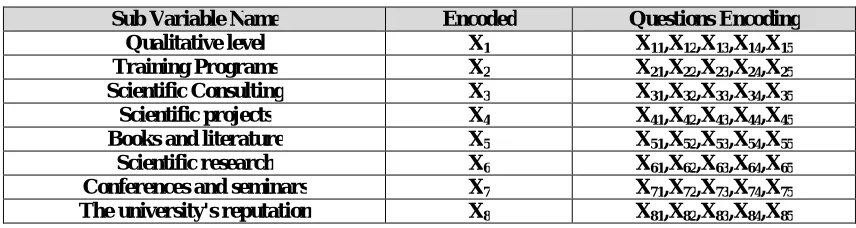
In this partwe will build a linear programming model as shown in Table (2) to the outputs of statistical software (SPSS) to identify optimization (to the quality of education output variablesquestions) that achieve the highest possible quality in light of determinants (sub-quality variables), because progress in mathematical analysis of administrative and economic problems achieve a big progress whichlinear programming is one of these methods. Mathematical linear programming is the field of management science, which interested in finding the best solution or the ideal (Optimal) in the best and effective use of limited resources to achieve the top score both at the level of the individual or companies.
Table (2) Building Linear Programming Model
Questions Encoding
Encoded
Sub Variable Name
X11,X12,X13,X14,X15
X1
Qualitative level
X21,X22,X23,X24,X25
X2
Training Programs
X31,X32,X33,X34,X35
X3
Scientific Consulting
X41,X42,X43,X44,X45
X4
Scientific projects
X51,X52,X53,X54,X55
X5
Books and literature
X61,X62,X63,X64,X65
X6
Scientific research
X71,X72,X73,X74,X75
X7
Conferences and seminars
X81,X82,X83,X84,X85
X8
The university's reputation
Depending on the questions arithmetic means and variables that have been obtained from the statistical analysis of the sample as indicators to indicate the relative importance and determine the optimal structure to achieve the maximum possible quality of the educational process outputs, built linear programming model, as follows:
MaxZ=3.54(X11+X12+X13+X14+X15)+4.24(X21+X22+X23+X24+X25)+3.92(X31+X32+X33+X34+X35)+3.02(X41+X42+X43+
X44+X45)+2.77(X51+X52+X53+X54+X55)+3.71(X61+X62+X63+X64+X65)+3.56(X71+X72+X73+X74+X75)+3.68(X81+X82+X83
+X84+X85)
3.65X11+3.59X12+3.62X13+3.28X14+3.55X15≤ 5
3.63X21+4.57X22+3.63X23+4.75X24+4.54X25 ≤ 5
4.72X31+4.43X32+4.30X33+2.71X34+3.43X35 ≤ 5
2.15X41+3.15X42+3.60X43+3.51X44+2.70X45 ≤ 5
3.98X51+2.55X52+2.64X53+2.51X54+2.20X55 ≤ 5
3.65X61+3.95X62+3.57X63+3.68X64+3.90X65 ≤ 5
3.74X71+3.95X72+3.15X73+3.42X74+3.25X75 ≤ 5
3.12X81+3.78X82+3.55X83+3.33X84+4.05X85 ≤ 5
Xij ≥ 0 i=1,2,3,…,8 j=1,2,3,…,5
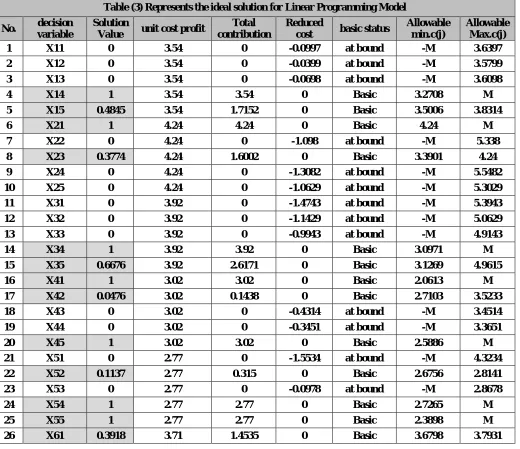
Program (Win QSB) was used which allocated to solve linear programming models to reach results (optimal solution) as shown in Table 3 below:
Table (3) Represents the ideal solution for Linear Programming Model
Allowable Max.c(j) Allowable min.c(j) basic status Reduced cost Total contribution unit cost profit
4.0149 -M at bound -0.3049 0 3.71 0 X62 27 M 3.6287 Basic 0 3.71 3.71 1 X63 28 3.7405 -M at bound -0.0305 0 3.71 0 X64 29 3.9641 -M at bound -0.2541 0 3.71 0 X65 30 4.0967 -M at bound -0.5367 0 3.56 0 X71 31 4.3268 -M at bound -0.7668 0 3.56 0 X72 32 M 3.4505 Basic 0 3.56 3.56 1 X73 33 3.7462 -M at bound -0.1862 0 3.56 0 X74 34 3.673 3.383 Basic 0 2.0265 3.56 0.5692 X75 35 M 3.4479 Basic 0 3.68 3.68 1 X81 36 4.1773 -M at bound -0.4973 0 3.68 0 X82 37 3.9231 -M at bound -0.2431 0 3.68 0 X83 38 3.9277 3.4519 Basic 0 2.0776 3.68 0.5646 X84 39 4.4757 -M at bound -0.7957 0 3.68 0 X85 40
Through results that have been reached after the dissolution of the mathematical model, table (3) illustrates the
importance of the study variables (Quality of Outputs) and questions related thereto. The results shows the variables
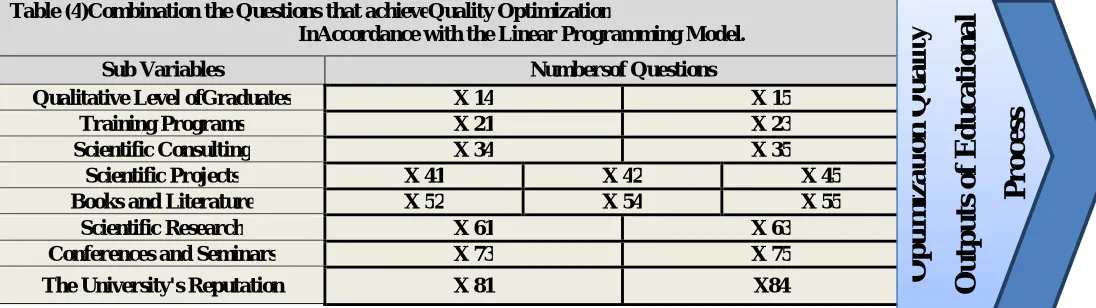
that have values in thesolution table that those questions are owns the ingredients which if achieved will access to the highest possible quality within the eight main variables.It means thatthe fourth question within the first variable (quality of qualitative level) which states (Society institutions demand on the working of our university graduates stems from their high efficiency) is index to raise the capacity and efficiency of graduate students through curriculum development to suit the requirements of the labor market.while the fifth question (University policy isto develop scientific disciplines fit the needs of the community) is further evidence of the importance of developing the capacity of graduate in the face of work difficulties. In the second variable (training programs), the quality achieved in the first question (the university has a scientific and efficient unit involved in community service and work in well-known to all of its institutions) and also in the third question (the university is keen to establish training workshops in conjunction with the relevant institutions of society).Moving to the third variable (scientific consulting) their quality associated with the fourth question (University provides scientific consultancy in all fields of knowledge that various institutions of society looking for), and so on for the rest of the variables of the study as shown in Table(4) below.Finally we can say that the achievement of these questions will be achieve, in particular, the purpose of the research (Optimizing Quality application in the Educational Process) and considered exemplary model at all levels.
Table (4)Combination the Questions that achieveQuality Optimization
InAccordance with the Linear Programming Model. Sub Variables Numbersof Questions
Qualitative Level ofGraduates X 14 X 15 Training Programs X 21 X 23 Scientific Consulting X 34 X 35
Scientific Projects X 41 X 42 X 45 Books and Literature X 52 X 54 X 55
Scientific Research X 61 X 63 Conferences and Seminars X 73 X 75 The University's Reputation
X 81 X84
O
IV. CONCLUSIONS
The statistical analysis show varying points of view of the research sample, the sample has negative perception of the quality of several types of university output, due to various reasons some of which fall within the responsibility of the university.
1. Sample confirmed that the quality of the qualitative level of the graduates which is the most important outputs
in higher education institutions is in low level. Although the responsibility for that rests with the university, but they are not the shortened always, as the reasons for this go back to some of the factors affecting lecturers'decisions at the university, others are due to the factors affecting the university itself.
2. Through results analysis it wasfound that the university colleges surveyed did not adopt the measurement and
evaluation of community organizations satisfaction on its performance on a regular basis, and this is a negative indicator to the quality of their output, because it is contrary to the principle of "continuous follow-up of the customer's satisfaction.
3. Sample opinion consistent that there is a clear decline in the quality of some other output of university
colleges surveyed; there is also a decline in the quality of training programs assigned to serve community as well as scientific consulting.
4. Sample opinionscoincided on the quality of output in: the research projects, books and scientific literature, scientific research directed to serve the community, conferences and seminars, and the reputation of the university,
through the results of arithmetic means respectively, (3.68,3.56,3.71,2.77,3.02) as shown in table (1) in abovewith this
consensus has been uneven at times.
5. There is a clear consensus that the university is taking into account ethical dimensions of community service.
The results of the sample examined confirm that the university colleges were interested in the necessity of the participation of labor market institutions representatives in seminars and conferences and scientific programs, but those institutionshave not invested these opportunities in supporting their capacities and needs.
6. Researchers demonstrated that labor market institutions did not investuniversity output a total investment
despite that those outputs was an inclusive rather which can cover most business segments needs in labor market.
7. The surveyed sample resultsproved the role of training programs for community organizations in supporting
and developing the quality of higher education output through measuring the coefficient of variation of the variables of the quality of education as it got proportion (11.2%). As shown in table (1) in above. This is what makes training programs occupies the first rank among the variables of the study.
8. Linear programmingresults showed a combination of questions check in its entirety and put the quality of the
educational process outputs at the maximum expected return of any investigation (Optimization) required if exploited, as shown in table (4) in above.
REFERENCES
1. Abdul Mail, and et al., 2014, "Critical Factor in Optimizing Quality Management System Process Implementation of Private Higher Education in Sulawesi – Indonesia,Australian Journal of Basic and Applied Sciences, 8(6) April 2014, Pages: 478-486
2. Al Haj, Faisal Abdullah, et al., 2008, "The Quality and Certification of the Arab Universities Union Members Assurance Manual", Amman, Hashemite Kingdom of Jordan.
3. Al Kazaz, Ismail Ibrahim, 2010, "Auditing Quality Systems", First Edition, Dar Tigris, Amman, Hashemite Kingdom of Jordan.
4. Al Tai, Yousef, et al., 2005, "The possibility of the Application of Total Quality Management in Higher Education: Empirical Study," Journal of Management and Economics, University of Kufa, Volume I, Issue (2).
5. Ausheba, FathiDarwish, 1999, "The Total Quality and the Possibilities of their Application in the Egyptian University Education - an Analytical Study" in: the Development of the Arabic Teacher Preparation and Training Systems in the Beginning of the Third millennium, the Annual Conference of the Faculty of Education, Helwan University, May 26 to 27, 2000.
6. D. Kennedy, Á. Hyland and N. Ryan, “Writing and Using Learning Outcomes: a Practical Guide”, University College Cork, 2007. 7. EFA, 2005, "Understanding Education Quality", Global Monitoring Report,USA.
8. Evans, J., 1997,”Applied Production and Operation Management,4th, Eldest Publishing Co.,1997.
9. Haksen& Others, 2000,"Service Management and Operations", 2nd Edition, Prentice-hall Upper Saddle River, New Jersey.
10. Hixon, j. and K, Lovelace, 1992,"Total Quality Management Challenge to Leadership, Academy of Management Review, Vol 50, No (3). 11. Hughes, Jeffry and Others, 1998," The Task Force on Initial Teachers Education Programs", Final Report, Manitoba University Winnipeg. 12. Hussen,Ali, "The preparation of the teacher in contemporary society", Wassit Journal for Humanities, Wassit University, 2007, Vol. 3, No. 5.
APPENDIX 1 (Questionnaire)
First Quality of the Qualitative Level for Graduates 1 2 3 4 5
X Paragraphs
X11 University graduates enjoy high efficiency qualify them to master their work at the beginning of designation.
X12 The University has an extensive knowledge of the needs of the community institutions in terms of the quality and efficiency of graduates.
X13 University follows up performance level of their graduates in the institutions in which they work to identify weaknesses in their skills and work on them.
X14 Society institutions demand on the working of our university graduates stems from their high efficiency. X15 University policy in the creation of scientific disciplines fit the needs of the community.
Second
Training Programs for Community Organizations 1 2 3 4 5
X21 The University has a scientific and efficient unit for community service and work is well known to all institutions.
X22 University always meets the needs and desires of the community institutions in the training of staff according to his specialty.
X23 The university is keen to establish training workshops in conjunction with the relevant institutions of society.
X24 University designed and implemented training programs on an ongoing basis in accordance with the latest developments in cognitive development.
X25 University sets training needs for workers in the institutions of society based on accurate and on studies to actual need.
Third
Scientific Consultant 1 2 3 4 5
X31 University seeks to programming advisory services according to objective plan with the introduction of the sectors of society requirements.
X32 University announces on their advisory potential via the Internet and the media and to make them known to the community.
X33 University allows the use of scientific data base to all for use when needed and unimpeded.
X34 University provides scientific consultancy in all fields of knowledge that are looking for by various institutions of society.
X35 Advisory university offices characterized by high-powered to meet the needs of the community advisory.
Forth Scientific Projects 1 2 3 4 5
X41 University announces their scientific projects in advance to the relevant authorities in the community and allowing them to take advantage.
X42 Adapt scientific projects adopted by the university with the actual need for the requirements of society.
X43 University support programs and scientific projects submitted by third parties and that meet the actual need of the society.
X44 Scientific projects at the university are compatible with the scientific and knowledge progress at the local and regional level.
X45 University contribute in the development and application of scientific projects on the ground.
Fifth Books and Scientific Literature 1 2 3 4 5
X51 The university is always seeking to authoring text books consistent with the needs of society. X52 University supports books and scientific literature which directly related to community needs.
X53 University rely on the problems and needs of the community as a source of authored their books and scientific reports.
X54 The university is keen on updating her writings according to the latest scientific developments to ensure the development capabilities of its graduates working in the various institutions of society.
X55 The university is working on access their scientific sources to society institutions in easy and accessible mechanisms.
Sixth Scientific Research 1 2 3 4 5
X62
The university is keen to issue a scientific research and publications on the need of the university both with those that meet the needs of society.
X63
University encourages its researchers to involve stakeholders from various institutions of society in the achievement of applied research with common goals.
X64 University works to allow scientific research to all beneficiaries from both inside and outside the university.
X65
University concluded research contracts with the institutions of society to achieve the goals of general interest.
Seventh Conferences, seminars 1 2 3 4 5
X71
The university has a clear plan and known for seminars and conferences directly related to community needs.
X72
University invites representatives of community organizations to attend and participate in seminars and conferences and scientific programs.
X73
University pursuing different variables in the community environment and designed appropriate programs.
X74 University designates some of the seminars and conferences to raise awareness and culture of society.
X75
University follow up the implementation of the recommendations of seminars and conferences oriented to society as far as related to it.
Eight The Reputation of the University 1 2 3 4 5
X81
The measurement and evaluation of community organizations satisfaction about the university's performance are periodically and continuously.
X82 University always take into account the ethical dimensions of community service.
X83 The University offers its services to all the institutions of society fairly and without discrimination.
X84 University teaching staff and employee handles with ethical professional manner with all its clients.
X85 University responds to suggestions and complaints made by all the institutions of society.
BIOGRAPHY