Mutations Affecting
the tRNA-Splicing Endonuclease Activity of
Saccharomyces cerevisiae
Mark Winey
andMichael
R.
Culbertson'Laboratories of Genetics and Molecular Biology, University of Wisconsin, Madison, Wisconsin 53706 Manuscript received September 23, 1987
Accepted December 26, 1987
ABSTRACT
Two unlinked mutations that alter the enzyme activity of tRNA-splicing endonuclease have been identified in yeast. The senl-1 mutation, which maps on chromosome 1 2 , causes temperature- sensitive growth, reduced in vitro endonuclease activity, and in vivo accumulation of unspliced pre- tRNAs. The s e d - 1 mutation does not confer a detectable growth defect, but causes a temperature- dependent reduction of in vitro endonuclease activity. Pre-tRNAs do not accumulate in s e d - 1 strains. The in vitro enzyme activities of senl-1 and sen2-1 complement in extracts from a heterozygous diploid, but fail to complement in mixed extracts from separate senl-I and sen2-1 haploid strains. These results suggest a direct role for SEN gene products in the enzymatic removal of introns from tRNA that is distinct from the role of other products known to affect tRNA splicing.
S
PLICING of precursor tRNAs in the yeast Sac-charomyces cerevisiae requires two separate enzy-
matic functions, a membrane-associated endonu- clease and a soluble ligase (PEEBLES et al. 1979). The endonuclease cleaves the pre-tRNA, releasing the
intron as a linear molecule (PEEBLES, GECENHEIMER and ABELSON 1983). T h e ligase joins the half tRNAs through an ATP-dependent, three-step mechanism involving cyclic phosphodiesterase, polynucleotide kinase, and RNA ligase activities (GREER et al. 1983). There is evidence for the formation of a splicing complex in vitro, suggesting the formation of such a complex in vivo (GREER 1986).
In previous studies, mutations in two genes, R N A l
and L O S l , were found to affect tRNA splicing in vivo
(HOPPER, BANKS and EVANGELIDIS 1978; HOPPER, SCHULTZ and SHAPIRO 1980). At the non-permissive temperature, strains carrying a temperature-sensitive allele of the R N A l gene accumulate pre-tRNAs, unprocessed rRNAs, and are defective for mRNA metabolism (ATKINSON, DUNST and HOPPER 1985). Given this pleiotropic phenotype, it seems unlikely that the R N A l product participates directly in the enzymology of tRNA splicing. Indeed, in vitro extracts from m a l strains have normal tRNA splicing activities (ATKINSON, DUNST and HOPPER 1985; this study). ATKINSON, DUNST and HOPPER (1985) suggest that
R N A l may be involved in the maintenance of nuclear
structure. Hence, mutant alleles of this gene probably affect tRNA splicing indirectly.
Mutations in the LOSl gene confer loss of nonsense suppression in strains carrying SUP4-0, an intron-
'
To whom correspondence should be addressed.Genetics 118: 609-617 (April, 1988).
containing, tyrosine-inserting ochre suppressor
tRNA gene (HOPPER, SCHULTZ and SHAPIRO 1980). These mutations result in pre-tRNA accumulation. However, like m a l strains, in vitro tRNA splicing activities are normal in extracts from losl strains (HURT et al. 1986; this study).
T h e gene encoding the tRNA-splicing ligase (LZGl )
was identified by reverse genetic techniques (PHI- ZICKY, SCHWARTZ and ABELSON 1986). T h e soluble ligase protein is a single polypeptide with an M , of 90 kD that co-purifies with all three activities required for ligation of tRNA half molecules (cyclic phospho- diesterase, polynucleotide kinase, and RNA ligase). In contrast, attempts to identify mutations in the structural gene(s) for the tRNA-splicing endonu- clease as well as attempts to purify the enzyme to homogeneity have thus far been unsuccessful. T h e difficulties with these approaches can be attributed largely to the lack of specificity in mutant selections based on loss or gain of suppression, and to problems inherent in stabilizing the membrane-associated en- donuclease during purification. For these reasons, knowledge of the genetics and biochemistry of en- donucleolytic cleavage of tRNA introns is severely limited.
In this communication we report the results of a direct screen for mutations affecting tRNA-splicing endonuclease activity. We have identified two new genes, SEN1 and SEN2, whose products are likely to
M. Winey and M. R. Culbertson
TABLE 1
Yeast strains
Strain Genotype Source
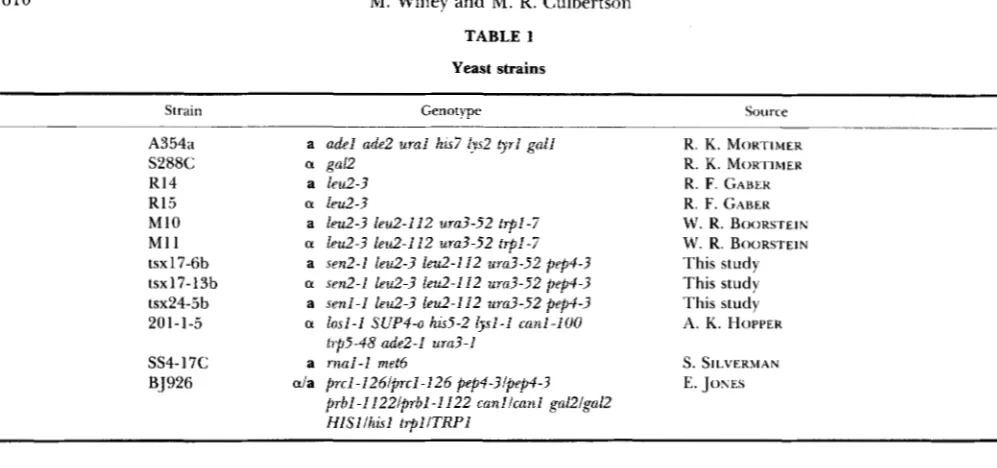
A354a a adel ade2 ural his7 lys2 tyrl gall R. K. MOKTIMEK
52886 a gal2 R. K. MOKIIMER
R14 a leu2-3 R. F. GAUEK
R15 a leu2-3 R. F. GABEK
MI0 a leu2-3 leu2-112 ura3-52 trpl-7 W. R. B O O K S T E I N
tsx17-6b a sen2-I leu2-3 leu2-112 ura3-52 pep4-3 This study
tsx17-13b a sen2-1 leu2-3 leu2-112 ura3-52 pep4-3 This study
- ~
M I 1 a l e d - ? l e d - 1 1 2 ura?-52 trpl-7 W. R. BOORSTEIN
tsx24-5b a senl-l leu2-3 leu2-112 ura3-52 pep4-3 This study 201-1-5 (Y losl-1 SUP4-o his5-2 lysl-1 canl-100 A. K. H O P P E R
trp5-48 ade2-1 urn?-i
SS4-17C a rnal-I me16 S. SILVERMAN
BJ926 ala prcl-126lprcI-126 pep4-3lpep4-3 E. JONES prbl -I 122lprbl -I 122 canllcanl ga12lga12
HISIlhisl trpllTRPI
MATERIALS AND METHODS
Yeast strains and genetic techniques: The collection of temperature-sensitive yeast strains (HARTWELL 1967) used to screen for tRNA-splicing endonuclease activity was ob- tained from C. MCLAUGHLIN. A strain containing the losl- 1 mutation was provided by A. HOPPER. Plasmid pSEYC58 containing the yeast L I G l gene was provided by E. PHIZICKY, and the plasmids YEpRNAl and YEpLOSl were provided by A. HOPPER. Yeast media and genetic techniques have been described (GABER and CULBER~SON 1982). The original isolates of the sen1 and sen2 mutant strains were successively out-crossed to strain S288C and its derivatives, R14, R15, M10 and M11 (Table 1). senl-1 and sen2-1 -containing strains derived from the final outcrosses (Table 1) were used in the experiments reported in this communication.
Labeling of RNA: I n vivo tRNA synthesis was assayed
!J
pulse-labeling phosphate-starved yeast for 30 min withP-orthophosphate. KNAPP et al. (1978) describe the yeast labeling, RNA extraction and purification, and gel frac- tionation techniques. Steady-state levels of' small RNAs were assayed in a similar manner except that labeling periods were extended to 4 to 6 hr. Steady-state levels of pre-tRNAs and tRNAs were also assayed by in vitro "P-3'- end-labeling using yeast tRNA nucleotidyl transferase. Small RNAs were isolated from log phase cultures as described above and end-labeled as described by LEE and KNAPP (1985). Yeast nucleotidyl transferase was prepared by a modified method of STERNBACH et al. (1971).
In vitro techniques: End-matured proline pre-tRNAucc: transcripts of the suf8 wild-type gene (CUMMINS, CULBEW- SON and KNAPP 1985) were synthesized in vitro using a yeast RNA polymerase 111 transcription system (ENGELKE, GE-
GENHEIMER and ABELSON 1985). T h e pre-tRNA was uni-
formly labeled with 32P-UTP (Amersham, 400 Cdmmol). Labeled pre-tRNAs were eluted from polyacrylamide gels, ethanol-precipitated (MAXAM and GILBERT 1977), and used as substrate for tRNA-splicing endonuclease (referred to throughout as the endonuclease).
The method of PEERLES, GEGENHEIMER and AflEI.SON (1983) was used for large scale endonuclease partial puri- fication. The endonuclease fraction used in experiments described in this communication is equivalent to the Triton X-100 extract of yeast membranes designated as fraction IV in PEEBLES, GEGENHEIMER and AREISON (1983). Total protein in this fraction was determined as in LOWRY PL al.
(195 1). Endonuclease assays were performed as previously described in WINEY et al. (1986). The reactions were ter- minated as in LEE, MILLICAN and KNAPP (1988). The reaction products were fractionated on 10% (19: 1) poly- acylamide gels containing 4 M urea. T o obtain quantitative data from these reactions, bands were excised from the gels and analyzed by Cerenkov counting.
Screening procedure: A rapid procedure for preparing extracts with endonuclease activity was developed to screen the temperature-sensitive mutant collection. The extract is a small-scale version of the yeast nuclear extract used for
in vitro RNA polymerase 111 transcription (ENCELKE, GE- GENHElMER and ABELSON 1985). Individual extracts (desig- nated throughout as mini-extracts) from each of 300 tem- perature sensitive strains were assayed for tRNA splicing endonuclease activity as described below.
Yeast cells were grown to early log phase (ODs",, = 0.3- 1.2). The equivalent of 1.0 ml of cells at ODfioo = 0.9 were collected in 1.5-ml microfuge tubes. The cell pellet was suspended in 35 pl of an isotonic buffer [ 1 .O M sorbitol, 50
mM Tris (pH 7.9), 10 mM MgC12, 10 mM dithiothreitol] and left at room temperature for 15 min. The cells were collected and resuspended in another 35 pI of the isotonic buffer with 0.1 mM dithiothreitol and 0.15 mg/ml Zymolyase 60,000 (Kirin), followed by incubation for 1 hr with gentle agitation at room temperature to allow formation of spher- oplasts. The spheroplasts were collected by centrifugation at 4", and all subsequent steps were performed at 4". Ice- cold hypotonic buffer [lo0 1.1, 15 mM KCI, 10 mM Hepes (pH 7.9), 5 mM MgCI2, 0.1 mM EDTA, 3 mM dithiothreitol] was added to the spheroplast pellet. The pellet was resus- pended and the spheroplasts lysed by grinding with a pestle (Kontes, Chicago). The lysate was spun in a microfuge for 10 sec. The supernatant was discarded and the nuclei- containing pellet was resuspended in 20 pl of endonuclease buffer [25 mM Tris (pH 8.0), 0.5 mM EDTA, 100 mM
(NH4)2S04, 10 mM spermidine, 1% Triton X-100, 5.0 mM p-mercaptoethanol, 0.5 mM phenylmethylsulfonyl fluoride,
Splicing Mutants 61 1
A:
4
B:
END0
CzA364o
D:
sen,?-
/E:
sen
/- /F:
rno
/- /6:
/OS /- /-
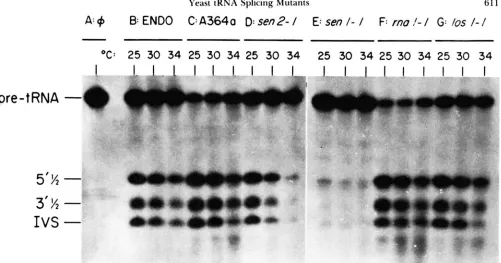
FIGURE I.-fn vitro assays of tRNA splicing endonuclease activity. Assays were performed at the indicated temperatures using reaction conditions described in Materials and Methods. Reaction products were fractionated on IO% polyacrylamide gels containing 4 M urea. (A) shows the uncleaved proline pre-tRNAt!c;(: substrate in the absence of enzyme. (13) shows the prcxlucts o f cleavage with partially purified endonuclease (PEEnLFs. GeN(;ewieIwx and AHEISON 1983). The identity of prcxlucts was determined previously (Wisev d a/. 19x6). The remaining assays show endonuclease activity in mini-extracts (see M ~ V I E R I A I S ASI) SIE'~IIOI)S) as follows: (C), wiltl-type (strain A3Cia. Table
I); (D), s m 2 - f (original isolate): (E), s c n f - f (original isolate): (F). n m f - f (strain SS14-17<:, Table I): (G) l n s f - f (strain 201-1-5. Talde I).
RESULTS
Identification of mutations affecting tRNA-splic-
ing endonuclease. T h e endonuclease activity was
assayed in mini-extracts from 300 temperature-sen-
sitive strains grown at permissive temperature. En- donuclease activity is detected by the cleavage of pre-
tRNA to half tRNAs and introns (Figure I ) . In vitro
assays were carried out at three different tempera- tures. These include the permissive temperature
(25"), the optimal temperature for in vitro endonu-
clease activity (30"), and the maximum nonpermissive
temperature giving detectable wild-type endonu-
clease activity (34"). At 34", wild-type endonuclease
activity is present at comparable albeit reduced levels
in both partially-purified endonuclease (fraction IV)
(PEEBLFS, GECENHEIMER and ARELSON 1983) (Figure
1B)
and in mini-extracts (Figure 1C). Since the mini-extracts were comparable in activity to partially pur-
ified enzyme at all temperatures, they were regarded as suitable for use in screening for mutants. Altered
endonuclease activity was detected in mini-extracts
from two out of the 300 strains screened. Data
provided below show that these strains contain mu-
tations in two unlinked genes, designated SEN1 and
SEN2 (splicing endonuclease).
In mini-extracts thesenl-I mutation causes reduced endonuclease Pctivity at all assay temperatures (Fig-
ure IE). T h e s&-I mutation confers temperature-
sensitive endonuclease activity with near normal ac- tivity at 25". reduced activity at 30°, and little to no
activity at 34" (Figure 1 D). For comparison, we as-
sayed strains containing two previously identified
mutations, rnal-I (Figure 1 F) and losl-1 (Figure 1 G ) ,
that cause in vivo accumulation of intron-containing
pre-tRNA (HOPPER, BANKS and EVANGELIDIS 1978;
HOPPER, SCHULTZ and SHAPIRO 1980). T h e endonu-
clease activity in these strains was similar to wild-type
activity, as shown previously (ATKINSON, DUNST and
HOPPER 1985; HURT et al. 1986), and did not resemble
the altered activities associated with the senl-1 and
s&-1 mutations. T h e reduced endonuclease activi-
ties conferred by the senl-1 and s e d - 1 mutations are
not due to the presence of an inhibitor in the in vitro system since mixtures of wild-type and mutant ex- tracts resulted in wild-type endonuclease activity.
Co-purification of wild-type and mutant endon-
uclease activities. To verify whether results obtained
from mini-extracts are reliable, the endonuclease was partially purified by the method of PEERLES, GEGEN-
H E I M E R and AHELSON (1983) from wild-type, s e d - I ,
and s e d - 1 strains. Fraction IV (PEERLF~S, GEGENHEI-
MER and ARELSON 1983) was used to assay endonu-
clease activity. This fraction is the detergent extract
of a membrane fraction that is devoid of soluble
proteins including tRNA-splicing ligase (see ~ T E -
RIALS A N D METHODS).
Winey and Culbertson
A. WILD-TYPE 0. sen 7-7
c.
Set? 2-1FIGURE 2.-h vitro activities of partially purified endonuclease were determined for (A) wild t y p e (strain BJ926, Table I); (B) sml-1
(strain tsx24-5b. Table I); and (C) s e d - 1 (strain tsx17-6b. Table I ) . Reactions were carried out at 25" and 32" as described in MATERIALS A N D METHODS. Instead of using equal units of enzyme per reaction, equal quantities of protein were used per reaction (3.8 pg proteid10
pl reaction). Percent cleavage was determined by the method of GHEER, SOLI. and WILLIS (1987). T h e maximum standard deviation for any point was s2 = 2.5%.
FIGURE %--In vitro endonuclease activity was assayed as in Figure I in mini-extracts from the four spore clones of two
representative tetrads, one from the cross sml-1 X SEN1 (A) and one from the cross s e d - 1 X SEN2 (B). In both tetrads the mutant phenotype segregates 2:2 (spore A. +; B.
-
; C. -; and D. +).tion IV endonuclease from the wild-type and mutant
strains weFe determined by measuring the percentage
of precursor cleavage as a function of reaction time
at 25" and 32" (Figure 2). The latter assay temperature
was chosen for these experiments because 32" is the
highest temperature yielding an endonuclease activity
equivalent to that found at 25" in a wild-type strain
(Figure 2A). Higher temperatures result in inhibition
of the wild-type endonuclease activity. Using these
reaction conditions, the endonuclease from a senl-1
strain has reduced activity at both temperatures (Fig- ure 2B), similar to that found in mini-extracts (Figure
1E).
The endonuclease activity from a s d - 1 straindecreases with increasing temperature (Figure 2C),
also in a manner similar to that found in mini-extracts
(Figure 1 D).
We have also performed mixing experiments with
partially purified fractions and shown that senl-1 and
s d - 1 strains do not contain inhibitors of wild-type
endonuclease activity. We conclude from these ex- periments that the endonuclease from wild-type and mutant strains shows similar behavior in both mini-
extracts and a partially purified endonuclease
fraction.
Genetic -gation analysis: The altered in vitro
endonuclease activity found in strains containing the
s a l - 1 mutation was analyzed in tetrads from senl-11
S E N 1 diploids. Figure 3A shows a 2:2 Mendelian
segregation for altered vs normal endonuclease activ-
ity in mini-extracts from spore segregants of a rep-
resentative tetrad. A similar 2: 2 segregation was
observed in 34 tetrads derived from eight successive
outcrosses of the original s a l - 1 isolate. In the initial
outcrosses, several temperature-sensitive mutations were found to segregate in tetrads. By successively crossing spore segregants containing altered endon-
uclease activity as determined by assaying mini-ex-
Yeast
A: sen 2-l
E:
DIPLOIDC:
sen I - / 0: PREMIXE:
POSTMIXO C : 25 30 34 25 30 34 25 30 34 25 30 34 25 30 34
I l l I l l
pre- tRNA
-
1
5%
-
3%
-
IVS
-
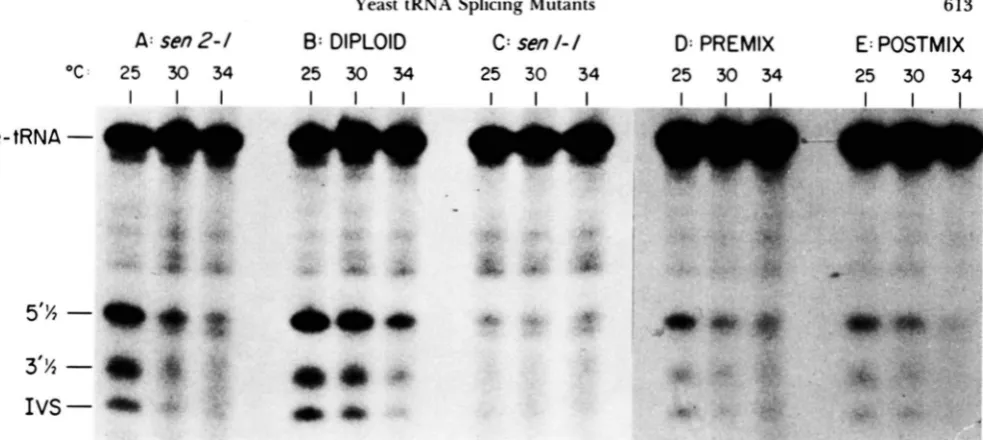
FIGURE 4.-Complementation of s m l - I and ~ m 2 - I . Endonuclease activity was assayed as in Figure I in mini-extracts from strains carrying (A) sm2-1 (strain tsxl7-l3b. Table I ) . (C) sml-I (strain tsx24-5b. Table I), and (R) a diploid strain derived from mating these haploids. (D) Extracts from the sm2-I and sml-1 haploid strains (A antl C) were alsn mixed and assayed for their ability to complement
i n vitro. (E) As a control, the extracts from (A) antl (C) were incubated with reaction compnnents separately. The reactions were then terminated. mixed. and fractionated on the gel. The results show that the mutants fail to complement in vitro.
with the altered in vitro phenotype. Both the in vitro
and in vivo phenotypes of sml-l are recessive to wild
tY Pe.
In order to confirm that temperature-sensitive
growth and altered in vitro endonuclease activity are
related phenotypes resulting from the senl-1 muta-
tion, we assayed endonuclease activity in mini-extracts from seven temperature-independent revertants. As- says of the mini-extracts showed that all seven rev- ertants had regained wild-type endonuclease activity,
indicating phenotypic co-reversion of temperature
sensitivity and reduced in vitro enzyme activity. It is
therefore likely that both phenotypes are related and are the result of a single mutation. These assays were not sensitive enough to discriminate between partial versus complete reversion.
The SEN1 gene maps on chromosome 12 as de-
termined by the method of CARER et al. (1983). Using
the temperature-sensitive phenotype to follow the
segregation of senl-I, linkage was detected between
the senl-1 and ural loci ( 1 1.3 cM; 4 1 parental ditype
asci, 0 nonparental ditype asci, 12 tetratype asci).
The altered endonuclease activity in s e d - I strains
is recessive to wild-type and also shows a 2: 2 Men-
delian segregation in mini-extracts from spore segre-
gants of a representative tetrad derived from a s d -
IISEN2 heterozygous diploid (Figure 3B). A similar
2: 2 segregation was observed in 3 1 tetrads from six
successive outcrosses. The sen2-1 mutation did not
co-segregate with any of several temperature-sensi- tive mutations in the original isolate. We conclude
that, unlike seizl-I, the s d - I mutation does not
confer detectable growth inhibition.
Further segregation tests demonstrate that thesenl-
I
and sen2-1 mutations are separable by recombina-tion and are distinct loci in the yeast genome. We
followed the segregation of both mutations by in vitro
assays using mini-extracts from tetrads derived from a sen1 -1ISEN1. sen2-IISEN2 heterozygous diploid.
Among ten tetrads, seven were recombinant (3 pa-
rental ditype; 2 nonparental ditype; 5 tetratype),
indicating nonlinkage of the two genes. Furthermore, double mutant haploid strains derived from these
crosses were phenotypically similar to the senl-1
single mutant (temperature-sensitive-for-growth; re-
duced in vitro endonuclease activity at all assay tem-
peratures), indicating that senl-1 is epistatic to s e d -
1 .
Complementation analysis: As expected for mu-
tations in unlinked genes, senl-1 and s e d - 1 comple-
ment each other in a heterozyogus diploid, since a mini-extract from the diploid has wild-type endon-
uclease activity (Figure 4, A-C). The heterozygous
genotype of the diploid was confirmed by showing
the segregation of thesenl-1 and s e d - 1 in vitro pheno-
types among spore progeny.
We also determined whether complementation oc-
curs upon mixing either mini-extracts or partially
purified fraction I V endonuclease extracts prepared
from two haploid strains, one containing senl-1 and
the other containing s e d - 1 (pre-mixed extracts, Fig-
ure
4D).
As a control, the additive activity from the separate extracts was assayed by mixing the products following reaction termination (post-mixed extracts,Figure 4E). The endonuclease activities of the pre-
indistinguishable from the activities of the post-mixed
extracts. Since mixing extracts from these two mu-
tants did not enhance endonuclease activity above
that found in the extracts separately, we conclude
that these extracts fail to complement in vitro. Addi-
tionally, crude homogenates (fraction I) (PEEBLES,
GEGENHEIMER and AREWON 1983) from the mutant
strains also failed to complement in vitro. This sug-
gests that no factors are lost in the preparation of mini-extracts o r partially purified endonuclease ex-
tracts that are required for complementation to occur.
Since tRNA-splicing endonuclease and ligase phys-
ically interact in vitro (GREER 1986). the altered en-
donuclease activities in sen1
-I
and s e d - 1 strains mightbe caused indirectly by a defective ligase. To examine
this possibility, strains containing s e d - 1 and s e d - 1
were tested for complementation with a wild-type
LtGl gene (tRNA-splicing ligase) (PHIZICKY,
SCHWAR-I-z and ARELSON 19S6). which was introduced
into the strains on a centromere-containing plasmid
(see MATERIAL. A N D METHODS) by transformation (11-0
el al. 1983). T h e mutant in vitro phenotypes in mini-
extracts of both strains were unaltered by the pres-
ence of the LtGl plasmid. This result shows that
LtGl fails to complement s e d - 1 o r sen?-I, and indi- cates that these genes probably do not encode tRNA- splicing ligase.
Since the sen?-1 mutation has not yet been mapped
due to the lack of a convient in vivo phenotype, we
tested sen?-1 allelism by complementation with the
wild-type R N A 1 and LOSI genes. T h e s e d - 1 strain
tsx 17-6b (Table 1) was transformed with the 2-mi-
cron-derived plasmids YEP-RNA 1 (ATKINSON,
DUNSI. and HOPPER 1985) o r YEP-LOSI (HURT et al.
1986). T h e endonuclease activities of transformants
were assayed in vitro using the mini-extract procedure
and found to be unaltered by the presence of the
R N A l gene o r the LOSI gene (data not shown).
These results indicate that s e d - I is not functionally
complemented by R N A l or LOSI and therefore, is
not likely to be an allele of either of these genes.
In vivo accumulation of intron-containing tRNA
precursors: Mutations that reduce endonuclease ac-
tivity might be expected to result in substrate accu-
mulation in vivo. To test this possibility, wild-type,
senl-1 and sen?-1 strains were grown at 25"C, labeled
with "P-orthophosphate at 25" or 37". and small
RNAs were'analyzed (see MATERIALS A N D METHODS).
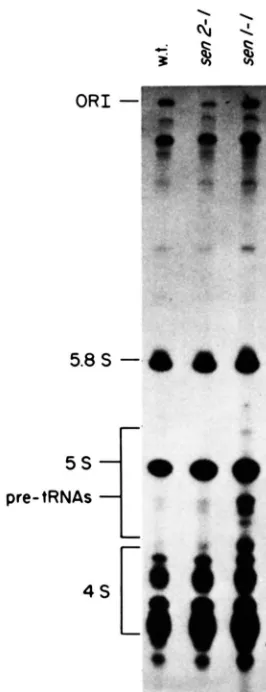
To examine small RNA synthesis, cells of pulse-
labeled wild-type and mutant strains were phenol-
extracted, and the resulting small RNAs were frac-
tionated on polyacrylamide gels (Figure 5). Com-
pared to a wild-type strain, the s e d - 1 strain contains
increased amounts of pre-tRNAs at both permissive
and nonpermissive temperatures. Furthermore, the
pre-tRNAs that accumulate in s e d - 1 strains appear
to be identical to those that accumulate in mal-1
Culbertson
5 . 8 s
-
A A A
pre- tRNAs 5 q -
';
FIGURE 5.-Pre-tRNA accumulation in sm strains. Wild-type, s m 2 - I , and senl-1 strains (S288C, tsx-17-6b. and tsx24-5b. respec-
tively, Table 1 ) were pulse-labeled for SO minutes at 25". The small RNAs were extracted and fractionated on a 1 0 1 polyacrylamide, 8 M urea gel (see M A T E R l A t s ASD METHODS). Equal counts-per-
minute of labeled RNA were loaded per lane. The results show that pre-[RNAs accumulate only in the sml-I strain. Similar results were obtained when these strains were labeled at 37" for 30 min (see text).
strains (data not shown, see below). Strains containing
sen?-1 resembled wild-type and did not appear to
accumulate pre-tRNAs at 25" (Figure 5) o r 37" (data
not shown). These results suggest that the rate of
precursor tRNA utilization in s e d - 1 strains is signif-
icantly reduced in vivo. In s e d - 1 strains the rates of
precursor utilization are not reduced to a level suf-
ficient to cause precursor accumulation.
T h e steady-state levels of pre-tRNAs were exam-
ined in the mutants by two methods. Unlabeled small
RNAs were extracted from logarithmic phase cultures
grown at 25". labeled in vitro (see MATERIALS A N D
METHODS), and analyzed on polyacrylamide gels (Fig-
ure 6). Secondly, cultures of the mutant strains were
steady-state labeled in vivo, and tRNAs were extracted
and analyzed on polyacrylamide gels (see MATERIALS
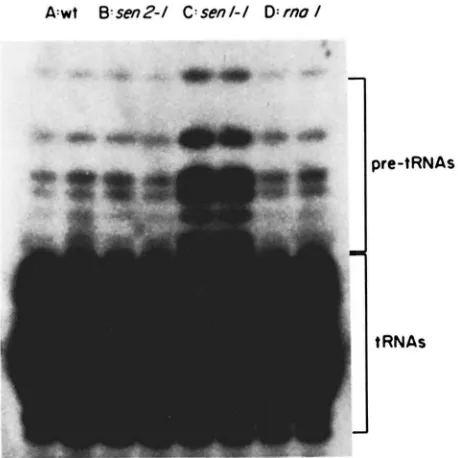
A N D METHODS, data not shown). Both methods showed
-
pre-tRNAs
i
tRNAs-
F I ( ; l x F . (i.--Stc;d\-state Icvcls o l ' pre-tKSf\s in (A) a wild-type strain (S28XC. Ta1)Ic I ), (13) a ~ ~ 1 1 2 - 1 strain (tsx I5-6b. Table I), ( C )
a sml-1 strain (1~x24-5b. 'Iable I), (D) an m a l - ] strain (SS4-15C. Table I). KNA was prepared from log-phase cultures and 3' end- labeled as tlescril~tl in MATERIALS ASD w m l o r x Duplicate reac- tions are shown for each KNA sample and the autoradiogram was purposely over-exposed so the relative level of pre-tKNAs could be visualized in all strains.
state levels of pre-tRNAs at 25", whereas m a l - I and
sen2-1 showed no significant increase in steady-state pre-tRNA levels at this growth temperature com-
pared to wild type (Figure 6). Figure 6 also shows
that the pre-tRNAs accumulated in senl-Z strains are
likely to have mature 5' and 3' ends because they co-
migrate with the pre-tRNAs observed in m a l strains
(KNAPP et af. 1978). These results phenotypically dis-
tinguish senl-1 from the other mutants since the senl-
I mutation appears to impose a block in the splicing
pathway that results in an increase in the steady-state levels of pre-tRNA.
DISCUSSION
Mutations in the S E N l and SEN2 genes: An in vitro screen for altered tRNA-splicing endonuclease activ-
ity resulted in the identification of recessive mutations
in two unlinked genes, S E N l and SEN2. This ap-
proach was attempted in light of previous success of
other workers looking for mutations in other enzy-
matic functions (DINARDO, VOELKEL and STERNCLANZ
1984; THRASH et al. 1984). Table 2 summarizes the properties of these mutations compared with muta-
tions in two other single copy genes that affect in vivo
tRNA splicing, RNAZ and LOSI (ATKINSON, DUNST
and HOITER 1985; HURT et al. 1986). It is noteworthy
that, unlike the mutations reported in this study,
mutations in R N A 1 and LOSl do not affect the activity
TABLE 2
Properties of yeast tRNA-splicing mutants
Pre-tRNA accumulation
In vitro
( k n e activity growlr location Pulse state
endonuclease Eflerl o n Map Steady
srnl-1 Reduced (all 1s" 12R
+
+
temperatures)sm2-1 I Ih No effect ? - -
mal-I' wt" ts" IJK
+
-latl-1' \v t" No effect I IL
+
-" ts = temperature-sensitive-for-gro\~,th.
' HorrER, h S K s and E\'ASGEl.II)IS (1978): ATKISSOS. Duysr
tl = thermoliabile enzyme activity. and HOPPER ( 1985).
w t = activity resembles wild-type enzyme activity.
' HOPPER. SCIICI:IZ and S k i m R o (1980): HcRI et a/. (1986).
of tRNA-splicing endonuclease in vitro and probably
d o not play a direct role in the enzymology of tRNA
intron removal. Genes of this type might affect tRNA
splicing indirectly by, for example, affecting com-
partmentalization of splicing enzymes or the integrity
of the substrates.
T h e results of genetic mapping show that S E N l is
a previously unknown gene whose function is re-
quired for normal in vitro endonuclease activity and
in vivo tRNA splicing. Furthermore, we have shown
by complementation tests that S E N l does not encode
tRNA-splicing ligase. T h e unique phenotype of the s e d - I mutation suggests that this gene plays a direct
role in cleavage of tRNA introns. In addition to
altered in vitro endonuclease activity, the senl-1 mu-
tation causes temperature-sensitive growth and an
increase in the steady-state level of pre-tRNA at both
permissive and restrictive temperatures. Based on
these results it appears likely that S E N l is an essential
gene in which loss of function confers lethality due
to a defect in tRNA splicing. However, we cannot at
present rule out the formal possibility that the wild-
type SEN1 gene product is not essential for viability
and that the sml-I mutant gene product causes
lethality only by acting as a poison subunit. This
question can be resolved in future experiments by
assaying the phenotype of a null allele constructed
through gene cloning techniques.
T h e s e d - 1 mutation confers temperature sensitive
endonuclease activity in vitro, but has no detectable
growth or pre-tRNA accumulation phenotype in vivo.
T h e phenotype of a null allele of the SEN2 gene
conferring complete loss of function has not yet been
determined. Given that the s e d - 1 allele may retain
substantial residual endonuclease activity in vivo, the
possibility remains that this gene encodes an essential
tRNA splicing function. We have, however, ruled out
the possibility that sen.2-I' is an allele of the LICI,
Relationship between SENl and SEN2 gene prod- ucts: The components of tRNA splicing may physi- cally associate in a complex consisting of tRNA splic- ing ligase, endonuclease, and perhaps other factors (GREER 1986). Since the endonuclease is extractable only in the presence of a detergent, it has been suggested that the putative splicing complex may be associated with the nuclear membrane (GREER 1986; CLARK and ABELSON 1987).
The results of complementation tests between senl -
I
and sen2-1 bear on the possibility of such a mem- brane-associated complex. Whereas complementa- tion between the mutations was observed in extracts from a heterozygous diploid, similar complementa- tion was not observed when mini-extracts or partially purified endonuclease extracts from separate senl -Iand s e d - 1 strains were mixed and assayed. A lack of complementation was also observed when crude un- fractionated extracts from the mutant strains were mixed. It is therefore unlikely that a factor required for complementation was lost during fractionation of extracts. T h e failure of extracts from these mutants to complement in vitro when mixed suggests that the two genes encode products that are functionally related.
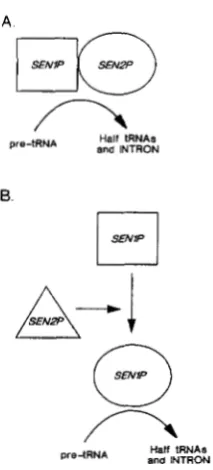
We envision two alternative generic models for the function of the SEN1 and SEN2 gene products
(SENlP and SEN2P, respectively; Figure 7). In these models tRNA-splicing endonuclease activity is di- rectly attributed to the function of the SENl andlor SEN2 gene product(s). Since the temperature-sensi- tive mutant collection was screened by assaying in vitro endonuclease activity at different temperatures in extracts from cells grown only at permissive tem- perature, the mutants most likely affect gene product function rather than synthesis (transcription or trans- lation). T h e models do not encompass functions that are unnecessary for normal in uitro endonuclease activity such as the RNA1 and LOSl gene products.
In the first model, SENlP and SEN2P are subunits of the endonuclease (Figure 7A), such that changes in either product directly affect enzyme activity. The term subunit is used in the broad sense, and could represent a polypeptide containing an active site for the enzyme, sites for binding of pre-tRNA, a mem- brane-docking protein, a scaffolding protein, or any other structural component that might be required in a splicing complex. T h e failure of extracts from mutant strains to complement in vitro is explained in this model by the failure of subunits to freely disso- ciate and reassociate, possibly because the enzyme is already assembled in a membrane-bound complex.
The second model differs from the first in that
SENlP is a structural component of the endonu- clease, whereas SEN2P is not such a component (Figure 7B). SENlP was chosen for this role because the senl -I mutation is epistatic to sen2-1, an assump-
A
n
and INTRON Half tRNA8
Half tRNA8
and INTRON
FIGURE 7.-Function and interaction of SENl and SEN2 gene products. In (A) the products are imagined to function as suhunits of tRNA-splicing endonuclease. In (B) SEN2P is imagined to be required for the activity of SENlP, where SENlP is a component of the enzyme.
tion that could be misleading if the sen2-1 phenotype differs substantially from that of a sen2 null allele. The SEN2P function is imagined to be required for the wild-type in vitro activity ofSEN1P. In the absence of any direct interaction with pre-tRNA or the splic- ing complex, SEN2P could be required to convert
SENlP from an thermolabile form to a temperature- resistant form. This could be accomplished by events such as proteolytic cleavage or protein modification. Thus, both mutants would be defective for the same enzymatic activity but for different reasons. Accord- ing to this model, the lack of in uitro complementation arises from the inability of SEN2P to function in the in vitro system. This might occur for two different reasons. SENlP might be inaccessible to SEN2P
action or reaction conditions in the in vitro system may not favor SEN2P function.
By analyzing the structures of SEN genes and their products and by examining the phenotypes of addi- tional mutant alleles, we hope to resolve these models by providing information on the structure, function, and localization of tRNA splicing components. T h e most immediate question to be answered centers on which products are structural components of the endonclea.se. Once this central question is resolved it
should be possible to discover how and where tRNA splicing occurs in intact cells.
We thank the following for advice, strains, and/or plasmids: A . HOPPER, T . PETES, R. STERNGLANZ, G. KNAPP, D. ENGELK~:, E.
M.R.C.), and U.S. Public Health Service training grant GM07215
(to M.W.). This is Laboratory of Genetics Paper NO. 2951.
LITERATURE CITED
ATKINSON, N. S., R. W. DUNST and A. K. HOPPER,
1985 Characterization of an essential Saccharomyces cerevisiae
gene related to RNA processing: cloning of RNAZ and gen- eration of a new allele with a novel phenotype. Mol. Cell. Biol.
CLARK, M. W., and J. ABELSON, 1987 The subnuclear localization of tRNA ligase in yeast. J . Cell Biol. 105: 1515-1526.
CUMMINS, C. M., M. R. CULBERTSVN and G. KNAPP,
1985 Frameshift supressor mutations outside the anticodon in yeast proline tRNAs containing an intervening sequence. Mol. Cell. Biol. 5: 1760-1771.
DINARDO, S., K. VOELKEL and R. STERNGLANZ, 1984 DNA topo- isomerase I1 mutant of Saccharomyces cereviszae: Topoisomerase is required for segregation of daughter molecules at the termination of DNA replication. Proc. Natl. Acad. Sci. USA
ENGELKE, D. R., P. GEGENHEIMER and J. ABELSON,
1985 Nucleolytic processing of a tRNAArK-tRNAA’p dimeric precusor by a homologous component from Saccharomyces cerevisiae. J. Biol. Chem. 260: 1271-1279.
CABER, R. F., and M. R. CULBERTSON, 1982 Frameshift suppres- sion in Saccharomyces cerevisiae 1V. New suppressors among spontaneous co-revertants of the group I1 h i d - 2 0 6 and leu2-
3 frameshift mutations. Genetics 101: 345-367.
CABER, R. F., L. MATHISON, I. EDELMAN and M. R. CULBERTSON,
1983 Frameshift suppression in Saccharomyces cerevisiae VI. Complete genetic map of twenty-five suppressor genes. Ge- netics 103: 389-407.
GREER, C . L., 1986 Assembly of a tRNA splicing complex: evi- dence for concerted excision and joining steps in splicing in vitro. Mol. Cell. Biol. 6: 635-644.
GREER, C . L., D. SOLL and I. WILLIS, 1987 Substrate recognition and identification of splice sites by the tRNA-splicing endon- uclease and ligase from Saccharomyces cerevisiae. Mol. Cell. Biol.
GREER, C. L., C. L. PEEBLES, P. GEGENHEIMER and J. ABELSON,
1983 Mechanism of action of a yeast RNA ligase in transfer RNA splicing. Cell 32: 537-546.
HARTWELL, L. H., 1967 Macromolecular synthesis in tempera- ture-sensitive mutants of yeast.
,I.
B a t e d . 93: 1662-1670.HOPPER, A. K., L. D. SCHULTZ and R. A. SHAPIRO, 1980 Processing of intervening sequences: a new yeast mutant which fails to excise intervening sequences from precursor tRNAs. Cell 19: 5: 907-9 15.
81: 2616-2620.
7: 76-84.
741-751.
HOPPER, A. K., F. BANKS and V. EVANGELIDIS, 1978 A yeast mutant which accumulates precussor tRNAs. Cell 14: 211- 219.
HURT, D. G . , S. S. WANG, Y-H. LIN and A. K. HOPPER,
1986 Cloning and characterization of LOSl, a Saccharomyces cerevisiae gene that affects tRNA splicing. Mol. Cell. Biol. 7:
ITO, H., Y. FUKADA, K. MURATA and A. KIMURA,
1983 Transformation of intact yeast cells treated with alkali cations. J. Bacteriol. 153: 163-168.
KNAPP, G., J. S. BECKMAN, P. F. JOHNSON, S. A. FUHRMAN and J. ABELSON, 1978 Transcription and processing of intervening sequences in yeast tRNA genes. Cell 14: 221-236.
LEE, M.-C. and G . KNAPP, 1985 Tranfer RNA splicing in Saccha- romyces cerevisiae, secondary and tertiary structures of the substrates. J. Biol. Chem. 260: 3108-3115.
LEE, M.-C., J. MILLICAN and G. KNAPP, 1988 Yeast pre-tRNA cleavage requires a single-stranded 3‘ splice site. J. Biol. Chem. in press.
LOWRY, 0. H., N. J. ROSEBROUGH, A. L. FARR and R. J. RANDALL,
1951 Protein measurement with Fohn phenol reagent. J.
Biol. Chem. 193: 265-275.
MAXAM, A. M., and W. GILBERT, 1976 A new method of sequenc- ing DNA. Proc. Natl. Acad. Sci. USA 74: 560-564.
PEEBLES, C. L., P. GEGENHEIMER and J. ABELSON, 1983 Precise excision of intervening sequences from precusor transfer RNA by a membrane associated yeast endonuclease. Cell 32: 525- 536.
PEEBLES, C. L., R. C. OGDEN, G. KNAPP and J. ABELSVN,
1979 Splicing of yeast transfer RNA, a 2 stage reaction. Cell
PHIZICKY, E. M., R. C. SCHWARTZ and J. ABELSON,
1986 Saccharomyces cerevisiae tRNA ligase, purification of the protein and isolation of the structural gene. J. Biol. Chem.
261: 2978-2986.
STERNBACH, H., F. VON DER HAAR, E. SCHLIMME, E. GAERTNER and
F. CRAMER, 1971 Isolation and properties of tRNA nucleo- tidy1 transferase from yeast. Eur. J. Biochem. 22: 166-172.
THRASH, C., K. VOELKEL, S. DINARDO and R. STERNGLANZ,
1984 Identification of Saccharomyces cerevisiae mutants defi- cient in DNA topoisomerase I activity. J . Biol. Chem. 459:
WINEY, M., M. D. MENDENHALL, C. M. CUMMINS, M. R. CULBERT- SON, and G. KNAPP, 1986 Splicing of a yeast proline tRNA containing a novel suppressor mutation in the anticodon stem.
J. Mol. Biol. 192: 49-63. 1208-1216.
18: 27-36.
1375-1377.