Copyright 0 1996 by the Genetics Society of America
Selfish Operons: Horizontal Transfer
May Drive
the
Evolution of Gene Clusters
Jeffrey
G.
Lawrence
and
JohnR.
Roth
Department of Biology, University of Utah, Salt Lake City, Utah 841 12 Manuscript received March 12, 1996
Accepted for publication May 17, 1996
ABSTRACT
A model is presented whereby the formation of gene clusters in bacteria is mediated by transfer of DNA within and among taxa. Bacterial operons are typically composed of genes whose products contribute to
a single function. If this function is subject to weak selection or to long periods with no selection, the contributing genes may accumulate mutations and be lost by genetic drift. From a cell’s perspective, once several genes are lost, the function can be restored only if all missing genes were acquired simultane-
ously by lateral transfer. The probability of transfer of multiple genes increases when genes are physically
proximate. From a gene’s perspective, horizontal transfer provides a way to escape evolutionary loss by allowing colonization of organisms lacking the encoded functions. Since organisms bearing clustered
genes are more likely to act as successful donors, clustered genes would spread among bacterial genomes. The physical proximity of genes may be considered a selfish property of the operon since it affects the probability of successful horizontal transfer but may provide no physiological benefit to the host. This process predicts a mosaic structure of modern genomes in which ancestral chromosomal material is
interspersed with novel, horizontally transferred operons providing peripheral metabolic functions.
T
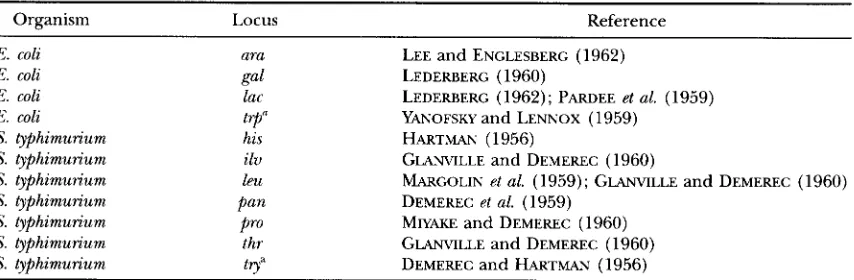
HE “one gene-one enzyme” hypothesis (BEADLE and TATUM 1941; HOROWITZ and LEUPOLD 1951) and the formation of genetic maps in the 1950s spurred efforts to understand the functional and evolutionary significance of how genes are arranged within the chro- mosomes of both eukaryotic and prokaryotic taxa. In many organisms, it was discovered that the genes re- sponsible for related, but not identical, functions were frequently located close together on genetic maps.Gene clusters are prominent features of bacterial chromosomes: The most striking examples of gene clusters were found in bacterial taxa (DEMEREC and HARTMAN 1959), such as Escherichia coli and Salmonella typhimurium (Table 1). In these taxa, the enzymes re- quired for particular biochemical pathways were often found to be encoded by physically proximate genes. Genes, such as the trp loci, known to be unlinked in the eukaryote Neurospora (BARRATT et al. 1954), were found to be clustered in E. coli (YANOFSKY and LENNOX 1959). Even more impressive was the tendency of genes for particular pathways to be arranged in the order of their biochemical reactions. The order of the 10 histi- dine biosynthetic genes within the E. coli and S. typhimu- n u m his operons is nearly identical to the order of their deduced chemical reactions; the same pattern holds true for the four E. coli trp genes. These features were taken as evidence for how gene clusters originated (see discussion of the Natal Model below). The first genetic map of S. typhimunum placed 40% of mapped loci into gene clusters (SANDERSON and DEMEREC 1965).
Corresponding author: Jeffrey G . Lawrence, Department of Biology, University of Utah, Salt Lake City, UT 84112.
E-mail: [email protected]
Genetics 1 4 3 184?-1860 (August, 1996)
Gene clusters are rare in eukaryotic chromosomes: Among eukaryotic taxa, however, genes for related functions were rarely found in close proximity. Putative eukaryotic clusters included the Aspergillus adenine, biotin, and proline loci (ROPER 1950; KAFER 1958), the Drosophila bithorax, miniature, yellow, and scute genes (GR~NBERG 1935; BRIDGES and BREHME 1944; LEWIS 1947;
K o w
1950; SLATIS and WILLERMET 1953), the Neurospora arginine, histidine, pyridoxine, and isoleu- cine/valine genes (BARRATT et al. 1954; MITCHELL 1955; FINCHAM and PATEMAN 1957; NEWMEYER 1957), and mouse developmental genes (DUNN and CASPARI 1945). However, such clusters of genes for related functions are exceptional in eukaryotic genetics. Most genes with associated functions are unlinked, and many of the pu- tative examples of gene clusters have been shown to reflect multiple alleles of a single cistron.1844 J. G. Lawrence and J. R. Roth TABLE 1
Prominent clusters of biosynthetic and degradative functions identified early during the development of E. coli and S. typhimurium genetics
Organism Locus Reference
E. coli ara LEE and ENGLESBERG (1962)
E. coli gal LEDERBERG (1960)
E. coli lac LEDERBERG (1962); PARDEE et al. (1959)
E. coli trp“ YANOFSKY and LENNOX (1959)
S. typhimurium his HARTMAN (1956)
S. typhimurium ilu GLANVILLE and DEMEREC (1960)
S. typhimum’um leu MARGOLIN et al. (1959); GLANVILLE and DEMEREC (1960)
S. typhimurium Pan DEMEREC et al. (1959)
S. typhirnurium Pro MIYAKE and DEMEREC (1960)
S . typhimurium thr GLANVILLE and DEMEREC (1960)
S. typhimurium tly” DEMEREC and HARTMAN (1956)
The
tv
tryptophan genes were renamed as trp genes.physical proximity provides no selective benefit to the individual organisms, but does enhance the fitness of the gene cluster itself. We suggest that the Selfish Op- eron model is more likely to explain the evolution of gene clusters in bacteria than other models.
THE NATAL MODEL OF GENE CLUSTERING Some genes may originate in clusters: The Natal model postulates that genes are clustered because they were born that way. HOROWITZ (1945, 1965) proposed that synthetic pathways may have evolved in a stepwise fashion, starting with a gene for the last enzyme in a biochemical pathway when a nutrient became limiting in the primitive environment. Each new enzyme would allow another natural compound to serve as a precursor to the nutrient. Additional genes would evolve to aug- ment the pathway as each successive intermediate sub- strate in the pathway became limiting. LEWIS (1951), extending the ideas of GRUNBERG (1935), proposed that gene duplication and differentiation could lead to linked loci with related functions (see also STEPHENS 1951). The tendency for the gene order within the S.
typhimurium trp and his operons to reflect the order of their corresponding biochemical reactions supported this hypothesis. Since the encoded enzymes would be working on similar substrates, this “assembly line of genes” was viewed favorably (PONTECORVO 1950). In a similar vein, DUNN (1954) proposed that subdivision of a large, multifunctional genetic element could lead to smaller, linked elements with related functions. These theories postulated that the existence of gene clusters reflected the process of gene origin.
As the amino acid sequences of proteins became known, however, these ideas lost merit. Virtually all bac- terial operons are composed of genes that show no obvious homology; many are closely related to unlinked genes encoding proteins that catalyze mechanistically similar reactions ( . g . , dehydrogenases, kinases, etc.). Few cases of gene duplication and divergence within
an operon have been demonstrated in bacteria (see however FANI et al. 1994). On the contrary, the E. coli MetB and MetC proteins, which clearly originated by an ancient gene duplication and catalyze successive steps in methionine biosynthesis (BELFAZIA et al. 1986), are encoded by unlinked genes.
In contrast to bacteria, the few examples of eukary- otic clusters of functionally related genes appear to be cases of duplication and divergence. For example, the mammalian P-globin gene cluster contains the
402,
E , G,, A,, $Dl,6,
andP
globin genes, all of which arose by duplication and divergence ( ~ ~ A N I A T I S et al. 1980). Four clustered human growth hormone (hGH) /chori- onic somaomammotropin (hCS) genes also arose by duplication and divergence (JONES et al. 1995). There- fore, while the Natal model is likely to account for the few gene clusters among eukaryotes, it appears unlikely to explain the more extensive gene clusters found in bacteria.The Natal model cannot explain the persistence of gene clusters: Not all early ideas on the significance of gene clusters focused on the origin of the component genes. DEMEREC and HARTMAN (1956) postulated that, regardless of how gene clusters originated, natural se- lection must act to prevent their separation. It followed, then, that natural selection might have worked to aggre- gate previously separated loci. DEMEREC and HARTMAN
Selfish Operons in Bacteria 1845
were relegated to extranuclear sites in eukaryotes. Therefore, eukaryotic taxa would have lost the selection for gene clustering, and previously clustered genes had dispersed.
In an alternative model, HARTMAN et al. (1960) pro- posed that gene clustering provided no biochemical benefit to the cell. Rather, the close proximity of the genes allowed a single transducing particle to repair multiple lesions in the genes for a single biochemical pathway. This model provided a selection for re- straining the separation of genes originating as clusters. However, it correspondingly provided selection against the clustering of dispersed genes; any chromosomal re- arrangement bringing genes together would preclude repair by transduction from a nonrearranged strain.
Diverse operons contain homologous genes: As the primary sequences of proteins accumulated, the com- parison of homologous proteins from distantly related organisms revealed the relationships among the genes
(ZUCKERKANDL and PAULING 1962). Families of globins (NOLAN and MARGOLIASH 1968), cytochromes (SMITH and MARGOLIASH 1964), and other proteins were de- duced. These families did not illuminate the question of bacterial operon origins until families of function- ally distinct dehydrogenases were inferred. ROSSMAN and colleagues (BUEHNER et al. 1973; ROSSMAN et al.
1974) proposed that the NAD-binding proteins lactate dehydrogenase, malate dehydrogenase, alcohol dehy- drogenase, and glyceraldehyde-3-phosphate dehydro- genase were derived from a common ancestor. In addi- tion, FAD-binding proteins, such as flavodoxin, were proposed to be distantly related to these NAD-binding proteins. Since dehydrogenases are found in many dif- ferent operons, these data strongly suggested that op- erons were composed of genes that arose indepen- dently, from distinct ancestors (unrelated to each other), and were later assembled into clusters. Mem- bership in a gene family has since become an estab- lished method for discerning the function of a novel protein (ORENGO et al. 1993; PETRILLI 1993; HOLM and SANDER 1994).
THE FISHER MODEL OF GENE CLUSTERING Genes clusters may reflect coadaptation: The Fisher model postulates that genes cluster if specific alleles work well together. Before the gene clustering debate began, FISHER (1930) noted that when specific alleles of two genes worked well together, the deduced linkage of the two genes would increase. This increase in the observed linkage resulted from selection for specific genotypes (.g.,
“AB”
and “ab”, where “A” and “a” are alleles at one locus and “B” and “b” are alleles at another) and counterselection against recombinants(e.g., “Ab” and “aB”)
.
This idea was extended by sev- eral workers (BODMER and PARSONS 1962; STAHL andMURRAY 1966) who suggested that such selection could
lead to the physical clustering of genes. The increased physical proximity would reduce the frequency of re- combination events that disrupt coadapted loci. In eu- karyotes, the predictions of this model are not seen since there are few examples of clustered, functionally related genes.
The Fisher model has been cited as motivating the clustering of genes within bacteriophage genomes (STAHL and MURRAY 1966; BOTSTEIN 1980; CAMPBELL and BOTSTEIN 1983; GASJENS et al. 1992). In both lamb- doid and T4 family bacteriophages, genes encoding proteins that function together as a logical group (e.g.,
head or tail proteins) are found in clusters. According to the Fisher model, this arrangement would allow re- combination between lambdoid bacteriophages to gen- erate new combinations of logical groups but would not disrupt the individual clusters of genes whose products must work together most intimately. This theory has been termed the “module” approach to bacteriophage evolution (BOTSTEIN 1980; CAMPBELL and BOTSTEIN
1983). As predicted by the Fisher model, the genes within many bacteriophage clusters encode proteins that interact physically; clustering minimizes the dis- tance between them (CASJENS 1974; CASJENS and HEN- DRIX 1988; CASJENS et al. 1992).
1846 J. G. Lawrence and J. R. Roth
TABLE 2
Functionally related unclustered genes identified early during the development of E. coli and S. typhimurium genetics
Organism Locus Linkage groups Reference
E. coli a% 5 GORINI et al. (1962)
E. coli PY7 3 BECKWITH et al. (1962)
S. typhimunum ad& 5 YURA (1956)
S. typhimurium 9 s 4 DEMEREC et al. (1955); HOWARTH (1958)
S. typhimurium met 4 SMITH (1961)
“The ade genes (adenine-requiring) were renamed pur (purine) genes.
cific strains (DESJARDINS et al. 1995; MAYNARD SMITH et
al. 1993).
THE COREGULATION MODEL OF
GENE CLUSTERING
Gene clusters can be regulated efficiently: The op- eron model for coregulation of genes under a common control mechanism stimulated new ideas to explain gene clustering (PARDEE et al. 1958; JACOB et al. 1960; JACOB and MONOD 1962). Genes found together, they
explained, could be induced and repressed simultane- ously by control at a single site, termed an operator. This control offered a selective mechanism by which a cluster of genes could provide a selective advantage over the same genes at dispersed sites. The operon of- fered both economy of expression and fixed relative product abundance to genes expressed from a single promoter. This model provided a rationale for both coregulation of genes and their clustering. As a result, the concept of the operon as the causative agent in gene clustering was widely accepted as a general expla- nation of why bacterial chromosomes were organized into gene clusters (AMES and MARTIN 1964). The force of this model was mitigated by the discovery of coregu- lated, unlinked genes (Table
2).
These cases showed that clustering is not a prerequisite for coregulation.Coregulation cannot drive gene clustering: A more serious problem of the Coregulation model was its fail- ure to suggest a plausible series of intermediate steps in the evolution of gene clusters. The regulatory bene- fits of an operon are derived from the cotranscription of multiple genes from a single promoter. Without co- transcription, genes 500 bases or 500 kb apart are, in effect, equally distant if transcription termination sites are located between them. No benefit is derived from proximity until cotranscription is possible.
If the only selective value of gene clustering were the final operon, the process of operon coalescence would have to occur in a single step, placing previously unlinked genes under the control of a single, regulated promoter. In effect, the extraordinarily rare event of a chromosomal rearrangement precisely juxtaposing two related genes would have to be strongly selected, so that it when it occurs it has a high likelihood of rising to high frequency
in the population. Moreover, such an event must occur for each gene added to every operon observed. Rear- rangements altering gene orders include inversions, which are relatively rare (ROTH et al. 1996), duplications, which are common and yield novel join points but are unstable, deletions, which are stable but permanently eliminate intervening DNA that may be selectively valu- able, and transpositions, in which mobile genetic ele- ments support the rearrangement of gene order.
A paradox is evident if coregulation were to drive gene clustering. The regulatory benefit of placing two genes under the control of a single promoter must be strong to ensure that the very rare rearrangement pre- cisely juxtaposing two related genes is fixed in the popu- lation before being lost by stochastic processes. How- ever, such strong selection is unlikely to be conferred by an allowing an operator to regulate one additional gene of a pathway. Therefore, the well-regulated pro- moter responsible for driving gene clustering cannot provide maximum benefit until all of the genes are clustered. Alternatively, well-regulated operators may slowly be selected simultaneously at unlinked loci, as is seen with the E. coli arg, met, and pur genes. Once this occurs, there is no selection for gene clustering.
Selfish Operons in Bacteria 1847
chromosome (BRUCKNER and MATZuRA 1981). How- ever, the L7/L12 protein is present in four copies per 50s subunit, while the other three proteins are present in one copy each ( H A R D Y 1975; SUBRAMANIAN 1975). We propose that coregulation may be a benefit derived secondarily from operon formation, and may provide a selective influence for maintaining operon organiza- tion. However, we feel that coregulation is unlikely to provide sufficient selection to drive the clustering of dispersed genes. Hence, the maintenance of operons may include selective forces not contributing to the origin of the clusters.
THE SELFISH OPERON MODEL OF GENE CLUSTERING
Genes move by horizontal transfer: To explain the formation of gene clusters in bacteria, we offer a model that relies upon the horizontal transfer of DNA between organisms. Inheritance of genetic information in bacte- ria occurs primarily by vertical transfer; that is, transfer from a parent cell to daughter cells at cell division. However, the transfer of DNA between organisms inde- pendent of reproduction is known to occur; this process has been termed horizontal transfer [reviewed by KID-
WELL (1993) and SWANEN (1994)l and entails the trans- fer of DNA between species. Although examples of hori- zontal transfer involving eukaryotic taxa have been documented (MOURANT 1971; BANNISTER and PARKER
1985; BRISSON-NOEL et al. 1988; HILDEBRANDT et al.
1989; DOOLITTLE et al. 1990) they are, for the most part, considered isolated events. In contrast, horizontal transfer among prokaryotes is mediated by common processes [(see review by SWANEN (1994)], including transducing bacteriophages, conjugative plasmids, or the direct uptake of foreign DNA. We define horizontal transfer and the mobilization of DNA between bacterial species. The transfer of genetic information among conspecific strains is typically denoted as recombination among bacterial isolates.
Genes for weakly selected functions can be lost:
Bacterial genomes encode both critical functions, re- quired for central metabolic processes, and merely use- ful functions, which provide sporadic benefits but are not continuously essential. Such noncritical functions include the degradation of unusual compounds as sources of carbon and energy; these compounds may not always be present or may represent a minor fraction of available growth substrates. We term such functions “weakly selected”. Weakly selected functions include those employed frequently for relatively unimportant tasks or those employed only under specific, rarely en- countered environmental conditions. Natural selection on genes encoding rarely used proteins may be tempo- rally or spatially heterogeneous. During periods of re- laxed selection, such genes may accumulate base substi- tutions rapidly since natural selection would not act to
remove null alleles from the population. Consequently, genomes with multiple defects in a single function can rise to high frequency by genetic drift.
A simple calculation demonstrates this process of loss of gene function. If the coefficient of selection (s) of a mutation is sufficiently small, the mutation may be considered effectively neutral ( K ” M 1983). In hap- loid populations, the magnitude of an effectively neu- tral selection coefficient may be approximated as s 5 1/2Ne, where Ne is the effective population size. Since natural selection may be temporally or spatially hetero- geneous, we define a weakly selected function in terms of an average selective coefficient, F, for that allele over all environments. If ~5 1/2N,, then the null alleles at that locus are effectively neutral. Every generation, a total of NPp mutations will arise (at a frequency p per cell in a population with effective size N e ) . Since each mutation has a probability of 1 / N to sweep the popula- tion, a total of N,p X l/Ne = p mutations will be fixed per generation. Therefore, effectively neutral null mu- tations may sweep a population in an average of 1/p
generations. For example, consider a function requir- ing five genes (or 5000 bp) in E. coli. If the probability of mutation is lo-’ per base pair, then the mutation rate can be estimated as p = 5 X 10⁻⁵/generation for these genes. Neutral alleles will sweep the population in 200,000 generations or
-
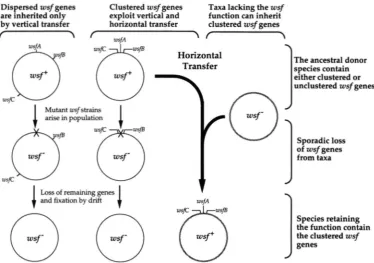
1000 years. (This frequency does not consider other factors, such as the loss by spontaneous deletion, or the effects of null alleles hitch- hiking on linked, selectively advantageous mutations at other loci.)Consider the hypothetical wsf locus encoding a weakly selected function (Figure 1). If natural selection is relaxed, null alleles (wsf- ) will eventually dominate the population and the weakly selected function will be lost. In other words, wsf’ cells have an insufficient selective advantage over wsf - cells to prevent their even- tual loss by genetic drift. If more than one gene is re- quired for this function, the target for potential muta- tions is correspondingly larger, and the rate of stochastic loss of this function is correspondingly higher. Once one gene contributing to a weakly se- lected, multigene function is lost, all selection is re- moved from the remaining genes and mutants with multiple defects rapidly arise.
Moreover, cells with multiple defects in a single meta- bolic pathway may be selected over cells with single lesions. In many cases, single mutations may confer a selective disadvantage, for example, by allowing the buildup of toxic metabolic intermediates. In such cases, additional mutations in the same pathway would pro- vide a selective advantage. Therefore, cells multiply mu- tant in particular pathways may shown a selective advan- tage over singly mutant cells. This was observed for some adenine mutants of Neurospora (MITCHELL and
1848
1.
G . Lawrence and J. R. RothDispersed wsf genes Clustered wsf genes Taxa lacking the wsf
are inherited only exploit vertical and by vertical transfer
function can inherit horizontal transfer clustered wsf genes
- f WsfA \-
I
Mutant wsfstrainsarise in population
Loss of maining genes
and fixation by drift
Horizontal Transfer
WsfA
1
The ancestral donor species contain either clustered or unclustered wsf genes1
Sporadic loss of wsf genesfrom taxa
7
the function contain Species retaining
the clustered wsf
genes
FIGURE I.-"odel for the transfer of gene clusters. Circles represent bacterial chromosomes; rusfABC denotes genes for a weakly selected function. Corresponding wsfphenotypes are provided at the center of each chromosome.
Horizontal transfer allows genes for weakly selected functions to escape extinction: The potential loss of the wsjgenes from their native species may not mean that the wsfgenes are doomed to extinction. Horizontal transfer may have mobilized the wsfgenes to a recipient taxon before their stochastic loss from the donor taxon. Hence, horizontal transfer allows the persistence of genes that could be doomed to evolutionary extinction if vertical transfer were their only means of inheritance. Such mechanisms are thought to influence the evolu- tion of transposons in eukaryotes, in which autonomous transposons must be horizontally transferred regularly to select for transposition function (HARTL et nl. 1992; HURST et nl. 1992). Unlike transposons, however, more than one wsj gene may be required to perform the weakly selected function. If so, the lateral transfer of only one 7u.f gene to a multiply deficient recipient would not provide the function to the recipient cell. Acquired genes that do not confer a selective advantage would not rise to high frequencies in the population; rather, they would be again lost from bacterial popula- tions by deletion or accumulation of mutations. Only when all wsfgenes required for the novel function are transferred at once will a potentially beneficial pheno- type result and a selective benefit be realized (Figure 1 ) . This process of loss and reacquisition can occur both within and among bacterial species; for the purposes of this paper, we will concentrate on the transfer of Selfish Operons among bacterial species.
The cluster is a selfish property of the constituent genes: Consider three genes, rusfA,
w s p ,
and w.fC, re- quired for a weakly selected function. If these genes arescattered on a chromosome, they may be propagated only by vertical transfer. Eventually, they will be lost by the accumulation of null mutations as described above (Figure 1 ) . If these genes are clustered, however, they may be propagated by both vertical and horizontal transfer. These genes can escape loss by genetic drift by exploiting transfer to novel genomes. Only when all three genes are transferred is the selective benefit to the recipient cell realized. The physical proximity of wsf genes provides no selective benefit to donor organism; organisms with clustered or unclustered wsfgenes are equally fit. However, physical proximity provides a strong advantage to the wsfgenes themselves when com- peting via lateral transmission with unclustered alterna- tive alleles. Therefore, the gene cluster can be consid- ered a selfish property. The cluster is advantageous only to the genes themselves not to the immediate host or- ganism. This feature distinguishes the Selfish Operon model from the Coregulation model of gene clustering in which the host gains a fitness advantage due to better regulation. This feature also distinguishes the Selfish Operon model from the Fisher model in which the physical proximity of coadapted alleles increases the organism's fecundity by reducing the frequency of less fit recombinant offspring.
Bacteriophage genes-the Fisher model revisited:
Selfish Operons in Bacteria 1849
Horizontal transfer
unrelated taxon
of wsfgenes to an Deletion of the now unselected intervening genes
FI(;I’RF. 2.-Rapid clustering of
genes within foreign genomes. Cir- cles represent bacterial chromo-
somes; 711.fAn denotes genes for a weakly selected function, wg, abso- wsfA nug
I
I
u
DNA cannot be deleted between The aeg gene is now represented
the wsfA and wsfB genes due to as the nug new useless gene
the aeg absolutely essential gene in the recipient chromosome
extended Fisher model, recombination among diverse bacteriophages disrupts coadapted gene complexes, and the recombinants are counterselected.
As
a result, bacteriophages are proposed to evolve tight clusters of coadapted genes; these clusters minimize detrimental recombination between coadapted genes. Yet recombi- nation among bacteriophages is currently viewed as avery rare event between distantly related partners; therefore, extensions of the Fisher model cannot ex- plain gene clustering in bacteriophages. We believe that the evolution of these gene clusters is explained better by the Selfish Operon model.
Since the genes for bacteriophage proteins are co- adapted, successful propagation of any one gene re- quires that all coadapted genes are transferred in a
single recombination event. Transfer of a single gene of a coadapted complex to a bacteriophage genome lacking the analogue of this gene would be unsuccess-
ful; since the remaining genes in the recipient genome are coadapted, any newly acquired single gene would not function properly in this new context. In contrast, the introduction of an entire, coadapted gene complex into a bacteriophage genome lacking one gene of its analogous complex would be successful. Moreover, the products of the remaining genes of the recipient’s com- plex could not interact with the products of the newly introduced, coadapted gene complex and therefore would be removed from selection and lost. Hence, the coadapted nature of the genes can accelerate the co- transfer of genes contributing to a single function. The Selfish Operon model predicts that clusters of function- ally related genes can colonize naive genomes or ge- nomes having lost two genes of a single pathway. Clus- ters of coadapted, functionally related genes can invade genomes from which only a single gene has been lost. Rather than disrupting coadapted complexes, as in the Fisher model, recombination in the Selfish Operon model facilitates the propagation of clusters of co- adapted genes. In contrast to the Fisher model, the transfer of genes between bacteriophage genomes can drive clustering even if recombination is rare. Since the recombination events generally do not involve closely related bacteriophage genomes, they can be thought of as horizontal transfer events mobilizing small sequence elements. Viewed in this manner, the Selfish Operon
I Irltely cssential gene, nug, now use-
less gene.
Horizontal transfer allowed closer juxtaposition of the
wsfA and WSJB genes.
model explains the clustering of bacteriophage genes and bacterial chromosomal genes by parallel pathways.
PROPERTIES O F T H E SEI.FISH O P E R O N M O D E L Horizontal transfer accelerates gene clustering: The Selfish Operon model allows genes to cluster into an operon by a series of approximations. This is an attrac- tive alternative to the “instant operon” required by the Coregulation model. The efficicncy by which multiple genes are cotransferred increases as genes are brought closer together. Therefore, genes can be slowly moved into clusters even before coregulation is possible. Any rearrangement that brings two or more genes with co- operating products closer together increases that group’s ability to be mobilized. In contrast, the Coregu- lation model requires that operons be formed in one step (see above).
Horizontal transfer can contribute more directly to the clustering of genes by making the intervening DNA
nonessential. Following horizontal transfer, an intro- gressed DNA fragment containing loosely clustered genes will be foreign to the host. Since this is foreign
DNA, the intervening material (between the selected, loosely clustered genes) will not bc csscntial for thc
growth of the rccipicnt ccll. This inlel-vcllillg DNA is subject to spontaneous deletions, which can bring the loosely clustered genes into closer proximity (DEMEREC 1960) (Figure 2 ) . In this manner, loosely clustered genes transferred horizontally may be brought rapidly and incrementally into very close proximity. In this model, the deletions, whichjuxtapose genes, delete for- eign DNA, not essential DNA. The rt~fgenes contained in the horizontally transferred DNA will be selected; the intervening material is unselected and can be lost be deletion. If the intervening material encodes prod- ucts that disrupt the metabolism of the recipient cell, deletion of these sequences may be selected, thereby accelerating further the clustering of the beneficial 7 4
1850 J. G . Lawrence and J. R. Roth ing the constraints on deletion of the intervening mate-
rial.
Selfish operons and the evolution of promiscuity: The evolution of gene clusters by the Selfish Operon model does not require cotranscription. Yet bacterial chromosomes are notable for clusters of genes under the control of single promoters, that is, for operons. If each gene of a transferred cluster must be transcribed by a separate promoter, it is likely that one or more of these promoter sequences may not function in some recipient genomes which recognize different promoter types. If so, the gene cluster would not provide a se- lectable phenotype and would be lost by deletion.
Cotranscription is a selfish property of genes: We suggest that the cotranscription of genes for specific metabolic functions may facilitate horizontal transfer of gene clus ters into genomes with RNA polymerases that recognize different promoter sites than those found in the donor genome. An introgressed operon requires only a single new promoter sequence, which may be provided by the recipient at the site of insertion. Therefore, while physical proximity is strongly selected so that cotransfer may occur, cotranscription may be subsequently se- lected to allow transcription of all genes in the widest possible variety of new environments. Indeed, the new host may provide the single promoter that allows ex- pression of the laterally transferred genes; the individ- ual promoters for the donor-cell RNA polymerase may be superseded by a single promoter site well recognized by the recipient-cell RNA polymerase. The cotranscrip- tion of genes within operons may be a trivial result of the inevitable loss of individual, species-specific pro- moter sequences.
Cotranscription may select f o r the maintenance ofgene clus- ters: Only following operon formation could regulation at a single operator provide a selective advantage to the cell, However, once an operon is formed, coregulation may provide a selection against the subsequent disper- sion of genes. Once genes have clustered into an op- eron (for selfish purposes), the regulation of the single promoter may provide selective benefits to the host or- ganism. In this manner, coregulation may provide a selection for the maintenance of operons, even though it cannot provide a selection for the formation of oper- ons. Moreover, the close proximity of genes within an operon reduces the probability of gene dispersal, since the chromosomal rearrangements leading to operon disruption are likely to damage some of the genes within the operon. The relative contributions made by the Coregulation model and the Selfish Operon model toward the maintenance of gene clusters cannot be eas- ily estimated and would depend on the selective benefit of coregulation enjoyed by individual operons.
Translational coupling may be a seljish property of Opm- ons: In a fashion similar to transcription initiation, translation initiation requires sequence signals that vary among species. Therefore, ribosomes of a foreign host
may not recognize all of the translation initiation sites in a transferred operon. Within bacterial operons, the translation of downstream genes is sometimes initiated by ribosomes completing the translation of upstream genes; this has been termed “translational coupling” (OPPENHEIM and YANOFSKY 1980). The de novo initiation of translation is not required for the second gene of a coupled pair; rather, ribosomes completing the transla- tion of the first gene do not dissociate fully from the mRNA. After dissociation of the 50s subunit, the 30s
subunit may reinitiate translation at a physically proxi- mate translation start site (MARTIN and WEBSTER 1975). We view translational coupling as a mechanism to en- sure translation by foreign ribosomes of all proteins encoded by a single message. Hence, five clustered genes not organized into an operon would require five transcription initiation and five translation initiation events for expression; an operon of five translationally coupled genes would require a single transcription initi- ation and a single de novo translation initiation event. While translational coupling would offer this advantage to horizontally transferred genes, it is not obligatory.
The clustm‘ng of operons with genes encoding their trans- acting regulators is selfish: A notable feature of some bac- terial operons is the adjacent location of a gene encod- ing a transacting regulatory protein. In E. coli, this ar- rangement is observed for the separately transcribed putA and putP genes, araC and araBAD genes, rhaRS
and rhaBAD genes, ebgR and ebgACB genes, melR and melAB genes, and l a d and lacZYA genes. In each case, the genes listed first encode a transacting regulatory protein; the gene(s) listed second comprise a single transcription unit controlled by that regulatory protein. The close proximity of the regulatory genes and the regulated operons is not essential for the control mech- anism since these proteins can act at distant sites. For example, the AraC regulatory protein controls both the araBAD operon (linked to the araC gene) and the
dk-
tant araEFGoperon; thus it functions effectively in trans, suggesting that the proximity of the araC gene and the araBAD operon is not necessary for function. Similarly, the chromosomally encoded Lac1 protein routinely reg- ulates lac promoter sequences on common cloning vec- tors and could thus act in trans on an unlinked, chromo- somal lacZYA operon. Although the proximity of these regulatory genes to their targets cannot be explained simply on a functional basis, their proximity can be explained by the Selfish Operon model. The adjacent location of the regulatory gene and the regulated op- eron may have been selected since that proximity has allowed efficient cotransfer of the operon and its regu- latory apparatus.Selfish Operons in Bacteria 1851
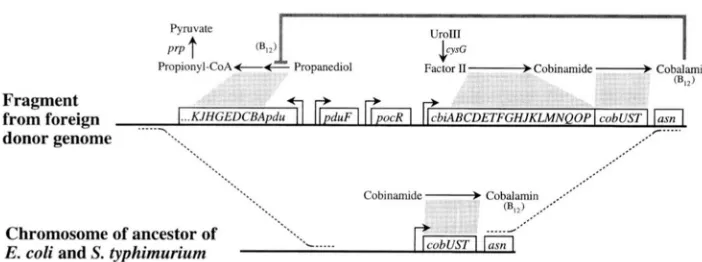
FIGURE 3.-Schematic of the horizontal transfer event introduc- ing the cob and pdu operons into the Salmonella genome. Genes and operons are represented by boxes; grey lines demarcate reactions cata- lyzed by the encoded proteins. The dotted lines represent the pro- posed sites of introgression of the cob and pdu operons into the Snlmrr
nelln chromosome.
S. typhimunum synthesizes cobalamin, employing the 20 genes of the cob operon, only under anaerobic growth conditions (JETER et al. 1984). Propanediol degradation depends upon BI2 as a cofactor and requires the en- zymes encoded by the p d u operon, transcribed diver- gently from the cob operon (Figure 3). Since the cob and p d u operons are both induced by propanediol (BOBIK et al. 1992), the degradation of propanediol is believed to provide the primary selection for cobalamin biosyn- thesis in S. typhimurium. These two functions, requiring nearly 1% of the S. typhimunum chromosome, must be under strong selection in this genus; Salmonella species are almost universally capable of propanediol degrada- tion and cobalamin biosynthesis (LAWRENCE and ROTH 1996). The functions of the cob and pdu operons are the basis of metabolic tests designed to discriminate between Salmonella spp. and other enteric bacteria
( RAMBACH 1990).
Most enteric bacteria synthesize cobalamin under aerobic conditions and employ the cofactor in glycerol and propanediol dehydratases (IAWRENCE and ROTH
1996). The immediate ancestor of Salmonella spp. and E. coli is believed to have lost both cobalamin synthesis and the two dehydratases. E. coli isolates reflect these losses and neither synthesize cobalamin de novo, nor degrade propanediol or glycerol in a cobalamin-depen- dent fashion (LAWRENCE and ROTH 1995,1996). In con- trast, Salmonella spp. appear to have acquired a foreign cluster of genes encoding proteins for cobalamin syn- thesis (cob) and propanediol degradation ( p d u ) . Since these operons are adjacent, it is likely that both were acquired from a single transferred fragment; this event is diagrammed in Figure 3 and evidence for the hori- zontal transfer event is detailed elsewhere (LAWRENCE and ROTH 1995, 1996). It is likely that the simultaneous introduction of the adjacent cob and p d u operons into the ancestral genome of Salmonella allowed that ge- nome to rise to high frequency since it introduced a new degradative pathway and the biosynthetic pathway for the required cofactor.
The cob and p d u operon region contains all necessary proteins for the synthesis of cobalamin and its use in the degradation of propanediol. The precursors to co- balamin biosynthesis and the product of propanediol degradation are constituents of existing Salmonella me-
tabolism. The substrate for cobalamin biosynthesis is a methylated tetrapyrrole that is produced by the CysC protein during siroheme synthesis (SPENSER et al. 1993; FMZIO and ROTH 1996). Siroheme is required for cys- teine biosynthesis, and the CysG protein is expressed constitutively at a basal level. Therefore, the substrate for the Cob biosynthetic proteins is consistently avail- able in the Salmonella cellular environment. Similarly, the product of propanediol degradation (propionyl- CoA) may be converted to pyruvate by the enzymes involved in propionate degradation (J. TITTENSOR and
J.
R. ROTH, unpublished data). Hence, the product of propanediol degradation by the Pdu enzymes readily enters Salmonella central metabolism. The transacting pocR regulatory gene, as expected, is located between the cob and p d u operons (see above and Figure 3 ) .This arrangement of genes in the cob/pdu operon cluster includes hierarchical levels of selfish gene clus- ters. The 20 cotranscribed cobgenes can provide cobala- min synthesis when mobilized to recipient genomes (Figure 3). Similarly, the adjacent p d u operon can be transferred into foreign genomes to confer the ability to degrade propanediol (Figure 3). Together, the adja- cent cob and p d u operons together form a selfish regu- Ion, providing the functions of propanediol degrada- tion and synthesis of the cofactor required for that process.
This process of loss and reacquisition has also been proposed to account for the remarkable similarity be- tween the structure and sequence of the t? operon in Brmibactm'um lactofennentum and the t? operons of enteric bacteria (MATSUI et al. 1986; CRAWFORD and MILKMAN 1991). CRAWFORD and MILKMAN (1991) postu- lated that the t? functions were lost from the ancestor of B. lactofennentum, and only the transfer of the entire t? operon could have restored the tryptophan biosyn- thetic functions.
J. G. Lawrence and J. R. Roth 1852
TABLE 3
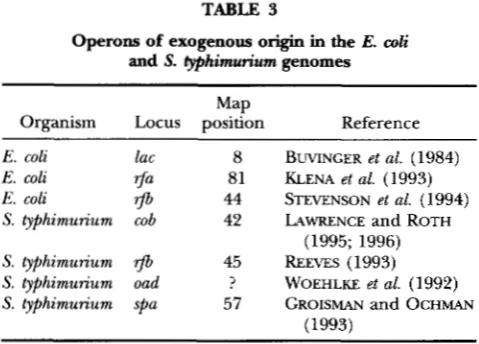
Operons of exogenous origin in the E. coli and S. typhimurium genomes
Map
Organism Locus position Reference
E. coli lac 8 BUVINCER et al. (1984)
E. coli $a 81 KLENA et al. (1993)
E. coli
rfb
44 STEVENSON et al. (1994)S. typhimunum cob 42 LAWRENCE and ROTH
(1995; 1996)
S. typhimurium
rJb
45 REEVES (1993)S. typhimunum oad ? WOEHLKE et al. (1992)
S. typhimurium spa 57 GROISMAN and OCHMAN
(1993)
ers (REEVES 1993; X b W G et al. 1994) have determined that the rjh locus of Salmonella spp. has been introduced by horizontal transfer. Moreover, this 15 gene operon appears to be an evolutionary mosaic, representing nu- merous horizontal transfer events that assembled the
rjh locus from many different genomes. The rjh and rfa
loci of E . coli also reflect patchwork patterns of gene composition indicating different evolutionary origins for gene subclusters (KLENA et al. 1993; LIU and REEVES 1994; STEVENSON et al. 1994).
The spa genes contribute to the ability of Salmonella spp. to invade eukaryotic cells. This operon is also pur- ported to be of exogenous origin; spa homologues are not found among closely related taxa and the GC con- tents of the genes (-30-40% G+C) are atypical of
s.
typhimurium coding sequences (GROISMAN and O C H W 1993). The mosaic pattern of GC content among spa genes suggests that, like the
rfa
and rjh operons, the spa operon may represent another example of an operon of genes assembled from different chromosomes. Like the spa operon, genes of the S. Qphimurium oad operon have aberrant GC contents (-65% G+C and 587% G+C in the third codon position) and other DNA se- quence features indicative of horizontal transfer ( O C H - MAN and LAWRENCE 1996). Similarly, the cat operon of Acinetobacter calcoaceticus has a mosaic structure indica- tive of recent assembly from multiple sources ( SHANLEY et al. 1994). The nucleotide composition of genes are commonly used as indicators of possible exogenous ori- gin ( M ~ D I G U E et al. 1991; WHITTAM andAKE
1992; OCH- MAN and LAWRENCE 1996); the $a (35-39% GC), rjh (31-40% GC), cob (59% GC), andpdu (59% GC) oper- ons described above all show GC contents atypical of the S. typhimurium genome.Simulations of the Selfish Operon model: To test mathematically the predictions of the Selfish Operon model, a computer model was developed (Figure 4). A collection of virtual taxa was created bearing 5 10 genes required for a hypothetical function. In any particular simulation, all taxa in the collection had the same num- ber of genes contributing to this function; the genes
simulation
I
&
1 minutewith a probability of PlmS to create
move one gene to a random position with probability P,,,
I
[ For each positivespecies, transfer1
I
1
FIGURE 4.“Flow chart describing computer simulation of horizontal transfer events. The numbers of positive taxa were allowed to vary between 10 and 900 species. The distance between loci was calculated as the minimum chromosome arc containing all genes in the putative cluster. Average distance was calculated as the arithmetic mean of these distances among positive taxa. Positive taxa lose the simulated function with a probability of Pbss per cycle. For each positive taxon,
one gene may translocate to a random location within the 100-min chromosome with a probability of Pmmc per cycle. For each positive taxon, the genes may be transferred to a negative taxon with a probability of Pl,a,,,m per cycle; P,,,, varies in- versely with the distance between the loci in that taxon; a maximal PlYa+, occurs when 0 min separate the loci.
were placed randomly on a linear, 100-min genetic map. Taxa carrying functional alleles of all genes are termed “positive”; taxa lacking any of these genes are termed “negative.” The collection of taxa is exposed to successive rounds of loss of gene function, converting a positive taxon into a negative taxon, chromosome rearrangement, in which randomly chosen single genes in a positive taxon may move independently to random chromosomal locations, and horizontal transfer, by which a negative taxon is converted to a positive taxon; the probability of transfer was inversely related to the distance separating all of genes required for the func- tion (Figure 4). An effectively infinite pool of negative taxa was available as recipients of the horizontal trans- ferred genes. The arrangement of genes within the newly created positive taxon is identical to that of the donor taxon. This process is repeated and the average distance separating the genes in question is deter- mined. Clustering results, and the process is allowed to continue until the genes in question are separated by
<1 min, on average, among the collection of positive taxa.
Selfish Operons in Bacteria 1853
transfer, and the number of genes required for the function. The logic of the computer model reveals that genes must be horizontally transferred to avoid eventual loss [The purpose of the computer model is to examine the properties of the Selfish Operon model, and not to determine its veracity by rigorous simulation. Such a
test would require estimates of parameters (e.g., the population sizes and rates of horizontal transfer among species
2
billion years ago) that cannot be obtained.] Without opportunity for horizontal transfer, all taxa ultimately become negative. Since the probability of horizontal transfer is inversely related to the distance separating the loci (Figure 4), successive rounds of hori- zontal transfer allow more tightly clustered genes to dominate the collection of virtual taxa. The model was employed to determine how the average rate of gene clustering was influenced by the number of genes to be clustered, the rates of deletions and rearrangement, and the probability of horizontal transfer.Two caveats should be noted. First, the process of the loss of gene function from any one taxon has been reduced to a single step; that is, a single event repre- sents the sum of the initial mutation at one gene, its fixation in the population, and subsequent loss of all other genes in that pathway. Second, during any one simulation (that is, one run of the computer model as depicted in Figure 4), the loss of gene function was not allowed if very few positive taxa remained. This stipulation prevented all of the taxa from becoming negative (extinction of the function), leading to an un- successful termination of the simulation without gene clustering. In series of simulations without this condi- tion, clustering still occurred, but greater numbers of simulations were required to obtain the same data.
Gene clustering occurs in a three-step process: The pro- gress of a single simulation reflecting the clustering of three genes is shown in Figure 5 . This simulation is typical of all simulations using this model and reflects three distinct phases. The initial shuffling phase is char- acterized by little net change in the average distance between loci in the collection of taxa. Since no gene clusters have arisen at this stage, there is little or no horizontal transfer of genes between taxa. However, as soon as a single taxon obtains a gene cluster by random gene shuffling, that cluster rapidly populates negative genomes. In concert with the inevitable loss of genes from all positive taxa, the average distance between genes steadily decreases among the collection of taxa. This period of decrease is designated the sweep phase. The sweep phase depicted in Figure 5 was initiated by a cluster of three genes positioned within an 8-min chromosome fragment. The rate of the sweep is depen- dent on the size of the fragment containing the gene cluster; tight clusters have a greater probability of trans- fer and sweep more quickly. Following the sweep phase, periodic sweeps by more tightly clustered genes occur; this is termed the cluster phase. The number of genera-
Shuille
Phase
I
1
200
150
5 7 9 11 13 15 17 19 21 23
Hundreds of cycles to cluster
sweep Phase
j Cluster
: Phase
I I 1 1 1 1 1 1
2 3 4 5 6 7 8 9 1 0
Hundreds of cycles
FIGURE 5.-The clustering of three gene following the model illustrated in Figure 4. The simulation was terminated at cycle 1005, when the average distance between’the three loci was 0.3 min. The shuffle phase, sweep phase, and cluster phase are described in the text. For the simulation described here Ploss = 0.001, P,,, = 0.01, and maximal PCramr.. = 0.01 (see Figure 4). Inset histogram shows the times to clustering for three genes for 1000 simulations. Genes are considered “clustered” when the final average distance between alleles <1 min among the collection of positive species.
tions required for gene clustering can vary (inset in Figure 5 ) ; differences in the length of the cluster phase imparts much of this variance (data not shown).
The cluster phase is characterized by the rapid, suc- cessive transfer of newly created gene clusters to naive genomes. The great length of the cluster phase (see Figure 5) is likely to be an indirect result of the simula- tion methods. As discussed above, the Selfish Operon model predicts that loosely clustered genes will aggre- gate rapidly once they are transferred to naive genomes; this is due to the rapid removal of the nonselected, intervening DNA. When the deletion of intervening
DNA is included in the simulation, the cluster phase is essentially eliminated. The overall behavior of the shuf- fle and sweep phases are not significantly altered.
The time to gene clustmng is a linear function of the number
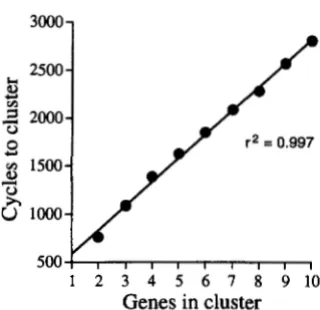
of genes: One might expect that the time required for gene clustering would increase exponentially as more genes are required for the cluster. If so, the model would predict that clusters containing large numbers of genes would rarely be observed in extant genomes. However, simulations show that the time required for gene clustering is linearly related to the number of genes required for the function ( R2 = 0.997, Figure 6).
1854 J. G. Lawrence and J. R. Roth
I 2 3 4 5 6 7 8 9 1 0
Genes
in cluster
FIGURE 6.-The average time to clustering is plotted as a
function of the number of genes in the cluster. Each point represents the average of 1000 simulations; parameters for the simulations were Ploss = 0.001, P,, = 0.01, and maximal PmWfm = 0.01 (see Figure 4 ). The regression line Y = 248.6X
+
333 has a correlation coefficient of 0.997.is dependent on the size of the fragment containing the initial cluster, not on the number of genes in the cluster. Once the sweep phase is initiated, clusters of similar lengths sweep at similar rates. Therefore, this simulation predicts that naturally occurring clusters may harbor large numbers of genes. Inspection of the
E. coli and S. typhimurium genetic maps reveal many operons of substantial size. The
S.
typhimuriumrJb
and cob operons, discussed above, contain 15 and 20 genes, respectively.PREDICTIONS OF THE SELFISH OPERON MODEL
Genes for essential processes should not cluster:
The Selfish Operon model predicts that genes provid- ing for essential processes should not be found in clus- ters. Mutant cells without an essential gene function could not survive in any environment, precluding the process of loss and acquisition posited by the Selfish Operon model. In contrast, the Coregulation model predicts that essential genes whose coregulation is most critical are those most likely be found in operons. Sur- veys of bacterial chromosomes generally support the predictions of the Selfish Operon model. In general, genes providing for essential processes are not found in clusters. For example, the genes for NAD biosynthe- sis and cycling are found in 2 1 3 distinct loci in the
S.
typhimurium chromosome (SANDERSON et al. 1995) ;
genes for DNA synthesis comprise 211 distinct loci in
E. coli (BACHMANN 1990). A few exceptional cases of clustered essential genes, e.g., the clusters of genes en- coding ribosomal proteins, are discussed in detail be- low. The Selfish Operon model predicts that strongly clustered genes should be those that encode proteins for conditionally dispensable biosynthetic or degrada- tive pathways for which selection can be relaxed for long periods of time.
Genes for nonessential functions are clustered We
predict that many operons have formed during the di- versification of bacterial species and have been present in host genomes for long periods of time. For example, many selfish operons may encode degradative pathways. Generally the encoded enzymes degrade a particular substance to produce a metabolite that easily enters central metabolism; the
S.
typhimurium pdu operon dis- cussed above is one such operon. Genes for catabolic functions in Pseudomonas uerupnosa and P. putidu are also clustered; these clusters are commonly located on plasmids (HOLLOWAY et al. 1990). HOLLOWAY and MOR- GAN (1986) suggested that the chromosomes of these species have been augmented by the introgression of such plasmids bearing clusters of useful genes. In E. coli (BACHMANN 1990), gene clusters encode functions for the degradation of lactose ( ZucZZYA), n-acetylglucos- amine (nagABE), galactose (gulKTE),
proline (PutAP),cellibiose (celFDCB), galactitol (gutCAD), glycerol-phos- phate (g&QTACB), y-amino-butyrate (gubCPDT)
,
sor- bitol (srZABDR) , fucose (JucDAPIKR), P-galactosides(ebgRACB) , hexuronates (uxaAC)
,
xylose (xylABRF),
mannitol (mtDAC) , galactonate (dgoADKTR) , Pgluco- sides (bglWG), ribose (rbsABCDW
,
rhamnose (rha- DABR), melibiose (melRAB), and mannonate (uxu- R B A ) . While these functions are useful, the failure to degrade any of these substances is counterselected only when that substance is present in high concentration.Another class of transiently selected operons are those conferring transport functions. In E. coli, such operons include functions for the transport of fer- richromes W u A B C D )
,
potassium (kdpDCBA),
gluco- nate (glnQPH), oligopeptides (oppABCD), cobalamin(btuCED)
,
mannose (munXYZ),
arabinose (aruFGH),methylgalactosides (mglBACD), histidine (hisJPM)
,
pro- line ( p r o w w ),
glycerol-3-phosphate (upgCEAB), leu- cine, isoleucine, and valine ( liuGMHKLJ,
hexose phos- phates (uhpTCBA) , and phosphates (PstABCS).
Such transport functions may be considered selfish in that they would augment degradative or biosynthetic oper- ons in recipient taxa.Biosynthetic genes are only under selection when the end product of the encoded pathway is missing from the environment. In E. coli, such operons under non- continuous selection encode proteins for the synthesis of threonine (thrABC)
,
betaine (betABT),
tryptophan(trpABCDE) , histidine (hisGDCBHAFE), menaquinone
(menACEBD), isoleucine and valine (iluGMEDAYC),
and thiamine ( thiABC). The products of these operons are typically compounds available in the growth envi- ronment, or compounds not absolutely required for cell growth.
Recently introduced Selfish Operons can be detected
Selfish Operons in Bacteria
TABLE 4
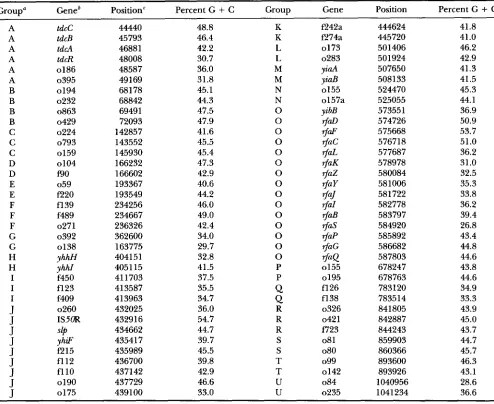
Atypical gene clusters in a 1.1”B region of the E. coli chromosome
1855
GrouD“ Geneb Position‘ Percent G
+
C Group Gene Position Percent G+
C A A A A A A B B B B C C C D D E E F F F G G H H I I IJ
J
J
J
J
J
J
J
J
tdcC tdcB tdcA tdcR 0186 0395 0194 0232 0863 0429 0224 0793 01 59 0104 BO 059 E20 f139 f489 0271 0392 0138 yhhH yhhl f450 f123 f409 0260 ISSOR yhiF f215 fl12 fllO 0190 01 75SlP 44440 45793 46881 48008 48587 49169 681 78 68842 69491 72093 142857 143552 145930 166232 166602 193367 193549 234256 234667 236326 362600 163775 404151 405115 41 1703 413587 413963 432025 432916 434662 435417 435989 436700 437142 437729 439100 48.8 46.4 42.2 30.7 36.0 31.8 45.1 44.3 47.5 47.9 41.6 45.5 45.4 47.3 42.9 40.6 44.2 46.0 49.0 42.4 34.0 29.7 32.8 41.5 37.5 35.5 34.7 36.0 54.7 44.7 39.7 45.5 39.8 42.9 46.6 33.0 K K L L M M N N 0 0 0 0 0 0 0 0 0 0 0 0 0 0 0 P P
Q
Q
R R R S S T T U U 444624 445720 501406 501924 507650 5081 33 524470 525055 573551 574726 575668 576718 577687 578978 580084 58 1006 581 722 582778 583797 584920 585892 586682 587803 678247 678763 783120 783514 841805 842887 844243 859903 860366 893600 893926 1040956 1041 23441.8 41.0 46.2 42.9 41.3 41.5 45.3 44.1 36.9 50.9 53.7 51 .O 36.2 31.0 32.5 35.3 33.8 36.2 39.4 26.8 43.4 44.8 44.6 43.8 44.6 34.9 33.3 43.9 45.0 43.7 44.7 45.7 46.3 43.1 28.6 36.6
“All genes comprising a group are contiguous; no intervening genes have been eliminated.
“Position in contiguous sequence beginning with GenBank sequence U18997 (through base 367560) and continuing through sequences U00039 (trhough base 491891), L10328 (through base 721915), M87049 (through base 815802), L19201 (through base 916648), and U00006 (through base 1090099); the region corresponds to minutes 67-92 on the E. coli genetic map.
Gene designations were described in the corresponding GenBank entry.
DNA composition, these genes can be identified by their unusual DNA sequence features, such as base com- position, codon usage bias, and dinucleotide finger- prints. If the transfer were recent, then the DNA se- quence would not have had time to ameliorate, that is to adjust their composition to resemble the sur- rounding DNA (OCHMAN and LAWRENCE 1996). These gene clusters may represent selfish clusters of recent introgression. The cob, p d u , @, spa, and oad operons discussed above (and listed in Table 3) provide some examples of introgressed operons in the S. typhimurium
chromosome; each operon shows an unusual DNA com- position.
A more systematic analysis of the E. coli chromosome reveals numerous gene clusters that appear atypical