Copyright 0 1997 by the Genetics Society of America
The
Estimation of the Number
and
the Length Distribution of Gene Conversion
Tracts From Population
DNA Sequence Data
Esther Betrhn,"
JulioRozas? Arcadio Navarro" and
AntonioBarbadilla"
*Departament de Genitica i de Microbiologia, Facultat de Ciincies, Universitat Autdnoma de Barcelona, 081 93 Bellaterra (Barcelona), Spain and +Departament de Genitica, Facultat de Biolopa, Universitat de Barcelona, 08071 Barcelona, Spain
Manuscript received January 30, 1996 Accepted for publication January 24, 1997
ABSTRACT
DNA sequence variation studies report the transfer of small segments of DNA among different se- quences caused by gene conversion events. Here, we provide an algorithm to detect gene conversion tracts and a statistical model to estimate the number and the length distribution of conversion tracts for population DNA sequence data. Two length distributions are defined in the model: ( 1 ) that of the observed tract lengths and ( 2 ) that of the true tract lengths. If the latter follows a geometric distribution, the relationship between both distributions depends on two basic parameters: $, which measures the probability of detecting a converted site, and
4 ,
the parameter of the geometric distribution, from which the average true tract length, 1 / ( 1 -4
) , can be estimated. Expressions are provided for estimating4
by the method of the moments and that of the maximum likelihood. The robustness of the model is examined by computer simulation. The present methods have been applied to the published rp49 sequences of Drosophila subobscura. Maximum likelihood estimate of for this data set is 0.9918, which represents an average conversion tract length of 122 bp. Only a small percentage of extant conversion events is detected.S
TUDIES of intra- and interspecific DNA sequence variation are providing extremely useful informa- tion to infer the mechanisms generating genetic varia- tion at the population level. Gene conversion, the non- reciprocal transfer of information between homologous nonsister chromatids in individual meiotic tetrads, has been proposed to account for the observation of "mo- saic sequences," the shift of small continuous segments of DNA among different sequences o r haplotypes (RILEY et al. 1989; HAMMER et al. 1991; HUGHES et al. 1993; ROZAS and AGUADE 1994; POPADIC and ANDERSON 1995). Although conversion events are often intuitively inferred from mosaic sequences, there are, however, rigorous statistical methods for their detection. STE- PHENS' method ( 1985) is based on the clustering pat- tern of variable sites among transferring haplotypes. This method is especially appropriate for small sample sizes, on the order of two or three sequences. SAWYER ( 1989) introduced a powerful and more general statisti- cal test for detecting conversion, based on the number of segregating sites distinguishing any two regions of DNA. Both the STEPHENS and SAWYER approaches sim- ply infer that gene conversion has occurred among the sampled sequences. They ignore the pattern, the num- ber, and the tract lengths of gene conversion events. Here, we provide for a sample of homologous DNA sequences: ( 1 ) a new method for detecting gene con-Correspondi~guautho7:Antonio Barbadilla, Departament de Geni.tica i de Microbiologia, Facultat de Cihcies, Universitat Autbnoma de Barcelona, 08193 Bellaterra (Barcelona), Spain.
E-mail: [email protected]
Genetics 146: 89-99 (May, 1997)
version tracts and ( 2 ) a statistical model to estimate the true length distribution of gene conversion tracts and the true number (observable plus hidden ) of con- version events from the tracts detected by our method. In their study of Drosophila melanogaster rosy locus, HIL- LIKER et al. (1994) recovered extensive co-conversion events for selected and unselected heterozygous sites of known molecular localization by crossing strains with very close markers. Gene conversion tract lengths in- ferred from these and previous co-conversion data fit- ted a geometric distribution well (ENGELS 1994), from which the maximum likelihood estimation for
4,
the parameter of the distribution, and the mean conversion tract length (352 bp) were estimated. DNA sequence data from population surveys can also be used to esti- mate the parameter of the conversion tract length distribution. However, statistical inference from DNA population data is more complicated than in the rosy locus, because sequence data from sampled popula- tions lack aprim'
differentiated (heterozygous) posi- tions, and a new parameter giving the probability that a converted site is detected must be introduced.1994; POPADIC and ANDERSON 1995) and of the mouse (HAMMER d al. 1991), or when haplotypes are main- tained by balancing selection for a very long time (Class I MHC loci of humans, HUGHES pt al. 1993; or locus Adh in D. mPlanogmtPr, HUDSON and KAPLAN 1988), or when admixture between differentiated populations oc- curs (CHAKRABORW and
M7Erss
1988). These subpopula- tions could also be hvo sets of paralogous sequences (7- globins in humans, SLICHTOM Pt nl. 1980). In all theseconditions, it is possible to detect conversion events and to estimate their length distribution.
Consider, for example, the sequence data of ROUS
and ACUADB (1994). Thirtyfour sequences for the q149
locus were analyzed for two polymorphic chromosomal gene arrangements (Oc, and O,,,) in Dros+hiln sub-
obscrrm (Figure 1). Because ( 1 ) the q149 gene is very
close to a chromosomal inversion breakpoint where crossing over is mostly suppressed, and (2) the q 4 9
sequences from the two chromosome arrangements are partially differentiated, the authors were able to identify five gene conversion tracts from the observation of the mosaic sequences. This data set will be used to illustrate the statistical model described here.
Gene Conversion in DNA Sequences 91
length of conversion tracts is crucial to determine the importance of gene conversion in generating haplo- typic diversity (ISHII and CHARLESWORTH 1977, LESLIE and WATT 1986; BERRY and BARBADILLA 1997).
THE MODEL
The reasoning underlying the model is as follows: consider two sets of differentiated (i.e., exhibiting link- age disequilibrium) sequences (e.g., sequences derived from two different polymorphic inversions). A fraction of the tracts exchanged between each set, or subpopula- tion, will produce detectable mosaic haplotypes. We will introduce first a method for the detection of these tracts that considers that two or more subpopulation-specific variants (diagnostic or informative nucleotides) must be transferred to distinguish a conversion event from mu- tation. These detected or observed tracts will constitute the empirical basis of the whole model. We assume that each observed tract is produced by a single conversion event, ie., each tract has not subsequently been broken by additional conversion or crossing-over events. This assumption holds for DNA regions with a moderate or low density of conversion or crossing-over events. Because informative nucleotides are a subset of all nu- cleotides, the observed tract length (measured as the distance between the outermost informative nucleo- tides) will always be equal to, or less than, the true tract length. The relationship between observed and true tract length depends both on the frequency of informa- tive sites in the two subpopulations (measured by the parameter +, see below) and on the true tract length distribution. Assuming that the latter follows a geomet- ric distribution with parameter
4
(HILLIKER et al. 1994), estimators of the parameter are provided. Having esti- mated the true tract length distribution, the fraction of detected (and undetected) gene conversion tracts can also be determined.Distribution of gene conversion tracts: The model assumes that, once a conversion tract is initiated at a given nucleotide, the tract either elongates to a new nucleotide with probability
4
(see Table 1 for a list of symbols), or terminates with probability ( 1 -4 )
(HILL I E R et al. 1994). Given the independence of each nu- cleotide-adding step, the probability that a gene conver- sion event generates a tract of length n is P ( N = n) =
( 1 -
4 )
4n-1.
This function, which decreases monotoni- cally on n, is the probability function of the geometric distribution. The mean and variance of the tract length are, respectively, 1 / ( 1 -4 )
and 1/(1 - + ) 2 .Probability of a site being informative (#) and detec- tion of gene conversion tracts: A conversion event can be detected if it captures at least two diagnostic nucleo- tides (STEPHENS 1985). Informative (or diagnostic) nu- cleotides are those revealing the mosaic origin o f a tract. Let
4
(psi) be a parameter measuring the probability of detecting a conversion event between any two s u bTABLE 1
Definitions of symbols
Probability that a converting tract elongates to an
Probability of a site being informative of a
Random variable for true tract lengths
Length of a true conversion tract, P ( N = n) = (1
Expected true tract length, E ( N ) = 1/(1 -
4)
Random variable for observed informative sites in
Number of informative sites in a tract
Random variable for observed informative sites
Random variable for observed tract lengths Length of an observed tract determined by the
additional nucleotide
conversion event
-
4)
a tract
higher than one in a tract
outermost informative sites within a conversion tract
Random variable for observed tract lengths larger than one bp
Expected length of observed tracts larger than one bp
Observed number of tracts
Expected true number of tracts (observed plus hidden) exchanged between two
subpopulations
site j in subpopulation 1
at site j from subpopulation 1 to 2
Relative frequency of the nucleotide variant i at
Probability of observing the transferred variant i
Length of the analyzed sequence
Flux of conversion events per generation between
Expected sum of the lengths of the branches of
Inter-subpopulation heterozygosity
Conversion rate per the analyzed region per
Conversion rate per base pair per generation Number of segregating sites
Mutation rate per DNA sequence per generation two subpopulations
the sample genealogy (in generations)
generation
populations at a given site (i.e., the probability of a site being informative). For example, a q5 value of 0.01 means tha; a given conversion tract has, on average, 1
%
of informative nucleotides showing the mosaic origin of the tract. Assuming an uniform distribution of
CC,
along the sequence, for a true tract of length n, the probability of observing s informative sites within the tract is bino- mial as follows:P(S=
S I N = n) = (Sn)$hS(1 - *)"-". (1)Accordingly, the probability of detecting a conversion tract is
P ( S 2 2 ( N = n) = 1 - P ( S <
2 )
92 E. Betfin rt al.
site: 1 2 3 4 5 6 7 8 9 1 0 1 1
s e q l A T A A A A A A C G C
s e q 2
T A A C A A A C G C s e q 1 0 A
A T A A C A A A C G C
s e q 9
A T A C C C A A C T C
s e q 8
A T A A C A A A C G C
s e q 7
A T A C C C A C C G C
s e q 6
A T A C C C A A C G C
s e q 5
s e q 4 A T A A C A T A C G C
A T A C C A A A C T C
s e q 3
A T A A A A A A C G C
s e q 1 1 A T T T G A T C C T C
s e q 1 2 A T T T G A T C C T C
s e q 1 3 A T T G G G T C T T C
s e q 1 4 A T T G G A T C T T C
s e q 1 5 A T T T G C T C T T A
s e q 1 6 A T T G G A A C T T C
s e q 1 7 A T T G G A T C C T C
s e q 1 8 A T T T G A T C T T A
s e q 1 9 A T T T G T T C C T C
s e q 2 0 A T T T G A T C C T A
W 0 0 1 1 0 . 9 0 0 0 . 9 0 0 . 9 5 0 . 2 5 0 . 4 0 0
FIGURE 2.-Examples of I,/I values for sites with different types of polymorphism for 20 hypothetical sequences (se- quences 1
-
10 belong to subpopulation 1 and sequences l l-
20 to subpopulation 2).
Although (I, is a well defined theoretical parameter, its estimation from DNA sequence data is a different issue, because the informative content of a site depends on the nature of sequence variation. Thus, when consid- ering a site and any two subpopulations, there are two contrasting types of variation: ( 1 ) a monomorphic site, ie., the same nucleotide variant in both subpopulations; and (2) a site with different fixed variants in each sub- population. In the first case, sites are not informative, that is, the probability of detecting a converted site is equal to zero (sites 1 and 2 in Figure 2). In the second one, sites are completely informative, P = 1 (sites 3 and 4 in Figure 2). Variation at many sites is, however, intermediate among these two cases (sites 5-1 1 in Fig- ure 2). In these instances, it is not evident how to infer whether parallel mutation or gene conversion is respon- sible for the polymorphisms.
We need, therefore, two algorithms: one to estimate
(I, and other to detect gene conversion tracts from dif- ferent sequence data. They are provided in APPENDIX A.
The algorithms, which should be viewed as operational, have been implemented in the version 2.0 of DnaSP program (ROTA and ROZAS 1997). When the algo- rithms were applied to ROUS and AGUADE'S data (1994), five different conversion tracts were detected and their observed length, measured as the distance between the outermost informative site within a tract, were as follows: 12, 17, 39, 65 and 122 bp (APPENDIX
A). The average observed length of the five tracts was 51 bp. The value of I$ for the whole region (1518 bp),
computed from Equation A4 in the APPENDIX, was
0.00847.
Relationship between observed and true tract length distributions: Given a true conversion tract of length
n, the probability of observing any tract of length L =
Zwill depend on (I, as shown in Figure 3. The expression for this conditional probability, when
L
>
1, isP ( L = ZIN = n) = ( n -
z
+
l)(I,*(l - (I,)"-[. (3) Note that the probability of observing a tract of length1 is the probability of n
-
Z
noninformative sites flank- ing out the two informative sites. The probability values for I, = 0 (orS
= 0 ) , and I, = 1 (or S = l ) , are ( 1-
(I,)'' and n(
Z
-
(I,)"-'$, respectively. As "tracts" of length 0 are not observable, and those of length 1 cannot be distinguished from parallel mutation events, we will as- sume that only tracts larger than 1 bp ( i e . , with two or more informative sites) can be observed. The range of observed values of L must therefore be redefined for values > 1 , obtaining the probability function of the new variable L*, which has been normalized by the factor l / P ( L 2 2).P(L* =
Z I
N = n)-
( n-
I +
l)(I,"l-
I))""-
1 - ( 1 - (I,)"
-
n(l-
$)'"I$.
(4)The expected value of the observed tract length, E( L*),
for a given true tract length n is
"
E ( L * I N = n) =
ZP(L*
= ZIN= n)1=2
[Ww(I, - 1 ) - 2((I,*
-
2(I,+
1 ) 1 ( 1-
(I,)"(I,[(n(I, - (I,
+
1 ) ( 1-
I))"+
(I,-
11-
-
+
((I,-
1)[..1cr+ 2((I,
-
1)l.
(5)Figure 4a shows the relationship between expected length of the observed tracts (ordinate), and the true tract lengths (abscissa) for different values of
(I,.
The average observed tract is an increasing monotone func- tion of the true tract length. In addition, however, the expected length of the observed tracts is also positively correlated with the (I, value. If (I, zz 0.05, the expected observed length and the true length are close; but, when I) zs 0.005, the observed lengths are much lower than the true ones. In this case, the slope relating both variables is low, meaning that slight variation in the observed values can result in large differences in the inferred true tract lengths.The unconditional probability function of observing a tract of length Zmust introduce the distribution of the random variable of true tract lengths ( N )
,
a geometric distribution with parameter4:
X
P(L* = I ) = C P ( L * = ZIN = n ) P ( N = n) n= I
X
= P
(L*
= ZIN=~ ~ ) 4 " - ~ ( 1
-
4 ) .
(6) n= I(;me Conversion i n D S X Scqllences 9.7
2 bp, so I'(N = n ) has been normalized by the factor I / & , so that the s u n over its range equals unity.
The expected value of the obsenetl tract lengths is a s fhllo\\'s:
);(I,:::) = ); [ E(
I,*
I
,v
= n )3
=
c
k;(I?l,\'= n)(1,"-2(l - (I).(7)
n=!!
Figure 4b shows a graphical represcntation of expres- sion ( 7 ) for different q!~ and (1, values. For most of the range of both
4~
and4,
the expected ohsetwtl wlucs are considcrably lower than the expected true \dues.Estimation of
4:
The basic parameter describing the true distribution of tracts is(I.
Expression(7)
allows the estimation of (1, by the method ofmoments. If I/J andthe average ohsenred tract length (k,'[ I;*] ) are estimated
FK;I'KK 3.-Prohahi-
lily o f ohsrning a t r x t
length I given a tr11c con-
version I K I C I o f ' Ic*ngth n .
1. is t h r I-;unrlom \aria- Ilk lbr ohscncd tli1ct
t l o m variihlc for t r l l c
tract lengths. I// is thc
probability t h t :I site is informative o l ' a c o n ~ e r - sion r v c ~ ~ t . I'hck s q l l ; w ~ s
rcprtascnt diagnostic sites. white ones rcprcsent
noninfolm;lti\c sites ; I n d
gray sq""r"s I-cprcscnt those sites f o r which wc
do n o t cart x l , o u t its in- 1i)rmativc state.
Irngths. ; 1 n d .Y the l i l l l -
from scquence data, then
6
can be estimatctl by solving Eqtlation f .The maximum likelihood (MI,) estimator hats better statistical properties than those of the method o f mo- ments and is t\.pically preferable (see KIsn.M.1. ;md ST['-
.\RT 1973; M'EIK 1990 for details). Given Ir o h s c ~ ~ e d conversion events of lengths
I,
, I..,.
.
.
,I,:,
thc likelihootl ol' an obsel~ed data set is givenb y
I:
/,(@) =
n
/I(I.*
= 1, ).
( 8 ) I = I94 E. Betrkn et al.
5 0 0 .
Y e 1 yeo.O1
-
- -. H . 0 50 100 200 300 400 5 0 0
True tract lengths
FIGURE: 4.- ( a ) Relationship between expected values of observed tracts and a given true tract length, for different values of $. ( b ) Relationship between expected values of observed tracts and
4,
for different values of $.estimate can be obtained from the second derivative of In [ L ( + )
3
(see WEIR 1990).In ROZAS and AGUADE'S example, the average ob- served length of the five detected tracts, E ( L*)
,
is 51 bp. For the estimation of+
by the method of moments,E ( L*) and
JI
must be substituted in expression( 7 )
by their respective estimates, and+
can be solved by successive numerical iterations. The estimated value wasc$
= 0.9909, which corresponds to an expected true tract length of I?( N ) = 1/
( 1 - +) = 110.36 bp. For the ML estimate of4,
first we plotted expression ( 8 ) for an interval around the value of the moment esti- mate. We concentrated on a subinterval on which ex- pression ( 8 ) has the highest values and performed iter- ations with different values of+
in progressively smaller overlapping intervals until we obtained a maximum4
value. This ML estimate wasc$
= 0.9918, the average length then being ,!?( N ) = 121.95 bp. The asymptotic standard deviation of+
was 0.0043. Kolmogorov-Smir- nov test for goodness of fit between observed lengths and expected according to the model was not signifi- cant ( dvn,z, = 0.33, 5 d.f., P>
0.05).These estimates are based on the assumption that
JI
is constant along the analyzed sequence. However, this assumption can be relaxed. In the rp49 data we can break the sequence up into four regions with differentJI
values: 5' flanking region: nucleotides 26-575,$
=0.01879; nucleotides 576-866,
$
= 0.00113; coding re- gion: nucleotides 867-1330,(2,
= 0.00000; and 3' flank- ing region: nucleotides 1331-1543,$
= 0.01025. Four out of five observed tracts were within the first region and the fifth one was in the fourth region. To estimate+,
expression ( 8 ) must be modified to account for the heterogeneity inJI
values. The probability P ( L* =I,)
for each observed length 1, must be substituted by the conditional probability P ( L* = 1,
I
JI
= J I L ),
beingJI,
the
JI
value in the region of the observed tract 1,. Inour case expression ( 8 ) would expand as follows: L (
+
) = P ( L * = 1211) = O.O1879)P(L* =171JI
=0.01879) P ( L * = 39lJI = O.O1879)P(L* = 65lJI =
O.O1879)P( L* = 1221+ = 0.01025). The
+
value that maximizes this expression, and its asymptotic standard deviation are, 0.9904 and 0.0040, respectively. The aver- age tract length is ,!?( N ) = 104.17 bp.According to expression ( 6 ) , the probability of ob- serving a length 1 is a function of both
JI
and+
parame- ters. The number of informative sites associated to an observed length has not been considered as an addi- tional variable. In APPENDIX B is shown that this variable does not provide in fact new information for the estima- tion of parameter+.
Undetected gene conversion events: Consider now the related yet independent problem of nondetecting a given conversion event in a sample of sequences. The probability of a conversion event being undetected and that of the expected true length associated with these unobserved events are derived from Equations 2 and the geometric distribution, as follows:
P ( S o r I, =
o
or 1 ) = P ( L<
2)+""(1 - + ) zn= 1
z
E ( N I
L =o
or 1 ) = ~ P ( L<
2 ) 4 " " ( 1 -4 )
n= I
-
- ( 1 -
+)(I
-+
+
3 4 ~ 1 - 2 ~ ' ) .( 1 -
+
+
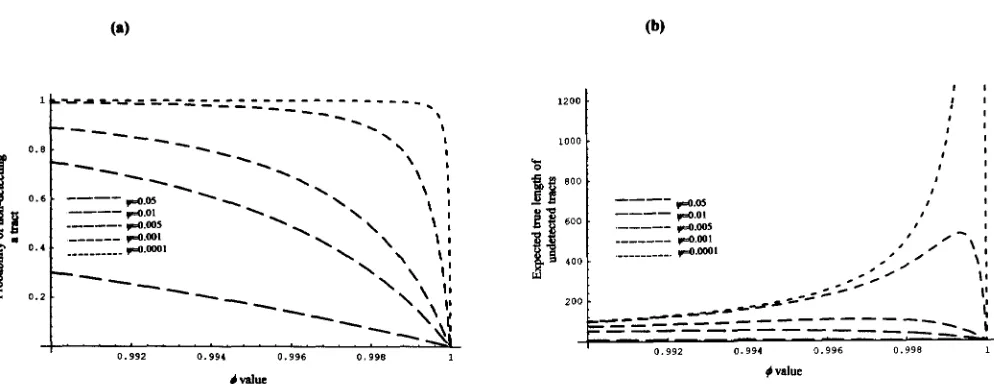
+ * ) 3Figure 5, a and b, plot expressions ( 9 ) and (10) for different values of
JI
and+.
It is remarkable that for a wide range of IC, and+
values the probabilities of unde-Gene Conversion in DNA Sequences 95
0.992 0.994 0.996 0.998 1
I I
I I
I I
I I
4 value
FIGURE 5.- ( a ) Probability of an undetected conversion event as a function of
4
and I). ( b ) Expected true length associated with unobserved events.most sequence data we are only able to detect a small fraction of all extant conversion events in the sample. The probability of detecting a conversion event will be high only for those conversion events occurring be- tween very divergent sequences (large @ values, @
>
0.05) and/ or between DNA regions with large ex- pected tract lengths (large
+
values,+
>
0.999). Let us assume that there exist 20 exchanged conversion tracts in the sampled sequences. If+
= 0.995 (an ex- pected true tract of 200 bp) , then we will observe 16.6 tracts (83% ) when @ = 0.05, but only an average of 0.5 tracts ( 3% ) for @ = 0.001. On the other hand, large tracts can pass undetected for small values of @ (Figure 5 b ) . In rp49 data set, @ and+
are 0.00847 and 0.9918, respectively. P ( L<
2 ) = 0.742, that is, 74% of conver- sion tracts occurred among both arrangements were undetected. The expected true length of undetected tracts estimated for this data set is 59.62.Gene conversion rate: If @,
4,
and the number of detected conversion tracts ( k ) have been estimated, we can also estimate the expected true number (observed plus hidden ) of conversion events between two any sub- populations in the sampled sequences, ( E ( k T ) , wherek,. is the random variable true number of conversion events exchanged), by the expression: E ( k,.) = k / P( L
2
2 )
.
The variance of k T , assuming a binomial distribu-tion for k , is
Var ( k,.)
- Var(k)
-
E ( k , . ) P ( L 22 )
[ l - P ( L 2 2 ) ] -P ( L 2 2)2
If each conversion event is assumed to be unique, then conversions can be seen as point mutation events, and
kT can be expressed as
E ( k , r ) = @E( T ) = H c E ( T ) , (11)
where
CP
= Hc and E ( T ) are, respectively, the flux ofconversion events per generation between different subpopulations for the analyzed region, and the ex- pected sum of the lengths of the branches of the geneal- ogy of the sample in generations (HUDSON 1990).
W
is the intersubpopulation heterozygosity, that is, the probability that the two alleles of an individual comes from any two subpopulations. c is the rate of gene con- version events per generation for the analyzed DNA sequence. The number of exchanged conversion events is assumed to be Poisson distributed through genera- tions with parameter
CJ
= He. IfCJ
varies slightly among generations (because H , e , or both vary), He can be substituted by2
c,
the average heterozygosity and aver- age conversion event rate per generation on the course of the history of the sample. Expression ( 11 ) can be used to estimate the parameter e . Let ct$ be the probabil- ity of a site being transferred per generation (the con- version rate per base pair per generation).
c and cy, are related according to the expression = cE( N )/
m. Note that while c refers to the rate of conversion events regardless of their tract lengths, cbP considers both the rate and the average length of conversion tracts, being therefore, the parameter measuring the potential re- combination effect of gene conversion. So, Hdqcbp is the per base pair proportion of new recombinant sites (converted) per generation (where dsi is the average number of nucleotide substitutions per site between subpopulations, NEI 1987, equation 10.20).96 E. Betran et al.
the sample, is equal to
2.78
-
IO’
generations (estimated from S I . / p, where S,, is the total number of segregating sites and is the mutation rate per DNA sequence per generation, from ROZAS and AGUADE’S data).
Substitut- ing this value in expression ( 11 ) we obtain a flux esti- mate of (i, = Hc = 6.98 * If we suppose that thecurrent value of heterozygosity H = 0.2054 (from
Ro-
ZAS et d . 1995) has remained approximately constant along the history of the sample, then the conversion rate per the sequenced region per generation would be equal to 2 = 3.40 * 10 -6 (here we are assuming that
the conversion rate remains unaltered in heterokaryo- types, CHOVNICK 1973). The estimate of the conversion rate per base pair per generation is t,,{> = ( 3.40
-
10 -”X 121.95/1518) = 2.73.10”.
DISCUSSION
The enhancing effect of gene conversion on the ex- tant haplotypic diversity depends on two main parame- ters: ( 1 ) the rate of gene conversion events per genera- tion and
( 2 )
the average length of a conversion tract. Our model allows estimation of both parameters for population DNA sequences granted we have subsets of differentiated sequences from which we can detect con- version tracts ( $>
0 ) . Different population processes and chromosomal mechanisms can generate divergent haplotypes within and between populations and, the model can, therefore, be applied to a broad data set. We distinguish between observed and true tract lengths. Observed lengths, if considered as true lengths, will considerably underestimate the true distribution, especially when the I) values are lower than 0.01, which is probably frequently the case. Because of the positive correlation between expected lengths and $ values, a spurious relationship (for example, that the true tract lengths are larger for more divergent sequences) could be inferred between these variables if observed lengths are not corrected.We show that many conversion events are undetected for a wide range of $ and
4
values. This result is in agreement with the theoretical works of HUDSON and KAPLAN (1985) and STEPHENS (1986), which show that conventional recombination events (single crossovers) are usually undetectable in homologous DNA se- quences. Consequently, there will be a tendency to de- tect only those conversion events occurring between very divergent haplotypes or those with a high value of4.
This explains why gene conversion is recognized when it occurs between paralogous sequences ( SLICHTOM et d . 1980), but often overlooked when occurring among homologous sequences. This bias, that can be corrected by the factor 1 / P ( S 2 2 ) fromexpression
2,
can result in an underestimation of the importance of gene conversion as a recombination factor.The parameter $ is a measure related with the extent
of differentiation among sequences from different sub- populations. Nevertheless, unlike other measures of ge- netic differentiation between populations (
d,q
or d,,; NEI 1987),ct/
takes into account both the pair base nucleotide differences within and between populations, and the direction of a conversion event (one popula- tion is donor and the other is receiver). NEI’S distance measures, for example, do not distinguish between do- nor and receiver populations. In addition, we introduce a criterion that considers the type of polymorphism at a site to decide whether or not a converted nucleotide is detectable. The criterion is, however, restrictive and can be modified depending on the amount of differen- tiation between subpopulations. So, when the value of E ( S) = $E( N ) (the expected number of informative sites included in a conversion tract) is >2, conditions ( 1 ) a n d ( 2 ) of our criterion given in APPENDIX A canbe relaxed.
Our estimators work if, and only if, each observed tract comes from one single conversion event. The older a conversion tract, the higher the probability of being part of a recurrent conversion event. Likewise, the higher the density of conversion tracts in a region, the higher the probability of recombination is in a pre- viously converted tract. If the per site probability of a converted site between subpopulations is lower than 0.05, then the probability of an informative site being involved in a recombination event more than once is negligible. Otherwise, the per site probability of a con- verted site being involved in a subsequent recombina- tion within a subpopulation is assumed to he of the same order of magnitude than between subpopulations. This assumption could not hold in inversions because of the suppression of crossover. However, at the molec- ular level, the probability of a crossover seems to be 20% that of a conversion event ( HILIJKER et nZ. 1991 ) ,
thereby inversions would not change significantly the probability of a subsequent recombination in a tract. Another implicit assumption in our model is that the observed tracts are a random sample of all new oc- curring tracts, which implies, for example, the absence of selective differences associated with tract lengths.
Gene Conversion in DNA Sequences 97
From ROZAS and AGUADE'S data it could be estimated that around 10 of the 19 (19 X P ( S
>
0 ) ) estimated conversion events result in the transfer of one or more different nucleotides between arrangements, thereby generating new haplotypes. The estimate of the conver- sion rate per base pair per generation ist[,,,
= 2.73-
10". This value is about two orders of magnitude higher than the estimated value of the mutation rate per base pair and per generation for this region, 2.16-lop9
( ROZAS and ACUADE 1994). Given that only 34 sequences were analyzed, this indicates that gene conversion is indeed a main factor generating intra- genic sequence diversity.We appreciate very much the helpful discussions a n d / o r com- ments of A. BERRY, M. A G U A D ~ , J. BRAVERMAN, A. RVIZ, W. SIEPHAN and two anonymous referees. This work has been supported by grants PB95-0607 and PB94-0923 awarded, respectively, to A. RLuz and M. A G C A I ) ~ by the DirecciBn General de la InvestigaciBn Ckntifica y
Tecnica, Spain. E.B. and A.N. have been supported by doctoral F.P.I. fellowships from the DGU (Generalitat de CdLIhlIIyd, Catalonia, Spain ) ,
LITERATURE CITED
BERRY, A,, and A. BAKRAI)II.IA, 1997 The generation ofgenetic diver- sity at the DNA level: gene conversion is a major factor, pp. in Gnrtics, Evolution and LSocirty (Dedicated to Richard Lewontin), ed- ited by R. SINGH and C. KRIMBAS. Chicago University Press, Chi- cago (in press).
CHAKRABORIY, R., and R. K. WE", 1988 Admixture as a tool for finding linked genes and detecting that difference from allelic association between loci. Proc. Natl. Acad. Sci. 8 5 9119-9123.
CHOVNICK, A., 1973 Gene conversion and transfer of genetic infor- mation within the inverted region of inversion heterozygotes. Genetics 75: 123-131.
ENG~:I.s, W. R., 1994 Analysis of conversion tract data with a geomet- ric tract length distribution. Appendix to HIILIKER et al. 1994. HAMMER, M. F., S. BLISS and I.. M. SILVER, 1991 Genetic exchange
across a paracentric inversion of the mouse t complex. Genetics 128: 799-812.
HIILIKER, A. J., H. C I m and A. CHOVNICK, 1991 The effect of DNA sequence polymorphisms on intragenic recombination in the
rosy locus of Drosophila mrlanogaster. Genetics 129: 779-781. HII.I.I~:R, A. J., G. HWLM, A. G. REAUME, M. GUY, S. H. CUKK et
al., 1994 Meiotic gene conversion tract length distribution within the rosy locus of Drorophila melanogastw. Genetics 137: 1019-1026.
HUDSON, R. R., 1987 Estimating the recombination parameter of a finite population model without selection. Genet. Res. 50: 245- 250.
HLIDSON, R. R., 1990 Gene genealogies and the coalescent process. Oxf. Surv. Evol. Biol. 9: 1-44.
HI~IXON, R. R., and N. L. K i \ P I A N , 1985 Statistical properties of the number of recombination events in the history of a sample of DNA sequences. Genetics 111: 147-164.
HUIXON, R. R., and N. L. K;ZPIAN, 1988 The coalescent process i n
models with selection and recombination. Genetics 120: 831- 840.
HU(;11ES, A. I.., M. K. HI'GHES and D. I. W.VIKINS, 1993 Contrasting roles of interallelic recombination at the H Z A A and HZA-B loci.
Genetics 133: 669-680.
ISITll, K., and B. CHARI.ESM.ORTH, 1977 Associations between allo- zyme loci and gene arrangements due to hitch-hiking effects of new inversions. Genet. Res. 30: 93-106.
Kl;.NDAI.I., M. G., and A. STLT:\w, 1973 The Aduunced Throly ofStatis- l k Charles Griffin & Co., London.
LESLIE, J. F., and W. B. W.xl-1, 1986 Some evolutionary conse- quences of the molecular recombination process. Trends Genet. 2: 288-291.
NEI, M., 1987 Molecular Evolutiona~ Genetics. Columbia University Press, New York.
P o ~ m r i : , A,, and W. W. ANDERSON, 1995 Evidence of gene conver- sion in the Amylase multigene family of Drosophila prrudoobscura.
Mol. Biol. Evol. 12: 564-572.
RILEY, M. A,, M. E. HAI.IAS and R. C. IXWONTIN, 1989 Nucleotide polymorphism at the xanthine dehydrogenase locus in Drosophila
psmdoobscura. Mol. Biol. Evol. 9: 56-69.
R o u s , J., and M. AGUADE, 1994 Gene conversion is involved in the transfer of genetic information between naturally occurring inversions of Drosophila. Proc. Natl. Arad. Sci. USA 91: 11517-
11521.
R o z ~ s , J , , and R. ROZAS, 1997 DnaSP version 2.0: a novel software package for extensive molecular population genetics analysis. Comput. Applic. Biosci. (in press,).
Rous, J., C;. SE(;ARRA, C. ZMATA, G. ALVAREL and M. AcumE, 1995 Nucleotide polymorphism at the rp4Y region ofDrosophila subobsc-
ura: lack of geographic subdivision within chromosomal arrange- ments in Europe. J. Evol. Biol. 8 : 355-367.
SAWYER, S., 1989 Statistical tests for detecting gene conversion. Mol.
Biol. Evol. 6: 526-538.
S I . K ; H I ~ M , J. I.., A. E. BIKHI. and 0. SMITHIES, 1980 Human fetal
''7- and "7-globin genes: complete nucleotide sequences suggest that DNA can be exchanged behveen these duplicated genes.
Ccll 21: v27-638.
STEPHENS, J. C., 1985 Statistical methods of DNA sequence analysis:
detection of'intragenic recombination or gene conversion. Mol.
Biol. Evol. 2: 539-556.
STEPlIENS,,J. C , 1986 On the frequency of undetectable recombina-
tion events. Genetics 112: 923-926.
W E I R , B. S . , 1990 Crnetic Data Analysis. Sinauer Associates, Sunder- land, MA.
Communicating editor: B. S. WEIR
APPENDIX A
Algorithms €or conversion tract detection and t,b esti- mation: We introduce first an operational criterion with two frequency-dependent conditions to decide if a given nucleotide variant in a particular site is informa- tive of a conversion event. Consider a conversion tract in a chromosome of subpopulation 2 (receiver) com- ing from a chromosome of subpopulation 1 ( d o n o r ) . Nucleotide variant i (at a particular site) is assumed to be informative of a conversion tract if the following conditions are met.
Condition 1: Its relative frequency in subpopulation
2 is 20% or less (the same applies when the subpopula- tion 1 is the receiver subpopulation). The reasoning for this condition is as follows: an observed tract is de- fined by at least two co-converted sites. An apparent tract with two co-converted sites can also be originated by two independent parallel mutations. Given two paral- lel mutations in subpopulation 2 , the probability that they appear on the same chromosome, according to our criterion and assuming independent association (linkage equilibrium) among sites within subpopula- tion 2, is P 5 0.2' = 0.04. This probability is less than the conventional signification level of 0.05 (of course, if the number of informative co-converted sites is >2, this probability will be much lower). This condition implies that five or more sequences must be determined for the receiver (converted) subpopulation.
Condition 2: The relative frequency of nucleotide
98 E. Betran et al.
times higher than in subpopulation 2 (receiver). Here we make the plain assumption that a transferred nucleo- tide is quite more frequent in the donor than in the receiver subpopulation. This condition implies that at least three sequences must be determined for the donor subpopulation. Following these conditions, we propose both an algorithm for tract detection and for the estima- tion of parameter
I,!J.
Algorithm fw tract detection: Detection of gene conver-
sion tracts from subpopulation 1 ( donor ) to subpopula- tion 2 (receiver). Let s1 and sz be the number of ana- lyzed sequences in subpopulation l and 2, respectively. Let I+ be the informative state of nucleotide variant i
( i = 1, 2, 3 or 4 corresponding to nucleotides A, T, C
or G ) at site
j
of the sequence k in subpopulation 2. There are two possible states at this site: informative when Itjk2 = 1, and noninformative, when &,k, = 0. I q k 2is defined by the above criterion as follows:
where xyl is the relative frequency of the nucleotide variant i present at site
j
in subpopulation 1. x@ is the relative frequency of nucleotide variant i at sitej
in subpopulation 2. A putative tract must not contain in-congruent nucleotides. We consider that a nucleotide
within a putative tract in population 2 is incongruent with an origin in population 1 when xill = 0 and xii2
>
0.2.
If the outermost informative nucleotide sites of a con- gruent tract are TI. (left) and TR (right), TR
>
T , ~ , then the observed tract length is simply the length spanned by these nucleotides: L = TR - TI.+
1.The detection of gene conversion tracts from subpop- ulation
2
(donor) to subpopulation 1 (receiver) fol- lows the same reasoning.ROZAS and AGUADE'S (1994) data were used to illus- trate the algorithm for detection. In the line Jll, for example, they found five informative nucleotide vari- ants ( G in site 48, C in site 62, G in site 64, G in site 68, and G in site 112) without incongruent variants among them (Figure 1 )
.
From these sites, a conversion tract was identified of 1 = 65 bp. In total, five different conversion tracts were detected with lengths 12,17,
39, 65 and 122 bp (Figure 1 ).
The average observed length of the five tracts being 51 bp.Algorithm for the estimation of $: To make the whole
model internally consistent, the algorithm for the esti- mation of If, must be in agreement with that of detecting a conversion tract. The probability that a site is informa- tive is the sum of the information of its constituent nucleotides. More specifically, I,!J~, the probability of de- tecting a conversion event at site
j ,
is defined as4,
=[
i
X Q I P ~ ~ + ~+
i
x:T2pii2+1 / 2 . ( ~ 2 )t= 1 i= 1
1
X i k is the relative frequency of the nucleotide variant i
present at site j in subpopulation k . For computing x:ik, each informative nucleotide within a detected tract is replaced by the most frequent nucleotide at that site in its respective subpopulation.
pv1+
is the probability of observing the transfer of nucleotide variant i , from subpopulation 1 to2,
at sitej ,
and takes the following values:X L k and x;k refers to the relative frequency of nucleotide
variant i before and after a hypothetical conversion tract including that variant i , respectively; that is, x$ = xL2
+
( 1 - / (number of sequences in population 2 ) .The probability of observing the transfer of the nucleo- tide variant i at site j from subpopulation 2 to 1,
pq2,,
,is defined in the same way.
The average value of
+
per site iswhere m is the total number of nucleotide sites com- pared.
As an example, the estimation of Jti (using Equation A2) at sites 48, 377, 442 and 694 of Figure 1 is =
1.000, 0.250, 0.156 and 0.000, respectively. The average value of
4
for the whole region (1518 bp) is, from Equation A4, 0.00847.Computer simulations: We have carried out different
computer simulations to check the robustness of the parameter
CC,
in different sequence configurations. The simulation steps were as follows:Step 1: Forty monomorphic sequences of DNA of 12,000 nucleotides each were generated (20 se- quences from each subpopulation )
.
Step 2: Nucleotide polymorphisms are thrown down at random in both subpopulations until the sequences have reached a predetermined value of $. We em- ployed two types of polymorphic sites: ( 1 ) sites fixed in both subpopulations but with different nucleotide variant in each subpopulation (as site 3 in Figure
2),
( 2 )
sites with two different nucleotides segregat- ing in a subpopulation (sites 8- 11 in Figure 2 ).
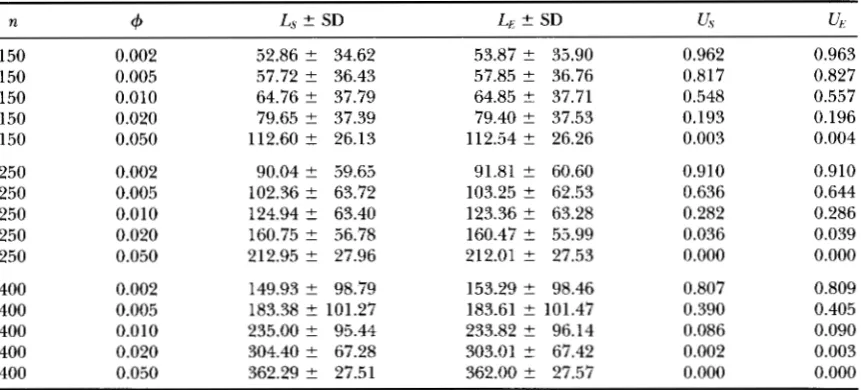
We performed simulations with different proportions of both types of polymorphic sites.Step 3: In any simulation ( 10,000 replicates with a fixed value of JI and a fixed proportion of polymorphic sites), a tract of fixed length is converted from one subpopulation to the other. For each replicate, we determined the observed gene conversion tract length. Finally, estimates were computed as the aver- age values of replicates.
Gene Conversion in DNA Sequences
TABLE A1
Results obtained in the computer simulations
99
150 0.002 52.86 ? 34.62 53.87 ? 35.90 0.962 0.963
150 0.005 57.72 ? 36.43 57.85 ? 36.76 0.817 0.827
150 0.010 64.76 t 37.79 64.85 ? 37.71 0.548 0.557
150 0.020 79.65 2 37.39 79.40 ? 37.53 0.193 0.196
150 0.050 112.60 t 26.13 112.54 ? 26.26 0.003 0.004
250 0.002 90.04 ? 59.65 91.81 ? 60.60 0.910 0.910
250 0.005 102.36 Ifr 63.72 103.25 t- 62.53 0.636 0.644
250 0.010 124.94 Ifr 63.40 123.36 ? 63.28 0.282 0.286
250 0.020 160.75 ? 56.78 160.47 2 55.99 0.036 0.039
250 0.050 212.95 ? 27.96 212.01 ? 27.53 0.000 0.000
400 0.002 149.93 ? 98.79 153.29 ? 98.46 0.807 0.809
400 0.005 183.38 2 101.27 183.61 ? 101.47 0.390 0.405
400 0.010 235.00 ? 95.44 233.82 t- 96.14 0.086 0.090
400 0.020 304.40 ? 67.28 303.01 ? 67.42 0.002 0.003
400 0.050 362.29 ? 27.51 362.00 ? 27.57 0.000 0.000
Only results based in simulations including a 50% of each type of polymorphic sites are shown. n, true gene conversion tract length; Ls, observed tract length in the simulations; 4 , expected tract length from equation (5); SD, standard deviation; Us, frequency of undetected tracts in simulations; U,, expected frequency of undetected tracts (from Equation 2).L
populations with respect to the different classes of poly- morphisms, the observed values of the tract lengths in the simulation are in good agreement with the expected theoretical ones (Equation 5 )
.
Table A1 summarizes some of our simulation results.APPENDIX B
Length
and
number of informative sites in a conver- sion tract: Our model only takes into account the infor- mation provided by the two outermost informative sites of a conversion tract. It does not consider the potential information of the number of informative sites s span- ning a tract. Instead of using P ( L* = l z ) for the ML estimation of4
(expression 8 ) , we could use P ( L* =1, and S* = s )
.
However, S* (the variable S redefined for S z 2 ) is a function dependent completely ont,b
(expression 1 ) , and therefore this variable is redun- dant when considering t,b, that is, it does not add any additional information for the estimation of
4,
the model purpose. Let us show it.The probability for L* = 1 and S* = s given that N
= nis
P ( L * = l a n d S* = S I N = n )
= P ( L * = ZIN= n a n d S* = s ) P ( S * = S I N = n ) .
The probability of the second factor is derived from expression ( 1 ) , and that of the first factor can be de- rived from STEPHENS ( 1985)
,
as follows:Note that STEPHEN'S d variable is 1 - 1 here.
Consider now k observed conversion events of lengths I,, 12,
. . .
,
lk, with a respective number of informative sites sI, s2,. . .
,
sk. For the likelihood estimation of4,
the likelihood function of an observed data set is given
by
k
L ( 4 )
=n
P ( L * = 1, and S* = s t ) . (B2)L= 1
This expression differs from that of Equation 8 by factor