Copyright1998 by the Genetics Society of America
Effects of Differential Selection in the Sexes on Cytonuclear Dynamics:
Life Stages With Sex Differences
Christina S. Babcock
1and Marjorie A. Asmussen
Department of Genetics, University of Georgia, Athens, Georgia 30602 Manuscript received August 23, 1997
Accepted for publication April 13, 1998
ABSTRACT
We extend our investigation of cytonuclear selection by determining when differential selection between the sexes will generate allele frequency changes or cytonuclear disequilibria in populations with constant viability selection and an adult census. We demonstrate analytically that there can be a cytonuclear hitchhiking effect upon a selectively neutral marker in either sex provided the other marker is selected in that sex and there is allelic disequilibrium between the loci in females. Cytonuclear disequilibria are generated de novo in both sexes when both loci affect fitness in females and there is a nonmultiplicative fitness interaction between them. Similar fitness interactions in males generate male disequilibria only. Through numerical analyses, we investigate the potential magnitude of such disequilibria, their qualitative dynamics, the expected frequency of detectable disequilibria under particular patterns or strengths of selection, and the possible disequilibrium sign patterns resulting from selection. These adult/viability results subsume those for populations with a gamete census and either constant fertility or viability selection. Although previous work suggests that the disequilibria generated by cytonuclear selection may be difficult to detect experimentally, this study shows that cytonuclear disequilibria at life stages with sex differences can be useful markers of the presence and strength of selection.
T
HE joint analysis of nuclear and cytoplasmic mark- fects of natural selection because of the growing experi-mental evidence of detectable selective interactions ers and the statistical associations (cytonucleardis-between the functionally interdependent nuclear and equilibria) between them are proving very useful for
cytoplasmic genomes (Edwardson 1970; Hiraizumi delineating evolutionary processes that may be
unde-1985; Clark and Lyckegaard 1988; MacRae and tectable through nuclear data alone. The many
applica-Anderson 1988; Fos et al. 1990; Hutter and Rand tions to date demonstrate how cytonuclear assays can
1995; Kilpatrick and Rand 1995; Saavedra et al. facilitate the detection and estimation of such key
fac-1996). Initial theoretical studies of the effects of selec-tors as nonrandom mating, admixture, gene flow,
popu-tion on joint cytonuclear genotypes focused on the con-lation subdivision, mutation, and genetic drift in diploid
ditions necessary to maintain joint, nuclear-cytoplasmic plant and animal populations (Lamband Avise1986;
polymorphisms (Watsonand Caspari 1960; Caspari Asmussenet al. 1987, 1989;Arnoldet al. 1988;
Asmus-et al. 1966; Clark 1984; Gregorius and Ross 1984; senandSchnabel1991;AsmussenandArnold1991;
RossandGregorius1985). They concluded that these Forbes and Allendorf 1991; Fu and Arnold 1991,
conditions were very restrictive because simple cyto-1992; Schnabel and Asmussen 1992; Cruzan and
nuclear selection models with random mating and con-Arnold1993, 1994;ScribnerandAvise1993, 1994a,b;
stant viabilities or fertilities cannot maintain cytoplasmic Abernethy1994;Dattaet al. 1996a,b;Siteset al. 1996;
variation (Clark 1984; Gregorius and Ross 1984). Aviseet al. 1997;HarrisonandBogdanowicz1997).
Indeed, these early studies identified only one set of In addition, some basic hybrid zone frameworks for
circumstances with the demonstrated potential to pre-using cytonuclear data from haplodiploids or X-linked
serve cytonuclear polymorphism under constant selec-markers in diploids to estimate assortative mating by
tion: asymmetrical fertility differences between the sexes the pure parental species and differential gene flow
in mixed-mating populations practicing a mixture of through a hybrid zone by direction or sex (Goodisman
selfing and random outcrossing (GregoriusandRoss andAsmussen1997;Goodismanet al. 1998) now exist.
1984). The proper interpretation of cytonuclear data also
Motivated by the need to explain recent experimental requires a better understanding of the cytonuclear
ef-reports of both dramatic dynamics and polymorphic equilibria for mtDNA frequencies (MacRaeand Ander-son 1988; Fos et al. 1990; Hutter and Rand 1995; Corresponding author: Marjorie A. Asmussen, Department of Genet- Kilpatrick
andRand1995), we (Babcockand Asmus-ics, Life Sciences Building, University of Georgia, Athens, GA
30602-sen1996) recently readdressed this issue. Our analysis 7223. E-mail: [email protected]
revealed that constant selection can generate both per-1Present address: Department of Biological Sciences, Humboldt State
University, 1 Harpst St., Arcata, CA 95521. manent cytonuclear polymorphisms and disequilibria
in random mating populations provided viability or fer-tility differences are sufficiently strong both within and between the sexes. In investigating the exact cytonuclear dynamics and disequilibria, which are model depen-dent, our previous study focused on the three mathe-matically equivalent models censused at life stages with-out frequency differences between the sexes. These include constant fertility selection with a zygote or adult census and constant viability selection with a zygote cen-sus, which we shall collectively refer to as the “zygote/ fertility models.”
As a first step toward understanding the expected allele frequency dynamics under joint cytonuclear
selec-tion, we derived the precise analytic conditions under Figure 1.—Six models of differential selection according
which selection will generate cytoplasmic frequency to life stage censused and selection component analyzed. Dou-ble-headed arrows connect mathematically equivalent selec-changes or a cytonuclear hitchhiking effect in these
tion models, while the single-headed arrow indicates that the systems. We also determined that relatively small, but
gamete models are a subset of the adult/viability model. Italics potentially detectable levels of cytonuclear disequilibria indicate the three models discussed in the text.
can be generated de novo in the zygote/fertility models if the cytoplasmic and nuclear loci each affect female
fitness and the two markers have a nonmultiplicative inheritance, and no genetic drift, mutation, or gene flow. In the following sections we provide a detailed fitness interaction in females (BabcockandAsmussen
1996). However, these disequilibria will usually be only analysis of differential, constant viability selection be-tween the sexes, with censusing at the adult stage. Later, weak markers of cytonuclear selection because they tend
to be of fairly short duration and exhibit the same tran- in the discussion, we indicate how the adult/viability results subsume those for the two gamete-census mod-sient sign patterns as those between two neutral markers.
In this article, we extend our analysis of constant cyto- els, with either differential viabilities or fertilities. Figure 1 provides a schematic summary of the relationships nuclear selection to the three remaining models in
which there are sex differences at the time of census. among the six models considered here and in our previ-ous study (BabcockandAsmussen1996).
These include viability selection with an adult or gamete
census and fertility selection with a gamete census. We Cytonuclear variables:As in our previous models, we assume the population has two alleles, A and a, at the primarily focus here on the “adult/viability model,”
be-cause it conveniently subsumes the two gamete-census diploid nuclear marker and two cytotypes, C and c, at the haploid cytoplasmic marker. The frequencies of the models, which are themselves mathematically
equiva-lent. These new models are much more complex than six possible joint cytonuclear genotypes in adult females are denoted in Table 1, with the column sums providing those considered in our original study because of the
need to separately monitor the dynamics within each the marginal frequencies of the three nuclear genotypes (Uf, Vf, Wf) and the row sums providing the marginal
sex, but they also promise to be of greater practical
importance, because now the life stage censused pro- frequencies of the two cytotypes (Xf, Yf). From these,
the marginal nuclear allele frequencies in females can vides a more direct reflection of the effects of
differen-tial selection. After first delimiting when cytonuclear be calculated as selection will generate sex-specific allele frequency
Pf5Uf11⁄
2Vf5freq(A)
changes or de novo disequilibria in an adult/viability
system, we provide detailed numerical investigations of and the magnitude, duration, and sign patterns of the
re-Qf5Wf1 1⁄
2Vf5freq(a)512Pf, (1)
sulting disequilibrium trajectories. We also explore
whether detectable disequilibria can be correlated with where for these and all other female variables freq de-notes the frequency in adult females. The joint and either particular patterns or the strength of selection.
marginal frequencies in adult males are analogous to those in Table 1 and (1), with each superscript f re-ANALYTIC STUDY
placed by m.
The remaining frequency variables are those within We want to determine the basic effects of constant
cytonuclear selection at life stages with frequency differ- the two gamete pools. Female gametes carry the four possible cytonuclear combinations, in the frequencies ences between the sexes. We assume a diploid, random
mating population with discrete, nonoverlapping gener- specified by Table 2. With only viability selection, the female gametic frequencies are simply the frequencies ations, an autosomal nuclear locus exhibiting
TABLE 1
Genotypic frequencies in adults
Nuclear genotype
Cytotype AA Aa aa Total
C Uf
15UfXf1D1f Vf15VfXf1Df2 Wf15WfXf1Df3 Xf
c Uf
25UfYf2D1f Vf25VfYf2Df2 Wf25WfYf2Df3 Yf
Total Uf Vf Wf 1.0
Frequencies are given for females. Male frequencies are analogous with each superscript f replaced by m.
and are calculated from the joint genotypic frequencies defined in each sex as freq (A/C) 2 freq(A)freq(C), which similarly measure the association between cyto-(Table 1) as
plasmic and nuclear alleles within adult females and
Pf
i 5Ufi 11⁄2Vi,f Qfi 5Wfi 1 1⁄2Vfi for i51, 2. males, respectively.
(2) The four disequilibria within each sex are related by
the formulas Because males only transmit the nuclear marker, the
male gamete pool is fully described by its nuclear allele
D *1 1D *2 1D *3 50, D *5 D *1 11⁄2D *2, (5)
frequencies, which in the absence of fertility and
ga-metic selection are the same as those in adult males where * is f for females and m for males. Although
(Pm, Qm). this reduces the number of independent disequilibrium
In the adult/viability model, eight disequilibrium sta- measures to two in each sex, we analyze all eight because tistics are needed to fully describe the departures of their joint sign patterns can be useful markers of selec-cytonuclear frequencies from expectations under ran- tion. The sex-specific genotypic frequencies and the dom associations, because disequilibria must be mea- female gametic frequencies can be parameterized in sured separately in the adults of each sex. Of these, six terms of the marginal frequencies and the disequilibria, are genotypic disequilibria, which measure nonrandom as shown in Tables 1 and 2, respectively.
associations between the two cytotypes and each of the Frequency recursion equations:The basic cytonuclear three nuclear genotypes within each sex. The three fe- recursions for the joint genotypic frequencies in adults male genotypic disequilibria are defined as are easily derived by tracing the changes through the two steps of the generation cycle. Each generation
be-Df
1 5Uf12UfXf5freq(AA/C )2 freq(AA) freq(C ) gins with adults in the frequencies shown in Table 1.
These individuals first mate at random, after which the
Df
2 5Vf12VfXf5freq(Aa/C ) 2freq(Aa) freq(C)
interim, zygote frequencies in both sexes are simply
Df
3 5Wf12WfXf5 freq(aa/C)2freq(aa) freq(C). products of the gamete frequencies described previously
(3) (Table 3). The generation cycle then concludes
follow-ing differential viability selection, for which the viabili-The male genotypic disequilibria are analogous to
ties of female and male genotypes are designated as in those in (3) with each f replaced by m and freq now the
Table 4, where the subscript refers to the cytonuclear frequency in adult males. There are also two measures of
genotype (with cells numbered across the rows) and the
allelic disequilibrium,
superscript refers to the sex. The recursions for the
Df5Uf
11 1⁄2Vf12 PfXf (4a) joint, genotypic frequencies in adult females are thus
Dm5Um
1 1 1⁄2Vm1 2PmXm, (4b) (Uf 1)9 5
φf 1Pf1Pm
φf , (U
f 2)9 5
φf 4Pf2Pm
φf
(Vf 1)9 5
φf
2(Pf1Qm1Qf1Pm)
φf , (V
f 2)9 5
φf
5(Pf2Qm1Qf2Pm) φf
(Wf 1)9 5
φf 3Qf1Qm
φf , (W
f 2)9 5
φf 6Qf2Qm
φf ,
TABLE 2
Female gametic frequencies
(6) Nuclear allele
where a prime (9) denotes a value in the next
genera-Cytotype A a Total
tion; the normalization factor
C Pf
15PfXf1Df Q1f 5QfXf2Df Xf
c Pf
25PfYf2Df Qf25QfYf 1Df Yf φf5φf1Pf1Pm1 φf2(Pf1Qm1Qf1Pm)1 φf3Qf1Qm
Total Pf Qf 1.0
1φf
TABLE 3
Genotypic frequencies in zygotes
Nuclear genotype
Cytotype AA Aa aa Total
C u15Pf1Pm v15Pf1Qm1Qf1Pm w15Qf1Qm x
c u25Pf2Pm v25Pf2Qm1Qf2Pm w25Qf2Qm y
Total u5PfPm v5PfQm1QfPm w5QfQm 1.0
is the mean viability in females; the nuclear frequencies sen 1996). For instance, there must be selective differences among females for there to be a change in the male gamete pool (Pm, Qm) are as defined in (1)
with f replaced by m; and the female gamete frequencies in adult female cytoplasmic frequencies, and although male selection cannot by itself cause a change in female (Pfi, Qfi) are as defined in (2). The corresponding
re-cursions for the marginal frequencies of the cytotypes frequencies it can affect the amount of change gener-ated by female selection through its effect on the nu-and the nuclear genotypes nu-and alleles in adult females
are given inappendix a. The frequency recursions and clear allele frequency in the male gamete pool, Pm. Furthermore, there are exactly two situations that will the mean viability for males have the same form as those
in (6–7) and (A1–A5) for females with eachφf
ireplaced result in a change in female cytoplasmic frequency: ei-ther the cytoplasmic gene must affect the female fitnesses byφm
i andφfbyφm.
The 12 basic equations in (6–7) and their male coun- directly in at least one nuclear background (φf
1?φf4or φf
2?φf5orφf3?φ6f), or the cytoplasmic gene must
hitch-terparts determine the dynamics of the full
adult/viabil-ity model, which has 10 independent variables, 5 in each hike on a nuclear gene whose alleles are nonrandomly associated with the cytoplasmic gene in females (Df ?
sex. However, substitution of the decompositions of the
female gametic frequencies shown in Table 2 reveals 0) and affect female fitness in at least one cytoplasmic background (either φf
1 5 φf2 5 φf3 fails or φf4 5 φf5 5φf6
the important point that the full cytonuclear dynamics
are, in fact, determined by the dynamics of just 4 key fails). The two key differences from the earlier zygote/ fertility models are that the female cytoplasmic changes variables: the nuclear allele frequencies in the two sexes
(Pf, Pm), the cytoplasmic frequency in females (Xf), and in adult/viability systems depend on the nuclear allele
frequencies rather than the nuclear genotypic frequen-the allelic disequilibrium in females (Df).
Cytoplasmic frequency changes:Since the dynamics cies, and cytoplasmic hitchhiking requires allelic dis-equilibrium in females, rather than overall genotypic differ between adult males and females, separate
analy-ses must be made for each sex. In the case of females, disequilibria, with a selected nuclear gene in females. The change in male cytoplasmic frequency after one the relations in Tables 1 and 2 show in conjunction
with the genotypic recursions in (6) that the change in generation of selection, directly parallels that for fe-males in (8) only if fe-males and fefe-males have the same cytoplasmic frequency after one generation of selection,
cytoplasmic frequencies in the previous generation (i.e.,
φfDXf5[(φf
12φf4)PfPm1(φf32φf6)QfQm]XfYf
Xf5Xm). Otherwise, the strict maternal inheritance of
1 (φf
2 2φf5)(PfQm1QfPm)XfYf the cytoplasmic gene makes the frequency change
in males a complicated convolution of the previous male 1 [(φf
12φf2)Pm1(φ2f 2φf3)Qm]YfDf
and female cytoplasmic frequencies. The reason for 1 [(φf
42φf5)Pm1(φ5f 2φf6)Qm]XfDf, (8) this complexity is that in the absence of male selection
(φm
1 5φm2 5 φm3 5φm4 5φm5 5 φm6), the male cytoplasmic
whereDXf5Xf92Xf, has many parallels to the
compos-frequency does not necessarily remain constant, but ite (non-sex-differentiated) cytoplasmic dynamics
un-instead takes on the cytoplasmic frequency in females der the zygote/fertility models (Babcockand
Asmus-of the previous generation (i.e., Xm95 Xf) paralleling
the behavior of selectively neutral X-linked genes. The change in male cytoplasmic frequency from one
TABLE 4
generation to the next is consequently best analyzed
Cytonuclear fitnesses
when decomposed into two distinct components
Nuclear genotype D
Xm5Xm92Xf1Xf2Xm (9)
Cytotype AA Aa aa
corresponding to the change caused by departure from
C φ*1 φ*2 φ*3
the neutral dynamic (Xm92 Xf) and the change caused
c φ*4 φ*5 φ*6
by sex differences in the previous generation (Xf2Xm).
with each φf
i replaced byφmi and φf byφm, but with the (φf15φf25φf3andφ4f5φf55φf6), the change per
genera-tion in the nuclear allele frequency in adult females is female cytoplasmic frequencies (Xf, Yf) and allelic
dis-equilibrium (Df) unchanged. With this formula in place,
the decomposition in (9) reveals that the adult male DPf5 1⁄
2(Pm2 Pf)1
(φf
1 2φf4)Df
2(φf
1Xf1φf4Yf)
. (11)
cytoplasmic frequency will change from one generation to the next provided (1) males and females have
differ-A change in the female frequency at a nuclear locus with ent cytoplasmic frequencies in the previous generation;
no selective effect in females can therefore be generated (2) the cytoplasmic gene is under direct selection in
either by (1) differences in male and female nuclear
males (i.e., φm
1 ? φm4 or φm2 ? φm5 or φm3 ? φm6); or (3) a
allele frequencies in the previous generation or (2) form of crisscross genetic hitchhiking occurs in which the
hitchhiking upon a cytoplasmic marker that is both un-cytoplasmic gene in males hitchhikes on a selected
der selection and in allelic disequilibrium with the nu-clear locus in males whose alleles are nonrandomly
asso-clear marker in females (φf
15φf25φf3?φf45φf55φf6and
ciated with the cytoplasmic gene in females. In addition,
Df? 0). Selection on the nuclear locus in males can
because of the distinctive neutral dynamics prescribed by
contribute to a change in Pfindirectly through its effect
maternal inheritance, the cytoplasmic frequency changes
upon Pm. For a selectively neutral nuclear marker in
in males caused by frequency differences in the sexes
males (φm
1 5 φm2 5 φm3 and φm4 5 φm5 5 φm6), the
per-can be generated by cytoplasmic frequency changes (and
generation change in the nuclear allele frequency in selection) in the previous generation of females, through
adult males is equivalent to the female formula in (11) either direct selection on the cytoplasmic gene in
fe-with Pfand Pminterchanged and each φf
i replaced by males or genetic hitchhiking upon a selected nuclear
φm
i . Thus, similar to what was found for cytoplasmic gene in females that is in allelic disequilibrium with the
markers, a male frequency change at a neutral nuclear cytoplasmic gene in females.
locus in males will be generated by either prior fre-Nuclear allele frequency changes:Since the nuclear
quency differences in the two sexes or crisscross hitchhik-marker is inherited biparentally, the change in the
nu-ing upon a cytoplasmic marker that is under direct
selec-clear allele frequencies after one generation of selection
tion in males and in allelic disequilibrium with the has the same basic form in adult females and males,
nuclear marker in females.
Disequilibrium dynamics:The female disequilibrium
φ*DP *5(φ*1Xf1φ*4Yf)PfPmQ *2(φ*3Xf1φ*6Yf) QfQmP *
dynamics are obtained by substituting the recursions
11⁄
2(φ*2Xf1φ*5Yf)(PfQm1QfPm)(Q*2P *) for the joint genotypic frequencies from (6–7) and the
marginal genotypic and allele frequencies from (A1–A5)
1[(φ*1 2φ*4)PmQ *1(φ*3 2φ*6)QmP *]Df
into the disequilibrium definitions in (3) and (4). The
11⁄
2(φ*2 2φ*5)(Qm2Pm)(Q*2P *)Df, (10)
resulting equations are quite cumbersome, and here we present only the portions that are relevant to the with * representing f for Pfin females and * representing
generation of disequilibria de novo (i.e., starting with no m for Pmin males. The nuclear allele frequency
dynam-disequilibria in either sex), ics thus depend in both sexes upon the cytoplasmic
frequency and allelic disequilibrium in females (Xfand
(φf)2(Df
1)9 5(φf1φf62φf3φ4f)PfPmQfQmXfYf Df) as well as upon the nuclear allele frequencies in
1(φf
1φf52φf2φf4)(PfQm1QfPm) PfPmXfYf
both females and males (Pfand Pm).
Furthermore, as for the male cytoplasmic frequency, 1
. . ., (12a)
changes can be generated in the nuclear allele
frequen-cies from one generation to the next simply by fre- (φf)2(Df
2)9 5(φf2φf42φf1φ5f)(PfQm1QfPm)PfPmXfYf
quency differences in the sexes within the previous
gen-1(φf
2φf62φf3φf5)(PfQm1QfPm) QfQmXfYf
eration. This is because in the absence of selection,
Pf9 5 Pm9 5 1⁄
2(Pf 1 Pm), which shows that DPf 5 1. . ., (12b)
2DPm 51⁄
2(Pm2Pf) will be nonzero whenever Pm?
(φf)2(Df
3)9 5(φf3φf42 φf1φf6)PfPmQfQmXfYf Pf. Paralleling (9), the change in the presence of
selec-tion in one or both sexes can be decomposed into the 1 (φf
3φf52φf2φf6)(PfQm1QfPm) QfQmXfYf
change caused by departure from the neutral dynamic
1. . ., (12c)
[e.g., Pf92 1⁄
2(Pf 1 Pm) for females] and the change
caused by frequency differences between males and
fe-(φf)2(Df)9 51⁄
2(φf1φf52φf2φf4)(PfQm1QfPm)PfPmXfYf
males in the previous generation [e.g.,1⁄
2(Pm2Pf) for
11⁄
2(φf2φf62φf3φf5)(PfQm1QfPm) QfQmXfYf
females]. However, since the first component is still
diffi-cult to interpret in the general case, we will focus as in 1 (φf1φf
62φf3φf4)PfPmQfQmXfYf1. . .,
Babcock andAsmussen(1996) on the important
spe-(12d) cial case giving the conditions for a reverse hitchhiking
effect from a selected cytoplasmic locus in either sex. where the other terms are of the form Df( )1(Df)2( ).
ficients for Dfand (Df)2, are given inappendix b. The strengths of selection, and determine the possible sign
patterns of disequilibria in adult males and females male disequilibrium recursions have the same form as
those in (12) with eachφf
i replaced byφmi andφfbyφm, caused by viability selection. Following the same basic approach developed in our previous study (Babcock but all variables unchanged.
These equations are much more complex than the andAsmussen1996), we have investigated these issues in computer simulations based on random fitnesses and composite, non-sex-differentiated disequilibrium
recur-sions for the zygote/fertility models of differential selec- initial conditions, with particular emphasis on the four basic selection regimes:
tion censused at life stages without sex differences ( Bab-cockandAsmussen1996). However, as in the previous
1. Differential selection between sexes: All 12 fitnesses are models, it is evident that disequilibria in females can
independently generated by a random number be generated de novo only if the cytoplasmic and nuclear
generator with a uniform distribution on [0, 1]. loci each affect female fitness with a nonmultiplicative
It is important to note that our subsequent use of component between the two markers, such that at least
the phrase “differential selection between sexes” two of the following conditions hold in females:
always implies there is selection both within and between sexes.
φf
1φf6? φf3φ4f or φf1φf5?φf2φf4 or φf2φf6?φf3φf5 (13)
2. Equal selection between sexes: All 6 female fitnesses Two points should be noted regarding this result. First,
are randomly generated from [0, 1], and each although each of these three inequalities will generate
male fitness is set equal to the corresponding fe-female disequilibria, at least two must hold because
male parameter. equality in any two of the combinations will ensure
3. Female selection only: Female fitnesses are generated equality in all three. Second, while allelic disequilibria
randomly from [0, 1], while all male fitnesses are can be generated by any of the three fitness interactions
assigned a value of 1.0. in (13), a given genotypic disequilibrium is generated
4. Male selection only: Male fitnesses are generated
ran-de novo by either of the two involving the associated
domly from [0, 1], while all female fitnesses are nuclear genotype. For example, nonrandom associations
assigned a value of 1.0. between the cytotypes and the AA nuclear genotype
(Df
1) can be generated by the first two interactions, which We again consider disequilibria to be measurable if
they are greater than 0.01 in magnitude, which is a are the two involving AA individuals. Fitness differences
in males cannot generate female disequilibria de novo, typical minimum at which cytonuclear associations are detectable at a 0.05 significance level with reasonable but may affect the amount of disequilibrium generated
by selection in females through their influence on the marginal frequencies and sample sizes (Asmussenand Basten 1994; Basten and Asmussen 1997). The dis-nuclear frequency in the male gamete pool (Pm).
Although disequilibria in males do not contribute in equilibrium trajectories are classified as follows: (i) none, disequilibria were never measurable in any generation any way to the next generation, male disequilibria can
be generated de novo by nonmultiplicative cytonuclear of their trajectory (always ,0.01 in magnitude); (ii)
transient, disequilibria were measurable at some point
fitness interactions in males analogous to those in (13),
in the same way that such female fitness interactions along their trajectory, but were no longer so at equilib-rium; or (iii) permanent, disequilibria were measurable generate female disequilibria. Moreover, just as male
selection can modify female disequilibria, selective dif- at equilibrium. It should also be emphasized that the results below are all based on simulations with no initial ferences in females can affect the amount of
disequilib-ria generated in males through their influence on Pf, cytonuclear associations and are thus caused by
selec-tion alone with no confounding effects from preexisting
Xf, and Df. Female selection has by far the stronger
impact, however, since selective differences in females associations in the population. The statistics reported are averages across three replicate runs, each consisting can even generate male disequilibria de novo by
generat-ing allelic disequilibria in females (Df) although it will of 100,000 sets of random parameters/initial
condi-tions. In all cases, variance between runs was negligible. take two generations to see male disequilibria that are
produced solely in this manner. A more detailed description of our methods can be found in BabcockandAsmussen(1996).
Initial generation of disequilibria:In censuses without NUMERICAL STUDY
sex differences (BabcockandAsmussen1996) the aver-age magnitudes of disequilibria produced de novo by a The primary goal of this study is to determine if
mea-surable cytonuclear disequilibria detected in an adult single generation of selection are the same for each of the three basic selection regimes with selection in fe-census of natural populations can be attributed to
viabil-ity selection. Here we quantify the potential magnitude males (differential selection between sexes, equal selec-tion between sexes, and female selecselec-tion only), which of disequilibria, qualitatively describe the
disequilib-rium dynamics, investigate the likelihood of producing are the only ones capable of generating disequilibria
de novo in those systems. Here, in censuses with sex
Figure 2.—A comparison of the average magnitudes of
cytonuclear disequilibria generated de novo by a single genera-tion of random differential selecgenera-tion between the sexes under the adult/viability vs. zygote/fertility models. For adults, values are for females; similar results were found for males.
differences, we have already seen analytically that all four basic selection regimes are capable of generating disequilibria de novo in at least one sex: differential or equal selection between sexes can immediately generate both male and female disequilibria, while in one genera-tion selecgenera-tion only in females or males produces disequi-libria only in the sex with selective differences.
In our simulations, the average magnitudes of adult/ viability disequilibria produced by one generation of
selection are virtually the same in all cases and are much Figure3.—A comparison of the distributions of normalized
higher than those generated in the zygote/fertility mod- cytonuclear disequilibria generated de novo by a single genera-tion of random differential selecgenera-tion between the sexes under els. As shown in Figure 2, there is a fourfold difference
the adult/viability model (top) versus the zygote/fertility mod-between the models in the average initial magnitudes
els (bottom). For adults, values are for females; similar results of the heterozygote disequilibrium (0.038 vs. 0.009) and
were found for males. Disequilibria are normalized according roughly a twofold difference for the homozygote and to their maximum possible magnitudes as described by
Asmus-allelic disequilibria (0.021–0.026 vs. 0.012). Interest- senandBasten(1996).
ingly, the heterozygote association is, on average, the greatest disequilibrium under the adult/viability model,
whereas it is the smallest, on average, under the zygote/ generation and requires two generations of selection. A simulation testing the strength of this indirect effect fertility models of differential selection (Babcockand
Asmussen 1996). A comparison of the distributions of reveals that the average initial magnitudes of male dis-equilibria produced by two generations of selection in normalized disequilibria after one generation of
selec-tion (Figure 3) further indicates that differential selec- females are substantially less than those in Figure 2 after one generation of direct selection (0.005 vs. 0.038 for tion generates disequilibria near their maximum
possi-ble magnitude much more frequently in the adult/ the heterozygote disequilibrium and 0.011 vs. 0.021– 0.026 for the other disequilibria). Moreover, the average viability model. Consequently, our initial results suggest
that surveys of natural populations are much more likely magnitudes of female disequilibria increase in the meantime (between the first and second generation), to detect measurable disequilibria generated by
selec-tion if the populaselec-tion is censused at a life stage at which because of the additional round of female selection such that there is a sevenfold difference in the heterozygote males and females may have different cytonuclear
fre-quencies. disequilibrium measures and a threefold difference in
the other disequilibrium measures between males and Another noteworthy result regarding the initial
dis-equilibria arises when there are selective differences in females in the second generation. The upshot is thus that measurable disequilibria can be produced in males only one of the sexes. We already know analytically that
male selection can never by itself generate disequilibria by an indirect, time-delayed effect of selection in fe-males, but these appear to be substantially less than in females, while female selection can generate
differential selection, the average generation past which female disequilibria are no longer measurable is virtually the same as that for the composite, non-sex-differentiated associations in the earlier models (13 generations), al-though the female, adult/viability disequilibria are on average measurable for a few more generations (11 vs. 9 generations). In contrast, the male disequilibria are lost about 1 generation sooner than the others (12 vs. 13 generations) and are measurable for the same average number of generations as the zygote/fertility associa-tions (and thus for almost 2 generaassocia-tions less than those in females). For both sexes, however, the ratio between the average number of measurable generations and the average generation lost is high, suggesting that, as in
Figure 4.—The frequency of generating measurable
tran-the previous models, most transient disequilibria peak sient or permanent (inset) cytonuclear disequilibria by
ran-quickly in magnitude and then rapidly decay to zero, dom differential selection between the sexes under the adult/
rather than have more complex trajectories. viability model (females only) versus the zygote/fertility
mod-els. Male values are similar for permanent associations, but Sex-specific cytonuclear effects:The greatest sex-spe-5–7% higher for transient disequilibria. cific effects of cytonuclear selection are seen by a qualita-tive comparison of the frequency of generating measur-able transient or permanent disequilibria in females presumably because of the diminution by the interven- and males under the four basic selection regimes of the ing round of random mating. adult/viability model. In each case, these distinctions Disequilibrium dynamics under differential selection: are based on the theoretical results of our simulations; Moving on to the full disequilibrium trajectories, we the ability to detect these sex differences experimentally find qualitatively similar results to those for the initial will of course depend upon the magnitude of the differ-disequilibria. We see from Figure 4, for instance, that ence and the sample size employed. One interesting under random differential selection between the sexes, discovery is that, although male disequilibria tend to
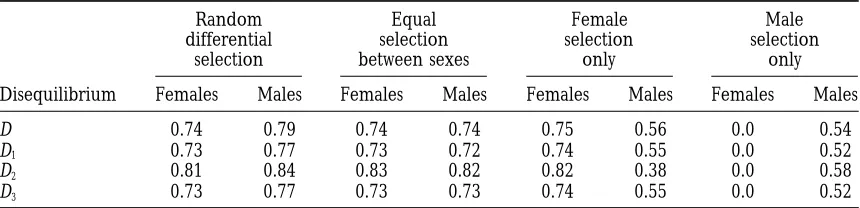
measurable transient and permanent disequilibria are dissipate sooner (Table 5), random differential
selec-both more likely to be found under the adult/viability tion seems to generate measurable transient associa-model than the zygote/fertility associa-models. On average, tions slightly more often in males (3–5%) than in fe-measurable transient disequilibria are generated in both males (Table 6). However, on average, the maximum sexes by 73–84% of random fitnesses and initial condi- magnitude of disequilibria attained along a trajectory tions under the adult/viability model vs. only 50–58% is virtually the same in both sexes when averaged across of the time in the non-sex-differentiated life stages of all trajectories that converge to equilibrium, whether the zygote/fertility models. There is a similar increase or not measurable disequilibria are produced (Table in the overall production of measurable permanent dis- 7). Sex differences are also absent when selection is the equilibria under the adult/viability model (1.5–2.1% vs. same in males and females, which produces measurable 1.2–1.5%); however, permanent disequilibria are still transient associations at roughly the same rate (72–83% rare and, as in the zygote/fertility models, account for of the time) and with the same average maximum mag-onlyz2.5% of all measurable trajectories under random nitude (0.03–0.05) in both sexes.
differential selection. This low incidence of permanent The most striking sex-specific effects are found when associations is expected, since the opportunity for per- there is selection in only one sex. Selection only in manent disequilibria is dependent upon the opportu- females is evidently as effective in generating measur-nity for permanent joint cytonuclear polymorphism, able transient associations in females as the two basic which is low (2.6%) and does not differ between models regimes with selection in both sexes (74–82% of the (Babcock andAsmussen 1996). In addition, the two time), but is considerably less successful at generating classes of models differ in the frequency of trajectories measurable male disequilibria (38–56% of the time). with measurable heterozygote vs. homozygote/allelic The maximum magnitudes of the disequilibria gener-disequilibria in the same way that their initial, de novo ated along a trajectory by female selection show a similar disequilibria vary: under the zygote/fertility models the difference; on average, the homozygote and allelic dis-heterozygote disequilibrium is measurable slightly less equilibria in females exceed those in males by a factor often than the others, but is the most likely association of two, and the heterozygote disequilibrium differs by to be measurable under the adult/viability model. a factor of four (Table 7).
TABLE 5
Duration of transient disequilibria under random differential selection
Average Average
generation measurable
Model losta generationsa Ratiob
Zygote/fertility 13.3 8.7 0.65
Adult/viability, females 13.1 10.9 0.83
Adult/viability, males 11.7 9.4 0.80
aResults are averaged over all four disequilibrium measures.
bRatio is computed as the average number of measurable generations/the average generation lost.
at generating measurable male disequilibria (Table 6), However, unexpectedly, and in strong contrast to the previous models, permanent disequilibria can be pro-despite the higher average maximum magnitudes for
male disequilibria under male selection (Table 7). The duced in adult/viability systems by male selection only, for which a sizable fraction of the disequilibria produced one anomaly is the male heterozygote disequilibrium,
which is generated least often and with the smallest among males (17–22%) is permanent. In this case cyto-nuclear polymorphism is maintained in males for 33.3% maximum magnitude by selection in females alone. The
unusually low incidence of male heterozygote disequi- of random male fitnesses and initial conditions, because with no selection in females the cytotype frequency does libria under selection only in females is also the one
exception to the trend of finding heterozygote disequi- not change in zygotes, and, thus, joint cytonuclear poly-morphism is preserved at all life stages whenever selec-libria generated more often than the others in the
adult/viability model. This anomaly may be a useful tion maintains nuclear variation (overdominance in males). Because of the higher incidence of permanent, indicator of the form of cytonuclear selection present
when analyzing the disequilibria found in natural popu- joint cytonuclear polymorphism, there is an increased opportunity for permanent disequilibria to be gener-lations.
Further contrasts are found in the frequency with ated in males. Interestingly, this opportunity is not real-ized in the life stages without sex differences, for using which the four basic forms of adult/viability selection
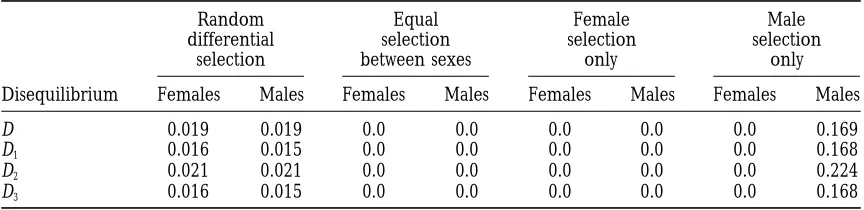
generate measurable permanent disequilibria (Table 8). the recursions inBabcockandAsmussen(1996) it can be shown analytically that without selection in females On average, permanent disequilibria are produced in
nearly equal frequencies in the two sexes, and at rates the non-sex-differentiated disequilibria always rapidly decay to 0, led by the allelic disequilibrium, which decays comparable to those in the zygote/fertility models, if
there is differential selection both within and between at the constant geometric rate of1⁄
2per generation
ex-pected for two neutral markers. each sex (the only regime that produces permanent
associations in the zygote/fertility models). Permanent Special cases of selection:We have also analyzed 10 special cases of selection to determine if there are partic-disequilibria are never found in any of the models if
selection is equal in the two sexes or present only in ular patterns of selection that have an increased likeli-hood of generating permanent disequilibria. These in-females, since these forms of selection cannot maintain
a cytonuclear polymorphism at any life stage (Babcock clude the nine special selective regimes considered and described inBabcockandAsmussen(1996), together andAsmussen 1996).
TABLE 6
Frequency of generating measurable (magnitude.0.01) transient disequilibria in adults under four modes of viability selection
Random Equal Female Male
differential selection selection selection
selection between sexes only only
Disequilibrium Females Males Females Males Females Males Females Males
D 0.74 0.79 0.74 0.74 0.75 0.56 0.0 0.54
D1 0.73 0.77 0.73 0.72 0.74 0.55 0.0 0.52
D2 0.81 0.84 0.83 0.82 0.82 0.38 0.0 0.58
TABLE 7
Average maximum magnitude of disequilibria generated along a trajectory by four modes of viability selection
Random Equal Female Male
differential selection selection selection
selection between sexes only only
Disequilibrium Females Males Females Males Females Males Females Males
D 0.036 0.033 0.032 0.032 0.034 0.017 0.0 0.025
D1 0.041 0.039 0.037 0.037 0.039 0.017 0.0 0.031
D2 0.050 0.051 0.047 0.047 0.047 0.011 0.0 0.043
D3 0.041 0.039 0.037 0.037 0.039 0.017 0.0 0.031
with random reverse overdominance, in which fitnesses are surable transient or permanent disequilibria is low to negligible under very weak selection (a 5 0.9), and generated randomly from [0, 1] and then reassigned as
necessary so that opposite heterozygotes in females and steadily increases as the potential selective differences increase to their maximal levels (a 5 0). However, as males are overdominant (e.g.,φf
2. φf1,φf3andφm5 . φm4,
might be expected from the other contrasts between
φm
6 in Table 4).
the models, it takes much weaker selection to generate The results in Table 9 suggest that the 10 special
measurable disequilibria in the adult/viability model. forms of selection generate permanent disequilibria at
For instance, the incidence of measurable transient dis-roughly the same frequencies in the two sexes and at
equilibria in the adult/viability model is over twice that roughly the same frequencies as the zygote/fertility
in the zygote/fertility models when fitnesses are drawn models. The one slight exception is reverse cytoplasmic
from [0.5, 1] and over four times higher when fitnesses
selection (for which the fitnesses in cytotype C of females
are drawn from [0.7, 1]. The results in Table 10 also are the fitnesses in cytotype c of males and vice versa),
suggest that the relative ease of generating male vs. which generates measurable permanent associations in
female disequilibria depends on the strength of selec-males at only about 80% the rate for feselec-males. None of
tion. Although measurable disequilibria are usually the tested selection patterns is very likely to produce
more common in females, interestingly, males have a permanent disequilibria, although random reverse
over-higher incidence of measurable transient associations
dominance/underdominance (in which opposite cytotypes
than females when selection is strong. in females and males are overdominant, and the
com-Sign patterns of disequilibria:The interrelationships plementary cytotypes are underdominant) has the
high-among the disequilibria in (5) allow eight possible sign est potential for permanent disequilibria in both types
patterns among the four disequilibria within each sex, of models (4–8%) along with the highest frequency of
in terms of which are positive or negative. In our previ-permanent cytonuclear polymorphism (8.5%).
ous study (BabcockandAsmussen 1996), we demon-Strength of selection: A certain minimal strength of
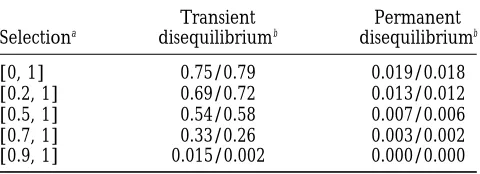
strated analytically that the sign patterns produced by selection is necessary to generate measurable cytonuclear
the zygote/fertility models are not useful markers of disequilibria in the adult/viability model, just as it is in
cytonuclear selection because they always exhibit one the zygote/fertility models (Table 10). For both types of
of the four sign patterns found between two selectively models, when genotypic viabilities are chosen at random
from intervals of the form [a, 1], the likelihood of mea- neutral markers: in every generation the allelic and AA
TABLE 8
Frequency of generating measurable (magnitude.0.01) permanent disequilibria in adults under four forms of viability selection
Random Equal Female Male
differential selection selection selection
selection between sexes only only
Disequilibrium Females Males Females Males Females Males Females Males
D 0.019 0.019 0.0 0.0 0.0 0.0 0.0 0.169
D1 0.016 0.015 0.0 0.0 0.0 0.0 0.0 0.168
D2 0.021 0.021 0.0 0.0 0.0 0.0 0.0 0.224
TABLE 9
Frequency of permanent disequilibria in adults under different patterns of viability selection
Disequilibria in females Disequilibria in males
Selection regime Df Df
1 Df2 Df3 Dm Dm1 Dm2 Dm3
Random differential selection 0.020 0.016 0.021 0.017 0.020 0.016 0.023 0.016
Hybrid inviability selection 0.0 0.0 0.0 0.0 0.0 0.0 0.0 0.0
Reverse hybrid inviability 0.056 0.053 0.050 0.053 0.050 0.040 0.051 0.041
Reverse cytonuclear selection 0.011 0.0070 0.013 0.0070 0.0094 0.0099 0.013 0.0095
Reverse cytoplasmic selection 0.057 0.049 0.055 0.049 0.040 0.038 0.049 0.037
Reverse directional selection 0.0071 0.0049 0.0071 0.0056 0.0076 0.0052 0.0093 0.0068 Reverse directional/overdominance 0.046 0.025 0.053 0.037 0.040 0.025 0.053 0.042 Hybrid superiority/overdominance 0.015 0.016 0.0016 0.015 0.013 0.012 0.012 0.013
Reverse overdominance 0.043 0.031 0.046 0.032 0.036 0.028 0.044 0.028
Random reverse overdominance 0.038 0.028 0.040 0.030 0.032 0.026 0.038 0.024
Random reverse over-/underdominance 0.076 0.063 0.083 0.044 0.062 0.064 0.079 0.047
genotypic disequilibria (D and D1) will have the same terns each occur just 16–17% of the time, and over 34%
of the time one of the other four possible sign patterns sign, and the aa genotypic disequilibrium (D3) will have
the opposite, with the sign of the heterozygote disequi- (patterns 5–8) is observed, with frequencies of 8–9% each. In these new, nonneutral patterns either the sign librium (D2) either the same as or opposite that of D,
depending on whether the nuclear gene frequency in of the heterozygote disequilibrium (D2) is different than
the other three (patterns 5 and 8) or the heterozygote the male gamete pool is less or greater than1⁄
2.
In contrast, the complexity of the cytonuclear disequi- and allelic disequilibria (D2 and D) have one sign, and
the two homozygote disequilibria (D1and D3) have the
librium recursions in (12) suggests there may be an
opportunity in the adult/viability model for distinctive opposite sign (patterns 6 and 7).
We also investigated the frequency of sign patterns sign patterns to be indicative of selection. We have
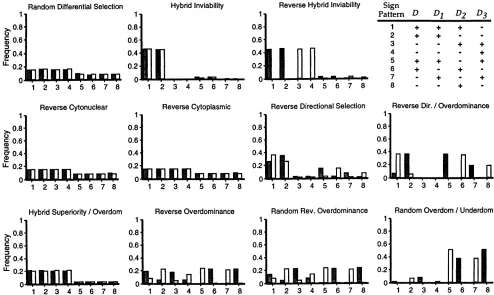
inves-tigated this possibility by using computer simulations to produced by one generation of each of the 10 special cases of viability selection considered above (Figure 5). compute the frequency with which one generation of
random differential selection produces each of the eight It is evident that some special forms of selection are more likely than others to produce distinctive sign pat-permissible disequilibrium sign patterns within adults
of each sex. The results are presented in Table 11 along terns of disequilibria. For example, random
overdomi-nance/underdominance almost always results in one of the
with the frequency distribution under the
zygote/fertil-ity model. As proven analytically, the zygote/fertilzygote/fertil-ity four nonneutral sign patterns, and thus its disequilibria are especially valuable markers of nonneutrality or other disequilibria always have one of the four sign patterns
(patterns 1–4) expected under selective neutrality (As- deviations from Hardy-Weinberg conditions. The re-verse is true of the disequilibria produced by hybrid supe-mussen et al. 1987), and these each occur with equal
frequency (25%). However, in the sex-specific disequi- riority/overdominance (all nuclear heterozygotes have a
fitness of 1), which almost always have one of the four libria of the adult/viability model, the four neutral
pat-neutral sign patterns, and thus their patterns are not informative. Reverse hybrid inviability selection (in which
TABLE 10 different complementary homozygous genotypes are
most fit in the two sexes) also only rarely generates a
Frequency of generating measurable (magnitude.0.01)
nonneutral pattern within either sex; however, under
transient and permanent disequilibria in adults under
different strengths of viability selection this selection scheme the female disequilibria almost always have sign pattern 1 or 2 (in which the allelic and Transient Permanent AA homozygote disequilibria are positive and the aa Selectiona disequilibriumb disequilibriumb
homozygote disequilibrium negative), while the male disequilibria almost always have one of the two
comple-[0, 1] 0.75/0.79 0.019/0.018
mentary sign patterns. Such an asymmetry between the
[0.2, 1] 0.69/0.72 0.013/0.012
[0.5, 1] 0.54/0.58 0.007/0.006 sexes is not consistent with strictly neutral, Hardy-Wein-[0.7, 1] 0.33/0.26 0.003/0.002 berg conditions. Taken together, our results thus sug-[0.9, 1] 0.015/0.002 0.000/0.000 gest that a joint analysis and comparison of the observed disequilibrium sign patterns within each sex may be a aRange from which random fitnesses are drawn.
TABLE 11
Frequency of disequilibrium sign patterns following one generation of random differential selection
Disequilibrium Model
Pattern D D1 D2 D3 Zygote/fertility Adult/viabilitya
1 1 1 1 2 0.250 0.163/0.163
2 1 1 2 2 0.250 0.167/0.166
3 2 2 1 1 0.251 0.162/0.160
4 2 2 2 1 0.249 0.161/0.166
5 1 1 2 1 0.0 0.093/0.086
6 1 2 1 2 0.0 0.079/0.084
7 2 1 2 1 0.0 0.089/0.087
8 2 2 1 2 0.0 0.084/0.088
aResults are for disequilibria in females followed by disequilibria in males.
presence and form of viability selection on cytonuclear ulations (MacRaeandAnderson1988;Foset al. 1990; HutterandRand1995;KilpatrickandRand 1995) genotypes.
and to determine the extent to which distinctive pat-terns of cytonuclear disequilibria that could be used DISCUSSION
as markers of selection in natural and experimental populations are produced.
This study represents the second step in an ongoing
theoretical investigation of the major effects of selection In our first study (BabcockandAsmussen1996), we developed six models of constant, differential selection in cytonuclear systems. Two long-term goals are to
deter-mine what forms of joint cytonuclear or hitchhiking on cytonuclear genotypes and provided a detailed analy-sis of the three mathematically identical models for selection could account for the striking, polymorphic
mitochondrial dynamics observed in experimental pop- which there are no sex differences at the life stage
cen-Figure5.—Frequency of different sign patterns of cytonuclear disequilibria following a single generation of viability selection
sused: fertility selection with a zygote or adult census, involvement of female disequilibria is understandable, however, in light of the fact that genetic hitchhiking and viability selection with a zygote census. The fertility
selection models assume multiplicative fertilities (i.e., between two nuclear loci requires linkage disequilib-rium between the loci (Thomson1977;Asmussenand the fertility of a mating pair equals the product of the
fertilities of each mate). Here we have extended our Clegg 1981). Since in our models male cytonuclear disequilibria contribute in no way to the next genera-analysis to the three remaining models, with sex
differ-ences at the life stage censused, which include viability tion, the cytonuclear associations in females are the only forms of disequilibria through which a hitchhiking selection with an adult or gamete census and
multiplica-tive fertility selection with a gamete census. Although effect could occur, and in fact, female allelic disequilib-ria are able to mediate cytoplasmic and nuclear hitch-we have focused on the context of adult/viability
selec-tion, this formulation fully subsumes the two gamete hiking in both sexes.
Further asymmetrical effects of male and female selec-systems. The results given here for the allelic frequencies
and disequilibrium in adult females, and the nuclear tion are found in the cytonuclear disequilibria. Whereas nonmultiplicative cytonuclear fitness interactions in fe-allele frequency in adult males, apply equally to the
corresponding variables in the female and male gamete males immediately generate female disequilibria de
novo, they only secondarily generate male disequilibria
pools, with the viabilities replaced by fertilities in the
case of fertility selection. after a one-generation delay. The corresponding fitness interactions in males can generate disequilibrium de A key, general discovery, applying to all six models,
is that stable, cytoplasmic and joint cytonuclear poly- novo, but only in males. As might be expected, the male
disequilibria produced by direct selection in males are, morphisms require strong differential selection both
within and between sexes. (The case of male selection on average, higher than those produced by indirect, time-delayed selection in females. In other ways, how-only is a degenerate case in this regard, since without
selection in females, the cytotype frequency is constant ever, female selection still plays the predominant role in that, on average, selection in females generates mea-in most life stages, thereby allowmea-ing multiple, neutrally
stable polymorphic equilibria.) In contrast, the dynam- surable female disequilibria as often as selection in both sexes and generates measurable male disequilibria even ics of cytonuclear frequencies and disequilibria are
strongly dependent on the form of selection and life slightly more often than direct selection in males. The potential in males for a double dose of selective effects stage censused. At the life stages without sex differences,
male selection plays only a subordinate role, serving from the two sexes presumably explains our discovery that under random differential selection, with selection in most instances only to modify the effects of female
selection. For example, the cytoplasmic frequency will in both sexes, it is generally somewhat easier to generate detectable levels of transient disequilibria in males than change only through direct selection on the cytoplasmic
gene in females or through genetic hitchhiking on a in females. In interpreting these results, however, it must be emphasized that they represent the overall po-selected nuclear gene in females, and cytonuclear
dis-equilibria are only generated de novo by nonmultiplica- tential for cytonuclear disequilibria, based on drawing fitnesses at random from [0, 1], which allows the full tive, cytonuclear fitness interactions in females.
Not surprisingly, the dynamics in populations cen- range of possible selection strengths. In any particular situation, the sex-specific effects may be different. For sused at sex-differentiated life stages provide a much
clearer reflection of the presence of cytonuclear selec- instance, the relative ease of generating measurable transient associations in males and females is reversed tion and its sex-specific effects. Although in females,
female selection still plays the predominant role in the when selection is weak, for which the reason is unclear. Together, these results complete our basic under-generation of cytoplasmic frequency changes, the
ef-fects of male selection are now apparent in males. For standing of when cytoplasmic frequency changes, ge-netic hitchhiking, permanent gege-netic variation, or cyto-instance, the male cytoplasmic frequency will change as
a result of direct cytoplasmic selection in males or ge- nuclear disequilibria will be generated by cytonuclear selection. The differences between the disequilibria netic hitchhiking upon a selected nuclear gene in males.
On the other hand, the cytoplasmic frequency can generated at the various possible census times also reveal useful practical guidelines for experimental surveys. In change in males simply as a result of prior cytoplasmic
frequency differences in males and females, so that male general, the disequilibria at life stages without sex differ-ences will be difficult to detect in experimental and changes can also be caused indirectly by selection in
females. natural populations and be poor markers of cytonuclear
selection because they tend to have low magnitude, Another striking feature of the allele frequency
dy-namics in the sex-differentiated life stages is that cyto- short duration, and sign patterns consistent with those for two neutral markers. In contrast, measurable dis-nuclear hitchhiking in males involves a crisscross
inter-action between the sexes, requiring selection on the equilibria are produced much more frequently in the adult/viability model, are on average two to four times other marker in males, but allelic disequilibria between
measur-Basten, C. J.,andM. A. Asmussen,1997 The exact test for
cyto-able longer. Furthermore, under the adult/viability
nuclear disequilibria. Genetics 146: 1165–1171.
model, disequilibria are more likely to be generated Caspari, E., G. S. WatsonandW. Smith,1966 The influence of
cytoplasmic pollen sterility on gene exchange between popula-under weaker selection pressures and to have distinctive
tions. Genetics 53: 741–746. sign patterns, either within or between the two sexes,
Clark, A. G.,1984 Natural selection with nuclear and cytoplasmic
which are not possible between two selectively neutral transmission. I. A deterministic model. Genetics 107: 679–701.
Clark, A. G., andE. M. S. Lyckegaard, 1988 Natural selection
markers.
with nuclear and cytoplasmic transmission. III. Joint analysis of Cytonuclear disequilibria generated by joint
cyto-segregation and mtDNA in Drosophila melanogaster. Genetics 118: nuclear selection are therefore much more likely to 471–481.
Cruzan, M. B., andM. L. Arnold,1993 Ecological and genetic
be detected in natural populations and provide useful
associations in an Iris hybrid zone. Evolution 47: 1432–1445. markers of cytonuclear selection if populations are
cen-Cruzan, M. B., andM. L. Arnold,1994 Assortative mating and
sused at life stages with frequency differences between natural selection in an Iris hybrid zone. Evolution 48: 1946–1958.
Datta, S., Y.-X. FuandJ. Arnold,1996a Dynamics and equilibrium
the sexes, such as when cytonuclear genotypes differ in
behavior of cytonuclear disequilibria under genetic drift, muta-either viability or fertility and gametes are sampled, or
tion, and migration. Theor. Pop. Biol. 50: 298–324.
cytonuclear genotypes differ in viability and adults are Datta, S., M. Kiparsky, D. M. RandandJ. Arnold,1996b A
statisti-cal test of a neutral model using the dynamics of cytonuclear sampled. The next, important step will be to delimit
disequilibria. Genetics 144: 1985–1992. the complete cytoplasmic dynamics in these systems, to
Edwardson, J. R.,1970 Cytoplasmic male sterility. Bot. Rev. 36:
determine what forms of cytonuclear selection could 341–420.
Forbes, S. H., andF. W.Allendorf,1991 Associations between
account for trajectories observed in natural and
experi-mitochondrial and nuclear genotypes in cutthroat trout hybrid mental populations, and to extend this analysis to
cyto-swarms. Evolution 45: 1332–1349.
nuclear systems with X-linked nuclear markers. Ulti- Fos, M., M. A. Dominguez, A. LatorreandA. Moya,1990
Mito-chondrial DNA evolution in experimental populations of Drosoph-mately, for practical applications, it will also be useful
ila subobscura. Proc. Natl. Acad. Sci. USA 87: 4198–4201. to consider the simultaneous effects of random genetic
Fu, Y.-X., andJ. Arnold, 1991 On the association of restriction
drift and sampling variation. fragment length polymorphisms across species boundaries. Proc. Natl. Acad. Sci. USA 88: 3967–3971.
C. Bastenkindly provided the random number generator used in
Fu, Y.-X.,andJ. Arnold,1992 Dynamics of cytonuclear disequilibria
these computer simulations. We are grateful toD. Brownfor generous
in finite populations and comparison with a two-locus nuclear assistance with the figures and toR. D. Overath, M.A.D. Goodisman,
system. Theor. Pop. Biol. 41: 1–25.
A. G. Clark,and an anonymous reviewer for many helpful comments
Goodisman, M. A. D., D. D. ShoemakerandM. A. Asmussen, 1998
on an earlier draft. This work was supported by National Institutes Cytonuclear theory for haplodiploid species and X-linked genes. of Health Training grants T32GM-07103, IT32AI-07475-01 (C.S.B.), II. Stepping-stone models of gene flow and application to a fire
ant hybrid zone. Evolution (in press). and National Institutes of Health grant GM-48528 (M.A.A.).
Goodisman, M. A. D.,andM. A. Asmussen,1997 Cytonuclear theory
for chaplodiploid species and X-linked genes. I. Hardy-Weinberg dynamics and continent-island, hybrid zone models. Genetics
147:321–338. LITERATURE CITED
Gregorius, H.-R.,andM. D. Ross,1984 Selection with
gene-cyto-plasm interactions. I. Maintenance of cytogene-cyto-plasm polymorphisms.
Abernethy, K.,1994 The establishment of a hybrid zone between
red and sika deer (genus Cervus). Mol. Ecol. 3: 551–562. Genetics 107: 165–178.
Harrison, R. G.,andS. M. Bogdanowicz,1997 Patterns of variation Arnold, J., M. A. AsmussenandJ. C. Avise,1988 An epistatic mating
system model can produce permanent cytonuclear disequilibria and linkage disequilibrium in a field cricket hybrid zone. Evolu-tion 51: 493–505.
in a hybrid zone. Proc. Natl. Acad. Sci. USA 85: 1893–1896.
Asmussen, M. A.,andJ. Arnold,1991 The effects of admixture Hiraizumi, Y., 1985 Genetics of factors affecting the life history
of Drosophila melanogaster. I. Female Productivity. Genetics 110: and population subdivision on cytonuclear disequilibria. Theor.
Pop. Biol. 39: 273–300. 453–464.
Hutter, C. M.,andD. M. Rand,1995 Competition between mito-Asmussen, M. A.,andC. J. Basten,1994 Sampling theory for
cyto-nuclear disequilibria. Genetics 138: 1351–1363. chondrial haplotypes in distinct nuclear genetic environments: Drosophila pseudoobscura vs. D. persimilis. Genetics 140: 537–548.
Asmussen, M. A.,andC. J. Basten,1996 Constraints and normalized
measures for cytonuclear disequilibria. Heredity 76: 207–214. Kilpatrick, S. T.,andD. M. Rand,1995 Conditional hitchhiking
of mitochondrial DNA: frequency shifts of Drosophila melanogaster
Asmussen, M. A.,andM. T. Clegg,1981 Dynamics of the linkage
disequilibrium function under models of gene-frequency hitch- mtDNA variants depend on nuclear genetic background. Genet-ics 141: 1113–1124.
hiking. Genetics 99: 337–356.
Asmussen, M. A.,andA. Schnabel,1991 Comparative effects of Lamb, T.,andJ. C. Avise,1986 Directional introgression of
mito-chondrial DNA in a hybrid population of tree frogs: the influence pollen and seed migration on the cytonuclear structure of plant
populations. I. Maternal cytoplasmic inheritance. Genetics 128: of mating behavior. Proc. Natl. Acad. Sci. USA 83: 2526–2530.
MacRae, A. F.,andW. W. Anderson,1988 Evidence for
non-neutral-639–654.
Asmussen, M. A., J. ArnoldandJ. C. Avise,1987 Definition and ity of mitochondrial DNA haplotypes in Drosophila pseudoobscura.
Genetics 120: 485–494. properties of disequilibrium statistics for associations between
nuclear and cytoplasmic genotypes. Genetics 115: 755–768. Ross, M. D.,andH.-R. Gregorius,1985 Selection with
gene-cyto-plasm interactions. II. Maintenance of gynodioecy. Genetics 109:
Asmussen, M. A., J. ArnoldandJ. C. Avise,1989 The effects of
assortative mating and migration on cytonuclear associations in 427–439.
Saavedra, C., D. T. Stewart, R. R. StanwoodandE. Zouros,1996
hybrid zones. Genetics 122: 923–934.
Avise, J. C., P. C. Pierce, M. J. Van Den Avyle, M. H. Smith, W. S. Species-specific segregation of gender-associated mitochondrial
DNA types in an area where two mussel species (Mytilus edulis
NelsonandM. A. Asmussen, 1997 Cytonuclear introgressive
swamping and species turnover of bass after an introduction. J. and M. trossulus) hybridize. Genetics 143: 1359–1367.
Schnabel, A.,andM. A. Asmussen,1992 Comparative effects of
Hered. 88: 14–20.
Babcock, C. S.,andM. A. Asmussen,1996 Effects of differential pollen and seed migration on the cytonuclear structure of plant
populations. II. Paternal cytoplasmic inheritance. Genetics 132: selection in the sexes on cytonuclear polymorphism and