Deletions in a dSpm Insert in a Maize
bronze-1
Allele Alter RNA Processing
and Gene Expression
Victor Raboy,' Hwa-Yeong Kim,' John W. Schiefelbeid and Oliver
E.
Nelson, Jr.
Laboratory of Genetics, University of Wisconsin, Madison, Wisconsin 5 3 7 0 6 Manuscript received October 8, 1988
Accepted for publication April 10, 1989
ABSTRACT
The bz-m13 allele of the bronze-I (bz) locus in maize contains a 2.2-kb defective Suppressor-mutator (dSpm) transposable element inserted in the second exon. We compared bz expression in bz-m13 and
five derivatives in which the dSpm insertion had sustained deletions ranging from 2 to 1300 bp. Tissues homozygous for bz-m13 in the absence of Spm-s activity were found to contain from 5 to 13% of the enzymatic activity conditioned by a wild-type allele at the bz locus. Tissues homozygous for the deletion derivatives contained enzymatic activities ranging from less than 1% to 67%. These differ- ences are closely correlated with the steady-state level of one of two alternatively spliced transcripts. In all alleles bz transcription proceeds through the dSpm insert. Subsequent RNA processing uses the donor site of the single bz intron and either one of two alternative acceptor splice sites (AS1 and AS2) located within the dSpm sequence. Use of the AS1 removes all but 2 bp of dSpm sequence and produces the 1.8-kb transcript whose level corresponds closely to the level of enzymatic activity. Use of AS2 produces a transcript which retains more than 600 bp of dSpm sequence. Those derivatives in which AS2 is either deleted or inactivated have substantially increased levels of both the 1.8-kb transcript and enzymatic activity. We therefore document one sequence of events which began with the insertion of a transposable element and resulted in novel and stable introns which retain element- derived sequence and which in certain cases permit substantial host-gene expression.
R
ECENT studies have shown that in certain cases maize (Zea mays L.) transposable element inser- tions in structural genes do not alter the structural gene's transcription initiation site, and that transcrip- tion proceeds through the transposable element inser- tion. Most or all of the transposable element sequence is then removed from the primary transcript using either donor or acceptor splice sites which are found within the transposable element sequence but are not part of a known transposable element gene (DENNIS et al. 1988; KIM et al. 1987; SIMON and STARLINCER1987; WESSLER, BARAN and VARAGONA 1987). These studies have demonstrated that maize transposable element insertions can in certain cases alter the inter- vening sequence of a structural gene.
The Suppressor-mutator (Spm) family of transposable elements in maize consists of autonomous transposi- tion-competent Sprn elements and nonautonomous transposition-defective Sprn (dSpm) elements, which can be excised from a locus only in the presence of an active Sprn (MCCLINTOCK 1954, 1955; FEDOROFF
1983). PETERSON (1 953, 1960) independently char- acterized the Enhancer (En) transposable element,
Montana State University, Bozeman, Montana 59717.
myeon, Pyeongchang-gun, Gangwon-do 232-950, Republic of Korea. University, East Lansing, Michigan 48824.
Genetics 122: 695-703 (July, 1989)
Present address: USDA-ARS, Department of Plant and Soil Science,
* Present address: Alpine Experiment Station, #1 Hoinggye-ri, Doam- ' Present address: MSU-DOE Plant Biology Laboratory, Michigan State
which he showed to be genetically equivalent to Sprn
(PETERSON, 1965), and which subsequently was found to be nearly identical in sequence to Sprn (PEREIRA et
al. 1986; MASSON et al. 1987). MCCLINTOCK (1954) found that the association of dSpm elements with structural genes can in certain cases permit nonmutant phenotypes in the absence of Sprn activity.
NELSON and KLEIN (1 984) reported the isolation of a dSpm insertion mutation of this type in the bronze-1 (bz) locus in maize, termed bz-m13. Functional Bronze (Bz) alleles at the bz locus encode the enzyme UDP g1ucose:flavonoid 3-0-glucosyltransferase (UFGT, EC 2.3.1.91), which catalyzes a late step in the anthocy- anin biosynthetic pathway (LARSON and COE 1977; DOONER and NELSON 1977a). T h e bz-m13 allele con- tains a 2.2-kb dSpm insertion in the second exon of the bz gene, 38 bp downstream of the 3' end of the single bz intron (SCHIEFELBEIN et al. 1988). In the absence of an active, standard Spm (Spm-s), the accu- mulation of anthocyanin pigment in the aleurone layer of kernels homozygous for bz-m13 is indistinguishable from that of a Bz allele, but a reduced level of UFGT activity is recovered from endosperm extracts (KLEIN and NELSON 1983).
696 V. Raboy et al.
SON and KLEIN 1984). T h e majority of these mutations (up to 83% of a progeny family) represent excision of the dSpm resulting in stable functional (Bz') or non- functional (bz') derivatives (NELSON and KLEIN 1984;
SCHIEFELBEIN et al. 1988). A small fraction of ger- minal mutations result in novel unstable derivatives of bz-m13. These derivatives differ from bz-m13 in their Spm-induced pattern of somatic reversion.
MCCLINTOCK (1 968) termed such derivatives "changes-in-state" (CS). Six CS derivatives of bz-m13 have been described (SCHIEFELBEIN et al. 1985). Aleu- rone pigmentation in these six CSs in the absence of Spm-s is indistinguishable from that of the initial state of bz-m13. A molecular analysis of these six CSs re- vealed that the site of dSpm insertion has not changed
(SCHIEFELBEIN et al. 1985). Five of the six CSs con- tained deletions within the 2.2-kb dSpm insert.
One of these, bz-m13 CS9 (CS9), conditions 40-50% of Bz UFGT activity in the absence of Spm-s (KIM et al. 1987). This relatively substantial level of enzymatic activity is made possible by the fact that all but 2 bp of CS9 dSpm sequence is efficiently spliced out of the initial transcript as part of a novel intron. T h e splicing event utilizes the donor site of the single bz intron and an acceptor splice site located within the 13 bp dSpm terminal inverted repeat. Here we compare gene expression in bz-m13 and the five deletion derivatives. We document a multi-step sequence of events that began with the insertion of a transposable element and resulted in novel, stable intron structures which in certain cases such as CS9 permit substantial host- gene expression.
MATERIALS AND METHODS
Plant materials: The isolation of the initial dSpm inser- tion in the bz locus, bz-ml?, was previously described (NEL- SON and KLEIN 1984). The five CS deletion derivatives of
bz-ml? included in this study are designated bz-ml? CS3, bz- ml? CS5, bz-ml? CS6, bz-ml? CS9, and bz-ml? CS12 (abbre- viated as CS?, CS5, etc.), and their isolation was previously described (SCHIEFELBEIN et al. 1985). The following bz al- leles were used as controls or for comparative purposes: bz- R , the null reference allele; bz-x2, a deletion of the bz locus kindly provided by J. MOTTINCER; Bz'?, a functional deriv- ative of bz-ml? in which the dSpm and the 3 bp host-sequence duplication created upon its insertion have been perfectly excised (SCHIEFELBEIN et al. 1988); Bz-McC, a functional allele isolated from a stock provided by B. MCCLINTOCK; Bz-WZZ, a functional allele isolated from the W22 back- ground; Bz-McC2, the functional allele extracted from the stock used in the isolation of bz-ml?, and thus its progenitor allele. The molecular structure of Bz'3, BrMcC2, and bz- m l 3 and its CSs was determined using both restriction mapping of genomic DNA and sequence analysis of genomic clones, as previously described (SCHIEFELBEIN et al. 1985,
1988).
At the onset of this study the Bz-McC2 allele had not yet been extracted genetically from the c-m5 Sh Bz wx-m8 stock utilized in the isolation of bz-ml?. In an earlier report, the Bz-McC allele was used as a functional Bz control in compar-
isons with b z - m l 3 (KLEIN and NELSON 1983). Subsequently, DNA sequence analysis revealed a number of differences between the Bz-McC allele and the Bz sequence common to the alleles in the bz-ml? series (SCHIEFELBEIN 1987). There- fore, for biochemical comparisons we initially decided to use the Bz'3 allele as a functional Bz control. Subsequently, Bz-
McC2 was isolated at the genetic and molecular levels and found to be indistinguishable from Bz'? (Table 2; SCHIEFEL-
BEIN 1987).
All alleles used in this study originated in or were incor- porated into the common background of the inbred W22. These stocks carry functional alleles at complementary loci necessary for anthocyanin synthesis in the aleurone (A 1 , A 2 , B z 2 , C l , C 2 , C l J R , and V p ) and are homozygous for a given bz allele in the absence of an active Spm-s. For maxi- mum Bz expression in husk tissue, stocks were constructed to carry the dominant alleles at the booster ( b ) , and purple plant ( p l ) loci (GERATS et al. 1984).
UFGT extraction and assay: Individual ears carrying the above alleles were harvested from field-grown plants at maturity, shelled, and stored at room temperature. Husk tissues were harvested from field-grown plants 15 days after silk emergence and stored at -70°C. For preparation of crude extracts of mature endosperms, 10 kernels were al- lowed to imbibe for 20 to 40 minutes in distilled H 2 0 . The pedicel, germ and pericarp were removed, and the endo- sperms thus prepared were ground to pass through a 40 mesh screen in a Wiley Mill. Unless otherwise indicated, all subsequent steps were conducted at 4°C. The flour was then extracted in 7.5 ml extraction buffer [ 100 mM HEPES pH 7.5, 100 mM NaCI, 50 mg ml-I Ag 1-X2 (CI-) anion exchange resin, 10 mM P-mercaptoethanol] for 1 hr with constant stirring. Extracts were then centrifuged (1 0,000 g for 10 min), and the supernatants were decanted through a small glass-wool pad. For preparation of crude extracts of husks, tissue samples were pulverized in liquid NP, and crude extracts were prepared as above except that 1 g of tissue was extracted in 4-ml extraction buffer that contained 250 mg ml" AgLX2 (GI-).
Assays of UFGT activity were conducted using the method of KLEIN and NELSON (1 983). Crude extract (20 p l ) was assayed in a total volume of 50 containing 25 mM HEPES (pH 7.5), 5 mM CaC12, 2% PEG 8000, 10 mM P- mercaptoethanol, 2 mM [I4C]UDPG (specific activity of 0.5 mCi mM-0 and 5 mM quercitin (dissolved in ethyleneglycol monomethylether). Reactions were stopped after 30 min by the addition of 150 pl of ethyl acetate, and the mixtures centrifuged for 3 min in a microcentrifuge to separate phases. The reaction products in the ethyl acetate phase were separated by ascending paper chromatography on Whatman No. 1 as described (DOONER and NELSON 1977a, b), and the incorporation of ['4C]glucose into isoquercitrin was determined. All assays were conducted in duplicate. A unit of UFGT activity is defined as the synthesis of 1 pmol of isoquercitrin per hr.
Thermal stability profiles were conducted as previously described (DOONER and NELSON 1977b). Measurement of cross-reactive material (CRM) was conducted as previously described using polyclonal antibodies raised against partially purified Bz-W22 endosperm UFGT (KLEIN and NELSON
1983).
RNA blot hybridization analysis: Total cellular RNA was extracted as described (FURTEK 1986) from the husk tissue preparations used for the UFGT assays described above. RNA samples (7 pg) enriched for polyadenylated [poly(A)+]RNA were fractionated in 1.2% agarose/2.2 M
Bronze-1 Expression in bz-m13 States
S1 nuclease protection analysis: We used a modification of the procedures as previously described (BERK and SHARP
1977; FAVALORO, TREISMAN and KAMEN 1980). The opti- m u m hybridization temperature was calculated using an equation for the determination of the melting temperature ( T m ) of the probe DNA as described by CANTOR and SCHIMMEL (1980). Ten micrograms of poly(A)’ RNA, 20 pg of calf liver R N A (Sigma type IV), and 1 X I O 4 cpm of 5”end-labeled DNA fragment were coprecipitated, redis- solved in 5 pl of hybridization solution [400 mM NaCl, 40
mM PIPES (pH 6.4), 1 mM EDTA, and 80% formamide], heated for I O min at 85°C. and immediately placed in a water bath set at 70”. After 19 hr of incubation, 50 pl of SI nuclease buffer [ 5 0 mM NaOAc (pH 5.5), 1 mM ZnS04, 300 mM NaCl, 10 pg ml-I denatured Sigma calf thymus DNA] and 800 units ml-I S1 nuclease (Pharmacia-PL) were added, and the reaction was incubated at 3 7 ” . The reaction was stopped after 1 hr by the addition of 14 pl of termination buffer (2.5 M NH40Ac, 50 mM EDTA, 400 pg ml-I Sigma E. coli tRNA). Nucleic acids were ethanol-precipitated, re- suspended in formamide sample buffer, and fractionated in a 5 % urea-polyacrylamide gel.
Assay of dSpm germinal excision rate: The genetic tests used here to assay rates of germinal excision of dSpm inser- tions, leading to the production of stable Bz’ and bz‘ deriv- atives of bz-m13, follow those described by NELSON and KLEIN (1984). Briefly, plants of the genotype Sh bz-mZ3lsh
bz-r; +Spm-s (indicating the genome contains at least one active Spm-s element) or Sh b z - m l 3 CSISh bz-r; +Spm-s were used as males and females in crosses with a tester stock of the genotype sh bz-r; +Spm-s. The germinal excision rate is calculated as the percentage of stable Bz’ or bz’ derivatives in the bz-m13 progeny. Sh and sh are alleles of the shrunken locus, which is closely linked to the bz locus (2 map units). Homozygous sh endosperms display a characteristic shrunken phenotype, whereas one or more copies of Sh condition a wild-type, plump endosperm. The Sh b z - m l 3 linkage is used here only to distinguish stable Sh bz‘ deriva- tives in the test-cross progeny from sh bz-r progeny.
In theory, every kernel in these test-cross progeny should contain at least one active Spm-s. In practice, a fraction of kernels contain no active Spm-s. Therefore, kernels display- ing non-sectored anthocyanin pigmentation may represent either an allele of bz-m13 in the absence of an active Spm-s,
or a stable Bz’ derivative, which is nonsectored in the presence or absence of an active Spm-s. T o distinguish these genotypes, an active Spm-s was reintroduced in progeny tests of nonsectored kernels using bulked pollen of several sh bz-
r +Spm-s tester stock plants. The use of bulked tester pollen ensures that the majority of kernels on a given test-cross ear will receive an active Spm-s, permitting clear distinction between an unchanged allele of b z - m l 3 and a Bz‘ derivative.
RESULTS
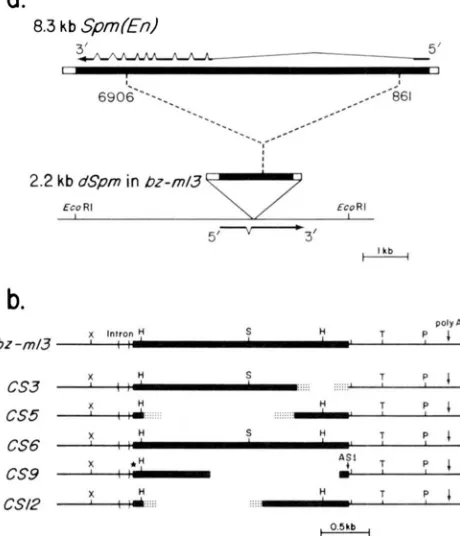
Structure of the bz-mZ3 alleles: A summary of our current knowledge (SCHIEFELBEIN et al. 1988) of the structures o f the initial dSpm insertion mutation, bz-
m J3, and the five CSs included in this study are given in Figure 1. T h e 2.2 kb dSpm element in bz-m 13 is a deletion derivative of the full-length Spm (Figure la). This deletion removed 6045 bp of Spm’s internal sequence, but did not alter any of the element’s ter- minal components. Thus the 2.2-kb dSpm retains the 13 bp terminal inverted repeats that are typical of elements in this family (SCHWARZ-SOMMER et al.
2.2 kb dSpm in bZ-mI.3
Eco RI €so R I
1
5 1 -3 ‘
1 Lb
b.
X ? S
...
. . . . . . . .. . ,
:
7 1. ... T P I
x y S H 7 7 1
x *: 7 4
. .. T 9 1
cs3 ....
cs5
-
CS6 cs9
H
X H
A S 1
,
L‘CSI2
An
H
FIGURE 1 .--Structure of br-ml3 and its change-in-state (CS) de- rivatives. a) Structural relationship between the autonomous Spm
(En) element and the dSpm element in bz-ml3. The portion of the Spm element deleted in the dSpm element is noted by the dashed lines, and the coordinates are those of the En-I element (PEREIRA
et al. 1986). The subterminal repetitive regions are indicated by the open portions of the bars. The structure of the major Spm (En)
transcript (PEREIRA et al. 1986) is shown above the Spm element. The structure of the Br gene transcript (FURTEK 1986) given under the structure of bz-ml3 indicates that the dSpm element is inserted in the second exon of the Br gene and illustrates that the direction of transcription from the Br promoter is opposite to the direction from the Spm (En) promoter. b) Structure of bz-mI3 and its CS
derivatives. Open areas of CS3, CS5, CS9, and CS12 indicate dele- tions of the dSpm sequence. Stippled areas represent regions of the dSpm elements where the exact deletion endpoints are unknown. The two bp deletion in the terminal inverted repeat of the dSpm in
CS6 is indicated by a star. A S I , pre-mRNA acceptor splice site identified within the terminal inverted repeat of CSY. Restriction enzyme sites: X . Xmal; H , Hincll; S, S p h l ; T, Sstl.
1984), the 180- and 299-bp “subterminal repetitive regions” (SRRs; MASSON et af. 1987; SCHWARZ-SOM-
MER et af. 1984) one of which contains the putative promoter for Spm’s major (gene 1) transcript (PEREIRA
et al. 1986), and the GC-rich first exon o f gene 1. T h e d S p m is inserted into the bz gene in opposite orienta- tion in terms o f the bz and Spm gene l’s directions o f transcription. T h e five CSs were found to contain deletions within the 2.2-kb dSpm without a change in the position or orientation o f the insert (Figure l b ;
698 V. Raboy et al.
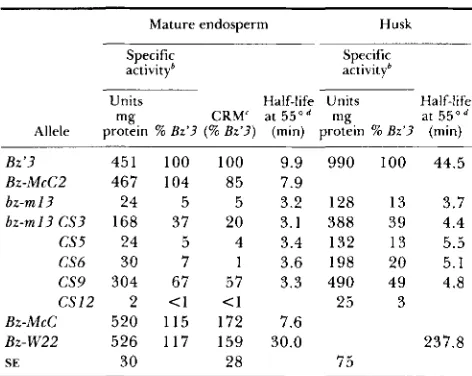
TABLE 1
Characteristics of UFGT isolated from mature endosperm and husk tissues" of bz-m13 and its change in state derivatives
Mature endosperm Husk
Specific activityb
Specific activity'
Units Half-life Units Half-life
mg CRM' at 5 5 0 d mg at 5 5 0 d Allele protein % 82'3 (% &'3) (rnin) protein % 82'3 (min)
Bz'3 451 100 100 9.9 990 100 44.5
bz-m 13 24 5 5 3.2 128 13 3.7
Bz-McCP 467 104 85 7.9
b z - m I 3 C S 3 168 37 20 3.1 388 39 4.4
CS5 24 5 4 3.4 132 13 5.5
CS6 30 7 1 3.6 198 20 5.1
CS9 304 67 57 3.3 490 49 4.8
C S 1 2 2 <1 <1 25 3
Bz-W22 526 117 159 30.0 237.8
Bz-McC 520 115 172 7.6
SE 30 28 75
'Tissue was isolated from plants homozygous for the indicated
Br allele. T h e data represent the mean value for two replications consisting of individual plants. T h e standard deviation of the mean, o r standard error, is given below each variable.
'
A unit of UFGT activity is defined as a pmol of isoquercitrin formed per hour. With the methods used here, UFGT activity is not detectable above background (<0.3% of Bz'3) in assays of the reference recessive allele (bz-r) or a deletion of the bz locus (bz-XP).' CRM: the amount of UFGT-specific cross-reacting material present in crude extracts of each tissue.
T h e thermal inactivation rate at 55" of partially purified UFGT was determined and the half-life was calculated from the data.
tion removed the terminal two bp of the 5' 13 bp inverted repeat.
UFGT activities and CRM levels: At maturity, crude extracts of bz-m13 endosperms contain approx- imately 5% of the level of UFGT activity observed in crude extracts of Bz'3 endosperms, the functional Bz
control (Table 1). UFGT activities are quite stable over time in the mature dry seed. Once extracted the UFGTs produced by the bz-m13 series of alleles are unstable as compared with B z ' 3 and other functional
Bz alleles' UFGTs (see below). Therefore, to optimize comparisons of genetic differences in enzymatic activ- ity, we conducted all assays on freshly made crude extracts, and not on 30-60% ammonium sulfate frac- tions, as done previously (KLEIN and NELSON 1983).
The endosperm UFGT activities of CS5 and CS6
were similar to that of bz-m13 (Table 1). CS3 and CS9
had increased levels of endosperm UFGT activity as compared with bz-m13 (37 and 67% of Bz'3 UFGT activity, respectively). CS12 endosperm UFGT activity is reduced as compared with bz-ml3, to the extent that it is not reproducibly detectable in this tissue. It has been previously shown that the reduction in UFGT activity in mature endosperms of bz-m13 as compared with BzMcC is not due to a change in the developmental timing of bz expression (KLEIN and
NELSON 1983). We found this also to be true for the
CSs of bz-m13 included in this study (data not shown). Although the stocks used in this study are near- isogenic, residual heterogeneity might have been re- sponsible for some of the observed differences in endosperm UFGT activity. Therefore, as a second test of allelic differences we assayed husk UFGT ac- tivities in stocks homozygous for B and PI and the various bz alleles. T h e relative differences in husk UFGT activity observed among bz-m13 and its CSs closely paralleled observed differences in endosperm UFGT activity (Table 1). UFGT activities of bz-m13
and its CSs tended to be higher relative to B z ' 3 in husk tissues versus endosperm tissues. As an example, where we recover
7%
or less of B z ' 3 activity in the endosperms of bz-mI3, CS5, and CS6, we recovered from 13 to 20% of B z ' 3 activity in husk crude extracts. In addition, where we could not reproducibly detect UFGT activity in endosperm crude extracts of CS12,we can consistently detect UFGT activity in crude extracts of husk tissue of this mutant. This activity is reduced as compared with bz-m13
(25
vs. 128 units/ mg protein, respectively), confirming the difference between these two alleles observed in endosperm tis- sues.CRM levels in the endosperm crude extracts were closely proportional to endosperm UFGT activity in all cases (Table 1). At the time of this study, the only anti-UFGT serum available was raised against partially purified Bz-W22 endosperm UFGT. In attempting to measure CRM levels in husk extracts, we found that this anti-endosperm UFGT serum had a very low affinity for husk UFGT (data not shown). We there- fore made no further attempts to measure CRM levels in crude husk extracts. As will be discussed in the next section, endosperm and husk UFGTs from a given allele also differ in their thermal stability. These tissue- specific differences in the properties of UFGT require further study.
UFGT thermal stability profiles: Thermal stability profiles were determined using endosperm and husk UFGTs obtained in a 30-60% ammonium sulfate fraction, dialyzed overnight to equilibrate salt concen- trations, and adjusted against the same dialysis buffer to a constant total protein concentration. N o data are given for CS12 since UFGT activity was too low to accurately measure thermal denaturation. T h e half- lives at 55" of UFGT activities were calculated and are given in Table 1.
Bronze-l Expression in bz-rn13 States 699
C l
.-
5 1.4
1
0n
4
OI
-I
0 5 IO 20 30 40
Time at 55OC (mid
~~~
FIGURE 2.-Thermal inactivation profiles of UFGTs isolated from husk tissue of bz-m13 (0), CS9 (0). Bz’3 (U), and mixtures of
br-m13 and Br’3 (W), and CS9 and 8 2 ’ 3 (A). Aliquots of enzyme preparations that were ammonium sulfate fractionated, dialyzed and adjusted to equivalent levels of total protein were incubated at
55” for the indicated times and assayed for remaining UFGT activity using standard methods. For the mixing experiments, ali- quots of the given enzyme preparations that were of equal volume and total protein were thoroughly mixed and assayed for thermal inactivation rates.
stabilities of bz-m13 and CS husk UFGTs were similar (half-lives at 55” ranging from 3.4 to 5.5 min), and less stable than Bz‘3 husk UFGT (44.5 min at 55”).
Mixing experiments were conducted to determine whether the relative thermal instability of bz-m13 and CS9 UFGTs as compared with Bz’3 UFGT is due to an intrinsic difference in their UFGTs or due to an extrinsic factor present in their crude extracts. An aliquot of bz-m13 or CS9 husk extract, containing an equivalent amount of total protein, was mixed with an aliquot of Bz’3 husk extract, and the UFGT ther- mal stability profile of the mixture was determined. Aliquots of extracts of the mutant alleles imparted no significant instability to the UFGT in extracts of Bz’3 (Figure 2). This indicates that no extrinsic factor is responsible for the observed differences in thermal stability. An experiment using Bz-W22 husk crude extract instead of Bz‘3 provided similar results (data not shown).
R N A
analyses: Blot hybridization analyses of poly(A)+ RNAs isolated from the husk tissue of plants homozygous for bz-m13 or its CSs in the absence of an active Spm reveal that each of these alleles produce a Bz-specific RNA similar in size to that of the Bz’3 mRNA (1.8 kb, Figure 3a). In addition, the bz-m13 series of alleles produce either one (CS3 and CS9) or two (bz-ml3, CS5, CS6 and CS12) RNA species of larger size not found in the blots of Bz‘3 poly(A)+ RNA. Of these additional RNA species, the largest species in each case corresponds in size to that ex- pected if one were to add the size of the particular dSpm insert to that of the Bz‘3 mRNA. T h e RNA species of intermediate size found in bz-ml3, CS5,a.
kb
4.2 +
kb
4.2 -a
2.4 +
1.8 --c
1.2 -c
probe 3’81 dSpm
b.
exon I
‘f
exon 25’
t
- 3’
Intron 3’82 probe
3‘ &
% Bz 100 21 68 23 27 67 6
FIGURE 3.-Northern blot analysis of poly(A)+ RNAs encoded by br-m13 and its change in state derivatives. Poly(A)+ RNAs were isolated from husk tissue of plants homozygous for the indicated alleles of the bz locus in the absence of an active Spm: x2, bz-x2; Bz,
Br’3; ml3, bz-ml3; CS3, CS5 etc., br-m13 CS3, bz-m13 CS5, etc. a) The poly(A)+ RNAs were fractionated in forrnaldehyde-contain- ing 1.2% agarose gels, transferred to nitrocellulose filters, and hybridized to the ”P-labeled probes indicated at the bottom of the autoradiograms. The size of the RNAs given on the left were calculated on the basis of the mobility of the R N A size markers. b) Quantitation, relative to the internal levels of a R N A , of the levels of the 1.8 kb RNAs that hybridize to the 3’ Br probe in (a). An autoradiogram of the filter in (a), hybridized to the 3’ Br probe indicated at the bottom of (a), was produced using a shorter expo- sure than that used in (a). Only the bands of the 1.8-kb RNAs are shown. The filter was stripped of the 3’ Br probe and rehybridized with the “P-labeled plasmid pALC2, which contains the transcrip tion unit of the a locus. The autoradiogram of the reprobed filter shows only one band of R N A hybridizing to the a probe in each lane, as indicated in (b). The amounts of probe hybridizing to each band was measured with a densitometer. The levels of 1.8-kb RNAs were normalized to the levels of R N A hybridizing to the a probe, and expressed asa percentage of the normalized level Of Br’3 RNA, given at the bottom of (b).
CS6, and CS12, but not found in CS3 and CS9, are similar in size (approximately 2.4 kb). T h e larger RNA species hybridize to both the Bz sequence 3’ of the dSpm insertion and to the dSpm sequence, whereas the 1.8 kb RNA bands only hybridize to 3’ Bz se- quence.
700 V. Raboy et al.
control to best assay the above correspondence since husk tissue samples may differ slightly in develop- mental state, and variable levels of poly(A)+ RNA are recovered from any given preparation. T h e filter in Figure 3A was stripped of Bz probe, and hybridized with the plasmid pALC2, which contains the entire transcriptional unit of the a gene (SCHWARZ-SOMMER
et al. 1985), an anthocyanin pathway structural gene. T h e autoradiograms of the Northern blots probed with Bz sequence, and reprobed with a (Figure 3b), were scanned with a densitometer. T h e levels of the
1.8-kb RNA, normalized relative to internal levels of a mRNA and expressed as a percent of Bz'3, are given in Figure 3B. T h e results clearly demonstrate that these levels are proportional to the levels of husk UFGT activities observed in each allele (Table 1).
We have previously shown (KIM et al. 1987) that a splicing event utilizing the donor splice site of the single bz intron and an acceptor splice site (AS1) in the dSpm's 13-bp terminal inverted repeat can pro- duce the 1.8-kb RNAs observed in Figure 3a. We next hypothesized that the 2.4 kb RNAs found in bz-mI3, CS5, CS6, and CS12, are the products of a splicing event which utilizes a second, alternative acceptor splice site (AS2) located within the dSpm sequence upstream of AS 1. T h e difference in size between the 1.8- and 2.4-kb RNAs (0.6 kb) led us to search the corresponding region of the dSpm for such a site. We therefore conducted an S1 nuclease protection exper- iment utilizing as probe a 706-bp 5' end-labeled SphI-
Sal1 fragment which encompasses this region (Figure
4). T h e results in Figure 4 show that bz-m13 RNA protects a fragment of 363 to 367 bp. This would place AS2 about 627 bp upstream of AS1. A sequence which has the obligatory AG dinucleotide and 11 of
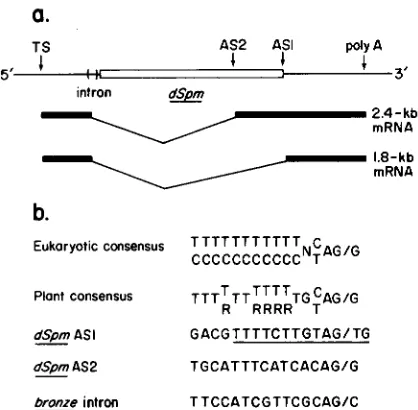
16 bp homologous to the consensus plant acceptor site sequence (BROWN 1986) was identified at this position (Figure 5).
T h e deletions that gave rise to the two CSs which have an increased level of UFGT activity relative to
bz-mI3, CS3 and CS9, removed similar portions of the
dSpm sequence, and it is these two CSs that lack the intermediate 2.4-kb RNA. In the case of CS9, the deletion removed AS2, whereas in CS3 the deletion removed approximately 400 bp between AS1 and AS2.
A 1.2-kb RNA which hybridizes to the dSpm probe is also detected in the Northern blots (Figure 3A). This RNA differs from the higher molecular weight RNAs which hybridize to the dSpm probe in two ways: it does not hybridize to either 3' (Figure 3A) or 5' (data not shown) Bz probes; it is detected in Bz'3
poly(A)+ RNA as well as in the poly(A)+ RNAs isolated from the bz-m13 series of alleles. This 1.2-kb RNA is much more abundant in CS12 poly(A)+ RNA than any of the other alleles tested.
706 b
363-367 b
AS2? 1st
SPhl I SOIl I
5' 1 3'
intron *m
probe
-
706 b protected fragment-
363-367 bFIGURE 4."sl nuclease mapping of the alternative acceptor splice site (indicated as AS2 in the fiture) presumably located 5' to the acceptor splice site located in the dSpm's terminal inverted repeat (indicated as AS1 in the figure). The 5"end-labeled SphI/
Sal1 fragment shown in the diagram was hybridized to polV(A)+ RNAs isolated from b z - m l 3 (m13). treated with SI nuclease, and fractionated in a 5% urea-polyacrylamide gel. D N A sequence re- actions were used as size markers.
dSpm germinal excision rates: T h e deletions which gave rise to these CSs of bz-m13 occurred in the presence of Spm-s activity. Their subsequent germinal stability in the presence of Spm-s activity is relevant to an evaluation of their evolutionary significance. Therefore, to further characterize the effects of these deletions we estimated their germinal excision rates in response to Spm-s. T h e large number of stable bz' and Bz' derivatives produced by bz-m13 in the pres- ence of Spm-s has been shown to result from Spm-s
induced excision of the dSpm insert (SCHIEFELBEIN et
Expression in 701
a.
1 I I
TS AS2 AS1 poly A
5’ B d 3 ’
intron
b.
Eukaryotic cmsensus T T T T T T T T T T T c
CCCCCCCCCCCNTAG/G
Plont consensus T T T ~ T T ~ ~ ~ ~ T G C A G I G
R RRRR T
dSpm AS I G A C G T T T T C T T G T A G I T G
dSpm AS 2 TGCATTTCATCACAGIG
b z e intron T T C C A T C G T T C G C A W C -
FIGURE 5,”Proposed structure of the bz-m13 mRNAs, and com- parison of the acceptor splice site sequences that generate these proposed mRNAs with the consensus eukaryotic and plant acceptor site sequences. a) The proposed structures of the 2.4-kb and 1.8-kb
mRNAs observed in bz-ml3 and several of its CSs. AS1 refers to the acceptor splice site located within the terminal inverted repeat (KIM et al. 1987). AS2 refers to the alternative acceptor site located 627 bp 5’ to the AS1 splice site. TS, transcription start site; poly A, polyadenylation site. b) Comparison of the sequences of the AS1 and AS2 splice sites with the consensus sequences for eukaryotic
(MOUNT 1982) and plant (BROWN 1986) acceptor sites. The 13-bp
terminal inverted repeat of the Spm family that contains the AS1 splice site is underlined. The acceptor site sequence of the bz intron
(FURTEK 1986) is shown for comparative purposes. R = A or G ; N
= A, C, G , or T ; slash (1) = the intron-exon junction. When two bases are shown in the same position, the upper base is observed more frequently.
allele in the absence of Spm-s activity (NELSON and KLEIN 1984; Table 2). T h e initial state of bz-ml3, in the presence of Spm-s, yields numerous stable Bz’ derivatives, and only a small fraction of kernels dis- playing full anthocyanin pigmentation represent an unchanged bz-m13 in the absence of Spm-s. T h e CSs, on the other hand, produce few stable Bz’ derivatives, and subsequent progeny tests reveal that most fully pigmented kernels on test cross ears contain un- changed CSs in the absence of Spm-s activity.
DISCUSSION
The relationship between
UFGT
activity and steady-state RNA levels: We found that two CSs, CS5 and CS6, have similar UFGT activities to that of the initial insertion mutation bz-m13. Two CSs, CS3 and CS9, have increased UFGT activities, and the fifthCS, C S 1 2 , has a decreased UFGT activity. T h e close relationship between CRM levels and UFGT activity suggests that the differences in UFGT activity in the mature dry kernels were primarily due to differences in the accumulation of UFGT protein, and not due to large differences in the catalytic properties of a given mutant UFGT. Also, observed differences in
TABLE 2
Estimated germinal excision rates of the bz-mlf alleles’ dSpm insertions in the presence of an active Spm-s
Progeny kernel genotypesb
bz-m13 Sh bz’ Estimated
Allele” tested kernels sh br +Spm-s -Spm-s Br’ Sh bz excision‘
bz-m13 6 280 139 41 0 33 67(3) 71
0 216 111 45 3 19 38 (2) 53 CS3 6 243 112 126 5 0 0 0
0 390 191 176 15 0 8 ( 4 ) 2 CS5 6 232 125 101 1 1 4 ( 2 ) 1
0 254 116 131 3 1 3 ( 3 ) 1 CS6 6 310 115 146 4 0 15(3) 7
0 332 164 159 1 0 8 ( 3 ) 3 CS9 6 256 132 122 1 1 1
0 259 138 120 1 0 0
CS12 6 264 121 139 0 0 4 ( 3 ) 1
0 418 218 193 4 0 3 ( 3 ) 0
Gametes Total and % germinal
Plants of the genotype Sh bz-ml3lsh bz-r;
+
Spm-s or Sh bz-m13 “CS”/sh bz-r; +Spm-s were used as both males and females in crosses with a tester stock of the genotype sh bz-r/sh bz-r; +Spm-s. Typical data from crosses of each allele are given.a Allele: bz-m13, the initial state; CS3, bz-m13 CS3; CS5, bz-ml3
CS5 etc. All bz-ml3 alleles are linked to Sh, a nonshrunken allele of
the shrunken locus, with the exception of CS9, which is linked to sh, a shrunken allele.
Kernel phenotypes: sh bz, shrunken bronze; bz-m13 allele
+
Spm-s, variegated; bz-m13 allele -Spm-s, nonsectored purple; Bz’, non- sectored purple; Sh bz’and Sh bz, nonshrunken bronze. The number in the parentheses under “Sh bz’ and Sh bz” are estimates of the numbers of Sh bz kernels expected based on the assumption of 2% recombination between sh and bz. The linkage with Sh and sh is used here only to distinguish between sh bzlsh bz and Sh bz’lsh bz progeny. The CS9 allele is linked to sh, so this distinction cannot be made in this case.
‘ The estimated germinal excision rates are calcualted as 100 X
the sum of (1) the excess of Sh bz kernels (assumed to be Sh bz’) over the expected number resulting from recombination between sh and bz and (2) the number of Bz’ kernels divided by the sum of (1) and (2) plus the number of bz-ml3
+
and-
Spm-s kernels.UFGT activity could not be attributed to differences in the developmental timing of expression or to dif- ferences in thermal stability.
RNA analyses indicate that in all alleles transcrip- tion proceeds through the dSpm insert thus producing the largest Bz-specific RNA. We hypothesize that the pre-mRNA processing event using the AS1 site as
illustrated in Figure 5a is responsible for the produc- tion of the mRNA whose translation produces the functional UFGT found in bz-m13 and the other CSs. This hypothesis is supported by the close relationship between the level of the 1.8-kb mRNA and the level of UFGT activity typical of each allele.
702 V. Raboy et al.
nonfunctional UFGT protein (KIM 1987). When dele- tions remove AS2, as in the case of CS9, competition of AS2 with AS1 cannot occur, and the prevalent splicing event is that which utilizes AS1.
The deletion found within the dSpm insert in CS? did not remove AS2, instead it removed approxi- mately 400 bp of sequence between AS1 and AS2. If AS2 were utilized during processing of CS3 RNA, a 2.1-kb band would be produced. Since no such RNA has been detected, the 400 bp deletion in CS? altered the utilization of the AS2 site.
Other factors may contribute to the differences in UFGT activity and 1.8-kb RNA levels among bz-ml? and these CSs. Transposable element insertions may affect transcription rates and not RNA processing (ROWLAND and STROMMER 1985). Differences in tran- scription rate may contribute in part to the observed differences in bz expression. T h e deletions in the CSs
may alter RNA stability, or alter the formation of the lariat structure critical to the splicing reaction by deleting or changing the position of branch points (GREEN 1986). T h e deletion in CS9 has removed the promoter of Spm’s gene 1 transcript located within the SRR and the GC rich sequence proximal to Spm’s 5’ SRR. These two types of sequences may influence bz transcription rate. Activity of the Spm gene 1 pro- moter would produce transcripts containing dSpm se- quence complementary, or antisense, to the dSpm sequence in transcripts resulting from bz promoter activity. Complementary transcripts may result in an antisense RNA interaction (ECKER and DAVIS 1986), reducing net bz expression in those states retaining the promoter.
At present we do not understand the cause of the reduction in bz expression in CS12 as compared with bz-ml?. T h e deletion found in CS12 may be respon- sible via an unknown mechanism. Alternatively, the relative abundance of the 1.2-kb dSpm-specific RNA in CS12 poly(A)+ RNA may be responsible. Perhaps this RNA is antisense to the dSpm sequence in C S l 2 ’ s primary transcript.
Evolutionary relationships between transposable elements and introns: There are two views, often characterized as being diametrically opposed, on the origin and evolution of introns (CAVALIER-SMITH
1985; GREEN 1986; SHARP 1985). The first view holds that ancestral eukaryotic genes were discontinuous, and that splicing evolved to bring coding sequences together. T h e second view holds that introns arose by insertion of transposable elements. CAVALIER-SMITH (1 985) proposed that certain introns might have orig- inated as “defective transposons in which the RNA- splicing mechanism evolved from preexisting DNA splicing enzymes specific for their termini.” Arguing against this hypothesis, SHARP (1985) noted that no known transposable element has splice sites at its
termini. Our previous report (KIM et al. 1987) docu- mented the presence of an acceptor splice site (ASl) in the terminal inverted repeat of dSpm elements.
Here we show that the initial insertion mutation bz- m l ? and several of its derivatives also contain an alternative acceptor site (AS2 in Figure 5a) internal to AS 1. Members of the Activator-Dissociation (Ac-Ds) family of maize transposable elements also contain splice sites in their minus strand adjacent to their terminal inverted repeats and not associated with any known transposable element gene. T h e wx-m9 allele of the waxy locus in maize contains a 4.3-kb Dissociation
(Ds)
element inserted in wx’s 10th exon (WESSLER, BARAN and VARAGONA 1987). This Ds element rep- resents a deletion derivative of the Activator (Ac) trans- posable element, is inserted in the wx gene in opposite orientation in terms of their respective directions of transcription and contains a series of four putative 5‘ donor sites in its minus strand within 30 bp of its 3’terminal inverted repeat. In the absence of Ac activity, transcription proceeds through the Ds insertion in wx- m9. Nearly all of the Ds sequence in the pre-mRNA is removed during pre-mRNA processing in a splicing event using one of the four 5’ donor splice sites in the Ds termini and a cryptic acceptor splice site in wx sequence 3’ of the insertion. A similar splicing event removes Ds sequence from transcripts of the A d h l - FM??5 allele of the maize ADH 1 gene (DENNIS et al.
1988).
In both cases the donor site provided by the Ds insertion is internal to Ds’s terminal inverted repeat. Thus the Ac-Ds family contains a series of alternative donor sites in its minus strand adjacent to its terminus, and the Spm-dSpm family contain at least two acceptor splice sites in its minus strand within and internal to its terminus. These splice sites allow for the removal of element sequence from read-through transcripts of genes in which these elements are inserted in exons in opposite orientation in terms of their respective directions of transcription. This splicing mechanism may serve to reduce the impact of transposable ele- ment insertion on gene expression (KIM et al. 1987; WESSLER, BARAN and VARAGONA 1987).
Bronze-1 Expression in bz-m13 States 703
effects. In the case where the deletion removed AS2,
the dSpm sequence in the pre-mRNA is efficiently
removed as part of a novel intron, producing near wild-type levels of an mRNA which upon translation produces significant quantities of functional protein.
The authors would like to thank ANITA KLEIN for assistance with t h e UFGT activity assay and for providing UFGT-specific antisera, DOUGLAS FURTEK for helpful discussions, ZSUZSANNA SCHWARZ- SOMMER for the A gene clone, Steven Sickler for Assistance in the laboratory, RUSSEL HUSSETH for assistance in the field, and SUSAN WESSLER for constructive criticism of the manuscript. This is Paper No. 3008 from the Laboratory of Genetics, University of Wisconsin- Madison. The research was supported by the College of Agriculture and Life Sciences and by grant DCB-8507895 from the National Science Foundation.
LITERATURE CITED
BERK, A. J., and P. A. SHARP, 1977 Sizing and mapping of early adenovirus mRNAs by gel electrophoresis of S1 and endonu- clease digested hybrids. Cell 12: 721-732.
BROWN, J. W. S., 1986 A catalogue of splicejunction and putative branch point sequences from plant introns. Nucleic Acids Res.
1 4 9549-9559.
CANTOR, C. R., and P. R. SCHIMMEL, 1980 Biophysical Chemistry. W. H. Freeman, San Francisco.
CAVALIER-SMITH, T., 1985 Selfish DNA and the origin of introns. Nature 315: 283-284.
DENNIS, E. S., M. M. SACHS, W . L. GERLACH, I. BEACH and W. J. PEACOCK, 1988 The D s l transposable element acts as an intron in the mutant allele Adhl-Fm??5 and is spliced from the message. Nucleic Acids Res. 16: 3815-3828.
DOONER, H. K., and 0. E. NELSON, 1977a Genetic control of UDPg1ucose:flavonoid 3-0-glucosyltransferase in the endo- sperm of maize. Biochem. Genet. 1 5 509-519.
DOONER, K., and 0 . E. NELSON, 1977b Controlling element- induced alterations in UDPg1ucose:flavonoid glucosyltransfer- ase, the enzyme specified by the bronze locus in maize. Proc. Natl. Acad. Sci. USA 74: 5623-5627.
ECKER, J. R., and R. W. DAVIS, 1986 Inhibition of gene expression in plant cells by expression of antisense RNA. Proc. Natl. Acad. Sci. USA 83: 5372-5376.
FAVALORO, J. R., R. TREISMAN and R. KAMEN, 1980 Transcription maps of polyoma virus-specific RNA: analysis by 2-dimensional nuclease S1 gel mapping. Methods Enzymol. 6 5
7 18-749.
FEDOROFF, N., 1983 Controlling elements in maize, pp. 1-63 in Mobile Genetic Elements, edited by J. SHAPIRO. Academic Press, New York.
FURTEK, D. B., 1986 Cloning and sequence analysis of the bronze locus in maize: location of transposable element insertions and comparison of two wild type alleles. Ph.D. thesis, University of Wisconsin-Madison.
GERATS, A. G. M., J. BUSSARD, E. H. COE and R. LARSON, 1984 Influence of B and P I on UDPG:flavonoid-3-0-gluco-
syltransferase in Zea mays L. Biochem. Genet. 22: 1161-1 169. GREEN, M. R. 1986 Pre-mRNA splicing. Annu. Rev. Genet. 20:
67 1-708.
KIM, H-Y., 1987 Molecular characterization of a functional mu- tation caused by insertion of a defective Suppressor-mutator transposable element in the br-1 locus of maize. Ph.D. thesis, University of Wisconsin-Madison.
KIM, H-Y., J. W. SCHIEFELBEIN, V. RABOY, D. B. FURTEK and 0.
E. NELSON, 1987 RNA splicing permits expression of a maize gene with a defective Suppressor-mutator transposable element insertion in an exon. Proc. Natl. Acad. Sci. USA 84: 5863- 5867.
KLEIN, A. S., and 0. E. NELSON, 1983 Biochemical consequences of the insertion of a suppressor-mutator (Spm) receptor at the bronze-1 locus in maize. Proc. Natl. Acad. Sci. USA 8 0 7591- 7595.
LARSON, R. L., and E. H. COE, 1977 Gene dependent flavonoid glucosyltransferase in maize. Biochem. Genet. 1 5 153-156. MASSON, P., R. SUROSKY, J. A. KINGSBURY and N . V. FEDOROFF,
1987 Genetic and molecular analysis of the Spm-dependent a-m2 alleles of the maize a locus. Genetics 117: 11 7-1 37. MCCLINTOCK, B., 1954 Mutations in maize and chromosomal
aberrations in Neurospora. Carnegie Inst. Wash. Year Book
53: 254-260.
MCCLINTOCK, B., 1955 Controlled mutation in maize. Carnegie Inst. Wash. Year Book 5 4 245-255.
MCCLINTOCK, B., 1968 The states of a gene locus in maize.
MOUNT, S. M . , 1982 A catalogue of splice junction sequences.
NELSON, 0. E., and A. S. KLEIN, 1984 Characterization ofan Spm- controlled bronze-mutable allele in maize. Genetics 106: 769- 779.
PEREIRA, A., H. CUYPERS, A. GIERL, 2. SCHWARZ-SOMMER and H. SAEDLER, 1986 Molecular analysis of the En/Spm transposable element system of Zea mays. EMBO J. 5: 835-841.
PETERSON, P. A., 1953 A mutable pale green locus in maize. Genetics 38: 682.
PETERSON, P. A,, 1960 The pale green mutable system in maize. Genetics 45: 1 15-1 33.
PETERSON, P. A., 1965 The relationship between the Spm and En control systems in maize. Am. Nat. 99: 391-398.
ROWLAND, L. J., and J. N. STROMMER, 1985 Insertion of an unstable element in an intervening sequence of maize A d h l effects transcription but not processing. Proc. Natl. Acad. Sci. USA 82: 2875-2879.
SCHIEFELBEIN, J. W., 1987 Molecular characterization of muta- tions at the maize bronze-1 locus caused by the Ac-Ds and Spm- dSpm transposable element families. Ph.D. thesis, University of Wisconsin-Madison.
SCHIEFELBEIN, J. W., V. RABOY, N. V. FEDOROFF and 0. E. NELSON, 1985 Deletions within a defective Suppressor-mutator in maize affect the frequency and developmental timing of its excision from the bronze locus. Proc. Natl. Acad. Sci. USA 82:
4783-4787.
SCHIEFELBEIN, J. W., V. RABOY, H.-Y. KIM and 0. E. NELSON, 1988 Molecular characterization of Suppressor-mutator (Spm)- induced mutations at the bronze-I locus in maize: the bz-m13 alleles, pp. 261-278 in Plant Transposable Elements, edited by
0. E. NELSON. Plenum Press, New York.
SCHWARZ-SOMMER, Z., A. GIERL, R. B. KLOSGEN, U . WIENAND, P. A. PETERSON and H. SAEDLER, 1984 The Spm ( E n ) transpos- able element controls excision of a 2-kb DNA insert at the wx-
m8 allele of Zea mays. EMBO J. 3: 1021-1028.
SHARP, P. A., 1985 On the origin of messenger RNA precursors. Cell 42: 397-400.
SIMON, R., and P. STARLINCER, 1987 Transposable element Ds2 of Zea mays influences polyadenylation and splice site selection.
Mol. Gen. Genet. 2 0 9 198-199.
WESSLER, S. R., G. BARAN and M. VARAGONA, 1987 The maize transposable element Ds is spliced from RNA. Science 237:
916-918.
Carnegie Inst. Wash. Year Book 66: 664-672.
Nucleic Acids Res. 10: 459-472.