Copyright2000 by the Genetics Society of America
Long-Term Experimental Evolution in
Escherichia coli.
IX. Characterization
of Insertion Sequence-Mediated Mutations and Rearrangements
Dominique Schneider,* Esther Duperchy,* Evelyne Coursange,* Richard E. Lenski
†and Michel Blot*
*Laboratoire Plasticite´ et Expression des Ge´nomes Microbiens, Universite´ Joseph Fourier, 38041 Grenoble Cedex 9, France and†Center for Microbial Ecology, Michigan State University, East Lansing, Michigan 48824
Manuscript received March 30, 2000 Accepted for publication June 12, 2000
ABSTRACT
As part of a long-term evolution experiment, two populations ofEscherichia coliB adapted to a glucose minimal medium for 10,000 generations. In both populations, multiple IS-associated mutations arose that then went to fixation. We identify the affected genetic loci and characterize the molecular events that produced nine of these mutations. All nine were IS-mediated events, including simple insertions as well as recombination between homologous elements that generated inversions and deletions. Sequencing DNA adjacent to the insertions indicates that the affected genes are involved in central metabolism (knockouts ofpykFandnadR), cell wall synthesis (adjacent to the promoter ofpbpA-rodA), and ill-defined functions (knockouts ofhokB-sokBandyfcU). These genes are candidates for manipulation and competition experiments to determine whether the mutations were beneficial or merely hitchhiked to fixation.
I
NSERTION sequence (IS) elements are small DNA 1994). Several evolution experiments have shown that some IS-mediated mutations are beneficial (e.g.,Trevessequences that carry genetic information related to
their transposition and its regulation (Mahillonand et al.1998), but there has been no systematic study to identify the full range of IS-associated substitutions in
Chandler1998). They are ubiquitous in bacterial
ge-nomes and contribute significantly to spontaneous mu- an evolving population and then determine which ones were beneficial and which were deleterious mutations tagenesis in bacteria (Lieb1981;Rodriguezet al.1992;
Kitamuraet al. 1995;Hall 1999). Insertion of an IS that presumably hitchhiked with some beneficial muta-tion. The findings that we present here represent an element often leads to gene inactivation and strong
polar effects (Jordanet al.1968;Saedleret al.1974). intermediate, but essential, step in such a study. Our analysis is based on two populations ofEscherichia coliB However, certain IS elements carry promoters or other
protein-binding sequences, such that an IS insertion that evolved in the laboratory for 10,000 generations (Lenskiet al.1991, 1998;LenskiandTravisano1994). can also activate cryptic genes or alter the expression
of adjacent genes (Saedler et al. 1980; Reynolds et Papadopouloset al.(1999) performed restriction frag-ment length polymorphism (RFLP) analyses using seven al.1981;Ciampiet al.1982;MahillonandChandler
1998). Furthermore, IS elements act as substrates for IS elements as probes with genomic DNA from 170 clones isolated at eight time points from these two popu-recombination pathways leading to chromosomal
re-arrangements, such as inversions and deletions (Reif lations. They found that several IS-associated mutations arose and were fixed in each population, all involving andSaedler1975;Louarnet al.1985;Deonier1996).
IS and other transposable elements are presumably either IS1or IS150.In this study, we identify the affected loci and characterize the molecular events that led to of considerable importance for the evolution of bacteria
and other organisms that carry them, given the high many of these mutations. In the future, we intend to reconstruct isogenic genotypes, with and without these rate and diversity of mutations they cause (McClintock
1965;Federoff 1983;Hartlet al. 1986;Blot 1994). mutations, and perform competitions to determine whether particular mutations were beneficial or, alter-However, there is some debate about whether
transpos-able elements are an important source of variation for natively, hitchhiked to fixation. adaptive evolution or, alternatively, genomic parasites
whose primary effect is to generate deleterious
muta-MATERIALS AND METHODS tions (for reviews, seeBlot1994;Charlesworthet al.
Strains and plasmids:Twelve populations ofE. coliB were founded from two variants of a common ancestor and propa-gated for 10,000 generations in glucose minimal medium
Corresponding author:Dominique Schneider, CNRS EP2029, CEA
(LenskiandTravisano1994). Samples from each population LRC12, Universite´ Joseph Fourier, Laboratoire Plasticite´ et Expression
were stored at⫺80⬚every 500 generations. The ancestor con-des Ge´nomes Microbiens, CERMO, BP 53, 38041 Grenoble Cedex 9,
France. E-mail: [email protected] tains neither plasmids nor active prophages. One ancestral
variant can grow on arabinose, whereas the other cannot; they CTGA-3⬘. G5 is near the left extremity of IS150, G21 is near the IS150 EcoRV site, and both are directed outward. All PCR differ by a single mutation that is neutral under the conditions
used in the evolution experiment and serves as a genetic reactions were performed using Pfu DNA polymerase (Strata-gene) according to the manufacturer’s recommendations. marker (Lenskiet al.1991). In this study, we used two
popula-tions, designated Ara⫺1 and Ara⫹1, which were arbitrarily The PCR products containing IS1- and IS150-adjacent se-quences were cloned using the PCR-Script Cam cloning kit chosen as foci for certain aspects of our research on these
populations, including molecular genetic work. Numerous (Stratagene). The plasmid content of white colonies was di-gested with EcoRV, allowing the isolation of two DNA frag-clones were isolated from the stored samples (Papadopoulos
et al.1999) and provide the genetic material used in this study. ments. For IS1, each fragment contained either the left- or right-adjacent sequence; for IS150, one fragment contained The strain used in cloning experiments was Epicurian Coli
XL10-Gold (Stratagene, La Jolla, CA). The plasmid used as the left-adjacent sequence and the other fragment carried a small piece of the IS element. To obtain the right-adjacent the cloning vector was PCR-Script (Stratagene).
Media and growth conditions: Experimental conditions fragments for IS150, additional RFLP experiments were per-formed using IS150as a probe, but genomic DNA was digested used for the evolving populations were described previously
(Lenskiet al.1991). For routine work, we used Luria-Bertani with eitherHincII orPvuII, which do not cut within IS150; two restriction enzymes were needed because of comigrating broth (LB) and LB containing 12 g/liter agar as growth media
(Sambrooket al. 1989). Media were supplemented with 30 fragments of similar size. The left-adjacent sequence of each IS150was then used as a probe withHincII orPvuII reference g/ml chloramphenicol (Cam), 40 g/ml Xgal, or 50 m
IPTG as required. Strains were grown at 37⬚with shaking (200 membranes, allowing identification of fragments that con-tained the IS150element. These fragments were self-ligated rpm).
DNA handling and hybridizations: Genomic DNA (from and used in inverse PCR with primers G5 (see above) and G6, 5⬘-CTGAAGGATGCTGTTACGG-3⬘. G6 lies near the right 3-ml cultures) and plasmid DNA (from 1.5-ml cultures) were
extracted followingSambrooket al.(1989). For sequencing, extremity of IS150and is directed outward. This procedure allowed the characterization of both adjacent sequences of plasmid DNA was prepared with the QIAGEN (Chatsworth,
CA) plasmid purification midi kit. Restricted DNA fragments IS150.
All adjacent sequences were used as DIG-labeled probes were separated on 0.8% agarose gels and transferred to nylon
membranes (Boehringer Mannheim, Indianapolis) as de- with reference membranes (see below) to confirm that pre-dicted IS-containing fragments hybridized. Sequencing of ad-scribed bySouthern(1975). Hybridizations were performed
jacent DNA was done by the dideoxy chain termination at high stringency (68⬚) with cold-labeled DNA probes using
method (Sanger et al.1977), using the same primers as in the Boehringer Mannheim DIG system.
the PCR experiments. Sequences were compared to databases
Characterization of sequences adjacent to IS elements by
using BLAST (Altschulet al.1997). We give chromosomal
inverse PCR: We refer to the left and right sides of an IS
locations based onE. coliK-12 (Blattneret al.1997). element according to the direction of transcription of its
trans-Reference membranes:Sequences adjacent to IS elements posase gene.Papadopouloset al.(1999) analyzed clones from
were used to probe reference membranes that had been pre-populations Ara⫺1 and Ara⫹1 by RFLP experiments using
viously probed with the IS elements themselves. These mem-EcoRV-digested genomic DNA. They used as probes internal
branes carryEcoRV-,HincII-, andPvuII-digested genomic DNA IS fragments lackingEcoRV restriction sites to detect mutations
from the ancestor and diverse evolved clones, including those associated with IS1and IS150.However,EcoRV cuts once near
from which the adjacent sequences were obtained. The mem-the right extremity of IS150, and the IS150-specific probe used
branes were probed with the IS elements, stripped, and re-by Papadopouloset al.(1999) corresponds to the left part
probed with adjacent sequences to show that the correct se-of the IS. Therefore,EcoRV fragments allow cloning of only
quences were cloned. By comparing clones with and without the left IS150-adjacent sequence, whereas both IS1-adjacent
a particular IS element, we could identify its adjacent se-sequences can be cloned usingEcoRV because it does not cut
quences and characterize the mutational event. within IS1. We reexamined the clones studied by
Papado-Nomenclature for IS elements: To denote a particular IS poulos et al. (1999), using two other restriction enzymes,
element present in the ancestral strain, the element’s name HincII andPvuII, that do not cut within the IS150elements
is followed by an identifying numeral: e.g., IS150-1 is one (D. Schneider, unpublished data). We detected no additional
of five IS150 elements present in the ancestor. To denote IS-associated mutations except for one IS150-mediated
dele-a pdele-articuldele-ar element thdele-at wdele-as detected in dele-a new restriction tion recently discovered byCooper (2000) that was fixed in
fragment from the genome of an evolved clone, the element’s both focal populations. This deletion was missed by
Papado-name is followed by an identifying letter: e.g., IS1-A is an pouloset al.(1999) because it occurred immediately adjacent
element in a fragment that was not present in the ancestor. to the right IS150extremity. Our new RFLP data also
con-firmed all the mutations previously detected withEcoRV diges-tions.
Genomic DNA of a clone was digested with EcoRV, and RESULTS
fragments were separated onto a 0.8% agarose gel withPst
I-andHindIII-digested lambda DNA as size markers. Gel frac- We characterized three mutations that arose and were tions containing IS fragments were cut and DNA purified fixed in population Ara⫺1 and six that were fixed in using a modification of the BIO 101 (Vista, CA) Geneclean
Ara⫹1 (Table 1). All nine mutations were IS-mediated kit (BoyleandLew1995). These fragments were self-ligated
events, including six simple insertions and three com-with T4 DNA ligase (Boehringer Mannheim) at 5–10 g/
ml, and the ligated mixtures were used as templates in PCR plex rearrangements. All six insertions involved IS150 experiments. Primers used for inverse PCR to amplify se- elements, including five such events in Ara⫹1 (Table quences adjacent to IS1were G3, 5⬘-GTCATCGGGCATTATC 1), which experienced a “burst” of IS150 activity in TGAAC-3⬘; and G4, 5⬘-AGAAGCCACTGGAGCACC-3⬘. They
which its copy number tripled (Papadopoulos et al. are near the IS1extremities and directed outward. The IS150
1999). Each population exhibited a large inversion that left-adjacent sequence was amplified using G5, 5⬘-GATCCTG
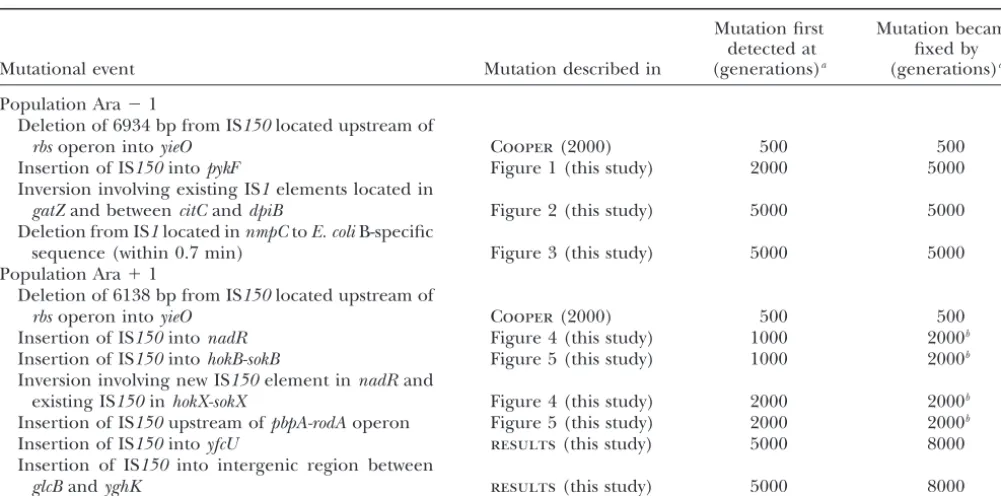
TABLE 1
IS-mediated mutations that arose and were fixed in two evolving populations ofE. coli
Mutation first Mutation became
detected at fixed by
Mutational event Mutation described in (generations)a (generations)a
Population Ara⫺1
Deletion of 6934 bp from IS150located upstream of
rbsoperon intoyieO Cooper(2000) 500 500
Insertion of IS150intopykF Figure 1 (this study) 2000 5000
Inversion involving existing IS1elements located in
gatZand betweencitCanddpiB Figure 2 (this study) 5000 5000
Deletion from IS1located innmpCtoE. coliB-specific
sequence (within 0.7 min) Figure 3 (this study) 5000 5000
Population Ara⫹1
Deletion of 6138 bp from IS150located upstream of
rbsoperon intoyieO Cooper(2000) 500 500
Insertion of IS150intonadR Figure 4 (this study) 1000 2000b
Insertion of IS150intohokB-sokB Figure 5 (this study) 1000 2000b
Inversion involving new IS150element innadRand
existing IS150inhokX-sokX Figure 4 (this study) 2000 2000b
Insertion of IS150upstream ofpbpA-rodAoperon Figure 5 (this study) 2000 2000b
Insertion of IS150intoyfcU results(this study) 5000 8000
Insertion of IS150 into intergenic region between
glcBandyghK results(this study) 5000 8000
aTime in generations. At least seven clones from each population were analyzed at generations 500, 1000, 1500, 2000, 5000, 8000, and 10,000.
bThese mutations were absent from 1 of 10 clones sampled at generation 2000, but were present in all 31 later clones.
elements in one population and IS150elements in the target site. The pykF gene encodes pyruvate kinase I, one of twoE. colipyruvate kinases (Blediget al.1996), other (Table 1). Ara ⫺ 1 also underwent a deletion
involving an IS1element (Table 1). In addition to the and is located at 37.8 min on the K-12 chromosome. The insertion almost certainly inactivatedpykF. nine IS-mediated mutations identified and
character-ized in this study,Cooper(2000) found that both popu- Inversion between two IS1in Ara ⫺1: The features used to characterize this chromosomal rearrangement lations fixed deletions involving an IS150 element
lo-cated immediately upstream of the rbs operon; the are illustrated in Figure 2. The 6.2- and 2.3-kbEcoRV fragments containing IS1-A and IS1-C, respectively, were proximal deletion endpoints were identical, although
the distal endpoints were not. Aside from these parallel detected in all 34 clones from generation 5000 onward (Figure 2B), but not in any of 53 clones from earlier deletions, none of the other IS-mediated mutations
in-volved the same genes in the focal populations (Table samples. The gains of IS1-A and IS1-C could have been generated by two different insertions, in which case (i) 1). In the paragraphs below, we briefly summarize the
molecular evidence used to characterize the nine muta- the IS1-A probe should hybridize with a 5.5-kb EcoRV fragment (6.2 kb for IS1-A reduced by 0.7 kb for IS1) tions discovered in this study.
Insertion of IS150intopykFin population Ara ⫺ 1: in the ancestor and early clones; and (ii) the IS1-C probe should hybridize with a 1.6-kbEcoRV fragment (2.3 kb Figure 1 shows the essential features used to identify
this mutation. A 6.4-kbEcoRV fragment containing the for IS1-C less 0.7 kb for IS1) in these same clones. How-ever, the actual hybridization results were more com-left-adjacent sequence of IS150-D was detected in 1 of
8 clones sampled at generation 2000 and in all 34 clones plex. The left- and right-adjacent sequences of IS1-A and -C hybridized only with IS1-containing fragments. from later generations; the fragment was absent from
45 clones sampled before generation 2000. The left- In the ancestor and early clones, hybridization showed two IS1-containing EcoRV fragments, one containing adjacent sequence was cloned and used to probeHincII
andPvuII reference membranes, which confirmed the IS1-15 and the other IS1-6 (Figure 2A); both these frag-ments were absent in clones isolated from generation 1.4-kb size increase predicted for an IS150 insertion.
The 2.9-kb HincII fragment was self-ligated and used 5000 onward.
The IS1-C left-adjacent sequence and the IS1-A right-with inverse PCR to clone the sequences adjacent to
IS150-D. Sequencing showed the insertion was in the adjacent sequence both hybridized with the fragment containing IS1-6, and the IS1-C right-adjacent sequence pykFgene, 682 bp downstream from the ATG start
Figure 1.—Insertion of an IS150 element into pykF in population Ara⫺1. The genepykFencodes pyr-uvate kinase I and is located at 37.8 min. The directions of transcription of the IS150 transposase and pykF genes are shown by arrows. The 6.4-kbEcoRV fragment allowed cloning of the IS150-D left-adjacent sequence after self-ligation and inverse PCR us-ing primers G5 and G21 (arrow-heads). The 2.9-kb HincII fragment was identified using the left-adjacent sequence to probe reference mem-branes. The IS150-D right-adjacent sequence was cloned from this frag-ment by inverse PCR using primers G5 and G6 (arrowheads). Only rele-vant restriction sites are shown. IS150 terminal inverted repeats are indi-cated by triangles. ThepykFpromoter region is shown as a bent arrow. Only pykFand IS150-D are drawn to scale.
with the IS1-15 fragment. Complementary results were end of nmpC. However, the left-adjacent sequence of IS1-B did not correspond to the 5⬘end of this gene; in seen using sequences adjacent to IS1-15 and IS1-6 as
probes. These results imply that an inversion between fact, it did not show homology with any sequence in the databases. The inverse PCR was repeated twice to clone ancestral elements IS1-15 and IS1-6 produced the new
elements IS1-A and IS1-C. This inversion was confirmed and sequence the genes adjacent to IS1-B, with identical results. This left-adjacent sequence was used to probe by sequencing DNA adjacent to all four fragments,
which also identified the endpoints of the inversion EcoRV-digested genomic DNA of theE. coli B ancestor and various K-12 strains; hybridization occurred only (Figure 2). One endpoint, corresponding to IS1-6 in
the ancestor, was located in thegatZgene at 46.9 min on with the ancestor, indicating a B-specific sequence. This novel sequence, whose function (if any) is unknown, the K-12 chromosome. The other inversion endpoint,
corresponding to IS1-15, was in an intergenic region was deposited in GenBank (accession no. AJ271006). Replicative transposition of IS1often generates inver-betweencitCDanddpiBAat 14.1 min. It is unlikely that
this inversion would directly affect the expression of the sion or deletion of the sequence between IS1 and its target (Turlan and Chandler 1995); such an event genes at either endpoint.
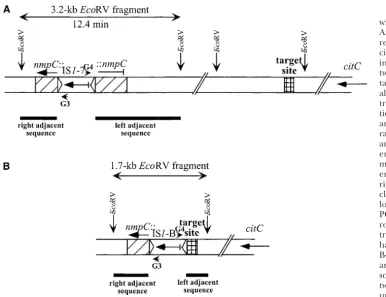
Deletion associated with IS1 in Ara ⫺ 1: Figure 3 might have produced IS1-B, with the target being the E. coliB-specific sequence. If the mutation were an inver-summarizes information used to identify this mutation.
A 1.7-kbEcoRV fragment containing IS1-B was detected sion, then an additional IS1-containing fragment would have been detected. However, apart from the fragments in all 34 clones from generation 5000 onward (Figure
3B), but was absent from the ancestor and all 53 earlier already accounted for, no new IS1-containing fragment was seen, indicating a deletion event. An alternative clones. The two sequences adjacent to IS1-B were used
to probe reference membranes of the ancestor and early explanation, which we cannot exclude, is that transposi-tion and deletransposi-tion events occurred in different genera-clones. The right-adjacent sequence hybridized a 3.2-kb
EcoRV fragment that carried the ancestral IS1-7 element, tions. In either case, given the orientation of IS1 ele-ments innmpC(IS1-B; Figure 3) and nearcitC(IS1-15 which disappeared from later clones, and the
left-adja-cent sequence hybridized with a 1.8-kbEcoRV fragment and IS1-C; Figure 2), the B-specific sequence must lie between 12.4 and 14.1 min. Moreover, three different that did not contain any IS1in the ancestor and early
clones. These results suggested a rearrangement that IS elements located together at 13.1 min in the ancestor were all still present in evolved clones with the deletion. might be associated with the IS1element.
Sequencing on both sides of IS1-7 showed that this Therefore, the maximum extent of the deletion is from 12.4 to 13.1 min.
ancestral element was innmpC, which encodes an outer
membrane porin carried by a defective prophage; this Insertion of IS150intonadRand a subsequent inver-sion involving that element in Ara⫹1:Figure 4 shows gene is located at 12.4 min on the K-12 chromosome.
This insertion was previously reported for another E. the genetic features used to identify two mutations that were fixed in Ara⫹1, the first being a simple insertion coliB derivative and leads to inactivation ofnmpC(
Figure 2.—Inversion between two IS1elements in population Ara ⫺ 1. Two new fragments, designated IS1-A and IS1-C, resulted from homologous recombination between two preexisting elements, IS1-6 and IS1-15; this event should lead to the inversion of the intervening region. Arrows indicate the directions of transcription of genes. (A) The chromosomal arrangement in the ancestor and clones isolated through generation 2000. (B) The rearrangement in clones isolated from generation 5000 onward. The adjacent sequences of the IS1elements are indicated; they were cloned fromEcoRV-cut DNA, following self-ligation and inverse PCR using primers G3 and G4 (arrowheads). Only genes and IS1elements are drawn to scale, and only relevant restriction sites are shown. Open triangles represent IS1terminal inverted repeats. citC, similar to citrate lyase ligase gene in Klebsiella pneumoniae (Bott and Dimroth 1994); dpiB, gene encoding putative histidine kinase of a two-component signal transduction system involved in plasmid inheritance (Ingmeret al.1998);gatY, D-tagatose-1,6-bisphosphate aldolase gene involved in galactitol utilization;gatZ, gene of unknown function involved in galactitol utilization;gatA, gene encoding galactitol-specific enzyme IIA of phosphotransferase system (NobelmannandLengeler1996).
IS150-E was detected in 5 of 33 clones from generations adjacent regions, and sequencing showed that IS150-E had inserted in thenadRgene, 168 bp downstream of 1000 and 1500, and in 40 of 41 clones from generation
2000 onward. The left-adjacent sequence of IS150-E was its start codon (Figure 4A); the insertion also produced a 4-bp duplication of the target site. The nadR gene used to probe reference membranes and revealed a 3-kb
HincII fragment and a 4.9-kb PvuII fragment in the encodes a repressor of the nicotinamide adenine dinu-cleotide (NAD) biosynthesis genes (Zhuet al.1991) and ancestor. In evolved clones from generations 1000 and
1500 that carried IS150-E, we saw a 4.5-kb HincII frag- is located at 99.7 min in K-12. The IS150-E insertion almost certainly inactivated nadR. The 5.3-kb HincII ment and a 6.4-kbPvuII fragment (Figure 4A), in accord
with a new insertion of IS150.However, in clones from fragment from later clones was used to characterize the subsequent rearrangement; the left-adjacent sequence generation 2000 onward, the same probe hybridized
with a 5.3-kbHincII fragment and a 5.5-kbPvuII frag- of IS150 was unchanged and corresponded to the 5⬘ end ofnadR.However, the right-adjacent sequence was ment (Figure 4B), indicating a further change. Both
fragments from later clones contained IS150, which sug- homologous to thehokX-sokXlocus downstream ofcysJIH at 62.2 min (Pedersen and Gerdes 1999), where gested a rearrangement involving the new element.
Figure3.—Deletion associated with an IS1element in population Ara⫺1. This mutation suggests a replicative transposition and asso-ciated recombination event, lead-ing to deletion of the region be-tween IS1-7 at 12.4 min and the target site (⬍0.7 min away). An alternative explanation is that the transposition preceded the dele-tion. Transcriptional directions are shown by arrows. (A) The ar-rangement seen in the ancestor and clones isolated through gen-eration 2000. (B) The rearrange-ment in clones isolated from gen-eration 5000 onward. Left- and right-adjacent sequences were cloned fromEcoRV fragments, fol-lowing self-ligation and inverse PCR with primers G3 and G4 (ar-rowheads). The target site of the transposition is shown as a cross-hatched box; it is a novel E. coli B-specific sequence. Only genes and IS1 elements are drawn to scale. The precise distance be-tweennmpCand the target site is unknown, but the persistence of other IS elements indicates that the target site is not beyond 13.1 min. Open triangles show IS1terminal inverted repeats.citC, similar to citrate lyase ligase gene (BottandDimroth1994);nmpC, inactivated gene whose inferred product was a porin (Prilipovet al.1998).
which suggested that recombination between them ent in 5 of 33 clones sampled at generations 1000 and 1500, and in all except 1 of 41 clones sampled later. caused an inversion of the intervening sequence (Figure
4B). Amplification by PCR using primers at the 3⬘end Using the left-adjacent sequence of IS150-G as a probe on reference membranes, we saw a 3.4-kbHincII frag-of cysH and overlapping the HincII site within nadR
confirmed the inversion. BothnadR andhokX-sokXre- ment in the ancestor and a 4.9-kb HincII fragment in clones carrying IS150-G, indicating an insertion. Se-mained disrupted after this event.
Insertion of IS150upstream ofpbpA-rodAin Ara⫹1: quencing adjacent regions revealed that the insertion site was within the hokB-sokB locus (Pedersen and Figure 5A shows the essential features of this mutation. A
2.7-kb EcoRV fragment containing IS150-F was seen in Gerdes1999) at 32.1 min, whose genes are homologous to plasmid-stabilization systems that operate by postseg-all 41 clones, except 1, from generation 2000 onward.
Its left-adjacent sequence was used to probe reference regational killing. The IS150 interrupts the stable mRNA and presumably prevents expression of the toxin. membranes. In the ancestor, the probes gave HincII
andPvuII fragments of 1.7 kb and 4.3 kb, respectively; Five homologous loci are present inE. coli K-12 and a sixth was found in E. coli B (Pedersen and Gerdes
in clones containing IS150-F, both fragments were 1.4
kb larger (the size of IS150), which indicated an inser- 1999). Only one, hokB-sokB, appears to be active in K-12, and that one was disrupted by this mutation in B. tion. Sequencing the adjacent regions showed that
IS150-E had inserted only 11 bp upstream of the putative Insertion of IS150inyfcUin Ara⫹1:AnEcoRV frag-ment carrying IS150-H was present in 5 of 7 clones from promoter of an operon that contains pbpA and rodA
(Asohet al. 1986), located at 14.4 min; the insertion generation 5000 and in all 24 clones sampled later, but it was absent from the ancestor and all 51 clones sampled produced a 4-bp duplication of the target site. ThepbpA
gene encodes penicillin-binding protein 2, while rodA earlier. Sequencing around IS150-H indicated a new insertion inyfcU, an ORF of unknown function located is involved in determining cell shape; the operon also
contains two small open reading frames (ORFs) of un- at 52.9 min in K-12. The insertion probably inactivated this gene.
known function (Figure 5A). Given its location so near
the promoter, IS150-F is likely to influence the regula- Insertion of IS150betweenglcBandyghKin Ara⫹1:
IS150-I was present in the same clones from generation tion or expression of this operon.
Insertion of IS150inhokB-sokBin Ara⫹1:The impor- 5000 onward that carried IS150-H. The sequences adja-cent to IS150-I showed that this new element was in-tant features of this mutation are summarized in Figure
en-Figure4.—Insertion of an IS150element intonadRin population Ara⫹1, and a subsequent inversion involving that new element. The nadRgene encodes the repressor of NAD synthetic genes and is located at 99.7 min; this new IS150-E later undergoes homologous recombination with IS150-1, located at 62.2 min, producing an inversion. Arrows indicate directions of transcription. (A) The chromosomal arrangement in some clones at generations 1000 and 1500. The ancestral IS150-1 disrupts thehokX-sokXlocus. The IS150-E insertion innadRwas detected in generation 1000. The 2.5-kbEcoRV fragment allowed cloning of the IS150-E left-adjacent sequence by inverse PCR using primers G5 and G21 (arrowheads). This left-adjacent sequence was used as a probe to identify the 6.4-kbPvuII and 4.5-kbHincII fragments; the latter allowed cloning of the right-adjacent sequence using primers G5 and G6. The IS150-1 adjacent sequences were cloned from the 3-kbHincII fragment by inverse PCR using primers G5 and G6. (B) Rearrangement seen in clones isolated from generation 2000 onward. The 5.3-kb HincII fragment allowed cloning of IS150adjacent sequences by inverse PCR using primers G5 and G6. PCR amplification using a primer at the 3⬘ end of cysH and another overlapping the HincII site in nadRconfirmed this rearrangement. Open triangles show IS150 terminal inverted repeats. Only genes and IS150elements are drawn to scale.cysH, adenylylsulfate reductase gene; hokX-sokX, homologous to plasmid stabilization systems (PedersenandGerdes1999);sms(radA), gene involved in radiation sensitivity.
codes malate synthase G, and an uncharacterized ORF, morphology during 10,000 generations in a glucose yghK, at 67.2 min. Sitting 39 bp downstream ofglcBand minimal medium. By performing RFLP analyses with IS 387 bp upstream ofyghK, IS150-I seems unlikely to affect elements as probes,Papadopouloset al.(1999) showed expression of these genes. that these populations also underwent substantial geno-mic evolution. In each of two focal populations, they observed several mutations that were shared by all the
DISCUSSION descendants in a population, as well as many other
muta-tions that were not fixed. They noted that the mutamuta-tions
Lenski and Travisano (1994) demonstrated that
that were fixed were the best candidates for having bene-evolving populations of E. coli greatly improved their
Figure5.—Two insertions of IS150elements, upstream ofpbpA-rodAand intohokB-sokB, in population Ara⫹1. (A) IS150-F is a new insertion upstream of thepbpA-rodAoperon at 14.4 min. The bent arrow indicates the putative promoter (Asohet al. 1986). The 2.7-kb EcoRV fragment allowed cloning of the left-adjacent sequence by inverse PCR using primers G5 and G21 (arrowheads). This sequence was used as a probe to identify the 5.7-kb PvuII fragment, which allowed cloning of the right-adjacent sequence using primers G5 and G6.pbpA, penicillin-binding protein 2 gene;phpB, gene for putative phosphohistidine protein;rodA, gene involved in determining cell shape;ybeAandybeB, genes of unknown function. (B) IS150-G is a new insertion in thehokB-sokBlocus near 32.1 min. The 4-kbEcoRV fragment allowed cloning of the left-adjacent sequence using primers G5 and G21. The left-adjacent sequence was used as a probe to identify the 4.9-kbHincII fragment, which allowed cloning of the right-adjacent sequence with primers G5 and G6. The disruptedhokB-sokBlocus is shown by cross-hatching.cybB, cytochrome b561 gene;hokB-sokB, homologous to plasmid stabilization systems (PedersenandGerdes1999);trg, encodes protein III used in chemotaxis to ribose and galactose. Open triangles are IS150terminal inverted repeats. Only genes and IS150elements are drawn to scale.
based on indirect evidence, that the genomic changes either by transposition or homologous recombination between IS elements. The nine mutations characterized they detected were caused by IS transpositions or
re-arrangements, as opposed to mutations in restriction in this study involved different genes and were unique to one population or the other. However,Cooper(2000) sites. However, they did not characterize the underlying
molecular events. found parallel losses of ribose catabolic function, which
were used to identify similar but not identical IS150 -In this study, we identified the precise genetic bases
a phenotype that could be readily scored, Cooper inserted into an ORF of unknown function and the other into an intergenic region that seems unlikely to (2000) isolated several spontaneous mutants (without
resorting to genetic reconstruction) and then assessed affect gene expression. Nonetheless, it should be possi-ble to measure their fitness effects using isogenic con-their effects on fitness in the glucose medium. All of
these IS-mediatedrbs deletion mutations were benefi- structs, as discussed above.
The first three insertions in Ara⫹1 are much more cial, with selection coefficients ofⵑ1.4%.
At present, it is unclear whether any of the nine muta- promising from the standpoint of adaptive evolution because they were substituted early and, moreover, they tions that we have identified gave a selective advantage
in their respective populations. According to one hy- suggest physiological effects that might be beneficial. These insertions were IS150-E into nadR (Figure 4); pothesis, IS elements are genomic parasites that persist
owing to high transposition rates, especially when there IS150-G in thehokB-sokBlocus (Figure 5B); and IS150-F near the promoter of thepbpA-rodAoperon (Figure 5A). is sufficient horizontal transfer to offset their harmful
effects (Charlesworthet al.1994). Alternatively, enough The nadRgene encodes the repressor of NAD biosyn-thetic genes (Zhuet al.1991);hokB-sokBis homologous IS insertions have beneficial effects to offset their
harm-ful effects, such that they persist by their overall positive to a plasmid stabilization system (PedersenandGerdes
1999); andpbpA-rodAencodes proteins controlling cell contribution to bacterial fitness (Blot 1994). To
ad-dress this issue, it will be necessary to construct geno- growth and shape (Matsuzawaet al.1989;Vinellaet al.1992;BeggandDonachie1998).
types with and without each of these mutations, but
otherwise isogenic, and then perform competition ex- NAD is involved in nearly all of the metabolic pathways within the cell. Two genes,nadAandnadB, of the biosyn-periments to test whether a mutation is beneficial or not.
Insertion events:Only one of the mutations character- thetic pathway and one,pncB, of a recycling pathway are under negative transcriptional control by the product of ized in population Ara⫺1 was a simple transposition
(Figure 1), and this was first detected at generation nadR; disruption ofnadRshould therefore cause their constitutive expression and increase the intracellular 2000. In particular, IS150-D inserted into the middle of
thepykFgene, which encodes pyruvate kinase I, one of level of NAD (Fosteret al.1990;PenfoundandFoster
1996). Besides its regulatory role, NadR is a bifunctional two glycolytic isoenzymes that catalyze the conversion
of phosphoenolpyruvate (PEP) and ADP into pyruvate protein involved in transport of nicotinamide mono-nucleotide (NMN) across the cell membrane. The regu-and ATP.Ponceet al.(1995) reported that a mutation
inpykFimpaired growth on glucose, albeit in a different latory activities of NadR depend on cell physiology and particularly on levels of NAD (Fosteret al.1990;Zhuet al. strain and other conditions. This finding certainly
sug-gests that the pykF::IS150 mutation that was fixed in 1991;PenfoundandFoster1999). The NadR protein switches between a form that induces NMN transport Ara ⫺ 1 will prove to be deleterious, although there
are also physiological grounds for proposing that this (but does not repress the biosynthetic genes) at low NAD levels and a form that represses the biosynthetic mutation may be advantageous. In particular, PEP is
the proximate source of phosphate for enzyme I in the genes (but does not induce NMN uptake) at high NAD levels. The new IS150-E lies at the 5⬘end of the gene phosphotransferase system (PTS), by which glucose and
certain other substrates are transported across the inner (Figure 4), which encodes the protein’s N terminus responsible for its repressor function (Fosterand
Pen-membrane ofE. coli(SaierandReizer1992). Working
with the long-term lines,TravisanoandLenski(1996) found1993). Expression of the NadR domain involved in transport and located in the protein’s C terminus presented evidence from competitions performed on
various substrates that the PTS was an important target might still occur if the IS150element provides the neces-sary transcription and translation signals. Whether the of selection. Viewed in this light, thepykF::IS150
inser-tion may provide a benefit by slowing the conversion nadR::IS150mutation is beneficial or harmful toE. coli under the conditions of the experimental evolution is of PEP to pyruvate, such that more PEP is available to
drive the PTS. We emphasize that this putative benefit difficult to say, but it seems unlikely that such a mutation would be neutral, given the central role of NAD in is a hypothesis that will require testing, as discussed
above. metabolism. The evolved lines have higher maximum
growth rates than their ancestor (Vasiet al.1994), and Five of the six mutations characterized in Ara ⫹ 1
were new IS150 insertions. Three of these were nearly these fast-growing cells may need more NAD than do cells growing slowly, suggesting a possible advantage for fixed by generation 2000, whereas the others were
poly-morphic at generation 5000 and became fixed only later this mutation. The evolving populations also spend⬎16 hr each day in stationary phase, but have shorter lag (Table 1). These late insertions are less promising
candi-dates for having beneficial effects because they arose times upon renewal of the medium (Vasi et al.1994). High NAD⫹/NADP⫹ levels may promote repair of oxi-when fitness improvement was much slower and because
they were associated with the burst of IS150hyperactivity dized proteins in starving cells (Antelmannet al.1997), which may give an advantage when growth resumes. in this population. Also, neither one suggests a
was the insertion of IS150-G in thehokB-sokBlocus. The coupled with homologous recombination between the upstream and new elements, leading to deletion of the hok-sok locus of plasmid R1 is responsible for killing
plasmid-free segregants, a function that seems more intervening region. As noted above, theserbsdeletions were shown to be beneficial (Cooper2000). The addi-beneficial to a plasmid than to its bacterial host. The
hokgene encodes a toxin, andsokencodes an antisense tional deletion in Ara ⫺ 1 may have occurred by a similar mechanism, but with IS1; it was not seen until RNA that prevents translation of the toxin. Fivehok-sok
loci are present inE. coliK-12 and four—all except the generation 5000. In this case, there was evidently recom-bination between an ancestral IS1element in nmpCat hokB-sokBlocus—have been functionally inactivated, in
most cases by IS elements (PedersenandGerdes1999). 12.4 min and a new copy in a sequence specific to E. coli B (Figure 3). Alternatively, the transposition and Repeated inactivation of these loci suggests that their
function is deleterious to the host, at least in the absence deletion events might have occurred at different times. In either case, the net result was deletion of the region of plasmids. If so, then the IS150-G mutation would
have been beneficial under the plasmid-free conditions between the IS1 element at 12.4 min and the nearby B-specific sequence. The precise location of this B-spe-of the evolution experiment. Alternatively, this
muta-tion may simply indicate a preferential insermuta-tion site cific sequence is unknown, but it must lie between IS1-7 at 12.4 min and three different IS elements located at because only IS150 and IS186are found in thehok-sok
loci (PedersenandGerdes1999). 13.1 min that were still present in evolved clones car-rying the deletion. It may be possible to test the effect Another early substitution in Ara⫹1 was the IS150-F
insertion only 11 bp from the putative promoter of the of this deletion on fitness by constructing an ancestral strain that carries the deletion.
pbpA-rodAoperon (Asohet al.1986), which encodes two
essential cell cycle proteins (BeggandDonachie1998). The inversion in Ara⫺1 was generated by homolo-gous recombination between two IS1’s, one located in The pbpA gene encodes penicillin-binding protein 2,
which is involved in peptidoglycan synthesis and elonga- gatZat 14.1 min and the other between citCanddpiB at 46.9 min (Figure 2). The inversion was not detected at tion of the cell wall; the characteristic rod shape of E.
colicells also depends on therodA gene (Matsuzawa generation 2000 but it had become fixed by generation 5000. In Ara ⫹1, the inversion occurred between two et al. 1989). Peptidoglycan is a dynamic structure that
shows a balance between hydrolysis and synthesis (Pisa- IS150 elements, one in hokX-sokXat 62.2 min and the other in the nadR gene at 99.7 min (Figure 4). The
barroet al.1985;TuomanenandCozens1987;
Huis-man et al. 1996), and the insertion in the regulatory latter IS150 element was a new insertion first seen in several clones at generation 1000; the inversion was first region of thepbpA-rodAoperon may alter this balance.
It is interesting that the evolving populations studied detected at generation 2000 and was subsequently fixed in the population. Both inversions involve about one-here underwent large increases in cell volume and
com-mensurate increases in surface area (LenskiandMon- third of the chromosome, based on the K-12 map. In terms of potential fitness effects, some inversions affect
gold 2000), which may require more peptidoglycan
synthesis. It is also noteworthy that a non-IS-related mu- expression of genes at their boundaries, but this seems unlikely here because both involved IS elements already tation in the upstream regulatory region of another
operon involved in peptidoglycan synthesis,glmUS, was there when the inversions occurred. Inversions may change the direction of transcription relative to replica-fixed early in the evolution of the Ara⫺ 1 population
(M. Stanek, personal communication). These findings tion of genes within the inverted region, and they may alter the effective copy number of genes during growth. suggest that the populations may have achieved parallel
physiological adaptations by different genetic solutions, With one-third of the chromosome involved in each inversion, these effects could produce subtle but wide-which can be tested by reconstructing the relevant
geno-types and testing their fitness effects. spread differences in gene expression.
Large-scale inversions have been previously reported
IS-mediated rearrangements:During 10,000
genera-tions, each focal population underwent two or more inE. coli(HillandHarnish1981;Louarnet al.1985;
XiaandEnomoto1986) and other bacteria (Liu and chromosomal rearrangements that were mediated by IS
elements (Table 1). These rearrangements included a Sanderson1995;GibbsandMeyer1996;Itaya1997;
Ro¨ mlinget al.1997;Daveran-Mingotet al. 1998). In very large inversion in each population that involved
different IS elements and affected different regions of all cases, inversions occurred between inverse-ordered repeated sequences, such as IS elements andrrn oper-the chromosome; parallel deletions of oper-the rbs operon
discovered by Cooper (2000); and another deletion ons. Some studies deliberately placed known sequences in inverse order at various locations to generate inver-present only in Ara ⫺ 1. The parallel deletions of rbs
involved an IS150 element located immediately up- sions and observe their effects (Segallet al.1988; Mie-sel et al. 1994). In most cases, growth properties of stream of this operon, and they were substituted in the
first 500 generations in both focal populations. The the inversion strains were indistinguishable from their parent, but some inversions were detrimental (Hilland deletions appear to have involved transposition of a
Begg, K. J.,andW. D. Donachie, 1998 Division planes alternate in
et al.(1996) hypothesized that selection maintains
sym-spherical cells ofEscherichia coli.J. Bacteriol.180:2564–2567. metry between the replication origin and the termina- Blattner, F. R., G. Plunkett III, C. A. Bloch, N. T. Perna, V. tion sequences located roughly opposite on the chromo- Burlandet al., 1997 The complete genome sequence of
Esche-richia coliK-12. Science277:1453–1462. some. The observation that only inversions maintaining
Bledig, S. A., T. M. Ramseier andM. H. Saier Jr., 1996 FruR this symmetry are found in natural populations is consis- mediates catabolite activation of pyruvate kinase (pykF) gene ex-tent with this view, as is the conservation of gene order pression inEscherichia coli.J. Bacteriol.178:280–283.
Blot, M.,1994 Transposable elements and adaptation of host bacte-betweenE. coliand Salmonella. InE. coliK-12, the
repli-ria. Genetica93:5–12.
cation origin,oriC, is located at 84.5 min, whileterCat Bott, M.,andP. Dimroth, 1994 Klebsiella pneumoniae genes for 34.6 min is the first termination site to impede clockwise citrate lyase and citrate lyase ligase: localization, sequencing, and
expression. Mol. Microbiol.14:347–356. replication andterAat 28.9 min is the first to do so for
Boyle, J. S.,andA. M. Lew, 1995 An inexpensive alternative to the counterclockwise fork (Hill 1996), after 50.1 and glassmilk for DNA purification. Trends Genet.11:8.
55.6 min, respectively. The inversion endpoints in the Charlesworth, B., P. SniegowskiandW. Stephan, 1994 The evo-lutionary dynamics of repetitive DNA in eukaryotes. Nature371:
evolved population Ara⫺ 1 are at 14.1 and 46.9 min,
215–220.
and those in Ara⫹1 are located at 62.2 and 99.7 min. Ciampi, M. S., M. B. SchmidandJ. R. Roth, 1982 Transposon Tn10 In Ara⫹1,oriCis moved counterclockwise by 7.1 min, provides a promoter for transcription of adjacent sequences.
Proc. Natl. Acad. Sci. USA79:5016–5020. such that clockwise and counterclockwise replication
Cooper, V. S.,2000 Consequences of ecological specialization in should be impeded after 57.2 and 48.5 min, respectively. long-term evolving populations ofEscherichia coli.Ph.D. disserta-In Ara⫺1, the termination loci have been moved and tion, Michigan State University, East Lansing, MI.
Daveran-Mingot, M. L., N. Campo, P. RitzenthalerandP.
LeBour-flipped in their orientation, such that terAshould
im-geois, 1998 A natural large chromosomal inversion in
Lactococ-pede clockwise replication after 47.6 min, while terC cus lactisis mediated by homologous recombination between two should impede the counterclockwise fork after 58.1 min. insertion sequences. J. Bacteriol.180:4834–4842.
Deonier, R. C.,1996 Native insertion sequence elements: locations, (These distances are based on the map of K-12, and
distributions, and sequence relationships, pp. 2000–2011 in
Esche-they may be somewhat longer or shorter depending on richia coli and Salmonella: Cellular and Molecular Biology, edited by any insertions or deletions in Bvs.K-12.) Thus, in both F. C. Neidhardt.ASM Press, Washington, DC.
Federoff, N.,1983 Controlling elements in maize, pp. 1–63 inMobile
cases, asymmetry seems to have increased slightly
rela-Genetic Elements, edited byJ. Shapiro.Academic Press, New York. tive to the ancestral state, which suggests that the inver- Foster, J. W.,andT. Penfound, 1993 The bifunctional NadR regula-sions may be deleterious. If so, they were presumably tor ofSalmonella typhimurium: location of regions involved with DNA binding, nucleotide transport and intramolecular commu-fixed by hitchhiking with a beneficial mutation that
nication. FEMS Microbiol. Lett.112:179–184.
occurred in the same background. However, owing to Foster, J. W., Y. K. Park, T. Penfound, T. FengerandM. P. Spector, the problem of constructing otherwise isogenic strains 1990 Regulation of NAD metabolism inSalmonella typhimurium: molecular sequence analysis of the bifunctionalnadRregulator with and without large inversions, it will be difficult to
and thenadA-pnuCoperon. J. Bacteriol.172:4187–4196. test their effects. Gibbs, C. P.,andT. F. Meyer, 1996 Genome plasticity inNeisseria
In conclusion, the work reported here has identified gonorrhoeae.FEMS Microbiol. Lett.145:173–179.
Hall, B. G.,1999 Spectra of spontaneous growth-dependent and a number of IS-mediated mutations that became fixed
adaptive mutations atebgR.J. Bacteriol.181:1149–1155. during long-term evolution experiments with popula- Hartl, D. L., M. Medhora, L. GreenandD. E. Dykhuizen, 1986 tions ofE. coli.Some of the affected genes can now be The evolution of DNA sequences inEscherichia coli.Philos. Trans.
R. Soc. Lond. Ser. B312:191–204. directly manipulated to determine whether or not they
Hill, C. W.,andJ. A. Gray, 1988 Effects of chromosomal inversions were targets of natural selection in the experimental on cell fitness inEscherichia coliK-12. Genetics119:771–778. environment. Hill, C. W.,andB. W. Harnish, 1981 Inversions between ribosomal
RNA genes of Escherichia coli. Proc. Natl. Acad. Sci. USA 78:
We thank Vaughn Cooper and Mark Stanek for sharing unpublished
7069–7072.
data, and anonymous reviewers for useful comments. This research Hill, T. M.,1996 Features of the chromosomal terminus region, pp. was supported by grants from the French Centre National de la Re- 1602–1614 inEscherichia coli and Salmonella: Cellular and Molecular cherche Scientifique and the Commissariat a` l’E´ nergie Atomique to Biology, edited byF. C. Neidhardt.ASM Press, Washington, DC. M.B., and from the U.S. National Science Foundation to R.E.L. Huisman, G. W., D. A. Siegele, M. M. ZambranoandR. Kolter, 1996 Morphological and physiological changes during station-ary phase, pp. 1672–1682 inEscherichia coli and Salmonella: Cellular and Molecular Biology, edited by F. C. Neidhardt.ASM Press, Washington, DC.
LITERATURE CITED
Ingmer, H., C. A. MillerandS. N. Cohen, 1998 Destabilized inheri-tance of pSC101 and otherEscherichia coliplasmids by DpiA, a novel
Altschul, S., F. Stephen, T. L. Madden, A. A. Schaffer, J. Zhang
two-component system regulator. Mol. Microbiol.29:49–59.
et al., 1997 Gapped BLAST and PSI-BLAST: a new generation
Itaya, M.,1997 Physical map of theBacillus subtilis166 genome: of protein database search programs. Nucleic Acids Res.25:3389–
evidence for the inversion of an approximately 1900 kb continu-3402.
ous DNA segment, the translocation of an approximately 100 kb
Antelmann, H., R. SchmidandM. Hecker, 1997 The NAD
synthe-segment and the duplication of a 5 kb synthe-segment. Microbiology tase NadE (OutB) ofBacillus subtilisis aB-dependent general
143:3723–3732. stress protein. FEMS Microbiol. Lett.153:405–409.
Jordan, E., H. SaedlerandP. Starlinger, 1968 O0 and strong
Asoh, S., H. Matsuzawa, F. Ishino, J. L. Strominger, M.
Matsu-polar mutations in thegaloperon are insertions. Mol. Gen. Genet.
hashiet al., 1986 Nucleotide sequence of thepbpAgene and
102:353–363. characteristics of the deduced amino-acid sequence of
penicillin-Kitamura, K., Y. Torii, C. MatsuokaandK. Yamamoto, 1995 DNA binding protein 2 ofEscherichia coliK-12. Eur. J. Biochem.160:
chromo-some of Escherichia coli K12: insertion elements dominate the possible role of two large nondivisible zones on theEscherichia colichromosome. Proc. Natl. Acad. Sci. USA85:9391–9395. mutational spectra. Jpn. J. Genet.70:35–46.
Lenski, R. E.,andJ. A. Mongold, 2000 Cell size, shape, and fitness Reif, H. J.,andH. Saedler, 1975 IS1is involved in deletion forma-tion in thegalregion ofE. coliK12. Mol. Gen. Genet.137:17–28. in evolving populations of bacteria, pp. 221–235 inScaling in
Biology, edited byJ. H. BrownandG. B. West.Oxford University Reynolds, A. E., J. FeltonandA. Wright, 1981 Insertion of DNA activates the crypticbgloperon inEscherichia coliK12. Nature293:
Press, New York.
Lenski, R. E.,andM. Travisano, 1994 Dynamics of adaptation and 625–629.
Rodriguez, H., E. T. Snow, U. BhatandE. L. Loechler, 1992 An diversification: a 10,000-generation experiment with bacterial
populations. Proc. Natl. Acad. Sci. USA91:6808–6814. Escherichia coliplasmid-based, mutational system in whichsupF
mutants are selectable: insertion elements dominate the
sponta-Lenski, R. E., M. R. Rose, S. C. SimpsonandS. C. Tadler, 1991
Long-term experimental evolution inEscherichia coli.I. Adaptation neous spectra. Mutat. Res.270:219–231.
Ro¨ mling, U., K. D. SchmidtandB. Tu¨ mmler, 1997 Large genome and divergence during 2,000 generations. Am. Nat.138:1315–
1341. rearrangements discovered by the detailed analysis of 21 Pseudo-monas aeruginosaclone C isolates found in environment and
dis-Lenski, R. E., J. A. Mongold, P. D. Sniegowski, M. Travisano, F.
Vasiet al., 1998 Evolution of competitive fitness in experimental ease habitats. J. Mol. Biol.271:386–404.
Roth, J. R., N. Benson, T. Galitski, K. Haack, J. G. Lawrenceet al., populations ofE. coli: What makes one genotype a better
competi-tor than another? Antonie Leeuwenhoek73:35–47. 1996 Rearrangements of the bacterial chromosome: formation and applications, pp. 2256–2276 inEscherichia coli and Salmonella:
Lieb, M.,1981 A fine structure map of spontaneous and induced
mutations in the lambda repressor gene, including insertions of Cellular and Molecular Biology, edited byF. C. Neidhardt.ASM Press, Washington, DC.
IS elements. Mol. Gen. Genet.184:364–371.
Liu, S. L.,andK. E. Sanderson, 1995 The chromosome ofSalmonella Saedler, H., H. J. Reif, S. HuandN. Davidson, 1974 IS2, a genetic element for turn-off and turn-on of gene activity inEscherichia paratyphiA is inverted by recombination betweenrrnHandrrnG.
J. Bacteriol.177:6585–6592. coli.Mol. Gen. Genet.132:265–289.
Saedler, H., G. Cornelis, J. Cullum, B. SchumacherandH. Som-Louarn, J.-M., J.-P. Bouche, F. Legendre, J. LouarnandJ. Patte,
1985 Characterization and properties of very large inversions mer, 1980 IS1-mediated DNA rearrangements. Cold Spring Harbor Symp. Quant. Biol.45:93–98.
of theE. colichromosome along the origin-to-terminus axes. Mol.
Gen. Genet.201:467–476. Saier, M. H., Jr., andJ. Reizer, 1992 Proposed uniform nomencla-ture for the proteins and protein domains of the bacterial
phos-Mahillon, J.,andM. Chandler, 1998 Insertion sequences.
Micro-biol. Mol. Biol. Rev.62:725–774. phoenolpyruvate:sugar phosphotransferase system. J. Bacteriol.
174:1433–1438.
Matsuzawa, H., S. Asoh, K. Kunai, K. Muraiso, A. Takasugaet al.,
1989 Nucleotide sequence of therodAgene, responsible for the Sambrook, J., E. F. FritschandT. Maniatis, 1989 Molecular Clon-ing: A Laboratory Manual, Ed. 2. Cold Spring Harbor Laboratory rod shape ofEscherichia coli:rodAand thepbpAgene, encoding
penicillin-binding protein 2, constitute therodAoperon. J. Bacte- Press, Cold Spring Harbor, NY.
Sanger, F., S. NicklenandA. R. Coulson, 1977 DNA sequencing riol.171:558–560.
with chain-terminating inhibitors. Proc. Natl. Acad. Sci. USA74:
McClintock, B.,1965 The control of gene expression in maize.
5463–5467. Brookhaven Symp. Biol.18:162–184.
Segall, A., M. J. MahanandJ. R. Roth, 1988 Rearrangement of
Miesel, L., A. SegallandJ. R. Roth, 1994 Construction of
chromo-the bacterial chromosome: forbidden inversions. Science241:
somal rearrangements inSalmonellaby transduction: inversions
1314–1318. of non-permissive segments are not lethal. Genetics146:919–932.
Southern, E. M.,1975 Detection of specific sequences among DNA
Nobelmann, B.,andJ. W. Lengeler, 1996 Molecular analysis of
fragments separated by gel electrophoresis. J. Biol. Chem.98:
thegatgenes fromEscherichia coliand of their roles in galactitol
503–517. transport and metabolism. J. Bacteriol.178:6790–6795.
Travisano, M., and R. E. Lenski, 1996 Long-term experimental
Papadopoulos, D., D. Schneider, J. Meier-Eiss, W. Arber, R. E.
evolution inEscherichia coli.IV. Targets of selection and the
speci-Lenskiet al., 1999 Genomic evolution during a
10,000-genera-ficity of adaptation. Genetics143:15–26. tion experiment with bacteria. Proc. Natl. Acad. Sci. USA96:
Treves, D. S., S. ManningandJ. Adams, 1998 Repeated evolution 3807–3812.
of an acetate-crossfeeding polymorphism in long-term
popula-Pedersen, K.,andK. Gerdes, 1999 Multiplehokgenes on the
chro-tions ofEscherichia coli.Mol. Biol. Evol.15:789–797. mosome ofEscherichia coli.Mol. Microbiol.32:1090–1102.
Tuomanen, E.,andR. Cozens, 1987 Changes in peptidoglycan
com-Penfound, T.,andJ. W. Foster, 1996 Biosynthesis and recycling
position and penicillin-binding proteins in slowly growing
Esche-of NAD, pp. 721–730 inEscherichia coli and Salmonella: Cellular
richia coli.J. Bacteriol.169:5308–5310.
and Molecular Biology, edited byF. C. Neidhardt. ASM Press,
Turlan, C.,andM. Chandler, 1995 IS1-mediated intramolecular Washington, DC.
rearrangements: formation of excised transposon circles and
rep-Penfound, T.,andJ. W. Foster, 1999 NAD-dependent
DNA-bind-licative deletions. EMBO J.14:5410–5421. ing activity of the bifunctional NadR regulator ofSalmonella
typhi-Vasi, F., M. TravisanoandR. E. Lenski, 1994 Long-term
experi-murium.J. Bacteriol.181:648–655.
mental evolution in Escherichia coli. II. Changes in life-history
Pisabarro, A. G., M. A. DePedroandD. Vazquez, 1985 Structural traits during adaptation to a seasonal environment. Am. Nat.
144:
modifications in the peptidoglycan ofEscherichia coliassociated 432–456.
with changes in the state of growth of the culture. J. Bacteriol. Vinella, D., R. D’AriandP. Bouloc, 1992 Penicillin binding
pro-161:238–242. tein 2 is dispensable inEscherichia coliwhen ppGpp synthesis is
Ponce, E., N. Flores, A. Martinez, F. ValleandF. Bolivar, 1995 induced. EMBO J.11:1493–1501.
Cloning of the two pyruvate kinase isoenzyme structural genes Xia, X.-M., and M. Enomoto, 1986 A naturally occurring large fromEscherichia coli: the relative roles of these enzymes in pyruvate chromosomal inversion inE. coli K12. Mol. Gen. Genet.205: biosynthesis. J. Bacteriol.177:5719–5722. 376–379.
Prilipov, A., P. S. Phale, R. Koebnik, C. WidmerandJ. P. Rosen- Zhu, N., B. M. OliveraandJ. R. Roth, 1991 Activity of the nicotin-busch, 1998 Identification and characterization of two quies- amide mononucleotide transport system is regulated inSalmonella cent porin genes,nmpCandompN, inEscherichia coliB-E. J. Bacte- typhimurium.J. Bacteriol.171:4402–4409.
riol.180:3388–3392.