Copyright 0 1989 by the Genetics Society of America
Enhancement of
Escherichia coli Plasmid and Chromosomal
Recombination
by
the Ref Function of Bacteriophage PI
Craig S. Laufer,*’ John B. Hays,** Bradford E. Windle,*. Timothy S. Schaefer,+
Eui Hum Lee,*’ Sharon L. Hayst and Melody R. McCluret
*Department of Chemistry, University ofMaryland Baltimore County, Catonsville, Maryland 21228, and +Department of
Agricultural Chemistry, Oregon State University, Coruallis, Oregon 97331 Manuscript received October 10, 1988
Accepted for publication August 10, 1989
ABSTRACT
The Ref activity of phage P1 enhances recombination between two defective lacZ genes in the Escherichia coli chromosome (lac- X lac- recombination). Plasmid recombination, both lac- X lac- and tet- X tet-, was measured by transformation of recA strains, and was also assayed by measurement of @-galactosidase. The intracellular presence of recombinant plasmids was verified directly by Southern blotting. Ref stimulated recombination of plasmids in rec+ and rec(BCD) cells by 3-6-fold, and also the low level plasmid recombination in recF cells. RecA-independent plasmid recombination, either very low level (recA cells) or high level (recB recC sbcA recA cells), was not stimulated. Ref stimulated both intramolecular and intermolecular plasmid recombination. Both normal and Ref-stimulated lac- X lac- chromosomal recombination, expected to be mostly RecBC-dependent in wild-type bacteria, were affected very little by a recF mutation. We have previously reported Ref stimulation of lac- X lac- recombination in recBC sbcB bacteria, a process known to be RecF-dependent. Chromosomal recombination processes thought to involve activated recombination substrates, e.g., Hfr conjugation, P1 transduction, were not elevated by Ref activity. We hypothesize that Ref acts by unknown mechanisms to activate plasmid and chromosomal DNA for RecA-mediated recombination, and that the structures formed are substrates for both RecF-dependent (plasmid, chromosomal) and Rec(BCD)- dependent (chromosomal) recombination pathways.
W
E previously described the discovery and initialcharacterization of an activity, encoded by bac- teriophage P 1, that stimulates certain RecA-depend- ent recombination events in the Escherichia coli chro-
mosome (WINDLE and HAYS 1986). Specifically, for-
mation of Lac+ papillae on colonies of the Konrad
“hyper-rec-detection” strain KS391 (KONRAD 1977) as
a result of recombination between its two defective
lac2 genes (lac- X lac- recombination) was stimulated
as much as a 100-fold by a single (unregulated) copy of this P1 ref (recombination enhancement function)
gene. Lu, Lu and GOTTESMAN (1989) independently
discovered Ref activity on the basis of its stimulation of the RecA-dependent conversion of certain galT: :IS1 bacteria to Gal+.
Expression of the ref gene is controlled by an elab-
orate phage-encoded regulatory mechanism (WINDLE
and HAYS 1986; WINDLE, LAUFER and HAYS 1988),
but Ref action appears dependent on host recombi-
Maryland 2 170
’
1.Present address: Department of Biology, Hood College, Frederick,
sion Laboratory,
’
La Jolla, California 92037.Present address: The Salk Institute for Biological Studies, Gene Expres-
School of Medicine, Stanford, California 94305.
’
Present address: Department of Biochemistry, Stanford University
of page charges. This article must therefore be hereby marked “advertisement”
The publication costs of this article were partly defrayed by the payment
in accordance with 18 U.S.C. 5 1734 solely to indicate this fact.
Genetics 123: 465-476 (November, 1989)
nation functions. Since there is no recombination even in Ref-overexpressing recA- bacteria, Ref appears not to be an independent recombination activity, such as
phage lambda Red function (ECHOLS and GINGERY
1968; SIGNER and WEIL 1968). Ref is active not only
in bacteria in which most recombination is RecBCD- dependent but also in those in which most recombi- nation is thought to be RecF-dependent (WINDLE and HAYS 1986).
R e f phages grow in and lysogenize both wild-type and rec- E. coli strains as well as wild-type phages do,
so the utility of Ref activity for PI remains to be
determined. A number of RecA-dependent processes
in E. coli, notably recombination of Xred- phages, are
not markedly Ref-stimulated (WINDLE and HAYS 1986).
A better understanding of the mechanism(s) of Ref action would shed light on processes by which chro- mosomes are activated for homologous recombina-
tion, often the rate-limiting factor in determining
frequencies (HAYS and BOEHMER 1978; KORBA and
HAYS 1980; ZAGURSKY and HAYS 1983), and may
illuminate host-virus interactions. Although lac- X
lac- chromosomal recombination, observed as the for-
mation of Lac+ papillae on Lac- colonies (KONRAD
466 C. S. Laufer et al.
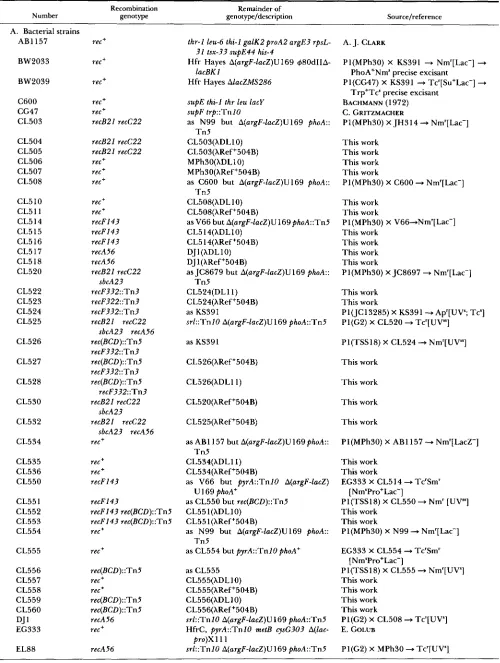
TABLE 1
Bacteria, bacteriophages and plasmids
Recombination
Number genotype genotype/description Remainder of Sourcelreference
A. Bacterial strains AB1 157 BW2033 BW2039 C600 CG47 CL503 CL504 CL505 CL506 CL507 CL508 CL5 10 CL511 CL5 14 CL515 CL5 16 CL517 CL5 18 CL520 CL522 CL523 CL524 CL525 CL526 CL527 CL528 CL530 CL532 CL534 CL535 CL536 CL550 CL55 1 CL552 CL553 CL554 CL555 CL556 CL557 CL558 CL559 CL560 DJ 1 EG333 EL88 rec+ rec+ rec+ rec+ rec+ recB2l recC22 recB2l recC22 recB2l recC22 rec+ rec+ rec+ rec+ rec+ recFl43 recF143 recF143 recA56 recA56 recB21 recC22 sbcA23 recF332::Tnj recF322::Tnj recF332::Td r e d 2 1 recC22
sbcA23 recA56 rec(BCD)::Tn5 recF332::Tnj rec(BCD)::Tn5 recF332::Tnj rec(BCD)::Tn5 recB2l recC22 recF332:Tn3 sbcA23
sbcA23 recA56 recB21 recC22
rec+ rec+ rec+ recF143 recFl43 recFl43 rec(BCD)::Tn5 recF143 rec(BCD)::Tn5 rec+ rec+ rec(BCD)::Tn5 rec +
rec +
rec(BCD)::Tn5 rec(BCD)::Tn5 recA56 rec+
recA56
thr-1 leu-6 thi-1 galK2 proA2 argE3 rpsL-
Hfr Hayes A(argF-1acZ)U 169 480dIIA-
Hfr Hayes AlacZMS286
supE thi-1 thr leu lacy supF trp::TnlO
as N99 but A(argF-lacZ)U169 phoA::
CL503(XDL10) CL503(XRef+504B) MPh30(XDL10) MPh30(XReff504B)
as C600 but A(argF-lacZ)U169 phoA::
CL508(XDL10) CL508(XRef+504B)
as V66 but A(argF-1acZ)U 169phoA::Tn5 CL5 14(XDL 10)
CL5 14(XRef+504B) DJI(XDLI0)
DJl(XRef+504B)
as JC8679 but A(argF-lacZ)U169 phoA::
CL524(DLIl) CL524(XRef+504B) as KS391
srl::TnlO A(argF-1acZ)U 169 phoA::Tn5
as KS391
CL526(XRef+504B)
CL526(XDL11)
CL520(XRef+504B)
CL525(XRef+504B)
as AB1 157 but A(argF-1acZ)U 169 phoA::
CL534(XDLll) CL534(XRef+504B)
as V66 but pyrA::TnlO A(argF-lacZ) U 169 phoA+
as CL550 but rec(BCD)::Tn5 CL551(XDL10)
CL551(XRef+504B)
as N99 but A(argF-lacZ)U169 phoA::
as CL554 but pyrA::TnlO phoA+
as CL555 CL555(XDL10) CL555(XRef+504B) CL556(XDL10) CL556(XRef+504B)
sr1::TnlO A(argF-1acZ)U 169 phoA::Tn5 HfrC, pyrA::TnlO metB cysC303 A(1ac-
sr1::TnlO A(argF-lacZ)U169 phoA::Tn5
31 tsx-33 supE44 his-4
lacBK 1
T n 5
T n 5
T n 5
T n 5
T n 5
pro)X 1 1 1
A. J. CLARK
Pl(MPh30) X KS391 + Nrn'[Lac-] +
Pl(CG47) X KS391 + Tc'[Su+Lac-] +
BACHMANN (1 972)
C. GRITZMACHER
Pl(MPh3O) X JH314 + Nm'[Lac-]
This work This work This work This work
Pl(MPh3O) X C600 + Nm'[Lac-]
This work This work
Pl(MPh30) x V66+Nm'[Lac-] This work
This work This work This work
Pl(MPh3O) X JC8697 + Nrn'[Lac-]
This work This work
Pl(JC13285) X KS391 +Apr[UVs; Tc'] Pl(G2) X CL520 + Tc'[UV"]
Pl(TSSl8) X CL524 + Nm'[UV"]
This work
This work
This work
PhoA+Nrns precise excisant
Trp+Tc' precise excisant
This work
Pl(MPh3O) X AB1 157 + Nrn'[LacZ-]
This work This work
EG333 X CL5 14 + Tc'Srn'
Pl(TSSI8) X CL550 + Nrn' [UV"] This work
This work
Pl(MPh3O) X N99 + Nrn'[Lac-]
EG333 X CL554 4 Tc'Srn'
Pl(TSS18) X CL555 ".* Nm'[UV"]
This work This work This work This work
Pl(G2) X CL508 -+ Tc'[UV"]
E. GOLUB
Pl(G2) X MPh3O + Tc'[UV"]
[ NrnSPro+Lac-]
P 1 -Enhanced Plasmid Recombination 467
Number
Recombination Remainder of
genotype genotype/description Source/reference
G2 HN356 JH314 JH 1048 JC8679
JCl3285
JH 1048 JMlOl
KK 1 KS39 1
KS469 MPh 30 N99
NlOO
TSS 18
recA56 recB21 recB21 recC22 recA3 recB2l recC22
sbcA23 recF322::Tn3
recA3 rec +
rec+ rec +
rec+ rec+
rec+
recA3
rec(BCD)::Tn5
sr1::TnlO as N99 as N99 as C600 as AB1157
argE3 his-4 leuB6 proA2 thr-1 rpsL31
lacy1 galK2 mtl-1 xyl-5 tna300::TnIO supE44
as C600
A(la~-proAB)(F'traD36proAB+) l a d q lacZ AM15
as KS391, but 1eu::TnlO
Hfr Hayes AlacZMS286 $80dII Alac-
AlacZMS286 $80dIIAlacZBKl ara
A(argF4acZ)U 169 phoA::Tn5 galK2 rpsL200
as N99
as KS39 1 ZBK 1
CSONKA and CLARK (1980) H. NASH
SMITH and HAYS (1985) Pl(N100) x C600 + Tc'[Srl-]
A. J. CLARK (GILLEN, WILLIS and CLARK
A. J. CLARK (BLANAR et al. 1984) 198 1)
Pl(N100) X JH1045 + Srl+[Tc', UV']
MESSING (1983)
KORBA and HAYS (1 980)
KONRAD (1 977)
B. KONRAD (unpublished) R. WOLF
Meselson strain 28 [Smr derivative of
W3102 (BACHMANN 1972)]
Meselson strain 152 (GOTTESMANN and YARMOLINSKY 1968)
This laboratory (T. SCHAEFER, unpub- lished)
G. SMITH V66 recF143 Rac-his-4 argA gal- rpeL x y 1 (?)F
Designation Genotype/remarks Source/reference B. Bacteriophage strains
XDL 10 XDLll XDL69
XRef+503H
XRef+504B
P1 CmO c+ PI CmO b o f l
Pl::Tn5-503
as XDL69, but lacPO lacZ,::(multirestriction site insert) WINDLE (1986) as XDL10, but restriction-site-insert in reverse orientation WINDLE (1 986)
BamlosrI(1-2)A(att+,int+) C1857 nin-5 shn6" HindIII, BamHI clon- MIZUSAWA and WARD (1980)
ref+-encoding (H2::Tn5-503) fragment from Pl::Tn5-503 inserted WINDLE and HAYS (1986) ing vector
into XDL69. High level Ref expression when depressed. Partial insensitivity to P1 regulation. T n 5 DNA fragment does not encode Nm'
mycin resistance) replacement-cloned into XDLlO at XbaI, SacI,
sites. Ref phenotype similar to XRef+503H
ref+ XbaI-Sac1 fragment from pUCl3-(B8::Tn5-504) (encodes neo- This work
Cm' N. STERNBERG
Derepressed for Ref expression N. STERNBERG (TOUATI-
Cm'Nm'. Partially depressed for Ref expression WINDLE and HAYS (1 986) SCHWARTZ 1979)
Designation Relevant properties/remarks Sourcelreference
C. Plasmids pACYC184 pCL 102 pCL103
pCL 104
pELlOl pHN915 pMB1044
pTS202 pTS2 1 1 pTS2 12 pTS221 pTS222
Cm'Tc'. Compatible with pBR322 bla+ lacZ;lr8 cat+ lor;lacZ (AprLac+Cmr)
bla+ lacZ+, bla+ l a ~ Z 6 , ~ ~ cat+ l,,r;lacZ;~5s cat+ l0T)lacZ (Ap'Lac+Cm')
bla+ lac+, bla+ lacZ;158 cat+ lo5;lacZ (Ap'Lac+Cmr) dimer. Product
bla+ lacZ;l58 lor)lacZ
bla+ tet;39 &et (but Tc')
bla+ lacZ+. Derived from pMLBlO31 (pMLB1034 with EcoRI site at bp 4305) by insertion of the 246-bp HaeIII/SmaI fragment of pUC9 containing the lac operator/promoter region into the SmaI
site
dimer. Intermolecular recombination product of pCLlO2
of pMB1044-pCL202 recombination
bla+ tet;39 cat+ &et (Tc') bla+ tet& &et
bal+ tet;lo cat+ > S t e t
bla+ tetLSl &et bla+ tet&l cat+ &et
CHANG and COHEN (1978) This work (Figure 2) This work (Figure 2)
This work (Figure 1)
H. NASH
SILHAVY, BERMAN and ENQUIST (1 984)
468 C. S. Laufer et al.
seems inherently unsuitable for mechanistic studies, because of the 2-3-day period required, the impreci-
sion of the Lac+ papillation assay, and the unwieldiness
and low copy-number of the bacterial chromosome.
Here we describe Ref enhancement of lac- X lac- and
tet- X tet- recombination in certain E . coli plasmids.
MATERIALS AND METHODS
Bacteria, bacteriophages and plasmids: These are de- scribed in Table l .
Preparation of plasmid DNA: Large-scale plasmid stocks were prepared from 200-ml cultures of appropriately trans- formed recA bacteria grown overnight at 38" in LB broth (1% Bacto-tryptone, 0.5% yeast extract, 1% NaCI). Lysis and plasmid extraction were according to the detergent- lysis procedure described by MANIATIS, FRITSCH and SAM- BROOK (1982) except that Triton X-100 (5%) was used instead of sodium dodecyl sulfate, and extraction with phenol-chloroform before (CsCI
+
ethidium bromide) equi- librium sedimentation was omitted.Crude small-scale plasmid stocks (MANIATIS, FRITSCH and SAMBROOK 1982) were extracted from 1.5-ml stationary- phase cultures grown in LB-broth plus ampicillin (40 pg per ml) at 32", by the boiling method of HOLMES and QUIGLEY (1981), with Triton X-100 ( 5 % ) substituted for sodium dodecyl sulfate. Extracts were treated successively with equal volumes of phenol and chloroform, and precipitated with ethanol.
DNA procedures: Restriction enzymes (from Bethesda Research Laboratories or New England Biolabs) were used as specified by the suppliers. For joining of DNA fragments, phage T 4 DNA ligase was used overnight at 16" under conditions specified by the supplier (New England Biolabs). To fill in restriction-fragment ends with 5' overhangs, phage T 4 DNA polymerase was employed in the presence of deoxynucleotide triphosphates as described by MANIATIS, FRITSCH and SAMBROOK (1982). XhoI linkers (p- CCTCGAGG, from New England Biolabs) were joined to restriction fragments with filled-in ends by treatment of a
1OO:l linker: fragment mixture with T 4 DNA ligase (400 units per 0.5-pg fragment). For transformation with plasmid DNA, bacteria were grown in 20-ml LB broth cultures to early exponential phase and treated with CaC12 essentially as described by MANDEL and HICA (1 974).
Measurement of recombination: &galactosidase assay: Bacteria were transformed with plasmids pELlOl or pCL102, with selection on LB-plates (LB broth plus 1.5% agar) containing ampicillin (40 pg/ml). After 48 hr at 32", multiple colonies (50-100 colonies washed from plates with 2 ml LB broth) were used to inoculate 10 ml of LB broth plus ampicillin (40 pg/ml) for overnight growth at 32 O . For
0-galactosidase assays, aliquots of these cultures were diluted 100-fold with minimal "A" medium (MILLER 1972) and grown to early exponential phase. Permeabilization with chloroform plus sodium dodecyl sulfate, and measurement of hydrolysis of orthonitrophenyl-&galactoside (ONPG), were as described by MILLER ( 1 972). Miller units represent ONPG hydrolysis rates normalized for turbidities of cell cultures, i e . , they correspond to specific activities.
Plasmid-transformation assay: Overnight cultures, grown from multicolony inocula as described above for B-galacto- sidase assays, were used for preparation of crude small-scale plasmid stocks as described above. recA bacteria (strain DJ1) were transformed with these plasmid stocks. For assaying lac- X lac- recombination, transformants were spread on McConkey-lactose plates (4% McConkey base agar, 1 % lac-
tose) containing ampicillin (40 pg per ml), and both total Ap' transformants and Lac+Ap' bacteria ~ o u n t e d . ~ For as- saying tet- X tet- recombination, transformants were spread on LB plates containing ampicillin, and on LB plates con- taining both ampicillin and tetracycline (1 2.5 pg per ml).
Southern-blot assay: Crude small-scale plasmid prepara- tions were treated with restriction enzymes and subjected to electrophoresis in 0.8% agarose (in 80 mM Tris-phosphate buffer, pH 8.0); DNA was transferred to nitrocellulose filters as described by MANIATIS, FRITSCH and SAMBROOK (1982). Prior treatment of the filters for 3-4 hr at 41 O ,
mixing with IO' cpm of radioactive probe [linear pELlOl DNA "P-labeled by the random-oligo-primer method of FEINBERG and VOGELSTEIN (1983)], hybridization overnight at 41 "C, washing of filters, and exposure to KODAK X- OMAT AR film were as described by SILHAVY, BERMAN and ENQUIST (1 984).
Determination of relative transformation efficiencies: Stocks of plasmid pMB1044 (6.5-kb Lac+ Cm" monomer) and pCLlO3 (1 7.9-kb Lac+ Cm' dimer) (see Figure 2) were used to transform strain DJ1 at a series of decreasing plas- mid:cell ratios. In the range where transformation efficien- cies were directly proportional to amount of plasmid, aver- age transformation efficiencies were: pMB1044, 4.5 X 10" CFU per pmole plasmid and pCL103, 1.0 X 10" CFU per pmole plasmid.
RESULTS
Ref-stimulated plasmid recombination: In order
to determine whether Ref activity could stimulate
recombination in which one partner was not the bac-
terial chromosome, we deleted the lacZMS286 gene
from the lac- lac- strain KS391 (creating strain
BW2033) and introduced plasmid pMB1034 (not
shown), in which lacPO and a small N-terminal portion
of lacZ are missing (SILHAVY, BERMAN and. ENQUIST
1984). Formation of Lac+ papillae by recombination
between the plasmid and the chromosomal
@80dIIAlacBK1 gene, in BW2033 (pMB1034) bacte- ria, was virtually undetectable in the absence of Ref activity: no papillae in individual colonies after 72-hr incubation, and only an occasional papilla in heavy streaks. However, BW2033 (pMB1034) (XRef+503B) lysogens showed about ten papillae per colony after only 48 hr.
In order to test lac- X lac- recombination in easily
manipulable substrates, we constructed plasmid
EL101 (Figure 1). This plasmid contains a tandem
partial duplication of the lacZ gene-a 1. 1-kb4 N-ter-
minal segment followed by a 2.0-kb C-terminal seg-
ment-and thus can become lac+ only by break-and-
join "splices" (STAHL 1979) within the 1 .O-kb (ClaI-
SacI) overlap region ('lacz') (Figure 1). Recombina- tion of PEL 10 1 was assayed in two ways: transforma-
resistant, sensitive, to ampicillin, chloramphenicol, neomycin, streptomycin, Abbreviations used: Ap', Ap'; Cm', Cm'; Nm', Nm'; Sm', Sm"; Tc', Tc':
tetracycline, respectively. CFU: colony-forming units. kb: kilobase pairs. lac',
T4
P 1 -Enhanced Plasmid
lac'/
,
H 3 ( b p 20)c/al restriction/ lacy' Sac1 restriction
I polymerase
J
I
Hind I 1 1
restriction/
H 3
I
\
Xh
I
I\
Hindlllrestriction Fragment
\
isolotion H 31954 bp
/
'x
f
lacP0
p E L l O l Xh-
7.6 k b 'lac2
lacy' Sa
FIGURE 1 .-Construction of the 1acZ"lacZ plasmid pELl0 I . De- tails of procedures are given in MATERIALS A N D METHODS section:
Sac1 or Clal restriction of plasmid pMB1044; treatment with phage T 4 DNA polymerase in the presence of deoxynucleotide triphos- phates to produce blunt ends; HindIll restriction; isolation of large HindlII-blunt (Clal) and small Hindlll-blunt (SacI) fragments by
agarose-gel-electrophoreses and electroelution; ligation of a mix- ture of the isolated fragments and Xhol linkers (phosphorylated by treatment with phage T 4 polynucoleotide kinase in the presence of ATP): transformation of recA bacteria (strain J H 1048). pooling of Ap' transformants, small-scale extraction of plasmid DNA, trans- formation of AlacZ recA56 bacteria (EL88): screening of small-scale plasmid preparations from cultures grown from individual colonies by Xhol and EcoRI-plus-Hindlll restriction and agarose-gel electro- phoresis. (o), lac DNA (lacZ', bp 1-21 58; 'lacZ, bp 1051-bp 3350).
o,
204-bp multirestriction site insert (HindllI, P s t l , Sall, EamHI, Smal, EamHI) replacing codons 5 through 8 of the lacZ structural gene, in frame (SILHAVY, BERMAN and ENQUIST 1984). (CXh),Xhol linker, CCTCGAGG. Restriction-enzynle sites: H S , Hindlll;
CI, Clal; Sa, Sacl. Ap', ampicillin-resistance determinant.
tion of recA AlacZ bacteria with small-scale plasmid
preparations made from liquid cultures grown from colonies washed off plates, and direct measurement of &galactosidase in similarly obtained log-phase cul-
tures (Table 2). By both assays, Ref enhanced lac- X
lac- plasmid recombination about fivefold. In recB recC cells, lac- X lac- plasmid recombination, Ref-
stimulated or not, was about the same as in rec+
Recombination 469
TABLE 2
Recombination of plasmid pEL102
Frequency of Lac+- 8-Galactosidase plasnlid transform- Pertinent pheno- specific activity ants ;unong Ap' Strain type (Miller units) (X lo')
CL506 Rec' Ref" 1 2 f 1 0.16 CL507 Rec'Ref' 71 f 9 0.85 CL504 Rec(BCD)- Ref" 1 2 f 3 0.12
CL.505 Rec(BCD)- Ref' 85 f 5 0.63
-
1.arge-scale preparation of purified stocks of plasmid pEl.101 from r d bacteria (strain DJI). transformation of the indicated bacterial strains to ampicillin resistance and plate-growth a s indi- cated. @-galactosidase assays on liquid cultures grown 4 hr from cells washed off plates, small-scale plasmid preprations from same cultures after overnight growth. transformation of recA AlacZ bac- teria (strain Djl). and spreading on XGal-ampicillin plates were a s
described under MATERIALS A N D METHODS. &Galactosidase specific activities (Miller units) are averages of values for two different original transformation plates for each strain (range indicated). Lac' plasmid frequencies are mong 4800 (CL506). 1400 (CL.507). 1700 (CL504). and 3700 (CL505) total ampicillin-resistant (Ap') colonies scored.
bacteria, unlike lac- X lac- chromosomal recombina-
tion, which appears mostly RecBCD-dependent (WIN- DLE and HAYS 1986).
Analysis of the structures of recombinant plas- mids: Plasmid pELlOl (Figure 1) can yield a Lac'
product by either intramolecular or intermolecular
recombination. T h e respective products, lac+ mono-
mers and dimeric plasmids encoding lac+ and
1acZ"lacZ"lacZ genes (lac+, 1acZ"lacZ"lacZ dimers), are readily distinguished by physical analysis. We used
plasmids extracted from Rec+Ref+ cultures (strain
CL507) to transform recA AlacZ bacteria (strain DJ1).
T h e structures of plasmids obtained from a few Lac+ transformants selected at random were analyzed by
HindIII and XhoI restriction and agarose gel electro-
phoresis. Of five plasmids analyzed, four were lac+
monomers and one was a lac+, 1acZ"lacZ"lacZ dimer
(data not shown).
T o facilitate further product analysis, we con-
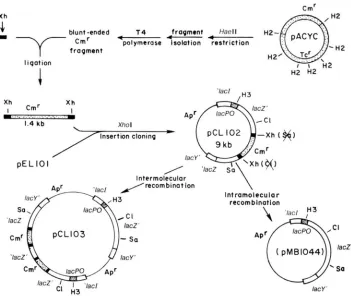
structed plasmid pCLlO2 by inserting a fragment
encoding cat (chloramphenicol resistance) into
PEL1 01 (Figure 2). T h e product, pCLlO2, yielded
both Lac+Cms products, presumably by intramolecu-
lar recombination, and Lac+Cmr products (e.g.,
pCL 103), presumably by intermolecular recombina- tion, with a small bias towards the latter (Table 3). A
number of colonies, obtained by transformation of
recA mutants with plasmids originally extracted from
Ref+ cultures, were used to prepare plasmids for
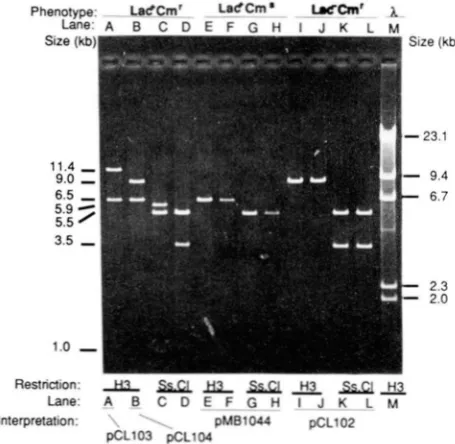
analysis by HindIII and SstI-plus-ClaI restriction and agarose gel electrophoresis (Figure 3). All (4/4) of the CmsLac+ plasmids analyzed yielded the restriction pat- tern expected for an intramolecular recombinant
(pMB1044). Analysis of two CmsLac+ plasmids is
shown in Figure 3: Hind111 restriction yielded a 6.5-
470 C . S. Laufer et al.
Cm' Xh
J.
blunt -ended T 4- e fragment
-
Haellpolymerase isolation restricttan
liqation
H i A2 H2
Xh
Insertion cloning pCL 102
p E L l O l
Intramolecular recornblnation
AP
\
'0:;:
'lac/ ,"3(pMB1044)
lacy'
FIGURE 2.-Construction and recombination of plasmid pCL 102. Details of construction procedures are given in MATERIALS A N D METHODS
section: Hue11 restriction of plasmid pACYC184 and isolation of 1.4-kb Cm'-encoding fragment by agarose gel electrophoresis and electroelution; treatment with phage T 4 DNA polymerase to create blunt ends: ligation to Xhol linkers (CCTCGAGG): XhoI digestion of Cm' fragment and ligation with Xhol-digested pCLIOI: transformation of J M l O l bacteria and selection of Ap'Cm' colonies: screening of small-scale plasmid preprations by Xhol restriction and agarose-gel electrophoresis. pCL101 and pMB1044 are products expected for intermolecular and intramolecular recombination within facZ. respectively. (0). lac DNA (facZ', bp 1-2158; 'facZ', bp 1051-2158: 'facZ, bp 1051-3350). (Ed), in-frame multi-restriction-site insertion in facZ (see legend to Fig. 1). (W-Xh), Xhol linker, CCTCGAGG. (0, Cm'-encoding 1.4-kb fragment from pACYC. Restriction enzyme sites: H2, Haell; Xh, Xhol; CI, Clal; S a , S a d :
H,
H,
sites destroyed by DNA polymerase fill-in; H3, Hindlll.TABLE 3
Analysis of products of recombination plasmid pCL102
Correcred ratio
Lac+/totnl Lac+Cm'/Lac+
Strain Phenotype Total Lac+ (XIO') Lac+Cm' (X IO')
CL510 Rec+Refo 1.8 X I O 4 17 0.09 9 20 CL511 Rec+Ref+ 6.6 X 10' 50 0.76 31 26
Large-scale preparation of a purified stock of plasmid pCLIO3 from recA bacteria (strain DJ 1). transformation of indicated bacteria to ampicillin resistance, growth on plates at 32" for 48 hr, multi- colony inoculation into broth, overnight growth. transfer and growth for 4 hr in fresh broth, small-scale plasmid extraction, transformation of tecA AlacZ bacteria (strain DJ1) to ampicillin resistance on McConkey-lactose plates and scoring of Lac+ colonies were as described under MATERIALS A N D METHODS. Colonies were tested for chloramphenicol resistance ( C d ) by toothpicking onto LB plates containing the drug (30 pg/ml). Ratio of Lac+ Cm'among total Lac+ transformants was corrected for the relative transfor- mation efficiencies of pMB1044 (Lac+Cm') and pCL103 (Lac'Cm'):
4.5 X 10l2 CFU per pmole plasmid and 1.0 X 10" CFU per pmol
plasmid respectively (see MATERIALS A N D METHODS).
kb HindIII-restricted parental pCLlO2 (lanes I, J),
and SstI(Sac1 isoschizomer)
+
ClaI restriction (lanesG , H) yielded the 1.0-kb fragment interior to lac+
(designated 'lacZ') plus the 5.5-kb fragment (common
to all plasmids) that encodes the vector backbone and
the N- and C-terminal lac portions that flank 'lacZ',
rather than the 3.5-kb 'lacZ'cut+'lacZ' fragment from
pCL 102 (lanes K, L).
Of four apparent intermolecular recombinant
(Cm'Lac+) plasmids, three appeared similar to
pCL103, and one yielded the restriction pattern ex-
pected for a double recombinant. A sample of each
was analyzed (Figure 3): the pCLlO3-type molecule was cut by HindIII nuclease into 6.5-kb and 11.4-kb
fragments (lane A) (corresponding to the size of two
9.0-kb pCL102 monomers), and
SstI
+
ClaI restric-tion (lane C) yielded the 1.0-kb 'IacZ' fragment, two copies of the 5.5-kb backbone fragment, and a 5.9-kb
fragment that encodes 'lacZ'cat+'lacZ'cat+'lacZ'; the
apparent double recombinant, designated pCLlO4,
was cut by HindIII into 6.5 and 9.0-kb fragments
(lane B) that correspond to complete copies of
pCLlO2 (lanes I, J) and pMB1044 (lanes E, F), and
SstI
+
ClaI restriction yielded the 1.0-, 3.5- and 5.5-kb (double) bands (lane D) expected for a pCL102-
pMB1044 cointegrate (compare with lanes G , H and
K, L), or for an intramolecular recombinant of
PI-Enhanced Plasmid Recombination 47 1
Phenotype: -La@Cm\ -La@cm?
-"'
2 -L a n e : A B C D E F G H I J K L M
Sire (kb) Sire (kb)
-
23.1 11.4- ,
9.0
-
-
9.46.5
-
5.9-
3.5
-
5.5 0
6.7
-
2.0 2.3Restriction: .&Q & && &
Lane: A B C D E F G H I J K L M
Interpretation: \ '.., pMB1044 pCL102 PCL103 pCL104
FIGURE 3.-Restriction analysis of pCLI02 recombination. Strain DJ 1 (RecA-) was transformed with pCLl02 plasmids propa- gated i n strain CL511 (Rec'Ref'), as described in the legend to Table 3. Four colonies displaying each indicated phenotype were randomly selected for extraction of plasmids and analysis by Hind1 I I (H3) and Sstl
+
Clal (Ss, CI) restriction, electrophoresis in 1 %agarose and ethidium bromide staining. Representatives of each of the three recombinants identified (pMB1044, pCLl03, pCL104: see text), as well as pCLIO2 parental plasmids, were re-analyzed simultaneously, along with Hindlll-digested phage X DNA.
result of one of two well-defined homologous recom- bination events.
Ref-stimulated plasmid and chromosomal recom- bination in rec mutants: Most homologous recombi-
nation processes in E . coli are completely RecA-de-
pendent or nearly so, but some, e.g., Hfr conjugational
recombination (CLARK 1973). are highly RecBCD-
dependent, whereas others, e.g., some plasmid recom-
bination processes (JAMES, MORRISON and KOLODNER
1982), are highly RecF-dependent. We tested the
ability of Ref activity to stimulate recombination of plasmid pCLlO2 in various mutant bacteria (Table 4).
As expected, plasmid recombination was RecBCD-
independent and mostly RecF-dependent. Ref not
only stimulated plasmid recombination about fivefold in Rec+ and Rec(BCD)- bacteria, but also stimulated the residual recombination in RecF- cells. We do not know whether this last result reflects leakiness of the
recFI43 mutation or stimulation of some RecF-inde- pendent plasmid recombination process. T h e low re-
combination in recA cells was not increased by Ref
activity. Similar results were obtained when pELlO 1
plasmids were propagated in Ref' and Ref+ bacteria
and transformed into DJ1 (recA AZac) for detection of
Lac+ plasmids: the Lac+ frequencies among plasmids
propagated in
ret+
(CL5 10) and recB recC (CL504)Ref" control bacteria were about the same, and were
elevated four- to sixfold in the corresponding Ref+
TABLE 4
Recombination of plasmid pCL102 in rec mutants
Relative Control ReT+ Recombination
Kef
strain" srralnb phenotype recon1hin;ltion' f;Ictord
plasmid stinlul;lrion
CL557 CL558 Rec' ( 1 ) 6 2 2 CL.5.59 CL56O Rec(BCD)- 1 2 0 . 5 4 f I CL.515 CL516 RecF- 0.1 f 0.1 4 2 I
CL517 CL.518 RecA- 0.05 & 0.1 0.8 f 0.2 CL520 CL5S0 Rec(BCD)-. SbcA 5 f 2 2 & 0.5 CL525 CL532 Rec(BCD)-, SbcA 3 2 2 0.9 & 0.2
RecA-
Plasmid pCLI02 purified from recA bacteria ( D J l ) was used to transform the indicated strains to ampicillin resistance. Colonies were grown on rich plates at 32" for 48 hr. From 50 to 200 transformant colonies were mixed together in LB broth and used to inoculate LB broth supplemented with ampicillin for overnight growth at 32". This overnight culture was used to inoculate minimal medium A for growth at 92" for 4 hr. Aliquots of these cultures were used in /%galactosidase assays as described under MAI'ERIALS A N D METHODS. Data correspond to averages for three to four trials. Standard deviations are indicated.
*
Lysogenic for XRef'504B. Lysogenic for XDLIO.Rltio of specific &galactosidase activity to that of wild-type Ratio of specific &galactosidase activity of Ref' strain to that strain.
of Ref" control.
derivatives (CL511, CL505); the low residual recom-
bination in a recF mutant (CL515) was elevated four-
fold in the Ref+ derivative (CL516), but propagation
in the corresponding recA pair (CL517, CL518) re-
sulted in very low recombination and no Ref stimula- tion.
In order to verify that /3-galactosidase measure-
ments and Lac+-plasmid transformation frequencies corresponded at least qualitatively to intracellular plasmid distributions, populations extracted directly
from rec- (pCLlO2) and
ret+
(pCLI 02) bacteria wereanalyzed en masse, by ClaI-plus-SstI restriction, gel
electrophoresis and "Southern" blotting with a
pCLlO2 probe (Figure 4). Fragments corresponding
to the 1acZ"ZacZ parent pCL102 (5.5 and 3.5 kb), and
unique fragments corresponding to pMB 1044-type
intramolecular recombinants (1 .O-kb: Figure 4, lane
K; see also Figure 3, lane G ) and pCL103-type inter-
molecular recombinants (1 .O, 5.9 kb: Figure 4, lane
A; see also Figure 3, lane C) were readily distinguished
from one another. By this technique we detected no
recombinant bands among plasmids from recA and
recF rec(BCD) bacteria (Figure 4, lanes J, H, I) and
faint recombinant bands among RecF- plasmids (lanes
F, G ) . (This is more obvious in autoradiograms ex- posed for longer times.) In plasmid populations from
rec+ (lanes D, E) and rec(BCD) (lanes B, C) bacteria,
the recombinant bands were relatively prominent.
Increases in recombinant bands in the presence of Ref
activity could be detected for
ret+
bacteria, where thebands were not too dark (lane B us. C, 5.9 kb; lane D
472 C . S. Laufer PI al.
Rec phenolype: (BCD). Rec' F ' FlBCD[ d
Ref phenotype: (pCL103) + 0 + 0 + 0 + 0 0 (pMB1044)
Lane. A B C D E F G H I J K Size (kb)
-
5 90 0 -
-
-
1.0FIGURE 4.-Southern blot analysis of pCL102 recornhination in rtc nlutmts. Propagation of various strdins containing pCLI 02 and lysogenic for XDLl 1 (or XDLIO) or for XRef+504B. extraction of plasnlids. Hindlll
+
Ssfl restriction, electrophoresis. transfer of hmds to filter paper and hybridization with a pELl0I probe were as described under MATERIALS A N D METHODS. Lanes correspond to the following strains: B, CL560; C. CL.5.59; D. CL5.58; E, CL557;F, CL.5 16; G , CL5 15; H, CL.533; I . CL.552: J. D J 1 ( n o X prophage). I.;lnes A and K contained pCL104 and pVB1044 DNA, respec- tivelv.
exposed autoradiograms (not shown). However, this
technique is neither as sensitive nor as quantitatively
accurate as the &galactosidase or plasmid-transfor-
mation assays. Recombinant bands were also detected
in plasmids extracted from recA recB recC sbcA and
recB recC sbcA bacteria (data not shown).
We previously observed that both Ref-independent
and Ref-stimulated lac- X lac- chromosomal recom-
bination (Lac' papillation) mostly required RecBCD
function, but that the residual recombination in recBC
mutants was Ref-enhanceable (WINDLE and HAYS
1986). Here we tested the effect of Ref activity on
lac- X lac- chromosomal recombination in recF, and
recF rec(BCD) mutants (data not shown). T h e recF
bacteria (CL522, CL523) behaved similarly to
ret+
bacteria with respect to both unstimulated and Ref-
stimulated (about 50-fold) levels of Lac+ papillation.
T h e corresponding recF rec(BCD) derivatives CL527
and CL528, showed greatly reduced, but Ref-en-
hanceable, recombination (no Lac+ papillae and about
one-half papillae per colony, respectively). T h u s Ref
stimulates recombination in the absence of RecBCD
functions, in the absence of RecF functions, and in
the apparent absence of both. In the last case we have
not ruled leakiness of the rec mutations.
Although Ref activity did not stimulate the residual
plasmid recombination in recA bacteria (Table 4, line
4), it seemed possible that more efficient RecA-inde-
pendent processes might be enhanceable. Plasmid re-
combination in sbcA bacteria (ret+ or recA) is thought
to proceed via a RecA-independent RecE-dependent
process (FISHEL, JAMES and KOLODNER 1981). We
found lac- X lac- plasmid recombination to be more
efficient in recB recC sbcA than rec+ bacteria. Ref did
u
"l.1 Ip n z m
FIGVRE .5.-Construction of ret' 'let plasmids. Details of proce- dures are given i n MATERIALS AND METHODS section. Plasmids
pTS221 and pTS222: PstI
+
Xhol restriction of pRDK58 and pRDK37 and electrophoresis-electroelution isolation of snlall( l ~ l a ' t t - t l ~ , ) and large ('bla,&et) fragments. respectively; ligation. transformation of recA bacteria and isolation of Ap' Tc' transform- ants; verification of pTS22 1 structure (bla+tefL, ,&el) by restriction analysis. including presence of Xhol site; isolation of small Xhol
fragment (encoding cat+) from pCLl02 and insertion into Xhol site of pTS221; transformation of recA bacteria and selection for Ap'CnVTc' transformants; verification of structure of plasmid pl'S222 (bla+ f e h r cat+ &et) by restriction analysis. Plasmids pTS2 1 1 and pTS2 12: Nrul restriction of pBR322 and brief h'nl5 1
digestion (estimated end-point at bp 970); digestion with SI endo- nuclease and fill-in using E. coli DNA polymerase Klenow fragment; attachment of Xho linkers (CCTCGAGG), ligation and transfor- mation of strain C600; identification of Ap'Tc' transfornlants and demonstration of Xhol sensitivity of corresponding plasmid (pTS1 10); PsfI
+
Xhol treatment of pTSl 10 and isolation of 'blu ttt;;,, fragment; ligation of 'bla f e 1 4 ~ ~ to bla' ,&et fragment from pRDK57 (see above); isolation of bla+ tef& J&f pl;lsmid pTS2I 1as for pTS22 1 above; insertion of cat+ Xhol fragment from pCl.102 into pTS2I 1 to produce bfa+ cat+ ,,:ref plasnlid pTS212. as for pTS222 above. Construction of pTS202: insertion of Xhol rut+
ftxgment from pCLI02 into pHN915 to produce bla' t t h caf+ plasmid pTS202. as for pTS2 I2 above.
not enhance recombination in recA recB recC sbcA cells
and only slightly stimulated that in recB recC sbcA
mutants (Table
4).
Similar results were obtained usingp E L l 0 1 plasmids (data not shown). In these experi-
ments the observed Ref stimulation of recombination
in the control strain (CL536) (data not shown) ruled
out any requirement for the cryptic Rac prophage
(Low 1973), present in many E. coli K-12 strains but
absent from AB1 157 and its derivatives (KAISER and
MURRAY 1979).
T h e UV-sensitivity of recB recC mutants is reversed
by sbcA and sbcB mutations, concomitant with resto-
ration of recombination proficiency (BARROUR et al.
1970; KUSHNER et al. 197 1). Presumably some recom-
P 1 -Enhanced Plasmid Recombination 473
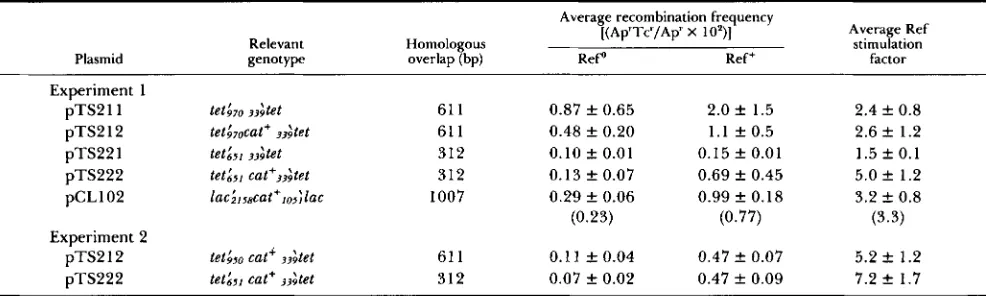
TABLE 5
Recombination of tet' bet plasmids
Plasmid
Relevant genotype
Average recombination frequency
Homologous
overlap (bp) Ref' Ref+
[(Ap'Tc'/Ap' X lo')] Average Ref stimulation
factor
Experiment 1 pTS211 pTS2 12 pTS221 pTS222 pCLlO2
Experiment 2 pTS2 1 2 pTS222
t e t h &et 61 1 0.87 f 0.65 tet&Ocat+ &et 61 1 0.48 f 0.20 tet&, &et 312 0.10 f 0.01 tetilf cat+&et 312 0.13 f 0.07 lac;ljscat+lo5;lac 1007 0.29 f 0.06
(0.23)
tet& cut+ &et 61 1 0.1 1 f 0.04
tet& cat+ &et 312 0.07 f 0.02
2.0 rt 1.5 1 . 1 rt 0.5 0 . 1 5 f 0.01 0.69 f 0.45 0.99 rt 0.1 8
(0.77)
0.47 f 0.07 0.47 f 0.09
2.4 f 0.8 2.6 f 1.2 1.5 f 0.1 5.0 f 1.2 3.2 f 0.8 (3.3)
5.2 1.2
7.2 f 1.7
Plasmids were prepared from recA bacteria UH 1048) and transformed into C600 for selection by growth for 16 hr on LB plates containing ampicillin (50 rg/ml). Colonies (about 500) were washed off plates with broth. Resuspended cultures were used for preparation of crude small-scale plasmid stocks; these were used to transform JH1048 cells. Transformants were spread on plates containing ampicillin and ampicillin plus tetracycline (12.5 Pg/ml) for determination of the recombination frequency, defined as the fraction of tetracycline-resistant bacteria (Tc') among ampicillin-resistant (Ap"). Data correspond to average from four (experiment 1 ) or three (experiment 2) recA transformations with each crude plasmid preparation, standard deviations are indicated. For pCL102, data in parentheses correspond to
frequencies calculated from sum total Ap' and Ap'Tc' bacteria for all trials.
damaged DNA (RUPP et al. 1971) is abolished. We
observed no significant change in the UV-sensitivity of re#, r e d recC, or recF recB r e d mutants in the presence of a XReff prophage, in contrast to the Ref
effects on lac- X lac- recombination described above
(data not shown). Thus in this respect Ref activity
does not replace RecBCD function or compensate for its absence.
Ref stimulation of (tet-)' plasmid recombination:
In order to determine whether Ref stimulation was
specific for the lac sequences involved in the plasmid
and chromosomal recombination processes described
above, we constructed (tet-)' plasmids analogous to
PEL1 01 and pCLl02. In this case the availability of
plasmids with unique XhoI linkers inserted into the tet
gene at several different TaqI sites (DOHERTY, MOR-
RISON and KOLODNER 1983) made it possible to con- struct substrates with different lengths of homologous overlap and with different homologous-overlap se-
quences of the same length. T h e N-terminal tet-frag-
ments used are designated as t e t b , tet&9.
.
.
.
, depend-ing on the site of the XhoI linker, and the C-terminal
fragments similarly as .&et, &et. T h e construction of
the tetAsj 33;tet plasmid pTS22 1 (analogous to
PEL1 01), and the tetAsj cat+ 39$et plasmid pTS222
(analogous to pCL102) is diagrammed in Figure 5.
T h e results of experiments in which (tet-)' plasmids
were propagated on rec+ bacteria in the absence and
presence of Ref activity, and the frequency of tet+
plasmids was assayed by extraction of plasmids, trans-
formation of recA bacteria, and selective plating, ap-
pear in Table 5. Ref activity stimulated recombination of tet'cat+'tet plasmids about as well as it stimulated
pCL 102 recombination. Thus it appears that Ref stim-
ulation is not markedly sequence-specific. Ref stimu-
lation may increase with decreasing length of homol- ogy when the recombining sequences are relatively
far apart (compare lines 2 and 6 with lines 4 and
7
inTable 5). [Note that in the case of pTS211 and
pTS221 (Table 5, lines 1, 3), the decrease in homol- ogy was accompanied by a 50% reduction in the
spacing between the tet homologies, and the recom-
bination frequency decreased significantly. In both
pTS212 and pTS222 (lines 2, 4) the homology-ho-
mology separation is relatively large, because of the
intervening cat+ segment.]
T h e tet$Js &et plasmid pHN9 15 confers tetracycline
resistance, most likely because tet;39 encodes pret (but
not a complete tet gene) and 2itet encodes translation
signals and the entire tet coding sequence (but not a
promoter). Insertion of the cat+ fragment, forming
pTS202, nearly eliminates tetracycline resistance, pre- sumably because p,,,-initiated transcription is termi- nated. Ref increased the apparent recombination fre- quency of pTS202 about fourfold. However, there was a background of many very small colonies when cells transformed with pTS202 were spread on tetra-
cycline plates. Since a little
p,,,
transcription may leakthrough the Cm' fragment, and there may be a high
background of nonrecombinational events that in-
crease the leakage, the apparent Ref stimulation factor for pTS202 may be too low. However, this plasmid does provide a third sequence, distinct from those in
pTS221 and pCL102, whose recombination is Ref-
stimulated.
In plasmid pRDK41, the t e t : : X h ~ I ~ ~ plasmid
pRDK35 is joined in tandem to the tet::Xh01~~~7 plas-
mid pRDK39 (DOHERTY, MORRISON and KOLODNER
1983). Ref stimulated formation of Tet+ plasmids
474 C. S. Laufer et al.
(pRDK41) bacteria on solid and liquid media (data not shown). Here the various Tet+ recombinant prod-
ucts that can be formed (DOHERTY, MORRISON and
KOLODNER 1983)-monomers; tet+, tet::XhoI23:Xh01~2~,
dimers; gene-conversion dimers such as tet+, tet::Xho12’; higher-order oligomers-were not distin- guished.
Transcription and lac- X lac- recombination: Ko-
BYASHI and IKEDA (1977) reported that rifampicin
inhibited recombination between X bacteriophages in
the presence of chloramphenicol, and inferred that
transcription was stimulating recombination. Thus
putative differences in transcription activity might
explain the differences between the extent of Ref
stimulation of (lac-)’ plasmids and (lac-)’ bacterial
chromosomes. However, we found that during growth
in TBY broth or glycerol-minimal medium, addition
of the lac inducer IPTG had no effect on the fre-
quency of lac- X lac- chromosomal recombination in
KS39 1 bacteria, as determined by subsequent plating on McConkey-lactose plates (Lac+ cell frequency was
about 1 0-5 after growth without lac induction or after
growth in the presence of three different concentra- tions of IPTG). We also tested the effect of Ref activity
on l a d + expression, both repressed and IPTG-in-
duced, with negative results: &galactosidase synthesis during growth in the absence of Ref (strain N99) in
glycerol-minimal medium was 2.3 f 0.1 without IPTG
and (1.9 f 0.2) X lo3 (average for two cultures) in
0.1 mM IPTG; in the presence of Ref activity
[N99(XRef+504B)] the corresponding values were 1.3
f 0.1 and (2.5 f 0.1) X 10’ (averages for four cul-
tures). Thus transcription of genes and Ref stimula- tion of recombination within them appear uncoupled.
Recombination processes not markedly stimu-
lated by Ref expression: We have previously reported that several RecA-dependent recombination proc-
esses-e.g., excision of a phage X tandem duplication,
reassortment of genetic markers by IS1 x IS1 recom-
bination in a P7-P1 hybrid phage, precise excision of a 1acZ::TnlO insertion-were stimulated less than two-
fold by Ref activity (WINDLE and HAYS 1986). We
sought further information about possible specificity of Ref stimulation by testing a variety of additional recombination processes, focusing on relatively effi- cient processes in which the DNA structure of at least
one recombining partner was in other than closed
duplex form, and thus might be presumed to be
already activated for recombination.
Two extensively studied recombination processes
affecting the E . coli chromosome, those associated with
Hfr conjugation and with P1 transduction, involve
DNA structures thought to be recombinagenic: tem-
porarily single-stranded regions in Hfr DNA and lin- ear duplex DNA, respectively. We compared linkage of pyrA::TnlO to other donor alleles, at both nearby and more distant loci, in conjugal crosses between the
Hfr donor EG333 and strain AB1 157 lysogenic for
either XDLl 1 or XRef+504B. T h e respective frequen-
cies of pyrA::TnlO transconjugants carrying donor
alleles in the Ref’ and Ref+ crosses were: thr’, 96%
and 95%; leu+, 93% and 87%; met-, 94% and 99%;
lac-, 74% and 64%. Linkages between pairs of auxo- trophic markers appeared normal in both cases, and yields of total tetracycline-resistant transconjugants differed by less than a factor of two. In the case of P 1 -mediated transductions, using phages grown on strain K K l , both the yield of leu::TnlO transductants
and the linkage between the leu and ara loci were
measured in recipients lacking Ref activity [strain KS469 and KS469 (DLlO)] and in those producing
high levels of Ref activity [KS469 (XRef+503H)]. T h e
number of 1eu::TnZO transductants varied less than
twofold among the three recipients, and the respective
frequencies of co-transduction with ara+ were 68%,
60% and 74%, respectively. In another experiment, we used P1 phages grown on AlacZMS286 phoA::Tn?
or AZacZBK1 trp::TnlO bacteria for transduction of
KS391 derivatives. Here the exchanges involve the same chromosomal lacZ- genes whose recombination with one another is stimulated two orders of magni- tude by Ref activity. Nevertheless, the presence of Ref in the recipients did not affect transduction effi- ciencies (data not shown). We conclude that Ref activ- ity does not significantly increase either conjugational
or transductional recombination frequencies.
Although Ref does not appear essential for normal
lytic growth or lysogeny, in E . coli at least, Ref-stimu-
lated recombination could play a role in resistance of P1 to DNA damage, as RecA-dependent daughter-
strand-gap repair does in E . coli (RUPP et al. 1971).
However, the yield from infections with UV-irradi- ated phages did not vary markedly (twofold at most) as a function of multiplicity (0.2-10 phages per cell)
[“multiplicity reactivation” (HUSKEY 1969)], and ref+
phages showed at most a twofold increase over ref-
phages in survival at higher multiplicities.
DISCUSSION
Ref activity significantly stimulated recombination of several different well-defined plasmid substrates. In the case of (lac-)’ plasmids, substantially similar results were obtained using two different recombina-
tion assays-segregation of plasmids by extraction from
cells and transformation of recA cells, and measure- ment of @-galactosidase-and the intracellular presence of appropriate plasmids was verified qualitatively by Southern blotting of plasmid populations. Measure-
ment of @-galactosidase is much more rapid than seg-
regation of plasmids by transformation and is more
P 1 -Enhanced Plasmid Recombination 475
The key observations are the following: (1) Ref stimulated plasmid recombination in strains other than KS391, the strain in which the Ref effect was
discovered (WINDLE and HAYS 1986).
(2)
Ref stimu-lated both lac- x lac- and tet- X tet- plasmid recom-
bination. (3) Ref stimulated intramolecular and inter-
molecular processes. (4) Ref stimulated RecF-depend-
ent plasmid recombination. It also stimulated
chromosomal recombination in recF bacteria, a proc-
ess thought to depend on RecBCD function (ZIEG and
KUSHNER 1977). ( 5 ) Four processes thought to involve
DNA already activated for recombination-conjugal
recombination, P 1 transduction, multiplicity reacti-
vation of UV-irradiated phages, and RecE-dependent
plasmid recombination (in recB recC sbcA mutants)-
were not affected by Ref activity. (6) Ref stimulated
lac-
x
lac- plasmid recombination three to six-fold,but stimulated lac- X lac- chromosomal recombina-
tion 20-100-fold (WINDLE and HAYS 1986), even
though the propagation times and conditions for the two measurements were about the same.
At what stage(s) in recombination processes does
Ref act? Several observations argue that Ref mediates an initial activation step that increases substantially the amount of recombinagenic DNA that is a substrate for “recombinases” (products of genes implicated di-
rectly in recombination). First, if RecF and RecBCD
functions may be presumed to act after activation [except perhaps in the case of RecBCD and Chi sites
(TAYLOR et al. 1985)], because they are each impli-
cated in several different recombination processes
(presumably involving different activated substrates), then the fact that Ref stimulates both RecF-dependent and RecBCD-dependent processes suggests a role for
Ref in activation. Second, Ref fails to significantly
stimulate recombination processes for which activated substrates are thought to be already present-conju-
gation (single-stranded Hfr DNA), P1 transduction
(linear duplexes), multiplicity reactivation (daughter- strand gaps in replicated UV-irradiated DNA), plas-
mid recombination in recB recC sbcA bacteria (3’-OH
single-stranded ends?). Third, Ref stimulates both in- tramolecular and intermolecular processes.
None of the above considerations rule out involve- ment of Ref in some rate-limiting postactivation step common to RecF- and RecBCD-dependent processes, heteroduplex repair, for example. What is the evi-
dence that activation is in fact rate-limiting in E. coli
recombination? First, metabolically inert X phage
DNA is a poor recombination substrate (HAYS and
BOEHMER 1978). Second, mutants hyper-rec for chro-
mosome recombination have invariably proved to be defective in DNA metabolism rather than being re-
combinase overproducers (KONRAD 1977; ZIEG, MA-
PLES and KUSHNER 1978). Third, massive overpro-
duction of known recombinases increases X phage
recombination relatively little (KORBA and HAYS
1980; ZAGURSKY and HAYS 1983). (Similar studies
have not been performed for plasmid recombination.) Thus the activation stage is a likely target for recom- bination-enhancing activities.
Why does plasmid recombination seem so much less
Ref-sensitive than chromosomal recombination? This may not actually be the case. The frequency of Ref- dependent chromosomal recombination (Lac+ cells) during overnight colony growth and subsequent over-
night growth in broth is about (WINDLE and
HAYS 1986), whereas the frequency of recombinant
plasmids in Ref + cells propagated under roughly sim-
ilar conditions is about lo-* (Tables 4 and 5). A
judgement as to whether Ref stimulates plasmid or
chromosomal recombinations more efficiently de-
pends on whether stimulation factors or absolute Ref-
dependent frequencies are compared. If Ref activates DNA for recombination, as we argue above, then it
appears that it activates plasmids more efficiently than
it activates bacterial chromosomes. Although there
are other efficient activation mechanisms for plasmids,
there appear to be none such for chromosomes. Thus Ref-activated plasmid recombination is a physiologi-
cally significant process whose “signal” relative to Ref-
independent “noise” is low but acceptable. Since plas- mids offer many experimental advantages, they seem the best choice for further study of Ref recombina- tion-stimulation mechanisms.
This work was supported by National Institutes of Health grants GM 22585 and GM 33236 to J.B.H. This is technical report No. 8678 from the Oregon Agricultural Experiment Station.
LITERATURE CITED
BACHMANN, B., 1972 Pedigrees of some mutant strains of Esche- richia coli K-12. Bacteriol. Rev. 3 6 525-557.
BARBOUR, S. D., H. NAGAISHI, A. TEMPLIN and A. J. CLARK, 1970 Biochemical and genetic studies of recombination pro- ficiency in Escherichia coli, 11. Rec+ revertants caused by indirect suppression of Rec- mutations. Proc. Natl. Acad. Sci. USA 67:
BLANAR, M. A., S. J. SANDLER, M.-E. ARMENGOD, L. W. REAM and A. J. CLARK, 1984 Molecular analysis of the recF gene in Escherichia coli. Proc. Natl. Acad. Sci. USA 81: 4622-4626. CHANG, A. C. Y., and S. N. COHEN, 1978 Construction and
characterization of amplifiable multicopy DNA cloning vehicles derived from the P15A cryptic miniplasmid. J. Bacteriol. 1 3 4
CLARK, A. J., 1973 Recombination deficient mutants of E. coli
CSONKA, L. N., and A. J. CLARK, 1980 Construction of an Hfr strain useful for transferring recA mutations between Esche- richia coli strains. J. Bacteriol. 143: 529-530.
DOHERTY, M. J., P. T. MORRISON and R. D. KOLODNER, 1983 Genetic recombination of bacterial plasmid DNA. Phys- ical and genetic analysis of the products of plasmid recombi- nation in Escherichia coli. J. Mol. Biol. 167: 539-560.
ECHOLS, H . , and R. GINGERY, 1968 Mutants of bacteriophage X
defective in vegetative genetic recombination. J. Mol. Biol. 3 4
FEINBERG, A. P., and B. VOGELSTEIN, 1983 A technique for 128-135.
1141-1156.
and other bacteria. Annu. Rev. Genet. 7: 67-86.
476 C . S. Laufer et al.
radiolabeling DNA restriction endonuclease fragments to high specific activity. Anal. Biochem. 132: 6-13.
FISHEL, R. A,, A. A. JAMES and R. KOLODNER, 1981 recA-inde- pendent general genetic recombination of plasmids. Nature
2 9 4 184-186.
GILLEN, J. R., D. K. WILLIsand A. J. CLARK, 1981 Genetic analysis of the RecE pathway of genetic recombination in Escherichia coli K-12. J. Bacteriol. 145: 521-532.
GOTTESMANN, M. E., and M. B. YARMOLINSKY, 1968 Integration- negative mutants of bacteriophage lambda. J. Mol. Biol. 31:
487-505.
HAYS, J. B., and S. BOEHMER, 1978 Antagonists of DNA gyrase inhibit repair and recombination of UV-irradiated phage X.
Proc. Natl. Acad. Sci. USA 75: 4125-4129.
HOLMES, D. S., and M. QUIGLEY, 1981 A rapid boiling method for the preparation of bacterial plasmids. Anal. Biochem. 114:
193-197.
HUSKEY, R. J., 1969 Multiplicity reactivation as a test for recom- bination function. Science 164: 3 19-320.
JAMES, A. A., P. T. MORRISON and R. KOLODNER, 1982 Genetic recombination of bacterial plasmid DNA. Analysis of the effect of recombination-deficient mutations on plasmid recombina- tion. J. Mol. Biol. 1 6 0 41 1-430.
KAISER, K., and N. E. MURRAY, 1979 Physical characterization of the “Rac prophage” in E. coli K12. Mol. Gen. Genet. 175: 159- 174.
KORYASHI, S., and H. IKEDA, 1977 Formation of recombinant DNA of bacteriophage lambda by recA function of Escherichia coli without duplication, transcription, translation, and matu- ration. Mol. Gen. Genet. 153: 237-245.
KONRAD, E. B., 1977 Method for the isolation of Escherichia coli
mutants with enhanced recombination between chromosomal duplications. J. Bacteriol. 130: 167-172.
KORRA, B. E., and J. B. HAYS, 1980 Novel mutants of Escherichia coli that produce recombinagenic lesions in DNA. 11. Properties
of recombinagenic X phages grown on bacteria carrying arl
mutations. J. Mol. Biol. 1 3 9 473-489.
KUSHNER, S. R., H. NAGAISHI, A. TEMPLIN and A. J. CLARK, 1971 Genetic recombination in Escherichia coli: the role of exonuclease I. Proc. Natl. Acad. Sci. USA 68: 824-827. Low, K. B., 1973 Restoration of the rac locus of recombinant
forming ability in r e d - and recC- merozygotes of Escherichia coli K-12. Mol. Gen. Genet. 122: 119-130.
Lu, S. D., D. Lu and M. GOTTESMAN, 1989 Stimulation of IS1 excision by bacteriophage P1 ref function. J. Bacteriol. 171:
MANDEL, M., and A. HIGA, 1970 Calcium-dependent bacterio- phage DNA infection. J. Mol. Biol. 53: 159-162.
MANIATIS, T., E. F. FRITSCH and J. SAMBROOK, 1982 Molecular Cloning. A Laboratory Manual. Cold Spring Harbor Labora- 3427-3432.
tory, Cold Spring Harbor, N.Y.
101: 20-78.
MESSING, J., 1983 New vectors for cloning. Methods Enzymol.
MILLER, J. H., 1972 Experiments in Molecular Genetics. Cold Spring Harbor Laboratory, Cold Spring Harbor, N.Y.
MIZUSAWA, S., and D. F. WARD, 1982 A bacteriophage lambda vector for cloning with BamHl and Sau3A. Gene 2 0 317- 322.
RUPP, W. D., C. E. WILDE 111, D. L. RENO and P. HOWARD- FLANDERS, 1971 Exchanges between DNA strands in ultra- violet-irradiated Escherichia coli. J. Mol. Biol. 61: 25-44. SIGNER, E. R., and J. WEIL, 1968 Recombination in bacteriophage
X. I. Mutants deficient in general recombination. J. Mol. Biol.
34: 26 1.
SILHAVY, T. J., M. L. BERMAN and L. W. ENQUIST, 1984
Experiments with Gene Fusions. Cold Spring Harbor Laboratory, Cold Spring Harbor, N.Y.
SMITH, T. A. G., and J. B. HAYS, 1985 Repair and recombination of nonreplicating UV-irradiated phage DNA in E. coli. 11.
Stimulation of RecF-dependent recombination by excision re- pair of cyclobutane pyrimidine dimers and of other photoprod- ucts. Mol. Gen. Genet. 201: 393-401.
STAHL, F., 1979 Genetic Recombination. Thinking about I t in Phage
and Fungi. W. H. FREEMAN, San Francisco.
TAYLOR, A. F., D. N . SCHULTZ, A. S. PONTICELLI and G. R. SMITH, 1985 RecBC enzyme nicking at Chi sites during DNA un- winding: Location and orientation-dependence of the cutting. Cell 41: 153-163.
WINDLE, B. E., 1986 Phage lambda and plasmid expression vec- tors with multiple cloning sites and lacZ,-complementation. Gene 45: 95-99.
WINDLE, B. E., and J. B. HAYS, 1986 A phage P1 function that stimulates homologous recombination of the Escherichia coli
chromosome. Proc. Natl. Acad. Sci. USA 83: 3885-3889. WINDLE, B. E., C. S. LAUFER and J. B. HAYS, 1988 Sequence and
deletion analysis of the recombination enhancement gene ( r e f )
of bacteriophage P 1 : evidence for promoter-operator and at- tenuator-antiterminator control. J. Bacteriol. 1 7 0 4881-4889. ZAGURSKY, R. J., and J. B. HAYS, 1983 Expression of the phage X
recombination genes exo and bet under lacPO control on a multi-copy plasmid. Gene 23: 277-292.
ZIEG, J., and S. R. KUSHNER, 1977 Analysis of genetic recombi- nation between two partially deleted lactose operons of Esche- richia coli K-12. J. Bacteriol. 131: 123-132.
ZIEG, J., V. F. MAPLES and S. R. KUSHNER, 1978 Recombination levels of Escherichia coli K-12 mutants deficient in various replication, recombination or repair genes. J. Bacteriol. 1 3 4
958-966.