Genetic Algorithm based controller design
for a higher order process
1
C. Ishwarya,
2S. Nandhini,
3T. Bhuvaneshwari,
4S. M. Girirajkumar
U.G. student, Department of Instrumentation and Control, Saranathan College of Engineering, Trichy, Tamil Nadu, India1, 2, 3
Professor, Department of Instrumentation and Control, Saranathan College of Engineering, Trichy, Tamil Nadu, India4
Abstract: This Paper deals with the tuning of PID controller using conventional methods and computational technique like Genetic Algorithm. The mainobjective is to prove that the response of the system obtained is more desirable and satisfactory when the PID controller is tuned using Genetic Algorithm than when tuned using traditional methods. The obtained value is compared with conventional methods like Ziegler Nicholas and Tyreus Luyben methods. The criteria used for comparison include time domain specifications, Performance index and robustness of the system.
Keywords:PID tuning, Computational technique, GA, ZN, TL, PI, Controller
I. INTRODUCTION
Increasing complexities in industrial processes have compelled the control engineers to implement advanced control strategies to improve the efficiency of the process control system. Usage of PID controllers has become indispensible for its simplicity, reliability and flexibility [1]. The proportional term in the controller generally helps in establishing system stability and improving the transient response while the derivative term is often used when it is necessary to improve the closed loop response speed even further. Conceptually the effect of the derivative term is to feed information on the rate of change of the measured variable into the controller action. The most important term in the controller is the integrator term that introduces a pole at s = 0 in the forward loop of the process [5]. This makes the compensated open loop system a type 1 system for perfect steady state set point tracking. Technically, a PID controller reduces the steady state error, minimizes the overshoot and improves the settling rate [6]. They do, however, present some challenges to control and instrumentation engineers in the aspect of tuning of the gains required for stability and good transient performance [5]. These features can be attained only by proper tuning of the PID controller. Various tuning algorithms were proposed by many scientists- each algorithm having its own merits and demerits. PID controller is tuned using the algorithm which is suitable for that particular process. Well known and widely implemented algorithms include ZN tuning, Cohen-Coon method, Tyreus Luyben technique and Internal model controller.
ZN method was proposed by John G. Ziegler and Nathaniel B. Nichols in 1942 [5]. ZN method is one of the most widely used tuning techniques as it involves simple algorithm for its implementation. The Cohen-Coon method of controller tuning corrects the slow, steady-state response given by the Ziegler-Nichols method when there is a large dead time (process delay) relative to the open loop time constant; a large process delay is necessary to make this method practical because otherwise unreasonably large controller gains will be predicted. This method is only used for first-order models with time delay; due to the fact that the controller does not instantaneously respond to the disturbance. IMC was introduced by Garcia and Morari in the year 1982 [2]. Design of IMC based controller depends on the complexity of the model and the performance requirements stated by the designer. The proposed IMC structure provides valuable insight regarding controller tuning effects on both performance and robustness.
controlling the process using Genetic Algorithm are taken from “Application of Genetic Algorithm for tuning of PID Controller for a real time industrial process”.
II. SYSTEM DESCRIPTION
The human eye is an organ that is easily accessible for experiments. It has a control system which adjusts the pupil opening to regulate the light intensity at the retina. This control system was explored extensively by Stark in the late 1960s [4]. To determine the dynamics, light intensity on the eye was varied sinusoidally and the pupil opening was measured. A fundamental difficulty is that the closed loop system is insensitive to internal system parameters. Analysis of a closed loop system thus gives little information about the internal properties of the system. Stark used a clever experimental technique which allowed him to investigate both open and closed loop dynamics. He excited the system by varying the intensity of a light beam focused on the eye and he measured pupil area. By using a wide light beam that covers the whole pupil, the measurement gives the closed loop dynamics. The open loop dynamics was obtained by using a narrow beam. By focusing a narrow beam on the edge of the pupil opening the gain of the system can be increased so that the pupil oscillates.
Fig 1: Closed loop response Fig 2: Open loop response
Fig 3: High gain
The model of the above described system can be given as
0.17e-0.2s
III.CONVENTIONALTUNINGMETHODS
A suitable PID controller should be included in the process control loop to improve the response of the system. ZN and Tyreus- Luyben techniques were proven to be the suitable techniques for tuning a higher order process.
ZN tuning technique:
Tuning a controller using ZN technique involves determining the values of ultimate gain (Ku) and ultimate
period (Tu). These values were found using Bode plot and root locus. For ωco=8.26rad/sec, it is found that Ku=10
and Tu=0.76.
TL tuning technique:
T-L tuning method is simple to implement in the sense that controller of any system can be tuned using the mathematical model i.e. the transfer function of the system. The tuning formula involves ultimate gain and ultimate period as variables.
IV.GENETICALGORITHM
Genetic Algorithm form a class of adaptive heuristics, based on principles derived from the dynamics of natural genetics. The searching process simulates the natural evolution of biological creatures and turns out to be an intelligent exploitation of a random search. A candidate solution (chromosome) is represented by an appropriate sequence of numbers. In many applications the chromosome is simply a binary string of 0’s and 1’s. The quality of its fitness function evaluates a chromosome, with respect to the objective function of the optimization problem. A selected population of solution initially evolves by employing mechanisms modelled similar to those used in Genetics.
Various operations are performed while tuning a controller with GA namely Reproduction, Crossover and Mutation.
Reproduction
Reproduction selects goods strings in a population and forms a mating pool known as selection operator. Here, Rank order method is used as reproduction operator where the probability of selecting a particular string is more if its fitness is more.
Crossover
Crossover involves creating new strings by exchanging information among strings of the mating pool based on a probability Pc. A string point crossover operator is used here which is performed randomly by choosing a crossing site along the string and by exchanging all bits on either side of the chosen site.
PID parameters Kp Ki Kd
ZN tuning Formula
0.6Ku 0.5Tu Tu/8
ZN based Tuned values
6 15.78 0.57
PID parameters Kp Ki Kd
T-L tuning formula
Ku/3.2 2.2/Tu Tu/6.3
T-L based tuned values
Mutation
Mutation involves changing one particular bit of the selected string i.e. 1 is mutated into 0 and vice versa. The need for mutation is to create a point in the neighbour of the current point, thereby achieving a local search around the current solution. Mutation is also used to maintain diversity in the population.
The controller can be tuned using Genetic Algorithm by assuming the following operators: Initial population size=100
Bounds of controller parameters: Kp = [0 8] Ki = [0 20] Kd = [0 2] Objective function: Integral of Absolute Error
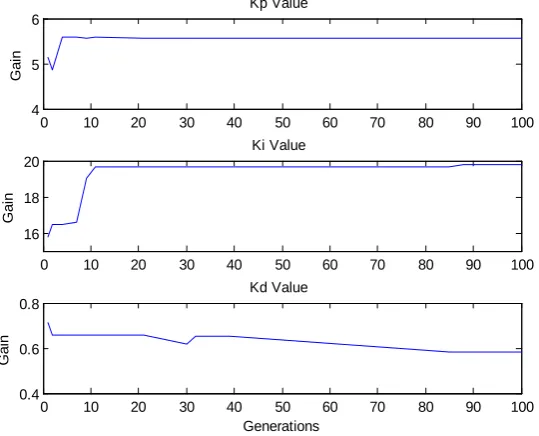
The implementation of GA is done to find the optimal PID controller parameters. They are plotted as the best values among the considered population size for all the iterations, and are given in the following figures:
Fig 4: Iterations of all gain values
PID parameters Kp Ki Kd
GA tuned values 5.0745 19.262 0.50634
0 10 20 30 40 50 60 70 80 90 100
4 5 6
Kp Value
G
a
in
0 10 20 30 40 50 60 70 80 90 100
16 18 20
Ki Value
G
a
in
0 10 20 30 40 50 60 70 80 90 100
0.4 0.6 0.8
Kd Value
Generations
G
a
V. RESULTSANDCOMPARISON
Response of the system was observed by applying a unit step input with a PID controller tuned using the proposed conventional methods and genetic algorithm. The following graph shows the comparative analysis of all the three methods:
Time domain specifications
Time domain specifications such as rise time, peak overshoot, settling time and offset are found from the above graph and tabulated as follows:
Rise time = 63.2% of the final value
Peak overshoot = 1- (Maximum value of the first peak observed in the response graph) Settling time= time required to get settled at the set value without oscillations
Offset= steady state error (set value – settled value)
Time domain specifications
ZN tuning T-L tuning GA tuning
Rise time 0.4 2.7 0.4
Peak overshoot 0.12 0 0.18
Settling time 5.61 --- 2.76
Offset 0 0.09 0
Performance index
The performance of the system can be analysed using various error criteria such as IAE, ISE, ITAE and MSE.
𝐼𝐴𝐸 = |𝑒 𝑡 |
𝑇
0
𝑑𝑡
𝐼𝑆𝐸 = |𝑒 𝑡 |2𝑑𝑡 𝑇
0 0.2 0.4 0.6 0.8 1 1.2
0 5 10
Amp
lit
u
d
e
Time
ZN tuned
T-L tuned
𝐼𝑇𝐴𝐸 = 𝑡|𝑒 𝑡 |𝑑𝑡
𝑇
0
𝑀𝑆𝐸 = 1/𝑡 |𝑒 𝑡 |2
𝑇
0
𝑑𝑡
Performance index
ZN tuning T-L tuning GA tuning
IAE 4.2809 28.8169 3.7796
ISE 3.386 12.247 3.3722
ITAE 1.1839 139.2034 0.6227
MSE 0.0335 0.1213 0.0112
Robustness Estimation
The robustness investigation for the process is analyzed by calculating the performance index to the transfer function model whose parameters such as process gain, time constant and propagation delay are deviated by ±20 %. The altered model which possesses the uncertainties is given by,
0.1734e-0.204s
0.00051s3+0.0192s2+0.24s+1
Performance index for the uncertain model can be tabulated as follows:
Performance index
ZN tuning T-L tuning GA tuning
IAE 4.2605 28.3515 3.8215
ISE 3.42 12.001 3.4039
ITAE 1.1522 88.8588 0.6396
Servo Response
Servo response of the system was obtained by giving a step change to the input or set point. The obtained response by implementing the three proposed tuning strategies can be plotted as follows:
Regulatory Response
Regulatory response of the system can be obtained by disturbing the system i.e. by applying a unit step change in the load side. Obtained regulatory responses are plotted as follows for the mentioned tuning strategies:
0 0.5 1 1.5 2 2.5
0 5 10
A
mp
li
tu
d
e
Time
ZN tuned
TL tuned
GA tuned
0 0.5 1 1.5 2 2.5
0 5 10
A
mp
li
tu
d
e
Time
ZN tuned
TL tuned
VI.CONCLUSION
It is obvious from the presented results that the response of the system with a GA tuned PID controller significantly outmatches the responses of the system with conventionally tuned PID controllers. Rise time and settling time of the system is notably lower for a GA tuned controller than its conventional counterpart. The values of all errors are lower for a GA tuned controller. System with controller tuned using genetic algorithm is more robust for uncertain models. Better servo and regulatory responses are obtained if the controller is tuned using Genetic algorithm.
The various results presented prove the betterness of the GA tuned PID settings than ZN and TL tuned ones. The simulation responses for the models reflect the effectiveness of the GA based controller in terms of time domain specifications. The performance index under the various error criterions for the proposed controller is always less than the conventionally tuned controller.
GA presents multiple advantages to a designer by operating with a reduced number of design methods to establish the type of the controller, giving a possibility of configuring the dynamic behaviour of the control system with ease, starting the design with a reduced amount of information about the controller (type and allowable range of the parameters), but keeping sight of the behaviour of the control system.
REFERENCES
[1]. S. M. Girirajkumar, Atal. A. Kumar, N. Anantharaman, Application of Genetic Algorithm for tuning of PID Controller for a real time industrial process, in sensors and Transducers Journal , Oct 2010.
[2]. Mohd Sazli Saad, Hishamuddin Jamaluddin, Intan Zaurah Mat Darus, Implementation of PID Controller Tuning using Differential Evolution and Genetic Algorithm, in International Journal of Innovative computing, Information and control, November 2012 .
[3]. Neenu Thomas, Dr. P. Poongodi, Position Control of DC Motor Using Genetic Algorithm Based PID Controller, in the Proceedings of the World Congress on Engineering 2009 Vol II.
[4]. Book named Control and dynamical systems by Richard M. Murray, Chapter 6 named Transfer Function.
[5]. Arturo Y. Jaen-Cuellar, Rene de J. Romero-Troncoso, Luis Morales-Vela Zquez and Roque A. Osornio-Rios, PID controller tuning optimization with Genetic Algorithm in Servo system, in International Journal of Advanced Robotic Systems, May 2013.