STATE OPTIONS FOR NONSTRUCTURAL FLOOD RISK MANAGEMENT
J a c k P. Royer
School of F o r e s t r y and Environmental S t u d i e s Duke U n i v e r s i t y
Durham. N.C. 27706
The work upon which t h i s p u b l i c a t i o n i s based was s u p p o r t e d i n p a r t by f u n d s p r o v i d e d by t h e U.S. Department of t h e I n t e r i o r . Washington, D.C.. t h r o u g h t h e Water Resources Research I n s t i t u t e of The U n i v e r s i t y of North C a r o l i n a a s a u t h o r i z e d by t h e Water Research and Development Act of 1978.
P r o j e c t No. B- 140-NC Agreement No. 14-34-0001-1255
The author wishes t o express h i s a p p r e c i a t i o n t o M r . John Morris, M r . John S u t h e r l a n d , and M r . June Beane of t h e North Carolina Department of Natural Resources and Community Development f o r t h e i r support and a s s i s t a n c e ; t o M r . Milton Heath of t h e I n s t i t u t e of Government f o r h i s i n s i g h t and a s s i s t a n c e ; t o M r . Bernard Ingram and Mr. Ken Old of t h e U . S . Army Corps of Engineers and M r . David Reynolds of t h e League of M u n i c i p a l i t i e s f o r t h e i r i d e a s ; and
i e s p e c i a l l y t o D r . James Stewart of t h e Water Resources Research I n s t i t u t e f o r
h i s i n t e r e s t , i n s i g h t s , and encouragement. The author a l s o wishes t o
acknowledge t h e r e s e a r c h and e d i t o r i a l a s s i s t a n c e of M r . John Lohnes and t h e a i d of t h e following graduate s t u d e n t s : M s . Beth Koenig,
Mr.
John McDonnefl, Mr.Michael Maul., and M s . Susan Bolle-Hoskins.
DISCLAIMER STATEMENT
Contents of t h i s p u b l i c a t i o n do not n e c e s s a r i l y r e f l e c t t h e views and p o l i c i e s of t h e United S t a t e s Department of t h e I n t e r i o r nor does mention of t r a d e names o r commercial products c o n s t i t u t e t h e i r endorsement o r recommendation f o r use by t h e United S t a t e s Government.
ABSTRACT
Options f o r a program of n o n s t r u c t u r a l f l o o d r i s k management i n North C a r o l i n a a r e examined through analyses of ( 1 ) c u r r e n t s t a t e l e g i s l a t i o n
SUMMARY, CONCLUSIONS, AND RECOMMENDATIONS Flooding i n North C a r o l i n a
H Eleven p e r c e n t estimated t o be Department of N
(3,57 1,00 0 a c r e s ) of t h e North Carolina' s t o t a l land a r e a is
s u b j e c t t o f l o o d water and sediment damage (North Carolina a t u r a l Resources and Community Development, 1977 )
.
The a r e a s s u b j e c t t o g r e a t e s t f l o o d water and sediment damage a r e i n t h e Roanoke and Cape Fear Basins, while t h e b a s i n s with h i g h e s t annual damages a r e t h eRoanoke, Neuse, Tar, and Cape Fear. The Federal Insurance Administration has i d e n t i f i e d 410 m u n i c i p a l i t i e s and c o u n t i e s having a r e a s of s p e c i a l high flood hazards.
H Figures from t h e U.S. Weather S e r v i c e i n d i c a t e t h a t t h e average annual s t a t e -
.
The n e x t( French, damages Carolina wide f l o o d l o s s e s between 1956 and 1965 amounted t o $2.3 m i l l i o n
decade, 1966 t o 1975, saw average annual l o s s e s of $8.4 m i l l i o n 1980). Estimates f o r 1977 fin r e a l d o l l a r s ) show average annual a t t r i b u t a b l e t o f l o o d s t o be between $90 and $100 m i l l i o n (North Dept. of Natural Resources and Community Development, 1977).
Current Programs
lE A t p r e s e n t North Carolina has t h r e e avenues through which it can s t r u c t u r a l methods:
pursue non-
1 ) N a t i o n a l Flood Insurance Program. By 1982, 154 comnunities i n North Carolina, about 38% of t h e m u n i c i p a l i t i e s with i d e n t i f i e d f l o o d hazard a r e a s , were p a r t i c i p a t i n g i n t h e r e g u l a r phase of t h e NFIP ( F e d e r a l Emergency Management Agency, 1982). Some of t h e s e communities passed r e g u l a t i o n s more s t r i n g e n t than t h e r e q u i r e d b u i l d i n g code, but
d e s p i t e t h e i n t e n t of t h e program t h e encroachment of development o n t o flood-prone a r e a s continued. I n 1977, 11,927 permits were. granted f o r new c o n s t r u c t i o n i n f l o o d hazard a r e a s . Many a d m i n i s t r a t o r s b e l i e v e t h a t t h e a v a i l a b i l i t y of r e l a t i v e l y low-cost insurance may a c t u a l l y encourage development by reducing t h e r i s k a s s o c i a t e d with b u i l d i n g i n t h e s e a r e a s ( French, 1980 )
.
2 ) The North C a r o l i n a Floodway Regulation Law of 1971. The Floodway Law with i t s amendments, empowers l o c a l governments t o d e l i n e a t e t h e floodway of l o c a l watercourses and t o e s t a b l i s h a permit system r e g u l a t i n g new floodway development. It a l s o g i v e s r e s p o n s i b i l i t i e s t o t h e S t a t e t o a s s i s t l o c a l i t i e s with t h e i r r e g u l a t o r y e f f o r t s . The law has never been f u l l y implemented, however; few m u n i c i p a l i t i e s have enacted ordinances broader than those r e q u i r e d f o r t h e NFIP, v e r y l i t t l e s t a t e funding o r s t a f f t i m e has been a l l o t t e d f o r community a s s i s t a n c e , and t h e S t a t e has not prepared any floodway d e l i n e a t i o n s f o r communities. Furthermore, t h e l e g i s l a t i o n l a c k s breadth, applying only t o land i n t h e floodway and encouraging only r e g u l a t o r y
n o n - s t r u c t u r a l approaches.
3 ) The North C a r o l i n a C o a s t a l Area Management Act. Under this program, t h e s t a t e d e s i g n a t e s "Areas of Environmental Concern" ( A E C s ) i n t h e twenty c o a s t a l c o u n t r i e s and r e q u i r e s permits f o r new development i n those a r e a s . Flood-prone a r e a s may be included a s AEC under
s e v e r a l c a t e g o r i e s , b u t t h e p r o t e c t i o n a f f o r d e d by AEC d e s i g n a t i o n is
weakened by a r e l a t i v e l y l i m i t e d p e r m i t t i n g system. I n t h e f i r s t year of t h e system's o p e r a t i o n (March 1978 t o February 19791, 459 permits were i s s u e d ' f o r new c o n s t r u c t i o n i n flood-prone AECs (French, 1 9 8 0 ) . Land-Use P a t t e r n s and Trends i n North Carolina Flood P l a i n s
I Of t h e t o t a l flood-prone acreage in t h e s t a t e , 98 p e r c e n t i s under a g r i c u l t u r a l o r f o r e s t c u l t i v a t i o n , with t h e remaining 2 p e r c e n t b e i n g urbanized land. However, urbanized land accounts f o r 46 p e r c e n t of t h e
economic l o s s e s a t t r i b u t a b l e t o flooding, and t h a t percentage i s i n c r e a s i n g a s urban developnent spreads onto flood-prone a r e a s (Clay e t e l . , 1977).
I A survey of f l o o d p l a i n land i n 27 North Carolina communities showed 65
p e r c e n t of t h a t land i n conforming uses ( a g r i c u l t u r e , f o r e s t , open-space) and 35 p e r c e n t i n non-conforming u s e s ( r e s i d e n t i a l , commercial, i n d u s t r i a l ) . These percentages vary among c o m u n i t i e s and physiographic regions; t h e
mountain f l o o d p l a i n s e x h i b i t e d t h e h i g h e s t percentage of non-conforming u s e s with 44 p e r c e n t ; t h e c o a s t a l p l a i n f l o o d p l a i n s contained 4 0 p e r c e n t
non-conforming u s e s ; communities i n t h e piedmont contained only 20 p e r c e n t non-conf orming uses.
I I n t h e 27 c i t i e s s t u d i e s , conforming uses of t h e flood p l a i n were p r e v a l e n t i n a l l t h r e e physiographic regions. This i n d i c a t e s some p o t e n t i a l f o r
n o n s t r u c t u r a l f l o o d p l a i n management a c r o s s t h e S t a t e .
Local A t t i t u d e s Toward Floodplain Management
I A survey of l o c a l government o f f i c i a l s i n 2 8 flood-prone North Carolina communities r e v e a l e d t h a t , given t h e infrequency of f l o o d i n g , l o c a l l e a d e r s t e n d t o be w e l l informed on t h e s u b j e c t and a r e g e n e r a l l y s u p p o r t i v e of most f l o o d p l a i n management s t r a t e g i e s .
I Local o f f i c i a l s t e n d t o support t h e r e g u l a t i o n or management of flood-prone l a n d s , b u t not a t t h e expense of l o c a l autonomy. Local o f f i c i a l s would p r e f e r t o devise and implement t h e i r own programs, with t h e s t a t e providing support and guidance r a t h e r than assuming d i r e c t c o n t r o l .
I Leaders a r e discouraged from pursuing comprehensive l o c a l programs by: ( a ) perceived p u b l i c apathy o r o p p o s i t i o n from l o c a l landowners,
(b) l a c k of c u r r e n t and a c c u r a t e maps on which t o base a management program and d e l a y s i n r e c e i v i n g t h i s information from f e d e r a l agencies, and
( C ) l a c k of funding t o c a r r y o u t such a program.
Economic Evaluation of N o n s t r u c t u r a l A l t e r n a t i v e s
I Methods f o r e v a l u a t i n g n o n s t r u c t u r a l a l t e r n a t i v e s f o r flood p l a i n management can e a s i l y become too complicated f o r l o c a l flood p l a i n managers. A
s i m p l i f i e d b e n e f i t / c o s t procedure i l l u s t r a t e s t h a t n o n s t r u c t u r a l a l t e r n a t i v e s may be v i a b l e o p t i o n s where r e c r e a t i o n a l and f l o o d - r e l a t e d b e n e f i t s can be i d e n t i f i e d and evaluated. The e v a l u a t i o n of f l o o d and non-flood b e n e f i t s a l s o r e v e a l s ways t o p r e s e n t l o c a l f l o o d p l a i n management p r o j e c t s f o r e x t r a - l o c a l c o s t sharing.
Recommendations
I The North Carolina Floodway Regulation Law should be strengthened by: 1 . broadening t h e l o c a l a u t h o r i t y t o include t h e flood p l a i n s and r e l a t e d
f l o o d hazard a r e a s a s well a s t h e floodway;
2 . i n c l u d i n g c o a s t a l f l o o d i n g i n t h e enabling a u t h o r i t y of t h e law;
3 . changing t h e u n q u a l i f i e d exemptions t o t h e permit requirements so t h a t a l l f l o o d p l a i n land-uses must be permitted;
4 . a u t h o r i z i n g a broader s t a t e a s s i s t a n c e program and g i v i n g t h e r e s p o n s i b i l - i t y of a s s i s t a n c e programs t o t h e S e c r e t a r y of t h e Department of Natural Resources and Community ~ e v e l o p m e n t ;
5. dropping t h e p r o v i s i o n s f o r j u d i c i a l review and allowing normal j u d i c i a l procedures t o r u l e ;
6 . c l a r i f y i n g t h e a u t h o r i t y of t h e Environmental Management Commission and i t s d e l i n e a t i o n powers i n f l o o d hazard a r e a s under t h e 1973 amendment.
I Funds should be provided f o r :
1. f u l l - t i m e i n t e r d i s c i p l i n a r y s t a f f ; 2 . mapping and t e c h n i c a l a s s i s t a n c e ;
3. p u b l i c education promoting t h e b e n e f i t s of land-use management i n f l o o d hazard a r e a s ;
TABLE OF CONTENTS
I. INTRODUCTION AND PROBLEM STATEMENT
. . .
1 n O O D PLAIN MANAGEMENT LEGISLATION AND PROGRAMSINNORTHCAROLINA.
. . .
1 0 C h a r a c t e r i s t i c s of Flooding in North C a r o l i n a. . . .
10C o a s t a l f l o o d i n g Piedmont f l o o d i n g Mountain f l o o d i n g
The H i s t o r y of Flood P l a i n Management i n
. . .
North Carolina 15
Floodway Regulation Law of 1971
. . .
19 D e l i n e a t i o n of t h e f loodwayRegulatory powers Permit procedures Exempt i o n s
R e p o n s i b i l i t i e s
A d d i t i o n a l d i r e c t i v e s Amendments
Implementation
N a t i o n a l Flood I n s u r a n c e Program
. . . , . . . .
25 C o a s t a l Area Management Act. . .
2 7. . .
Other S t a t u t e s , Programs, and D i r e c t i v e s 30 Enabling l a w s f o r land-use r e g u l a t i o n
Small watershed p r o j e c t s D a m S a f e t y Law
Sedimentation P o l l u t i o n Control Law D i v i s i o n of Emergency Management
North C a r o l i n a Flood Damage Reduction Task Force
A P r e l i m i n a r y Conclusion
. . .
3 3111- LAND-USE PATTERNS AND TRENDS ON NORTH CAROLINA
FLOODPLAINS
. . .
35S t a t e w i d e P a t t e r n s
. . .
39 R e s u l t s of t h e Land-Use Inventory. . . , . . .
39C o a s t a l p l a i n o p p o r t u n i t i e s Piedmont o p p o r t u n i t i e s Mountain o p p o r t u n i t i e s
P o l i c y and Program I m p l i c a t i o n s
. . .
46. . .
C o n c l u s i o n . 47
I V . LOCAL ATTITUDES TOWARD NONSTRUCTURAL FLOOD HAZARD
MANAGEMENT I N NORTH CAROLINA . a * . . . 49
M e t h o d . .
. . .
49R e s u l t s
. . .
50Community concern and a t t e n t i o n t o f l o o d problems Leaders' knowledge and awareness of f l o o d p l a i n management a c t i v i t i e s Leaders' p e r c e p t i o n of t h e need f o r n o n s t r u c t u r a l measures P r e f e r e n c e s f o r management s t r a t e g i e s O b s t a c l e s t o l o c a l f l o o d p l a i n management Needs f o r s t a t e a s s i s t a n c e Summary of Survey Findings
. . .
69V. ECONOMIC EVALUATION OF NONSTRUCTURAL FLOOD RISK MANAGEMENT MEASURES I N NORTH CAROLINA
. . .
71L i t e r a t u r e Review and C r i t i q u e
. . .
72The Ledger Method of Flood P l a i n Benefit/Cost
. . . .
77Case Study of Lumberton, North C a r o l i n a
. . .
8 0 - . VI. PROGRAM EVALUATION AND RECOMMENDATIONS FOR STRENGTHENING NORTH CAROLINA'S FLOOD PLAIN MANAGEMENT PROGRAM. . .
94Lead Agency
. . .
97Funding
. . .
98Technical A s s i s t a n c e
. . .
99APPENDICES
.
.
Appendix A: Appendix B: Appendix C: REFERENCES. .
North Carolina Floodway Regulation Law.
104 Flood P l a i n Land Use I n v e n t o r y and Ordination Method. . .
109LIST OF ILLUSTRATIONS
. . .
1. A Conceptual Framework f o r Flood P l a i n Management2. Flooding problems i n t h e United S t a t e s
. . .
3 . River b a s i n s and physiographic r e g i o n s i n North Carolina
.
.
4. Communities s t u d i e s i n t h e North Carolina land-use inventory
5. Land u s e s on North Carolina flood p l a i n s i n c l u d i n g
percentages by physiographic regions
. . .
.
P r i o r i t y given t o f l o o d p l a i n management by t h e communitya s compared t o t h e p r i o r i t y given o t h e r n a t u r a l resource problems i n 28 North Carolina communities, 1981
. . .
7 . The a t t e n t i o n given t o managing flood-prone lands r e l a t i v e t o t h e a t t e n t i o n given o t h e r n a t u r a l resource problems
. . .
i n 28 North Carolina communities, 19818. The s u f f i c i e n c y of e x i s t i n g f l o o d p l a i n management a c t i o n s a s judged by community o f f i c i a l s i n 28 North Carolina
communities, 1981
. . .
9 . The importance of flood p l a i n land f o r f u t u r e growth in 28 North Carolina communities, by r e g i o n , 1981
. . .
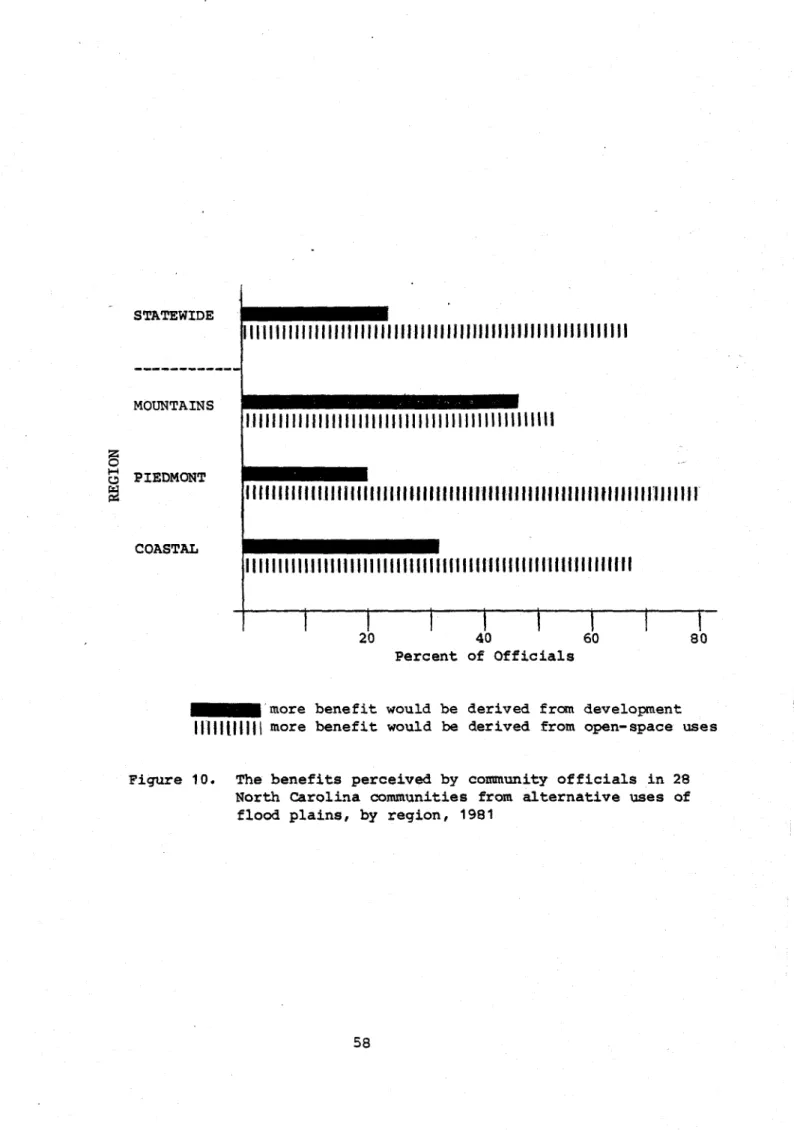
10. The b e n e f i t s perceived by community o f f i c i a l s i n 28 North Carolina communities from a l t e r n a t i v e uses of f l o o d
p l a i n s , by region, 1981
. . .
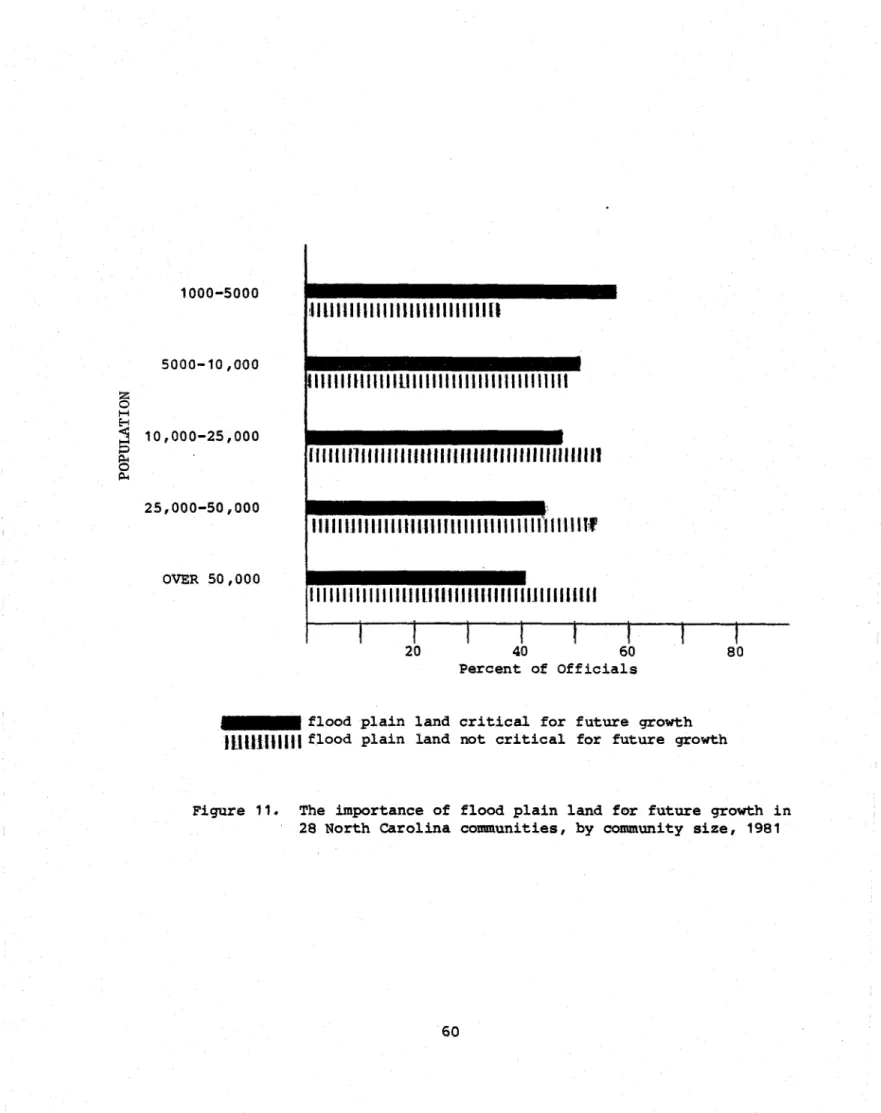
11. The importance of f l o o d p l a i n land f o r f u t u r e growth i n 28 North Carolina communities, by community s i z e , 1981
.
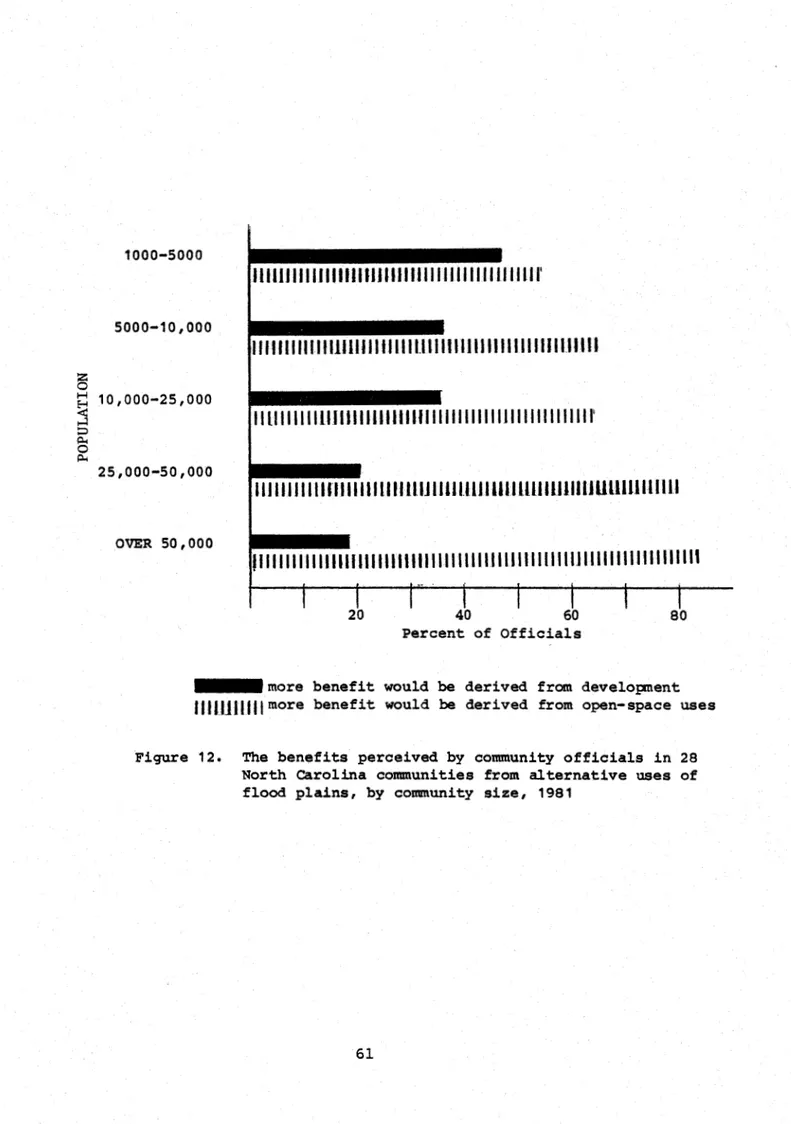
12. The b e n e f i t s perceived by community o f f i c i a l s i n 28 North Carolina communities from a l t e r n a t i v e uses of flood
p l a i n s , by community s i z e , 1981
. . .
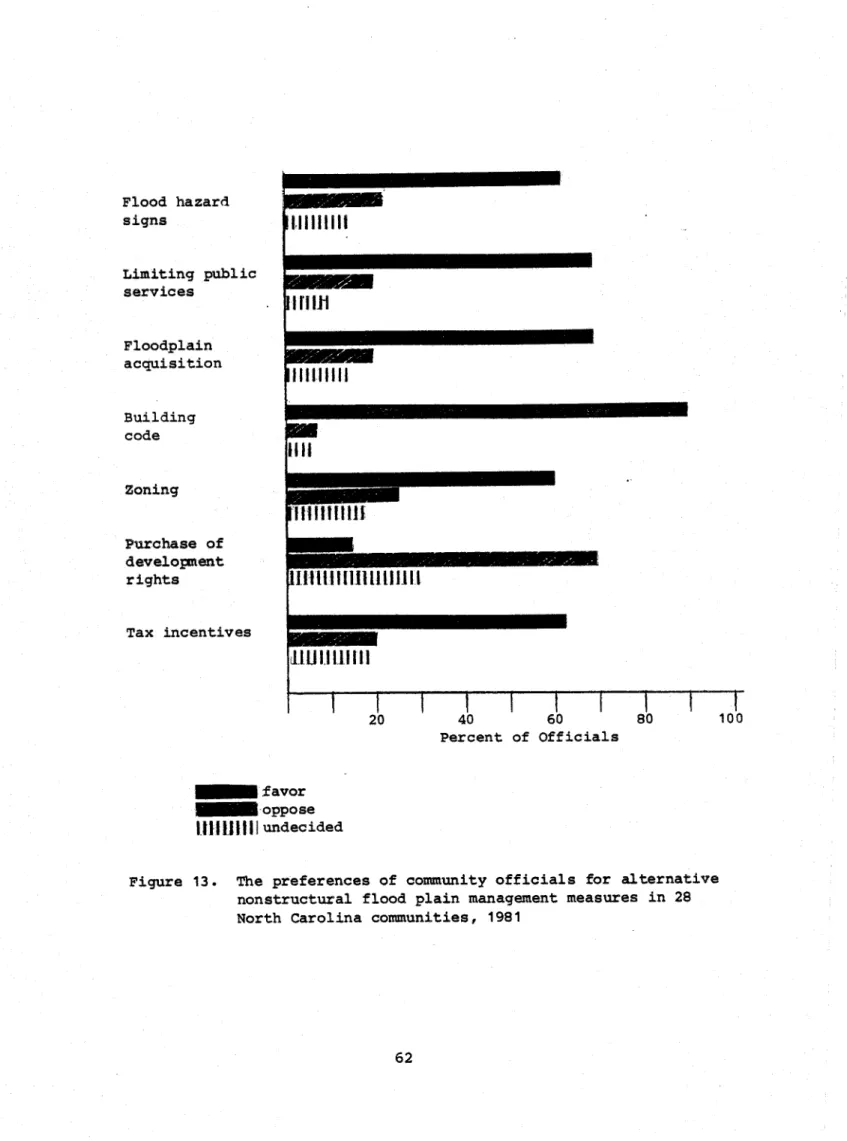
13. The p r e f e r e n c e s of community o f f i c i a l s f o r a l t e r n a t i v e n o n s t r u c t u r a l f l o o d p l a i n management measures i n 28
North Carolina communities, 1981
. . .
14. The o p p o r t u n i t i e s f o r using a l t e r n a t i v e n o n s t r u c t u r a lflood p l a i n management measures i n 28 North
Carolina communities, 1981
. . .
15. Perceived o b s t a c l e s t o implementing n o n s t r u c t u r a l flood p l a i n management a l t e r n a t i v e s i n 28 North Carolina
16. The p o t e n t i a l e f f e c t of s t a t e a s s i s t a n c e on flood p l a i n
LIST O F TABLES
Land Use Cataqories and D e s c r i p t i o n s f o r t h e Inventory of Flood P l a i n Land Uses i n 2 7 North Carolina
Communities, 1981
. . .
37 Land Uses on t h e Flood P l a i n s of 27 North CarolinaCommunities, 1981
. . .
41A Summary of B e n e f i t s and Costs Associated with an Open Land Approach t o Flood P l a i n Management i n t h e l'Bottoms" Area of Lumberton, North Carolina,
1982
. . .
90I
INTRODUCTION AND PROBLEM STATEMENT
A perplexing and pervasive land use problem in North Carolina, and
elsewhere nationwide, i s t h e i n a p p r o p r i a t e use of f l o o d p l a i n s . Flooding causes over 90 m i l l i o n d o l l a r s i n p r o p e r t y damages on average each year i n North
Carolina (North Carolina Department of Natural Resources and Community
Development, 1977) and although s t r u c t u r a l flood c o n t r o l p r o j e c t s such as dams,
l e v e e s , and channels have been c o n s t r u c t e d throughout t h e s t a t e , average annual
f l o o d l o s s e s continue t o r i s e a t a r a t e g r e a t e r than i n f l a t i o n (French, 1980).
This suggests t h a t encroachment of development onto f l o o d p l a i n s i s o c c u r r i n g f a s t e r than c o n t r o l s t r u c t u r e s can be b u i l t and t h a t p u b l i c p o l i c i e s a r e needed
t o curb encroachment onto flood p l a i n s .
H i s t o r i c a l l y , f l o o d p l a i n s developed because of t r a n s p o r t a t i o n , l o c a t i o n ,
o r o t h e r advantages. But a n a t i o n a l assessment of flood p l a i n use e s t i m a t e s
t h a t some 90 p e r c e n t of t h e u s e r s of flood p l a i n s gain no p a r t i c u l a r advantage
from t h e i r l o c a t i o n (White
&.,
1 9 7 5 ) . Consequently, t h e n a t i o n ' s view of how f l o o d l o s s e s should be reduced has been changing--the t r e n d being away froms o l e r e l i a n c e on s t r u c t u r e s t o "keep water away from people and property1' and
towards e f f o r t s t o i n f l u e n c e flood p l a i n use and t h u s "keep people and p r o p e r t y
away
t h a t
year
from water." Nonetheless, t h e Second National Water Assessment p r e d i c t s
flood damage t o urban land, nationwide, w i l l i n c r e a s e 80 p e r c e n t by t h e
-
people p e r s i s t i n b u i l d i n g homes and businesses i n flood-prone a r e a s (Roder,
1961; Rates, 1962; James e t a l . , 1971; Burton
- -
e t a l . , 1978).The response of t h e f e d e r a l government t o i n a p p r o p r i a t e uses of flood p l a i n s has been t o encourage n o n s t r u c t u r a l measures i n a d d i t i o n t o , o r a s
a l t e r n a t i v e s t o , s t r u c t u r a l p r o j e c t s
.
Congress i n d i c a t e d it is w i l l i n g t o c o n s i d e r and fund a l t e r n a t i v e n o n s t r u c t u r a l measures by i n c l u d i n g t h e f o l l o w i n gp r o v i s i o n s i n S e c t i o n 73 of the Water Resources Development Act of 1974: { a ) I n t h e survey, planning, o r design by any f e d e r a l agency of any p r o j e c t involving f l o o d p r o t e c t i o n , c o n s i d e r a t i o n s h a l l be given t o
n o n s t r u c t u r a l a l t e r n a t i v e s t o prevent o r reduce f l o o d damages i n c l u d i n g , b u t n o t l i m i t e d t o , floodproofing of s t r u c t u r e s ; f l o o d p l a i n r e g u l a t i o n s ;
a c q u i s i t i o n of f l o o d p l a i n lands f o r r e c r e a t i o n a l , f i s h and w i l d l i f e , and o t h e r p u b l i c purposes; and r e l o c a t i o n with a view toward formulating t h e most economically, s o c i a l l y , and environmentally a c c e p t a b l e means of reducing o r preventing flood damages.
( b) Where a n o n s t r u c t u r a l a l t e r n a t i v e is recommended, nonf e d e r a l p a r t i c i p a t i o n s h a l l be comparable t o t h e v a l u e of l a n d s , easements, and right-of-way which would have been r e q u i r e d of nonfederal i n t e r e s t s under s e c t i o n 3 a f t h e A c t of June 27, 1936 ( P u b l i c Law Numbered 738,
Seventy-fourth Congress), f o r s t r u c t u r a l p r o t e c t i o n measures, b u t in no event s h a l l exceed 20 p e r centum of t h e p r o j e c t c o s t s (U.S. Congress,
1974).
The f e d e r a l p o s i t i o n was f u r t h e r c l a r i f i e d i n Executive Order 11988 of 1977
and t h e Unified National Program f o r Flood P l a i n Management updated by t h e Water
Resources Council i n 1979. Executive Order 11988 i n s t r u c t s each federal agency
t o :
. .
.
t a k e a c t i o n t o reduce t h e r i s k of flood l o s s , t o minimize t h e impacts of f l o o d s on human s a f e t y , h e a l t h and w e l f a r e , and t o r e s t o r e and p r e s e r v e t h e n a t u r a l and b e n e f i c i a l v a l u e s served by f l o o d p l a i n s i n c a r r y i n g o u t itsr e s p o n s i b i l i t i e s f o r ( 1 ) a c q u i r i n g , managing, and d i s p o s i n g of f e d e r a l l a n d s and f a c i l i t i e s ; ( 2 ) p r o v i d i n g f e d e r a l l y undertaken, financed, o r a s s i s t e d c o n s t r u c t i o n and improvements; and ( 3 ) conducting f e d e r a l a c t i v i t i e s and programs a f f e c t i n g l a n d use, i n c l u d i n g but not l i m i t e d t o water and r e l a t e d
l a n d r e s o u r c e planning, r e g u l a t i n g s , and l i c e n s i n g a c t i v i t i e s (Executive Order 11988, 1977).
The Unified National Program f o r Flood P l a i n Management s p e c i f i e s numerous
plains1 t o f l o o d damage and d i s r u p t i o n . " This s t r a t e g y along with "modifying
flood flows" and "modifying f l o o d impacts" form t h e mainstays of f e d e r a l p o l i c y
toward flood p l a i n management. The Unified Program f u r t h e r notes:
The f e d e r a l government has a fundamental i n t e r e s t i n how t h e n a t i o n ' s f l o o d p l a i n s a r e used and managed, b u t t h e b a s i c r e s p o n s i b i l i t y f o r
r e g u l a t i n g use of f l o o d p l a i n s l i e s with s t a t e and l o c a l government.
. . .
.
To a t t a i n a u n i f i e d n a t i o n a l program, t h e f e d e r a l agencies must develop c o n s i s t e n t p o l i c i e s and a c t i v i t i e s , i n c l u d i n g those which encourage and support t h e S t a t e si n
developing e f f e c t i v e programs of t h e i r own. I n a p r a c t i c a l sense, t h e f e d e r a l r o l e should continue t o be s t r o n gi n
information g a t h e r i n g , developing f l o o d p l a i n management c r i t e r i a , funding programs, and i n t e c h n i c a l , planning, and c o n s t r u c t i o n s e r v i c e s . The f e d e r a l r o l e should become more supportive of ongoing s t a t e f l o o d p l a i n management a c t i v i t i e s and encourage adoption of s i m i l a r programs i n s t a t e s where t h e s e are absent ( U . S . Water Resources Council, 1 9 7 9 ) .
These agency d i r e c t i v e s coupled with t h e National Flood Insurance Program
c o n s t i t u t e major f e d e r a l i n i t i a t i v e s t o f o s t e r t h e use of n o n s t r u c t u r a l
a l t e r n a t i v e s . A s a group t h e i n i t i a t i v e s r e p r e s e n t a marked d e p a r t u r e f r a n p a s t f e d e r a l p o l i c y which was l a r g e l y l i m i t e d t o c o r r e c t i n g l o c a l f l o o d i n g problems
by i n v e s t i n g i n engineering works upon t h e r e q u e s t of l o c a l i t i e s . But t h e
success of f e d e r a l e f f o r t s t o meld n o n s t r u c u t r a l measures i n t o a more
comprehensive s t r a t e g y depends t o a l a r g e e x t e n t on s t a t e and l o c a l response, a s
suggested i n t h e Unified National Program. I n t h e words of one p a s t d i r e c t o r of
t h e Water Resources Council:
The d i f f i c u l t d e c i s i o n s regarding land use
. .
.
f r e q u e n t l y have to be borne by nonfederal governments, e s p e c i a l l y a t t h e l o c a l l e v e l . When a l l t h e verbiage i s s t r i p p e d away from t h e papers, r e p o r t s , and recommendations of t h e e x p e r t s on f l o o d p l a i n management, t h e ensuing programs should focus on h e l p i n g t h e nonfederal governments meet t h e i r problems.In t h e f i n a l a n a l y s i s , t h e response of nonfederal l e v e l s of government w i l l u l t i m a t e l y determine t h e success o r f a i l u r e of t h e n a t i o n a l f l o o d p l a i n management program ( F a i r c h i l d , 1 9 7 4 ) .
The dependence of a n a t i o n a l program on s t a t e and l o c a l i n i t i a t i v e s r a i s e s
numerous questions: What o p p o r t u n i t i e s e x i s t f o r s t a t e a c t i o n ? What c o s t
s h a r i n g arrangements among governments a r e a p p r o p r i a t e and e f f e c t i v e ? What
\
l o c a l support e x i s t s f o r n o n s t r u c t u r a l a l t e r n a t i v e s ? And, how might a s t a t e
o r g a n i z e t o coordinate o r d e l i v e r a program of n o n s t r u c t u r a l a l t e r n a t i v e s ? This
r e s e a r c h examines t h e s e q u e s t i o n s , u s i n g North Carolina a s a c a s e study.
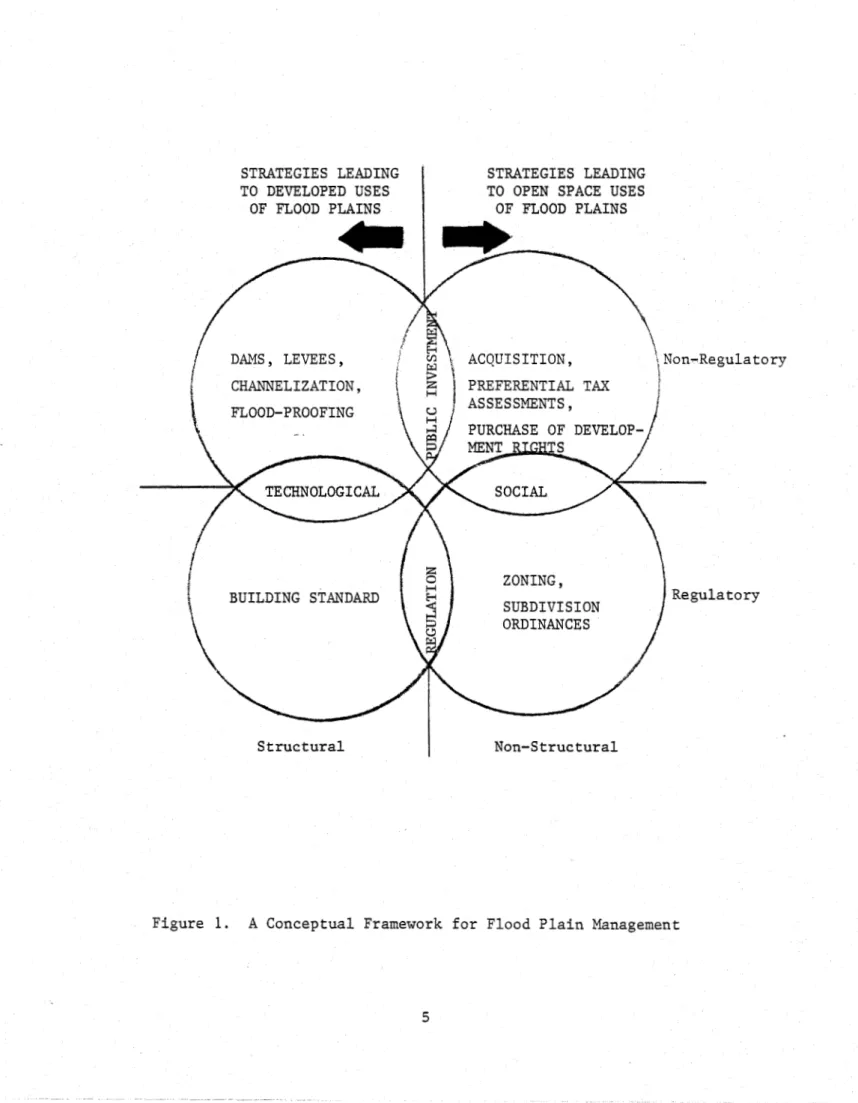
The term " n o n s t r u c t u r a l measures" is defined i n t h i s study a s those a c t i o n s which a r e intended t o keep flood-prone land f r e e of i n t e n s i v e development ( s e e
F i g u r e 1 ) . That is, n o n s t r u c t u r a l measures a r e s o c i a l adjustments t o f l o o d i n g ( s u c h a s through l a n d use c o n t r o l s ) r a t h e r than t e c h n o l o g i c a l adjustments t o
f l o o d i n g (such a s through t h e m o d i f i c a t i o n of b u i l d i n g p r a c t i c e s o r flood
f l o w s ) . Examples of n o n s t r u c t u r a l measures i n c l u d e zoning, s u b d i v i s i o n
r e g u l a t i o n s , f l o o d p l a i n a c q u i s i t i o n , and p r e f e r e n t i a l p r o p e r t y t a x i n c e n t i v e s .
Some a c t i o n s t r a d i t i o n a l l y viewed a s n o n s t r u c t u r a l a l t e r n a t i v e s a r e not defined
a s such f o r t h i s study. For example, t h e flood-proofing of homes and businesses
i s n o t considered a n o n s t r u c t u r a l a l t e r n a t i v e because it i s not intended t o keep damageable p r o p e r t y away from f l o o d prone a r e a s . N o n s t r u c t u r a l f l o o d r i s k
management i n t h i s study c o n s i s t s of t h o s e a c t i o n s which l e a d u l t i m a t e l y t o non-intensive use of f l o o d p l a i n s a s shown i n Figure 1 .
A t p r e s e n t , North Carolina has t h r e e p r i n c i p a l avenues through which it can pursue n o n s t r u c u r a l methods: ( 1 ) t h e N a t i o n a l Flood Insurance Program, ( 2 ) t h e
North Carolina Coastal Areas Management Program, and ( 3 ) t h e North Carolina Floodway Regulation Law. The National Flood Insurance Program (NFIP) p r o v i d e s
d i s a s t e r r e l i e f and s u b s i d i z e d insurance t o c i t i z e n s i n designated flood-prone communities. To q u a l i f y f o r t h i s program, a community must f i r s t implement some
type of l a n d development c o n t r o l . I n most c a s e s , t h i s c o n s i s t s of a b u i l d i n g
code t h a t r e q u i r e s permits f o r new c o n s t r u c t i o n i n flood-prone a r e a s . I t may, however, i n c l u d e a c t i o n s which i n f l u e n c e c a t e g o r i e s of l a n d use, not j u s t
b u i l d i n g p r a c t i c e s , Currently, 154 communities i n North C a r o l i n a , about 3 8 p e r c e n t of t h e 410 m u n i c i p a l i t i e s with i d e h t i f i e d f l o o d hazard a r e a s ,
ACQUISITION,
\
!
Non~Regulatory
PREFERENTIAL TAX
ASSESSMENTS,
I
STRATEGIES LEADING
TO DEVELOPED USES
OF FLOOD PLAINS
DAMS, LEVEES,
CHANNELIZATION,
FLOOD-PROOFING
BUILDING STANDARD
SUBDIVISION
ORDINANCES
STRATEGIES LEADING
TO OPEN SPACE USES
OF n O O D PLAINS
Structural
I
Non-Structural
Agency, 1982). Only a few of t h e s e communities, however, have passed
r e g u l a t i o n s more s t r i n g e n t than those r e q u i r e d by t h e b u i l d i n g code.
A second means f o r promoting n o n s t r u c t u r a l methods in North Carolina i s through t h e s t a t e ' s Coastal Areas Management l e g i s l a t i o n . Under t h i s program,
t h e s t a t e C o a s t a l Management Commission d e s i g n a t e s "Areas of EhvironmentaP
Concern" ( A E C s ) i n t h e twenty c o a s t a l c o u n t i e s and r e q u i r e s permits f o r new development i n t h o s e a r e a s . Flood-prone a r e a s may be included a s AECs under t h e
c a t e g o r i e s "Ocean Hazard Area" o r " E s t u a r i n e system." Like t h e f l o o d i n s u r a n c e
program, however, t h e p r o t e c t i o n afforded by AEC d e s i g n a t i o n is weakened by a
r e l a t i v e l y l i m i t e d p e r m i t t i n g system. I n t h e f i r s t year of t h e system's
o p e r a t i o n (March 1978 t o February 1979), 459 permits were i s s u e d f o r new
c o n s t r u c t i o n i n flood-prone AECs (French, 1980). Furthermore, t h e AEC
d e s i g n a t i o n a p p l i e s only i n c o a s t a l c o u n t i e s . No s i m i l a r system e x i s t s f o r t h e
mountain or piedmont regions.
The t h i r d and most s i g n i f i c a n t s t a t e o p t i o n is t h e North Carolina Floodway
Regulation Law of 1971 ( ~ ~ ~ ~ 3 1 4 3 - 2 1 5 . 5 1 t o ,621. The law, with i t s amendments of 1973 and 1979, empowers l o c a l governments t o d e l i n e a t e t h e floodway of l o c a l
watercourses and t o e s t a b l i s h a permit system r e g u l a t i n g new development t h e r e .
I t a l s o g i v e s r e s p o n s i b i l i t i e s t o t h e Department of Natural Resources and Community Development (NRCD) and t h e Environmental Management Commission (EMC) t o a s s i s t l o c a l i t i e s with t h e i r r e g u l a t o r y r e s p o n s i b i l i t i e s . The law f u r t h e r
g i v e s NRCD t h e a u t h o r i t y t o d e l i n e a t e t h e floodways i f l o c a l governments do n o t t a k e a c t i o n .
Although t h i s l e g i s l a t i o n r e p r e s e n t s North C a r o l i n a ' s major attempt a t
e s t a b l i s h i n g a statewide program f o r reducing flood l o s s e s , it has not been
widely used. Few m u n i c i p a l i t i e s have used t h i s law t o e n a c t ordinances o t h e r
h a s been a l l o t t e d f o r community a s s i s t a n c e . Moreover, t h e NRCD has not prepared any floodway d e l i n e a t i o n s f o r communities. The Floodway Law i t s e l f a p p l i e s only t o land i n t h e floodway and encourages only a r e g u l a t o r y approach t o
n o n s t r u c t u r a l flood p l a i n management. Nonreguatory approaches such a s p u b l i c
a c q u i s i t i o n of flood-prone lands o r p r e f e r e n t i a l t a x assessments, a r e not
s p e c i f i c a l l y encouraged by s t a t e programs, although some l a r g e r conununities have
pursued t h e a c q u i s i t i o n a l t e r n a t i v e on t h e i r own.
The a n a l y s i s of North C a r o l i n a ' s o p t i o n s f o r f u r t h e r i n g i t s e f f o r t s toward n o n s t r u c t u r a l flood r i s k management i s presented i n f i v e s e c t i o n s i n t h i s
r e p o r t : ( 1 ) an overview of North C a r o l i n a ' s f l o o d i n g problem including a d e s c r i p t i o n and c r i t i q u e of t h e North Carolina Floodway Regulation Law, t h e
National Flood Insurance Program, and t h e o t h e r e x i s t i n g s t a t e programs
a f f e c t i n g development i n flood-prone a r e a s ; ( 2 ) the p o t e n t i a l f o r s t r e n g t h e n i n g
s t a t e programs i n l i g h t of e x i s t i n g land-use p a t t e r n s ; ( 3 ) l o c a l a t t i t u d e s and p r e f e r e n c e s toward n o n s t r u c t u r a l measures; ( 4 ) economic c o n s i d e r a t i o n s important t o t h e use of n o n s t r u c t u r a l methods; and ( 5 ) recommendations f o r improving t h e
s t a t e ' s c u r r e n t use of n o n s t r u c t u r a l measures i n i t s f l o o d p l a i n management program.
Two assumptions u n d e r l i e t h e r a t i o n a l e f o r t h i s study. The f i r s t
assumption i s t h a t t h e s t a t e o r any l e v e l of government should a c t t o manage flood-prone land. The second i s t h a t t h e success of s t a t e e f f o r t s t o encouraage
f l o o d p l a i n management l i k e l y hinges on l o c a l government support and i n p u t .
Many people b e l i e v e t h a t landowners who b u i l d in flood-prone a r e a s should s u f f e r t h e consequences of t h e i r f o l l y ; t h a t t h e b e s t way t o keep development o u t of
flood hazard a r e a s i s t o allow i n d i v i d u a l s t o be d i r e c t l y accountable f o r t h e i r a c t i o n s without p u b l i c i n t e r v e n t i o n . In t h e words of one i n d i v i d u a l c o n t a c t e d
F i r e , wind and water a r e indeed dangerous and in many c a s e s
u n c o n t r o l l a b l e . [But] wood i s e a s i l y burned, so should our government t e l l us not t o b u i l d a house from wood? Should they t e l l us not t o b u i l d on a h i l l o r t h e wind w i l l blow us away? Some t h i n g s should be l e f t t o t h e i n d i v i d u a l t o decide.
Yet such an a t t i t u d e b e l i e s t h e complexity of t h e s i t u a t i o n . The response of landowners t o u n p r e d i c t a b l e n a t u r a l hazards has been well-documented and
d i s c u s s e d by o t h e r r e s e a r c h e r s (Roder, 1961; Kates, 1962; James e t a l . , 1971;
Burton,
et
s.,
1978). People choose t o r e s i d e o r b u i l d i n any given a r e a f o r awide v a r i e t y of s o c i a l , economic, a e s t h e t i c , o r o t h e r c u l t u r a l and psychological
reasons. The r i s k of a f l o o d may not be a major f a c t o r i n t h e d e c i s i o n t o
l o c a t e on t h e f l o o d p l a i n . Other f a c t o r s may o f f e r s t r o n g i n c e n t i v e s f o r t h e
landowner not t o r e l o c a t e , even i f he i s aware of t h e hazard. I n such c a s e s t h e
tendency i s f o r t h e owner t o minimize t h e r i s k and t o assume t h a t "it won1 t happen t o me" o r even "it won't happen t o m e again." Researchers have a l s o
found t h a t under-discounting of r e s i d e n t i a l p r o p e r t y v a l u e s and e x p e c t a t i o n s of
l i b e r a l f e d e r a l d i s a s t e r r e l i e f have f r e q u e n t l y c o n t r i b u t e d t o over-development
of f l o o d p l a i n s ( P a r k and M i l l e r , 1 9 8 2 ) .
For t h e s e reasons, development has continued on flood p l a i n s and may be
expected t o continue i n t h e f u t u r e without c o l l e c t i v e a c t i o n . What seems on t h e s u r f a c e t o be i r r a t i o n a l behavior on t h e p a r t of i n d i v i d u a l s is i n f a c t a
f u n c t i o n of common s o c i e t a l p r e s s u r e s and t h u s r e q u i r e s some a c c o u n t a b i l i t y on
t h e p a r t of t h e community a s w e l l as t h e i n d i v i d u a l . The damages caused by a
flood a f f e c t o t h e r s b e s i d e s t h o s e who s u f f e r a p e r s o n a l l o s s of property.
Taxpayers must bear t h e c o s t of r e s t o r i n g roads, water and sewer l i n e s , and o t h e r p u b l i c s e r v i c e s t o t h e s e a r e a s .
The second assumption underlying t h i s study i s t h a t t h e success of s t a t e
and input. This i s important f o r two reasons. F i r s t , t h e powers t o c o n t r o l and
manage land i n North Carolina, a s i n most of t h e United S t a t e s , a r e granted t o t h e l o c a l governments through enabling l e g i s l a t i o n . Although t h e s t a t e may
reassume those powers, t h e c o n t r o l of land i s , by t r a d i t i o n and s t a t u t e , a l o c a l r e s p o n s i b i l i t y (Healy and Rosenberg, 1979). Second, f l o o d s a r e l o c a l l y
o c c u r r i n g e v e n t s t h a t vary i n both time and type a c r o s s t h e s t a t e . C o a s t a l
f l o o d i n g is g e n e r a l l y caused by h u r r i c a n e s and ocean storms. Flash f l o o d s in
t h e mountains a r e u s u a l l y t h e r e s u l t of s p r i n g snowmelt o r heavy r a i n s and a r e
more l i m i t e d t o e s t a b l i s h e d streambeds. Floods i n urban a r e a s tend t o be
r e l a t e d t o s u r f a c e runoff and drainage problems. Also, t h e proportion of
flood-prone a r e a s a l r e a d y developed v a r i e s from one community t o t h e next. This
r e g i o n a l and l o c a l v a r i a t i o n suggests t h a t t h e l o c a l response t o flood problems
w i l l l i k e l y d i f f e r , along with t h e management s t r a t e g i e s t h a t should be employed. Despite t h e advantages of l o c a l a d m i n i s t r a t i o n , however, l o c a l
governments may be faced with numerous problems when implementing n o n s t r u c t u r a l
f l o o d management s t r a t e g i e s . Lack of funds, personnel, and t e c h n i c a l r e s o u r c e s ,
p r e s s u r e s t o broaden the tax base and promote economic development, and t h e
r e l u c t a n c e t o impose "more government" on landowners a r e a l l p o s s i b l e o b s t a c l e s .
Lack of awareness of t h e problem or apathy on t h e p a r t of r e s i d e n t s and p u b l i c o f f i c i a l s may a l s o impede implementation and enforcement (Ward, 1978; fiowe, 1978; c o s t a , 1978; French, 1980 1. Thus, while the management of flood-prone l a n d should u l t i m a t e l y be a l o c a l r e s p o n s i b i l i t y , i t s o v e r a l l success l i k e l y
depends on some form of s t a t e involvement and a s s i s t a n c e . On t h i s b a s i s , s t a t e
FLOOD PLAIN MANAGEMENT LEGISLATION AND PROGRAMS I N NORTH CAROLINA
C h a r a c t e r i s t i c s of Flooding i n North C a r o l i n a
North Carolina l a c k s t h e major r i v e r i n e flood p l a i n s found i n o t h e r
s e c t i o n s of t h e United S t a t e s . Most of t h e urban and population growth has been
confined t o t h e piedmont s e c t i o n of t h e s t a t e where t h e c o i n c i d e n t f l o o d i n g
problems have been r e l a t i v e l y minor due t o t h e low, r o l l i n g topography and the
tendency fox developnent t o l o c a t e along r a i l r o a d r o u t e s r a t h e r t h a n water
t r a n s p o r t a t i o n r o u t e s . Because of t h e s e two f a c t o r s , f l o o d i n g has not been a
s e r i o u s problem i n most p a r t s of North Carolina. In r e c e n t y e a r s , however, t h e
changing p a t t e r n s of u r b a n i z a t i o n in t h e l a r g e c i t i e s of the piedmont and t h e
i n c r e a s i n g p o p u l a t i o n s i n t h e mountains and on t h e c o a s t have i n c r e a s e d t h e
chances f o r g r e a t e r p r o p e r t y l o s s e s due t o floods ( F i g u r e 2 ) .
The Federal Flood Insurance Administration has i d e n t i f i e d 410 l o c a l i t i e s
and c o u n t i e s i n North Carolina having a r e a s of s p e c i a l high f l o o d hazards. The l a r g e s t a r e a s s u b j e c t t o f l o o d water and sediment damage a r e i n t h e Roanoke and Cape Fear Basins, while t h e b a s i n s with t h e h i g h e s t annual damages a r e t h e
Roanoke, Neuse, Tar and Cape Fear ( F i g u r e 3 ) . Figures from t h e U. S. Weather S e r v i c e i n d i c a t e t h a t t h e average annual s t a t e w i d e l o s s e s ( i n r e a l d o l l a r s )
between 1956 and 1965 amounted t o $ 2 . 3 m i l l i o n . The next decade, 1966 t o 1975, had average annual l o s s e s of $8.4 m i l l i o n (French, 1980 )
.
Estimates f o r 1977Area in which flooding causes major damage to agricultural, urban, and other developments
Major streams and tributaries with periodic overbank flooding
Reasons for intensified flood damage
Urban, suburban, and industr~al development on flood pla~ns
0 Accelerated runoff from urban areas
Inadequate upstream watershed management
*
Loss of flood control from inadequate structural systems-
Tidal effects along coasts during storms and hurricanes-
Water resources regionS o u r c e :
U.S.
Water R e s o u r c e s C o u n c i l , 1978MOUNTAIN
L E G E N D
____
River Basin Boundary
COASTAL PLAIN___._.
-
Physiographic Region Boundary
MQ
j or River
Biver Basins
I.
Broad
7
Little Tennessee
113.
Roanoke
2.
Cape Fear
8. Lumber
14.
Savannah
3. Catawba
9. Neuse
15, Tar- Pamlico
4. Chowan
10. New
Coastal Plain)
16.
Wataugo
5. French Broad
I 1.
New
Mountains)17. Yadkin
-
Pee
Dee
6.
Hiowassee
12.Pasquotank
I
.-
Department of Natural Resources and Community Development, 1977). One observer
n o t e s :
The a v a i l a b l e evidence s t r o n g l y suggests t h a t both average annual and c a t a s t r o p h i c flood l o s s e s a r e r i s i n g i n North Carolina. With such n o t a b l e exceptions a s Charlotte/Mecklenburg County and F a y e t t e v i l l e , most of t h e f l o o d problem seems t o be l o c a t e d i n t h e c o a s t a l and ( t o a l e s s e r e x t e n t ) mountainous p a r t s of t h e s t a t e . The encroachment of urban development on formerly r u r a l f l o o d p l a i n s i n t h e mountains and b a r r i e r i s l a n d s on t h e c o a s t i s e n l a r g i n g t h e flood problem by exposing m i l l i o n s of d o l l a r s of new investment and hundreds of people t o a f l o o d hazard each year (French, 1980)
C o a s t a l f l o o d i n g
The c o a s t a l p l a i n i s bounded by t h e A t l a n t i c Ocean on t h e e a s t and by t h e
F a l l Line Zone on t h e west. The zone i s defined by a geologic formation
r e s u l t i n g i n an abrupt i n c r e a s e i n e l e v a t i o n t o t h e piedmont ( Fenneman
,
1938 ) ,The lower reaches of t h e Pasquotank, Chowan, Roanoke, Tar-Pamlico, Neuse, and
Cape Fear r i v e r s and t h e e n t i r e New River d r a i n t h e c o a s t a l p l a i n ( F i g u r e 3 ) .
Due t o t h e low r e l i e f , t h e r i v e r s a r e slow-flowing, drainage i s poor, and f l o o d p l a i n s a r e broad (Clay, 1 9 7 5 ) . Rather than being s u s c e p t i b l e t o t h e f l a s h
flooding t h a t occurs i n t h e mountain a r e a s , f l o o d i n g on t h e c o a s t a l p l a i n stems
p r i m a r i l y from ocean stonns a f f e c t i n g c o a s t a l lands. Coastal p l a i n r i v e r s tend
t o be s l u g g i s h and winding with broad flood p l a i n s d r a i n i n g t h e mostly f l a t
topography. The flood damages experienced a r e g e n e r a l l y those a s s o c i a t e d with
inundation ( r a t h e r than high v e l o c i t y water f l o w ) , notably crop drowning, road damage, and water damage t o lower f l o o r s of s t r u c t u r e s . Slow drainage of
flooded a r e a s i s c h a r a c t e r i s t i c of t h i s region, e x a c e r b a t i n g t h e f l o o d damage
problem.
On t h e b a r r i e r i s l a n d s , t h e u n s t a b l e n a t u r e of t h e beach environment i n c r e a s e s t h e r i s k of s e r i o u s l o s s e s following development. The high e r o s i o n
major h u r r i c a n e w i l l a f f e c t t h e North Carolina c o a s t on an average of every two t o t h r e e y e a r s ( P i l k e y e t a l . , 1978). The number of y e a r s s i n c e t h e l a s t
d e v a s t a t i n g ocean storm is g r e a t e r than t h i s c a l c u l a t e d i n t e r v a l and much of t h e
development o c c u r r i n g along t h e North Carolina c o a s t has taken p l a c e during t h a t
time. The market f o r second homes and r e c r e a t i o n a l p r o p e r t y has been i n t e n s e along t h e c o a s t l i n e and i s expected t o i n c r e a s e over t h e next t e n y e a r s ( B w b y , 1979)
.
Damages from f u t u r e h u r r i c a n e s can be expected t o be extremely high.Piedmont f l o o d i n g
The piedmont province s t r e t c h e s west from t h e F a l l L i n e Zone to t h e Blue Ridge s c a r p , o r t h e edge of t h e Blue Ridge Mountains. Rolling h i l l s and l o c a l
r e l i e f of a few hundred f e e t a r e c h a r a c t e r i s t i c of t h e headwaters and upper
reaches of t h e Dan, Tar, Neuse, Cape Fear, and Lumber Rivers a s w e l l a s t h e middle reaches of t h e Yadkin-Pee Dee, Catawba, and Broad Rivers ( F i g u r e 3 ) .
Encroachment onto f l o o d p l a i n s and changes i n land use have a f f e c t e d t h e
amount of f l o o d - r e l a t e d l o s s e s i n Raleigh and o t h e r piedmont c i t i e s i n North Carolina. A s u r b a n i z a t i o n s p r e a d s , more of t h e s o i l s u r f a c e i s covered and becomes impervious, i n c r e a s i n g t h e amount of runoff. Under t h e s e c o n d i t i o n s ,
downstream development p r e v i o u s l y on t h e f r i n g e s of t h e floodway a r e a can be
s u b j e c t e d t o higher p@ak flows and f l o o d i n g hazards. The impervious a r e a i n
piedmont c i t i e s ranges from about 85 p e r c e n t i n densely populated a r e a s t o about 15 p e r c e n t i n low-density r e s i d e n t i a l a r e a s . In r u r a l a r e a s t h e impervious
cover i s only about one p e r c e n t (Clay e t a l . , 1975). Twenty-five y e a r s ago Raleigh was n o t exposed t o any s e r i o u s flood hazard, b u t a s t h e c i t y grew,
Mountain f l o o d i n a
The e a s t e r n border of t h e mountain r e g i o n i s t h e Blue Ridge Scarp. The
westernmost edge c o i n c i d e s w i t h t h e boundary between t h e Uraka and Smoky
Mountains and t h e G r e a t V a l l e y i n Tennessee. The h i g h l y d i s s e c t e d mountain
p l a t e a u of t h e Blue Ridge Mountains is c h a r a c t e r i z e d by mountain c h a i n s , c r o s s
r i d g e s , and intermontane v a l l e y s ( C l a y e t a l . , 1975). The r i v e r s o r i g i n a t i n g i n
t h i s r e g i o n d r a i n both eastward toward t h e A t l a n t i c and westward toward t h e Gulf
o f Mexico. These r i v e r s a r e c o n s i d e r e d s m a l l b u t have an even g r a d i e n t and
narrow f l o o d p l a i n s .
S e r i o u s f l o o d i n g occurred i n western North C a r o l i n a in November, 1977.
S i x t e e n c o u n t i e s were d e c l a r e d d i s a s t e r a r e a s with p r o p e r t y damages exceeding
$50 m i l l i o n ; 13 p e o p l e d i e d ; 3,600 were l e f t homeless. I n 1979, f l o o d i n g i n t h e
n o r t h w e s t e r n c o u n t i e s of t h e s t a t e n e c e s s i t a t e d evacuation i n many a r e a s of f i v e
c o u n t i e s .
The H i s t o r y of Flood P l a i n Management i n North C a r o l i n a
I n 1957, t h e North C a r o l i n a l e g i s l a t u r e passed a law t o a u t h o r i z e zoning
and s u b d i v i s i o n r e g u l a t i o n s f o r a r e a s w i t h i n t h e s t a t e ' s flood-prone
m u n i c i p a l i t i e s and c o u n t i e s . This law was intended t o e s t a b l i s h e l i g i b i l i t y f o r
l o c a l i t i e s t o p a r t i c i p a t e i n t h e f i r s t N a t i o n a l Flood I n s u r a n c e Program (NFIP), which had been passed by Congress t h e y e a r b e f o r e . The 1956 NFIP was never
implemented, however, c a u s i n g t h e North C a r o l i n a a c t t o become o b s o l e t e .
Moreover, t h e 1957 s t a t e law was p o o r l y d r a f t e d and was considered t o be "more o f a hinderance on t h e books t h a n o f f " (Water Resources Research I n s t i t u t e ,
1969). I t was r e p e a l e d i n 1965,
I n 1963 an i n v e s t i g a t i v e s t u d y a u t h o r i z e d by t h e North C a r o l i n a Department
of Water Resources r e p o r t e d on o p t i o n s a v a i l a b l e f o r f l o o d damage p r e v e n t i o n i n
( T V A ) . The r e p o r t c o n s i s t e d mostly of a review of t h e o t h e r s t a t e s ' l e g i s l a t i v e e f f o r t s t o manage t h e i r flood hazard a r e a s . B r i e f l y , t h e document suggested
t h a t t h e r e were a v a r i e t y of n o n - s t r u c t u r a l s t r a t e g i e s t h a t might be implemented
i n North Carolina, including:
1 ) e n a b l i n g l e g i s l a t i o n f o r easy implementation of land use r e g u l a t i o n s ;
2 ) darn s a f e t y l e g i s l a t i o n t o p r o t e c t t h e p u b l i c a g a i n s t hazards t o l i f e and p r o p e r t y t h a t would r e s u l t from dam f a i l u r e ;
3 ) s t a t e l e v e l r e g u l a t i o n a g a i n s t encroachment on f l o o d p l a i n s ; 4 ) c o a s t a l and sand dune p r o t e c t i o n laws;
5 ) p u b l i c land a c q u i s i t i o n laws;
6 ) t a x i n c e n t i v e s ;
7 ) s t a t e a u t h o r i z a t i o n f o r agencies t o demarcate f l o o d hazard a r e a s ;
8 ) encouraging s t a t e agencies t o account f o r f l o o d i n g problems i n t h e i r planning (Water Recources Research I n s t i t u t e , 1969).
The r e p o r t cautioned t h a t t h e enforcement and a d m i n i s t r a t i o n of such
l e g i s l a t i o n was d i f f i c u l t , b u t recommended t h a t North Carolina implement
l e g i s l a t i o n . This study l i k e l y prompted t h e f i r s t s t e p s toward c r e a t i n g a more
comprehensive s t a t e flood p l a i n management policy.
A s p a r t of a package of water resource laws passed by t h e North Carolina General Assembly i n 1967, l e g i s l a t i o n was d i r e c t e d a t t h e Department of Water
Resources " t o i n i t i a t e , p l a n , study and execute a long-range f l o o d p l a i n
management program f o r t h e promotion of h e a l t h , s a f e t y and w e l f a r e of t h e
public" and " t o pursue an a c t i v e e d u c a t i o n a l program on f l o o d p l a i n management
measures, t o i n c l u d e i n each biannual r e p o r t a statement of f l o o d damages,
l o c a t i o n s where f l o o d p l a i n management i s d e s i r e d , and suggestions f o r
l e g i s l a t i o n , i f deemed d e s i r a b l e and w i t h i n i t s c a p a c i t i e s , t o provide advice
f o r flood p l a i n management with t h e l o c a l government. The S t a t e ' s
r e s p o n s i b i l i t y was t o provide guidance, a s s i s t a n c e , and t h e c o o r d i n a t i o n
necessary f o r l o c a l i t i e s t o c a r r y o u t t h e i r programs e f f e c t i v e l y .
A s p a r t of i t s planning e f f o r t s , t h e Department of Water Resources asked TVA t o do a study t h a t would make e x p l i c i t recommendations f o r f l o o d p l a i n
management i n t h e s t a t e . I n 1968, D r . James Goddard of t h e TVA s u h i t t e d a
I
r e p o r t f a v o r i n g a very a g g r e s s i v e s t a t e p o s i t i o n , s i m i l a r t o a c t i o n s implemented
i n Wisconsin. H e suggested a need f o r a f u l l - t i m e s t a f f t o work on t h e s t a t e ' f l o o d p l a i n management problem and s t r o n g l e g i s l a t i o n r e q u i r i n g communities t o
e x t a b l i s h f l o o d p l a i n management measures within a c e r t a i n time period. H e proposed t h a t i f no a c t i o n s were taken, North Carolina should be empowered t o
s t e p i n and impose whatever measures were necessary t o provide f o r t h e e f f e c t i v e
management of flood p l a i n s (Water Resources Research I n s t i t u t e , 1969).
Despite t h e ambitious language of t h e 1967 law, l i t t l e was done by t h e
s t a t e t o c a r r y o u t t h e 1967 p o l i c y . For p o l i t i c a l and f i n a n c i a l reasons,
recommendations were never submitted t o t h e s t a t e l e g i s l a t u r e f o r c o n s i d e r a t i o n .
Within the Department of Water Resources, a d i v i s i o n s t a f f e d by two people was
c r e a t e d t o handle North C a r o l i n a ' s flood p l a i n management program on a part-time
b a s i s . A f l o o d p l a i n information s p e c i a l i s t was h i r e d i n a temporary p o s i t i o n i n an attempt t o augment t h e Department's e f f o r t s . A l i s t of p r i o r i t y
communities f o r flood s t u d i e s was a l s o compiled but never used.
A t t h e suggestion of t h e f e d e r a l government, an informal committee was formed i n 1968 t o i n v e s t i g a t e ways i n which t h e s t a t e could a s s i s t l o c a l
governments i n t h e implementation of f l o o d c o n t r o l measures, a s i n d i c a t e d by
t e c h n i c a l study r e p o r t s of t h e Army Corps of Engineers and the S o i l Conservation
Service. The committee, made up of TVA and Army Corps of Engineers
needed t o permit r i g i d p r o t e c t i o n of an adequate watercourse; and (2) t h e 1967 law r e q u i r e d an amendment t o i n s u r e t h a t t h e v a r i o u s flood p l a i n r e g u l a t o r y
measures were a b l e t o be used by t h e c o u n t i e s and m u n i c i p a l i t i e s without t h e
t h r e a t of c o n s t i t u t i o n a l challenge.
An amendment t o t h e 1967 s t a t u t e c o n t a i n i n g s p e c i f i c a p p l i c a t i o n s of t h e North Carolina e n a b l i n g l a w s f o r f l o o d p l a i n r e g u l a t i o n was submitted t o t h e
1969 s e s s i o n of t h e General Assembly. By p r e s e n t i n g t h e argument t h a t these
were necessary p r o v i s i o n s f o r q u a l i f y i n g North Carolina communities f o r
p a r t i c i p a t i o n i n t h e National Flood Insurance Program, t h i s amendment was passed
(Water Resources Research I n s t i t u t e , 1969).
S t i l l , t h e Flood P l a i n Management P o l i c y of 1967 had l i m i t e d p o t e n t i a l f o r
program implementation. The S t a t e ' s a l l o c a t i o n of money t o c a r r y o u t t h e
l e g i s l a t i o n ' s d i r e c t i v e s was too small t o provide much impact and f u r t h e r
s t u d i e s were commissioned t o determine t h e b e s t o p t i o n s f o r t h e management of
f l o o d p l a i n s i n North Carolina.
Early i n t h e 1970s an opportunity arose again f o r f l o o d p l a i n management
and planning t o be modified i n North C a r o l i n a ' s law books. The Bowles
a d m i n i s t r a t i o n has proposed a comprehensive package of environmental
l e g i s l a t i o n , which was l i k e l y t o p a s s t h e General Assembly, and a group of
people from t h e TVA, t h e Wilmington and Charleston D i s t r i c t s of t h e Army Corps
of Engineers, t h e S o i l Conservation S e r v i c e , t h e I n s t i t u t e of Government a t
Chapel H i l l and numerous communities gathered t o d i s c u s s t h e p o s s i b i l i t i e s of d r a f t i n g a f l o o d p l a i n management b i l l and submitting it with t h e favored
package. A floodway law was believed t o a t t r a c t l i t t l e a t t e n t i o n a s p a r t of the
l a r g e environmental b i l l , and indeed, t h i s p i e c e of l e g i s l a t i o n passed through t h e 1971 s e s s i o n without o p p o s i t i o n (Heath, p e r s . comm., 1980). On J u l y 21,
and t h e Management and Conservation of Water Resources" was enacted. Amendments
t o t h e S t a t e ' s a i r p o l l u t i o n laws, r e g u l a t i o n s f o r c a r emissions and waste d i s p o s a l , implementation methods f o r water c o n s e r v a t i o n , a c a l l f o r water and
a i r q u a l i t y r e p o r t i n g and t h e Floodway Law were included i n t h e s t a t u t e .
The Floodway Law had passed with l i t t l e r e s i s t a n c e because few l e g i s l a t o r s
had p r i o r knowledge of t h e i s s u e s . The r e g u l a t i o n was l a t e r opposed by
i n d u s t r i a l groups and c i t y governments when the i m p l i c a t i o n s f o r land use r e g u l a t i o n became c l e a r e r . The o p p o s i t i o n q u i e t e d , however, a f t e r t h e 1973
amendments t o t h e National Flood Insurance Program were found t o r e q u i r e
s i m i l a r , i f not s t r o n g e r , land-use r e g u l a t i o n s (Heath,
pers.
-
comm., 1 9 8 0 ) .Floodway Regulation Law of 1971
The 1971 Floodway Law (N.C. General S t a t u t e s $143-215.51 t o .62) a u t h o r i z e s l o c a l governments t o adopt ordinances f o r t h e r e g u l a t i o n of c o n s t r u c t i o n in
floodways. The Law is not a p p l i c a b l e t o c o a s t a l f l o o d i n g a r e a s . The purpose of
d e s i g n a t i n g floodways, a s explained i n t h e preamble of t h e Floodway Law, is:
. .
.
t o h e l p c o n t r o l and minimize t h e e x t e n t of f l o o d s by p r e v e n t i n g o b s t r u c t i o n s which i n h i b i t water flow and i n c r e a s e flood height and damage, and thereby t o prevent and minimize l o s s of l i f e , i n j u r i e s ,p r o p e r t y damage and o t h e r l o s s e s ( b o t h p u b l i c and p r i v a t e ) i n flood hazard a r e a s , and t o promote t h e p u b l i c h e a l t h , s a f e t y and welfare of c i t i z e n s of North Carolina in f l o o d hazard a r e a s .
This p i e c e of l e g i s l a t i o n i s North C a r o l i n a ' s major e f f o r t towards a flood p l a i n
management program t o d a t e . The complete t e x t of t h e Floodway Law is given in ~ p p e n d i x A; t h e following s e c t i o n s h i g h l i g h t t h e l a w ' s key provisions:
D e l i n e a t i o n of t h e floodway
The IVmy Corps of Engineers ( COE 1
,
t h e S o i l Conservation S e r v i c e (SCS ),
t h e Tennessee Valley Authority (TVA) and t h e U.S. Geological Survey (USGS) a r ed e l i n e a t i n g floodways and e v a l u a t i n g flood p o t e n t i a l s . Local governments a r e
empowered by t h e Floodway Law t o r e q u e s t t h i s a s s i s t a n c e and t o u t i l i z e r e p o r t s
and d a t a from f e d e r a l and s t a t e agencies i n order t o implement t h e i r r e g u l a t o r y
powers over f lood-prone a r e a s .
Regulatory powers
Once a floodway has been d e l i n e a t e d , no a r t i f i c i a l o b s t r u c t i o n may be placed i n t h e floodway without a permit from t h e l o c a l government having
j u r i s d i c t i o n of t h e a r e a . E x i s t i n g o b s t r u c t i o n s i n t h e floodway a r e excluded
from t h e law, b u t a permit i s r e q u i r e d i f a s t r u c t u r e i s t o be enlarged o r
r e p l a c e d , i n p a r t o r i n t o t a l .
permit procedures
The s t a t u t e provides t h a t :
1 ) The r e s p o n s i b l e l o c a l government ( i .e., the c i t y o r county) s h a l l c o n s i d e r t h e e f f e c t s of a proposed floodway o b s t r u c t i o n i n c r e a t i n g danger t o l i f e and p r o p e r t y by backwater, d i v e r s i o n , downstream i n j u r i e s , and on- s i t e i n j u r i e s .
2 ) The c i t y or county s h a l l follow t h e procedures " f o r t h e b e t t e r government" of a c i t y o r county, a s t h e case may be, i n p r e s c r i b i n g permit i s s u a n c e s t a n d a r d s and i n i s s u i n g p e r m i t s . (The r e f e r e n c e t o procedures f o r ordinances " f o r t h e b e t t e r government" of a c i t y o r county a r e now o b s o l e t e , having been superceded by d i f f e r e n t language and
r e v i s e d procedures in r e c o d i f i c a t i o n s of NCGS $ 4 1 5 3 ~ and 160A.)
3 ) C i t i e s may e x e r c i s e t h e i r powers within t h e i r e x t r a t e r r i t o r i a l zoning j u r i s d i c t i o n s , and c o u n t i e s , w i t h i n ( a s well a s o u t s i d e ) c i t i e s with c i t y approval.
4 ) C i t i e s and c o u n t i e s may adopt r e g u l a t i o n s concerning t h e form, t i m e and manner of submission of floodway use permit a p p l i c a t i o n s .