ABSTRACT
ALDWAIRI, MONTHER MUSTAFA. Hardware Efficient Pattern Matching Algorithms and Architectures for Fast Intrusion Detection. (Under the direction of Dr. Paul Franzon).
Intrusion detection processors are becoming a predominant feature in the field of network
hardware. As demand on more network speed increases and new network protocols emerge,
network intrusion detection systems are increasing in importance and are being integrated in
network processors. Currently, most intrusion detection systems are software running on a
general purpose processor. Unfortunately, it is becoming increasingly difficult for software
based intrusion detection systems to keep up with increasing network speeds (OC192 and
10Gbps at backbone networks).
Signature-based intrusion detection systems monitor network traffic for security threats
by scanning packet payloads for attack signatures. Intrusion detection systems have to run at
wire speed and need to be configurable to protect against emerging attacks. This dissertation
describes the concept, structure and algorithms for a special purpose hardware accelerator
designed to meet those demands. We consider the problem of string matching which is the
most computationally intensive task in intrusion detection. A configurable string matching
accelerator is developed with the focus on increasing throughput while maintaining the
configurability provided by the software intrusion detection systems. A hardware algorithm
for efficient data storage and fast retrieval is used to compress, store and retrieve attack
signatures. Our algorithms reduce the size of the rules to fit on chip and enables intrusion
ii
Dedication
Biography
MONTHER ALDWAIRI was born on February 26, 1976, in Irbid, Jordan. He grew
up in Kittim, graduated from Khalil Al-Salem High School in Al-Husin. Monther
received his Bachelors of Science in Electrical Engineering from Jordan University of
Science and Technology in 1998. After graduation, Monther worked for ARAMEX
International as Systems Integration Engineer. In 2000, he followed on the footsteps
of his older brothers and sisters and moved to the United States to finish his
graduate studies. He joined the department of Electrical and Computer Engineering
at North Carolina State University. He received the Master's degree in Computer
Engineering in 2001 and the Doctor of Philosophy degree in 2006. Monther’s
research interests include but not limited to Network Processors, Network Security,
Intrusion Detection, Pattern Matching, Hardware Algorithms, and Digital Design.
Upon completing his Ph.D., Monther will be joining Jordan University of Science
iv
Acknowledgments
First, I am deeply indebted to my supervisor Professor Paul Franzon whose
guidance, inspiration, and suggestions helped me finish this work. Throughout my
years in school, he provided encouragement, sound advice, good teaching, and lots
of good ideas. I am also grateful to my committee members: Dr. Thomas Conte, Dr.
Yannis Viniotis, Dr. George Rouskas, Dr. Beverly Taylor and Dr. Gregory Byrd.
I would like to thank all of the members of the Electronic Research Laboratory
(ERL) for always keeping things interesting, particularly those whom I have worked
with in the past and those who have contributed to the Special Processors and
Microsystems Group. I would like to thank Mohamed Guled, Ambrish Varma, Lei
Luo, Meeta Yadav and Steven Mick.
I am grateful to all my friends who made the times I spent in North Carolina
both rewarding and enjoyable. For all the time we spent at Cup-a-Joe discussing
Hazim Aldwairi. I have to furthermore thank my great friends Muawyeh Al-Otoom,
Tariq Gaith, Mazen Kharbutli, Ali El-Haj-Mahmoud, Ahmed Alzawawi, Fatima
Al-Harbi and Saba Kawas. Many thanks to: Chen Qi, Ali Shayanfer, Bin Li and
Phoemphun Oothongsap.
Special thanks go to the members of NC State, NCTTA, Cary TTA and Cary TTC
table tennis clubs and organizations. To all my soccer buddies at the Miller fields,
Derr tracks, Lake Boone High and NCSU intramural soccer, thank you.
Finally and most importantly, I am forever indebted to my parents and my
family for their unconditional love, endless patience and encouragement when it
vi
T
ABLE OF
C
ONTENTS
LIST OF FIGURES... viii
LIST OF TABLES...x
1. INTRODUCTION...1
1.1SCOPE... 2
1.2PROBLEM OVERVIEW... 3
1.3SOLUTION SYNOPSIS... 5
1.4CONTRIBUTIONS AND CLAIMS... 7
1.5DISSERTATION OUTLINE... 10
2. STATE OF THE ART REVIEW ... 11
2.1. NETWORK SECURITY... 11
2.1.1. Denial of Service Attacks (DoS)...12
2.1.2. IP Spoofing...13
2.1.3. Viruses, Trojans and Worms...14
2.1.4. Stack Overflow Attacks...15
2.1.5. Summary...16
2.2. INTRUSION DETECTION... 17
2.3. STRING MATCHING ALGORITHMS... 19
2.4. CURRENT STATE OF THE ART FOR INTRUSION DETECTION... 22
2.4.1. Commercial Intrusion Detection Systems...22
2.4.1.1. Snort... 23
2.4.2. Intrusion Detection Research in Academia...26
2.4.2.1. Regular Expressions and Finite Automata... 27
2.4.2.2. Discrete Comparators and Pipelining... 29
2.4.2.3. CAMs and DCAMs... 31
2.4.2.4. Hash Functions... 32
2.4.2.5. Stateful IDS... 35
2.4.2.6. Behavioral IDS... 36
3. THE ARCHITECTURE...40
3.1. NETWORK PROCESSOR ARCHITECTURE... 41
3.2. THE SOFTWARE... 43
3.3. THE HARDWARE... 51
3.4. THE HARDWARE-SOFTWARE INTERFACE... 53
3.5. DESIGN CONSIDERATIONS... 56
4. THE CONCEPT AND ALGORITHMS...58
4.1. FSMSPLITTING... 59
4.2. CLASSIFICATION ALGORITHMS AND LOAD BALANCING... 63
4.3. STATE TABLE COMPRESSION ALGORITHM... 66
5. THE RESULTS AND ANALYSIS...73
5.1. SNORT RULES ANALYSIS... 74
5.2. MEMORY SIZE... 75
5.3. PERFORMANCE... 78
5.4. CONFIGURATION TIME... 81
5.5. COMPRESSION ALGORITHM ANALYSIS... 84
5.6. COMPARISON WITH PREVIOUS WORK... 89
6. CONCLUSIONS AND FUTURE WORK...92
7. BIBLIOGRAPHY ...96
8. APPENDICES... 105
8.1. APPENDIX A AC.CPP... 106
viii
L
IST OF
F
IGURES
FIGURE 2.1.FINITE STATE MACHINE DIAGRAM... 21
FIGURE 2.2.SAMPLE SNORT RULE... 24
FIGURE 2.3.MATCHING “A(B|C)?” ... 28
FIGURE 2.4PARALLEL RULE UNITS... 30
FIGURE 2.5.PARALLEL COMPARATORS... 31
FIGURE 2.6.CONTENT ADDRESSABLE MEMORIES MATCHING... 33
FIGURE 2.7.HASH TABLE FOR BLOOM FILTERS. ... 33
FIGURE 3.1.CONFIGURABLE NETWORK PROCESSOR ARCHITECTURE... 41
FIGURE 3.2.GENERAL AHO-CORASICK TREE... 45
FIGURE 3.3.OPTIMIZED AHO-CORASICK ALGORITHM PSEUDO-CODE... 46
FIGURE 3.4.PSEUDO-CODE FOR GENERATING THE BINARY STATE TABLE... 47
FIGURE 3.5.MATCHING ALGORITHM PSEUDO-CODE... 49
FIGURE 3.6.STRING MATCHING ACCELERATOR... 52
FIGURE 3.7.MATCHING HARDWARE... 52
FIGURE 4.1.AC STATE TABLE COMPRESSION ALGORITHM... 69
FIGURE 4.2.COMPRESSION ALGORITHM PSEUDO-CODE... 71
FIGURE 5.1.DISTRIBUTION OF THE STRING LENGTHS IN THE SNORT DATABASE... 75
FIGURE 5.2.RAM SIZE IN KB FOR DIFFERENT CHARACTER COUNTS... 77
FIGURE 5.4.THROUGHPUT FOR 0.13µRAM ... 80
FIGURE 5.5.CONFIGURATION TIME... 82
FIGURE 5.6.CONFIGURATION TIME PER CLASS... 83
FIGURE 5.7.COMPRESSED RAM SIZE IN BYTES... 88
FIGURE 5.8.CONFIGURATION TIME AFTER COMPRESSION... 88
x
L
IST OF
T
ABLES
TABLE 3.1STATE TABLE... 48
TABLE 3.2ACCELERATOR CONFIGURATION BITS... 55
TABLE 4.1SNORT RULE CLASSES... 64
TABLE 4.2REDUNDANT STATE INFORMATION... 68
TABLE 5.1.RAM SIZE IN BYTES FOR DIFFERENT RULE CLASSES... 77
TABLE 5.2COMPRESSED RAM SIZE IN BYTES FOR DIFFERENT RULE CLASSES... 85
Chapter 1
I
NTRODUCTION
Intrusion detection is becoming a necessary task in network processing. New activities that
involve the tracking of U.S. and allied network traffic and online shopping increased the
demand for secure networks. Wireless computing, cell phones being equipped with network
connectivity and multimedia application have increased the demand on network bandwidth.
As demand on more network speed increases and new network protocols emerge, Network
Intrusion Detection Systems (NIDS) are increasing in importance and are being integrated in
network processors.
Many of today’s networks require, or would benefit from, the inclusion of intrusion
detection. Currently, most Intrusion Detection Systems (IDSs) are software running on a
general purpose processor. Unfortunately, it is becoming increasingly difficult for software
based IDSs to keep up with increasing network speeds (OC192 or 10Gbps at backbone
networks). Application Specific Integrated Circuits (ASICs) used in networks today are
need to accelerate intrusion detection while maintaining the configurability needed to detect
new attacks.
1.1 Scope
This dissertation outlines the development of an intrusion detection system that is capable of
efficiently reconfiguring itself, while matching the speeds required by today’s networks. This
effort is driven by the need for high performance and flexibility in network intrusion
detection. The focus is on signature-based intrusion detection systems and specifically on the
most computationally expensive side of the intrusion detection problem, that is pattern
matching. The solution is presented here in the form of a high speed network intrusion
detection processor, which relies on special pattern matching algorithms and unique
architectures to reduce the memory requirements and achieve the required throughput. The
solution includes a complier that will read the attack signatures and generate compressed
state tables to initialize the architecture. The algorithms employ novel techniques to remove
all redundancies in the state tables to reduce its size to fit on-chip. To demonstrate those
1.2 Problem Overview
The explosion of recent attacks by CodeRed and MSBlast affected the productivity of
computer networks all over the world. It is difficult to precisely estimate the damages caused
by viruses and worms. The damages may include the loss of information, productivity and
customer confidence. With the Internet traffic doubling every six months, hacks, attacks and
viruses have increased as well, increasing the need for network security [1]. Everyone is
starting to recognize the increasing threat caused by cyber attacks and is taking measures to
effectively detect and respond to those attacks.
Traditionally, networks have been protected using firewalls that provide the basic
functionality of monitoring and filtering traffic. Firewall users can then write rules that
specify the combinations of packet headers that are allowed through. However, not all
incoming malicious traffic can be blocked and legitimate users can still abuse their rights.
Intrusion detection systems go one step further by inspecting packet payload for attack
signatures. Currently, the majority of IDSs are software applications running on a general
purpose processor and standard Microsoft Windows or Linux operating systems. These
platforms provide sufficient power to capture and process data packets at speeds of only 100
Mbps. Consequently, most intrusion detection systems today are running offline, analyzing
the traffic after it’s allowed into the network. Alerts are sent to the security engineer identify
Offline detection of suspicious activity is not enough and systems that protect networks
are needed. Intrusion Prevention Systems are able to protect the network from ongoing
attacks. They detect malicious packets and stop intrusions by dropping packets or resetting
connections. Intrusion prevention systems automatically block the suspicious traffic before it
does any damage rather than simply raising an alert. Therefore, packets need to be processed
in real-time or near real-time. Unfortunately, none of the systems available today can thwart
attacks effectively at line rates. This has prompted the need for faster intrusion detection and
prevention systems.
In an effort to meet the needs of today’s network security, academic researchers have
been active in creating new hardware architectures to speed up intrusion detection in general
and pattern matching specifically. Several hardware accelerators have been proposed. Early
efforts focused on using Deterministic Finite Automata (DFA) and mapped it directly on a
Field Programmable Gate Array (FPGA) [2,3]. The need to rebuild the FA and reprogram the
FPGA every time a rule is added or deleted made the FA implementations impractical. They
also achieved modest throughput due to the large size of the FA and consequently failed to
achieve line rates. More recent efforts included the use of Content Addressable Memories
(CAM) [4,5] and discrete comparators [6,7] (see Section 2.4 for a complete survey of the
related work). Both the CAM and discrete comparators implementations achieved higher
throughput, but not enough to run intrusion detection at backbone network speeds. Both
are intended to provide more flexibility than custom ASICs coupled with more throughput
than software IDSs.
Unfortunately, most of the proposed failed to provide enough throughput to support the
increasing network speeds or real time packet inspection. The systems that offered higher
speeds sacrificed configurability as well as area and power requirements.
1.3 Solution Synopsis
The move to hardware based systems allows the introduction of more parallelism than
possible in software based systems. Hardware based solutions are probably the only approach
currently practical to provide both the flexibility and performance required by current
cutting-edge and future networks. A hardware based intrusion detection accelerator can
provide intrusion detection and string matching at Giga-bit speeds, allowing inline packet
inspection. It can be easily reconfigured to protect against emerging attacks and can adapt its
structure to support new security features required by a particular network. Furthermore, the
device configurable structure and pattern matching algorithms can be adapted to perform
other networking tasks.
A configurable memory-based string matching accelerator is developed with the focus on
intrusion detection systems. Although ASICs are the best option for matching the speed
requirement, they are inflexible and very expensive to replace. With FPGA processing power
on the rise and some chips housing embedded processor cores; FPGAs could be a better
option today. FPGAs are easier to build, reprogram and make the task of creating a proof of
concept prototype easier. Here we propose that programmable logic devices and memories be
used to accelerate intrusion detection, as opposed to all software or ASICs. FPGA-based
platforms can exploit the fact that the NIDS rules change relatively infrequently, and use
reconfiguration to reduce implementation cost. In addition, FPGA-based systems can exploit
parallelism in order to achieve satisfactory processing throughput.
Special pattern matching algorithms are developed to reduce the memory required to
store the attack signatures to fit on-chip. A Special architecture is built to utilize those
algorithms and allow online reconfiguration. The size of the attack signatures is significantly
reduced so that an external high speed SRAM might be used to boost performance. The
memory based accelerator is composed of a software based component that runs on a general
purpose processor, and a standard RAM based technique for FSM implementation. The
software generates an FSM from the set of strings extracted from the Snort rule database. The
FSM matches multiple strings at the same time based on the Aho-Corasick string matching
algorithm (see Section 2.3). The software converts the FSM into state tables that are mapped
onto the RAM. Matching an incoming packet against the attack signatures is as simple as a
memory access. The RAM contributes to the accelerator flexibility, configurability and ease
utilizes special hardware efficient algorithms for data compression and fast retrieval. They
enable the system to reduce the amount of on-chip memory needed and to speed up the
memory access time. The algorithms simplify and accelerate the matching process and allow
higher throughput.
The investigation and development of such an intrusion detection processor is presented
here, with a focus on the added benefits of throughput, configurability, and reduced memory
requirements. A full description of the architecture and algorithms is presented. In addition, a
detailed performance analysis and experimental results are used to demonstrate the higher
throughput and smaller memory requirements.
1.4 Contributions and Claims
The objective of this effort is to demonstrate the viability of a high-speed reconfigurable
string matching accelerator for intrusion detection. The primary challenge faced is the
development of a hardware architecture that supports reconfiguration while maintaining the
performance needed by the state of the art networks of today. The architecture is flexible and
uses a memory to store the attack signatures in the form of state tables. This simplified the
pattern matching process to a series of memory reads. It also enabled easy and fast
reconfiguration in the form of memory writes compared to the expensive FPGA
mutual independence between the different packet streams to run multiple units at the same
time. That enabled higher throughput and allowed reconfiguring one unit while keeping the
other units online.
To support this effort, hardware algorithms were created to extract signatures and
produce compressed tables to program the accelerator memory, and a novel approach for
providing reconfiguration information to the system was devised. This includes the
development of special pattern matching algorithms suitable for hardware implementations.
In addition, the effort included the development of hardware compression algorithm that
reduces the large memory required to store the attack signatures. The primary benefit attained
through this, which advance the state-of-the-art, is a fast reconfigurable network intrusion
detection system that allows for line rate network protection and compresses the attack
signatures that fit on-chip. The concept of pattern matching presented here is not limited to
intrusion detection, however. It may be directly applied to any computing task requiring
pattern matching such as IP forwarding and packet classification.
The strengths and weaknesses of the algorithms and architecture are analyzed, and
experimental results are examined to determine the effectiveness of the implementation. The
resulting contributions of this work are threefold:
1. Pattern matching coprocessor to speed up intrusion detection with a reconfigurable
2. Hardware specific pattern matching algorithms for fast state table storage,
compression and retrieval.
3. Software (complier) that parses the strings, partitions FSMs, creates state tables and
compresses the data.
Specifically, this work makes the following research contributions:
• We describe a novel configurable string matching architecture that can operate at
speeds of more than 10 Gbps.
• We present a novel concept for splitting large FSMs to several small FSMs that can
run in parallel. They key to reduce the size of the database and achieve higher speeds
is to convert the FSM to a tabular format and program it into a RAM which can easily
be accessed through special hardware. In addition to that, we split the large FSM into
several small FSMs that can be accessed in parallel to achieve higher matching
speeds.
• We present a novel string matching algorithm that can store the Snort rule set in only
0.36 MB. The algorithm is based on compressing all the redundant information in the
state tables such as failure pointers to the idle states. The size of the Snort rules stored
in the software implementations is close to 58 MB and the best compression
• The compiler is a novel piece of software that parses the strings, partitions FSMs,
creates state tables and compresses the data. The compiler takes only in the order of
tens of milliseconds to complete.
1.5 Dissertation Outline
This document describes a solution to the problem presented in Section 1.2. Chapter 2
provides a background on string matching algorithms, summarizes IDS acceleration efforts
and points out some of the differences between the presented accelerator and the
architectures proposed in the literature. In Chapter 3, an overview of the structure and
operation of the string matching accelerator including the hardware architecture, software,
complier and interface is presented. Chapter 4 discusses in details the concept of splitting
FSMs, classification algorithms, load balancing, the modified pattern matching algorithms
and analyzes the proposed hardware specific compression algorithms for pattern matching.
Chapter 5 presents the simulation results, discusses the Snort rules, measures the memory
requirement, analyzes the performance of the accelerator, measures the configuration time,
presents the updated performance of the compression algorithm and compares the results
with the previous work. Finally, Chapter 6 summarizes the findings and provides some
Chapter 2
S
TATE OF
T
HE
A
RT
R
EVIEW
This chapter provides an introduction to network security and intrusion detection in Sections
2.1 and 2.2, respectively. Section 2.3 introduces two of the most widely used pattern
matching algorithms. Section 2.4 contains an overview of the current state of the art in the
area of intrusion detection. Section 2.5 summarizes the background, and lists the shortfalls of
the current intrusion detection technologies.
2.1
Network Security
Network security is a dynamic field; new attacks are catching the headlines every year.
Internet attacks have great impact on network and business productivity whether they are
successful or not. If a network is compromised, there is a loss of productivity, sales or
budgets to counter serious threats. The question is how to effectively protect against network
attacks? A traditional firewall alone is not enough to protect the network, nor is encryption.
To secure a network, a combination of IDSs, encryption and access control must be used.
Having a knowledgeable security engineer is a must, therefore, in this section we look at the
most common attacks and how to defend against them.
2.1.1
Denial of Service Attacks (DoS)
A "denial of service" attack is an attempt by attackers to prevent legitimate users of a service
from using that service, such as email or a popular website. It can be executed by consuming
a limited resource, destroying/changing configuration information or physical destruction of
network components. A very common example is the SYN flood attack, which is simply to
send a large number of SYN packets and never acknowledge any of the replies. This leads
the recipient to storing more records of SYN packets than it can handle. A technical fix was
introduced, called SYNcookie, where recipients don’t keep information of half opened
connections anymore. Instead they send back an encrypted version of their sequence number
and wait for the host to acknowledge before the connection is stored.
A new type of DoS attacks has surfaced lately; it’s called Distributed Denial of Service
Attack (DDoS). An attacker subverts a large number of machines over a period of time, and
machines (called zombies) start to bombard the target site with messages [8]. Those attacks
may sound complicated and that they require a deep knowledge of hacking techniques to
execute them. Unfortunately, that is not the case; tools such as Trinoo [9] are ready and
available online for script kiddies to download and use.
2.1.2
IP Spoofing
A remote machine acts as a node on the local network, finds vulnerabilities with the servers
and installs a backdoor program to gain control over network resources. An attacker takes
over a local host (X) down with some DoS attack, and then initiates a new connection with
another host (Y) pretending to be X. He can do that by guessing Y’s sequence number,
although modern stacks use random number generators and other techniques to avoid this
predictability. But several tools are available to assist crackers in performing such
vulnerability.
IP Spoofing is not easy to defend against, since it’s tightly related to the design of the
TCP/IP suite. At the firewall level, the incoming packets with private IP addresses on the
local network should be blocked. Additionally, the firewall should not accept addresses with
the network internal range as the source IP. For the outgoing packets, do not allow source
your network from sending spoofed traffic to the Internet. Hastings et al. [10] provides more
details on how to defend against IP spoofing.
2.1.3
Viruses, Trojans and Worms
A virus is a program or piece of code that is loaded onto a computer and runs without the
owners’ knowledge. Some are simply annoying, while others can be very destructive. Most
viruses replicate themselves by attaching themselves to other programs. A worm tries to
gradually infect as many computer files as possible, they also duplicate by attaching
themselves to email, or other file transfers. Worms may seem less destructive compared to
viruses, but they harm the network by spreading at higher rates affecting the productivity.
Worms might also contain payloads that could delete files on a host system, send confidential
files through email and install backdoors or Trojans. A Trojan is a destructive program that
pretends to be a useful one. The Trojan contains the virus code, which then infects the
computer. So, although the Trojan itself might not be self-replicating, the virus it contains is.
Viruses, worms and Trojans mainly spread by exploiting vulnerabilities in operating
systems and installed software. They also might spread by tricking users to assist them.
Protecting against viruses involves educating the users to only download files from trusted
sources. Users need not to be opening suspicious email attachments, and certainly should not
and operating systems. These need to be installed regularly on all network machines to
prevent virus infections. Anti-virus and anti-spyware software are an important components
in defending against viruses. There are many virus scanners and protection programs
available, both in open source and commercial versions. These programs contain signatures
of viruses, for which they scan the computer files, and that must be kept up to date. For
regular updates on viruses, worms and Trojans refer to Symantec [11] and McAfee [12]
online virus libraries. Intrusion detection systems can be extended to perform virus detection.
2.1.4
Stack Overflow Attacks
A buffer is a contiguous allocated block of memory, such as an array or a pointer. In C and
C++, there are no automatic bounds checking on a buffer, which means a user can write past
a buffer end point. A stack is a buffer that contains subroutine parameters and return
addresses. A stack pointer (SP) points to the top of the stack. Whenever a function call is
made, the function parameters are pushed onto the stack from right to left. Then the
return-address (return-address to be executed after the function returns), followed by a frame pointer (FP),
is pushed on the stack. A frame pointer is used to reference the local variables and the
function parameters, because they are at a constant distance from the FP. Local automatic
variables are pushed after the FP. In most implementations, stacks grow from higher memory
addresses to the lower ones. All these variables are cleaned up from the stack as the function
by over writing the space allocated to the FP, return address, etc. The C function strcpy()
which doesn’t check bounds was used to overwrite a function’s return address, which in turn
can alter the program's execution path. An intelligent hacker might want to spawn a shell
(with root permissions) by jumping the execution path to such code.
The defense against buffer overflows starts with code scrutiny or writing secure code.
Programmers should avoid the use of unsafe functions such as strcpy(), strcat() or any other
functions that don’t check for boundaries. Compilers play a big rule in generating warnings
against the use of unsafe functions. No complier warning should be taken lightly. Finally,
runtime boundary checking is the last line of defense against buffer overflow attacks.
Runtime boundary checking [13] adds instructions to check array bounds and performs
pointer checking in run time. Several approaches have been developed to check code for
buffer overflow vulnerabilities [14].
2.1.5
Summary
Observe that none of these attacks discussed above is stopped by encryption, and not all of
them by firewalls. Most of the exploits make use of application or operating system bugs, of
which the majority, are stack overflow vulnerabilities. The obvious solution is to fix the
system bugs, but as systems become more complicated, it is hard to keep up with all the
is a race between the attackers, who try to find loopholes, and the vendors, who develop
patches for them. Attackers are creating attack tools and posting them online for unskilled
hackers to use. In effect, hacking is being deskilled, while defense is becoming more
complex. Having multiple lines of defense is the best strategy to protect networks; a
combination of IDSs, encryption and access control must be used. United States Computer
Emergency Readiness Team (US-CERT) [15] is an excellent resource on all information
related to network security, including security alerts, advisories and virus resources. The next
subsection focuses on intrusion detection which is a very important line of defense against
security threats.
2.2
Intrusion Detection
Intrusion detection is the process of monitoring and analyzing activities in a computer system
or network to find intrusions. Intrusions are activities that violate the security policy of the
computer system or network. The intruders may be local users misusing their privileges or
Internet hackers trying to gain access to restricted resources. Intrusion detection is
particularly important because computer systems are designed without security in mind or
they might have bugs or weaknesses that could be exploited by an intruder.
Intrusion detection systems can run in one of several modes: intrusion detection, inline
draw the attention of network administrator to suspicious activity by sending alerts [16]. An
inline intrusion detection system or Intrusion Prevention System (IPS) actively filters
exploits from traffic in real-time. It can forge resets, drop packets, or modify the packets in
transit to defeat an attack. IPSs have to be extremely fast and reliable to process packets in
real-time and should be completely transparent, so there is no need to change the network
configuration. In honeypot mode, IDSs act as a closely monitored network decoy serving
several purposes, they can distract attackers from more valuable machines on a network. In
addition, they can provide early warning about new attacks and they allow the examination
of attacks during and after exploitation of the honeypot. Honeypots are becoming
increasingly popular and open-source versions are available for Windows and Linux [17,18].
Intrusion detection systems have been traditionally classified into host based, and
network based systems. Host based IDSs detect attacks against a single host. Network based
IDSs analyze network traffic to detect attacks on all computers connected to the network.
The NIDSs can be further segmented into one of two techniques: anomaly detection or
misuse detection (signature based). Anomaly detection is based on searching for
discrepancies from the models of normal behavior. These models are obtained by
performing a statistical analysis on the history of system calls [19,20,21] or by using rule
based approaches to specify behavior patterns [22,23]. Signature based or misuse detection is
based on searching packets for attack signatures. Rules are manually added to specify
signatures for new attacks. Misuse detection is much faster than anomaly detection, but can
have the advantage of being able to detect previously unknown attacks, however it suffers
from a large number of false positives.
Misuse detection can be also stateful by considering attacks spread over several packets.
Stateful IDS examines the packet content up to the application layer, monitors the state of a
connection and maintains historic information in a state table. This approach is more capable
of detecting advanced attacks but is much more expensive in terms of computing and
memory requirements making it a favorite target for denial of service attacks.
2.3
String Matching Algorithms
At the core of every intrusion detection system is a string matching algorithm. String
matching is the main task in intrusion detection. From a stream of packets, the algorithm
identifies those packets that contain data matching the signatures of a known attack. The
intrusion detection system then takes action that could vary from alerting the system
administrator to dropping the packet in the case of inline IDS. The problem of pattern
matching is well researched, many algorithms exist and they can be classified into either
single pattern string matching or multiple pattern string matching. In single pattern string
matching the packet is searched for a single string at a time. On the other hand, in multiple
Most known intrusion detection systems use a general purpose string matching algorithm
such as Boyer-Moore (BM) [24]. BM is the most widely used algorithm for string matching
in intrusion detection, the algorithm compares the string to the input starting from the
rightmost character of the string. To reduce the large number of comparisons, two heuristics
are triggered on a mismatch. The bad character heuristic shifts the search string to align the
mismatching character with the rightmost position at which the mismatching character
appears in the search string. If the mismatch occurs in the middle of the search string, then
there is suffix that matches. The good suffix heuristic shifts the search string to the next
occurrence of the suffix in the string. Fisk and Varghese suggested a set-wise
Boyer-Moore-Horspool algorithm specifically for intrusion detection [25]. It extends BM to match multiple
strings at the same time by applying the single pattern algorithm to the input for each search
pattern. Obviously this algorithm does not scale well to larger string sets.
On the other hand, Aho-Corasick (AC) [26] is a multiple pattern string matching
algorithm, meaning it matches the input against multiple strings at the same time. Multiple
pattern string matching algorithms generally preprocess the set of strings, and then search all
of them together over the packet content. AC is more suitable for hardware implementation
because it has a deterministic execution time per packet. Tuck et al. [27] examined the
worst-case performance of string matching algorithms suitable for hardware implementation. They
showed that AC has higher throughput than the other multiple string matching algorithms
that their compressed version of AC is the best choice for hardware implementation of string
matching for IDS.
Aho-Corasick works by building a tree based state machine from the set of strings to be
matched as follows. Starting with a default no match state as the root node, each character to
be matched adds a node to the machine. Failure links that point to the longest partial match
state are added. To find matches, the input is processed one byte at a time and the state
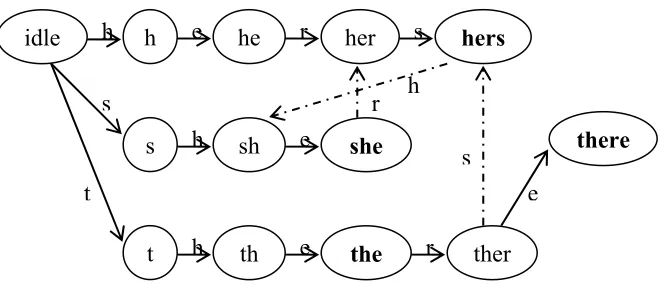
machine is traversed until a matching state is reached. Figure 2.1 shows a state machine
constructed from the following strings {hers, she, the, there}. The dashed lines show the
failure links, however the failure links from all states to the idle state are not shown. This
gives an idea of the complexity of the FSM for a simple set of strings.
Figure 2.1. Finite state machine diagram
idle h he her hers
sh she
s
th the
t ther
there
h e r s
h e
r
e
h e
s
t
h r
2.4
Current State of the Art for Intrusion Detection
Network intrusion detection is an active research field both academically and commercially.
Commercial systems are mostly software running on personal computers stripped out of all
unnecessary features that may be vulnerable to attacks. Commercial systems are continuously
offering new features such as stateful inspection and intrusion prevention. At the same time,
academic research continues into new methods of providing IDSs in reconfigurable
hardware. This section identifies the most widely used corporate IDSs and discusses current
academic research directed toward moving intrusion detection into reconfigurable hardware.
2.4.1
Commercial Intrusion Detection Systems
There is a large number of commercial and open-source intrusion detection systems. It would
be impractical to survey them all. On the other hand, open-source intrusion detection is
becoming increasingly popular with Snort [28] becoming the de facto standard for intrusion
detection system. Another popular open-source intrusion detection system is Shadow [29]
which released under GNU software license. Most of the configurable hardware developed
by academic research used Snort as the standard intrusion detection system. We selected
Snort because it is open source and because there is a vast amount of information available. It
would also make it easier to compare to other architectures. The next subsection presents a
2.4.1.1
Snort
Snort [28] is a widely used open-source intrusion detection system in which the rules refer to
the header as well as to the packet payload. Snort also allows stateful analysis to be
performed as explained in [30]. Snort signatures databases are freely available and
maintained online [31]. Snort rules are divided into two sections, the rule header and the rule
options. The header contains the rule's action, protocol, source and destination IP addresses
including network masks, and the source and destination ports. The options section is
optional, it follows the rule header and is enclosed inside a pair of parentheses. There may be
one option or many, and the options are separated with a semicolon. If a rule has multiple
options, these options form a logical AND. The action in the rule header is invoked only
when all criteria’s in the options are true. All options are defined by keywords specifying
which fields of the packet should be inspected, such as ttl and content. The content keyword contains a signature or data pattern to be matched against the packet content. The pattern
may be in the form of an ASCII string or a binary data in the form of hexadecimal characters.
The ASCII string is generally enclosed in a pair of double quotes (“”) and the hexadecimal
characters are enclosed in a pair of pipe or vertical bar symbols (||). If the signature includes
a double quote, semicolon or pipe characters, they must be escaped [32].
There are other keywords that are used with the content keyword to add additional criteria while finding a pattern inside a packet, such as the offset, depth, and nocase
start of the packet payload. The depth keyword is used to define the point after which Snort should stop searching for the pattern in the packets payload. The search is always case
sensitive unless the nocase keyword is used to indicate the opposite. The dsize keyword is used to test if the packet payload exceeds a certain set limit in case of buffer overflow
attacks. The msg keyword is used to add a text string for logs or alerts. The rev keyword indicates the revision number for the rule. The uricontent keyword is used to look for a string only in the URI part of a packet. For more details about Snort rules options check chapter
three of R. Rehman’s book [33].
alert tcp $TELNET_SERVERS 23 -> $EXTERNAL_NET any (msg:"TELNET root login"; content:"login\: root"; low:from_server, established;
classtype:suspicious-login;sid:719; rev:5)
Figure 2.2. Sample Snort rule
A sample Snort rule that detects Telnet root login attempt is shown in Figure 2.2. The
action to be taken is to send an alert message, other actions could be to log the packet or just
ignore (pass) it. Any packet from local telnet server port 23 destined to any external host
examined. The msg keyword contains the message to be logged “TELNET root login”. The
content keyword indicates the signature to be matched against the packet content. The sid
keyword indicates the vulnerability identification number assigned to this rules. The number
is used to get additional information, from the arachNIDS web database [31] for example.
Snort 2.0 is written in C, and is composed of three main components: the packets
decoder, detection engine and alerter or logger. The packet decoder performs all the parsing
to prepare the packet data for the detection engine. The detection engine is at the heart of
Snort. The engine is broken into three processing phases: The rule optimizer, the multi-rule
matching engine and the event selector. The rule optimizer optimizes the Snort rules by
sorting them into smaller sets. The packets are classified based on the header fields and
assigned to a specific rule subset. This allows Snort to inspect the packet against the
applicable rule set. The rules subsets are parsed and stored in a two dimensional linked list:
1. Chain Headers
2. Chain Options
These rule chains are searched recursively for each packet. If the matching engine
triggers a match an event is generated and added to the event queue. The event selector
prioritizes the events and processes the queue. The Logger or alerter then executes the action
specified in the rule definition. The logger allows the information to be logged in tcpdump
Snort can be run as a packet sniffer, packet logger and as a network intrusion detection
system. When Snort is run as a packet sniffer, the packet header information and data are
dumped on the standard output. As a packet logger, Snort logs the application and protocol
header information to a file. As an NIDS, Snort listens on the network interface and runs
Snort detection engine.
Based on the previous discussion of Snort, intrusion detection can be divided into two
problems: packet filtering or classification based on header fields and string matching over
the packet payload. The first problem was studied extensively in the literature and many
algorithms were suggested [35]. A recent study [36] showed that the string matching routines
in Snort account for up to 70% of the total execution time. We also have studied the Snort
rules and have showed that 87% of the rules contain strings to match against [37]. Therefore,
the second problem of string matching is the most computationally intensive. The following
section summarizes the academic efforts to accelerate pattern matching by building special
hardware.
2.4.2
Intrusion Detection Research in Academia
Academic research continues into new methods of providing IDSs in reconfigurable
hardware. The focus is on accelerating pattern matching in hardware which is the most
technique used to accelerate pattern matching. We discuss the advantages and disadvantages
of that technique and list the university groups working in that segment. The main techniques
used to accelerate IDS are: regular expressions, discrete comparators, CAMs/DCAMs and
hashing. The first four subsections discuss the techniques above, respectively. Subsection
2.4.2.5 presents the research done in the area of stateful IDS. Finally Subsection 2.4.2.6
discusses the most common techniques for behavioral detection.
2.4.2.1
Regular Expressions and Finite Automata
There have been several attempts to accelerate pattern matching in hardware recently, most
of the implementations used regular expressions. Regular expressions are a common way to
express string matching patterns. The characters to be matched, are the main elements of a
regular expression, they are combined with character operators such as concatenation “()”
and alternation “|”. A question mark matches 0 or 1 occurrences of the pattern in a string,
and an asterisk matches 0 or more occurrences of the pattern in a string. For example,
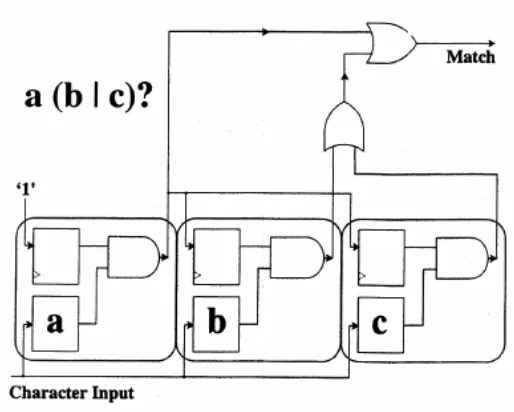
“a(b|c)?” matches: "a", "ab", and "ac", the circuit is shown in Figure 2.3 courtesy of [3].
Regular expressions are generated for every string in the rule set and a
Nondeterministic/Deterministic Finite Automata (N/DFA) that examines the input one byte
at a time is implemented. Java Hardware Description Language (JHDL) was used to
Finite automata machines are complex and hard to implement, the time and space
required to build an NFA increases respectively lineally and quadratic with the length of the
regular expression. Deterministic finite automata machines, on the other hand, require
exponential time and space. Every time a new attack is characterized and a signature is added
to the database the FA have to be rebuilt again. Both NFA and DFA can only process on byte
every clock cycle resulting in a modest throughput. To achieve higher bandwidth researchers
have proposed the use of packet-level parallelism [38], whereby multiple copies of the
automata work on different packets at lower rate. As we will discuss in the following
subsection, they also suggested the use of wide discrete comparators for the search. Since all
comparators work in parallel on the same input (one packet), it is straightforward to increase
the processing bandwidth of the system by adding more comparators.
One of the earliest attempts, at the University of Southern California, by Sidhu and
Prasanna mapped an NFA into a Virtex XCV100 FPGA [2]. Carver et al., at Brigham Young
University, wrote a regular expression generator in JHDL that extracts strings from the Snort
database, generates regular expressions and a netlist for a Xilinx FPGA [3]. Lockwood et al.,
at Washington University, St. Louis, used the Field Programmable Port Extender (FPX)
platform to perform string matching using DFAs [38].
2.4.2.2
Discrete Comparators and Pipelining
Due to the fact that if the pattern match operates at one character per cycle, the total
throughput is limited by the operating frequency, the attention shifted to using multiple
comparators in parallel. Several 32-bit or wider comparators are used in parallel to match
every rule against the packet content to achieve higher throughput. Mangione-Smith et al.,
from the University of California at Los Angeles, for example, used four parallel
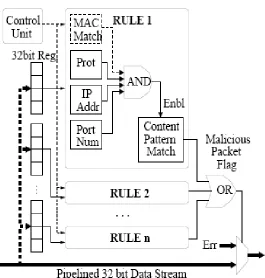
comparators per rule content [7]. Each rule is translated into structural VHDL unit, which is
then synthesized and mapped onto an FPGA as shown in Figure 2.4 (courtesy of [7]). The
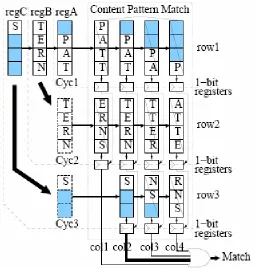
packet content is passed to the units through a 32-bit bus, i.e. handling four characters every
cycle as shown in Figure 2.5 (courtesy of [7]). On the other hand, Sourdis et al., from
Technical University of Crete, Greece, utilized N parallel comparators per search rule, so as
to process N packet bytes at the same time [6]. They also used extensive fine grain
large area required by the comparators and the long latency of the deep pipelines. The other
major disadvantage is the area of the comparators where the design needed 3 FPGA devices
of 120,000 logic cells to include the entire Snort rule options, and an additional device to
accommodate the entire Snort rule header matching.
Figure 2.5. Parallel Comparators
2.4.2.3
CAMs and DCAMs
Finite automata machines did manage to increase the performance of pattern matching by
about 10 times over the existing software implementations. Despite this ability to run at high
speeds, FA-based systems have their own drawbacks. Storing the attack signature in an FA
often requires a large amount of resources. As the number of signatures grows from hundreds
into thousands or more, on-chip memory becomes insufficient. In order to solve this problem
which use Content Addressable Memories (CAMs) were used. Content addressable
memories are initialized with several tables, these include: a protocol table, source and
destination IP addresses and content strings. The hardware appends to the packet a match
vector that records which CAM entries matched the packet. The rule processor receives each
packet scanned by the hardware and correlates the match vector to the internal rule database
and determines an action for each rule.
Gokhale et al., from Los Alamos National Laboratory, used a CAM to implement Snort
rules on a Virtex XCV1000E [5]. Sourdis et al., extended their discrete comparators IDS with
DCAMs [4]. Figure 2.6 shows a CAM based matching unit from Sourdis’s design. CAMs
based implementations achieve similar throughput to the discrete comparators
implementations with reduced area. The drawback is the high cost and the high power
requirement of CAMs.
2.4.2.4
Hash Functions
Recently, Dharmapurikar et al., from Lockwood group at Washington University, St. Louis,
used bloom filters to perform string matching [39]. The strings are compressed into an m-bit
long vector, by calculating multiple hash functions over each string. The hash functions set
bits in the m-bit long vector. The compressed m-bit vector is stored into a small memory
Figure 2.6. Content addressable memories matching
The same hash functions are applied to the string, if the resulting vector matches the
m-bit long vector then the string is a member of the bloom filter. If a string is found to be a
member of a bloom filter, it is declared as a possible match and a hash table or regular
matching algorithm is needed to verify the final match. If the resulting vector doesn’t match
any bloom filter then the string does not match any string in the set and the packet is cleared.
Since multiple strings might set the same bit, it is a little tricky to delete a string from the
m-bit vector. Counting bloom filters technique is used, where a counter is kept for every bit
in the m-bit long vector representing the number of strings that set each bit. When a string is
deleted the corresponding bit counters are decremented. Once the counter reaches zero the bit
is reset, meaning that there are no more strings setting that bit. Figure 2.7 shows a block
diagram of a bloom filter implementation, courtesy of [39].
The larger the m-bit vector and the smaller the number of strings, the better the bloom
filter represents the string set and the better the exclusion queries work. The number of hash
functions is a factor of how well the bloom filter works, the more the better. The large
number of hash functions and the large vector size can get expensive in some
implementations. Compared to the other techniques, bloom filters use less memory, are easy
to reprogram and achieve higher throughput than DFA implementations. They eliminate the
2.4.2.5
Stateful IDS
A Stateful inspection IDS is able to detect attacks spread over several packets. Once a
connection has been established, it is recorded in a table. This table is checked first when
packets arrive at the IDS, and if a packet matches the information there, it is allowed to pass.
Deep stateful intrusion detection system also examines the packet content up to the
application layer and can handle complex connections, such as FTP or Oracle. One of the
most useful security benefits of stateful inspection is the ability to enforce protocol standards.
For example, SSH creates encrypted connections, therefore many firewalls simply examine
the destination port to determine that the connection is SSH. Since it is an encrypted
connection, it is assumed that there is little else to be done. In other words, an intruder can
get malicious code or packets through the firewall by disguising them as an SSH connection.
A stateful inspection IDS examines the first few packets and ensures that they conform to the
SSH standard, in other words, that the connection is really SSH, and not something else.
S. Li et al., from the University of Oslo, built modules for TCP reassembly and
connection state maintenance in an FPGA [40]. They used Snort misuse IDS and discrete
comparators for pattern matching. C. Kruegel et al., from the Reliable Software Group at
University California, Santa Barbara, proposed to partition the incoming traffic into smaller
portions that can be statefully inspected by IDSs [41]. Intrusion detection is performed by a
set of signature based sensors, each of which is responsible for the detection of a subset of
size. Each traffic slice is analyzed by a subset of the intrusion detection sensors. The traffic
partitioning is done so that a single slice contains all the evidence necessary to detect a
specific attack, making sensor to sensor interactions unnecessary. G. Vigna from the same
group introduced a software system for stateful inspection in web servers [42]. They
introduced WebSTAT which is an extension to the STAT framework. State Transition
Analysis Technique (STAT) is state/transition-based attack description language designed to
support intrusion detection [43].
2.4.2.6
Behavioral IDS
Anomaly detection is based on searching for discrepancies from the models of normal
behavior. Anomaly detection has the ability to detect new attacks against computer systems.
Application behavior profiles have recently emerged as a substitute for the traditional user
based behavior. Application behavior profiles are built by capturing system calls made by the
program under analysis, under normal operational conditions. The profile can be used to
detect deviations from normal behavior such as those that occur when an application is being
misused by an intruder.
One of the first groups to develop application-based intrusion detection was S. Forrest's
research group out of the University of New Mexico. They constructed a profile of normal
application is monitored under normal usage conditions and a database of system calls is
built. If a behavior during the online operation of the application does not match a profile in
the normal database, a mismatch is recorded (called the equality approach). If the number of
mismatches detected is a significant percentage of all strings captured during the online
session, then an intrusion is registered. Subsequent work performed by A. Kosoresow et al.,
from the University of New Mexico [45], found recurrent patterns of system calls of any
given application. They constructed a DFA, by hand, to represent this behavior. DFA based
techniques will not scale well to real systems, as the presentation of the program behavior
could lead to a state explosion problem. Later work by A. Ghosh, of the Reliable Software
Technologies Corp., investigated machine learning such as neural networks back propagation
to be able to generalize from previously seen behaviors to map future unseen behaviors [46,
47].
One clear draw back of anomaly detection is its inability to identify the specific type of
attack that is occurring. However, the most significant disadvantage of anomaly detection
approaches is the high rates of false alarms. Because any significant deviation from the
baseline can be flagged as an intrusion, it is likely that normal behavior that falls outside the
normal profile captured will also be labeled as an intrusion. Another drawback of anomaly
detection approaches is that if an attack occurs during the training period for establishing the
2.5
State of the Art Summary
Network security is a dynamic field where new attacks are catching the headlines every year.
There is a race between the attackers, who try to find loopholes, and the vendors, who
develop patches for them. None of these attacks is stopped by encryption and not all of them
are stopped by firewalls. Intrusion detection systems are becoming more important in the
field of network processing where the demand on speed and flexibility is increasing. Most
commercially available IDSs are software-based and those systems are not able to keep up
with increasing network speeds.
Several approaches to the design of intrusion detection systems currently exist. All of
these approaches provide some means for efficiently handling high speed network traffic or
adapting to new attacks. The current design techniques used to build these intrusion detection
systems do not, however, fully address both aspects of the problem. Unfortunately, they
failed to meet both needs of flexibility and speed. For example, a DFA mapped on an FPGA
achieve low throughput, they are complex to build and configure. On the other hand, discrete
or parallel comparators were used to achieve higher throughput at the expense of increased
area and poor scalability. CAM based solutions reduce the area used by discrete comparators
and achieve similar throughput, with draw back of increased cost and power consumption.
Finally, bloom filters and hash functions were used to compress the string set, find probable
needed to maintain the flexibility of software IDSs while providing the required speed for
Chapter 3
T
HE
A
RCHITECTURE
Several approaches to intrusion detection acceleration were described in Section 2.4.2.
Although each design had something to offer, it was shown that none of them provided
sufficient speed to fully protect network systems at line rate, nor provided enough flexibility
to adapt to the ever morphing attacks. In this chapter, we present a new approach to intrusion
detection systems design that provides for both increased speed and enhanced
configurability. This design is a part of a larger configurable network processor that provides
the flexibility and performance required of the network processor while providing an
enhanced level of network security.
The rest of this chapter is organized as follows. The first section presents an overview of
the network processor components. Section 3.2 discusses the software, complier, algorithms
and the state table format. Section 3.3 describes the accelerator hardware, while in Section
3.4 we present the hardware-software interface. Finally, Section 3.5 discusses some of the
3.1
Network Processor Architecture
The configurable network processor architecture shown in Figure 3.1, it consists of a
Clustered Length Architecture Word processor (CLAW), a memory, Direct Memory Access
(DMA) and a number (N) of configurable hardware accelerators. CLAW is a 32-bit load-store processor with Harvard microarchitecture, 5-stage pipeline and virtual memory support.
It is a 2-wide multiple issue VLIW machine with hardware support for eight hyper threads.
CLAW evolved from the OpenCores.org OR1200 implementation of the OpenRISC
architecture [48]. This architecture targets medium to high performance networking,
embedded, automotive and portable computer environments. CLAW was written in Verilog,
simulated using Modelsim and synthesized using Cadence to program onto an FPGA. GCC
compiler version 3.4.2 was ported for CLAW and instruction scheduling is done completely
in software. The Verilog code was made available to the open source community [49].
Figure 3.1. Configurable network processor architecture (CLAW)
2-Wide VLIW OpenRISC
Core with Fine Grain Multithreading
and Extended ISA
Accelerator 1 RAM
DMA
Accelerator 0
Accelerator N •
• •
IDS
QoS Loads
Stores
The memory system consists of multi-port RAM and a high speed Direct Memory
Access. The RAM will hold the packets, which then will be streamed to the accelerators. The
RAM will also hold the IDS configuration, IP forwarding, Quality of Service (QoS) and
classification tables. The RAM is a key component of the network processor and will be the
limiting factor in terms of performance and the limiting factor in terms of area and power
consumption. The DMA is supposed to provide the accelerators with high speed data access
through to the RAM. It will also be responsible for arbitrating the accelerators access to the
shared RAM areas.
The configurable accelerators are used to speed up specific networking tasks such as
encryption, IP forwarding, quality of service (QoS) and string matching for intrusion
detection. CLAW is the core of the network processor and will run any general purpose
software as well as the software for the networking tasks mentioned earlier. The software
will use the acceleration hardware to speed up certain tasks that are computationally
extensive and cannot be executed efficiently on CLAW or any general purpose processor.
Pattern matching is the most computationally expensive task in intrusion detection.
Therefore, building a hardware accelerator will significantly improve the performance of an
intrusion detection system.
In this document we will focus on the IDS accelerator. The accelerator is composed of
two components: software that runs on CLAW and hardware for string matching. The
the Snort database, creates the FSM tree and generates the state tables. The hardware is a
straight forward FSM implementation that has a RAM to store the state tables and a control
logic that traverses the state tables and match the packet against the signature database.
3.2
The Software
The software, also referred to as the complier, converts the raw strings set into an AC
tree-based state machine. After the strings are extracted from the Snort rules set, they are in
either ASCII format or binary codes represented in hexadecimal characters. The hexadecimal
strings are converted into ASCII codes, the spaces are eliminated and the resulting string is
used in creating the AC tree. The parser does not support all Snort keywords except for
content and uricontent keywords. The uricontent keyword is similar to the content keyword except that it is used to look for a string only in the URI part of a packet. The offset, depth, and distance keywords are used to confine the search into a certain range within the packet payload. Those keywords are not supported by the complier. Finally, the pattern search is
always case sensitive and the nocase keyword is ignored by the complier.
The AC algorithm works by building a tree-based state machine from the set of strings to
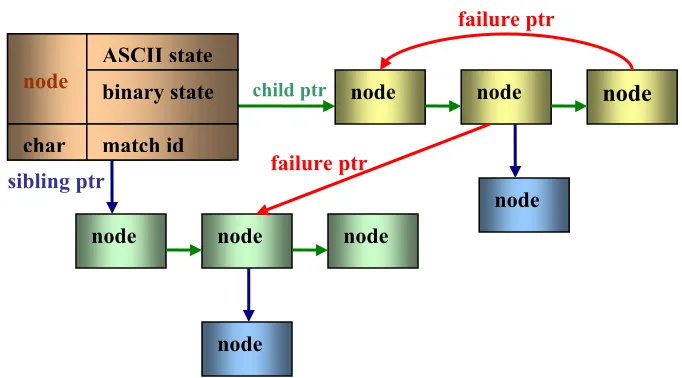
be matched. The tree is composed from an idle state, child and sibling nodes as shown in
A child node is one that has a prefix matching to its parent node. If there is more than one
child, the other siblings are connected to the first child using the sibling pointer.
After the complier is done parsing the strings and converting them into ASCII, the AC
state machine is built as described in the pseudo-code in Figure 3.3. Starting with a default
no match state as the root node, to add a new string to the tree, the tree is traversed to find the
node or child with the longest matching prefix to the new string. If the longest match does
not exist, each character of the new string adds a node to the machine starting from the idle
state. If a matching prefix was found the rest of the string characters add new nodes to the
longest match node. After all the strings are added, the tree is traversed and failure links that
point to the longest partial match are added. The algorithm is then optimized by following
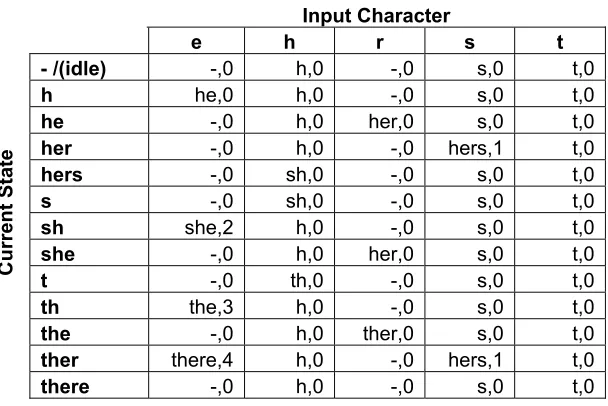
the failure links to compute the next state for every character from every state in the machine.
This shaves a cycle of the clock every time a no-match occurs and a failure link has to be
traversed. Rather than having an additional access to the RAM and state tables every failure,
the state will be pre-computed by the complier. This adds complexity to the complier in order
to be able to achieve higher pattern matching speeds.
After the software creates an AC tree-based state machine, the state machine is then
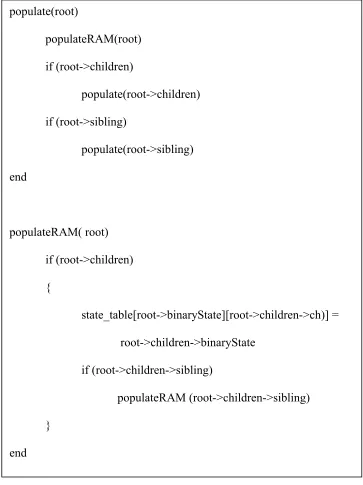
traversed and a state table is generated. The pseudo-code for the traversal algorithm that
generates the table is shown in Figure 3.4. Recursion is used to traverse the data structure and
hardware recursion is reduced to a RAM read. The state table is written to the RAM during
the initialization of the accelerator.
Figure 3.2. General Aho-Corasick tree failure ptr
child ptr
sibling ptr
node
node
node
node
node
node node
node
failure ptr
node
ASCII state binary state
Figure 3.3. Optimized Aho-Corasick algorithm pseudo-code add string()
state = idle state
for every character in the new string
find the longest matching substring in the tree
if part of the string exists in the tree
add the rest of the string to the tree
assign id to the string
else
start from idle and add a new state for every character
assign id to the string
end for
traverse the tree
create failure links to the longest matching prefix
compute the next state based on the failure links
traverse the tree
For the characters that cause transition
print out the final state table