HIGHLIGHTED ARTICLE INVESTIGATION
Rapid and Precise Engineering of the
Caenorhabditis
elegans
Genome with Lethal Mutation
Co-Conversion and Inactivation of NHEJ Repair
Jordan D. Ward Department of Cellular and Molecular Pharmacology, University of California, San Francisco, California 94158 ORCID ID: 0000-0001-9870-8936 (J.D.W.)
ABSTRACTAs in other organisms, CRISPR/Cas9 methods provide a powerful approach for genome editing in the nematodeCaenorhabditis elegans. Oligonucleotides are excellent repair templates for introducing substitutions and short insertions, as they are cost effective, require no cloning, and appear in other organisms to target changes by homologous recombination at DNA double-strand breaks (DSBs). Here, I describe a methodology inC. elegansto efficiently knock in epitope tags in 8–9 days, using a temperature-sensitive lethal mutation in thepha-1gene as a co-conversion marker. I demonstrate that 60mer oligos with 29 bp of homology drive efficient knock-in of point mutations, and that disabling nonhomologous end joining by RNAi inactivation of thecku-80gene significantly improves knock-in efficiency. Homology arms of 35–80 bp are sufficient for efficient editing and DSBs up to 54 bp away from the insertion site produced knock-ins. Thesefindings will likely be applicable for a range of genome editing approaches inC. elegans, which will improve editing efficiency and minimize screening efforts.
KEYWORDSoligonucleotide-mediated homologous recombination; CRISPR/Cas9; nonhomologous end joining;pha-1; co-conversion
S
EQUENCE-SPECIFIC nucleases are a critical tool forma-nipulation of DNA sequences. The bacterial type II clustered regularly interspaced short palindromic repeats (CRISPR) sys-tem, which normally protects against viral DNA and provides
a memory of exposure (Jineket al.2012), has recently
revo-lutionized genome editing in multiple organisms (Conget al.
2013; DiCarloet al.2013; Gratzet al.2013; Hwanget al.2013;
Liet al.2013; Ranet al.2013; Gratzet al.2014; Nakanishiet al. 2014). For genome editing, the system has been simplified to two components: the Cas9 nuclease, which generates DNA double-strand breaks (DSBs), and a chimeric small guide
RNA (sgRNA) thatfills the function of two small RNAs in
the native bacterial system (Conget al.2013). Specific
geno-mic sequences are targeted by the 59-most 15–20 bp of the
sgRNA through the formation of an RNA:DNA hybrid (Jinek et al. 2012; Mali et al. 2013). An NGG motif (protospacer adjacent motif, PAM) must immediately follow the target
sequence in the genome (Jinek et al. 2012; Ran et al.
2013). This PAM directs Cas9 to cleave the DNA 3 bp 59
to the PAM (Jinek et al. 2012). Depending on the desired
experimental outcome, one can select for error-prone repair by pathways such as nonhomologous end joining (NHEJ) to
generate insertion–deletion (indel) mutations, or homologous
recombination to knock in specific sequences.
Initial genome editing methods inCaenorhabditis elegans
harnessed excision of a Tc or Mos transposon to generate a DSB, and a plasmid repair template to knock in (Plasterk and Groenen 1992; Robert and Bessereau 2007;
Frøkjaer-Jensen et al. 2008; Frøkjær-Jensen et al.2012), or delete
(Frøkjær-Jensenet al.2010) desired sequences through
ho-mologous recombination. These methods are robust, but the relative rarity of the editing event requires use of a selectable
marker, such as unc-119 rescue or antibiotic resistance
(Frøkjaer-Jensen et al.2008; Giordano-Santini et al.2010),
and a transposon site is ideally needed within 1–2 kb of the
desired edit (Robert and Bessereau 2007). Zinc finger and
transcription activator-like effector nucleases (Wood et al.
2011) and CRISPR/Cas9 have allowed for similar efficient editing without the constraint of transposon insertions. In particular, the ease and rapidity of generating new sgRNAs for the CRISPR/Cas9 system means that transgenic strains can be created precisely and rapidly and any endogenous Copyright © 2015 by the Genetics Society of America
doi: 10.1534/genetics.114.172361
Manuscript received November 3, 2014; accepted for publication December 8, 2014; published Early Online December 9, 2014.
Available freely online through the author-supported open access option.
Supporting information is available online athttp://www.genetics.org/lookup/suppl/ doi:10.1534/genetics.114.172361/-/DC1.
Address for correspondence: University of California, San Francisco, Mission Bay, Genentech Hall S574, 600 16th St., San Francisco, CA 94158.
NGG sequence can theoretically be targeted. Several CRISPR/ Cas9 systems have been described, each with individual strengths and weaknesses (Waaijers and Boxem 2014). Cas9 can be
delivered by micro-injection of in vitro transcribed mRNA
(Chiu et al.2013; Loet al. 2013), pure protein (Choet al.
2013), or plasmid DNA (Chenet al. 2013b; Dickinsonet al.
2013; Friedland et al. 2013; Katic and Grosshans 2013;
Waaijerset al.2013). Similarly, the sgRNAs can be introduced
byin vitrotranscription, which does not require polyA tailing
or 59methyl cap addition (Chiuet al.2013; Choet al.2013;
Loet al.2013), or driven by RNA polymerase III promoters
such as U6 (Chenet al.2013b; Dickinsonet al.2013; Friedland
et al.2013; Katic and Grosshans 2013; Waaijerset al.2013) or
rpr-1(Chiuet al.2013). Most groups use the chimeric sgRNA,
though a previous report described higher in vitro nuclease
activity using the two separate bacterial small RNAs (Lo et al.2013). Multiple groups have developed protocols for both knockouts and knock-ins. Knock-ins have been primarily gen-erated through efficient selection schemes based on the earlier MosI-mediated single-copy transgene insertion methods using
genetic markers such asunc-119(Dickinsonet al.2013), drug
resistance markers (Chenet al.2013b), orfluorescence (Tzur
et al.2013). Typically, plasmid repair templates with 1 kb or
more of homology flanking the insert have been used (Chen
et al.2013b; Dickinsonet al.2013; Tzuret al.2013; Kimet al. 2014).
Recently, several reports have described methods to introduce single-basepair changes, small epitopes, and larger tags such as GFP without the need for selectable markers; these approaches
either directly screened all F1progeny from co-injection marker
positive animals (Paix et al.2014) or employed a co-CRISPR/
co-conversion approach where selection for one editing event resulted in an enrichment for edits at unrelated loci (Arribere et al. 2014; Kim et al. 2014). Direct screening of F1’s allows editing without introduction of additional mutations, but is more labor intensive, while co-CRISPR/co-conversion allows for iden-tification of editing events while minimizing hands-on screening, but requires outcrossing or meiotic segregation of the marker
allele. Co-CRISPR selects for mutation inthe unc-22 gene, with
mutant homozygotes identified in the F2progeny of co-injection
marker positive animals, or less frequently in the F1 progeny
(Kimet al.2014), though haploinsufficiency of theunc-22locus
in 1% nicotine should allow for identification ofunc-22mutant
heterozygotes in F1animals (Moerman and Baillie 1979).
Co-conversion selects for knock-in of dominant alleles in thedpy-10,
sqt-1, or rol-6 genes in the F1 progeny of injected animals
(Arribereet al.2014).
The goal of this study was to test whether repair of a temperature-sensitive lethal point mutation could be used as an alternate co-conversion marker, as such an approach could in theory provide robust selection, minimal screening, and no requirement for outcrossing or meiotic segregation of marker alleles/mutations. I focused on using single-stranded oligonucleotides (oligos) as a template as they have been successfully used in a range of model organisms (Igoucheva et al.2001; Storiciet al.2003; Chenet al.2011; Bedellet al.
2012; DiCarloet al.2013), are cost effective, and require no
cloning. In C. elegans, oligonucleotides have been used to
introduce single-base changes (Arribere et al. 2014; Zhao
et al.2014), inactivate genes by introducing premature stop
codons or deleting sequences (Lo et al. 2013; Paix et al.
2014), or insert small protein epitopes (Loet al.2013; Paix
et al.2014). Introduction of epitopes seamlessly into endoge-nous loci has numerous experimental uses: chromatin immu-noprecipitation, purification of protein complexes followed by mass spectrometry, and detection of proteins by immunofluo-rescence or immunoblotting. Furthermore, optimizing insertion of epitope tags using oligonucleotide templates is almost cer-tain to be applicable to single-base editing. Here, I describe a
robust, cost effective, widely applicable method usingpha-1
co-conversion and inactivation of NHEJ repair to rapidly and
pre-cisely engineer the C. elegans genome using oligo-templated
repair with the CRISPR/Cas9 system.
Materials and Methods
Genetics
The following strains were used in this study: N2(WT),
GE24pha-1(e2123)III,RB873lig-4(ok716)III, which were
provided by theCaenorhabditisGenetics Center.N2animals
and lig-4 mutants were propagated at 20°, while
pha-1(e2123)mutants were propagated at 15°. Animals were
maintained on nematode growth medium seeded with Escherichia coli OP50 (Brenner 1974). For later injection
experiments, pha-1(e2123) mutants were maintained on
HB101. Growth conditions for each experiment are indicated infigure and table legends. Strains generated for this study
are listed inSupporting Information,File S1,Table S1.
Microinjection
Mixtures of plasmids and oligos were microinjected into the gonad of young adult animals. Plasmids were purified using a Qiagen midiprep kit. Oligos were resuspended in TE buffer
and working stocks of 2 mg/ml were made with
nuclease-free dH20. Repair template oligos are listed inTable S2. For
PCR-generated PU6::sgRNA templates, PCR products were
purified from 100-ml reactions and concentrated 10-fold using
a DNA Clean and Concentrator kit (Zymo Research, no. D4004).
MfeI deletion assay
Wild-type (WT) animals were microinjected with 50 ng/ml
of pJW1138 or pJW1236 [klp-12 targeting CRISPR/Cas9
plasmids with original and flipped plus extended (F+E)
sgRNAs, respectively], 10 ng/mlmyo-2::tdTomatoco-injection
marker, and 40 ng/ml of pBluescript DNA. Marker positive F1
animals were picked into 30ml of M9 + gelatin in a 96 well.
ConcentratedOP50food (30ml; see the“PCR-based knock-in
screening” protocol (File S1) in the for recipe) was then
added and F1’s were incubated for 3–4 days at 25°to allow
described in thePCR-based knock-in screeningsection (see
Supporting Information). To each 10ml PCR, 5ml ofMfeI-HF
(NEB, R3589L) digestion mixture (1ml 103CutSmart buffer,
3.5 ml dH20, 0.5 mlMfeI-HF) was added. The reaction was
mixed, incubated at 37°for 1 hr, and then resolved on a 1.5%
TAE-agarose gel.
Temperature-sensitive pha-1 co-conversion screening
For temperature-sensitive pha-1 [pha-1(ts)] co-conversion
experiments, animals were microinjected with 60 ng/ml of
pJW1285(pha-1targeting) CRISPR/Cas9 plasmid, 60 ng/ml
of either pJW1285 (nhr-23 PAM no. 1 targeting), or
pJW1268 (nhr-23 PAM no. 2 targeting) Cas9 plasmid and
50 ng/ml of the appropriate repair oligos. In experiments
where a co-injection marker was included,myo-2::tdTomato
was used at 10 ng/ml. PCR-derived PU6::sgRNAtemplates
were injected at a concentration of 25 ng/ml along with
50 ng/ml of pJW1285(pha-1targeting CRISPR/Cas9) and
50 ng/ml of the appropriate repair oligos. Injected adults
grown at the permissive temperature (15°) were singled
into wells of a 24-well plate containing NGM-lite agar and
seeded with OP50, shifted to 25°, and incubated for 3–4
days. Rescued F1’s (L3s to adults) were the only animals
other than the P0 animals observed in wells. These F1
res-cues were singled onto individual plates and incubated for
two days to allow progeny development. The parental F1animals
were then genotyped by restriction digestion, as described
below, to identify animals with a 23FLAG insertion. The
remaining PCR product was purified using a DNA Clean and Concentrator kit (Zymo Research) and then sequenced using
knock-in specific primers (Table S3). To recover homozygotes
for sequence-verified knock-ins, 12–24 F2progeny were singled
onto individual plates, incubated at 25°for 2 days, and the
parental F2was genotyped to confirm the23FLAGinsertion.
These progeny were also genotyped forpha-1(ts)repair by PCR
and CEL-1 digestion followed by sequencing of candidate repair homozygotes.
Genotyping PCRs and restriction digestion
Single F1animals were picked into 10ml of single-worm lysis
buffer [10 mM Tris (pH 8.3), 50 mM KCl, 2.5 mM MgCl2, 0.45% IGEPAL, 0.45% Tween-20] containing 1 mg/ml
protein-ase K. Tubes were incubated on dry ice for 15 min, 62°for 1 hr,
and then heated to 95°for 20 min to inactivate the proteinase
K. Genotyping PCRs were performed using Phusion polymerase (NEB, no. M0530S) and High Fidelity buffer; 1/10 volume of lysate was used as template in the PCR. For identification of
knock-in events in the F1, 30-ml PCRs were performed. Five
microliters of this PCR was removed and BamHI digested by
adding 10ml of digestion mix per PCR (1ml 103NEBuffer 3,
0.5mlBamHI, and 8.5ml dH20) and digesting for 1 hr at 37°
before resolving on a 1.5% TAE-agarose gel. CEL-1 was purified from four heads of nonorganic celery (Safeway) with the celery juice extracted with a BJE510XL 900W juicer (Breville).
Purifi-cation was performed as described (Yanget al.2000) to the end
of dialysis in step I, as described by Loet al.(2013). For CEL-1
digestions, 10ml of enzyme mix (2ml CEL-1 + 2ml 5xPhusion
High Fidelity buffer + 6ml dH20) was added to the 5-ml PCR
and incubated at 42°for 1 hr prior to resolving on a 1.5%
TAE-agarose gel, as described above. Oligos used for genotyping are
listed inTable S3.
Vector generation
pJW1138 (klp-12 targeting CRISPR/Cas9) and pJW1185
(nhr-25targeting CRISPR/Cas9) were derived from pDD162
using a Q5 Mutagenesis kit (NEB, no. E0554S) as previously
described (Dickinson et al. 2013). sgRNA(F+E) was
synthe-sized as a gene fragment (IDT gBlock; sequence inTable S4)
with a Y61A9LA.1targeting sequence (Friedlandet al.2013)
and introduced into a pDD162-derived vector by Gibson
cloning (NEB, no. E5510S) to generatepJW1219. pJW1236
(klp-12targeting CRISPR/Cas9), pJW1254 (nhr-23PAM no.
1 targeting CRISPR/Cas9), pJW1268 (nhr-23PAM no. 2
tar-geting CRISPR/Cas9) andpJW1285(pha-1targeting CRISPR/
Cas9) were derived frompJW1219[CRISPR/Cas9 with sgRNA
(F+E)] through Q5 mutagenesis. The nhr-23, nhr-25, and
pha-1PAMs were manually chosen by searching for an NGG
sequence in either strand close to the desired insertion site; these sgRNA target sites were then checked for specificity
us-ing the http://crispr.mit.edu website. All target sites scored
.90 with no off-target sites in genes. The PU6::sgRNA
tem-plate sequence was deleted from the pJW1219vector using
Q5 mutagenesis to generatepJW1259. All plasmids (standard
vector propagation, and those generated by Gibson assembly, Q5 site-directed mutagenesis, or TOPO-blunt cloning) were transformed into PEG/DMSO DH5 alpha competent cells
(protocol in File S1) made in house.pJW1219,pJW1259,
pJW1285,pJW1310, andpJW1311 are available through AddGene.
Generation of U6 promoter::sgRNA templates by PCR
TheU6promoter and chimeric sgRNA(F+E) template were
amplified from pJW1219 and cloned into the pCR-Blunt
II-TOPO vector (Invitrogen, no. K2800-20) to generate
pJW1310 and pJW1311, respectively. The U6 promoter
was then PCR amplified from pJW1310 with oligos 1787
and 1788, while the sgRNA template was amplified from
pJW1311 with oligo 1790 and a target-specific 60mer that
contained 20 bp of homology to the U6promoter, 20 bp of
new sgRNA target sequence, and 20 bp of homology to the
sgRNA template (Table S3). New sgRNA template primers
can be made by replacing the N20in the following sequence
with 20 bp of target specific sequence: 59-cctcctattgcga
gatgtcttg(N20)gtttaagagctatgctgg-39. The U6 promoter and
sgRNA template PCRs were mixed (0.5 ml each per 100 ml
PCR reaction) and amplified using the external primers
(1787 and 1790; Table S3). The cycling parameters were:
(i) 98°denaturation; (ii) 35 cycles of 98°for 10 sec, 61°for
30 sec, 72°for 20 sec; and (iii) 72°for 1-minfinal extension.
To generate more PU6::sgRNAtemplates, the fused product
was used in a 100-ml nested reaction with primers 1793 and
RNAi
Feeding RNAi was performed as described (Kamath et al.
2001; Wardet al.2014). Four gravidpha-1(ts)adults were
placed on 6-cm plates freshly seeded withHT115bacteria
expressing control or cku-80 dsRNA, obtained from the
Ahringer library (Kamath et al. 2003). Adults were ready
to inject on the RNAi plates 4–6 days later. For each
exper-iment pha-1(ts) mutants were also put on plates seeded
with bacteria expressing nhr-25 dsRNA. RNAi efficacy was
confirmed by observing molting defects, protruding vulvae,
abnormal germlines, and sterility arising fromnhr-25
inacti-vation (Asahinaet al.2000; Gissendanner and Sluder 2000;
Brookset al.2003; Chenet al.2004).
Immunoblotting
Lysates were generated as described inFile S1and resolved
on Mini-PROTEAN TGX stain-free 4–15% gradient gels (Bio-Rad,
no. 456-8086). Stain-free gels (Bio-Rad) contain a compound evenly distributed in the precast acrylamide gel that reacts with
tryptophan following UV exposure and gives a strongfluorescent
signal that can be used to stain for total-protein levels in acryl-amide gels, monitor transfer in immunoblotting, and serve as a loading control. Following resolution, the stain-free compound
was activated (Poschet al.2013) and proteins were transferred
to an Immobilon FL PVDF membrane (Millipore, no. IPFL00010) at 100 V for 60 min. Total protein, pre- and post-transfer, was
monitored using the stain-freefluorophore as described (Posch
et al.2013). Stain-free imaging of total protein was used to confirm equal loading. The blots were sequentially probed with anti-FLAG (1:1000) (M2 clone, Sigma, no. F1504), and
sheep antimouse–HRP conjugate (1:5000) (GE Healthcare,
no. RPN4201). WesternBright Sirius HRP substrate (Advansta, no. K-12043-C20) and ECL Prime (GE Healthcare, no. RPN2232) were used to develop the blots in Figures 2 and 5, respectively. All blots were imaged using a ChemiDoc MP imaging system (Bio-Rad).
Accession codes
The accession codes are as follows: pJW1219
[Cas9-sgRNA(F+E) targeting site inY61A9LA.1, AddGene plasmid
61250]; pJW1259 (Cas9 plasmid with sgRNA deleted,
AddGene plasmid 61251); pJW1285[Cas9-sgRNA(F+E)
targeting site inpha-1, AddGene plasmid 61252];pJW1310
(U6 promoter template vector; AddGene plasmid 61253);
and pJW1311 [sgRNA(F+E) template vector, AddGene
plasmid61254].
Additional methods are described inSupporting Information.
Results and Discussion
sgRNA(F+E) displays increased activity relative to the original sgRNA in deleting an MfeI restriction site in the klp-12 gene
Initial reports describing use of oligos to introduce
single-base changes reported edits in 0.7–3.5% of the F1progeny
screened (Zhao et al. 2014). Recent work in mammalian
cells reported that a modified sgRNA(F+E), with an ex-tended Cas9 binding structure and removal of a potential
PolIII terminator by an A-U basepairflip, exhibits improved
activity (Chenet al.2013a). I therefore tested whether this
modified sgRNA(F+E) displayed increased activity inC. elegans,
as a potential tool to improve editing efficiency. The mod-ified sgRNA was introduced into the pDD162 CRISPR/Cas9
plasmid (Dickinson et al. 2013), and to evaluate sgRNA
activity, deletion of anMfeI restriction site in theklp-12gene
(Friedland et al. 2013) was used as a readout (Figure S1).
sgRNA(F+E) produced a significant increase in deletion of
the MfeI site in animals positive for the co-injection marker
(Table 1), and was used for all subsequent experiments.
pha-1(ts) co-conversion increases knock-in efficiency with minimal handling
Having increased sgRNA activity, I next turned to improving the screening process. Two recent reports describe that selection for a visible phenotype produced by a CRISPR/
Cas9 triggered editing event [i.e.,unc-22 mutation or
dpy-10(cn64)knock-in] results in an increase in knock-out and
knock-in efficiencies at other genomic loci (Arribereet al.
2014; Kimet al.2014). These approaches can be used in any
genetic background, but require outcrossing or meiotic seg-regation of the selective mutation. My aim was to develop a stringent system with minimal handling and no outcross-ing or meiotic segregation of selection markers required.
pha-1(e2123) is a temperature-sensitive embryonic lethal
mutation; mutants are viable at 15°, but display embryonic
and early larval lethality when cultivated at 25°(Schnabel
et al. 1991; Granatoet al. 1994). pha-1(e2123) has been previously used to select and propagate extrachromosomal
arrays carrying a pha-1(+) marker (Granato et al. 1994).
pha-1(ts)mutants display a low spontaneous reversion
fre-quency of 2.531025per haploid genome (Schnabelet al.
1991); the stringency of this selection was confirmed by
plating 144 gravid adults and shifting them to 25°; no viable
progeny were produced, only dead eggs and arrested larvae. I selected a CRISPR/Cas9 target site that would produce
a DSB 17 bp 39from thee2123point mutation and designed
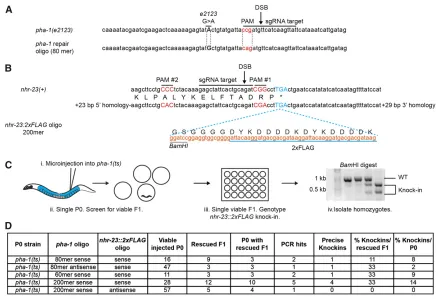
an 80mer repair oligo with the PAM silently mutated to prevent recleavage of the site in an edited animal (Figure 1A). Twelve WT animals were injected with the CRISPR/ Cas9 plasmid, a co-injection marker, and a commercially
purchased, PAGE purified repair 80mer. Eight rescued F1’s
were recovered, all heterozygotes forpha-1(ts)repair (data
not shown). Although all eight F1’s were positive for the
co-injection marker, in later experiments, I also observed
pha-1(ts)rescue in marker-negative animals. Thus, as previously
observed (Arribereet al.2014; Zhaoet al.2014), heritable
transgenesis is not a prerequisite for efficient editing.
Oligo-mediated repair ofpha-1(ts)allowed recovery of repair
heter-ozygotes, and the complete penetrance of thee2123embryonic
lethality meant that only F1heterozygotes (i.e., rescued
A homozygote forpha-1(ts) repair had no significant
dif-ference in brood size compared to a WT control (Table S5;
two-tailed t-test, P= 0.75).
I next tested whetherpha-1(ts)repair could be used to
enrich for knock-in of a23FLAGoligo into the 39end of the
nhr-23 gene (Figure 1B), a nuclear hormone receptor
in-volved in molting and embryonic development (Kostrouchova et al.1998, 2001). I identified two potential PAMs near the desired insertion site that could be silently mutated (Figure
1B). I designed a 200mer oligo to insert a23FLAGepitope
just before the stop codon. As half of sgRNAs have been
reported to fail inC. elegans (Kimet al. 2014), I mutated
two PAMs in the oligo to allow knock-in attempts with different sgRNAs. An 18-bp linker sequence encoding the flexible linker peptide glycine-serine-4xglycine (GSGGGG; Figure 1B) was included to spatially separate the 23FLAG
tag from the NHR-23 C terminus, potentially facilitating
accessibility of the tag for immunoprecipitation.
Addition-ally, the tag encoded a BamHI restriction site, which was
used for diagnostic restriction digestion in PCR-based screening (Figure 1B). I injected a CRISPR/Cas9 plasmid
targetingpha-1, an nhr-23CRISPR/Cas9 construct
target-ing the PAM nearest the stop codon (PAM no. 1; Figure
1B), the 80merpha-1(ts)repair oligo (Figure 1A), and the
200mer nhr-23:23FLAG oligo (Figure 1B); this oligo was
not PAGE purified to test whether PAGE purification was a necessary cost. From 16 viable injected P0 animals, nine
pha-1(ts)rescued F1progeny were obtained (Figure 1D).
These animals were plated, allowed to self-fertilize, and then single-worm genotyping was performed (Figure 1C). Two of these nine animals were heterozygous for a potential
23FLAG insertion by diagnostic digest, of which one was
a correct insertion; the other candidate had a frameshift in
the 23FLAG epitope. F2progeny of the animal carrying the
precise 23FLAG knock-in were singled and a homozygote for
both the insertion and the repaired pha-1(ts) allele was
obtained; both knock-ins were confirmed by sequencing. Brood-size analysis of a representative knock-in confirmed viability
with no phenotype, indicative ofnhr-23loss of function (i.e.,
molting defects or high embryonic lethality) (Table S5).
To distinguish between pha-1(ts) repair homozygotes
and heterozygotes without sequencing, I used CEL-1 digestion
of PCR products (Figure S2). CEL-1 is a celery endonuclease
that recognizes and cleaves mismatches in double-stranded
DNA (dsDNA) formed from single nucleotide polymorphisms
or small insertions or deletions (Yanget al.2000; Woodet al.
2011). In this assay, PCRs from repair heterozygotes will lead
to a digestion product (Figure S2). Normally, the absence of
digestion could indicate that the animals were homozygous
for either thetsallele or the repaired allele. However, growth
at the restrictive temperature eliminates all tshomozygotes;
therefore, all undigested PCR products are repair homozy-gotes. The genotypes predicted by CEL-1 digestion were confirmed by sequencing. CEL-1 or other mismatch cutting nucleases such as mung bean nuclease or T7E1 represent an efficient method to monitor single-basepair changes and help reduce the number of animals that need to be sequenced to identify homozygous knocked-in point mutations.
Short oligos are effective templates for gene conversion
The stringency of pha-1 co-conversion offered a powerful
tool to optimize oligo editing parameters. As much exper-imental effort was spent isolating homozygotes to confirm correct epitope insertion, I designed primers that allowed sequencing of the 23FLAG tag in heterozygotes. These pri-mers bound the insertion junction, with the two 39-most
bases binding to the inserted sequence (Figure S3). In some
cases, poor sequencing quality made it difficult to confirm the sequence in the center of the epitope; in these cases, a separate PCR was performed using the epitope-specific primer and an external primer and sequencing was performed on this purified PCR product using the external primer. Screening in heterozygotes greatly reduced hands-on effort required to identify correct insertions.
I next tested whether oligo length (200mer, 80mer, and 60mer) affected repair efficiency. The 80mer was PAGE purified, but the 200mer and 60mers were not. These oligos
were all sense in relation to the pha-1coding strand. The
80mer and 200mer produced similar numbers of pha-1
rescued F1’s (9 and 12, respectively) and with the 80mer
producing one nhr-23:23FLAG insertion and the 200mer
producing four insertions (Figure 1D). Interestingly, I
ob-served a high percentage of males in thepha-1(ts)repaired
F1, generated using the 200mer (Table S6). Despite the
60mer only producing three pha-1 rescues, two of those
F1 also had knock-ins at the nhr-23 locus. One knock-in
was incomplete and produced a frameshift; the other had an extra insertion after the 23FLAG tag, but frame was maintained. I confirmed the expression of the 23FLAG
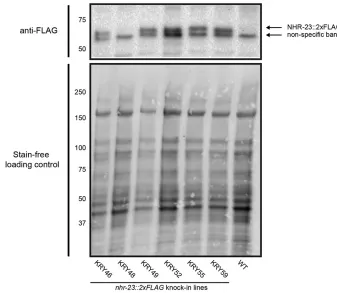
tag by immunoblotting infive knock-in lines carrying a
pre-cise insertion of the 23FLAG tag, as well as a line that
contained an imprecise insertion. All five precise
knock-ins expressed the FLAG tag, whereas no band was seen for the strain carrying the frameshifted FLAG tag (Figure
2).pha-1(ts)co-conversion allowed isolation of
sequence-verified homozygotes for a knock-in event within 8–9 days.
Additional repair template considerations
I then examined whether oligo polarity had an impact on editing, using a PAGE purified, antisense version of the 80mer Table 1 sgRNA(F+E) has increased activity relative to the original
sgRNA in deleting anMfeI restriction site in theklp-12gene
Genotype Guide RNA % deletiona(695% CI) N
WT Original sgRNA 54 (62.73) 157b
WT sgRNA(F+E) 83 (60.31)* 85c
N= number of co-injection marker positive F1progeny screened.
a(Number of animals with loss ofMfeI restriction site/total number of co-injection
marker positive animals screened)3100; CI, confidence interval; 95% confidence interval, Zs/On = 1.96s/On.*Two-tailedt-test comparing original sgRNA to sgRNA (F+E)P= 0.043.
pha-1(ts)repair oligo. The sense oligo was homologous to the coding DNA strand, whereas the antisense oligo was homolo-gous to the template DNA strand. The antisense oligo produced the fewest knock-ins per viable P0 animal of all conditions
tested, but still had a high rate of nhr-23::23FLAGknock-in
per rescued F1 (Figure 1D). Thus, it appeared to be a poor
repair template forpha-1(ts)repair, but once this repair event
was selected could still lead to enrichment innhr-23::23FLAG
knock-in. To further explore this variable, I tested whether
nhr-23::23FLAGcould be knocked in using an antisense 200mer.
Using a sensepha-1 200mer,five rescued F1’s were obtained
from 57 viable P0 animals, but no nhr-23::23FLAGknock-ins
were detected (Figure 1D). Including the antisense 200mer with the sense 200mer did result in a decrease in knock-in
efficiency (1/5 vs. 1/9), but more animals need to be
screened to determine if this effect is significant (Figure
S4). Interestingly, when annealed nhr-23::23FLAG sense
and antisense oligos were injected, no knock-ins were recov-ered, indicating that dsDNA is not a better template than
sin-gle-stranded DNA (ssDNA) and may be less effective (Figure
S4). These data suggest that the strand to which oligo
homol-ogy is derived could be an important parameter for editing efficiency and that ssDNA may be more effective than dsDNA for epitope knock-in. However, these inferences must be tested with many additional combinations of sgRNAs, loci, and repair templates to assess their generality.
Growth on HB101 suppresses pha-1(ts) low brood size and sterility
A number of injected P0s in these experiments were sterile. This sterility could have been a consequence of injection
trauma or general sickness ofpha-1(ts)mutants. To discriminate
Figure 1 Selection forpha-1(ts)oligo-mediated repair enriches fornhr-23::23FLAGknock-in. (A) Sequence of thepha-1(e2123)genomic locus targeted,
with the PAM (red text),e2123G-to-A mutation (boldface text and underline), sgRNA target sequence, and position of the DSB indicated. The 80mer repair
oligo also contains a silent C-to-A mutation to inactivate the PAM. (B) Sequence of thenhr-23genomic locus targeted. The stop codon (blue text), PAM (no.
1, red text) and sgRNA target, the DSB position, and an alternate PAM (no. 2, red text) are indicated. The 200mer repair oligo was designed to insert
a 23FLAG epitope with aflexible GSGGGG linker sequence, which also contains aBamHI site. The oligo contains silent C-to-A and G-to-A mutations to
inactivate the two indicated PAMs. (C) (i)pha-1(ts)mutants propagated at the permissive temperature were injected with 60 ng/ml each of CRISPR/Cas9
plasmids targeting the PAM inpha-1(ts)and PAM no. 1 innhr-23, 50 ng/ml of an oligo designed to correct thepha-1(ts)allele, and 50 ng/ml of the 200mer
nhr-23::23FLAGrepair oligo. (ii) P0 animals were singled onto individual plates and shifted to the restrictive temperature (25°). (iii) Three to four days later,
the plates were screened for the presence of viable progeny (L3s to adults); thee2123embryonic lethality phenotype is completely penetrant at 25°, and only
rescued animals develop. Rescued F1progeny were singled onto individual plates, allowed to lay eggs (2–3 days), and the parental F1was genotyped by PCR
followed by BamHI digestion. Correct insertion of the epitope is confirmed by sequencing-purified PCR products with knock-in-specific primers. (iv)
Homozygotes were recovered by plating 12–24 progeny from candidate nhr-23:23FLAG knock-in F1’s, allowing them to lay eggs (2–3 days), and
genotyping the parental F2animal by PCR andBamHI digestion. Marker size in kilobases is provided. (D) Summary ofpha-1(ts)co-conversion experiments.
Viable P0 are the number of injected animals that produced eggs; a variable number of animals are sterile in each experiment. The length and polarity (with
between these possibilities, I shifted adultpha-1(ts)mutants to
25°to mimic the selection protocol. Interestingly, these animals
displayed sterility (1/24 P0) and low brood sizes (,10 eggs) in
6 of 24 P0s. Growth onHB101has been shown to suppress the
slow growth rate ofeat-2(ad465)andeat-5(ad1402)mutants,
which have defective pharyngeal pumping (Shtonda and Avery
2006). Moreover,unc-119(ed3)strains are frequently grown on
HB101 in genome editing protocols to ameliorate sickness of
that strain (Frøkjær-Jensenet al.2010; Dickinsonet al.2013).
I therefore tested the effect ofHB101growth onpha-1(ts)
mutants by propagating animals for several generations on
HB101at 15°, then picking adult animals and shifting them
to 25°. Growth on HB101suppressed the low brood size
and sterility observed during growth on OP50. pha-1(ts)
mutants grown on HB101and then shifted toOP50 at L4
had brood sizes of 127 6 34 (Table S5) with 0% viable
progeny. Subsequently, thepha-1(ts)strain was maintained
onHB101at 15°prior to micro-injection.
A PCR fusion method to rapidly generate new sgRNA templates
Having demonstrated that oligo-mediated repair of the
pha-1(e2123) mutation can be used to efficiently enrich for
knock-ins at other loci, I next turned to optimizing sgRNA delivery. Generation of new sgRNA templates for plasmid-based CRISPR/Cas9 systems typically involves site-directed
mutagenesis (Dickinsonet al.2013) or cloning using
oligo-nucleotides (Waaijerset al.2013) or PCR products (Friedland
et al. 2013; Kim et al. 2014). A major impediment to the success of a CRISPR/Cas9 experiment is the efficiency of
the sgRNA; Kimet al.(2014) report that half of their tested
sgRNAs fail. Given that efficient promoter::GFP reporters can be generated by fusion PCR (Hobert 2002), I tested whether the same approach could be used to express sgRNAs from the
U6 promoter. This approach would allow rapid screening of
sgRNAs, as PCR templates could be injected on the same day of amplification without need for cloning or transformation. For cost efficiency, four PCR primers were used, of which only one is
changed to generate a new PU6::sgRNAtemplate (Figure 3A).
As a proof of principle, I generated PU6::sgRNAtemplate fusions
targetingpha-1andnhr-23PAM no. 1, and deleted the sgRNA
template sequence from the pJW1219Cas9/CRISPR plasmid.
Injecting this Cas9 plasmid (pJW1259), the PCR-generated
pha-1andnhr-23PU6::sgRNAtemplates, thepha-1(ts)sense 80mer
repair template, and thenhr-23:23FLAGsense 200mer, efficient
knock-in at both loci with comparable frequency to the
corre-sponding plasmid-based PU6::sgRNA templates was observed
(Figure 3B). Fusion PCR thus allows rapid, cost-effective
gener-ation of sgRNA templates driven by theU6promoter.
DSBs up to 54 bp from the insertion site can generate nhr-23::23FLAG knock-ins
During my initial design of thenhr-23::23FLAGrepair oligo,
I mutated two potential PAMs, as it has been reported that half of all sgRNAs fail; this single oligo would allow testing
of two separate sgRNAs (Kimet al.2014). While analyzing
the sequence of the 22 candidatenhr-23::23FLAGknock-ins
generated using sgRNAs targeting PAM no.1 and identified
byBamHI digest (Figure 1D, Figure 3B, Table 2), I observed
co-conversion of the PAM no. 2 silent mutation in six lines. Figure 2 Detection of NHR-23::23FLAG in precise knock-ins. Four micrograms of protein from synchronized gravid adults of the indi-cated strains was analyzed by immunoblotting with anti-FLAG. KRY48 contains a frameshift in
the 23FLAG tag and thus does not express the
These co-conversion events suggested thatpha-1(ts)selection could be used to explore gene conversion track lengths and effectiveness of DSB position relative to the insertion site.
The silent point mutations in PAMs no. 1 and no. 2 were 29 bp apart, which agrees with my observation that a 60mer with 29 bp of homology can be used to efficiently knock-in point mutations (Figures 1D and Figure 4A). For these next
experiments, I sequenced all pha-1(ts) rescued F1’s. I first
tested whether an sgRNA targeting PAM no. 2 could be used
to knock in the23FLAGtag into thenhr-2339end; 3 of 12
pha-1(ts)-rescued F1 animals had the PAM no. 2 mutation
knocked in, with one animal also containing the PAM no. 1 mutation and correct insertion of the 23FLAG tag (Figure 4B,Table S7). I next examined whether a DSB 54 bp away from the desired insertion site could be used to knock in the
23FLAGepitope (Figure 4A). I designed a modified version
of the 200mer used for the above experiment that also car-ried three silent mutations to disrupt the sgRNA binding to the PAM no. 3 target site, as well as the mutations in PAMs no. 1 and no. 2 (Figure 4A). A fourth potential PAM (no. 4) was left intact in the repair template, as inactivation would
leave only 10 bp of 59homology; this sgRNA was inactive
(Figure 4, A and B). Using an sgRNA targeting PAM no. 3 to
generate a DSB, two of eightpha-1(ts)-rescued F1’s carried
the silent mutation in PAM no. 3; the others all had wild-type sequence, suggesting that this may be an inefficient
sgRNA (Figure 4B,Table S7). Of the two animals with
muta-tions in PAM no. 3, both had the PAM no. 2 inactivating
mutation, and one had the PAM no. 1 mutation and
inser-tion of the 23FLAG tag (Table S7). Though there was a 1-bp
deletion within the tag, this experiment demonstrates that a DSB 54 bp from an insertion site can be used for introduc-tion of epitopes, and that the presence of mutaintroduc-tions in a stretch of homology does not prevent gene conversion; five point mutations in a 55-bp stretch were introduced into the genome along with the 65 bp of 23FLAG tag (with the 1-bp deletion). Animals were not tracked to identify originating P0s; however, for the PAM no. 1 knock-in experiment, the six animals with PAM no. 2 mutation co-conversion were isolated from six different injections, and thus represent independent events (Figure 4B). Knock-in efficiency appeared higher the closer the DSB was to the insertion site, but sgRNA efficiency could also play a role in this observation.
Homology arms of 35 bp are sufficient for oligo-templated insertion of a 23FLAG tag
Exploring DSB position relative to the insertion site
demon-strated that the stringency of pha-1(ts)co-conversion
com-bined with the speed and ease in recovering editing events allowed rapid testing of editing parameters. Interestingly, the 200mer used for the PAM no. 3 knock-in experiments
only had 29 bp of homology 59to the DSB (Figure 4, A and
B), suggesting that homology arms could be relatively short.
Efficient repair of thepha-1(ts)allele was observed using a
60mer with 29 bp of homology (Figure 1D). Furthermore, recent data using PCR-derived dsDNA repair templates demonstrated Figure 3 PCR generated sgRNA templates can be used forpha-1(ts)co-conversion. (A) Method for generating PU6::sgRNAtemplates by PCR. TheU6
promoter and sgRNA template were separately subcloned to generate pJW1310 and 1311, respectively. TheU6promoter is amplified with oligos 1 and
2, and the sgRNA template is amplified with oligos 3 and 4. Oligo 3 contains 20 bp of homology to the sgRNA template, the new 20 bp sgRNA targeting
sequence, and 20 bp of homology to theU6promoter. The resulting PU6and sgRNA template PCR products are then mixed and used as template in
a second PCR reaction using oligos 1 + 4. (B) Animals were injected with 60 ng/ml of the Cas9 plasmid, 25 ng/ml each of PCR generated PU6::sgRNA
templates targetingpha-1andnhr-23(same targeting sequence as in Figure 2), and 50 ng/ml each of the 200mer sensepha-1(ts)repair oligo and
nhr-23::23FLAGoligo. Viable P0 are the number of injected animals that produced eggs; a variable number of animals are sterile in each experiment. P0
that 30- to 60-bp homology arms were optimal, with knock-in efficiency actually decreasing with longer homology arms (Paix et al. 2014). To test the ideal length of homology for
oligo-mediated insertion of epitopes, I designednhr-23::23FLAG
oli-gos with 35 bp, 25 bp, or 15 bp of homology and tested their
ability to introduce the23FLAGepitope using a DSB generated
by an sgRNA targeting PAM no. 1. Knock-in efficiency using these homology arms was compared to pooled data from the
pha-1(ts)andnhr-23::23FLAGsense oligo experiments (Figure
1D and Figure 3B). This 200mer sensenhr-23::23FLAGoligo
(Figure 1B) contained 54 bp of homology 39to the insertion site
and 76 bp of homology 59to PAM no. 1 (76/54). With the
35-bp homology arms, two animals from 9 rescued F1’s had
correct insertion of the 23FLAG epitope (Figure 4C). This
22% knock-in per F1screened (2 of 9) is comparable to the
26% efficiency (7 of 27) observed using the 76/54 oligo (Figure 4C). The knock-in rate per successfully injected P0 was also comparable for the 35-bp and the 76/54-bp
homol-ogy arms [4.76% (2/42) vs. 6.86% (7/102)]. The 15- and
25-bp homology arm produced fewer pha-1(ts) rescues per
successfully injected P0, and only the 25-bp homology arms
could produce a23FLAGinsertion, though this knock-in
car-ried a point mutation (Figure 4C). These data suggest that,
similar to dsDNA templates, homology arms of 35–80 bp are
ideal for oligo-templated editing.
Inactivation of NHEJ repair increases knock-in efficiency
In Drosophila, increased homologous recombination
effi-ciency can come from inactivation of NHEJ (Beumeret al.
2008; Bottcher et al. 2014). I therefore used the pha-1(ts)
system to test whether NHEJ inactivation impacted knock-in by homologous recombination. NHEJ mutants may have ad-ditional background mutations due to compromised repair of endogenous DSBs and would require additional outcrossing. I therefore tested the effect on knock-in frequency of
tempo-rary inactivation of theC. eleganshomolog of Ku80 (cku-80),
part of a heterodimer that binds the end of DSBs in NHEJ,
and which had reported RNAi phenotypes (Dmitrievaet al.
2005; McColl et al. 2005).pha-1and nhr-23CRISPR/Cas9
plasmids, thepha-1sense 80mer repair oligo, and thenhr-23
sense 200mer repair oligo were injected into pha-1(ts)
mutants treated with control or cku-80RNAi. Control RNAi
produced onepha-1(ts)rescued F1, which also carried a
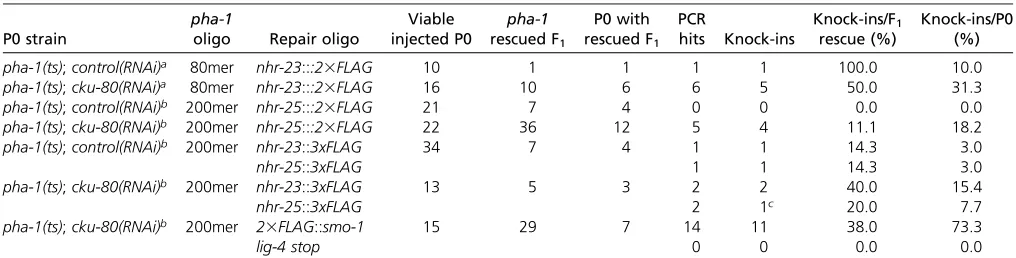
se-quence-confirmednhr-23 knock-in event (Table 2). However,
inactivation of cku-80by RNAi produced an increase in both
pha-1(ts)rescue (10 F1’s) andnhr-23:23FLAGco-knock-ins
re-covered (n= 5) (Table 2). These experiments suggested that
NHEJ inactivation boosts oligo-mediated knock-in efficiency.
To confirm thatpha-1(ts)co-conversion, PCR-generated
sgRNAs templates, and NHEJ inactivation were effective on other loci, I attempted to introduce a 23FLAG epitope in nhr-25, a broadly expressed nuclear hormone receptor that regulates several developmental and physiological programs
(Asahinaet al.2000; Gissendanner and Sluder 2000; Chen
et al.2004; Asahinaet al.2006; Mullaneyet al.2010; Ward et al. 2013, 2014). I selected the 39end ofnhr-25 as there
are two isoforms that share a common 39end, but differ in
promoter use; thus, targeting the 39end ofnhr-25with the
23FLAG should in principle allow for labeling of all known
nhr-25 isoforms. I designed a 175mer repair template with
six silent point mutations in the 20-bp sequence preceding
the PAM, as the PAM could not be silently mutated (Figure
S5, A and B). As with the nhr-23::23FLAG construct, an
18-bp spacer encoding with aBamHI site was also included
(Figure S5, A and B). This oligo contained 41 bp of
homol-ogy 59to the mutated sgRNA target sequence and 43 bp of
39 homologous sequence.pha-1(ts)mutant animals grown
on either control orcku-80RNAi were injected with a
pha-1(ts)CRISPR/Cas9 plasmid, annhr-25PU6::sgRNAtemplate
PCR product, andpha-1(ts)andnhr-25::23FLAGrepair
oli-gos. Seven pha-1rescues were recovered from the control
RNAi-treated animals and 36 from thecku-80RNAi-treated
animals (Table 2). No knock-in candidates were recovered
from the control RNAi injection, but five were recovered
Table 2 cku-80RNAi results in increased knock-in efficiency
P0 strain
pha-1
oligo Repair oligo
Viable injected P0
pha-1 rescued F1
P0 with rescued F1
PCR hits Knock-ins Knock-ins/F1 rescue (%) Knock-ins/P0 (%)
pha-1(ts);control(RNAi)a 80mer nhr-23:::23FLAG 10 1 1 1 1 100.0 10.0
pha-1(ts);cku-80(RNAi)a 80mer nhr-23:::23FLAG 16 10 6 6 5 50.0 31.3
pha-1(ts);control(RNAi)b 200mer nhr-25:::23FLAG 21 7 4 0 0 0.0 0.0
pha-1(ts);cku-80(RNAi)b 200mer nhr-25:::23FLAG 22 36 12 5 4 11.1 18.2
pha-1(ts);control(RNAi)b 200mer nhr-23::3xFLAG 34 7 4 1 1 14.3 3.0
nhr-25::3xFLAG 1 1 14.3 3.0
pha-1(ts);cku-80(RNAi)b 200mer nhr-23::3xFLAG 13 5 3 2 2 40.0 15.4
nhr-25::3xFLAG 2 1c 20.0 7.7
pha-1(ts);cku-80(RNAi)b 200mer 23FLAG::smo-1 15 29 7 14 11 38.0 73.3
lig-4 stop 0 0 0.0 0.0
Summary ofpha-1(ts)coselection experiments testing NHEJ inactivation. The RNAi treatment of the injected P0 animals is indicated. Viable P0 are the number of injected animals that produced eggs; a variable number of animals are sterile in each experiment. The length of thepha-1(ts)sense repair oligo is provided. Fornhr-23::23FLAG experiments, animals were injected with 60 ng/ml each of thepha-1andnhr-23CRISPR/Cas9 plasmids, and 50 ng/ml each of thepha-1(ts)repair andnhr-23::23FLAG(sense) oligos. For the remaining experiments, animals were injected with 50 ng/ml of thepha-1CRISPR/Cas9 plasmid, 25 ng/ml of appropriate PU6::sgRNAtemplate PCR product, and 50 ng/ml each of thepha-1(ts)repair oligo and knock-in oligo.
from the cku-80RNAi-treated animals, of which four were correct insertions of the 23FLAG tag (Table 2). Strikingly,
one of these animals was an F1homozygous knock-in. These
strains were viable and did not display defects associated
withnhr-25inactivation (protruding vulvae, molting defects,
embryonic lethality; seeTable S5for a representative brood
size). I confirmed expression of the 23FLAG tag in an out-crossed, representative line (Figure 5B).
Multiplexed editing using pha-1(ts) co-conversion and cku-80 RNAi
Given the efficient editing observed incku-80RNAi-treated
animals and the 35–80 bp of homology sufficient for
oligo-templated repair, I next tested whether I could introduce
larger epitopes usingpha-1(ts)co-conversion. As Kimet al.
(2014) had reported generating mutations in both avr-14
andavr-15 in oneunc-22co-CRISPR experiment, I
attemp-ted to knock in 84-bp 3xFLAG tags containing the GSGGGG
spacer into both nhr-23andnhr-25in one injection
exper-iment (Figure S5A). From 13 successfully injected P0
ani-mals treated withcku-80RNAi, two precisenhr-23::3xFLAG
lines were obtained (Table 2). A viablenhr-25::3xFLAGline
that expressed the 3xFLAG tag, but had a 51-bp duplication
in the 39UTR was also obtained; as the tag was expressed
and the strain was viable, this line was scored as a correct
knock-in (Table 2,Table S5). A single knock-in animal was
Figure 4 DSBs up to 54 bp from an insertion site, and 35-bp homology arms can be used for oligo-templated repair innhr-23. (A) Schematic of thenhr-23
39end, indicating the stop codon (blue text), four PAMs tested (red text), and position of the DSBs (scissor). Mutations used to inactivate PAMs in repair
templates are provided in thenhr-23(PAM MUT)sequence and indicated by the vertical lines between the(+)and(PAM MUT)sequence. (B) Testing effect of
DSB position onnhr-23::23FLAGepitope knock-in efficiency. The PAMs for the sgRNAs used to generate the DSB and mutations used to inactivate the PAMs
in the repair templates are provided in A. Animals were co-injected with 50 ng/ml ofpha-1targeting CRISPR/Cas9 plasmid, 50 ng/ml each of thepha-1(ts)
repair oligo and a 200mer sensenhr-23::23FLAGrepair oligo, and either 50 ng/ml ofnhr-23targeting CRISPR/Cas9 plasmid (PAMs no. 1 or no. 2), or 25 ng/
ml of PU6::sgRNAtemplate PCR product (PAMs no. 3 and no. 4). For the PAM no. 1 and no. 2 sgRNA experiments, the repair template carried mutations in
both PAMs. For the PAM no. 3 and no. 4 experiments, the repair template carried mutations in PAMs no. 1, no. 2, and no. 3. PAM no. 3 had a single PCR hit
with a 23FLAG insertion carrying a 1-bp deletion. For the PAM no. 1 row, all experiments usingnhr-23::23FLAG200mers were pooled (Figure 1, Figure 3,
Table 2); only animals that displayed a knock-in signature in the diagnosticBamHI digest from these experiments were sequenced. For the PAM no. 2, no. 3,
and no. 4 experiments, allpha-1(ts)F1rescued animals were sequenced. (C) Testing homology arm length onnhr-23::23FLAGknock-in efficiency. Homology
lengths in basepairs for 59and 39arms are provided. 59arm homology numbering starts from the middle G in PAM no. 1; 39homology numbering starts
from thefirst basepair of the stop codon. Animals were co-injected with 50 ng/ml each ofpha-1targeting andnhr-23PAM no. 1 targeting CRISPR/Cas9
plasmids, 50 ng/ml each of thepha-1(ts)repair oligo andnhr-23::23FLAGrepair oligo. For the 76/54-bp homology arm row in the table, data were pooled
from all non-RNAi experiments usingpha-1sense repair oligos andnhr-23::23FLAGsense 200mers (Figure 1 and Figure 3). With the exception of the pooled
obtained from 34 successfully injected P0 animals grown on
control RNAi (Table 2). This F1animal was homozygous for
an nhr-25::3xFLAG insertion and heterozygous for an
nhr-23::3xFLAGinsertion (Table 2). Viability was confirmed for
representative nhr-23::3xFLAG and nhr-25::3xFLAG lines
and for thenhr-23::3xFLAG; nhr-25::3xFLAGdouble knock-in
line (Table S5). No defects consistent withnhr-23ornhr-25
inactivation were observed, though the double knock-in
did have a lower brood size (Table S5). I confirmed FLAG
epitope expression in outcrossednhr-23::3xFLAGlines and
nhr-25::3xFLAGlines (Figure 5, A and B). The 3xFLAG epitope
lines displayed a marked increase in band intensity in
immuno-blots compared to 23FLAG lines, for bothNHR-23andNHR-25
(Figure 5, A and B). Notably, the nhr-23::23FLAG epitope
was not detectable in this experiment (Figure 5A), as a more potent ECL substrate was required for detection by immuno-blotting (Figure 2); this more potent ECL substrate may ex-plain the nonspecific band observed in Figure 2, but not in Figure 5A. I also observed extra bands in the 3xFLAG lines for NHR-23 and NHR-25 compared to the corresponding
23FLAG lines, which would be consistent withNHR-23and
NHR-25 isoforms, though they could also represent degrada-tion products (Figure 5, A and B). Comparing all NHEJ
inac-tivation experiments, growing P0 animals on cku-80 RNAi
produced a significant increase in the number of knock-ins
recovered per injection experiment (two tailed t-test P =
0.01) and percentage of knock-ins per viable P0 (two-tailed
t-testP= 0.016). No significant difference was observed in
the number of P0 animals with rescued F1 progeny (two
tailed t-test P = 0.16) or in the percentage of knock-ins
per rescued F1(two tailed t-test P= 0.85). Recent
manu-scripts have described a “jackpot” phenomenon (Arribere
et al. 2014; Paix et al. 2014), where the majority of edits come from a small number of P0 animals. There may be
a trend of“richer jackpots”incku-80RNAi-treated animals
with 2.6 rescued F1’s/P0 producing F1rescues (60.44; 95%
confidence interval) vs. 1.6 (60.50; 95% confidence
inter-val) in control RNAi-treated animals. This difference was
not significant in a two-tailedt-test (P= 0.19) potentially
due to the large variation in number of F1 rescues and
knock-ins produced across assays, and this observation will require further exploration.
PAGE purification of oligos is not necessary, but increases editing efficiency
Thenhr-25::3xFLAGoligo appeared to be a poor repair
tem-plate, as it yielded lower knock-in efficiency in comparison to
the nhr-25::23FLAGtemplate, and complex insertions were
observed in two nhr-25::3xFLAG candidate knock-in lines.
Although experiments demonstrated that PAGE purification
was not necessary, thenhr-25::3xFLAGtemplate was ideal to
test whether PAGE purification nonetheless increased knock-in
efficiency orfidelity. Resolving unpurified and purified oligos
on a denaturing TBE-Urea gel revealed that the unpurified oligo preparation contained large amounts of incorrectly sized
product (Figure S6A).pha-1(ts)animals grown on control or
cku-80RNAi were injected with thepha-1targeting CRISPR/
Cas9 vector, annhr-25sgRNA template PCR product, apha-1
repair oligo, and either purified or unpurifiednhr-25::3xFLAG
175mers. Interestingly, this experiment demonstrated that PAGE purification resulted in higher rates of knock-ins per F1
and per viable P0 (Figure S6B). Comparing all experiments
using the nhr-25::3xFLAGoligos (Table 2,Figure S6C), both
knock-in candidates obtained using the purified oligo were precise insertions, whereas two of the four candidates gener-ated with the unpurified oligo contained additional sequence
inserted (Figure S6C). These experiments suggested that one
can either opt for an increased knock-in rate with PAGE puri-fied oligos or avoid this cost and inject/screen more animals.
Efficient editing at other genomic loci and rapid testing of sgRNA activity using pha-1(ts) selection and
NHEJ inactivation
Finally, I wished to test these editing parameters on other genes to test their general applicability and robustness.
Based on my previous work onNHR-25sumoylation (Ward
et al.2013), I chose a previously described weakly efficient
sgRNA (Kim et al.2014) that cleaved 19 bp 39to the start
codon of the single C. elegansSUMO gene,smo-1 (Broday
et al. 2004). I designed a 175mer repair oligo to create a SMO-1N-terminal 23FLAG fusion (Figure S5, C and D). I also designed two overlapping sgRNAs to target the NHEJ
gene,lig-4, and a 60mer oligo as the homologous
recombi-nation template to insert a stop codon (oligos were unpuri-fied). From nine successfully injected P0 animals grown on
cku-80 RNAi and injected with PCR-derived sgRNA
tem-plates, 27pha-1(ts)rescued F1animals were obtained.
Four-teen of these F1’s carried knock-ins insmo-1, of which 11
were precise (Table 2). I confirmed the expression of the 23FLAG epitope in a representative line (KRY82) by immu-noblotting; signal was observed over a large range of molec-ular weights, as expected from SUMO conjugation to
hundreds of substrates in C. elegans (Kaminsky et al.2009)
(Figure 5C). Although viable, 23FLAG::smo-1 homozygotes
displayed partially penetrant phenotypes consistent with
smo-1reduction of function, such as small body size and
pro-truding vulvae. Thus, epitope placement may need to be
op-timized insmo-1, though the creation of a viable hypomorph
will be a useful reagent for the community. The lig-4
sgRNAs failed, as no knock-ins or mutations were obtained
in lig-4, demonstrating that this approach also allows rapid
testing of sgRNA efficacy, similar to Kimet al. (2014) (Table
2). Together, these results demonstrate that a co-conversion ap-proach using a temperature-sensitive mutant allele, PCR-gener-ated sgRNA templates, and NHEJ inactivation by RNAi provide aflexible, robust platform to recover genome editing events.
pha-1(ts) coselection increases screening efficiency
Based on recent co-CRIPSR/co-conversion reports (Arribere et al. 2014; Kimet al. 2014), and the frequency at which
relatively rare pha-1(ts)repair events were associated with
coselection increases screening efficiency. Prior to
develop-ing pha-1(ts) co-conversion, I had attempted to introduce
23FLAG tags onto the 39end of nhr-23andnhr-25and
re-cover knock-ins through direct screening of F1progeny, similar
to the approach described by Paixet al.(2014) (see
Support-ing Informationfor detailed methods). No knock-ins were
re-covered from 380 screened WT F1’s (Table S8). I also tested
the effect of NHEJ inactivation by injecting intolig-4(ok716)
mutants; DNA ligase 4 (lig-4) encodes the enzyme that seals
DSBs in canonical NHEJ, and ok716is an out-of-frame
dele-tion that removes the catalytic ligase domain and is predicted
to result in a premature stop codon (Clejan et al.2006). A
single knock-in was recovered from 768 screenedlig-4mutant
F1’s (Table S8); after outcrossing thelig-4mutation, this
nhr-25::23FLAG line had a brood size equivalent to a knock-in
produced bypha-1(ts)coselection (Table S5). In comparable
pha-1(ts) coselection experiments, no knock-ins were
recov-ered from 7 F1 laid by control RNAi treated P0s and four
knock-ins were recovered from 36 F1’s laid bycku-80
RNAi-treated P0 (Table 2).
For nhr-23::23FLAG knock-in experiments, I used a
knock-in-specific PCR screening approach; as in optimiza-tion experiments, it detected knock-in DNA diluted 1:1280 with WT DNA, whereas diagnostic restriction digestion of PCR products could only detect up to a 1:20 dilution of
knock-in DNA with WT DNA (Figure S7). No knock-ins were
recovered from 200 WT F1animals or 840lig-4mutant F1’s
(Table S8). In comparison, pha-1(ts) coselection using
a similar sense nhr-23::23FLAG repair template yielded
seven knock-ins from 27 screened pha-1(ts) rescued F1’s
(Figure 4C). Comparing all similar nhr-23::23FLAGand
nhr-25::23FLAGdirect selection andpha-1co-conversion
experiments (i.e., excluding antisense oligo and NHEJ
inacti-vation experiments) demonstrated a significant increase in
screening efficiency compared to direct F1 screening
(two-tailedt-test,P= 0.01).
Conclusions
Here, I demonstrate that selection for repair of a temperature-sensitive point mutation using an oligonucleotide template can be used to efficiently select for knock-in at other loci in as
quickly as 8–9 days. Severalfindings of this work should be
applicable for a range of co-conversion/co-CRISPR approaches. First, the increased sgRNA(F+E) activity (Table 1) may improve knock-in and knock-out efficiencies and reduce the number of sgRNAs that one must test to identify an active sgRNA. Second, for introduction of single-basepair changes, efficient editing was observed using 60mers, 80mers, and 200mers. There may be a slight improvement in knock-in efficiency with longer repair templates, but using shorter oligos still produces repair events at a high rate. These data are consistent with the 29-bp repair track length observed
using the second silent PAM mutation in thenhr-23::23FLAG
repair oligo and the efficient nhr-23::23FLAG knock-ins
obtained using 35 bp of homology (Figure 4). This optimal homology for oligo-mediated editing is similar to that
reported for dsDNA templates (Paixet al.2014). The 84-bp
3xFLAG nhr-23 and nhr-25 knock-ins is a larger insertion
than described by several recent reports (Lo et al. 2013;
Figure 5 Detection of FLAG epitope
ex-pression innhr-23-,nhr-25-, and
smo-1-tagged lines. Anti-FLAG immunoblot analyses of lysates are from mixed stage animals of the indicated genotypes. The
2x and 3xFLAG taggednhr-23 (A) and
Arribere et al. 2014; Paix et al. 2014; Zhao et al. 2014);
a 66-bp 3xFLAG insertion in thenos-1gene is the most
com-parable edit (Paixet al.2014). Based on the minimal
homol-ogy length of 35 bp and current oligo synthesis limit of 200 bp, it may be possible to knock in sequences of up to 130 bp using oligo templates. Third, I demonstrated that oligos do not need to be PAGE purified, as efficient editing was observed using
unpurified 60mers and 200mers to edit the pha-1(ts)allele
and to introduce the nhr-23::23FLAG epitope (Figure 1D).
However, PAGE purified oligos did result in increased
knock-in efficiency and fewer imprecise knock-knock-ins (Figure S6). Thus,
an investigator can choose between the additional cost for the increased editing efficiency or simply inject more P0 animals
and screen more F1’s. It is very important to note that there is
likely wide variation in quality of unpurified oligos between different suppliers. Different preparations may contain differ-ent inhibitors or cytotoxic compounds and one should confirm the efficiency of unpurified oligos from a new supplier by
testing a control such aspha-1(ts)rescue ordpy-10(gf)
knock-in (Arribereet al.2014). Fourth, PCR-generated PU6::sgRNA
templates allow rapid production of new sgRNAs without need for cloning. Moreover, the robust sgRNA activity observed when injecting linear dsDNA templates enables other technol-ogies for sgRNA template production such as gene synthesis or
oligonucleotide arrays (Bassiket al.2009; Gilbertet al.2014),
which could be used to create pooled sgRNA template libraries.
Injecting multiple PCR-generated PU6::sgRNAtemplates allows
several editing experiments to be performed simultaneously. From single-injection experiments, I was able to knock 3xFLAG
tags into both thenhr-23andnhr-25loci or generate23FLAG::
smo-1lines while also determining that thelig-4sgRNAs were inactive (Table 2). Finally, the observation that inactivation of NHEJ can lead to improved knock-in rates can be adap-ted for any HR-based editing system, though it would re-duce the efficiency of systems that rely on coselection of CRISPR-generated mutations as a marker. The increased knock-in efficiency observed following NHEJ inactivation was surprising and suggests that at least some knock-ins must be occurring outside in the germline; previous work has shown that NHEJ is actively suppressed in meiosis to ensure faithful repair of DSBs by homologous recombination
(Adamo et al. 2010). Determining the cell types in which
knock-ins are occurring and the DNA repair pathways in-volved could lead to improvements in editing efficiency.
It was intriguing that, forpha-1andnhr-23, higher editing
efficiency was observed using oligos with homology to the
coding strand. In these experiments, the sgRNA for pha-1
recognized the coding strand, while the nhr-23 PAM no. 1
sgRNA recognized the template strand (Figure 1D,Table S9).
Although numerous explanations could be invoked for a po-larity bias (sgRNA sequestration of the oligo, oligo:mRNA hybridization, different secondary structures in a given oligo and its reverse complement, etc.), it is unclear whether my data reflect a biologically meaningful trend or a chance ob-servation. Best practice should be to clearly report the strand to which the sgRNA binds and the strand to which the oligo
contains homologous sequence (Table S9). A metaanalysis of
many more combinations of sgRNAs and oligos of differing polarities at a large number of genes is required to definitively determine whether oligo polarity is an important parameter. If one fails to obtain oligo-templated knock-ins when using a sgRNA with confirmed activity, then it may be worth testing the complement of the oligo.
The pha-1(ts) approach is distinct from reported
co-CRISPR and co-conversion methods (Arribere et al. 2014;
Kim et al.2014) in that it starts with a mutant animal and results in restoration of a wild-type animal. In contrast, the other two approaches can be used with any strain, but re-quire outcrossing or meiotic segregation of the selection
marker. pha-1(ts) co-conversion may be advantageous as
a marker in cases where the desired insertion site is linked
to the selectable marker site. Arribereet al.(2014)
demon-strated iterative editing usingdpy-10(gf)co-conversion.
pha-1(ts)co-conversion should allow for iterative editing events,
though not as elegantly as the Arribere approach.pha-1(ts)
F1rescues have all been heterozygous for the repair event.
By shifting to the permissive temperature (15°) after
gener-ating homozygous animals of a desired knock-in, one could
reisolate the pha-1(ts)allele and perform another round of
editing; thispha-1(ts)reisolation would require an additional
5 days. Alternatively, one could simply cross the pha-1(ts)
allele back into an edited strain.
The optimizations I report make oligo-mediated editing efficient, cost effective, and can be applicable to any CRISPR-mediated editing system. The development of three distinct
variations of coediting selection (unc-22mutation; Kimet al.
2014),rol-6(gf)/sqt-1(gf)/dpy-10(gf)knock-in (Arribereet al.
2014), andpha-1(ts)repair (this article) highlight the
robust-ness of this method to select for genome editing events. The recent description of PCR-derived dsDNA templates (Paix et al.2014) will make these approaches even more powerful; the abundance of potential genetic markers in other model organisms should make these widely applicable approaches. A current challenge in cell-culture-based systems has been the laborious recovery of rare knock-in events. Coselection markers such as oligo-mediated repair of mutated GFP or drug resis-tance cassettes, or inactivation of hypoxanthine phosphoribosyl transferase, could yield similar improvements in editing event recovery in these systems.
Acknowledgments