Copyright to IJIRSET www.ijirset.com 773
ISSN (Online) : 2319 - 8753
ISSN (Print) : 2347 - 6710
I
nternationalJ
ournal ofI
nnovativeR
esearch inS
cience,E
ngineering andT
echnology An ISO 3297: 2007 Certified Organization, Volume 2, Special Issue 1, December 2013Proceedings of International Conference on Energy and Environment-2013 (ICEE 2013)
On 12th to 14th December Organized by
Department of Civil Engineering and Mechanical Engineering of Rajiv Gandhi Institute of Technology, Kottayam, Kerala, India
Balancing Labor Intensive Assembly Line Using
Genetic Algorithm
Jithendrababu B L,RenjuKurian, Pradeepmon T G
Dept. of Mechanical Engineering, Rajiv Gandhi Institute of Technology, Kottayam, Kerala, India Dept. of Mechanical Engineering Rajiv Gandhi Institute of Technology, Kottayam, Kerala, India
Dept. of Mechanical Engineering, SNGC College of Engineering
ABSTRACT
In this era of product customization, the optimal usage of resources especially the available facilities and operators who are adding the value to the product is important. When the main production system needs to produce a large variety of products, the cost must be kept at minimum. Therefore the assembly line has to be planned in a much more flexible way. The present work deals with the optimization of manpower in the labor intensive assembly lines. This problem occurs especially in the final assembly of consumer durable products where production is still very labor-intensive and where the wage rates depend on the requirements and qualifications to fulfill the work. In many real world assembly lines, the work-piece is of large size and there are several workers operating on the same work-piece in each station. This type of lines is called multi-manned assembly line (MAL). In the previous studies on MALs it is assumed that task times are deterministic and independent of other factors. But in many real world MALs task time are affected by other factors; one of these factors is the number of operators in the station. In other words intense concentration of workers in a station increases the task processing times because of operators blocking each other or waiting times for facilities to be released by other operators in the station. The line efficiency of the assembly line is well affected by the improper allocation of human resources. The maximum number of workers to be allocated to each station should also be important. Here a multi objective optimization was done using Genetic Algorithm by considering labor constraints, cost and the line efficiency. The experimental result showed meaningful improvement in the Line Efficiency as compared to the existing system.
Keywords: Assembly Line Balancing, Line Efficiency, Multi Manned Assembly Line (MAL), Genetic Algorithm(GA)
1. INTRODUCTION
Copyright to IJIRSET www.ijirset.com 774
assembly line requires partitioning the total amount of work into a set of elementary operations called tasks.Assembly lines have been widely used in various production systemsto produce high volume standardized products. An assemblyline includes a series of stations arranged along a material handlingsystem. The components are processed depending on a set of tasksfor a given cycle time. Tasks are assigned to an ordered sequence ofstations according to a given precedence relationship among them.The problem of assigning tasks to stations to optimize a specificobjective, such as minimizing the number of stations for a givencycle time, minimizing the cycle time for a given number of stations,or maximizing the efficiency of assembly line, subject to theprecedence relationships among tasks, is called the assembly linebalancing (ALB) problem. Multi-manned assembly line balancing problems (MALBP) are anew type of generalized assembly line balancing problems in whichthere is the possibility of assigning more than one operator to eachworkstation according to the product features. These types ofbalancing problems typically occur in industries with high volumeof products such as automotive industry in which the size of theproduct is reasonably large to utilize the multi-manned assemblyline configuration. In this type of assembly line, in eachworkstation instead of one worker several workers simultaneouslyperform different operations on the same individual product. The main goal of using this kind of multi-mannedworkstations is to minimize the number of workstations of the line while the total effectiveness of the line (in terms of numberof workers) remains optimal. The straight line assembly lines have more complexity as it is difficult to balance. In this work the straight line assembly line is balanced with respect to cost and efficiency parameters using proper allocation of workmen in different assembling positions.
2. LITERATURE REVIEW
The major aspect regarding the work is the optimization of the manpower so as to minimize the assembling cost. Traditionally the line balancing and optimization problems were based on mathematical modeling. Bartholdi (1993) was the first to address the Two-sided Assembly Line Balancing Problem (TALBP) with the objective of minimizing the number of stations by applying a simple assignment rule. The simplest version of ALB is the single-model and straight assembly line balancing (SALB) which was first studied by Salveson (1955) andhas been studied by many researchers to date. Performance of assembly lines, that are generally the last stage of production processes, has an importanteffect on general performance of entire production systems. Thus, it is very important to obtain effectivesolutions for ALB problems in a reasonable time. Vilarinho and Simaria(1996) gave the mathematical solution about the probability of jobs being completed within a desired time frame.
Chan et al. (1998) proposed a Genetic Algorithm for a Simple Assembly Line Balancing Type-1 problem in the clothing industry. The authors tried to improve the line efficiency by minimizing the time spent in assembly line balance planning. They also included the various skill levels of workers as problem-specific information to solve a 41- task ALBP. The experimental results showed that the performance of a genetic algorithm was much better than the performance of the greedy algorithm, which performed optimization by proceeding to a series of alternatives and assigned the most skillful worker to each task.
Chen et al. (2002) presented a Genetic Algorithm approach for assembly planning involving various objectives, such as minimizing cycle time, maximizing workload smoothness, minimizing the frequency of tool change, minimizing the number of tools and machines used and minimizing the complexity of assembly sequences. They classified the assembly line planning problems into line balancing, tooling and scheduling problems. The proposed method was improved by including heuristic solutions into initial population and developing a self-tuning method to correct infeasible chromosomes. Several examples were employed to illustrate the proposed genetic algorithm. Experimental results indicated that the proposed genetic algorithm efficiently yields many alternative assembly plans to support the design and operation of an assembly system.
Copyright to IJIRSET www.ijirset.com 775
each element is calculated by adding the durations of the other elements that follow the element chosen. After calculating all the elemental positional weights, arrange them in a table according to their rankings, from highest to lowest. The assigning of task elements to the work stations follows the ranking order. The procedures proposed by Kilbridge and Wester(2010), numbers are assigned to each operation describing how many predecessors it has. Operations with the lowest predecessors are assigned first to the workstations.
Nai-Chieh Wei and I-Ming Chao(2011) presents a type E simple assembly line balancing problem (SALBP-E) that combines models SALBP-1 and SALBP-2. The result showed a better understanding of management practice that optimizes assembly line efficiency while simultaneously minimizing total idle time. This is different from the previous methods, where the line balancing efficiency is not considered explicitly.AbdolmajidYolmeh et al.(2012)proposed a hybrid genetic algorithm (GA) to solve the assembly line balancing problem. The algorithm is hybridized using a dynamic programming procedure. Using dynamic programming, at any time a chromosome can be converted to an optimal solution. The computational results showed that the proposed GA outperforms all of the algorithms presented to solve assembly line balancing problems so far.
3. SCOPE OF THE WORK
There are so many researches going on in the field of Assembly Line Balancing. Recent researches are giving more importance to Meta-heuristics, as it gives better result than other state of the art algorithms. The work is done based on the study conducted at a Medical Transfusion industry. The work is meant to balance the assembly line in order to reduce the cost. This work is focused only on the assembling operations at the particular plant and the generalization depends on the other constraints. Also simulation has to be done to validate the practical aspects in implementation. The assumptions in the model are difficult to attain in reality, and thus would create technical difficulties with the implementation.
4. RESEARCH METHODOLOGY
Optimization models for ALBPs become extremely big as the number of tasks in theassembly line increases making it difficult to find a solution in a feasible computationaltime. It becomes more difficult when the complexity of parallel stations is added to themodel formulation. It has been realized that the possibility of assigning a given task to any station in the assemblyline was infeasible due to precedence constraints. The proposed methodology was designed for multiple product assemblyline withworkstations working in series. Since the assembly line is labor intensive, labor cost and other fixed costs were considered for further analysis.
A. Cost Associated Assembling Operations
Costs considered in the methodology were selected based on the research andconsulting production side engineers in highly manual assembly lines. From historical data the different proportion of the cost were analyzed. The direct material cost was avoided for analysis since the material cost has no effect on the assembling. The different heads under the assembling cost are shown below.
Direct Labor Indirect Labor Depreciation Utility
Repair and maintenance Stores and Spares Overheads
Copyright to IJIRSET www.ijirset.com 776
of the nature of the task, which include special fixtures,tools, equipment, and machines. The total task capital investment cost associated with aworkstation depends on which tasks are assigned to the workstation. Since themethodology searches for a minimum cost solution, it will minimize the use of parallelstations on those operations with tasks having special equipment or toolingrequirements.
TAC = N* WR + TIC (1)
where;
TAC Total Assembling cost/shift N Number of Operator/shift WR Wage Rate per Operator
TIC Total indirect cost/ shift/machine
Total indirect cost/min/machine =Indirect labor cost per minute + Depreciation + Utility + Repairs & Maintenance per machine + Stores & Spares + Overheads
B. Computation of Task Time
The time study was conducted to fix the normal time required to complete different tasks. Time study is also called work measurement. It is essential for both planning and control of operations. According to British Standard Institute time study has been defined as:the application oftechniques designed to establish the time for a qualified worker to carry out a specifiedjob at a defined level of performance.Time study is a direct and continuous observation of a task, using a timekeeping device to record the time taken to accomplish a task and it is often used when:
o There are repetitive work cycles of short to long duration, o Wide variety of dissimilar work is performed, or
o Process control elements constitute a part of the cycle.
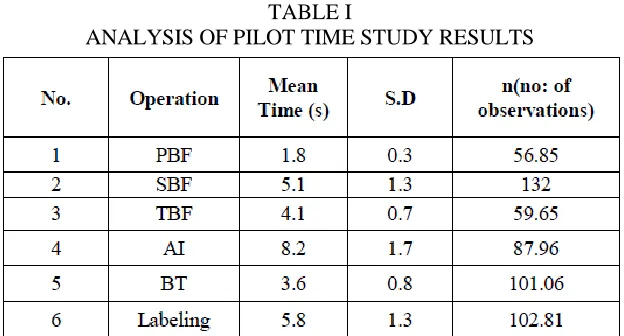
TABLE I
ANALYSIS OF PILOT TIME STUDY RESULTS
The General Electric method of time study was adopted here. Initially a pilot time study was done to find the number of observations required which is shown in Table I. The required number of observations needed is,
Copyright to IJIRSET www.ijirset.com 777
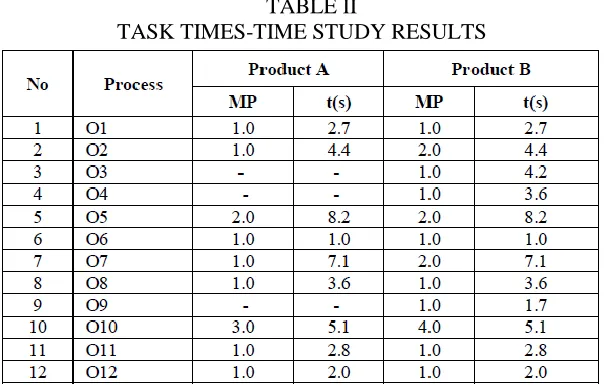
The normal time required to complete each assembling operations are calculated based on time study. The results of Time Measurement are shown in Table.II. Normal time is converted into standard time by multiplying the value with the specified performance rating. The rating factor chosen in the analysis is 75%.
TABLE II
TASK TIMES-TIME STUDY RESULTS
C. Optimization using Genetic Algorithm
Optimization problems arise in situations where discretechoices must be made, and solving those amounts to finding
an optimal solution among a finite or countable infinitenumber of alternatives.Many optimization problems are NPhard.Although the efforts made to solve the optimization
problems efficiently have produced important progress in the last years, there is no universal method. Consequently,there is much interest in approximation algorithms that canfind near-optimal solutions within a reasonable computationtime.
GA is a stochastic search method inspired by conceptsfrom Darwinian evolution theory and belongs to a class ofmeta-heuristic methods known as evolutionary algorithm(EA).As a solution approach,GAhas two advantages: (i) GAsearches a population rather than a single point and thisincreases the likelihood that the algorithmwill not be trappedin a local optimum since many solutions are considered concurrently,
and (ii) GA fitness function may take any formand several fitness functions can be utilized simultaneously.The fitness function in this work is the sum of the line efficiency (LE) and the cost component.
The various steps involved in the optimization is as below; Step 1: t= 0; // start with an initial time for iteration 1
Step 2: initpopulation P (t); // construct an initial population of individuals Step 3: evaluate P (t); // evaluate fitness of all individuals of initial population Step 4: t := t + 1; // increase the time counter
Step 5: P_ := selectparentsP (t);// select a sub-population for offspring production Step 6: crossover P_ (t); // crossover the “genes” of selected parents
Copyright to IJIRSET www.ijirset.com 778
Step 8: evaluate P_ (t); // evaluate its new fitness
Step 9: P := survive P,P_ (t); // select the survivors from actual fitness
Step 10: while not do steps4 through 9 // test for termination Criterion(time, fitness, etc.) Step 11: end GA // terminate the algorithm
5. RESULT AND DISCUSSION
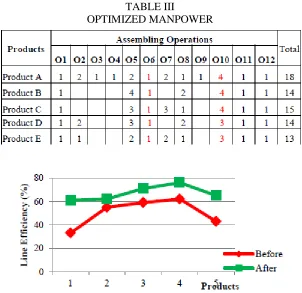
The Manpower Optimization is done based on Genetic Algorithm. The Schedule is created based on the maximum value of the objective function. The constraints were checked based on the practical scenario. The result shows that the new manpower allocation can give better line efficiency and reduced cost.The Process cost reduction is the important advantage in the proposed method. The optimized man power allocation is shown in Table III. The line efficiency is the measure of the effectiveness of the assembly line and has an important effect on the cycle time. The increase in the Line Efficiency will give consistent impact on the cost associated with the process.
TABLE III
OPTIMIZED MANPOWER
Fig. 1. Comparison of Line efficiency before and after optimization.
TABLE IV
Copyright to IJIRSET www.ijirset.com 779
6. CONCLUSION
Application of genetic algorithm in optimization was found to be considerably more efficient than the existing system. The result of Optimization shows that the Assembling and Labeling cost reduction is possible for the proposed manpower allocation. The productivity and efficiency of the assembly line can be made to optimum by the application of Genetic Algorithm. The corresponding change occurred in the cycle time help us to produce more number of assembled blood bags within the specified shift. That result in the cost reduction in this area. The timely availability of the assembled blood bags to the next stage of operation also improves the rate of production.
REFERENCES
[1] AbdolmajidYolmeh, FarhadKianfar, “An efficient hybrid genetic algorithm to solve assembly line balancing problem with
sequence-dependent setup times”,International Journal of Computers & Industrial Engineering, Elsevier-Volume 62, Issue 4, Pages 839- 1144, May 2012
[2] AdilBaykasoglu , ŞebnemDemirkolAkyol, “Meta heuristic Approaches for the Assembly Line Balancing Problem “Proceedings of
theInternational Conference on Industrial Engineering and Operations Management Istanbul, Turkey, July 3 – 6, 2012
[3] Ana Sofia Simaria, Pedro M. Vilarinho,“A genetic algorithm based approach to the mixed-model assembly line balancing problem of type II”,
Int. Journal ofComputers & Industrial Engineering 47 2004
[4] Anjani Kumar,“An Empirical Investigation of Assembly Line Balancing Techniques and Optimized Implementation Approach for Efficiency
Improvements”, Global Journal of Researches in Engineering Mechanical and Mechanics Engineering Volume 12 Issue 3 Version 1.0 , 2012
[5] AsqarHemmati, MojtabaHemmati and Mohammad Ahmadifard “ An imperialist competitive algorithm mixed model assembly line sequencing problem on just in time system” Scientific Research and Essays Vol. 7(41), pp. 3515-3527, 27 October, 2012
[6] Bartholdi, J.J,“Balancing two-sided assembly lines: A case study”,International Journal of Production Research, Vol.31,10,pp.2447-2461,
1993
[7] Chan, K.C.C, Hui, P.C.L., Yeung, K.W., Ng.F.S.F.. “Handling the assembly line balancing problem in the clothing industry using a genetic
algorithm”, International Journal of Clothing Science and Technology, Vol.10, pp. 21-37,1998
[8] HosseinRajabalipourCheshmehgaz, MohammdIshakDesa , FarahnazKazemipour“A Cellular-rearranging of Population in Genetic Algorithms
to Solve Assembly-Line Balancing Problem” Journal of Mechanical Engineering and Automation 2012, 2(2): 25-35 DOI:
10.5923/j.jmea.20120202.05 , 2012
[9] Liu, C.-M., C.-H. Chen.,“Multi-section electronic assembly line balancing problems: A case study”. Int. Journal of Product Planning.&
Control. 13 451-461, 2002
[10] MohdFadzilFaisaeRashid,WindoHutabarat, AshutoshTiwari “A Review on Assembly Sequence Planning and Assembly Line Balancing
Optimisation using Soft Computing Approaches” International Journal of Advanced Manufacturing Technology,2011, Volume 59, pp335-349
[11] Nai-ChiehWel, I-Ming Chao.A,“Solution procedure for type E simple assemply line balancing problem”:International Journal of Computers
& Industrial Engineering, Pages 824-830, 2011
[12] QingxinGuoLixin Tang, “A scatter search based heuristic for the
balancing of parallel assembly lines”, Joint 48th IEEE Conference on
Decision and Control and 28th Chinese Control Conference Shanghai,
P.R. China, December 16-18, 2009
[13] Salveson, M.E., “The Assembly Line Balancing Problem”,The Journal
of Industrial Engineering.Vol. 6,No.3: pp.18-25, 1955
[14] Vilarinho, P.M. &Simaria, A.S, “ANTBAL: An ant colony optimization algorithm for balancing mixed-model assembly lines with parallel