ISSN(Online): 2320-9801
ISSN (Print): 2320-9798
I
nternational
J
ournal of
I
nnovative
R
esearch in
C
omputer
and
C
ommunication
E
ngineering
(An ISO 3297: 2007 Certified Organization)
Vol. 4, Issue 2, February 2016
An Improved Method of Block Matching
Algorithm for Video Compression Using
Motion Estimation
K.Jayanthi1, ,S.Karthiga Swathini2
Assistant Professor, Dept. of ECE, Mahendra College of Engineering, Salem, India1
Assistant Professor, Dept. of ECE, Mahendra College of Engineering, Salem, India2
ABSTRACT: Video is progressively become one of the most pervasive technologies in terms of everyday usage, both for entertainment and an enterprise environments. Normally, Video file needs large bandwidth, large storage space during transmission and the time consumption is also high when it transmits from source to destination. So, Video compression is concerned with reducing the amount of data required to reproduce a video. The main intention of video coding in most video applications such as video conferencing, camcorder, HDTV, medical imaging, and military imaging is to reduce the amount of video signal for storing and/or transmission purposes without affecting its visual quality . In this paper video compression is achieved by Motion Estimation and Block Tree Coding. Multiwavelet transform is used in this proposed method for preserve high frequency details and good energy compaction. A block tree coding is used for compression and reconstruction of Multiwavelet transformed image and thus the proposed scheme is called as Multiwavelet Block Tree Coding (MBTC) and this approach yields the advantages of high energy compaction, PSNR, and a less number of bits for encoding.
KEYWORDS: Redundancy, Block Matching Algorithm, Block Tree coding, Multiwavelet
I. INTRODUCTION
Compression is the process of reducing the size of the data sent, thereby, reducing the bandwidth required for the digital representation of a signal. Many inexpensive video and audio applications are made possible by the compression of signals. Compression technology can result in reduced transmission time due to less data being transmitted. It also decreases the storage requirements because there is less data. However, signal quality, implementation complexity, and the introduction of communication delay are potential negative factors that should be considered when choosing compression technology.
ISSN(Online): 2320-9801
ISSN (Print): 2320-9798
I
nternational
J
ournal of
I
nnovative
R
esearch in
C
omputer
and
C
ommunication
E
ngineering
(An ISO 3297: 2007 Certified Organization)
Vol. 4, Issue 2, February 2016
II. PROBLEM FORMULATION AND SOLUTION METHODOLOGY
Real time applications problem and in solutions used wavelet basis. However scalar wavelet fails to possess both orthogonality and symmetry properties simultaneously [3],[4],[8]. Thus the use of multiwavelets for effective compression has become an open problem that warrants more in depth research. Block Tree Coding (BTC) is used to reduce number of encoding bits and to achieve better PSNR and energy compaction for multiwavelet transformed image with the concept of coefficient reorganization to yield parent child relationship[5].
A pair of algorithms that works together is called a video codec (encoder/decoder). Video codec’s of different standards are normally not compatible with each other; that is, video content that is compressed using one standard cannot be decompressed with a different standard[10].
2.1 MSE and PSNR
Error matrices are used to compare the various image compression techniques. They are
Mean Square Error (MSE) and
Peak Signal-to-Noise Ratio (PSNR).
The MSE is the cumulative squared error between the compressed and the original image whereas PSNR is the measure of the peak error.
The quality of image coding is typically assessed by the Peak signal-to-noise ratio (PSNR) defined as
PSNR = 20log 10 [255/sqrt(MSE)] --- (1)
Latency is defined as the time it takes to compress, send, decompress and display a file. The more advanced the compression algorithm, the higher the latency
III. PROPOSED METHOD
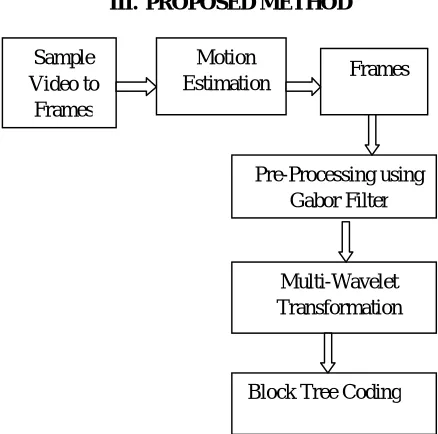
Fig. 1. Block Diagram of Proposed method
3.1 DVD Video Soft
Video is converted to frames by software tool as DVD video Soft .It is a software tool which does conversion of video in image, Audio, MP3 to AVI. It is the general purpose software
Sample Video to
Frames
Motion
Estimation Frames
Pre-Processing using Gabor Filter
ISSN(Online): 2320-9801
ISSN (Print): 2320-9798
I
nternational
J
ournal of
I
nnovative
R
esearch in
C
omputer
and
C
ommunication
E
ngineering
(An ISO 3297: 2007 Certified Organization)
Vol. 4, Issue 2, February 2016
3.2 Motion Estimation using Exhaustive Search
Consecutive frames in a video sequence are very similar. This redundancy between successive frames is known as temporal redundancy. Video compression methods can exploit temporal redundancy by estimating the displacement of objects between successive frames (motion estimation). The resulting motion information (a motion vector) can then be used for an efficient inter-frame coding (motion compensation). The motion information along with the prediction error are then transmitted instead of the frame itself.[16]
Block Matching (BM) techniques are the most common methods for motion estimation in video coding typically each block, known as macro block, (16x16 pixels) in the current frame is compared with displaced regions of the same size from the previous frame. The displacement which results in the minimum error is selected as the motion vector for the macro block. The prediction error frame is obtained by subtracting the motion compensated frame from the current frame. The best performance of the BM can be obtained by a full search that considers every possible movement of the macro block in the search area.
Motion compensation (MC) is one of the most powerful techniques that can be used to reduce temporal correlation between adjacent frames. It is based on the assumption that in a large number of applications adjacent frames are usually highly correlated[12]. Temporal correlation can be reduced by coding a block in a frame as a translated version of a block in a preceding frame. Of course the motion vector has to be transmitted too. In the following only translational motion will be considered. Frames are typically segmented in macroblocks of 16x16 pixels, made of 4blocks of 8x8 pixels (a reduced block representation error is obtained with finer segmentation but it produces a
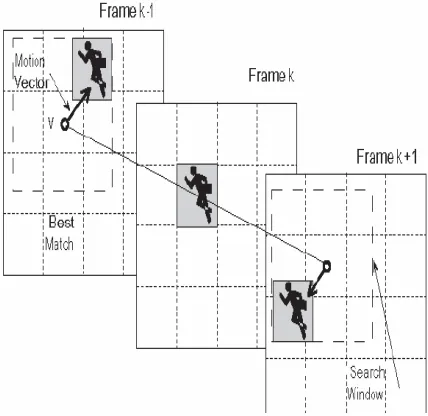
computational overhead). Figure shows how in coding the block in frame k, the “best match block” of previous frame is
computed and then the representation error is coded together with the information of the “motion vector”
Fig. 2. Motion Estimation
The accuracy of the prediction operation is determined by how well any movement between successive frames is estimated. The estimation process is not exact addition information must also be sent to indicate any small difference between the predicted and actual position of the moving segments
Exhaustive Search (ES) also known as Full Search, is the most computationally expensive block matching algorithm of all. This algorithm calculates the cost function at each possible location in the search window. As a result of which it finds the best possible match and gives the highest PSNR amongst any block matching algorithm. Fast block matching algorithms try to achieve the same PSNR doing as little computation as possible frames are classified as
I-frames: Intra (I) frames, also known as reference or key frames, contain all the necessary data to re-create a
ISSN(Online): 2320-9801
ISSN (Print): 2320-9798
I
nternational
J
ournal of
I
nnovative
R
esearch in
C
omputer
and
C
ommunication
E
ngineering
(An ISO 3297: 2007 Certified Organization)
Vol. 4, Issue 2, February 2016
frames: Predicted (P) frames are encoded from a “predicted” picture based on the closest preceding I- or
P-frame. P-frames are also known as reference frames, because neighboring B- and P-frames can refer to them. P-frames are typically much smaller than I-frames [7].
B-frames: Bi-directional (B) frames are encoded based on an interpolation from I- and P-frames that come
before and after them. B-frames require very little space, but they can take longer to decompress because they are reliant on frames that may be reliant on other frames.
There are two standard ways to measure the coding efficiency of a video coding standard, which are to use an
objective metric, such as PSNR, or to use subjective assessment of video quality. Subjective assessment of video quality is considered to be the most important way to measure a video coding standard since humans perceive video quality subjectively.
The best matching block is chosen based on the “energy difference” between the reference block in the search window and the current block, where blocks are well-matched if their energy difference is low (their pixel values in each location are similar)..
Fig. 3. Motion vector in frames
Assumptions:–Translational motion within block:–
2
---- (2)
--- (3)
--- (4)
MSE = Mean Square Error; MAE=Mean Absolute Error
ISSN(Online): 2320-9801
ISSN (Print): 2320-9798
I
nternational
J
ournal of
I
nnovative
R
esearch in
C
omputer
and
C
ommunication
E
ngineering
(An ISO 3297: 2007 Certified Organization)
Vol. 4, Issue 2, February 2016
3.3 Preprocessing Using Gabor Filters
Key functions of pre-processing are to improve the quality of image in various ways that increase the chances for success of other process. Generally filters are used to filter unwanted things or object in a spatial domain or surface. In digital image processing, mostly the images are affected by various noises.
The main objectives of the filters are to improve the quality of image by enhancing. Low- pass filter is a type of filter used for the image enhancement. It preserves the smooth region in the image and removes the sharp variation leading to blurring effect.
Gabor filter and Gaussian derivatives are flexible parameterizable function that analyses textured s patterns in the images. The advantage of gabor filter over Gaussian derivatives is related to a higher flexibility in the definition of the function shape, because of the general set of parameters (degree of freedom)Frames are preprocessed that means reduce noise and find the regular repetition of an element or pattern on a surface. Gabor filter are Orientation sensitive filter which is used for edge detection. Frequency and orientation response of the gabor filter is similar to HVS. Here preprocessing takes place using gabor.
3.4 Multiwavelet Transform
The spatial redundancy which is present between the image pixels can be reduced by taking transforms which decorrelates the similarities among the pixels. The choice of the transforms depends upon a number of factors, in particular, computational complexity and coding gain. Coding gain is a measure of how well the transformation compacts the energy into a small number of coefficients [13]. The predicted error frames are usually encoded using either block-based transforms. Multiwavelets have more than one mother wavelet functions and scaling functions i.e. multi-resolution analysis (MRA) is carried out using several scaling and wavelet functions.
3.5 Importance of choosing Multiwavelet
Algorithms based on scalar wavelets have been shown to work quite well in image compression.
Consequently, there must be some justification to use multiwavelets in place of scalar wavelets. Some reasons for potentially choosing multiwavelets are summarized below [14],[2]:
The extra degrees of freedom inherent in multiwavelets can be used to reduce the restrictions on the filter properties.
For example, it is well known that a scalar wavelet cannot simultaneously have both orthogonality and symmetric property. Symmetric filters are necessary for symmetric signal extension, while orthogonality makes the transform easier to design and implement. Also, the support length and vanishing moments are directly linked to the filter length for scalar wavelets. This means longer filter lengths are required to achieve higher order of approximation at the expense of increasing the wavelet’s interval of support [6].
A higher order of approximation is desired for better coding gain, but shorter support is generally preferred to achieve a better localized approximation of the input function. In contrast to the limitations of scalar wavelets, multiwavelets are able to possess the best of all these properties simultaneously.
One desirable feature of any transform used in image compression is the amount of energy compaction achieved.
A filter with good energy compaction properties can decorrelate a fairly uniform input signal into a small number of
scaling coefficients containing most of the energy and a large number of sparse wavelet coefficients. This becomes important during the quantization since the wavelet coefficients are represented with significantly fewer bits on average than the scaling coefficients. Therefore better performance is obtained when the wavelet coefficients have values clustered about zero with little variance, to avoid as much quantization noise as possible. Thus multiwavelets have the potential to offer better reconstructive quality at the same bit rate.
Multiwavelets can achieve better level of performance than scalar wavelets with similar computational
complexity.
ISSN(Online): 2320-9801
ISSN (Print): 2320-9798
I
nternational
J
ournal of
I
nnovative
R
esearch in
C
omputer
and
C
ommunication
E
ngineering
(An ISO 3297: 2007 Certified Organization)
Vol. 4, Issue 2, February 2016
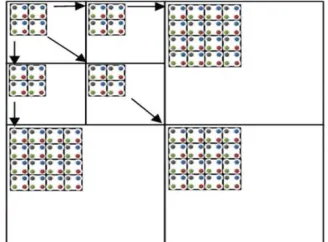
Fig. 4. Illustration of Parent child relation ship in SPIHT
Fig. 5. Illustration of parent-child relationship in BTC
Fig 4 and Fig 5 represents the difference between both parent child relationship and sorting pass.
The proposed WBTC for scalar wavelet decomposed images, which combines the features of both zero tree coding algorithm like SPIHT and zero block coding algorithm like Set Partitioning Embedded block (SPECK) to provide inter and intra subband correlation. The WBTC overhands the SPIHT in three aspects: first it creates zero trees with more elements. Second it strengthens the intra subband correlation and thirdly it reduces the encoding time. However its efficiency can be fully signified only when applied to multiwavelet transformed data.
This motivates to apply block tree coding to multiwavelet transformed image and for the first time applied this to Multiwavelet transformed image. The proposed MBTC algorithm partitions the image transformed coefficients into coefficient blocks and then block trees are formed with the roots in the topmost subband in a zerotree fashion. In a block tree, significant blocks are found using the tree partitioning concept of SPIHT, whereas significant coefficients within each block are found using the quad-tree partitioning of SPECK.
Consider an image X of size MxN that after Nd levels of wavelet transformation exhibits a pyramidal subband
structure. The transformed image is represented by an indexed set of transformed coefficients {Ci,j} located at ith row
and jth column. The coefficients are grouped together in blocks of size mxn and the block trees are formed with roots in
the topmost (LL) subband. A block tree is a tree of all descendent blocks of a root block.
In the LL band, out of each group of 2x2 blocks, one (top left) block has no descendent, and each of the other three blocks has four offspring blocks in the high frequency subbands of their corresponding orientations. By creating a blocktree, many of the SPIHT’s SOTs are combined into a single MBTC’s SOT.
Let us define a significant function, s(. ) in the bth most significant bit plane applied to set T as Sb(T)=({1, max |ci,j | } ) ≥ 2b, Ci,j ϵ T
0, Otherwise ----(5)
where set T may either be an individual block of mxn wavelet coefficients or SOT of a block. Like SPIHT, MBTC maintains three ordered lists.
ISSN(Online): 2320-9801
ISSN (Print): 2320-9798
I
nternational
J
ournal of
I
nnovative
R
esearch in
C
omputer
and
C
ommunication
E
ngineering
(An ISO 3297: 2007 Certified Organization)
Vol. 4, Issue 2, February 2016
LSP: List of significant pixels.
For each bit plane MBTC consists two main stages sorting pass and refinement pass. At the initialization step, the block in the lowest frequency band are added to LIB and those with the descendent are added to LIBS as type ‘A’ entries. The scanning starts with LSP as an empty set. The coding process starts with the coarest resolution and proceeds towards the finest resolution.
In the sorting pass the encoder checks the blocks in the LIB list against the current threshold. For each block it generates one bit i.e. it generates ‘0’ for zero block or insignificant block and ‘1’ for nonzero block or significant block. Thus m x n insignificant block is just encoded with single bit whereas in SPIHT it uses m x n ‘0’ bits. Thus in addition to providing bit reduction it also provides intra subband correlation. A significant block in quad partitioned i.e. four equal size subbands are formed. This partitioning is done recursively until single coefficient is found. In this stage the individual four coefficients are tested for significance individually [19]
The significant coefficient is encoded as ‘1’ followed by ‘0’ for positive and ‘1’ for negative sign and the coefficient is moved to LSP. After testing all the four individual coefficients, the current block is deleted from LIB. The insignificant coefficient is encoded as ‘0’ and moved to the LSB as a single coefficient block.
The encoder next examines the LIBS and performs the significance test on each set. It examines not the current block of the set but it examines the descendent blocks. If the descendent blocks of a set is insignificant it
remains in LIBS whereas the significant blocks are partitioned into subsets by quad tree partitioning. In the
significant block sets the four off springs are added to LIB and they are examined for significance as if they were in LIB. The scanning proceeds in the same manner for the same threshold until all the blocks are examined. After each sorting pass the coefficient in LSP are refined with one except those significant pixels that are just added at this bit plane. The algorithm repeats with this procedure until a block size of 1 x 1 (single pixel) is met as in case of SPIHT, by reducing threshold at each level by a factor of two. Reconstructing the video which is the reverse process of compression is used for decosed process includes Inverse block tree decoding, Inverse Multiwavelet transform and post processing.
IV. RESULTS AND DISCUSSION
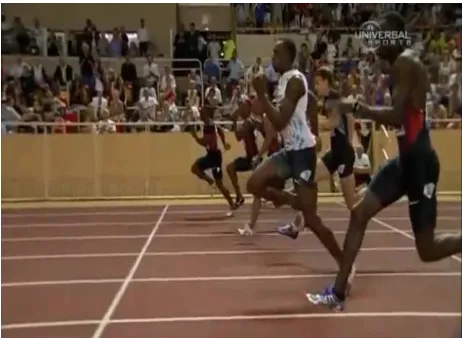
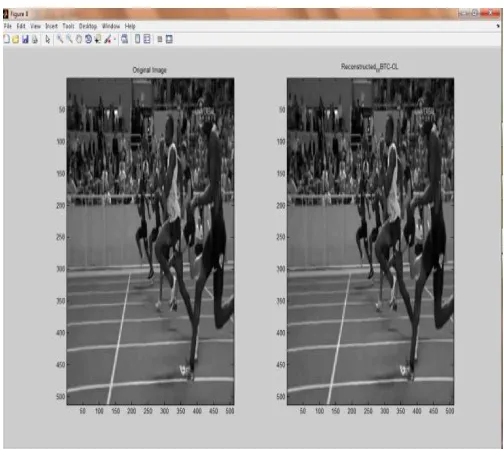
First video (sports) is converted into frames and further it could be processed through preprocessing,
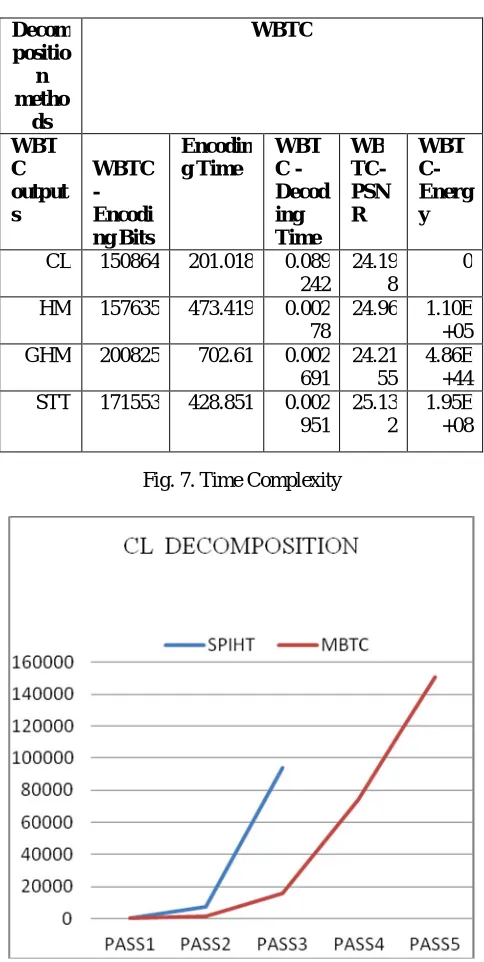
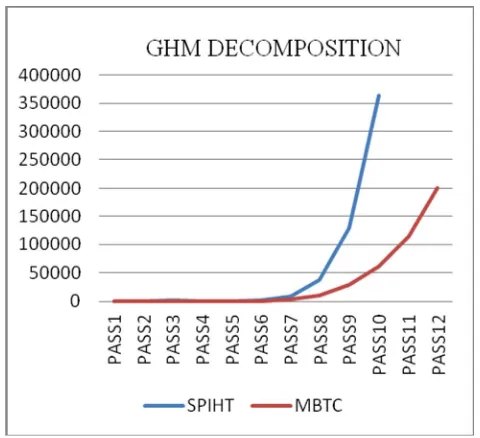
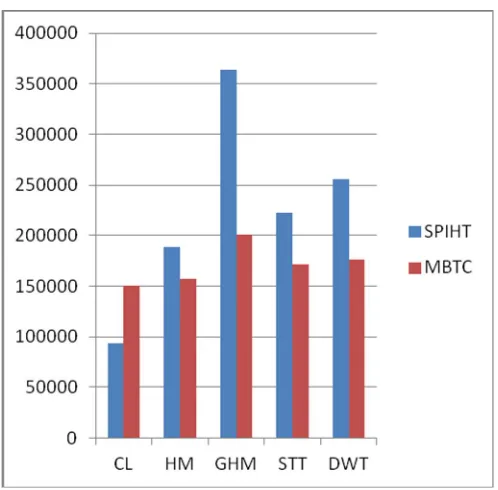
multiwavelet and block tree coding. Difference between the Existing SPIHT and WBTC was shown in the graph in terms of generating encoding bits. Then Multiwavelet Prefilters as CL, HM, GHM, STT are used and within that we have to concluded as STT is preferable for our method.
ISSN(Online): 2320-9801
ISSN (Print): 2320-9798
I
nternational
J
ournal of
I
nnovative
R
esearch in
C
omputer
and
C
ommunication
E
ngineering
(An ISO 3297: 2007 Certified Organization)
Vol. 4, Issue 2, February 2016
Fig. 7. Time Complexity
Fig. 8.a. Chui and Lian(CL) Decomposition
Decom positio n metho ds WBTC WBT C output s WBTC -Encodi ng Bits Encodin g Time WBT C -Decod ing Time WB TC-PSN R WBT C-Energ y
CL 150864 201.018 0.089
242 24.19
8
0
HM 157635 473.419 0.002
78
24.96 1.10E
+05
GHM 200825 702.61 0.002
691 24.21
55
4.86E +44
STT 171553 428.851 0.002
951 25.13
2
ISSN(Online): 2320-9801
ISSN (Print): 2320-9798
I
nternational
J
ournal of
I
nnovative
R
esearch in
C
omputer
and
C
ommunication
E
ngineering
(An ISO 3297: 2007 Certified Organization)
Vol. 4, Issue 2, February 2016
Fig. 8.b. HM Decomposition
ISSN(Online): 2320-9801
ISSN (Print): 2320-9798
I
nternational
J
ournal of
I
nnovative
R
esearch in
C
omputer
and
C
ommunication
E
ngineering
(An ISO 3297: 2007 Certified Organization)
Vol. 4, Issue 2, February 2016
Fig. 8.d. Geronimo, Hardin, and Massopust (GHM) Decomposition
The graph shown as different type of decomposition in SPIHT and MBTC interms of encoding bits in fig.8.( a),(b),(c),(d)
ISSN(Online): 2320-9801
ISSN (Print): 2320-9798
I
nternational
J
ournal of
I
nnovative
R
esearch in
C
omputer
and
C
ommunication
E
ngineering
(An ISO 3297: 2007 Certified Organization)
Vol. 4, Issue 2, February 2016
Fig. 9.b. Video output of HM decomposition method
ISSN(Online): 2320-9801
ISSN (Print): 2320-9798
I
nternational
J
ournal of
I
nnovative
R
esearch in
C
omputer
and
C
ommunication
E
ngineering
(An ISO 3297: 2007 Certified Organization)
Vol. 4, Issue 2, February 2016
Fig. 9.d. Video output of STT decomposition method
Fig. 9.(a),(b),(c),(d) shows the Decomposition occurs in different methods.
ISSN(Online): 2320-9801
ISSN (Print): 2320-9798
I
nternational
J
ournal of
I
nnovative
R
esearch in
C
omputer
and
C
ommunication
E
ngineering
(An ISO 3297: 2007 Certified Organization)
Vol. 4, Issue 2, February 2016
This graph shows the comparison of existing SPIHT and proposed MWBTC performance in terms of bits generated during encoding.
V. CONCLUSION
Experimental results show the effectiveness of the proposed approach in terms of PSNR and MSE despite the deterioration in the quality of the video. The proposed algorithm integrates macro block mode and significance coding to improve coding performance. In this Multiwavelet Block tree encoding (MWBTC) algorithm provides high efficiency for the given video sequence compared with existing Set Partitioning In Hierarchical Tree algorithm (SPIHT). Here experimental results show that the proposed MWBTC provides approximately 35% average bit rate reduction than SPIHT. CL, HM, GHM, STT decomposition takes place in this method and by using the graph have to concluded as encoding bits in each frame had reduced. This approach provides better video quality and high compression. Reconstructing the video which is the reverse process of compression is also possible by using includes Inverse block tree decoding, Inverse Multiwavelet transform and post processing.The proposed scheme does not use any quantization techniques in compression. This subject can directly contribute to improve the compression efficiency by sizeable margin.This approach presents other important features and can be used for other applications such as video summarization and description. As future work, we propose to study the use of 3D object segmentation and reconstruction for video compression purposes in order to improve results, give better generalization and increase performances.
REFERENCES
1. Hosam Khalil,Amir F. Atiya, and Samir Shaheen,”Three-Dimensional Video Compression Using Subband/Wavelet Transform with Lower Buffering Requirements” ieee transactions on image processing, vol. 8, no. 6, june 1999.
2. Athar Ali Moinuddin and Ekram Khan, ‘Wavelet Based Embedded Image Coding using Unified Zero-Block-Zero-Tree Approach’, IEEE ICASSP, Vol. 2, pp. 453-456, 2006.
3. Jo Yew Tham, Lixin Shen, Seng Luan Lee, and Hwee Huat Tan, ‘A General Approach for Analysis and Application of Discrete Multiwavelet Transforms’, IEEE Transactions on Signal Processing Vol. 48, No.2, pp 457-464, February 2000.
4. Jerome M. Shapiro (1993). ‘Embedded image coding using zerotree of wavelet coefficients’, IEEE Transactions on Signal Processing, Vol. 41, No. 12, pp 3445-3462, Decemder 1993.
5. Moinuddin A.A, Khan E. and Ghanbari M, ‘Efficient Algorithm for Very Low Bit Rate Embedded Image Coding’, IET Image Processing, Vol. 2, No. 2, pp 59-71, 2008.
6. Taubman and A. Zakhor, “Multirate 3-D subband coding of video,” IEEE Trans. Image Processing, vol. 3, pp. 572–588, Sept. 1994. 7. Y. K. Kim, R. C. Kim, and S. U. Lee, “On the adaptive 3D subbandvideo coding,” in Proc. SPIE, vol. 2727, pp. 1302–1312, Mar. 1993. 8. Y. Huang and I. Pollak, “MLC: A novel image coder based on multitree local cosine dictionaries,” IEEE Signal Process. Lett., vol. 12, no. 12,
pp. 843–846,Dec2005.
9. Jayakrishna sankara ,Navin thasagari,Pradeep,pavani(2012),A New video compression method using DCT/DWT and SPIHT based on Accordion Function.In:I.J.Image graphics and Signal Processing,vol.4,pp:28-34
10. Rao K. and Yip P., Discrete Cosine Transform:Algorithms, Advantages and Applications,Academic Press, 1990. 11. Iain G., Video Codec Design, John Wiley & Sons,New Jersey, 2002.
12. Srinivasan R. and Rao R., “Predictive Coding Based on Efficient Motion Estimation,” Computer Journal of IEEE Transactions on Communication,vol. 33, no. 5, pp. 888-896, 1985.
13. Strela P., Strang G., Topiwala P., and Heil C.,“Application of Multiwavelet Filter Banks to Image Processing,” Computer Journal of IEEE Transactions on Image Processing, vol. 8, no. 4,pp. 548-563, 1999.
14. Mainguy and L. Wang, “Performance analysis of 3-D subband codingfor low bit rate video,” in Proc. SPIE, vol. 2952, pp. 372–379, 1996. 15. S. Ponlatha and R. S. Sabeenian, ”Compression of Video Compression Standards”, International Journal of Computer and Electrical
Engineering, Vol. 5, No. 6, December 2013