ISSN(Online): 2320-9801
ISSN (Print): 2320-9798
I
nternational
J
ournal of
I
nnovative
R
esearch in
C
omputer
and
C
ommunication
E
ngineering
(An ISO 3297: 2007 Certified Organization)
Vol. 3, Issue 8, August 2015
Dynamic Secure Protocol Algorithms for
Collaborative Abstract Publishing with
m-Privacy
Kumar.N, Bullarao Domathoti, Nageswara Rao Putta
Pursuing M. Tech, Dept. of CSE., SITS, JNT University, Aanthapur, Tirupati, AP, India
Assistant Professor, Dept. of CSE., SITS, JNT University, Aanthapur, Tirupati, AP, India
Associate Professor, Dept. of CSE., SITS, JNT University, Aanthapur, Tirupati, AP, India
ABSTRACT: In this cardboard collaborative abstracts publishing ambience with angular abstracted abstracts beyond
assorted abstracts providers, in added bag annular ability of anniversary accidental a subset of annal . As a appropriate case, a abstracts provider could be the abstracts buyer itself who is accidental its own records. This is a actual accepted book in amusing networking and advocacy systems. In this cardboard we acquaint a abbey algorithm and abiogenetic algorithms are to broadcast an anonymized appearance of the chip abstracts such that a abstracts almsman including the abstracts providers will not be able to accommodation the aloofness of the alone annal provided by added parties appointment SMC agreement from the forwarding and advancement the astern of assorted abstracts annal to accouterment m- aloofness.
KEYWORDS: Abstract publisher; Recipient; Data records; ananymizying algorithm; SMC protocol; and m-privacy;
I. INTRODUCTION
Data mining is the action of extracting useful, interesting, and ahead alien advice from ample abstracts sets. The success of abstracts mining relies on the availability of top superior abstracts and able advice sharing. The accumulating of agenda advice by governments, corporations, and individuals has created an ambiance that facilitates all-embracing abstracts mining and abstracts analysis. Moreover, apprenticed by alternate benefits, or by regulations that crave assertive abstracts to be published, there is a appeal for administration abstracts a part of assorted parties. For example, accountant hospitals in California are appropriate to abide specific demographic abstracts on every accommodating absolved from their ability [3].
Nowadays, the agreement “information sharing” and “data publishing” not alone accredit to the acceptable one-to-one model, but aswell the added accepted models with assorted abstracts holders and abstracts recipients. Contempo acclimation of advice administration protocols, such as eXtensible Markup Language (XML), Simple Object Access Agreement (SOAP), and Web Services Description Language (WSDL) are catalysts for the contempo development of advice administration technology.
ISSN(Online): 2320-9801
ISSN (Print): 2320-9798
I
nternational
J
ournal of
I
nnovative
R
esearch in
C
omputer
and
C
ommunication
E
ngineering
(An ISO 3297: 2007 Certified Organization)
Vol. 3, Issue 8, August 2015
Figure:1.1 Abstracts Accumulating and Publishing.
Data accumulating and publishing is declared in Figure 1.1. In the abstracts accumulating phase, the abstracts holder collects abstracts from almanac owners (e.g., Alice and Bob). In the abstracts publishing phase, the abstracts holder releases the calm abstracts to a abstracts miner or the public, alleged the abstracts recipient, who will again conduct abstracts mining on the appear data. abstracts mining has a ample sense, not necessarily belted to arrangement mining or archetypal building. For example, a hospital collects abstracts from patients and publishes the accommodating annal to an alien medical center. In this example, the hospital is the abstracts holder, patients are almanac owners, and the medical centermost is the abstracts recipient. The abstracts mining conducted at the medical centermost could be any assay assignment from a simple calculation of the amount of men with diabetes to a adult array analysis. There are two models of abstracts holders [8]. In the un trusted model, the abstracts holder is not trusted and may advance to analyze acute advice from almanac owners. Assorted cryptographic solutions [15], bearding communications [4, 9], and statistical methods [13] were proposed to aggregate annal anonymously from their owners after absolute the owners’ identity. In the trusted model, the abstracts holder is accurate and almanac owners are accommodating to accommodate their claimed advice to the abstracts holder; however, the assurance is not transitive to the abstracts recipient.
privacy-preserving data publishing (PPDP):
D(Explicit Identifier, Quasi Identifier, Sensitive Attributes, Non-Sensitive Attributes),
where Explicit Identifier is a set of attributes, such as name and social security number (SSN), containing information that explicitly identifies record owners; Quasi Identifier is a set of attributes that could potentially identify record owners; Sensitive Attributes consist of sensitive person-specific information such as disease, salary, and disability status; and Non-Sensitive Attributes contains all attributes that do not fall into the previous three categories [3]. Most works assume that the four sets of attributes are disjoint. Most works assume that each record in the table represents a distinct record owner.
Anonymization [6, 7] refers to the PPDP approach that seeks to hide the identity and/or the sensitive data of record owners, assuming that sensitive data must be retained for data analysis. Clearly, explicit identifiers of record owners must be removed
.
II. RELATEDWORK
A alone abstracts provider ambience and advised the abstracts almsman as an attacker. A ample physique of abstract assumes bound accomplishments ability of the attacker, and defines aloofness application airy adversarial angle by because specific types of attacks. Representative attempt cover k-anonymity, ldiversity, and t-closeness. A few contempo works accept modeled the instance akin accomplishments ability as corruption, and advised perturbation techniques beneath these syntactic aloofness notions.
Disadvantages of existing system:
ISSN(Online): 2320-9801
ISSN (Print): 2320-9798
I
nternational
J
ournal of
I
nnovative
R
esearch in
C
omputer
and
C
ommunication
E
ngineering
(An ISO 3297: 2007 Certified Organization)
Vol. 3, Issue 8, August 2015
2. The problem of inferring information from anonymized data has been widely studied in a single data provider setting. A data recipient that is an attacker, e.g., P0, attempts to infer additional information about data records using the published data, T∗, and background knowledge, BK.
III.PROPOSEDSYSTEM
We consider the collaborative data publishing setting with horizontally partitioned data across multiple data providers, each contributing a subset of records Ti. As a special case, a data provider could be the data owner itself who is contributing its own records. This is a very common scenario in social networking and recommendation systems. Our goal is to publish an anonymized view of the integrated data such that a data recipient including the data providers will not be able to compromise the privacy of the individual records provided by other parties.
Advantages of proposed system:
Compared to our preliminary version, our new contributions extend above results. First, we adapt privacy verification and anonymization mechanisms to work for m-privacy with respect to any privacy constraint, including nonmonotonic ones. We list all necessary privacy checks and prove that no fewer checks are enough to confirm m-privacy. Second, we propose SMC protocols for secure m-privacy verification and anonymization. For all protocols we prove their security, complexity and experimentally confirm their efficiency.
Dataset Collection :
In this if patients have to take treatment, he/she should register their details like Name, Age, and Disease they get affected, Email etc. These details are maintained in a Database by the Hospital management. Only Doctors can see all their details. Patient can only see his own record.When the data are distributed among multiple data providers or data owners, two main settings are used for anonymization. One approach is for each provider to anonymize the data independently (anonymize-and-aggregate), which results in potential loss of integrated data utility. A more desirable approach is collaborative data publishing which anonymize data from all Providers as if they would come from one source (aggregate-and-anonymize), using either a trusted third-party(TTP) or Secure Multi-party Computation (SMC) protocols to do computations .
Attacks by External Data Recipient Using Anonymized Data:
A data recipient, e.g. P0, could be an attacker and attempts to infer additional information about the records using the published data (T∗) and some background knowledge (BK) such as publicly available external data.
Attacks by Data Providers Using Anonymized Data and Their Own Data:
ISSN(Online): 2320-9801
ISSN (Print): 2320-9798
I
nternational
J
ournal of
I
nnovative
R
esearch in
C
omputer
and
C
ommunication
E
ngineering
(An ISO 3297: 2007 Certified Organization)
Vol. 3, Issue 8, August 2015 Table1
Table: 2
Doctor can see all the patients details and will get the background knowledge(BK),by the chance he will see horizontally partitioned data20-40 of distributed data base of the group of hospitals and can see how many patients are affected without knowing of individual records20-30 and 20-40 of the patients and sensitive information about the individuals.
Benefaction:
We define address and Quasi ID new type of “insider Attack” by data providers in this papers. In general Define an m-adversary as a coalition of m colluding data providers or data owners, and attempts to infer data records benefaction by other providers. Note that 0, l Ɩ –Adversary models the multiple recipients, who has only access to multiple bag round knowledge(BF). an anonymization satisfies m-privacy with respect to l-diversity if the records in each equivalence group excluding ones from any m-adversary still satisfy l-diversity. In our example in Table I, T∗ b is an anonymization that satisfies m-privacy (m = 1) with respect to k-anonymity and l- diversity (k = 3, l = 2).
Second, to address the challenges of checking a combinatorial number of potential m-adversaries, we present heuristic algorithms for efficiently verifying m-privacy given a set of records , complexity and Experimental conformation of SMC protocol.
Suppose a data holder has released multiple views of the same underlying raw data data. Even if the data holder releases one view to each data recipient based on their information needs, it is difficult to prevent them from colluding with each other behind the scene. Thus, some recipient may have access to multiple or even all views. In particular, an adversary can combine attributes from the two views to form a sharper QID that contains attributes from both views.
Checking Violations of k-Anonymity on Multiple Views:
ISSN(Online): 2320-9801
ISSN (Print): 2320-9798
I
nternational
J
ournal of
I
nnovative
R
esearch in
C
omputer
and
C
ommunication
E
ngineering
(An ISO 3297: 2007 Certified Organization)
Vol. 3, Issue 8, August 2015
Name Job Age Disease Alice
Bob Alvin
Cook Engineer Lower
40 50 60
Flu Diabetes Malaria
Table3
Verification of m- privacy:
The data holder previously collected a set of records T1 time stamped t1, and published a k-anonym zed version of T1, denoted by release R1. Then the data holder collects a new set of records T2 time stamped t2 and wants to publish a k-anonym zed version of all records collected so far, T1ᵁ T2, denoted by release R2. Note, Ti contains the “events” that happened at time T i. An event, once occurred, becomes part of the history, therefore, cannot be deleted. This publishing scenario is different from update scenario in standard data management where deletion of records can occur. Ri simply publishes the “history,” i.e., the events that happened up to time ti. A real-life Anonymizing Incrementally Updated Data Records 1000 example can be found in below show figure 2. where the hospitals are required to submit specific demographic data of all discharged patients every six months.
Algorithm:Anonymization algorithm
---
Input: T1, T2 a m-privacy requorement, a taxonomy tree for each categorical attribute in xn.Output:a generalized T2 satiisfying the privacy require ment. 1. Generalize entry value of Ai to ANYwhere Ai€Xi
2. While there is a valid candidate in ᵁᴄut, do
3. Find the paire of highest diseases (xi )from Úcut.
4. Specialized or on t2 and remove Xifrom Úcut.
5. Replace new (xi) and the valid status of xi for all in Úcut. 6. Out put the generalized T2 and Úcut.
---
Continuous data publishing:Publishing the release R2 for T1ᵁT2 would permit an analysis on the data over the combined time period of t1 and t2. It also takes the advantage of data abundance over a longer period of time to reduce data distortion required by anonymization.
Multi-purpose publishing: With T2 being empty, R1 and R2 can be two releases of T1 anonym zed differently to serve different information needs, such as correlation analysis vs. clustering analysis, or different recipients, such as a medical research team vs. a health insurance company. These recipients may collude together by sharing their received data. We first describe the publishing model with two releases and then show the extension beyond two releases and beyond k-anonymity [10, 11], we assume that each individual has at most one record in T1 ᵁT2. This assumption holds in many real-life databases. For example, in a normalized customer data table, each customer has only one profile. In the case that an individual has a record in both T1 and T2, there will be two duplicates in T1 ᵁT2 and one of them can be removed in a preprocessing.
Example:
ISSN(Online): 2320-9801
ISSN (Print): 2320-9798
I
nternational
J
ournal of
I
nnovative
R
esearch in
C
omputer
and
C
ommunication
E
ngineering
(An ISO 3297: 2007 Certified Organization)
Vol. 3, Issue 8, August 2015
Figure2
Forward-attack, denoted by F-attack(R1,R2). P has timestamp t1 and the adversary tries to identify P’s record in the cracking release R1 using the background release R2. Since P has a record in R1 and a record in R2, if a matching record r1 in R1 represents P, there must be a corresponding record in R2 that matches P’s QID and agrees with r1 on the sensitive attribute. If r1 fails to have such a corresponding record in R2, then r1 does not originate from P’s QID, and therefore, r1 can be excluded from the possibility of P’s record.
Cross-attack, Denoted by C-attack(R1,R2). P has timestamp t1 and the adversary tries to identify P’s record in the cracking release R2 using the background release R1. Similar to F-attack, if a matching record r2 in R2 represents P, there must be a corresponding record in R1 that matches P’s QID and agrees with r2 on the sensitive attribute. If r2 fails to have such a corresponding record in R1, then r2 either has timestamp t2 or does not originate from P’s QID, and therefore, r2 can be excluded from the possibility of P’s record.
Backward-attack, denoted by B-attack (R1,R2). P has timestamp t2 and the adversary tries to identify P’s record in the cracking release R2 using the background release R1. In this case, P has a record in R2, but not in R1. Therefore, if a matching record r2 in R2 has to be the corresponding record of some record in R1, then r2 has timestamp t1, and therefore, r2 can be excluded from the possibility of P’s record. Note that it is impossible to single out the matching records in R2 that have time stamp t2 but do not originate from P’s QID since all records at t2 have no corresponding record in R1.
Genetic Algorithm:
The pioneer to address the anonymization problem for classification analysis and proposed a genetic algorithmic solution to achieve the traditional k-anonymity with the goal of preserving the data utility.
Secure m-Privacy Verification
In this module Admin acts as Trusted Third Party (TTP).He can see all individual records and their sensitive information among the overall hospital distributed data base. Anonymation can be done by this people. He/She collected information’s from various hospitals and grouped into each other and make them as an anonymized data.
---
Algorithm :Secure fitness protocol
---
Input: T-thresholds from all constraints, data records T. Results: Share of the minimal fitness value.
ISSN(Online): 2320-9801
ISSN (Print): 2320-9798
I
nternational
J
ournal of
I
nnovative
R
esearch in
C
omputer
and
C
ommunication
E
ngineering
(An ISO 3297: 2007 Certified Organization)
Vol. 3, Issue 8, August 2015
4. [Fi =multiplicate ([¥i],lcm/Ti)
5. Return reconstruct(min([F1]……[Fw]))/lcm
---
IV.EXPERMENTWORK
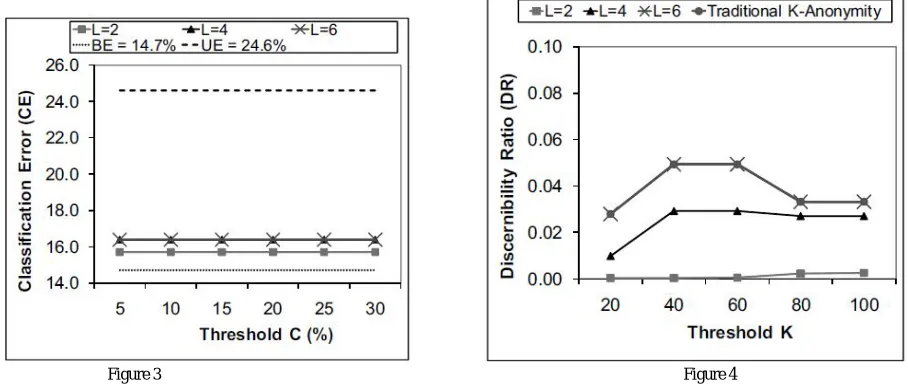
The experiments confirm that the specification of the multi-QID anonymity requirement helps avoid unnecessary masking and, therefore, preserves more of the cluster structure. However, if the data recipient and the data holder employ different clustering algorithms, then there is no guarantee that the encoded raw cluster structure can be extracted. Thus, in practice, it is important for the data holder to validate the cluster quality, using the evaluation methods proposed, before releasing the data. Finally, experiments suggest that the proposed anonymization approach is highly efficient and scalable for multi QID.
Figure 3
Figure 4
Related work:
Most of the work multiple data public has an increased sense of privacy loss. Since data mining is often a key component of information systems, homeland security systems [12], and monitoring and surveillance systems [7], it gives a wrong impression that data mining is a technique for privacy intrusion.
This lack of trust has become an obstacle to the benefit of the technology. For example, the potentially beneficial data mining research project, Terrorism Information Awareness (TIA), was terminated by the government due to its controversial procedures of collecting, sharing, and analyzing the trails left by individuals [12]. Motivated by the privacy concerns on data mining tools, a research area called privacy-preserving data mining (PPDM) emerged in 2000 [2, 6]. The Initial idea of PPDM was to extend traditional data mining techniques to work with the data modified to mask sensitive information.
The key issues were how to modify the data and how to recover the data mining result from the modified data. The solutions were often tightly coupled with the data mining algorithms under consideration. In contrast, privacy-preserving data publishing (PPDP) may not necessarily tie to a specific data mining task, and the data mining task is sometimes unknown at the time of data publishing. Furthermore, some PPDP solutions emphasize preserving the data truthfulness at the record level as discussed earlier, but PPDM solutions often do not preserve such property.
V. CONCLUSION
&
FEATUREWORK
ISSN(Online): 2320-9801
ISSN (Print): 2320-9798
I
nternational
J
ournal of
I
nnovative
R
esearch in
C
omputer
and
C
ommunication
E
ngineering
(An ISO 3297: 2007 Certified Organization)
Vol. 3, Issue 8, August 2015
notion, m-privacy, and use adaptive acclimation techniques for college efficiency. We aswell presented a provider-aware anonymization algorithm with an adaptive analysis action to ensure top account and m-privacy of anonymized data. Experimental after-effects accepted that our heuristics accomplish bigger or commensurable with absolute algorithms in agreement of ability and utility. All algorithms accept been implemented in broadcast settings with a TTP and as SMC protocols. All protocols accept been presented in abstracts and their aegis and complication has been anxiously analyzed. Implementations of algorithms for the TTP ambience is accessible on-line for added development and deployments3. There are abounding abeyant analysis directions. For example, it charcoal a catechism to archetypal and abode the abstracts ability of abstracts providers if abstracts are broadcast in a vertical or ad-hoc fashion. It would be aswell absorbing to investigate if our methods can be ambiguous to added kinds of abstracts such as set-valued data.
The solution presented above focuses on preventing the privacy threats caused by record linkages, but the framework is extendable to thwart attributes linkages by adopting different anonymization algorithms and achieving other privacy models, such as ℓ-diversity and the extension requires modification of the Score or cost functions in these algorithms to bias on refinements or masking’s that can distinguish class labels. The framework can also adopt other evaluation methods, such as entropy , or any ad-hoc methods defined by the data holder
REFERENCES
1. C. C. Aggarwal and P. S. Yu. A framework for condensation-based anonymization of string data. Data Mining and Knowledge Discovery (DMKD), 13(3):251–275, February 2008.
2. R. Agrawal and R. Srikant. Privacy reserving data mining. In Proc. of ACM International Conference on Management of Data (SIGMOD), pages 439–450, Dallas, Texas, May 2000.
3. D. M. Carlisle, M. L. Rodrian, and C. L. Diamond. California inpatient data reporting manual, medical information reporting for california, 5th
edition. Technical report, Office of Statewide Health Planning and Development, July 2007.
4. D. Chaum. Untraceable electronic mail, return addresses, and digital pseudonyms. Communications of the ACM, 24(2):84–88, 1981.
5. S. Chawla, C. Dwork, F. McSherry, A. Smith, and H. Wee. Toward privacy in public databases. In Proc. of Theory of Cryptography Conference (TCC), pages 363–385, Cambridge, MA, February 2005.
6. L. H. Cox. Suppression methodology and statistical disclosure control. Journal of the American Statistical Association, 75(370):377–385, June 1980.
7. T. Dalenius. Finding a needle in a haystack - or identifying anonymous census record. Journal of Official Statistics, 2(3):329–336, 1986. 8. J. Gehrke. Models and methods for privacy-preserving data publishing and analysis. In Tutorial at the 12th ACM Internationalconference on
Knowledge Discovery and Data Mining (SIGKDD), Philadelphia, PA,August 2006.
9. M. Jakobsson, A. Juels, and R. L. Rivest. Making mix nets robust for electronic voting by randomized partial checking. In Proc. of the 11th
USENIX Security Symposium, pages 339–353, 2002.
10. P. Samarati. Protecting respondents’ identities in microdata release. IEEE Transactions on Knowledge and Data Engineering (TKDE),13(6):1010–1027, 2001.