Partial Replacement of Cement with Different
Additives in Concrete
Gaurav Navnit Nagavkar1, Dr. Sandeep L.Hake2
M.E. Structure, Department of Civil, Savitribai Phule University of Pune, Pune, Maharashtra, India1
Associate Professor, Department of Civil, Dr. V. V. P. College of Engineering, Ahmednagar, Maharashtra, India 2
ABSTRACT: Due to development in construction industries demand & need for cement is increasing day by day, which is main cause of pollution. In the manufacturing process of cement, emission of CO2 is more but also consumes
significant amount of natural resource. Main problem is disposal of waste material as well as industrial by-product like from thermal power plant. As a matter of fact the current tendency in the world is to find new materials at lower cost which can guarantee better performances during their incorporations in the concrete. This study consist the development and properties of concrete by partial replacement of additives, Carbon Black Powder & Calcium Sulphate, Rice Ash Husk with Cement. An attempt was made using these materials, as filler, desiccant and which imparts the enhanced properties of concrete by partial replacement of cement with different percentage ratio. Concrete cubes and cylinders are cast depending on percentage ratio and it’s effect is studied at different ages by performing tests on concrete specimens. A comparison is made with test results to conventional concrete only to arrive at valid conclusion.
KEYWORDS: Concrete, Carbon Black, Gypsum, Sunla Gypsum, Rice Husk Ash, Compressive Strength, Chemical Composition.
I. INTRODUCTION
Concrete is a mixture of naturally, cheaply and easily available ingredients as cement, sand, aggregate and water. Cement is occupied second place as most used material in the world after water. The rapid production of cement creates big problems to environment. First environment problem is emission of CO2 during the production process of the cement. The CO2 emission is very harmful which creates big changes in environment. According to the estimation, 1 tone of carbon dioxide is released to the atmosphere when 1 tone of ordinary Portland is manufactured. As there is no alternative building material which totally replace the cement. The search for any such material, which can be used as an alternative or as a supplementary for cement should lead to global sustainable development and lowest possible environmental impact. Substantial energy and cost savings can result when industrial by products are used as a partial replacement of cement. Fly ash, Ground Granulated Blast furnace Slag, Rice husk ash, High Reactive Meta kaolin, silica fume are some of the pozzolanic materials(additives) which can be used in concrete as partial replacement of cement. In this project the PET as a partial replacement of fine aggregate and Carbon Black as a partial replacement of Cement.
After studying different journals it suggest that additives or mineral admixtures may enhance the concrete properties. Further studies establish the behavior of carbon black powder and calcium sulphate particularly effecting the parameters, such as strength, setting time, soundness, consistency, shrinkage, bleeding, heat of hydration etc. with respect to properties of materials used in it like aggregate, sand, cement, water, and other admixtures.
To suggest the optimum percentage of addition above additives in concrete number of cubes with different percentage were cast. The strength properties were again studied and its results are compared to conventional concrete.
II. LITERATUREREVIEW
B.Padmapriya, et. al.[1] says, reuse of waste materials acts eco friendly also prevents exploitation of resources. Usage of such materials for construction purpose enhances the traditional methods of construction. In this paper presents an experimental investigation on the effect of PET (Polyethylene Terephthalate) on various strength properties. The strength properties of M40 grade concrete are studied with 0%, 10% and 20% of PET. There is decrease in strength when the ratio of PET to fine aggregate was increased. So that the PET percentage is taken as constant, the Carbon Black as a partial replaced by cement with 0%, 10%, 20%, and 30%. The strength properties were again studied and its results are compared to conventional concrete.
M.Magistri, et. al[2] says, the experimental evidences that were collected during the present research clearly show how dehydration of natural, dihydrate, CaSO4 during the grinding process is indeed able to influence crucial cement quality parameters such as fineness and, even more importantly, compressive strengths. It has been observed how improvers of the early compressive strengths seem to be particularly effective as dihydrated CaSO4 becomes partially dehydrated to the corresponding hemihydrates form, while improvers of the late compressive strengths provide the best results when a complete dehydration of the SO3 source takes place.
Dr. G.Chitra, et. al[3] says, in this experimental investigation an attempt was made to minimize the presence of pores in conventional concrete using carbon black powder, a waste from rubber industry as filler. Carbon black filler material imparts the enhanced performance of concrete. To suggest the optimum percentage of carbon black to be added in concrete totally 18 number of concrete cubes, 12 number of concrete cylinders with carbon black of different percentage (0%, 2%, 5%, 8%, 12%, 15%) were cast. Study on morphology, surface hardness, uniformity, compressive strength, tensile strength and water absorption were carried out on carbon black concrete specimens.
S.Venkatasubbaiah,et. al.[4] says, the rapid increase in construction activities leads to massive shortage of conventional construction materials such as cement, fine aggregate and coarse aggregate.Phosphogypsum is a by-product of phosphate fertilizer plants and chemical industries. As it is contaminated with the impurities that impair the strength development of calcined products, it can be used as partial replacement of cement. The present paper deals with the experimental investigation on mechanical properties of partially cement replaced phosphogypsum concrete using0%, 2.5%, 5%, 7.5%, 10%, 12.5%, 15%, 17.5%and 20% replacement with M25 grade concrete with water-binder ratio of 0.48. The strength characteristics are studied by casting and testing specimens for 28 and 56 days such as mechanical properties of concrete, such as compressive strength, split tensile strength and flexural strength.
III.EXPERIMENTALWORK
3.1 MATERIAL USED:
The following materials are used for the preparation of concrete in concrete mixer:
1. Aggregates: The material retained on 4.75mm sieve is termed as coarse aggregate. Locally available 12.5 mm and 20 mm crushed aggregates to be used as coarse aggregates having specific gravity 2.8. Relating to zone-2 locally available crush sand is to be used as fine aggregate in the concrete mixes having specific gravity 2.7
2. Cement: To ensure a level of consistency between cement-producing plants, certain chemical and physical limits are placed on cements. These chemical limits are defined by a variety of standards and specifications. Cement of grade 53 ordinary Portland cement been used by production of J.K. Cement PVT. LTD. company conforming to IS:12269. Specific gravity of cement was 3.15.
3. Water: Drinkable and quality water is used having ph up to 7.
4. Carbon Black: Carbon black is virtually pure elemental carbon in the form of colloidal particles that are produced by incomplete combustion or thermal decomposition of gaseous or liquid hydrocarbons under controlled conditions. Its physical appearance is that of a black, finely divided pellet or powder. It is a waste from rubber industry. The specific gravity of carbon black was determined by density bottle method and it was found to be 1.33. Thep Hvalue was found to be 6. This indicates that carbon black is almost an inert material.
5. Gypsum: Gypsum is a light weight material which is formed as the result of evaporating sea water in massive prehistoric basins. In terms of its chemical composition, it is Calcium Sulphate Di-hydrate (CaSO4.2H2O) and inherently contains 21% water by molecular weight.
6. Rice Husk Ash: The Rice Husk used was obtained from Ile Ife, Nigeria. After collection, the Rice Husk was burnt under guided or enclosed place to limit the amount of ash that will be blown off.. The ash was ground to the required level of fineness and sieved through 600 μm sieve in order to remove any impurity and larger size particles.
3.2 MIXING & CASTING:
To suggest the optimum percentage of addition above additives in concrete number of cubes with different percentage were cast. The strength properties were again studied and its results are compared to conventional concrete.
This experiment includes the casting of concrete cubes of 150x150x150 mm size. And concrete cubes are casted for different percentage (2%, 5%, 10%, 15%, 20% & 25%) of carbon black powder, Gypsum, Sunla Gypsum, Rice Husk Ash with it’s partial replacement of cement.
M30 Grade of concrete is used for analysis. In this study, hand mixing was done also to obtain a cohesive mix different mixing procedure was adopted. Coarse aggregates, fine aggregate sand water were taken by weight basis and mixed manually on a water tight platform. Water was added gradually until all the materials were mixed to get uniform mix. After 10 minutes the cement and the amount of water were added. After 2 minutes of mixing, a d di ti ves r ep la cin g t o cem en t wer e introduced and mixed for 3 additional minutes. Tests are carried out on two experimental stages as, wet properties of concrete, harden properties of concrete.
IV.RESULTSANDDISCUSSION
The following test had been conducted only after cubes get dried once it gets removed from curing tank for efficient results. To determine the compressive strength of concrete cubes, the specimen was placed in the compression testing machine after curing. Likewise split tensile strength is carried out on cylindrical shape concrete cube. The maximum load at which the specimen failed was recorded.
4.1.1 COMPRESSION TESTING:
(A)FOR CARBON BLACK COMPOSITION:
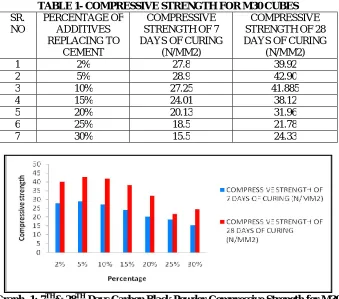
As per the procedure cubes were casted for carbon black powder. As the percentage of carbon black powder increases the variation in colour of concrete with respect to normal concrete changes to more black and dark in colour. Following are respective compressive strength results:
TABLE 1- COMPRESSIVE STRENGTH FOR M30 CUBES SR.
NO
PERCENTAGE OF ADDITIVES REPLACING TO
CEMENT
COMPRESSIVE STRENGTH OF 7 DAYS OF CURING
(N/MM2)
COMPRESSIVE STRENGTH OF 28 DAYS OF CURING
(N/MM2)
1 2% 27.8 39.92
2 5% 28.9 42.90
3 10% 27.25 41.885
4 15% 24.01 38.12
5 20% 20.13 31.96
6 25% 18.5 21.78
7 30% 15.5 24.33
Graph -1: 7TH& 28TH Days Carbon Black Powder Compressive Strength for M30
(B)FOR SUNLA GYPSUM COMPOSITION:
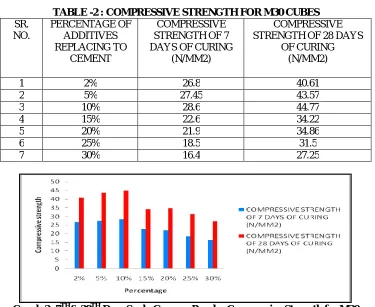
TABLE -2 : COMPRESSIVE STRENGTH FOR M30 CUBES SR.
NO.
PERCENTAGE OF ADDITIVES REPLACING TO
CEMENT
COMPRESSIVE STRENGTH OF 7 DAYS OF CURING
(N/MM2)
COMPRESSIVE STRENGTH OF 28 DAYS
OF CURING (N/MM2)
1 2% 26.8 40.61
2 5% 27.45 43.57
3 10% 28.6 44.77
4 15% 22.6 34.22
5 20% 21.9 34.86
6 25% 18.5 31.5
7 30% 16.4 27.25
Graph-2: 7TH& 28TH Days Sunla Gypsum Powder Compressive Strength for M30
(C)FOR POP/ GYPSUM COMPOSITION:
Pop/gypsum is less fine as compared to above two additives. As per the results 7th day compressive strength of cubes have less compressive strength. However after curing of 28 days it does gives satisfactory results.
TABLE-3: COMPRESSIVE STRENGTH FOR M30 CUBES SR.
NO.
PERCENTAGE OF ADDITIVES REPLACING TO
CEMENT
COMPRESSIVE STRENGTH OF 7 DAYS OF CURING
(N/MM2)
COMPRESSIVE STRENGTH OF 28 DAYS OF CURING
(N/MM2)
1 2% 25.7 38.86
2 5% 22.9 41.96
3 10% 18.4 36.42
4 15% 16.5 30.6
5 20% 16.12 29.38
6 25% 14.2 28.84
Graph-3: 7TH& 28TH Days Pop/Gypsum Powder Compressive Strength for M30
(D)FOR CARBON BLACK & GYPSUM MIX COMPOSITION:
During procedure as the percentage of additives increases the slump of concrete rapidly increases too. After a certain limit it may get collapse. Following are the results with respective graph:
TABLE-4: COMPRESSIVE STRENGTH FOR M30 CUBES SR.
NO.
PERCENTAGE OF ADDITIVES REPLACING TO
CEMENT
COMPRESSIVE STRENGTH OF 7 DAYS OF CURING
(N/MM2)
COMPRESSIVE STRENGTH OF 28 DAYS OF CURING
(N/MM2)
1 2% 26.29 41.73
2 5% 23.7 36.6
3 10% 24.1 37.86
4 15% 21.3 31.33
5 20% 18.97 27.56
6 25% 15.2 25.18
(E)FOR RICE HUSK ASH COMPOSITION:
Rice husk ash is fully cleaned ash. As the amount of rice husk ash increases, slump and workability effect of concrete decreases. Following are the results of RHA:
TABLE-5: COMPRESSIVE STRENGTH FOR M30 CUBES
SR. NO.
PERCENTAGE OF ADDITIVES REPLACING TO
CEMENT
COMPRESSIVE STRENGTH OF 7 DAYS OF CURING
(N/MM2)
COMPRESSIVE STRENGTH OF 28 DAYS
OF CURING (N/MM2)
1 2% 25.21 40.013
2 5% 21.45 35.42
3 10% 20.22 30.88
4 15% 18.76 24.043
5 20% 15.5 20.57
6 25% 11.3 18.68
Graph No.5. 7TH& 28TH Days Rice husk Ash Powder Compressive Strength for M30
4.2 SPLIT TENSILE STRENGTH [A] For Carbon Black Powder:
Here as the percentage goes on increasing colour changes rapidly towards more black in colour.
Table-6: Split Tensile Strength For Carbon Black Powder SR. NO. PERCENTAGE OF
ADDITIVES REPLACING TO
CEMENT
SPLIT TENSILE STRENGTH OF
7 DAYS OF CURING (N/MM2)
SLPIT TENSILE STRENGTH OF 28 DAYS OF CURING
(N/MM2)
1 2% 2.224 3.2
2 5% 2.312 3.432
3 10% 2.18 3.351
Graph-6: 7TH& 28TH Days Carbon Black Powder Tensile Strength for M30
[B] For Sunla Gypsum Composition:
As amount of percentage goes on increasing slump ratio goes on decreasing and vice versa.
Table-7: Tensile Strength Of Sunla Gypsum
SR. NO.
PERCENTAGE OF ADDITIVES REPLACING TO
CEMENT
SPLIT TENSILE STRENGTH OF 7 DAYS OF CURING
(N/MM2)
SLPIT TENSILE STRENGTH OF 28 DAYS OF CURING
(N/MM2)
1 2% 2.14 3.25
2 5% 2.19 3.49
3 10% 2.29 3.58
4 15% 1.81 2.74
[C] For Gypsum Powder Composition:
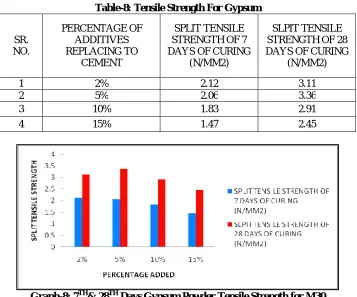
Cracks development due to excess vibration may occur with varying amount of gypsum.
Table-8: Tensile Strength For Gypsum
SR. NO.
PERCENTAGE OF ADDITIVES REPLACING TO
CEMENT
SPLIT TENSILE STRENGTH OF 7 DAYS OF CURING
(N/MM2)
SLPIT TENSILE STRENGTH OF 28 DAYS OF CURING
(N/MM2)
1 2% 2.12 3.11
2 5% 2.06 3.36
3 10% 1.83 2.91
4 15% 1.47 2.45
Graph-8: 7TH& 28TH Days Gypsum Powder Tensile Strength for M30
[D] For Combination Of Carbon Black & Gypsum Composition:
During procedure as the percentage of additives increases the slump of concrete rapidly increases too. After a certain limit it may get collapse. Following are the results with respective graph:
Table No. 5.9: Tensile Strength For Combination Of Additives
SR. NO.
PERCENTAGE OF ADDITIVES REPLACING TO
CEMENT
SPLIT TENSILE STRENGTH OF 7
DAYS OF CURING (N/MM2)
SPLIT TENSILE STRENGTH OF 28 DAYS OF
CURING (N/MM2)
1 2% 2.1 3.34
2 5% 1.89 2.93
3 10% 1.93 3.03
Graph-8: 7TH& 28TH Days Carbon Black & Gypsum Powder Tensile Strength for M30
[E] For Rice Husk Ash Composition:
Rice husk ash is fully cleaned ash. The amount of rice husk ash increases, slump and workability of concrete decreases. Following are the results of RHA:
Table-10 : Tensile Strength For Rice Husk Ash
SR. NO.
PERCENTAGE OF ADDITIVES REPLACING TO
CEMENT
SPLIT TENSILE STRENGTH OF 7 DAYS OF CURING
(N/MM2)
SLPIT TENSILE STRENGTH OF 28 DAYS OF CURING
(N/MM2)
1 2% 2.02 3.2
2 5% 1.72 2.83
3 10% 1.62 2.47
4 15% 1.5 1.92
Graph No.5.10: 7TH& 28TH Days Rice Husk Ash Tensile Strength for M30
4.3 CHEMICAL COMPOSITION
Table-13: CHEMICAL COMPOSITION TEST FOR RICE HUSK ASH
Test Particular Unit
Test Result
Silica Content ( SiO2) % 84.12
Combined Oxide (Al2O3+Fe2O3) % 12.2
Silica + Alumina+Ferric Oxide (SiO2+Al2O3+Fe2O3) % 96.32
Calcium Oxide (CaO) % 0.91
Magnesium Oxide (MgO) % 0.29
Sulphur Trioxide (SO3) % 0.68
Loss On Ignition % 12.2
Table-14: CHEMICAL COMPOSITION TEST FOR SUNLA GYPSUM
Test Particular Unit Test Result
Sulphur Trioxide ( So3) % by mass 42.31 Calcium Oxide ( CaO ) % by mass 29.321
Magnesium Oxide ( MgO ) % by mass 0.17
Loss On Ignition % 4.55
Freelime % "NIL"
Table-15:CHEMICAL COMPOSITION TEST FOR GYPSUM/POP
Test Particular Unit
Test Result Sulphur Trioxide (SO3) % by mass 45.21
Calcium Oxide (CaO) % by mass 31.32
Magnesium Oxide (MgO) % by mass 0.11
Loss On Ignition % 4.11
Table-16: CHEMICAL COMPOSITION TEST FOR CARBON BLACK POWDER
Test Particular Unit
Test Result
Silica Content ( SiO2) % 70.32
Alumina Content (Al2O3) % 2.3
Iron Content (Fe2O3) % 1.11
Calcium Oxide (CaO) % 11.23
Magnesium Oxide (MgO) % 6.33
Sulphuric Triunhydried % 0.98
Insoluble Residue % 9.85
Loss On Ignition % 6.22
V. CONCLUSION
The following conclusions were drawn from the experimental study carried on partial replacement of cement:
1. By replacement of cement in concrete, reduces the consumption of cement. Also it reduces environmental effects from wastes & residual amount of cement manufacturing.
2. From compressive strength results & split tensile results shows, 5%, 10% as optimum results for replacement of carbon black powder.
3. As per compressive strength, 10% replacement of sunla gypsum and 5% replacement of gypsum gives optimum results. Also it gives optimum results after complete 28 days of curing period. In split tensile test 10% addition of sunla gypsum gives optimum results. In case of pop/gypsum 2% replacement shows optimum results at age of 7 Days, 5% replacement gives optimum results at the age of 28 days of cylinder.
4. Combination of Carbon black & gypsum where, the percentage cement replacement increases strength carrying capacity decreases with decrease in workability. Both tests gives optimum results at 2%.
5. Rice husk ash, agricultural waste product increase strength of concrete. Under compressive strength test 5-10% replacement shows optimum results and gives satisfactory results. Split tensile tests gives 2% optimum result. 6. Hence it can be concluded that right percentage replacement of cement in concrete will give more effective
results.
7. Chemical composition tests satisfy the addition of additives in concrete. As required particles can sustain and make bonding reaction after replacing it with cement.
REFERENCES
[1] B. Padma priya, Mrs. K. pandeeswari.- .Experimental investigation on the properties of concrete with Plastic PET Fibre & carbon black.International Journal of AdvancedRe se a rch. (2016).ISSN 2320-5407, Vol 4, issue 4 1082-1088
[2] M.Magistri, P.Recchi, P.Forni - MapeiSpA, Milan, Italy- “Optimization in the use of cement additives: effect of gypsum dehydration on the reactivity of performance enhancers” published on net.
[3] Dr.G.Chitra, P.VetriSelvi & Dr.D.Vijayalakshmi-CarbonBlackasanAdditiveinConventionalConcrete. International Journal of Emerging Technology and Advanced Engineering. IACSIT International Journal of Engineering and Technology, Vol. 6, No. 1,February 2014
[6] Sami Masadeh- The Effect of Added Carbon Black to Concrete Mix on Corrosion of Steel in Concrete,Journal of Minerals and Materials Characterization and Engineering,.- International Conference on Recent Trends inengineering & Technology - 2013(ICRTET'2013) Vol.8 No.6
[7] Md. Jalal Uddin, Md. Quayyum- Influence of calcium sulphate on cement mortor& characteristics behaviour of different properties. IJCER vol.-2, Issue-6.